Enhanced Fluid Index Modulation for Integrated Data and Energy Transfer
Pith reviewed 2026-06-28 04:24 UTC · model grok-4.3
The pith
Fluid index modulation with fluid antennas and power splitting maximizes harvested power under BER and rate constraints in IDET systems.
A machine-rendered reading of the paper's core claim, the machinery that carries it, and where it could break.
Core claim
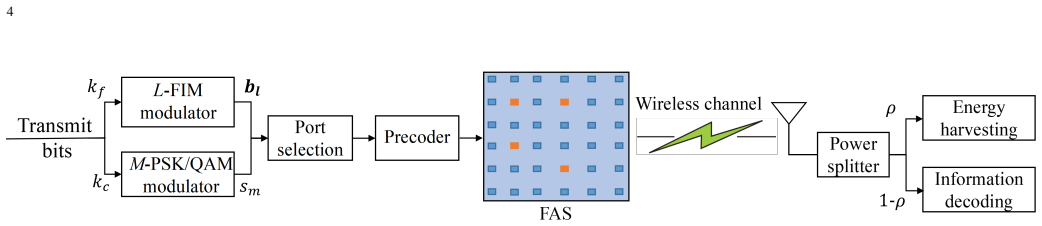
The paper establishes that fluid index modulation, where data is encoded in both symbol values and antenna port indices within a fluid antenna system, combined with receiver power splitting, permits closed-form performance metrics and an alternating optimization algorithm that jointly tunes port selection, precoding, and splitting ratio to maximize average harvested power while respecting bit error rate and rate limits.
What carries the argument
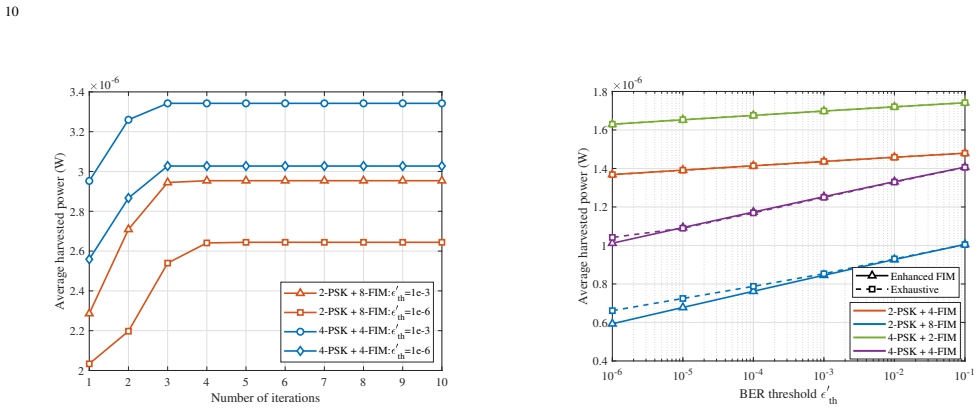
The alternating optimization framework that applies the Riemannian augmented Lagrangian method to the precoding vector and block coordinate descent to port selection, jointly optimizing port selection, precoding vector, and power splitting ratio.
If this is right
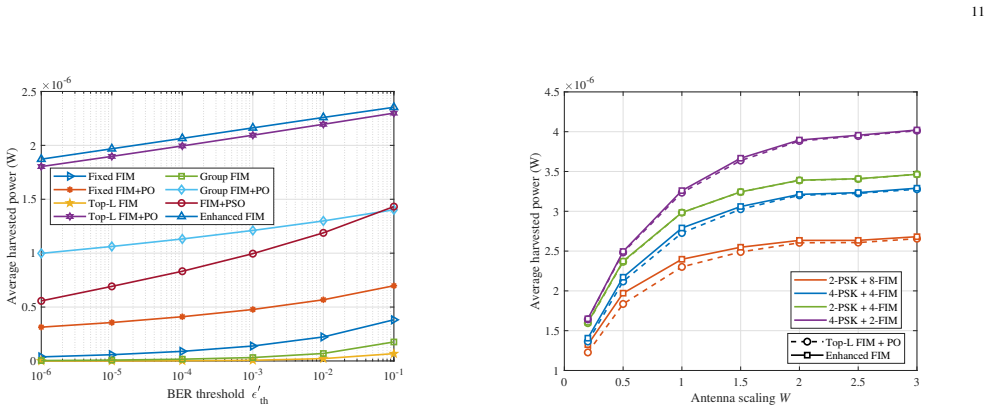
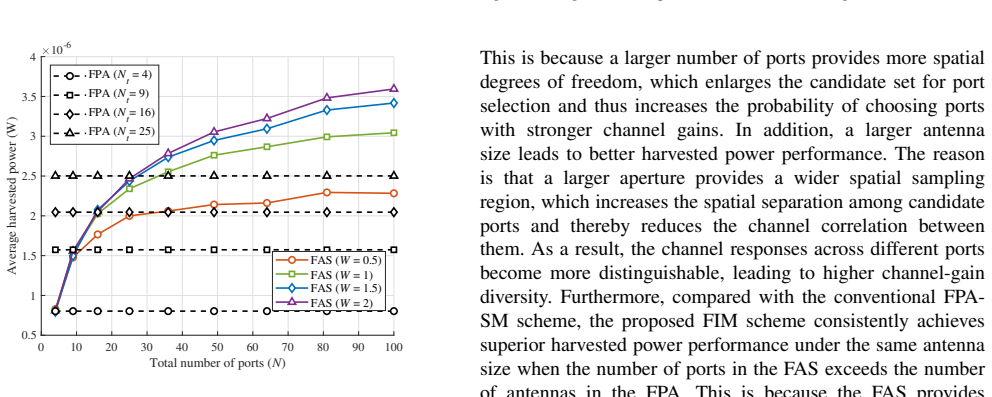
- The proposed scheme achieves a superior rate-energy trade-off over benchmark schemes.
- The algorithm attains near-optimal performance with significantly lower complexity than exhaustive search.
- Closed-form expressions for harvested power, BER, and rate enable direct evaluation without Monte Carlo simulation.
- The system supports sustainable low-power wireless networks by improving both reliability and energy transfer efficiency.
Where Pith is reading between the lines
- The same port-selection and precoding approach could be tested in multi-user or multi-antenna receiver settings to check scalability.
- Hardware impairments such as port switching latency or mutual coupling in the fluid antenna could be added to the model to assess robustness.
- The rate-energy objective might be compared against other index-modulation variants that use different selection criteria.
Load-bearing premise
The closed-form derivations for average harvested power, BER, and achievable rate under finite-alphabet signaling are accurate, and the alternating optimization framework converges reliably to a solution satisfying the BER and rate constraints.
What would settle it
A simulation or measurement in which the empirical bit error rate under the same finite-alphabet inputs deviates measurably from the derived closed-form expression would falsify the performance analysis.
Figures
read the original abstract
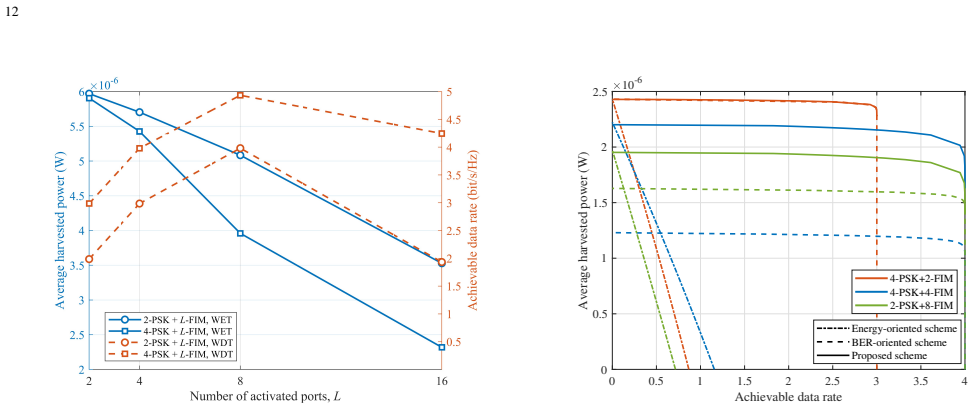
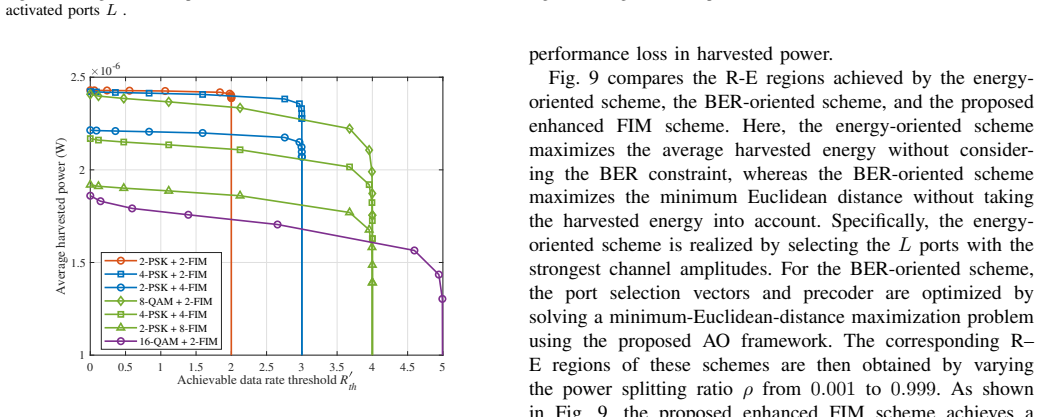
Integrated data and energy transfer (IDET) is a promising technique for supporting sustainable low-power wireless networks. To improve both communication reliability and energy transfer efficiency, this paper investigates a fluid index modulation (FIM) assisted IDET system, where the base station employs a two-dimensional fluid antenna system (FAS) and the receiver adopts a power-splitting architecture. In FIM, the information bits are delivered not only from the modulation symbols, but also the index of antenna position. Under finite-alphabet signaling, the average harvested power, bit error rate (BER), and achievable data rate are derived in closed form. A joint optimization problem is formulated to maximize the average harvested power subject to BER and achievable rate constraints by jointly optimizing the port selection, precoding vector, and power splitting ratio. An alternating optimization framework is developed, where the precoding vector and port selection are obtained via a Riemannian augmented Lagrangian method (RALM) and block coordinate descent (BCD) algorithm, respectively. Simulation results demonstrate that the proposed scheme achieves a superior rate-energy trade-off over benchmark schemes, while the proposed algorithm attains near-optimal performance with significantly lower complexity than exhaustive search.
Editorial analysis
A structured set of objections, weighed in public.
Referee Report
Summary. The paper proposes an enhanced fluid index modulation (FIM) scheme for integrated data and energy transfer (IDET) with a 2D fluid antenna system (FAS) at the base station and power-splitting receiver. Under finite-alphabet signaling, closed-form expressions are derived for average harvested power, BER, and achievable rate. A joint optimization maximizes harvested power subject to BER and rate constraints by optimizing port selection, precoding vector, and power splitting ratio. An alternating optimization framework uses Riemannian augmented Lagrangian method (RALM) for precoding/port selection and block coordinate descent (BCD) for the remainder. Simulations claim superior rate-energy trade-off versus benchmarks and near-optimal performance with lower complexity than exhaustive search.
Significance. If the closed-form expressions for harvested power, BER, and rate are accurate and the alternating optimization converges reliably, the work could contribute to practical IDET designs by improving the rate-energy trade-off via fluid antennas and index modulation. The use of finite-alphabet signaling and explicit complexity comparison to exhaustive search are positive aspects. However, the central claims rest entirely on unverified derivations whose correctness cannot be assessed from the provided material.
major comments (1)
- The central claims (superior rate-energy trade-off and near-optimal algorithm performance) depend on the accuracy of the asserted closed-form expressions for average harvested power, BER, and achievable rate under finite-alphabet FIM with FAS and power splitting. These expressions are used both to set the optimization constraints and to generate the reported simulation curves. No equations, derivations, or verification steps are supplied, preventing evaluation of whether port-selection statistics, constellation effects, or power-splitting ratios are handled correctly.
Simulated Author's Rebuttal
We thank the referee for the detailed review and for highlighting the importance of verifying the closed-form expressions. We address the major comment below and will strengthen the manuscript accordingly.
read point-by-point responses
-
Referee: The central claims (superior rate-energy trade-off and near-optimal algorithm performance) depend on the accuracy of the asserted closed-form expressions for average harvested power, BER, and achievable rate under finite-alphabet FIM with FAS and power splitting. These expressions are used both to set the optimization constraints and to generate the reported simulation curves. No equations, derivations, or verification steps are supplied, preventing evaluation of whether port-selection statistics, constellation effects, or power-splitting ratios are handled correctly.
Authors: We agree that the correctness of the closed-form expressions for average harvested power, BER, and achievable rate is foundational to all claims and simulation results. These expressions appear in Sections III-A (harvested power), III-B (BER), and III-C (rate) of the manuscript, derived under finite-alphabet signaling while accounting for port selection statistics, constellation effects, and the power-splitting ratio. However, we acknowledge that the provided material may not have included sufficient intermediate steps or verification. In the revision we will add an appendix containing the full step-by-step derivations together with Monte-Carlo validation plots that compare the closed-form expressions against empirical averages, thereby allowing direct assessment of the modeling assumptions. revision: yes
Circularity Check
No circularity: closed-form derivations are independent of optimization inputs
full rationale
The paper states that average harvested power, BER, and achievable rate are derived in closed form from the system model under finite-alphabet signaling, then inserted into an alternating optimization (RALM + BCD) that maximizes harvested power subject to BER/rate constraints. No quoted step reduces a claimed prediction or result to a fitted parameter, self-citation, or ansatz by construction; the expressions are presented as direct consequences of the channel and signaling model rather than being defined in terms of the target quantities. Simulations compare against external benchmarks, confirming the chain does not collapse to its own inputs.
Axiom & Free-Parameter Ledger
Reference graph
Works this paper leans on
-
[1]
Next generation advanced transceiver technologies for 6G and beyond,
C. You, Y . Cai, Y . Liu, M. Di Renzo, T. M. Duman, A. Yener, and A. L. Swindlehurst, “Next generation advanced transceiver technologies for 6G and beyond,”IEEE Journal on Selected Areas in Communications, vol. 43, no. 3, pp. 582–627, 2025
2025
-
[2]
Foundations of wireless information and power transfer: Theory, prototypes, and experiments,
B. Clerckx, J. Kim, K. W. Choi, and D. I. Kim, “Foundations of wireless information and power transfer: Theory, prototypes, and experiments,” Proceedings of the IEEE, vol. 110, no. 1, pp. 8–30, 2022
2022
-
[3]
Bridging theory and practice in reconfigurable fluid antenna systems,
H. Yang, Y . Zhao, K.-K. Wong, H.-H. Chen, and C.-B. Chae, “Bridging theory and practice in reconfigurable fluid antenna systems,”IEEE Wireless Communications, pp. 1–8, 2025
2025
-
[4]
A tutorial on fluid antenna system for 6G networks: Encompassing communication theory, optimization methods and hardware designs,
W. K. New, K.-K. Wong, H. Xu, C. Wang, F. R. Ghadi, J. Zhang, J. Rao, R. Murch, P. Ram ´ırez-Espinosa, D. Morales-Jimenez, C.-B. Chae, and K.-F. Tong, “A tutorial on fluid antenna system for 6G networks: Encompassing communication theory, optimization methods and hardware designs,”IEEE Communications Surveys & Tutorials, vol. 27, no. 4, pp. 2325–2377, 2025
2025
-
[5]
Reconfigurable antennas for next-generation mobile communication networks: A comprehensive survey and tutorial,
Y . Zhao, L. Zhang, H. Yang, K. Yang, R. Zhang, L. Song, and Y . Liu, “Reconfigurable antennas for next-generation mobile communication networks: A comprehensive survey and tutorial,”IEEE Communications Surveys & Tutorials, vol. 28, pp. 5267–5306, 2026
2026
-
[6]
Fluid antenna systems,
K. K. Wong, A. Shojaeifard, K. F. Tong, and Y . Zhang, “Fluid antenna systems,”IEEE Trans. Commun., vol. 20, no. 3, pp. 1950–1962, Mar. 2021
1950
-
[7]
LLM- enhanced space-air-ground-sea integrated networks,
H. Yang, S. Lambotharan, M. Derakhshani, and L. Hanzo, “LLM- enhanced space-air-ground-sea integrated networks,”IEEE Communica- tions Magazine, vol. 64, no. 4, pp. 74–81, 2026
2026
-
[8]
FAS-LLM: Large language model-based channel prediction for OTFS-enabled satellite- FAS links,
H. Yang, S. Lambotharan, and M. Derakhshani, “FAS-LLM: Large language model-based channel prediction for OTFS-enabled satellite- FAS links,”IEEE Journal on Selected Areas in Communications, vol. 44, pp. 2952–2963, 2026
2026
-
[9]
Performance analysis of fluid antenna system aided OTFS satellite communications,
H. Yang, M. Derakhshani, S. Lambotharan, and L. Hanzo, “Performance analysis of fluid antenna system aided OTFS satellite communications,” IEEE Journal on Selected Areas in Communications, vol. 44, pp. 1092– 1109, 2026
2026
-
[10]
A survey on spatial modulation in emerging wireless systems: Research progresses and applications,
M. Wen, B. Zheng, K. J. Kim, M. Di Renzo, T. A. Tsiftsis, K.-C. Chen, and N. Al-Dhahir, “A survey on spatial modulation in emerging wireless systems: Research progresses and applications,”IEEE Journal on Selected Areas in Communications, vol. 37, no. 9, pp. 1949–1972, 2019
1949
-
[11]
Receive spatial modulation aided simultaneous wireless information and power transfer with finite alphabet,
Y . Zhao, J. Hu, A. Xie, K. Yang, and K.-K. Wong, “Receive spatial modulation aided simultaneous wireless information and power transfer with finite alphabet,”IEEE Transactions on Wireless Communications, vol. 19, no. 12, pp. 8039–8053, 2020
2020
-
[12]
Reflective index modulation for IRS assisted integrated data and energy transfer,
Y . Zhao, L. Zhang, J. Hu, and K. Yang, “Reflective index modulation for IRS assisted integrated data and energy transfer,”IEEE Transactions on Wireless Communications, vol. 23, no. 9, pp. 11 508–11 520, 2024
2024
-
[13]
A novel nonlinear power receiver model for resource allocation in MIMO SWIPT based on input power and operating frequency of rectifier’s entropy,
M. Shirichian, G. Moradi, R. S. Shirazi, and M. J. Emadi, “A novel nonlinear power receiver model for resource allocation in MIMO SWIPT based on input power and operating frequency of rectifier’s entropy,” IEEE Transactions on V ehicular Technology, vol. 73, no. 12, pp. 19 040– 19 050, 2024
2024
-
[14]
SWIPT in mixed near- and far-field channels: Joint beam scheduling and power allocation,
Y . Zhang and C. You, “SWIPT in mixed near- and far-field channels: Joint beam scheduling and power allocation,”IEEE J. Sel. Areas Com- mun., vol. 42, no. 6, pp. 1583–1597, 2024
2024
-
[15]
Performance analysis of energy-buffer aided SWIPT in extra-large massive MISO systems,
Z. Wu, G. Cai, and J. He, “Performance analysis of energy-buffer aided SWIPT in extra-large massive MISO systems,”IEEE Wireless Communications Letters, vol. 15, pp. 620–624, 2026
2026
-
[16]
Performance of SWIPT for IRS-aided massive MIMO with statistical CSI-based phase-shift and transmit power optimization,
J. K. Dassanayake, D. Gunasinghe, and G. A. A. Baduge, “Performance of SWIPT for IRS-aided massive MIMO with statistical CSI-based phase-shift and transmit power optimization,”IEEE Transactions on V ehicular Technology, vol. 74, no. 4, pp. 5814–5832, 2025
2025
-
[17]
Energy-efficient beamforming design for RIS-aided MIMO downlink communication with SWIPT,
J. Yaswanth, S. K. Singh, K. Singh, and M. F. Flanagan, “Energy-efficient beamforming design for RIS-aided MIMO downlink communication with SWIPT,”IEEE Trans. Green Commun. Netw., vol. 7, no. 3, pp. 1164–1180, 2023
2023
-
[18]
FA-aided SWIPT systems with SIC capabilities: A stochastic geometry copula-based framework,
C. Skouroumounis, S. Chatzinotas, and I. Krikidis, “FA-aided SWIPT systems with SIC capabilities: A stochastic geometry copula-based framework,”IEEE Transactions on Wireless Communications, pp. 1–1, 2025
2025
-
[19]
Fluid antenna multiple access assisted integrated data and energy transfer: Outage and multiplexing gain analysis,
X. Lin, Y . Zhao, H. Yang, J. Hu, and K.-K. Wong, “Fluid antenna multiple access assisted integrated data and energy transfer: Outage and multiplexing gain analysis,”IEEE Transactions on Wireless Communi- cations, vol. 24, no. 9, pp. 7777–7793, 2025
2025
-
[20]
Performance analysis of fluid antenna multiple access assisted wireless powered communication net- work,
X. Lin, Y . Zhao, H. Yang, and J. Hu, “Performance analysis of fluid antenna multiple access assisted wireless powered communication net- work,”IEEE Journal on Selected Areas in Communications, vol. 44, pp. 1382–1399, 2026
2026
-
[21]
Joint time scheduling and port activation design for fluid antenna-empowered wireless powered communication networks,
T. Mao, Z. Chu, Y . Wang, Z. Zhu, W. Hao, D. Mi, and C. Pan, “Joint time scheduling and port activation design for fluid antenna-empowered wireless powered communication networks,”IEEE Internet of Things Journal, vol. 12, no. 13, pp. 22 904–22 914, 2025
2025
-
[22]
Joint port selection and beamforming design for fluid antenna assisted integrated data and energy transfer,
L. Zhang, H. Yang, Y . Zhao, and J. Hu, “Joint port selection and beamforming design for fluid antenna assisted integrated data and energy transfer,”IEEE Wireless Communications Letters, vol. 13, no. 7, pp. 1833–1837, 2024
2024
-
[23]
Energy-efficient port selection and beamforming design for integrated data and energy transfer assisted by fluid antennas,
L. Zhang, Y . Zhao, H. Yang, G. Liang, and J. Hu, “Energy-efficient port selection and beamforming design for integrated data and energy transfer assisted by fluid antennas,”IEEE Journal on Selected Areas in Communications, vol. 44, pp. 1480–1494, 2026
2026
-
[24]
SWIPT optimization design for multi-RIS-aided cell-free IoT networks with fluid antenna,
X. Li, Q. Cui, B. Zhao, Y . Hou, Y . Chen, and X. Tao, “SWIPT optimization design for multi-RIS-aided cell-free IoT networks with fluid antenna,”IEEE Transactions on Wireless Communications, vol. 25, pp. 10 484–10 497, 2026
2026
-
[25]
Index modulation for fluid antenna-assisted MIMO communications: System design and performance analysis,
J. Zhu, G. Chen, P. Gao, P. Xiao, Z. Lin, and A. U. Quddus, “Index modulation for fluid antenna-assisted MIMO communications: System design and performance analysis,”IEEE Transactions on Wireless Com- munications, vol. 23, no. 8, pp. 9701–9713, 2024
2024
-
[26]
Fluid antenna index modulation for MIMO systems: Robust transmission and low-complexity detection,
X. Guo, Y . Xu, D. He, C. Zhang, H. Hong, K.-K. Wong, W. Zhang, and Y . Wu, “Fluid antenna index modulation for MIMO systems: Robust transmission and low-complexity detection,”IEEE Transactions on Communications, vol. 73, no. 12, pp. 15 955–15 970, 2025
2025
-
[27]
Position index modulation for fluid antenna system,
H. Yang, H. Xu, K.-K. Wong, C.-B. Chae, R. Murch, S. Jin, and Y . Zhang, “Position index modulation for fluid antenna system,”IEEE Transactions on Wireless Communications, vol. 23, no. 11, pp. 16 773– 16 787, 2024
2024
-
[28]
Beam- forming design for fluid antenna port grouping index modulation with RIS-assisted SWIPT systems,
J. Wang, X. Jin, P. Han, M. Wen, Y . Ge, C. Huang, and Y . Yao, “Beam- forming design for fluid antenna port grouping index modulation with RIS-assisted SWIPT systems,”IEEE Transactions on Communications, vol. 74, pp. 3904–3918, 2026
2026
-
[29]
Fluid antenna- assisted rectangular differential index modulation: A non-coherent sys- tem design, optimization, and performance analysis,
P. Zhang, J. Dang, M. Wen, Z. Zhang, L. Wu, and Y . Yao, “Fluid antenna- assisted rectangular differential index modulation: A non-coherent sys- tem design, optimization, and performance analysis,”IEEE Journal on Selected Areas in Communications, vol. 44, pp. 1307–1321, 2026
2026
-
[30]
A new analytical ap- proximation of the fluid antenna system channel,
M. Khammassi, A. Kammoun, and M.-S. Alouini, “A new analytical ap- proximation of the fluid antenna system channel,”IEEE Trans. Wireless Commun., vol. 22, no. 12, pp. 8843–8858, 2023
2023
-
[31]
Fundamentals of wireless information and power transfer: From RF energy harvester models to signal and system designs,
B. Clerckx, R. Zhang, R. Schober, D. W. K. Ng, D. I. Kim, and H. V . Poor, “Fundamentals of wireless information and power transfer: From RF energy harvester models to signal and system designs,”IEEE Journal on Selected Areas in Communications, vol. 37, no. 1, pp. 4–33, 2019
2019
-
[32]
The augmented lagrangian methods: Overview and recent advances,
K. Deng, R. Wang, Z. Zhu, J. Zhang, and Z. Wen, “The augmented lagrangian methods: Overview and recent advances,” 2025. [Online]. Available: https://arxiv.org/abs/2510.16827
arXiv 2025
-
[33]
A riemannian manifold approach to constrained resource allocation in ISAC,
S. Zargari, D. Galappaththige, C. Tellambura, and H. V . Poor, “A riemannian manifold approach to constrained resource allocation in ISAC,”IEEE Transactions on Communications, vol. 73, no. 5, pp. 3655– 3670, 2025
2025
-
[34]
Movable antenna empowered secure near-field MIMO communications,
Y . Ma, K. Liu, Y . Liu, and L. Zhu, “Movable antenna empowered secure near-field MIMO communications,”IEEE Transactions on Communica- tions, vol. 73, no. 12, pp. 15 783–15 798, 2025
2025
-
[35]
RIS-aided beamforming design for MIMO systems via unified manifold optimization,
K. Zhong, J. Hu, H. Li, R. Wang, D. An, G. Zhu, K. C. Teh, C. Pan, and Y . C. Eldar, “RIS-aided beamforming design for MIMO systems via unified manifold optimization,”IEEE Transactions on V ehicular Technology, vol. 74, no. 1, pp. 674–685, 2025
2025
-
[36]
Waveform design for wireless power transfer,
B. Clerckx and E. Bayguzina, “Waveform design for wireless power transfer,”IEEE Transactions on Signal Processing, vol. 64, no. 23, pp. 6313–6328, 2016
2016
discussion (0)
Sign in with ORCID, Apple, or X to comment. Anyone can read and Pith papers without signing in.