Full-Disk Spectroscopy of the Solar Corona Across a Solar Cycle with Hinode/EIS
Pith reviewed 2026-06-28 04:12 UTC · model grok-4.3
The pith
Sun-as-a-star coronal intensity changes across the solar cycle mainly because active regions cover more or less of the disk, not because their internal plasma properties shift.
A machine-rendered reading of the paper's core claim, the machinery that carries it, and where it could break.
Core claim
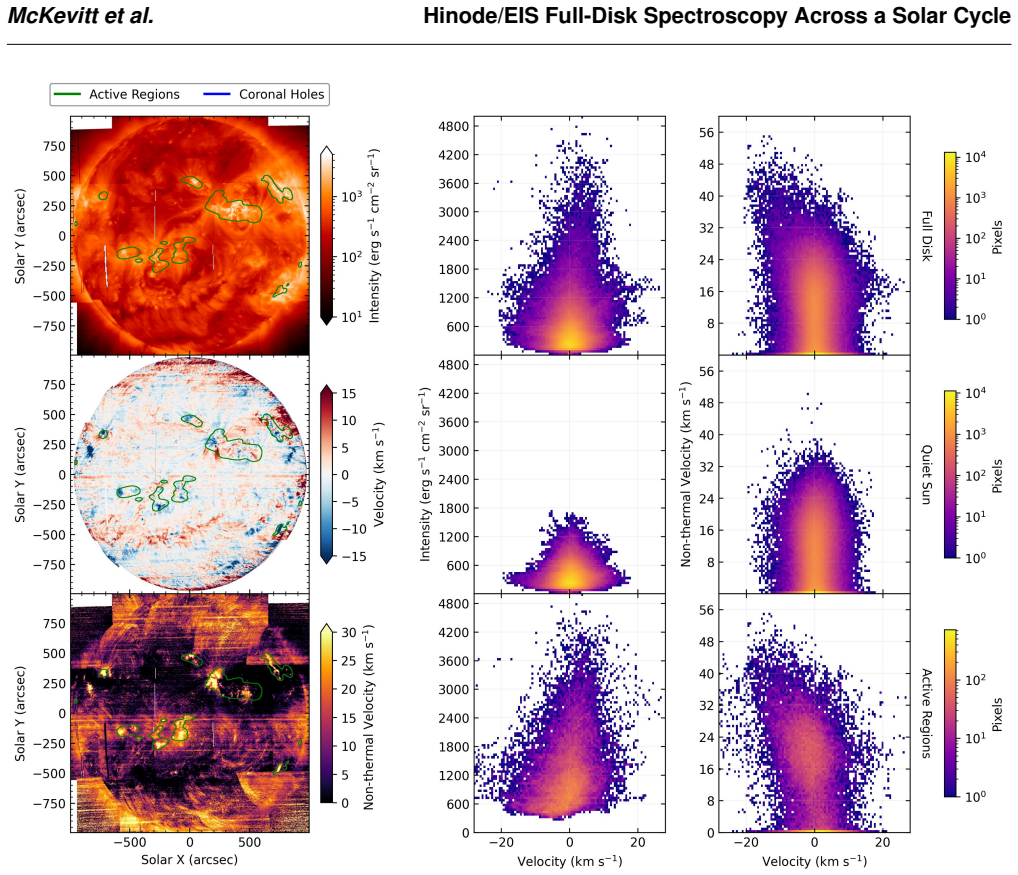
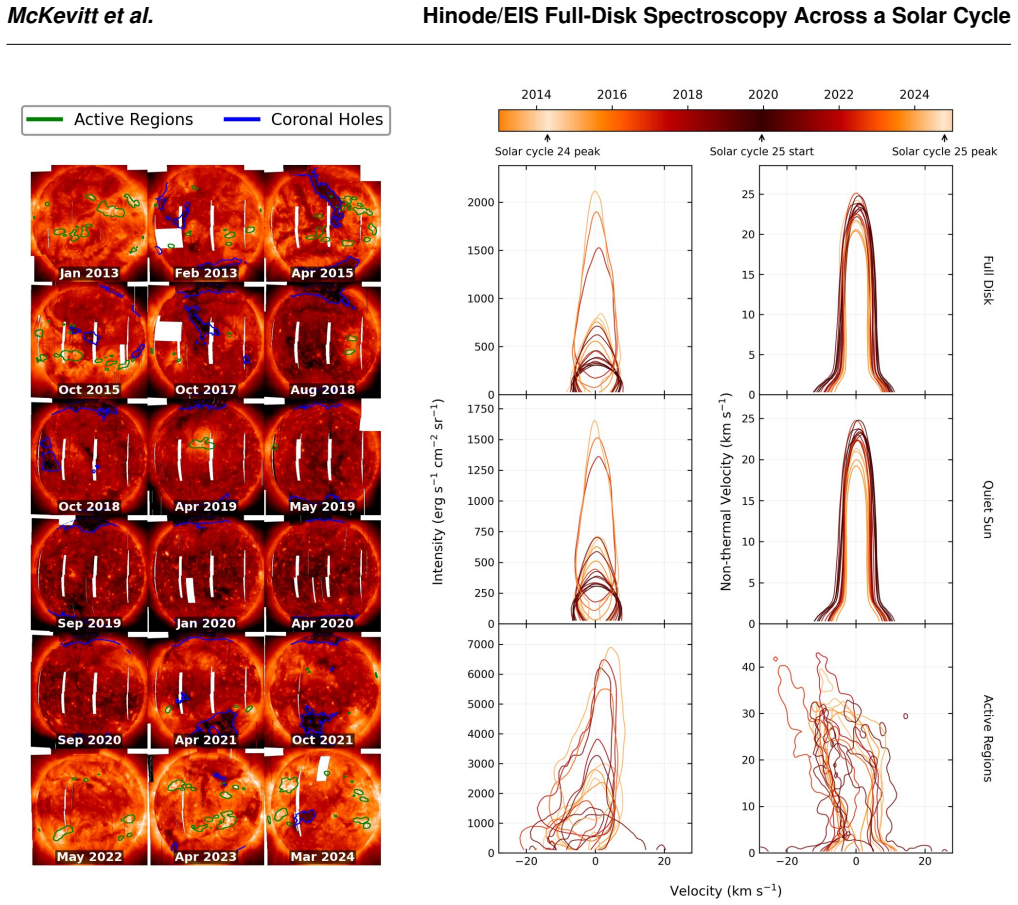
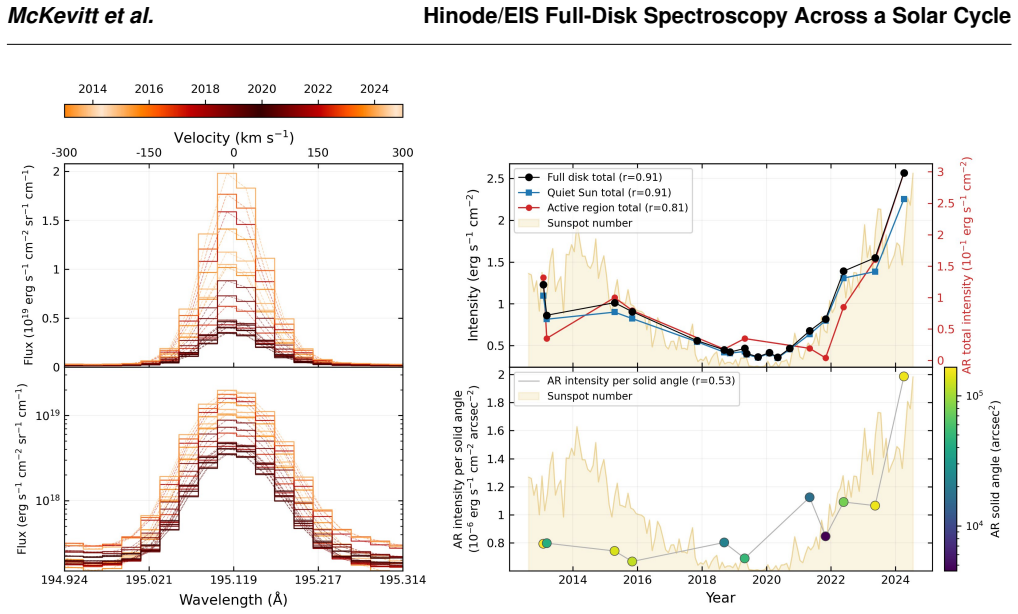
Disk-integrated coronal intensity is strongly correlated with the solar cycle, consistent with stellar observations. No clear solar-cycle variation is found in the distributions of coronal Doppler or non-thermal velocity in either active regions or the quiet Sun, though their total intensities do track the cycle. Active region intensity per unit solid angle shows a moderate correlation with solar cycle. Taken together, these results support the hypothesis that Sun-as-a-star coronal intensity variability across the solar cycle is driven primarily by the changing fraction of the disk occupied by active regions, rather than by changes in the log T~6.2 plasma properties of those regions.
What carries the argument
full-disk spectroscopic mosaic scans that separate active-region and quiet-Sun contributions to intensity and velocity of log T~6.2 plasma
If this is right
- The well-established correlation between upflowing plasma and elevated non-thermal line broadening in active regions persists throughout the cycle.
- The underlying kinematic properties of active region plasma are insensitive to the global magnetic field configuration.
- Stellar coronal activity cycles on solar-like stars can be interpreted using the solar pattern without requiring changes in the internal plasma properties of active regions.
- Disk-integrated intensity alone does not reveal cycle-driven changes in the velocity or non-thermal properties of the coronal plasma.
Where Pith is reading between the lines
- Stellar observers can treat solar-like intensity cycles as primarily a surface-coverage effect when modeling activity indicators.
- Magnetic-flux emergence rates may be a more direct driver of coronal variability than any evolution in the temperature or density structure inside active regions.
- Repeated full-disk spectroscopy of other stars could test whether the area-driven mechanism seen on the Sun applies more generally.
Load-bearing premise
The 18 selected mosaic scans are representative of the full range of solar activity levels and the chosen spectral lines and analysis techniques introduce no systematic biases that vary with the solar cycle.
What would settle it
Full-disk observations during a solar maximum in which the average intensity or velocity properties inside active regions changed sharply while the fractional area covered by active regions stayed constant would falsify the central claim.
Figures
read the original abstract
The structure and dynamics of the solar corona evolve with the Sun's magnetic cycle, yet how this variability manifests in the disk-integrated, Sun-as-a-star observables used in stellar activity studies remains poorly constrained. We compile 18 full-disk spectroscopic mosaic scans made by Hinode/EIS spanning 2013-2024, covering solar cycle 24 and the rise of solar cycle 25, and probe coronal plasma variability through the integrated and spatially resolved intensity, Doppler velocity, and non-thermal velocity of log T~6.2 plasma in active regions and the quiet Sun. Disk-integrated coronal intensity is strongly correlated with the solar cycle, consistent with stellar observations. No clear solar-cycle variation is found in the distributions of coronal Doppler or non-thermal velocity in either active regions or the quiet Sun, though their total intensities do track the cycle. Active region intensity per unit solid angle shows a moderate correlation with solar cycle. Taken together, these results support the hypothesis that Sun-as-a-star coronal intensity variability across the solar cycle is driven primarily by the changing fraction of the disk occupied by active regions, rather than by changes in the log T~6.2 plasma properties of those regions. The well-established correlation between upflowing plasma and elevated non-thermal line broadening in active regions persists throughout the cycle, implying that the underlying kinematic properties of active region plasma are insensitive to the global magnetic field configuration, a result with direct implications for the interpretation of coronal activity cycles on solar-like stars.
Editorial analysis
A structured set of objections, weighed in public.
Referee Report
Summary. The paper analyzes 18 Hinode/EIS full-disk spectroscopic mosaics from 2013-2024 to study variability in log T~6.2 coronal plasma. It reports strong solar-cycle correlation in disk-integrated intensity, moderate correlation in active-region intensity per unit solid angle, and no clear cycle dependence in Doppler or non-thermal velocities for either active regions or quiet Sun. The authors conclude that Sun-as-a-star intensity variability is driven primarily by the changing active-region filling factor rather than by changes in the plasma properties of those regions, with the upflow/non-thermal broadening correlation persisting throughout the cycle.
Significance. If the central claim holds after quantitative checks, the work supplies useful empirical constraints on how solar-cycle changes appear in disk-integrated observables, directly relevant to the interpretation of stellar activity cycles. The null result on velocity distributions and the persistence of the kinematic correlation are potentially valuable for stellar modeling. The purely observational nature of the study avoids circularity but leaves the relative weighting of filling-factor versus per-area effects unquantified.
major comments (2)
- [Abstract] Abstract (results paragraph): the claim that variability is 'driven primarily by the changing fraction of the disk occupied by active regions' rests on the reported moderate correlation for AR intensity per unit solid angle being secondary; however, no correlation coefficient, significance level, error bars, or explicit variance decomposition (e.g., partitioning disk-integrated intensity variance into area-fraction and brightness-per-area terms) is provided, leaving open whether the moderate per-area trend contributes substantially.
- [Dataset and Analysis] Dataset description (paragraph on the 18 scans): with only 18 selected mosaics spanning cycles 24-25, the manuscript must demonstrate that the sample is representative across activity levels and that selection or calibration effects do not introduce cycle-dependent biases; without this, the null velocity results and the filling-factor interpretation cannot be considered robust.
minor comments (2)
- [Abstract] The abstract mentions 'strong' and 'moderate' correlations without numerical values or figures; adding the actual coefficients and a supplementary table of per-mosaic statistics would improve clarity.
- [Methods] No mention of how active-region boundaries are defined or how quiet-Sun regions are masked; this definition should be stated explicitly to allow reproducibility.
Simulated Author's Rebuttal
We thank the referee for their constructive comments on our manuscript. We address each major comment below and will make the indicated revisions to strengthen the quantitative support for our conclusions and the robustness of the dataset analysis.
read point-by-point responses
-
Referee: [Abstract] Abstract (results paragraph): the claim that variability is 'driven primarily by the changing fraction of the disk occupied by active regions' rests on the reported moderate correlation for AR intensity per unit solid angle being secondary; however, no correlation coefficient, significance level, error bars, or explicit variance decomposition (e.g., partitioning disk-integrated intensity variance into area-fraction and brightness-per-area terms) is provided, leaving open whether the moderate per-area trend contributes substantially.
Authors: We agree that the abstract claim requires stronger quantitative backing to demonstrate that the per-area trend is secondary. In the revised manuscript we will report the Pearson (or Spearman) correlation coefficient, associated p-value, and uncertainties for active-region intensity per unit solid angle versus the solar-cycle proxy. We will also add a variance-partitioning analysis (or equivalent decomposition) that explicitly quantifies the fractional contribution of active-region area coverage versus brightness per unit area to the observed disk-integrated intensity variance. revision: yes
-
Referee: [Dataset and Analysis] Dataset description (paragraph on the 18 scans): with only 18 selected mosaics spanning cycles 24-25, the manuscript must demonstrate that the sample is representative across activity levels and that selection or calibration effects do not introduce cycle-dependent biases; without this, the null velocity results and the filling-factor interpretation cannot be considered robust.
Authors: The 18 mosaics comprise all full-disk EIS observations meeting our quality and coverage criteria between 2013 and 2024. To address representativeness we will add a supplementary table and/or figure showing the solar activity index (sunspot number or F10.7 flux) at each observation epoch, confirming sampling across the full range of cycle phases. We will expand the methods section with explicit discussion of selection criteria and standard EIS calibration procedures, and will include additional checks (e.g., velocity statistics binned by activity level) to test for cycle-dependent biases. While the small number of available full-disk mosaics inherently limits statistical power, these additions will allow readers to evaluate the robustness of the null velocity results and filling-factor interpretation. revision: yes
Circularity Check
No significant circularity; purely observational data analysis
full rationale
The paper compiles and analyzes 18 Hinode/EIS full-disk mosaic scans to report empirical correlations between disk-integrated coronal intensity, active-region filling factor, per-area intensities, and velocity distributions across solar cycle 24-25. No equations, model derivations, parameter fittings, or predictions are present that reduce to the input data by construction. The central claim follows directly from the observed trends (strong cycle correlation in integrated intensity, moderate in AR per-area intensity, none in velocities) without self-definitional loops, fitted inputs renamed as predictions, or load-bearing self-citations. The analysis is self-contained against external benchmarks and does not invoke uniqueness theorems or ansatzes from prior author work.
Axiom & Free-Parameter Ledger
axioms (2)
- domain assumption The chosen spectral lines accurately diagnose plasma at log T ~ 6.2 without cycle-dependent biases in formation or calibration
- domain assumption The 18 mosaic scans provide a representative sampling of solar cycle phases
Reference graph
Works this paper leans on
-
[1]
Babcock, H. W. (1961). The Topology of the Sun’s Magnetic Field and the 22-Year Cycle.The Astrophysical Journal133,
1961
-
[2]
ADS Bibcode: 1961ApJ...133..572B Bobra, M
doi:10.1086/147060. ADS Bibcode: 1961ApJ...133..572B Bobra, M. G., Sun, X., Hoeksema, J. T., Turmon, M., Liu, Y ., Hayashi, K., et al. (2014). The Helioseismic and Magnetic Imager (HMI) Vector Magnetic Field Pipeline: SHARPs - Space-Weather HMI Active Region Patches.Solar Physics289, 3549–3578. doi:10.1007/s11207-014-0529-3. ADS Bibcode: 2014SoPh..289.354...
-
[3]
doi:10.1038/ncomms6947 Brosius, J. W. (2025). Nonthermal Velocities in a Solar Active Region Observed by SERTS.The Astrophysical Journal979,
-
[4]
doi:10.3847/1538-4357/ada24d [Dataset] Carnall, A. C. (2017). SpectRes: A Fast Spectral Resampling Tool in Python. doi:10.48550/ arXiv.1705.05165. ArXiv:1705.05165 [astro-ph] [Dataset] Clette, F. and Lefèvre, L. (2015). SILSO Sunspot Number V2.0. doi:10.24414/QNZA-AC80 Frontiers 11 McKevitt et al.Hinode/EIS Full-Disk Spectroscopy Across a Solar Cycle Coff...
work page internal anchor Pith review Pith/arXiv arXiv doi:10.3847/1538-4357/ada24d 2017
-
[5]
doi:10.3847/1538-4365/ad981f Doschek, G. A. (2012). The Dynamics and Heating of Active Region Loops.The Astrophysical Journal 754,
-
[6]
ADS Bibcode: 2012ApJ...754..153D Doschek, G
doi:10.1088/0004-637X/754/2/153. ADS Bibcode: 2012ApJ...754..153D Doschek, G. A., Warren, H. P., Mariska, J. T., Muglach, K., Culhane, J. L., Hara, H., et al. (2008). Flows and Nonthermal Velocities in Solar Active Regions Observed with the EUV Imaging Spectrometer on Hinode: A Tracer of Active Region Sources of Heliospheric Magnetic Fields?The Astrophysi...
-
[7]
doi:10.1126/science.283. 5403.810. ADS Bibcode: 1999Sci...283..810H Hempelmann, A., Robrade, J., Schmitt, J. H. M. M., Favata, F., Baliunas, S. L., and Hall, J. C. (2006). Coronal activity cycles in 61 Cygni.Astronomy & Astrophysics460, 261–267. doi:10.1051/0004-6361: 20065459 Jarolim, R., Veronig, A. M., Hofmeister, S., Heinemann, S. G., Temmer, M., Podl...
-
[8]
doi:10.1007/ s41116-024-00039-4 Lemen, J. R., Title, A. M., Akin, D. J., Boerner, P. F., Chou, C., Drake, J. F., et al. (2012). The Atmospheric Imaging Assembly (AIA) on the Solar Dynamics Observatory (SDO).Solar Physics275, 17–40. doi:10.1007/s11207-011-9776-8 Lucy, L. B. (1974). An iterative technique for the rectification of observed distributions.The ...
-
[9]
Non-linear Least Squares Fitting in IDL with MPFIT
doi:10.1086/111605. ADS Bibcode: 1974AJ.....79..745L Mackay, D. and Yeates, A. (2012). The Sun’s Global Photospheric and Coronal Magnetic Fields: Observations and Models.Living Reviews in Solar Physics9. doi:10.12942/lrsp-2012-6 [Dataset] Markwardt, C. B. (2009). Non-linear Least Squares Fitting in IDL with MPFIT. doi:10.48550/ arXiv.0902.2850. ArXiv:0902...
work page internal anchor Pith review Pith/arXiv arXiv doi:10.1086/111605 2012
-
[10]
doi:10.1364/JOSA.62.000055 Robrade, J., Schmitt, J. H. M. M., and Favata, F. (2012). Coronal activity cycles in nearby G and K stars: XMM-Newton monitoring of 61 Cygni and α Centauri.Astronomy & Astrophysics543, A84. doi:10.1051/0004-6361/201219046 Scherrer, P. H., Schou, J., Bush, R. I., Kosovichev, A. G., Bogart, R. S., Hoeksema, J. T., et al. (2012). T...
-
[11]
doi:10.1088/0004-637X/ 773/2/93. ADS Bibcode: 2013ApJ...773...93S The Astropy Collaboration, Price-Whelan, A. M., Lim, P. L., Earl, N., Starkman, N., Bradley, L., et al. (2022). The Astropy Project: Sustaining and Growing a Community-oriented Open-source Project and the Latest Major Release (v5.0) of the Core Package*.The Astrophysical Journal935,
-
[12]
doi:10.3847/1538-4357/ac7c74 Tian, H., Harra, L., Baker, D., Brooks, D. H., and Xia, L. (2021). Upflows in the Upper Solar Atmosphere: Invited Review.Solar Physics296,
work page internal anchor Pith review doi:10.3847/1538-4357/ac7c74 2021
-
[13]
doi:10.1007/s11207-021-01792-7 Toriumi, S. (2026). Bridging Solar and Stellar Physics: Role of SDO in Understanding Stellar Active Regions and Atmospheric Heating.Solar Physics301,
-
[14]
doi:10.1007/s11207-026-02634-0 Toriumi, S. and Airapetian, V . S. (2022). Universal Scaling Laws for Solar and Stellar Atmospheric Heating.The Astrophysical Journal927,
-
[15]
doi:10.3847/1538-4357/ac5179. ADS Bibcode: 2022ApJ...927..179T Frontiers 13 McKevitt et al.Hinode/EIS Full-Disk Spectroscopy Across a Solar Cycle Toriumi, S., Airapetian, V . S., Hudson, H. S., Schrijver, C. J., Cheung, M. C. M., and DeRosa, M. L. (2020). Sun-as-a-star Spectral Irradiance Observations of Transiting Active Regions.The Astrophysical Journal 902,
-
[16]
doi:10.3847/1538-4357/abadf9. ADS Bibcode: 2020ApJ...902...36T Tsuneta, S., Acton, L., Bruner, M., Lemen, J., Brown, W., Caravalho, R., et al. (1991). The Soft X-ray Telescope for the SOLAR-A mission.Solar Physics136, 37–67. doi:10.1007/BF00151694 Ugarte-Urra, I., Young, P. R., Brooks, D. H., Warren, H. P., De Pontieu, B., Bryans, P., et al. (2023). The c...
-
[17]
doi:10.1088/0067-0049/ 213/1/11 Weberg, M. J., Warren, H. P., Crump, N., and Barnes, W. (2023). EISPAC - The EIS Python Analysis Code. Journal of Open Source Software8,
-
[18]
doi:10.21105/joss.04914 Wiener, N. (1949).Extrapolation, Interpolation, and Smoothing of Stationary Time Series: With Engineering Applications(The MIT Press). doi:10.7551/mitpress/2946.001.0001 Woods, T. N., Eparvier, F. G., Hock, R., Jones, A. R., Woodraska, D., Judge, D., et al. (2012). Extreme Ultraviolet Variability Experiment (EVE) on the Solar Dynam...
-
[19]
doi:10.3847/1538-4357/ ac8472 Frontiers 14
discussion (0)
Sign in with ORCID, Apple, or X to comment. Anyone can read and Pith papers without signing in.