Gravitational Wave Imprints of a High-Quality Axion and the Origin of Flavor Hierarchies
Pith reviewed 2026-06-28 05:13 UTC · model grok-4.3
The pith
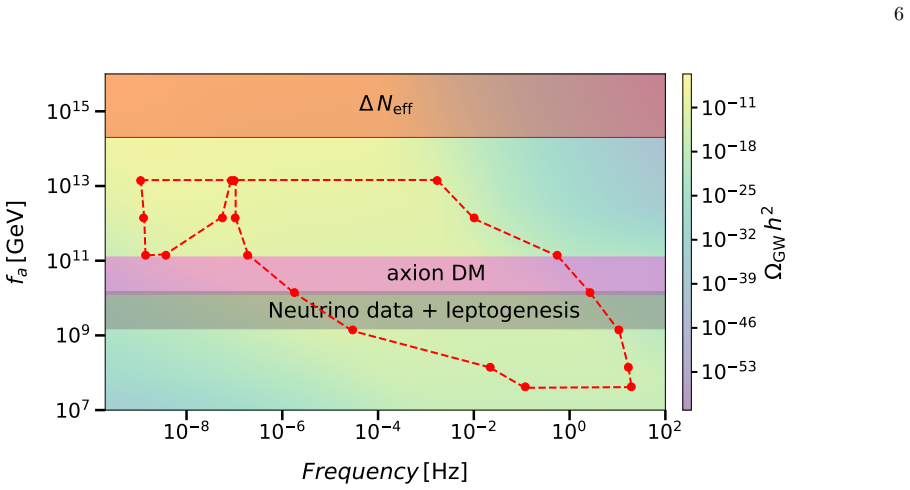
Gauged flavor symmetries protect axions from Planck effects and generate a plateau-valley gravitational wave spectrum from cosmic strings.
A machine-rendered reading of the paper's core claim, the machinery that carries it, and where it could break.
Core claim
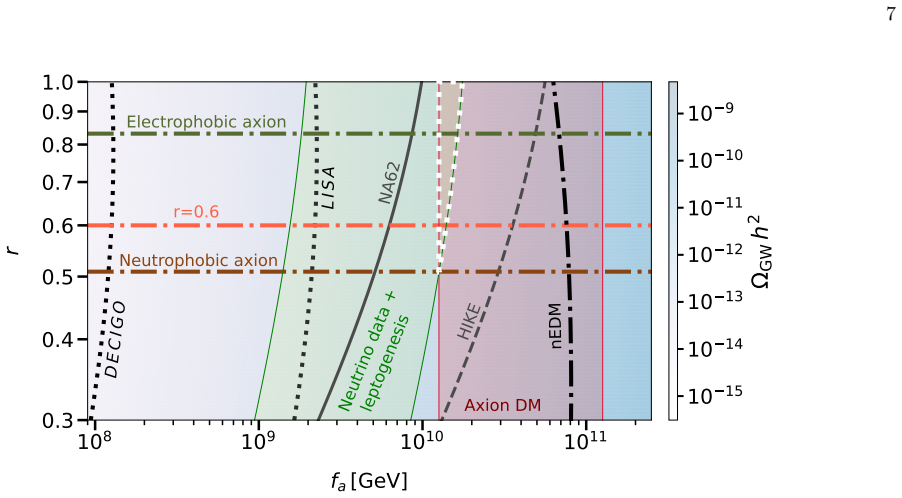
Constructions with gauged U(1)_F flavor symmetries shield the axion from Planck-suppressed operators, yielding an accidental high-quality flavored axion with unit domain wall number. These predict flavor-changing neutral currents at high flavor scales and stochastic gravitational waves from the evolution and decay of gauged flavonic and axionic cosmic-string networks, while global axionic strings can radiate axions to match the observed dark matter abundance. The resulting plateau-valley structure in the GW spectrum provides a distinctive probe of high-quality flavored axion dark matter models complementary to low-energy flavor experiments.
What carries the argument
Gauged flavonic and axionic cosmic-string networks whose evolution and decay source stochastic gravitational waves with a plateau-valley spectrum.
If this is right
- High flavor scales Lambda_FN greater than or equal to f_a lead to observable flavor-changing neutral currents such as K to pi a decays.
- Global axionic strings efficiently radiate axions that can account for the full dark matter relic density.
- The plateau-valley feature in the GW spectrum arises specifically from the combined flavonic and axionic string networks.
- The GW signal provides a probe independent of and complementary to searches for flavor violation at low energies.
Where Pith is reading between the lines
- Future GW observatories sensitive to the relevant frequency bands could directly test the cosmic string contribution without requiring flavor violation signals.
- The unit domain wall number condition may restrict the possible flavor symmetry charge assignments that simultaneously solve strong CP and flavor problems.
- If axions constitute dark matter via string radiation, the same models predict correlated signals in both GW detectors and flavor experiments.
Load-bearing premise
Gauged abelian flavor symmetries U(1)_F naturally shield the axion from Planck-suppressed operators while yielding an accidental high-quality flavored axion with unit domain wall number.
What would settle it
A measured stochastic gravitational wave spectrum from cosmic strings that lacks the predicted plateau-valley structure, or the absence of K to pi a decays at the expected rates for Lambda_FN greater than or equal to f_a.
Figures

read the original abstract
Axions, arising from an anomalous global Peccei-Quinn symmetry $U(1)_{\text{PQ}}$, offer a compelling solution to the strong CP problem but are vulnerable to Planck-suppressed operators. Gauged abelian flavor symmetries $U(1)_F$, invoked to explain the flavor hierarchies via the Froggatt-Nielsen mechanism, can naturally shield the axion from such effects, yielding an accidental high-quality flavored axion with unit domain wall number. Such constructions predict two complementary signatures: (i) flavor-changing neutral currents from $K\to\pi a$ decays, typically associated with high flavor scales $\Lambda_{\text{FN}}\gtrsim f_a$, and (ii) stochastic Gravitational Waves (GWs) sourced by the evolution and decay of gauged flavonic and axionic cosmic-string networks. In addition, global axionic strings can efficiently radiate axions, potentially accounting for the observed dark matter relic abundance. We show that the resulting characteristic plateau--valley structure in the GW spectrum provides a distinctive and powerful probe of high-quality flavored axion dark matter models, complementary to low-energy flavor experiments.
Editorial analysis
A structured set of objections, weighed in public.
Referee Report
Summary. The manuscript argues that gauged U(1)_F abelian flavor symmetries, introduced via the Froggatt-Nielsen mechanism to explain fermion mass hierarchies, can simultaneously protect an axion from Planck-suppressed operators. This yields an accidental high-quality axion with N_DW=1 whose associated flavonic and axionic string networks produce a characteristic plateau-valley structure in the stochastic gravitational-wave spectrum; the same construction also allows global axionic strings to radiate axions that may account for the dark-matter relic density. These features are presented as complementary probes to low-energy flavor processes such as K oπa decays.
Significance. If the central derivation holds, the work supplies a concrete, observationally distinctive link between flavor model-building and gravitational-wave phenomenology. The predicted spectral feature is falsifiable with future GW observatories and does not rely on post-hoc parameter tuning according to the abstract; this strengthens the case for the model as a unified explanation of flavor hierarchies, axion quality, and dark matter.
minor comments (2)
- The abstract states that the plateau-valley structure 'provides a distinctive and powerful probe,' but the manuscript should explicitly state the frequency range and amplitude scaling in terms of the string tension and network parameters to allow direct comparison with projected sensitivities of LISA, ET, or pulsar-timing arrays.
- Notation for the flavor scale Λ_FN versus the axion decay constant f_a should be clarified in the introductory section; the relation Λ_FN ≳ f_a is mentioned but its precise impact on the domain-wall number and string network evolution is not immediately transparent from the abstract alone.
Simulated Author's Rebuttal
We thank the referee for the positive assessment of our manuscript, the clear summary of its main results, and the recommendation for minor revision. No major comments appear in the report.
Circularity Check
No significant circularity; derivation chain is self-contained against external benchmarks
full rationale
The provided abstract and reader's summary present the central claim as a standard logical chain (gauged U(1)_F flavor symmetry → accidental high-quality axion with N_DW=1 → string network evolution → distinctive GW plateau-valley spectrum) without any quoted equations, fitted parameters, or self-citations that reduce a prediction to an input by construction. No self-definitional steps, fitted inputs renamed as predictions, or load-bearing self-citations appear in the visible material. The GW signature is framed as a derived consequence of string network dynamics, which are independently modeled in the broader literature, making the result falsifiable outside the paper's own choices. This is the normal case of an honest non-finding.
Axiom & Free-Parameter Ledger
Reference graph
Works this paper leans on
-
[1]
resonant leptogenesis
and an SM scalar singletSby the addition of the flavon fieldX. The role of theSfield in the DFSZ model is to avoid the Weinberg-Wilczek weak scale axion [8, 9] ruled out by ex- periments. This generalization integrates seamlessly with the FN mechanism using two Higgs doublets for the up- type, down-type quarks, plus charged lepton couplings, respectively....
-
[2]
axionic”global strings and Type-fstrings as“flavonic
points corresponding to variousrvalues, which are highlighted in Fig. 3. We consider a concrete scenario with (n, k) = (3,1 +), h u = 4, h d =−2/3, q X = 1 fixingq S = −13/9 =l/mfrom Eq. (4) as a simple and illustrative example and analyze the production of GWs in the com- ing section, while contrasting it with the axion flavor ob- servables of the curren...
2036
-
[3]
MINIMAL FLAVOR UNIFICATION VIA MULTIGENERATIONAL PECCEI-QUINN SYMMETRY,
A. Davidson and K. C. Wali, “MINIMAL FLAVOR UNIFICATION VIA MULTIGENERATIONAL PECCEI-QUINN SYMMETRY,”Phys. Rev. Lett.48 (1982) 11
1982
-
[4]
Axions and Family Symmetry Breaking,
F. Wilczek, “Axions and Family Symmetry Breaking,” Phys. Rev. Lett.49(1982) 1549–1552
1982
-
[5]
Family symmetry, gravity, and the strong CP problem,
K. S. Babu and S. M. Barr, “Family symmetry, gravity, and the strong CP problem,”Phys. Lett. B300(1993) 367–372,arXiv:hep-ph/9212219
Pith/arXiv arXiv 1993
-
[6]
Flaxion: a minimal extension to solve puzzles in the standard model,
Y. Ema, K. Hamaguchi, T. Moroi, and K. Nakayama, “Flaxion: a minimal extension to solve puzzles in the standard model,”JHEP01(2017) 096, arXiv:1612.05492 [hep-ph]
Pith/arXiv arXiv 2017
-
[7]
Minimal axion model from flavor,
L. Calibbi, F. Goertz, D. Redigolo, R. Ziegler, and J. Zupan, “Minimal axion model from flavor,”Phys. 9 Rev. D95no. 9, (2017) 095009,arXiv:1612.08040 [hep-ph]
Pith/arXiv arXiv 2017
-
[8]
Fermion Mass Hierarchy and a High Quality Axion From Gauged U(1) Flavor Symmetry,
K. S. Babu, S. C. Chandrasekar, and Z. Tavartkiladze, “Fermion Mass Hierarchy and a High Quality Axion From Gauged U(1) Flavor Symmetry,” (Feb, 2026) , arXiv:2602.24253 [hep-ph]
arXiv 2026
-
[9]
CP Conservation in the Presence of Instantons,
R. D. Peccei and H. R. Quinn, “CP Conservation in the Presence of Instantons,”Phys. Rev. Lett.38(1977) 1440–1443
1977
-
[10]
A New Light Boson?,
S. Weinberg, “A New Light Boson?,”Phys. Rev. Lett. 40(1978) 223–226
1978
-
[11]
Problem of StrongPandTInvariance in the Presence of Instantons,
F. Wilczek, “Problem of StrongPandTInvariance in the Presence of Instantons,”Phys. Rev. Lett.40(1978) 279–282
1978
-
[12]
Chiral Dynamics in the Large n Limit,
P. Di Vecchia and G. Veneziano, “Chiral Dynamics in the Large n Limit,”Nucl. Phys. B171(1980) 253–272
1980
-
[13]
Chiral Estimate of the Electric Dipole Moment of the Neutron in Quantum Chromodynamics,
R. J. Crewther, P. Di Vecchia, G. Veneziano, and E. Witten, “Chiral Estimate of the Electric Dipole Moment of the Neutron in Quantum Chromodynamics,”Phys. Lett. B88(1979) 123. [Erratum: Phys.Lett.B 91, 487 (1980)]
1979
-
[14]
Measurement of the Permanent Electric Dipole Moment of the Neutron,
C. Abelet al., “Measurement of the Permanent Electric Dipole Moment of the Neutron,”Phys. Rev. Lett.124 no. 8, (2020) 081803,arXiv:2001.11966 [hep-ex]
arXiv 2020
-
[15]
Planck scale physics and the Peccei-Quinn mechanism,
M. Kamionkowski and J. March-Russell, “Planck scale physics and the Peccei-Quinn mechanism,”Phys. Lett. B282(1992) 137–141,arXiv:hep-th/9202003
Pith/arXiv arXiv 1992
-
[16]
Solutions to the strong CP problem in a world with gravity,
R. Holman, S. D. H. Hsu, T. W. Kephart, E. W. Kolb, R. Watkins, and L. M. Widrow, “Solutions to the strong CP problem in a world with gravity,”Phys. Lett. B282(1992) 132–136,arXiv:hep-ph/9203206
Pith/arXiv arXiv 1992
-
[17]
Planck scale corrections to axion models,
S. M. Barr and D. Seckel, “Planck scale corrections to axion models,”Phys. Rev. D46(1992) 539–549
1992
-
[18]
Accidental Peccei-Quinn Symmetry From Gauged U(1) and a High Quality Axion,
K. S. Babu, B. Dutta, and R. N. Mohapatra, “Accidental Peccei-Quinn Symmetry From Gauged U(1) and a High Quality Axion,” (12, 2024) , arXiv:2412.21157 [hep-ph]
arXiv 2024
-
[19]
Hierarchy of Quark Masses, Cabibbo Angles and CP Violation,
C. D. Froggatt and H. B. Nielsen, “Hierarchy of Quark Masses, Cabibbo Angles and CP Violation,”Nucl. Phys. B147(1979) 277–298
1979
-
[20]
Topology of Cosmic Domains and Strings,
T. W. B. Kibble, “Topology of Cosmic Domains and Strings,”J. Phys. A9(1976) 1387–1398
1976
-
[21]
Vilenkin and E
A. Vilenkin and E. P. S. Shellard,Cosmic Strings and Other Topological Defects. Cambridge University Press, 7, 2000
2000
-
[22]
Gravitational radiation from cosmic strings,
A. Vilenkin, “Gravitational radiation from cosmic strings,”Phys. Lett. B107(1981) 47–50
1981
-
[23]
Radiation From Vacuum Strings and Domain Walls,
T. Vachaspati, A. E. Everett, and A. Vilenkin, “Radiation From Vacuum Strings and Domain Walls,” Phys. Rev. D30(1984) 2046
1984
-
[24]
From U(1)×U(1) symmetry breaking to Majoron cosmology: Insights from NANOGrav 15-year data,
T. Ghosh, K. Loho, and S. Manna, “From U(1)×U(1) symmetry breaking to Majoron cosmology: Insights from NANOGrav 15-year data,”Phys. Rev. D113 no. 4, (2026) 043036,arXiv:2507.04342 [hep-ph]. [23]LISACollaboration, P. Amaro-Seoaneet al., “Laser Interferometer Space Antenna,”arXiv:1702.00786 [astro-ph.IM]
arXiv 2026
-
[25]
Unveiling the gravitational universe atµ-Hz frequencies,
A. Sesanaet al., “Unveiling the gravitational universe atµ-Hz frequencies,”Exper. Astron.51no. 3, (2021) 1333–1383,arXiv:1908.11391 [astro-ph.IM]
Pith/arXiv arXiv 2021
-
[26]
Laser interferometry for the big bang observer,
G. M. Harry, P. Fritschel, D. A. Shaddock, W. Folkner, and E. S. Phinney, “Laser interferometry for the big bang observer,”Class. Quant. Grav.23(2006) 4887–4894. [Erratum: Class.Quant.Grav. 23, 7361 (2006)]
2006
-
[27]
Current status of space gravitational wave antenna DECIGO and B-DECIGO,
S. Kawamuraet al., “Current status of space gravitational wave antenna DECIGO and B-DECIGO,” PTEP2021no. 5, (2021) 05A105,arXiv:2006.13545 [gr-qc]
Pith/arXiv arXiv 2021
-
[28]
Detecting a gravitational-wave background with next-generation space interferometers,
H. Kudoh, A. Taruya, T. Hiramatsu, and Y. Himemoto, “Detecting a gravitational-wave background with next-generation space interferometers,”Phys. Rev. D 73(2006) 064006,arXiv:gr-qc/0511145
Pith/arXiv arXiv 2006
-
[29]
Pushing towards the ET sensitivity using ’conventional’ technology,
S. Hild, S. Chelkowski, and A. Freise, “Pushing towards the ET sensitivity using ’conventional’ technology,” arXiv:0810.0604 [gr-qc]. [29]AEDGECollaboration, Y. A. El-Neajet al., “AEDGE: Atomic Experiment for Dark Matter and Gravity Exploration in Space,”EPJ Quant. Technol.7 (2020) 6,arXiv:1908.00802 [gr-qc]. [30]LIGO ScientificCollaboration, B. P. Abbott...
Pith/arXiv arXiv 2020
-
[30]
On Possible Suppression of the Axion Hadron Interactions. (In Russian),
A. R. Zhitnitsky, “On Possible Suppression of the Axion Hadron Interactions. (In Russian),”Sov. J. Nucl. Phys. 31(1980) 260
1980
-
[31]
A Simple Solution to the Strong CP Problem with a Harmless Axion,
M. Dine, W. Fischler, and M. Srednicki, “A Simple Solution to the Strong CP Problem with a Harmless Axion,”Phys. Lett. B104(1981) 199–202
1981
-
[32]
µ→eγat a Rate of One Out of 10 9 Muon Decays?,
P. Minkowski, “µ→eγat a Rate of One Out of 10 9 Muon Decays?,”Phys. Lett. B67(1977) 421–428
1977
-
[33]
Neutrino Mass and Spontaneous Parity Nonconservation,
R. N. Mohapatra and G. Senjanovic, “Neutrino Mass and Spontaneous Parity Nonconservation,”Phys. Rev. Lett.44(1980) 912
1980
-
[34]
A. Pilaftsis and T. E. J. Underwood, “Resonant leptogenesis,”Nucl. Phys. B692(2004) 303–345, arXiv:hep-ph/0309342. [39]NA62Collaboration, E. Cortina Gilet al., “Searches for hidden sectors usingK + →π +Xdecays,”JHEP11 (2025) 143,arXiv:2507.17286 [hep-ex]. [40]HIKECollaboration, M. U. Ashrafet al., “High Intensity Kaon Experiments (HIKE) at the CERN SPS Pr...
Pith/arXiv arXiv 2004
-
[35]
Probing intermediate scale Froggatt-Nielsen models at future gravitational wave observatories,
D. Ringe, “Probing intermediate scale Froggatt-Nielsen models at future gravitational wave observatories,” Phys. Rev. D107no. 1, (2023) 015030, arXiv:2208.07778 [hep-ph]
arXiv 2023
-
[36]
Gravitational waves from cosmic strings in Froggatt-Nielsen flavour models,
S. Blasi, L. Calibbi, A. Mariotti, and K. Turbang, “Gravitational waves from cosmic strings in Froggatt-Nielsen flavour models,”JHEP05(2025) 019, arXiv:2410.08668 [hep-ph]
arXiv 2025
-
[37]
Gravity tidings from domain walls: Flavour hierarchies are making waves,
S. Antusch, I. de Medeiros Varzielas, and M. Levy, “Gravity tidings from domain walls: Flavour hierarchies are making waves,”arXiv:2603.23395 [hep-ph]
-
[38]
Axion Mass Prediction from Adaptive Mesh Refinement Cosmological Lattice Simulations,
J. N. Benabou, M. Buschmann, J. W. Foster, and B. R. Safdi, “Axion Mass Prediction from Adaptive Mesh Refinement Cosmological Lattice Simulations,”Phys. Rev. Lett.134no. 24, (2025) 241003, arXiv:2412.08699 [hep-ph]
arXiv 2025
-
[39]
Spectrum of global string networks and the axion dark matter mass,
K. Saikawa, J. Redondo, A. Vaquero, and M. Kaltschmidt, “Spectrum of global string networks and the axion dark matter mass,”JCAP10(2024) 043, arXiv:2401.17253 [hep-ph]
arXiv 2024
-
[40]
Planck scale symmetry breaking and majoron physics,
I. Z. Rothstein, K. S. Babu, and D. Seckel, “Planck scale symmetry breaking and majoron physics,”Nucl. Phys. B403(1993) 725–748,arXiv:hep-ph/9301213
Pith/arXiv arXiv 1993
-
[41]
Probing the pre-BBN universe with gravitational waves from cosmic strings,
Y. Cui, M. Lewicki, D. E. Morrissey, and J. D. Wells, “Probing the pre-BBN universe with gravitational waves from cosmic strings,”JHEP01(2019) 081, arXiv:1808.08968 [hep-ph]
Pith/arXiv arXiv 2019
-
[42]
X. Niu, W. Xue, and F. Yang, “Gauged global strings,” JHEP02(2024) 093,arXiv:2311.07639 [hep-ph]
arXiv 2024
-
[43]
String Decomposition and Gravitational Waves in High-quality Axion Gauge Theories,
C. Mupo and Y. Zhang, “String Decomposition and Gravitational Waves in High-quality Axion Gauge Theories,”arXiv:2510.23738 [hep-ph]
-
[44]
Gravitational waves from global cosmic strings and cosmic archaeology,
C.-F. Chang and Y. Cui, “Gravitational waves from global cosmic strings and cosmic archaeology,”JHEP 03(2022) 114,arXiv:2106.09746 [hep-ph]
arXiv 2022
-
[45]
High-quality axion dark matter at gravitational wave interferometers,
D. Bandyopadhyay, D. Borah, N. Das, and R. Samanta, “High-quality axion dark matter at gravitational wave interferometers,”Phys. Rev. D113no. 9, (2026) 095025,arXiv:2509.14323 [hep-ph]
Pith/arXiv arXiv 2026
-
[46]
S. Henrot-Versilleet al., “Improved constraint on the primordial gravitational-wave density using recent cosmological data and its impact on cosmic string models,”Class. Quant. Grav.32no. 4, (2015) 045003, arXiv:1408.5299 [astro-ph.CO]
Pith/arXiv arXiv 2015
-
[47]
A Cosmological Bound on the Invisible Axion,
L. F. Abbott and P. Sikivie, “A Cosmological Bound on the Invisible Axion,”Phys. Lett. B120(1983) 133–136
1983
-
[48]
Axionic domain walls at Pulsar Timing Arrays: QCD bias and particle friction,
S. Blasi, A. Mariotti, A. Rase, and A. Sevrin, “Axionic domain walls at Pulsar Timing Arrays: QCD bias and particle friction,”JHEP11(2023) 169, arXiv:2306.17830 [hep-ph]. [57]PlanckCollaboration, P. A. R. Adeet al., “Planck 2013 results. XVI. Cosmological parameters,”Astron. Astrophys.571(2014) A16,arXiv:1303.5076 [astro-ph.CO]
arXiv 2023
-
[49]
STRETCHING COSMIC STRINGS,
N. Turok and P. Bhattacharjee, “STRETCHING COSMIC STRINGS,”Phys. Rev. D29(1984) 1557
1984
-
[50]
Scaling of cosmic string loops,
V. Vanchurin, K. D. Olum, and A. Vilenkin, “Scaling of cosmic string loops,”Phys. Rev. D74(2006) 063527, arXiv:gr-qc/0511159
Pith/arXiv arXiv 2006
-
[51]
Cosmic string loops in the expanding Universe,
K. D. Olum and V. Vanchurin, “Cosmic string loops in the expanding Universe,”Phys. Rev. D75(2007) 063521,arXiv:astro-ph/0610419
Pith/arXiv arXiv 2007
-
[52]
Fractal properties and small-scale structure of cosmic string networks,
C. J. A. P. Martins and E. P. S. Shellard, “Fractal properties and small-scale structure of cosmic string networks,”Phys. Rev. D73(2006) 043515, arXiv:astro-ph/0511792
Pith/arXiv arXiv 2006
-
[53]
Cosmological evolution of cosmic string loops,
C. Ringeval, M. Sakellariadou, and F. Bouchet, “Cosmological evolution of cosmic string loops,”JCAP 02(2007) 023,arXiv:astro-ph/0511646
Pith/arXiv arXiv 2007
-
[54]
Stochastic gravitational wave background from smoothed cosmic string loops,
J. J. Blanco-Pillado and K. D. Olum, “Stochastic gravitational wave background from smoothed cosmic string loops,”Phys. Rev. D96no. 10, (2017) 104046, arXiv:1709.02693 [astro-ph.CO]
Pith/arXiv arXiv 2017
-
[55]
Gravitational Wave Signature and the Nature of Neutrino Masses: Majorana, Dirac, or Pseudo-Dirac?,
S. Jana, S. Manna, and V. P. K, “Gravitational Wave Signature and the Nature of Neutrino Masses: Majorana, Dirac, or Pseudo-Dirac?,”Phys. Lett. B877 (2026) 140476,arXiv:2509.10456 [hep-ph]
Pith/arXiv arXiv 2026
-
[56]
Gravitational Radiation from Cosmic Strings,
T. Vachaspati and A. Vilenkin, “Gravitational Radiation from Cosmic Strings,”Phys. Rev. D31 (1985) 3052
1985
- [57]
discussion (0)
Sign in with ORCID, Apple, or X to comment. Anyone can read and Pith papers without signing in.