Uncertainty Aware Functional Behavior Prediction and Material Fatigue Assessment for Circular Factory
Pith reviewed 2026-06-28 06:10 UTC · model grok-4.3
The pith
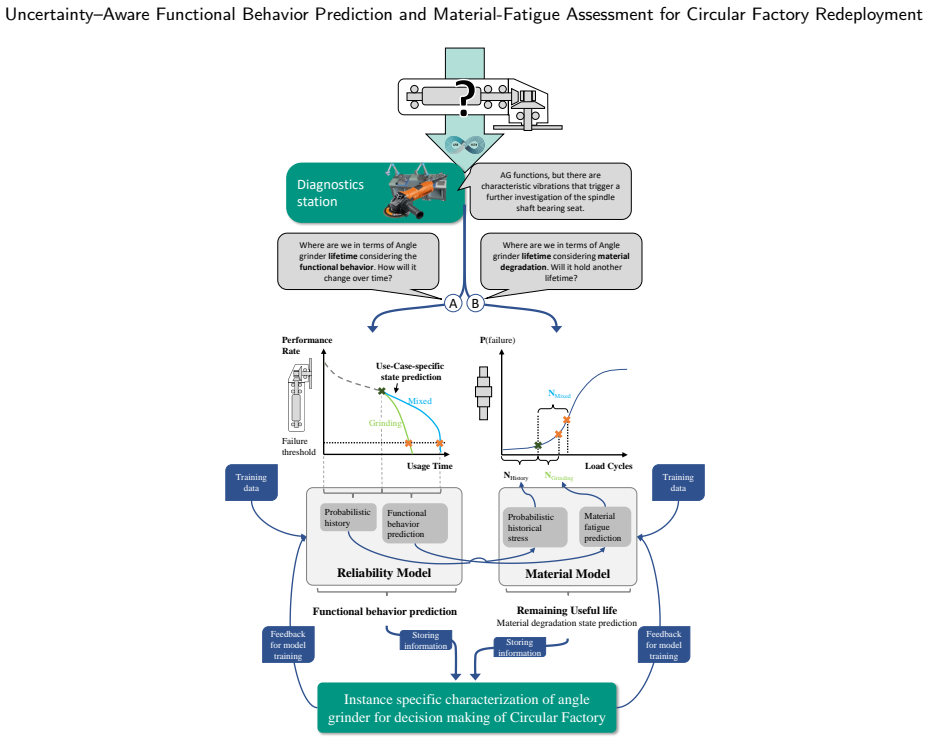
An LSTM predicts nine functional outputs with uncertainty for an angle grinder and links the same load history to fatigue estimates for reuse decisions.
A machine-rendered reading of the paper's core claim, the machinery that carries it, and where it could break.
Core claim
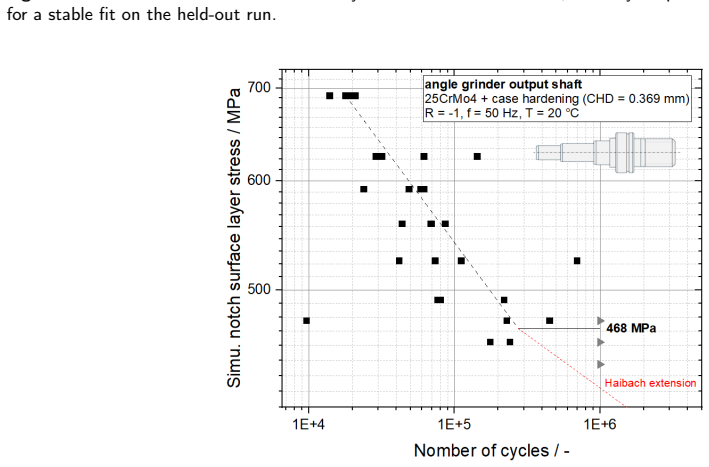
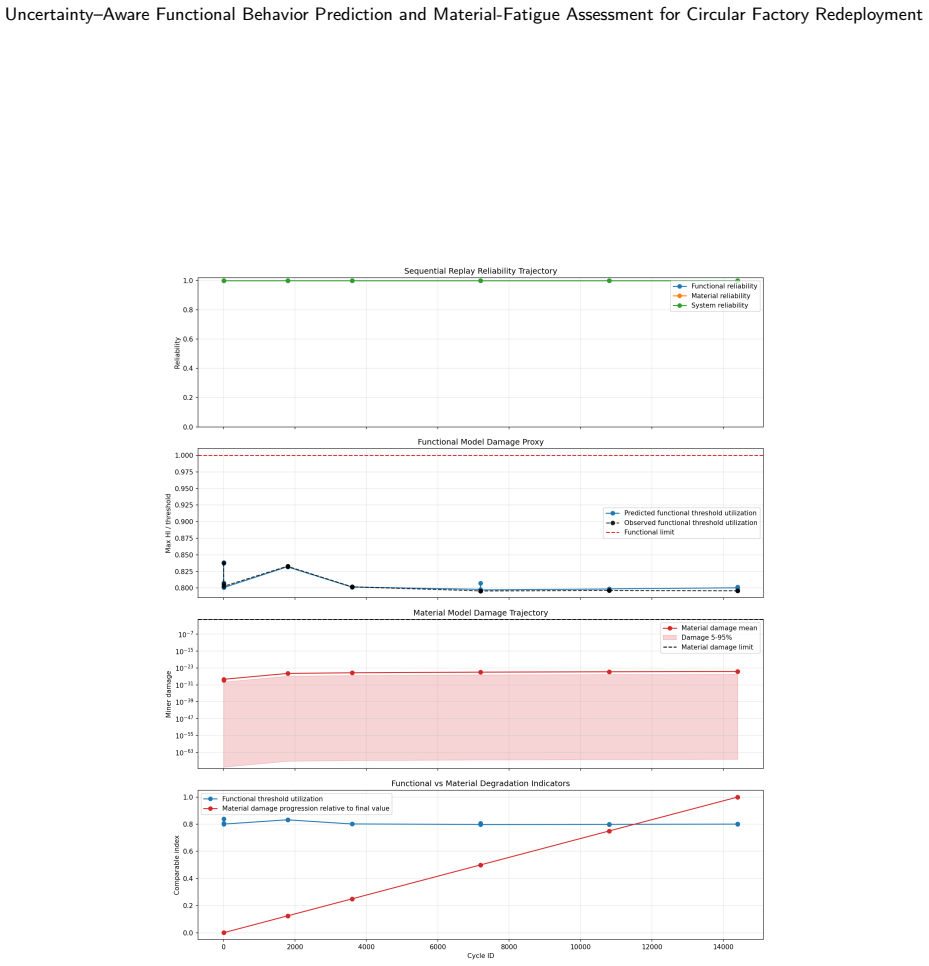
The framework shows that uncertainty-aware functional prediction via LSTM on recent usage windows, when driven by the same loading history used for finite-element-supported stress reconstruction, S-N/Miner damage summation with Haibach extension, and Paris-law crack growth, produces consolidated reliability trajectories that link system-level behavior forecasts to component-level fatigue for reuse assessment.
What carries the argument
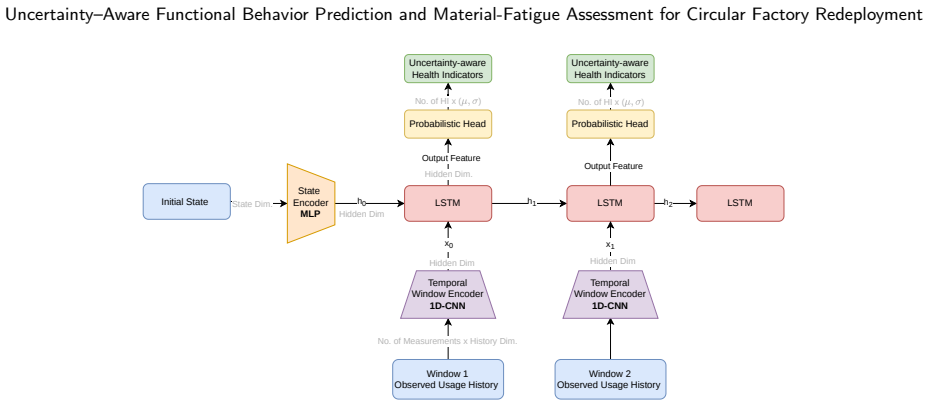
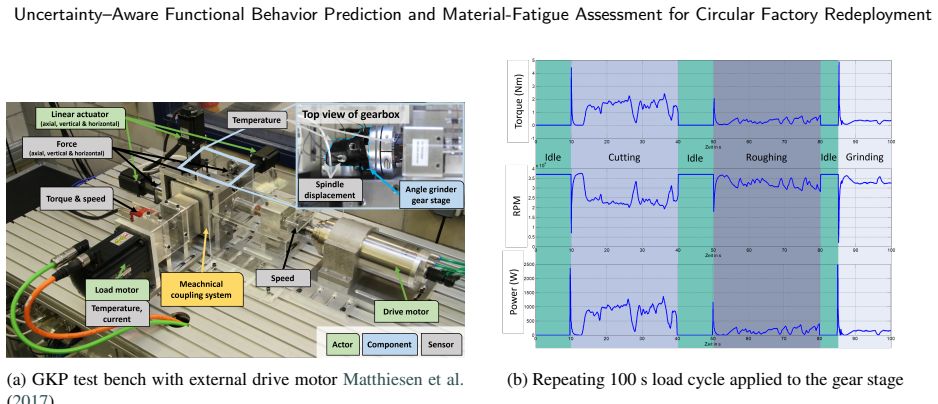
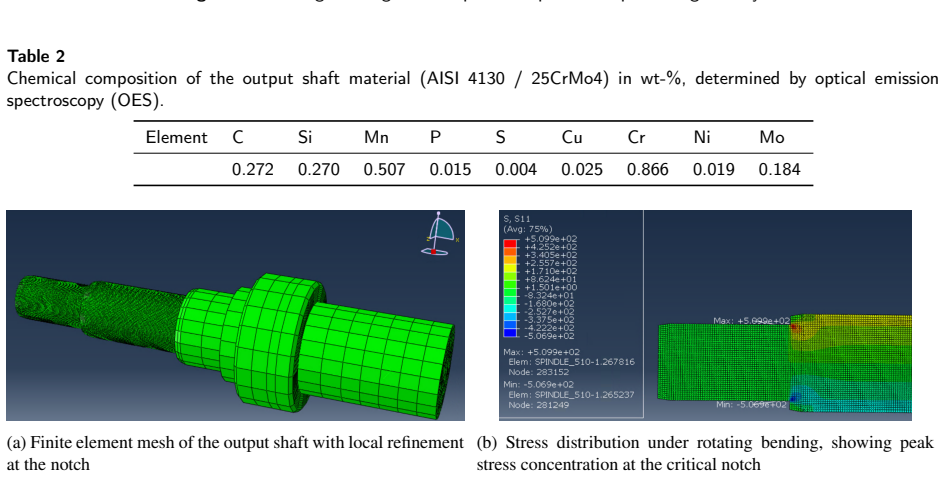
LSTM backbone that outputs Gaussian mean and variance estimates for nine functional variables, fed by a convolutional encoder on spindle-force and shaft-torque windows and aligned with the same history for S-N/Miner and Paris-law fatigue evaluation.
If this is right
- The approach yields instance-specific reliability trajectories that incorporate both functional exceedance probabilities and material damage accumulation.
- Torque history proves especially informative for the most dynamic outputs such as drive motor current.
- Conventional LSTM outperforms GRU and xLSTM under short-history conditions for this task.
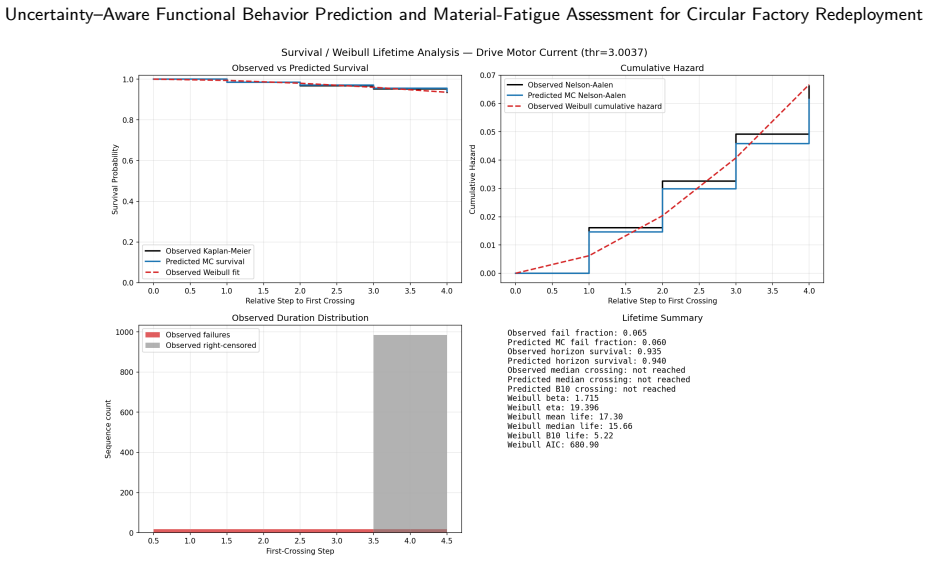
- Reliability calibration is strongest for variables like motor current where predicted and observed exceedance probabilities can be checked directly.
Where Pith is reading between the lines
- The same load-history linkage could support adaptive maintenance schedules that adjust based on predicted remaining capability rather than fixed intervals.
- Extending the workflow to other rotating tools would require only retraining the encoder-LSTM pair on their specific force-torque signatures while reusing the fatigue module.
- If uncertainty estimates remain well-calibrated across longer horizons, they could set explicit risk thresholds for accepting or rejecting a returned unit.
Load-bearing premise
That fatigue estimates computed from the loading history through finite-element stress and damage models are meaningfully connected to the LSTM functional predictions for making reuse decisions.
What would settle it
A direct comparison showing that observed component failures or remaining-life measurements diverge systematically from the reliability trajectories generated by the combined prediction and fatigue pipeline on new held-out usage sequences.
Figures





read the original abstract
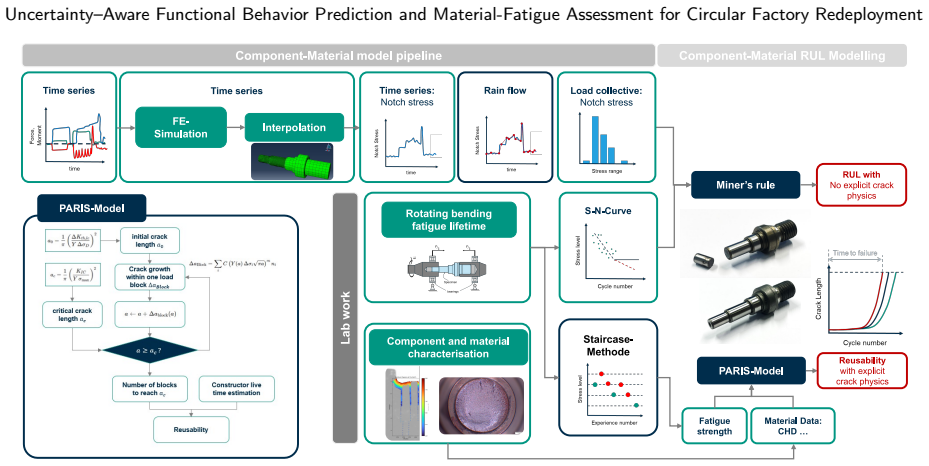
Returned products in circular factories re-enter production with heterogeneous degradation states, usage histories, and remaining capability. Reuse cannot be decided from the current inspection alone, because future function fulfillment and component integrity may evolve differently under the next service scenario. Existing PHM approaches support degradation prediction, but often target fixed operating conditions or isolated component benchmarks, while material-fatigue assessment is rarely linked to system-level functional prognosis. This paper addresses this gap for an angle grinder by combining uncertainty-aware functional prediction with component-level fatigue assessment in an instance-specific reliability workflow. The proposed framework combines the current tool state with recent force--torque usage windows. A convolutional encoder extracts loading patterns from spindle forces and shaft torque, and an LSTM backbone predicts nine functional variables as Gaussian mean and variance estimates. In parallel, the same loading history is translated into output-shaft fatigue information through finite-element-supported stress reconstruction, S--N/Miner damage evaluation with Haibach extension, and Paris-law crack-growth analysis. A streaming replay algorithm consolidates both branches into functional, material, and system reliability trajectories. Held-out tests show mean \(2\%\)-tolerance accuracy of 0.9652 across nine outputs. Thermal variables are predicted near-perfectly, while drive motor current and load speed remain the most demanding dynamic outputs, with \(R^2\) values of 0.9750 and 0.9924. Torque history is especially important for these variables, and the conventional LSTM outperforms GRU and xLSTM in the short-history setting. Reliability calibration is most informative for drive motor current, where predicted and observed exceedance probabilities ...
Editorial analysis
A structured set of objections, weighed in public.
Referee Report
Summary. The paper proposes an integrated workflow for circular factories that combines a convolutional-LSTM model (with uncertainty estimates) to predict nine functional variables of an angle grinder from force-torque histories, with a parallel finite-element-supported fatigue pipeline (stress reconstruction, S-N/Miner damage with Haibach extension, Paris-law crack growth). These branches are consolidated by a streaming replay algorithm into functional, material, and system reliability trajectories intended to support instance-specific reuse decisions. The only quantitative results reported are held-out LSTM performance: mean 2%-tolerance accuracy of 0.9652 across outputs, with R²=0.9750 (drive motor current) and R²=0.9924 (load speed).
Significance. If the missing quantitative linkage between the LSTM predictions and the fatigue/reliability trajectories can be demonstrated, the work would provide a concrete instance-specific bridge between functional PHM and material integrity assessment, which is currently rare in the literature.
major comments (3)
- [Abstract] Abstract and results: the central claim is an integrated workflow whose value lies in the consolidation of functional predictions with fatigue estimates into reliability trajectories for reuse decisions, yet the sole quantitative evidence consists of LSTM accuracy figures (0.9652 mean tolerance accuracy, two R² values); no numerical outcomes, calibration plots, or decision-level metrics are supplied for the fatigue branch, the streaming replay algorithm, or the joint trajectories.
- [Fatigue assessment pipeline] The finite-element-supported stress reconstruction, S-N/Miner evaluation with Haibach extension, and Paris-law analysis are described as operating on the same loading history used to train the LSTM, but no cross-check against physical measurements, no uncertainty propagation from the LSTM variances into the damage calculation, and no evaluation of the resulting reliability trajectories are reported, leaving the weakest_assumption untested.
- [Experimental setup] Validation protocol: the held-out accuracy numbers are presented without specification of temporal vs. random splitting, data exclusion rules, whether the test windows overlap training histories, or how the Gaussian uncertainty estimates were calibrated, which is required to assess whether the 0.9652 figure reflects genuine generalization.
minor comments (2)
- [Abstract] The final sentence of the abstract is truncated: "where predicted and observed exceedance probabilities ..."
- Notation for the nine output variables and the precise definition of the 2%-tolerance accuracy metric should be stated explicitly in the methods or results section.
Simulated Author's Rebuttal
We thank the referee for the constructive and detailed feedback. We address each major comment below, clarifying the current scope of the work and noting revisions to improve clarity and completeness.
read point-by-point responses
-
Referee: [Abstract] Abstract and results: the central claim is an integrated workflow whose value lies in the consolidation of functional predictions with fatigue estimates into reliability trajectories for reuse decisions, yet the sole quantitative evidence consists of LSTM accuracy figures (0.9652 mean tolerance accuracy, two R² values); no numerical outcomes, calibration plots, or decision-level metrics are supplied for the fatigue branch, the streaming replay algorithm, or the joint trajectories.
Authors: We agree that the abstract highlights the integrated workflow, while quantitative results are reported only for the LSTM functional predictions. The fatigue and reliability components are presented as a parallel methodological pipeline without end-to-end numerical evaluation. We will revise the abstract to explicitly state that the primary quantitative contribution is the held-out LSTM performance and that the consolidation into reliability trajectories is demonstrated at the workflow level rather than through decision metrics. revision: yes
-
Referee: [Fatigue assessment pipeline] The finite-element-supported stress reconstruction, S-N/Miner evaluation with Haibach extension, and Paris-law analysis are described as operating on the same loading history used to train the LSTM, but no cross-check against physical measurements, no uncertainty propagation from the LSTM variances into the damage calculation, and no evaluation of the resulting reliability trajectories are reported, leaving the weakest_assumption untested.
Authors: The manuscript provides a detailed description of the fatigue pipeline but does not include empirical cross-checks, uncertainty propagation, or trajectory evaluations, as these would require additional physical testing and computational runs not performed in the present study. We will add an explicit limitations subsection noting these gaps and outlining how uncertainty from the LSTM could be propagated in future extensions. revision: partial
-
Referee: [Experimental setup] Validation protocol: the held-out accuracy numbers are presented without specification of temporal vs. random splitting, data exclusion rules, whether the test windows overlap training histories, or how the Gaussian uncertainty estimates were calibrated, which is required to assess whether the 0.9652 figure reflects genuine generalization.
Authors: We will expand the experimental setup section to specify the validation protocol, including the use of a temporal (non-random) split with non-overlapping test windows to avoid leakage, the data exclusion criteria applied, and the calibration procedure used for the Gaussian uncertainty estimates (via reliability diagrams on the held-out set). revision: yes
Circularity Check
No circularity; held-out metrics and separate physics branch are independent
full rationale
The paper trains an LSTM on usage data to predict nine functional outputs (Gaussian means/variances) and evaluates on held-out tests, reporting explicit metrics (mean 2%-tolerance accuracy 0.9652, R² 0.9750/0.9924). These are standard out-of-sample performance numbers, not quantities defined by the fit itself. The fatigue branch applies independent FE stress reconstruction + S-N/Miner + Haibach + Paris-law to the same loading history; no equations or self-citations reduce either branch or their consolidation to the inputs by construction. No self-definitional steps, fitted-input-as-prediction, or load-bearing self-citations appear. The workflow is self-contained against external benchmarks.
Axiom & Free-Parameter Ledger
Reference graph
Works this paper leans on
-
[1]
Reliability Engineering & System Safety 133, 223–236
Practical options for selecting data-driven or physics-based prognostics algorithms with reviews. Reliability Engineering & System Safety 133, 223–236. doi:10.1016/j.ress.2014.09.014. Ansari,A.,YousefNia,S.,Afshari,A.,Mishra,S.,2025. EstimatingtheinsulationhealthindexofXLPEcablesusingmachinelearning. Scientific Reports doi:10.1038/s41598-025-25080-7. Aria...
-
[2]
Reliability Engineering & System Safety 217, 107961
Fusing physics-based and deep learning models for prognostics. Reliability Engineering & System Safety 217, 107961. doi:10.1016/j.ress.2021.107961. Bajarunas, K., Baptista, M., Goebel, K., Chao, M.A.,
-
[3]
doi:10.36001/phmconf.2023.v15i1.3477
Unsupervised physics-informed health indicator estimation for complex systems, in: Annual Conference of the PHM Society. doi:10.36001/phmconf.2023.v15i1.3477. Cubillo, A., Perinpanayagam, S., Esperon-Miguez, M.,
-
[4]
Advances in Mechanical Engineering doi:10.1177/1687814016664660
A review of physics-based models in prognostics: Application to gears and bearings of rotating machinery. Advances in Mechanical Engineering doi:10.1177/1687814016664660. Afifi. et al.:Preprint submitted to ElsevierPage 25 of 27 Uncertainty–Aware Functional Behavior Prediction and Material-Fatigue Assessment for Circular Factory Redeployment Deng, L., Lee...
-
[5]
Applied Mathematical Modelling 124, 325–352
Physics-informed machine learning in prognostics and health management: State of the art and challenges. Applied Mathematical Modelling 124, 325–352. doi:10.1016/j.apm.2023.07.011. EllenMacArthurFoundation,2013. Towardsthecirculareconomy:Economicandbusinessrationaleforanacceleratedtransition.https://www. ellenmacarthurfoundation.org/towards-a-circular-eco...
-
[6]
doi:10.1016/j.jclepro.2016.12.048
The circular economy – a new sustainability paradigm? Journal of Cleaner Production 143, 757–768. doi:10.1016/j.jclepro.2016.12.048. Geist, H., Balle, F.,
-
[7]
Yuling Zhan, Ziqian Kong, Ziqi Wang, Xiaohang Jin, and Zhengguo Xu
Health indicator for machine condition monitoring built in the latent space of a deep autoencoder. Reliability Engineering & System Safety 224, 108482. doi:10.1016/j.ress.2022.108482. Grauberger, P., Dörr, M., Lanza, G., Kaiser, J.P., Albers, A., Düser, T., Tusch, L., Seidler, M., Dietrich, S., Schulze, V., Matthiesen, S.,
-
[8]
Journal of Operations Management 21, 259–279
Building contingency planning for closed-loop supply chains with product recovery. Journal of Operations Management 21, 259–279. doi:10.1016/S0272-6963(02)00110-9. Guo, L., Li, N., Jia, F., Lei, Y., Lin, J.,
-
[9]
A recurrent neural network based health indicator for remaining useful life prediction of bearings. Neurocomputing 240, 98–109. doi:10.1016/j.neucom.2017.02.045. Haibach, E., . Betriebsfestigkeit: Verfahren und Daten zur Bauteilberechnung. VDI-Buch
-
[10]
A review on machinery diagnostics and prognostics implementing condition-based maintenance. Mechanical Systems and Signal Processing 20, 1483–1510. doi:10.1016/j.ymssp.2005.09.012. Johnson, P.,
-
[11]
doi:10.36001/phmconf.2010.v2i1.1883
Emerging challenges and technologies in signal processing for prognostics and health management in wind energy, in: Annual Conference of the PHM Society. doi:10.36001/phmconf.2010.v2i1.1883. Kirchherr, J., Reike, D., Hekkert, M.,
-
[12]
Resources, Conservation and Recycling 127, 221–232
Conceptualizing the circular economy: An analysis of 114 definitions. Resources, Conservation and Recycling 127, 221–232. doi:10.1016/j.resconrec.2017.09.005. Kumar,S.,Raj,K.K.,Cirrincione,M.,Cirrincione,G.,Franzitta,V.,Kumar,R.R.,2024. Acomprehensivereviewofremainingusefullifeestimation approaches for rotating machinery. Energies
-
[13]
Lanza, G., Deml, B., Matthiesen, S., Martin, M., Brützel, O., Hörsting, R.,
doi:10.3390/en17225538. Lanza, G., Deml, B., Matthiesen, S., Martin, M., Brützel, O., Hörsting, R.,
-
[14]
at–Automatisierungstechnik 72, 774–788
The vision of the circular factory for the perpetual innovative product. at–Automatisierungstechnik 72, 774–788. doi:10.1515/auto-2024-0037. Lei, Y., Li, N., Guo, L., Li, N., Yan, T., Lin, J.,
-
[15]
Machinery health prognostics: A systematic review from data acquisition to remaining useful life prediction. Mechanical Systems and Signal Processing 104, 799–834. doi:10.1016/j.ymssp.2017.11.016. Leitenberger, F., Mas, V., Afifi, N., Kleinhans, L., Hemmerich, J., Matthiesen, S.,
-
[16]
Engineering Fracture Mechanics 277, 108992
Notch fatigue life prediction of micro-shot peened 25CrMo4 alloy steel: A comparison between fracture mechanics and machine learning methods. Engineering Fracture Mechanics 277, 108992. doi:10.1016/j.engfracmech.2022.108992. Matthiesen, S., Gwosch, T., Gittel, H.J.,
-
[17]
Practical Reliability Engineering. 5 ed., Wiley, Hoboken, NJ. Paris,P.C.,Erdogan,F.,1963. Acriticalanalysisofcrackpropagationlaws. JournalofBasicEngineering85,528–533. doi:10.1115/1.3656900. Peng,C.,Zhao,Y.,Li,C.,etal.,2023. Amulti-featuredfactoranalysisanddynamicwindowrectificationmethodforremainingusefullifeprognosis of rolling bearings. Entropy 25,
-
[18]
Pyttel, B., Varfolomeyev, I., Berger, C.,
doi:10.3390/e25111539. Pyttel, B., Varfolomeyev, I., Berger, C., . FKM-Richtlinie „Bruchmechanischer Festigkeitsnachweis für Maschinenbauteile” 38, 387–397. URL: https://onlinelibrary.wiley.com/doi/10.1002/mawe.200700134, doi:10.1002/mawe.200700134. Schijve, J.,
-
[19]
European Journal of Operational Research 213, 1–14
Remaining useful life estimation—A review on the statistical data driven approaches. European Journal of Operational Research 213, 1–14. doi:10.1016/j.ejor.2010.11.018. Soualhi, A., Lamraoui, M., Elyousfi, B., Razik, H.,
-
[20]
Wang, B., Lei, Y., Li, N., Wang, W.,
doi:10.3390/en15196909. Wang, B., Lei, Y., Li, N., Wang, W.,
-
[21]
Journal of Manufacturing Systems 54, 215–226
Health indicator construction of machinery based on end-to-end trainable convolution recurrent neural networks. Journal of Manufacturing Systems 54, 215–226. doi:10.1016/j.jmsy.2019.11.008. Wang, D., Tsui, K.L., Miao, Q.,
-
[22]
Prognostics and health management: A review of vibration based bearing and gear health indicators. IEEE Access 6, 665–676. doi:10.1109/ACCESS.2017.2774261. Wu, D., Chen, D., Yu, G.,
-
[23]
doi:10.3390/machines12060362. Yan, J., He, Z., He, S.,
-
[24]
Computers & Industrial Engineering doi:10.1016/j.cie.2022.108559
A deep learning framework for sensor-equipped machine health indicator construction and remaining useful life prediction. Computers & Industrial Engineering doi:10.1016/j.cie.2022.108559. Yucesan,Y.A.,Viana,F.A.C.,2020. Aphysics-informedneuralnetworkforwindturbinemainbearingfatigue. InternationalJournalofPrognostics and Health Management
-
[25]
Zhan,X.,Liu,Z.,Yan,H.,etal.,2023
doi:10.36001/ijphm.2020.v11i1.2594. Zhan,X.,Liu,Z.,Yan,H.,etal.,2023. Anovelmethodofhealthindicatorconstructionandremainingusefullifepredictionbasedondeeplearning. Eksploatacja i Niezawodność – Maintenance and Reliability doi:10.17531/ein/171374. Zhou, H., Huang, X., Wen, G., Lei, Z., Dong, S., Zhang, P., Chen, X.,
-
[26]
doi:https://doi.org/10.1016/j.eswa.2022.117297. Afifi. et al.:Preprint submitted to ElsevierPage 26 of 27 Uncertainty–Aware Functional Behavior Prediction and Material-Fatigue Assessment for Circular Factory Redeployment Zhou,J.,Yang,J.,Xiang,S.,Qin,Y.,2025. Remainingusefullifepredictionmethodologieswithhealthindicatordependenceforrotatingmachinery: A com...
-
[27]
doi:10.1109/TIM.2025.3556919. Afifi. et al.:Preprint submitted to ElsevierPage 27 of 27
discussion (0)
Sign in with ORCID, Apple, or X to comment. Anyone can read and Pith papers without signing in.