Ahoy: LLMs Enacting Multiagent Interaction Protocols
Pith reviewed 2026-06-28 03:08 UTC · model grok-4.3
The pith
LLM agents can enact multiple declarative multiagent protocols concurrently without specialized training.
A machine-rendered reading of the paper's core claim, the machinery that carries it, and where it could break.
Core claim
Ahoy creates LLM agents that dynamically select and enact declarative protocols to achieve user goals. The paper demonstrates that an Ahoy agent can correctly and intelligently enact multiple protocols, including concurrently when appropriate to the user goal, without any specialized training or fine-tuning on the protocols.
What carries the argument
Ahoy, the system that uses large language models to interpret declarative protocol specifications and generate correct agent actions to meet goals.
If this is right
- Agents can be created once and then enact any number of existing declarative protocols without retraining or reprogramming.
- User goals that require coordination across several protocols can be handled by a single agent through concurrent enactment.
- Declarative protocol specifications become directly usable for building intelligent agents, improving knowledge engineering in multiagent systems.
- No protocol-specific code or training data is needed to produce correct enactment behavior.
Where Pith is reading between the lines
- Protocol libraries could be shared and reused across different LLM-based agents without modification.
- The approach may extend to domains where workflows are described declaratively, such as business processes or automated negotiations.
- Longer or more complex protocols might require additional mechanisms to maintain consistency over extended interactions.
- Testing across different LLMs could reveal which model capabilities are most important for reliable protocol following.
Load-bearing premise
Large language models can reliably interpret declarative protocol specifications and produce correct, intelligent behavior without any protocol-specific training or fine-tuning.
What would settle it
A test in which an Ahoy agent is given a clear declarative protocol specification and a simple user goal, then fails to produce the sequence of actions required by the protocol in repeated trials.
Figures




read the original abstract
An interaction protocol formalizes how the agents in a multiagent system interact, which facilitates implementing agents. Existing approaches yield agent implementations specific to the selected protocols. How can we engineer intelligent agents that can enact protocols but are programming-free? Our contribution, Ahoy, addresses this question by creating LLM agents that dynamically select and enact declarative protocols to achieve user goals. We demonstrate that an Ahoy agent can correctly and intelligently enact multiple protocols - concurrently if appropriate to the user goal - without specialized training. Ahoy's significance lies in that it brings together declarative protocols and LLMs, both approaches that promise improved knowledge engineering for agents.
Editorial analysis
A structured set of objections, weighed in public.
Referee Report
Summary. The paper introduces Ahoy, a system in which LLM-based agents dynamically select and enact declarative multiagent interaction protocols to achieve user-specified goals. The central claim is that such agents can correctly and intelligently enact multiple protocols (including concurrently when appropriate) without any protocol-specific training or fine-tuning, by combining declarative protocol specifications with the interpretive capabilities of LLMs.
Significance. If the demonstration is substantiated with rigorous evaluation, the work would usefully integrate two existing lines of research—declarative interaction protocols and LLM agents—to reduce the need for protocol-specific agent implementations. This could lower the engineering cost of multiagent systems while preserving the benefits of formal protocol descriptions.
major comments (2)
- [§4] §4 (Demonstration and Evaluation): The manuscript asserts that an Ahoy agent 'can correctly and intelligently enact multiple protocols' but supplies no quantitative metrics, success criteria, test protocols, failure-mode analysis, or comparison baselines. Without these, the empirical claim cannot be assessed and is load-bearing for the paper's contribution.
- [§3] §3 (Ahoy Architecture): The approach relies on LLMs reliably interpreting declarative protocol specifications and producing correct concurrent behavior without training; however, no analysis is given of how protocol state is maintained across LLM calls, how conflicts between concurrent protocols are resolved, or what happens on LLM hallucination or inconsistency.
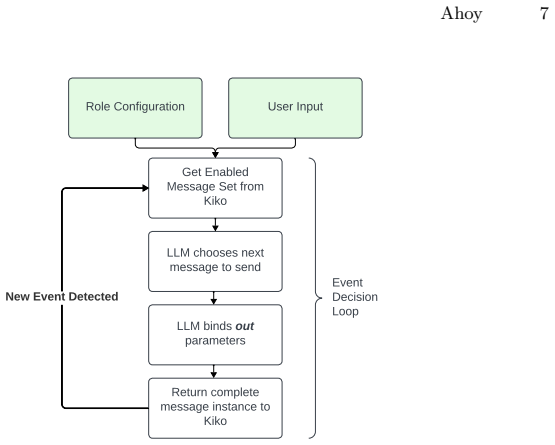
minor comments (2)
- [Abstract] The abstract and introduction repeat the same high-level claim without distinguishing between the engineering contribution and the empirical demonstration.
- [§3] Notation for protocol elements and LLM prompts is introduced informally; a small table or diagram would improve clarity.
Simulated Author's Rebuttal
We thank the referee for the constructive feedback. We address each major comment below, providing clarifications and committing to revisions that strengthen the empirical and architectural claims without overstating the current manuscript.
read point-by-point responses
-
Referee: [§4] §4 (Demonstration and Evaluation): The manuscript asserts that an Ahoy agent 'can correctly and intelligently enact multiple protocols' but supplies no quantitative metrics, success criteria, test protocols, failure-mode analysis, or comparison baselines. Without these, the empirical claim cannot be assessed and is load-bearing for the paper's contribution.
Authors: We agree that the current demonstration is qualitative and illustrative rather than a full empirical study. The manuscript's core contribution is showing feasibility of protocol enactment via LLMs without specialized training, but the referee is correct that the load-bearing claim requires more rigor to be assessable. In revision we will expand §4 with quantitative metrics (e.g., success rates over repeated trials), explicit success criteria, a set of test protocols, failure-mode analysis, and comparison to simple baseline agents that lack declarative protocol support. revision: yes
-
Referee: [§3] §3 (Ahoy Architecture): The approach relies on LLMs reliably interpreting declarative protocol specifications and producing correct concurrent behavior without training; however, no analysis is given of how protocol state is maintained across LLM calls, how conflicts between concurrent protocols are resolved, or what happens on LLM hallucination or inconsistency.
Authors: The manuscript describes high-level use of conversation history and prompt-based state, but we acknowledge the absence of explicit analysis on state maintenance, conflict resolution, and hallucination handling. In the revised version we will expand §3 with a dedicated subsection detailing: (1) state maintenance via explicit inclusion of protocol state in each prompt plus post-response validation against the declarative specification; (2) conflict resolution by prompting the LLM to jointly consider all active protocols and the user goal when choosing the next action; and (3) mitigation of hallucination/inconsistency through verification steps and fallback to a safe default action. These additions will make the robustness claims concrete. revision: yes
Circularity Check
Empirical demonstration with no derivation chain or self-referential reduction
full rationale
The paper's central claim is an empirical demonstration that LLM-based agents can enact declarative protocols without specialized training. No equations, fitted parameters, or mathematical derivations appear. No self-citations are invoked as load-bearing premises for uniqueness or ansatzes. The approach integrates existing ideas (declarative protocols and LLMs) but does not reduce any prediction or result to its own inputs by construction. The derivation chain is therefore self-contained against external benchmarks and receives the default non-circularity finding.
Axiom & Free-Parameter Ledger
Reference graph
Works this paper leans on
-
[1]
https://a2aprotocol.ai/ (Apr 2025), last accessed: 2025-08-03
A2A: Agent2Agent protocol. https://a2aprotocol.ai/ (Apr 2025), last accessed: 2025-08-03
2025
-
[2]
https://modelcontextprotocol.io/ (Nov 2024), last accessed: 02/23/2026
Anthropic: Model Context Protocol. https://modelcontextprotocol.io/ (Nov 2024), last accessed: 02/23/2026
2024
-
[3]
Autonomous Agents and Multi-Agent Systems28(4), 519–557 (2014)
Baldoni, M., Baroglio, C., Marengo, E., Patti, V., Capuzzimati, F.: Engineering commitment-based business protocols with the 2CL methodology. Autonomous Agents and Multi-Agent Systems28(4), 519–557 (2014)
2014
-
[4]
In: Proceedings of the 39th AAAI Conference on Artificial Intelligence
Baldoni, M., Christie V, S.H., Singh, M.P., Chopra, A.K.: Orpheus: Engineering multiagent systems via communicating agents. In: Proceedings of the 39th AAAI Conference on Artificial Intelligence. AAAI, Philadelphia (Feb 2025)
2025
-
[5]
In: Advances in Neural Information Processing Systems
Brown, T., Mann, B., Ryder, N., Subbiah, M., Kaplan, J.D., Dhariwal, P., Nee- lakantan, A., Shyam, P., Sastry, G., Askell, A., Agarwal, S., Herbert-Voss, A., Krueger, G., Henighan, T., Child, R., Ramesh, A., Ziegler, D., Wu, J., Winter, C., Hesse, C., Chen, M., Sigler, E., Litwin, M., Gray, S., Chess, B., Clark, J., Berner, C., McCandlish, S., Radford, A....
1901
-
[6]
ACM Transactions on Intelligent Systems and Technologies4(2), 20:1–20:23 (2013)
Chopra, A.K., Artikis, A., Bentahar, J., Colombetti, M., Dignum, F., Fornara, N., Jones, A.J.I., Singh, M.P., Yolum, P.: Research directions in agent communication. ACM Transactions on Intelligent Systems and Technologies4(2), 20:1–20:23 (2013)
2013
-
[7]
In: Proceedings of the 24th International Conference on Autonomous Agents and Multiagent Systems (AAMAS)
Chopra, A.K., Baldoni, M., Christie V, S.H., Singh, M.P.: Azorus: Commitments over protocols for BDI agents. In: Proceedings of the 24th International Conference on Autonomous Agents and Multiagent Systems (AAMAS). IFAAMAS, Detroit (May 2025)
2025
-
[8]
Journal of Artificial Intel- ligence Research69, 1351–1393 (2020)
Chopra, A.K., Christie V, S.H., Singh, M.P.: An evaluation of communication protocol languages for engineering multiagent systems. Journal of Artificial Intel- ligence Research69, 1351–1393 (2020)
2020
-
[9]
In: Proceedings of the 34th International Joint Conference on Artificial Intelligence (IJCAI)
Chopra, A.K., Christie V, S.H., Singh, M.P.: Requirement patterns for multiagent interaction protocols. In: Proceedings of the 34th International Joint Conference on Artificial Intelligence (IJCAI). pp. 38–46. IJCAI, Montr´ eal (Aug 2025). https: //doi.org/10.24963/ijcai.2025/5
-
[10]
In: Proceedings of the 25th International World Wide Web Conference
Chopra, A.K., Singh, M.P.: From social machines to social protocols: Software engineering foundations for sociotechnical systems. In: Proceedings of the 25th International World Wide Web Conference. pp. 903–914. ACM, Montr´ eal (2016)
2016
-
[11]
Christie V, S.H., Singh, M.P., Chopra, A.K.: Kiko: Programming agents to enact interaction protocols. In: Proceedings of the 22nd International Conference on Au- tonomous Agents and Multiagent Systems (AAMAS). pp. 1154–1163. IFAAMAS, London (May 2023). https://doi.org/10.5555/3545946.3598758
-
[12]
In: Proceedings of ECAI 2025: 28th European Conference on Artificial Intelligence
Ciatto, G., Aguzzi, G., Battistini, R., Baiardi, M., Burattini, S., Ricci, A.: Ex- ploiting GenAI for Plan Generation in BDI Agents. In: Proceedings of ECAI 2025: 28th European Conference on Artificial Intelligence. Frontiers in Artificial Intelli- gence and Applications, vol. 413, pp. 3495–3502. IOS Press, Bologna, Italy (2025). https://doi.org/10.3233/F...
-
[13]
In: Proceedings of ECAI 2025: 28th European Conference on Artificial Intelligence
Gatti, A., Mascardi, V., Ferrando, A.: Let Me Talk to You! Natural Language In- teraction Between Humans and BDI Agents via ChatBDI. In: Proceedings of ECAI 2025: 28th European Conference on Artificial Intelligence. Frontiers in Artificial Intelligence and Applications, vol. 413, pp. 3646–3654. IOS Press, Bologna, Italy (Oct 2025). https://doi.org/10.3233...
-
[14]
In: Proceedings of the 34th Inter- national Conference on Neural Information Processing Systems
Lewis, P., Perez, E., Piktus, A., Petroni, F., Karpukhin, V., Goyal, N., K¨ uttler, H., Lewis, M., tau Yih, W., Rockt¨ aschel, T., Riedel, S., Kiela, D.: Retrieval-Augmented Generation for Knowledge-Intensive NLP tasks. In: Proceedings of the 34th Inter- national Conference on Neural Information Processing Systems. pp. 9459–9474. NIPS ’20, Curran Associat...
2020
-
[15]
In: Proceedings of the 62nd Annual Meeting of the Association for Computational Linguistics
Li, J., Yang, Y., Bai, Y., Zhou, X., Li, Y., Sun, H., Liu, Y., Si, X., Ye, Y., Wu, Y., Lin, Y., Xu, B., Ren, B., Feng, C., Gao, Y., Huang, H.: Fundamental Capabilities of Large Language Models and their Applications in Domain Scenarios: A Survey. In: Proceedings of the 62nd Annual Meeting of the Association for Computational Linguistics. pp. 11116–11141. ...
-
[16]
A Comprehensive Overview of Large Language Models,
Naveed, H., Khan, A.U., Qiu, S., Saqib, M., Anwar, S., Usman, M., Akhtar, N., Barnes, N., Mian, A.: A Comprehensive Overview of Large Language Models. ACM Transactions on Intelligent Systems and Technology16(5), 1–72 (Oct 2025). https://doi.org/10.1145/3744746
-
[17]
In: Proceedings of the 36th International Con- ference on Neural Information Processing Systems
Ouyang, L., Wu, J., Jiang, X., Almeida, D., Wainwright, C.L., Mishkin, P., Zhang, C., Agarwal, S., Slama, K., Ray, A., et al.: Training Language Models to Follow Instructions with Human Feedback. In: Proceedings of the 36th International Con- ference on Neural Information Processing Systems. NIPS ’22, Curran Associates, Inc., New Orleans (2022)
2022
-
[18]
Generative agents: Interactive simulacra of human behavior,
Park, J.S., O’Brien, J.C., Cai, C.J., Morris, M.R., Liang, P., Bernstein, M.S.: Gen- erative Agents: Interactive Simulacra of Human Behavior. In: Proceedings of the 36th Annual ACM Symposium on User Interface Software and Technology. pp. 2:1–2:22. UIST ’23, Association for Computing Machinery, San Francisco (2023). https://doi.org/10.1145/3586183.3606763
-
[19]
In: Proceedings of the 23rd International Conference on Autonomous Agents and Multiagent Systems
Ricci, A., Mariani, S., Zambonelli, F., Burattini, S., Castelfranchi, C.: The Cog- nitive Hourglass: Agent Abstractions in the Large Models Era. In: Proceedings of the 23rd International Conference on Autonomous Agents and Multiagent Systems. pp. 2706–2711. AAMAS ’24, Association for Computing Machinery, Auckland, New Zealand (2024). https://doi.org/10.55...
-
[20]
In: Coordination, Organiza- tions, Institutions, Norms, and Ethics for Governance of Multi-Agent Systems XVII: International Workshop, COINE 2024, Revised Selected Papers
Savarimuthu, B.T.R., Ranathunga, S., Cranefield, S.: Harnessing the Power of LLMs for Normative Reasoning in MASs. In: Coordination, Organiza- tions, Institutions, Norms, and Ethics for Governance of Multi-Agent Systems XVII: International Workshop, COINE 2024, Revised Selected Papers. pp. 132–
2024
-
[21]
https://doi.org/10.1007/ 978-3-031-82039-7 9
Springer-Verlag, Auckland, New Zealand (2024). https://doi.org/10.1007/ 978-3-031-82039-7 9
2024
-
[22]
In: Proceedings of the 37th International Conference on Neural Information Processing Systems
Schick, T., Dwivedi-Yu, J., Dess` ı, R., Raileanu, R., Lomeli, M., Hambro, E., Zettle- moyer, L., Cancedda, N., Scialom, T.: Toolformer: Language Models Can Teach Themselves to Use Tools. In: Proceedings of the 37th International Conference on Neural Information Processing Systems. NIPS ’23, Curran Associates, Inc., New Orleans (2023)
2023
-
[23]
IEEE Computer31(12), 40–47 (Dec 1998)
Singh, M.P.: Agent communication languages: Rethinking the principles. IEEE Computer31(12), 40–47 (Dec 1998)
1998
-
[24]
In: Proceedings of the 10th International Conference on Autonomous Agents and MultiAgent Systems
Singh, M.P.: Information-driven interaction-oriented programming: BSPL, the Blindingly Simple Protocol Language. In: Proceedings of the 10th International Conference on Autonomous Agents and MultiAgent Systems. pp. 491–498. IFAA- MAS (2011)
2011
-
[25]
In: Proceedings of the 30th International Joint Conference on Artificial Intelligence (IJCAI)
Singh, M.P., Christie V, S.H.: Tango: Declarative semantics for multiagent com- munication protocols. In: Proceedings of the 30th International Joint Confer- Ahoy 19 ence on Artificial Intelligence (IJCAI). pp. 391–397. IJCAI, Online (Aug 2021). https://doi.org/10.24963/ijcai.2021/55
-
[26]
UCP: Universal commerce protocol (Jan 2026), https://ucp.dev, last accessed: 2026-02-20
2026
-
[27]
In: Proceedings of the 36th International Conference on Neural Informa- tion Processing Systems
Wei, J., Wang, X., Schuurmans, D., Bosma, M., Ichter, B., Xia, F., Chi, E.H., Le, Q.V., Zhou, D.: Chain-of-thought Prompting Elicits Reasoning in Large Language Models. In: Proceedings of the 36th International Conference on Neural Informa- tion Processing Systems. NIPS ’22, Curran Associates, Inc., New Orleans (2022)
2022
-
[28]
In: Proceedings of the 6th International Conference on Autonomous Agents and Multiagent Systems
Winikoff, M.: Implementing commitment-based interactions. In: Proceedings of the 6th International Conference on Autonomous Agents and Multiagent Systems. pp. 1–8 (2007)
2007
-
[29]
In: COLM 2024
Wu, Q., Bansal, G., Zhang, J., Wu, Y., Li, B., Zhu, E.E., Jiang, L., Zhang, X., Zhang, S., Awadallah, A., White, R.W., Burger, D., Wang, C.: AutoGen: En- abling Next-Gen LLM Applications via Multi-Agent Conversation. In: COLM 2024. COLM ’24, Association for Computational Linguistics, Philadelphia (Aug 2024)
2024
-
[30]
In: The Eleventh International Conference on Learning Representations
Yao, S., Zhao, J., Yu, D., Du, N., Shafran, I., Narasimhan, K.R., Cao, Y.: Re- Act: Synergizing Reasoning and Acting in Language Models. In: The Eleventh International Conference on Learning Representations. Kigali, Rwanda (2023)
2023
-
[31]
In: Proceedings of the 1st Interna- tional Joint Conference on Autonomous Agents and MultiAgent Systems
Yolum, P., Singh, M.P.: Flexible protocol specification and execution: Applying event calculus planning using commitments. In: Proceedings of the 1st Interna- tional Joint Conference on Autonomous Agents and MultiAgent Systems. pp. 527–
-
[32]
Buy a pen
ACM Press (2002) 20 O. Joshi et al. A Visualizations Purchase Protocol Enactment Logistics Protocol Enactment "Buy a pen" "Pack and ship items" Human Ahoy Logistics Protocol Purchase Protocol Fig. 3.Programming Freeness. Human Ahoy Purchase Protocol Logistics Protocol "Buy a plate, a bat and a vase and ship them to these addresses" Fig. 4.Concurrent parti...
2002
-
[33]
D e s t i n a t i o n : Alice ’ s House , Items : glass vase
-
[34]
Buy a plate, vase and a bat and ship them to these addresses
D e s t i n a t i o n : Bob ’ s House , Items : ceramic plate + wooden bat As shown in Figure 7, Ahoy then sends the threeRFQmessage instances to request the items and accepts the quotes generated by theselleras the prices fall within acceptable thresholds. Since Ahoy can perform both roles at the same time, it sends label requests to thelabelerwithout wa...
-
[35]
I n f o r m a t i o n provided 16from previous messages in the protocol
** in ** ( Causal ) : Must already know from prior messages . I n f o r m a t i o n provided 16from previous messages in the protocol
-
[36]
Your role ge ne ra te s unique values for i ns ta nc es
** out ** ( G e n e r a t i o n ) : You generate this binding ; it appears once per enactment , 18creating mutual ex cl us io n . Your role ge ne ra te s unique values for i ns ta nc es
-
[37]
choice
** nil ** ( Negative ) : Must NOT know this binding . Used for mutually ex cl us iv e 20paths where an agent cannot act until certain i n f o r m a t i o n remains unknown . 21 22Key p a r a m e t e r s identify protocol in st an ce s . Messages are ordered by i n f o r m a t i o n 23flow a cc ord in g to causal d e p e n d e n c i e s . 24 25EXTERNAL EVE...
-
[38]
I n f o r m a t i o n provided 17from previous messages in the protocol
** in ** ( Causal ) : Must already know from prior messages . I n f o r m a t i o n provided 17from previous messages in the protocol
-
[39]
Your role ge ne ra te s unique values for i ns ta nc es
** out ** ( G e n e r a t i o n ) : You generate this binding ; it appears once per enactment , 19creating mutual ex cl us io n . Your role ge ne ra te s unique values for i ns ta nc es
-
[40]
choice
** nil ** ( Negative ) : Must NOT know this binding . Used for mutually ex cl us iv e 21paths where an agent cannot act until certain i n f o r m a t i o n remains unknown . 22 23Key p a r a m e t e r s identify protocol in st an ce s . Messages are ordered by i n f o r m a t i o n Ahoy 27 24flow a cc ord in g to causal d e p e n d e n c i e s . 25 26EXTE...
-
[41]
rfq ( from Buyer to Seller ) 11ID : fcba4370 -2842 -4543 - bd31 -1 a c d f b 2 2 0 0 8 1 12item : pen under$20 for delivery to Raleigh , NC 27606 13
-
[42]
quote ( from Seller to Buyer ) 15ID : fcba4370 -2842 -4543 - bd31 -1 a c d f b 2 2 0 0 8 1 16item : pen under$20 for delivery to Raleigh , NC 27606 17price : 4 18 19=== END HISTORY (2 messages ) === 20 21Options :
-
[43]
Purchase / rfq - out : [ ’ ID ’ , ’ item ’]
-
[44]
Purchase / co mp le te d [ in : ID = fcba4370 -2842 -4543 - bd31 -1 acdfb220081 , item = pen under$20 for delivery to Raleigh , NC 27606 , price =4] - out : [ ’ satisfaction ’]
-
[45]
Purchase / reject [ in : ID = fcba4370 -2842 -4543 - bd31 -1 acdfb220081 , item = pen under$20 for delivery to Raleigh , NC 27606 , price =4] - out : [ ’ outcome ’ , ’ resp ’]
-
[46]
choice
Purchase / accept [ in : ID = fcba4370 -2842 -4543 - bd31 -1 acdfb220081 , item = pen under$20 for delivery to Raleigh , NC 27606 , price =4] - out : [ ’ address ’ , ’ resp ’] 26 27Response format JSON : Ahoy 29 28- To choose an option WITH p a r a m e t e r s : {" choice ": 0 , " params ": {" ID ": " value " , " item ": " value "} , " t o o l _ r e q u e...
discussion (0)
Sign in with ORCID, Apple, or X to comment. Anyone can read and Pith papers without signing in.