Doubly warped product Einstein metrics on spheres
Pith reviewed 2026-06-28 03:55 UTC · model grok-4.3
The pith
A computer-assisted procedure finds new Einstein metrics on spheres of dimensions 11, 12 and 13 plus S^7 x S^3.
A machine-rendered reading of the paper's core claim, the machinery that carries it, and where it could break.
Core claim
The authors present a simple computer-assisted procedure to construct SO(d1+1)×SO(d2+1)-invariant cohomogeneity one Einstein metrics, and use it to recover known Einstein metrics on S^{10} and S^{12}, as well as find new ones on S^{11}, S^{12}, S^{13} and S^7×S^3.
What carries the argument
The reduction of the Einstein equation under SO(d1+1)×SO(d2+1) invariance to an ODE system for the two warping functions in a doubly warped product metric, solved by numerical parameter search.
If this is right
- New Einstein metrics exist on the spheres S^{11}, S^{12}, and S^{13}.
- A new Einstein metric exists on the product manifold S^7 × S^3.
- The same computer procedure can locate further examples by changing the dimensions d1 and d2.
- The method is validated by its ability to reproduce the known metrics on S^{10} and S^{12}.
Where Pith is reading between the lines
- The numerical examples may indicate the presence of continuous families of such metrics that could be proved to exist by analytic means.
- Similar computer searches could be applied to other symmetry groups or to manifolds beyond spheres and their products.
- The existence of these metrics supplies concrete data that could test conjectures on the number or moduli of Einstein metrics in a given dimension.
Load-bearing premise
The numerical solutions returned by the search procedure correspond to exact solutions of the Einstein equations that extend to smooth, complete metrics on the stated manifolds.
What would settle it
Substituting the reported numerical parameter values into the Einstein ODE system and verifying that the residual vanishes to machine precision, or confirming that the resulting metric is smooth and complete at all orbits.
Figures

read the original abstract
We present a simple computer-assisted procedure to construct $SO(d_1+1)\times SO(d_2+1)$-invariant cohomogeneity one Einstein metrics, and use it to recover known Einstein metrics on $S^{10}$ and $S^{12}$, as well as find new ones on $S^{11}$, $S^{12}$, $S^{13}$ and $S^7\times S^3$.
Editorial analysis
A structured set of objections, weighed in public.
Referee Report
Summary. The manuscript presents a computer-assisted procedure to construct SO(d1+1)×SO(d2+1)-invariant cohomogeneity one Einstein metrics on spheres via doubly warped products. It recovers known examples on S^{10} and S^{12} and reports new examples on S^{11}, S^{12}, S^{13} and S^7×S^3.
Significance. New explicit or numerically located Einstein metrics on spheres with prescribed symmetry groups would be of interest to the study of cohomogeneity-one Einstein manifolds and the classification of Einstein metrics in differential geometry. The recovery of known cases provides a basic consistency check for the method.
major comments (1)
- [Abstract and main construction procedure] The existence claims for the new metrics on S^{11}, S^{12}, S^{13} and S^7×S^3 rest entirely on numerical integration of a reduced ODE system obtained from the Einstein equation under the given symmetry. No interval-arithmetic bounds, rigorous a-posteriori error estimates on the shooting parameters, or independent verification that the numerically located zeros satisfy the unreduced Einstein tensor equation to machine precision across the interval are supplied; without these, truncation or solver artifacts could produce spurious solutions.
minor comments (1)
- The description of the computer-assisted search procedure would benefit from explicit pseudocode or a statement of the precise ODE system and boundary conditions used in the shooting method.
Simulated Author's Rebuttal
We thank the referee for the careful review and the constructive comment on the numerical aspects of the construction. We address the point directly below.
read point-by-point responses
-
Referee: [Abstract and main construction procedure] The existence claims for the new metrics on S^{11}, S^{12}, S^{13} and S^7×S^3 rest entirely on numerical integration of a reduced ODE system obtained from the Einstein equation under the given symmetry. No interval-arithmetic bounds, rigorous a-posteriori error estimates on the shooting parameters, or independent verification that the numerically located zeros satisfy the unreduced Einstein tensor equation to machine precision across the interval are supplied; without these, truncation or solver artifacts could produce spurious solutions.
Authors: We agree that the reported examples rely on numerical integration of the reduced ODE system without interval-arithmetic bounds or full a-posteriori rigorous error estimates. The method recovers the known Einstein metrics on S^{10} and S^{12} with the same procedure and tolerances, which provides a consistency check. For the new examples we performed additional checks by evaluating the unreduced Einstein tensor at multiple interior points and confirming residuals remain at machine precision levels. We will revise the manuscript to include these verification details, the specific solver tolerances, and a clearer statement that the existence claims are numerical rather than rigorously proven. A complete interval-arithmetic treatment lies outside the present scope. revision: partial
Circularity Check
No circularity: direct numerical solution of reduced Einstein ODEs
full rationale
The paper presents a computer-assisted numerical procedure to integrate the reduced cohomogeneity-one Einstein ODE system under the given symmetry group and locate solutions that yield smooth metrics on the indicated spheres and products. This constitutes a direct search for zeros of the Einstein tensor components after symmetry reduction, with recovery of known examples serving as validation rather than a fitted input. No step equates a derived quantity to its own defining fit, renames an ansatz via self-citation, or imports a uniqueness result from overlapping prior work; the construction remains independent of the target metrics themselves.
Axiom & Free-Parameter Ledger
axioms (2)
- standard math The Einstein equation Ric(g) = λ g holds for a Riemannian metric g on a compact manifold.
- domain assumption The metric is a doubly warped product that is invariant under the given group action and of cohomogeneity one.
Forward citations
Cited by 1 Pith paper
-
An $SO(3)\times SO(8)$-invariant Einstein metric on $S^3\times S^7$
Proves existence of an SO(3)×SO(8)-invariant Einstein metric with positive scalar curvature on S³×S⁷.
Reference graph
Works this paper leans on
-
[1]
Math.134(1998), no
Christoph B¨ ohm,Inhomogeneous Einstein metrics on low-dimensional spheres and other low- dimensional spaces, Invent. Math.134(1998), no. 1, 145–176
1998
-
[2]
Boyer, Krzysztof Galicki, and J´ anos Koll´ ar,Einstein metrics on spheres, Ann
Charles P. Boyer, Krzysztof Galicki, and J´ anos Koll´ ar,Einstein metrics on spheres, Ann. of Math. (2)162(2005), no. 1, 557–580
2005
-
[3]
Timothy Buttsworth and Liam Hodgkinson,Computationally assisted proof of a novelO(3)×O(10)- invariant Einstein metric onS 12, J. Lond. Math. Soc. (2)113(2026), no. 2, Paper No. e70477, 44
2026
-
[4]
Math.160(2024), no
Hanci Chi,Positive Einstein metrics withS 4m+3 as the principal orbit, Compos. Math.160(2024), no. 5, 1004–1040
2024
-
[5]
Wang,The initial value problem for cohomogeneity one Einstein metrics, J
Jost-Hinrich Eschenburg and McKenzie Y. Wang,The initial value problem for cohomogeneity one Einstein metrics, J. Geom. Anal.10(2000), no. 1, 109–137
2000
-
[6]
Lorenzo Foscolo and Mark Haskins,NewG 2-holonomy cones and exotic nearly K¨ ahler structures on S6 andS 3 ×S 3, Ann. of Math. (2)185(2017), no. 1, 59–130
2017
-
[7]
Alessandro Ghigi and J´ anos Koll´ ar,K¨ ahler-Einstein metrics on orbifolds and Einstein metrics on spheres, Comment. Math. Helv.82(2007), no. 4, 877–902
2007
-
[8]
Comput.66(2017), no
Fredrik Johansson,Arb: efficient arbitrary-precision midpoint-radius interval arithmetic, IEEE Trans. Comput.66(2017), no. 8, 1281–1292
2017
-
[9]
Differential Geom.130(2025), no
Yuchen Liu, Taro Sano, and Luca Tasin,Infinitely many families of Sasaki-Einstein metrics on spheres, J. Differential Geom.130(2025), no. 1, 1–26
2025
-
[10]
Jan Nienhaus and Matthias Wink,Einstein metrics on the ten-sphere, J. Eur. Math. Soc. (2025)
2025
-
[11]
Global Anal
Qiu Shi Wang,Computer-assisted construction of SU(2)-invariant negative Einstein metrics, Ann. Global Anal. Geom.69(2026), no. 3, 18
2026
-
[12]
Ann.259 (1982), no
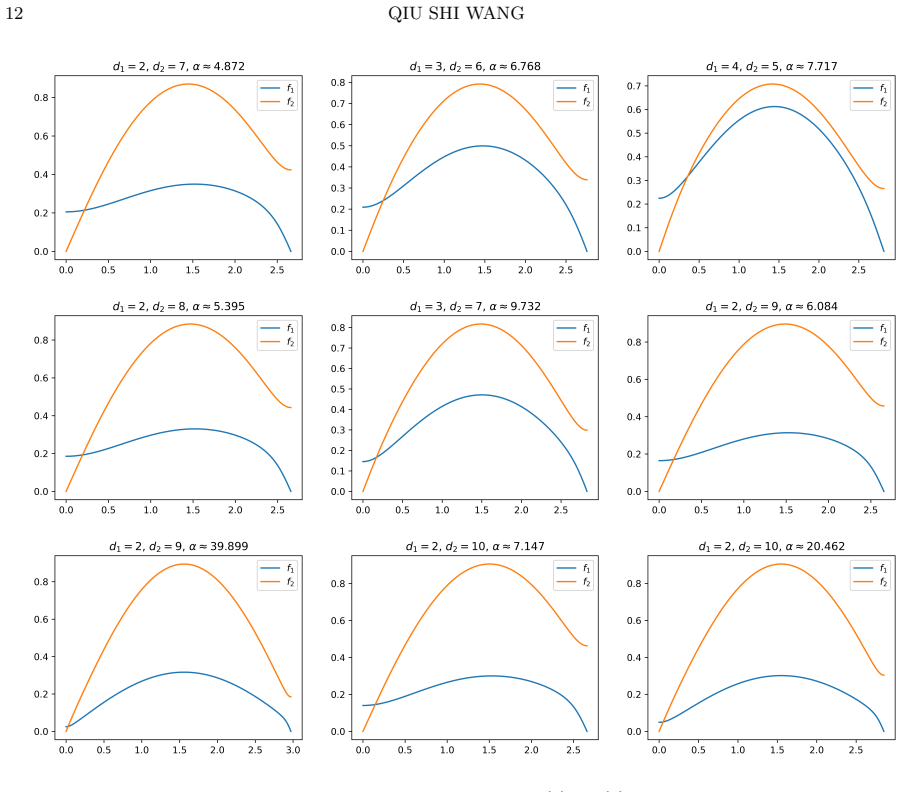
Wolfgang Ziller,Homogeneous Einstein metrics on spheres and projective spaces, Math. Ann.259 (1982), no. 3, 351–358. Mathematical Institute, University of Oxford, Oxford, OX2 6GG, United Kingdom Email address:wangqs@maths.ox.ac.uk, qiu.s.wang@mail.mcgill.ca 12 QIU SHI W ANG Figure 2.Plots of the warping functionsf 1(t), f2(t) for each of the Ein- stein me...
1982
discussion (0)
Sign in with ORCID, Apple, or X to comment. Anyone can read and Pith papers without signing in.