Methods for Inferring Interaction Potentials from Cross-Linking Mass Spectrometry Data
Pith reviewed 2026-06-27 23:45 UTC · model grok-4.3
The pith
Three optimization algorithms recover correct interaction parameters from XL-MS observables in a three-phase mixture.
A machine-rendered reading of the paper's core claim, the machinery that carries it, and where it could break.
Core claim
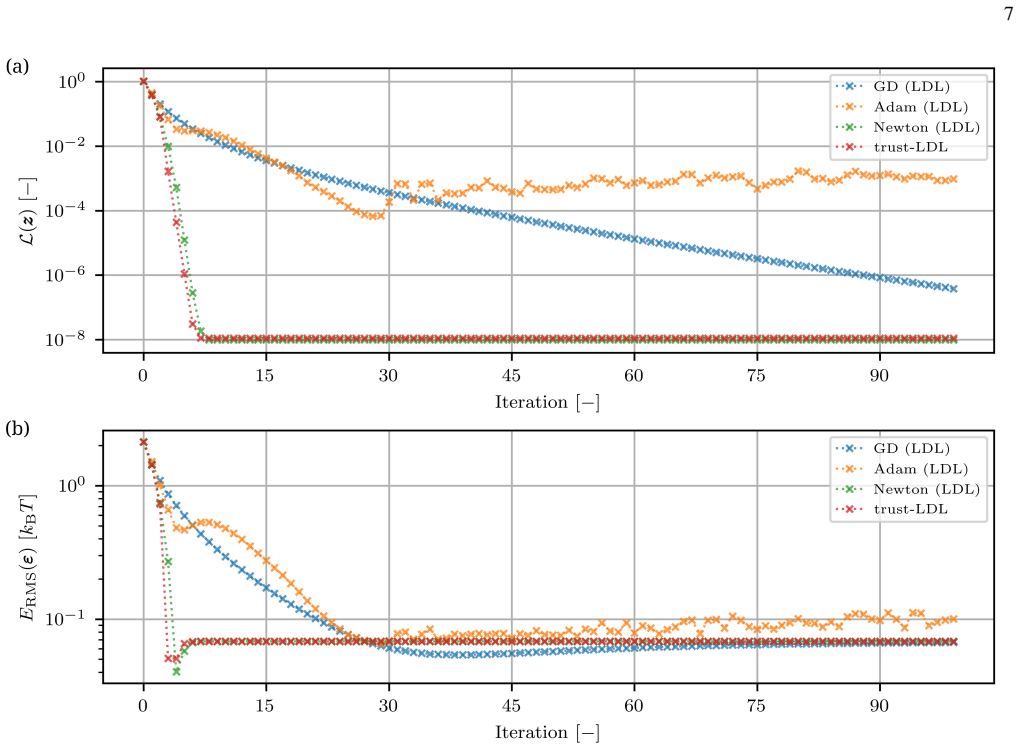
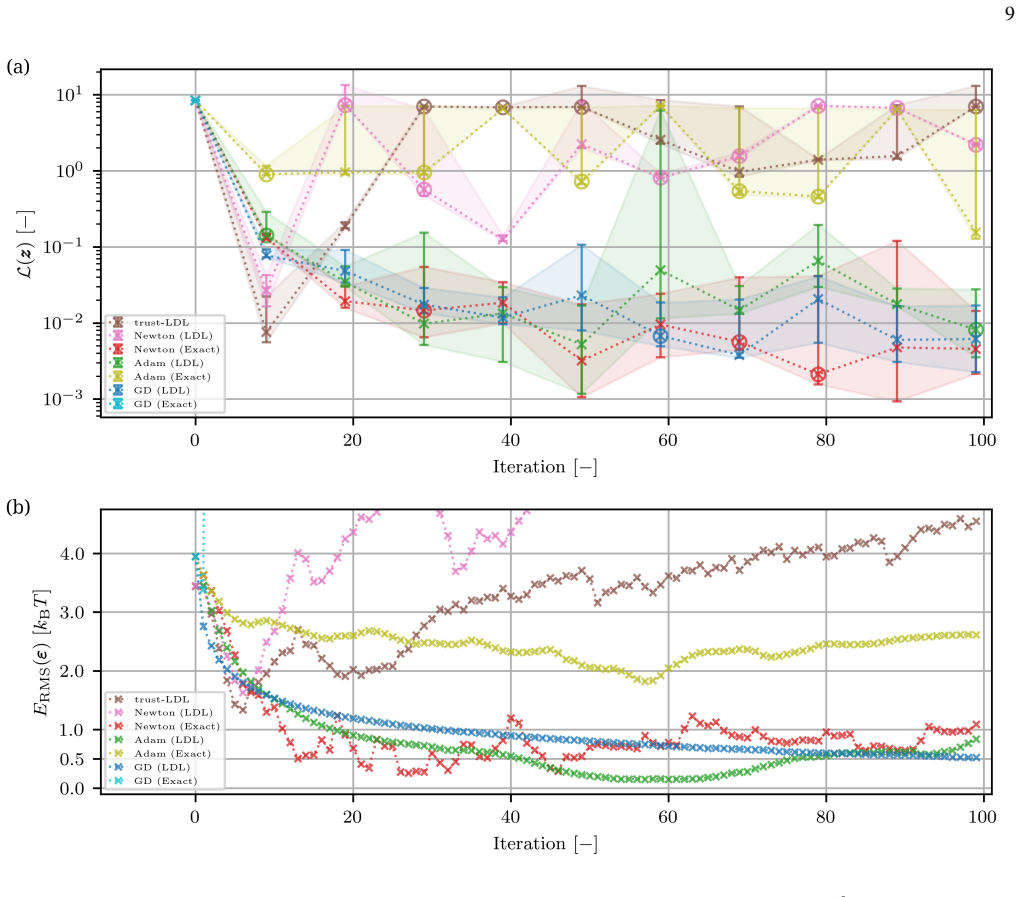
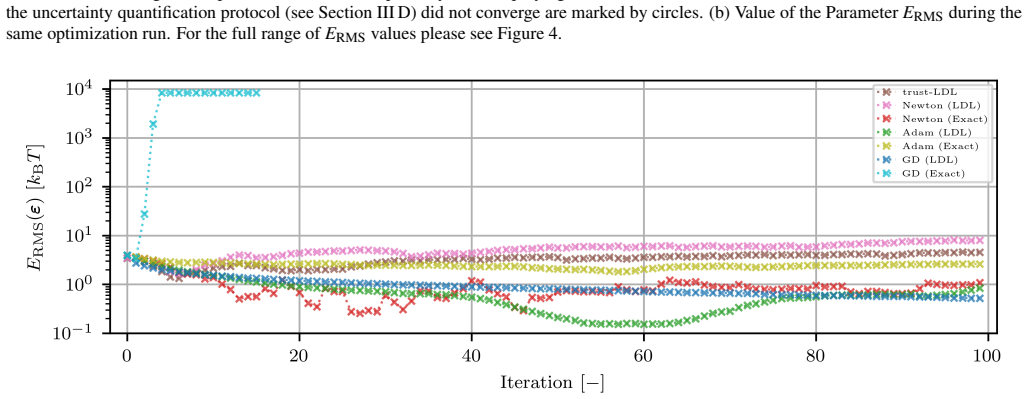
By framing the inference of pair potentials from XL-MS-derived coordination numbers and similar RDF functionals as an instance of the inverse Henderson problem, the authors show that several adapted optimization algorithms can parameterize multi-component interaction models even when the system undergoes three-phase separation. In homogeneous fluids every tested method converges efficiently; in the three-phase case Adam, gradient descent using the low-density derivative, and Newton iteration with the exact gradient each recover the original parameters to high accuracy.
What carries the argument
The adapted inverse Henderson framework that converts functionals of the radial distribution function (coordination numbers, etc.) into effective pair potentials via iterative inversion and gradient optimization.
If this is right
- All tested algorithms reach high accuracy and efficiency for homogeneous fluids.
- Adam, low-density gradient descent, and exact-gradient Newton iteration succeed on three-phase systems.
- The resulting potentials can be used directly in coarse-grained simulations of phase-separated protein mixtures.
- The same numerical pipeline applies to any set of RDF functionals obtained from experiment or simulation.
Where Pith is reading between the lines
- The framework could be tested on experimental XL-MS datasets from known biomolecular condensates to check whether the inferred potentials reproduce observed droplet compositions.
- If the low-density derivative approximation remains accurate at higher densities, it would simplify computations for larger mixtures.
- Extending the method to include higher-order correlation functions might relax the uniqueness assumption in systems with fewer phases.
Load-bearing premise
XL-MS observables supply enough independent constraints to determine a unique set of interaction potentials despite the general non-uniqueness of inverting RDF functionals.
What would settle it
Apply one of the three successful algorithms to a synthetic three-phase ten-component system whose true potentials and resulting coordination numbers are known in advance; the recovered potentials must reproduce the input observables within statistical error when the model is re-simulated.
Figures

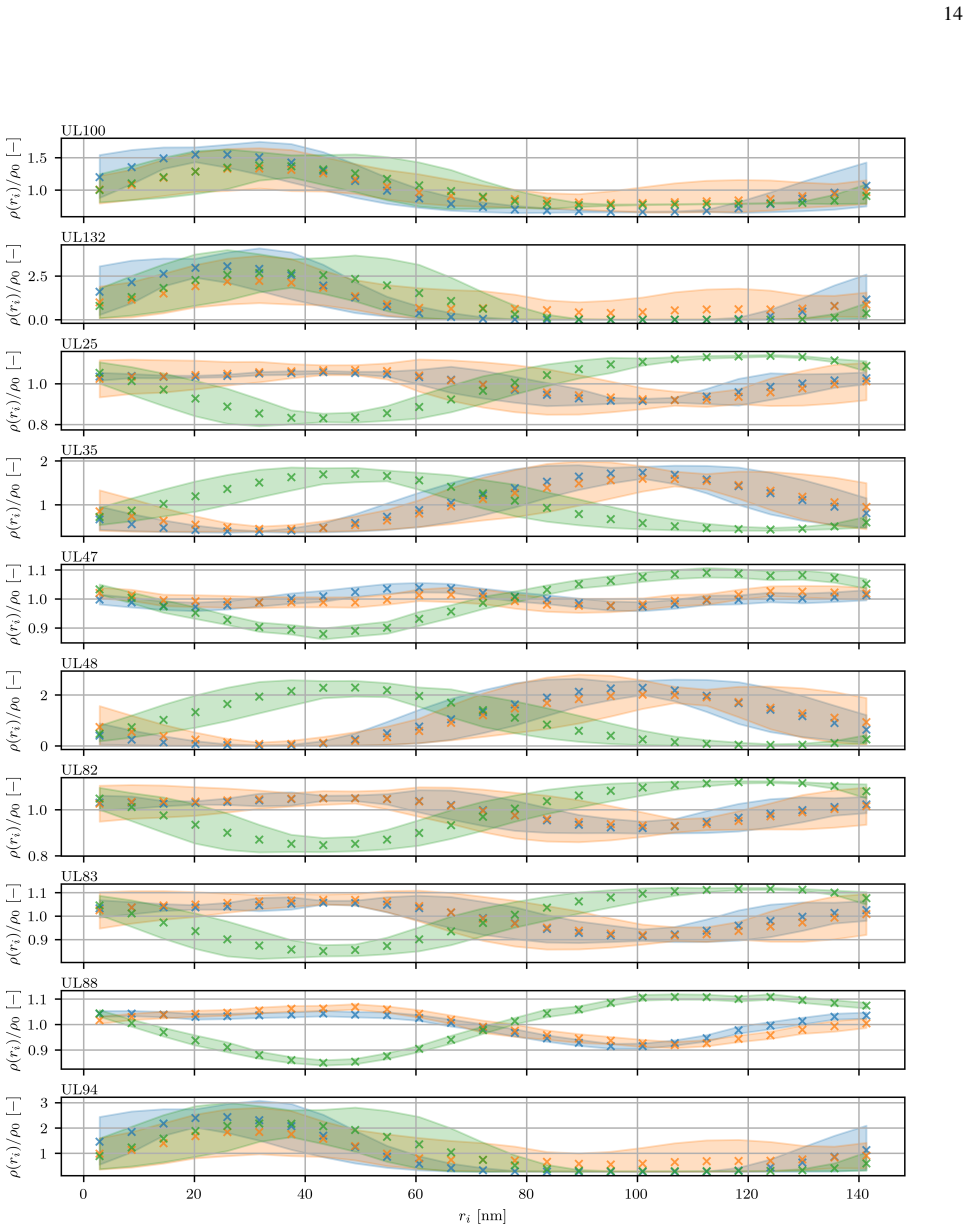
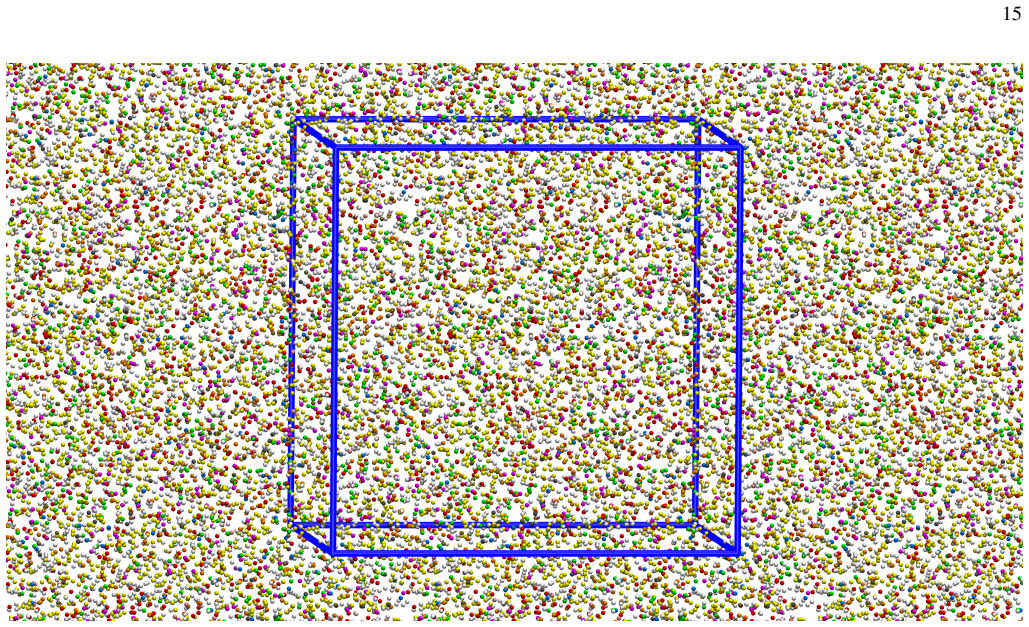

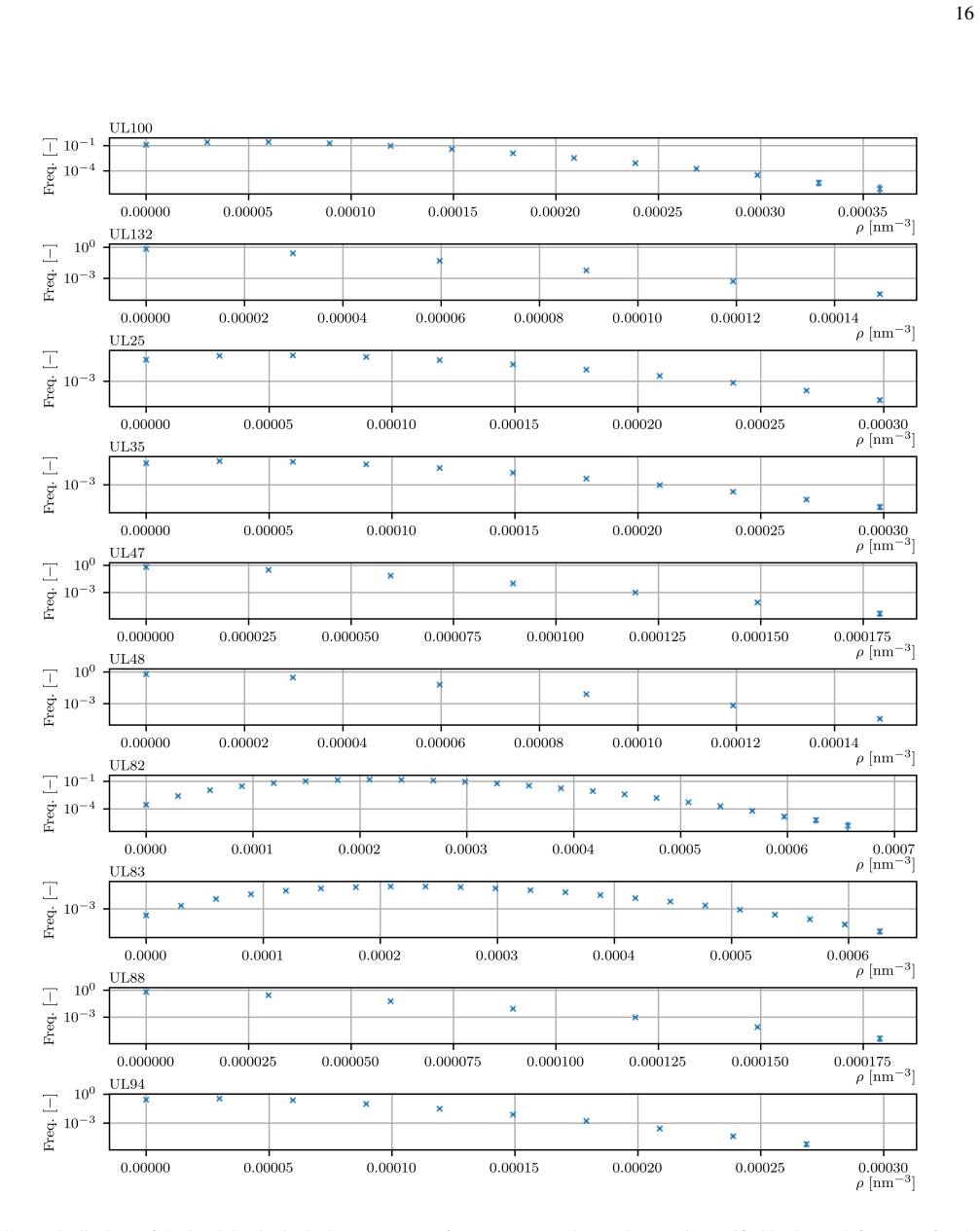

read the original abstract
Cross-linking mass spectrometry (XL-MS) has emerged as a powerful quantitative technique for probing intra-protein structural information as well as protein-protein interactions at an unprecedented scale. XL-MS data yield information on the pairwise spatial proximity of proteins through inter-molecular linkers. However, systematic methods for adapting such data for coarse-grained interacting particle models remain limited. Predominant focus is put on directly fitting radial distribution functions (RDFs), while numerous observables, e.g. coordination numbers, which are functionals of the RDF, cannot be uniquely inverted. In this work, we develop a framework for parameterizing interaction potentials from such observables in potentially phase-separated mixtures, as encountered in XL-MS results. We establish a connection between this problem and the inverse Henderson problem and adapt algorithms such as Iterative Boltzmann Inversion and Iterative Monte Carlo to its numerical solution. We derive exact and low-density limit gradient approximations and propose two new algorithms based on an adaptation of the predictor-corrector~framework. In total, we evaluate several optimization algorithms on biologically realistic ten-component test systems. We demonstrate that for homogeneous fluids, all methods achieve exceptional efficiency and accuracy. Critically, we further demonstrate successful parametrization in a challenging three-phase system. Here, three algorithms, namely Adam and gradient descent employing the low-density derivative as well as Newton's method with the exact gradient, reliably recover the correct parameters. These results establish a clear pathway from XL-MS experiments to coarse-grained protein models for systems where phase separation governs biological function, potentially enabling new investigations of biomolecular condensates and protein aggregation.
Editorial analysis
A structured set of objections, weighed in public.
Referee Report
Summary. The manuscript develops methods to infer coarse-grained interaction potentials from XL-MS observables (e.g., coordination numbers as functionals of the RDF) in multi-component mixtures that may phase-separate. It connects the problem to the inverse Henderson problem, adapts Iterative Boltzmann Inversion and Iterative Monte Carlo, derives exact and low-density gradient approximations, proposes predictor-corrector adaptations, and evaluates multiple optimizers (including Adam, low-density gradient descent, and exact-gradient Newton) on synthetic ten-component test systems, claiming that three of these reliably recover the true parameters even in a challenging three-phase system.
Significance. If the central claim holds after addressing uniqueness, the work would supply a systematic route from XL-MS data to coarse-grained models for phase-separated biomolecular systems, enabling studies of condensates and aggregation where current direct RDF fitting approaches are limited.
major comments (2)
- [Abstract] Abstract: The manuscript states that observables such as coordination numbers 'cannot be uniquely inverted,' yet the central claim is that Adam, low-density gradient descent, and exact-gradient Newton 'reliably recover the correct parameters' in the ten-component three-phase system. Recovery of one parameter set does not establish that the chosen XL-MS functionals supply enough independent constraints to eliminate degeneracies; an explicit test ruling out physically distinct potentials that yield identical observables is required to support the claim.
- [Abstract] Abstract: The abstract reports successful recovery on synthetic test systems but supplies no quantitative error metrics (e.g., parameter deviations, objective-function values, or cross-validation errors) and no details on how the observables were generated from the target potentials, leaving the strength of the three-phase result difficult to assess.
minor comments (1)
- The description of the new predictor-corrector algorithms and their relation to the low-density derivative would benefit from a concise algorithmic pseudocode or flowchart to improve reproducibility.
Simulated Author's Rebuttal
We thank the referee for the detailed and constructive comments on our manuscript. We address each of the major comments below.
read point-by-point responses
-
Referee: [Abstract] Abstract: The manuscript states that observables such as coordination numbers 'cannot be uniquely inverted,' yet the central claim is that Adam, low-density gradient descent, and exact-gradient Newton 'reliably recover the correct parameters' in the ten-component three-phase system. Recovery of one parameter set does not establish that the chosen XL-MS functionals supply enough independent constraints to eliminate degeneracies; an explicit test ruling out physically distinct potentials that yield identical observables is required to support the claim.
Authors: The statement regarding non-unique inversion refers to the general case for functionals of the RDF, as is standard in the inverse Henderson problem. Our central claim is based on empirical recovery in the specific test systems considered, where the optimization algorithms converged to the target potentials. We acknowledge that this does not rigorously prove uniqueness for all possible potentials. In the revised manuscript, we will include an additional analysis testing for potential degeneracies by attempting to recover parameters from observables generated with slightly perturbed potentials and checking if distinct potentials can produce identical observables within numerical tolerance. revision: partial
-
Referee: [Abstract] Abstract: The abstract reports successful recovery on synthetic test systems but supplies no quantitative error metrics (e.g., parameter deviations, objective-function values, or cross-validation errors) and no details on how the observables were generated from the target potentials, leaving the strength of the three-phase result difficult to assess.
Authors: We agree that the abstract would be improved by the inclusion of quantitative error metrics to allow readers to better assess the results. In the revised manuscript, we will update the abstract to report key quantitative measures such as the deviations in the recovered interaction parameters and the values of the objective function achieved in the three-phase system. The generation of the synthetic observables is described in detail in the Methods section, where we explain that they are obtained by performing molecular dynamics simulations with the known target potentials and then computing the coordination numbers and other XL-MS functionals from the resulting particle configurations; we will include a brief reference to this in the abstract as well. revision: yes
Circularity Check
No significant circularity; derivation and tests are self-contained
full rationale
The paper adapts known algorithms (IBI, IMC, gradient methods) to infer potentials from XL-MS functionals by connecting to the inverse Henderson problem, derives gradient approximations, and validates via forward simulation of observables from known potentials followed by recovery attempts. This is standard non-circular numerical testing. The abstract's non-uniqueness caveat is stated explicitly and does not enter the method definitions or test constructions as a self-referential loop. No load-bearing step reduces by definition, fitted-input renaming, or self-citation chain to its own inputs.
Axiom & Free-Parameter Ledger
axioms (1)
- domain assumption XL-MS observables can be treated as functionals of the radial distribution function that are sufficient for numerical inversion via adapted IBI/IMC methods in multi-component phase-separating fluids.
Reference graph
Works this paper leans on
-
[1]
author author L. Reatto , author D. Levesque , \ and\ author J. J. \ Weis ,\ title title Iterative predictor-corrector method for extraction of the pair interaction from structural data for dense classical liquids , \ 10.1103/PhysRevA.33.3451 journal journal Phys. Rev. A \ volume 33 ,\ pages 3451--3465 ( year 1986 ) NoStop
-
[2]
author author W. Schommers ,\ title title Pair potentials in disordered many-particle systems: A study for liquid G allium , \ 10.1103/PhysRevA.28.3599 journal journal Phys.\ Rev.\ A \ volume 28 ,\ pages 3599--3605 ( year 1983 ) NoStop
-
[3]
author author D. Reith , author M. P\" u tz , \ and\ author F. M\" u ller-Plathe ,\ title title Deriving effective mesoscale potentials from atomistic simulations , \ https://doi.org/10.1002/jcc.10307 journal journal J.\ Comput.\ Chem. \ volume 24 ,\ pages 1624--1636 ( year 2003 ) NoStop
-
[4]
author author A. P. \ Lyubartsev \ and\ author A. Laaksonen ,\ title title C alculation of effective interaction potentials from radial distribution functions: A reverse M onte C arlo approach , \ 10.1103/PhysRevE.52.3730 journal journal Phys.\ Rev.\ E \ volume 52 ,\ pages 3730--3737 ( year 1995 ) NoStop
-
[5]
author author F. Delbary , author M. Hanke , \ and\ author D. Ivanizki ,\ title title A generalized N ewton iteration for computing the solution of the inverse H enderson problem , \ 10.1080/17415977.2019.1710504 journal journal Inverse\ Probl.\ Sci.\ En. \ volume 28 ,\ pages 1166--1190 ( year 2020 ) NoStop
-
[6]
author author M. Sadeghi \ and\ author F. Noé ,\ title title Thermodynamics and kinetics of aggregation of flexible peripheral membrane proteins , \ 10.1021/acs.jpclett.1c02954 journal journal Journal of Physical Chemistry Letters \ volume 12 ,\ pages 10497--10504 ( year 2021 ) NoStop
-
[7]
author author M. Sadeghi ,\ title title Investigating the entropic nature of membrane-mediated interactions driving the aggregation of peripheral proteins , \ 10.1039/d2sm00118g journal journal Soft Matter \ volume 18 ,\ pages 3917 -- 3927 ( year 2022 ) NoStop
-
[8]
author author L. Piersimoni , author P. L. \ Kastritis , author C. Arlt , \ and\ author A. Sinz ,\ title title C ross- L inking M ass S pectrometry for investigating protein conformations and protein–protein interactions- A method for all seasons , \ 10.1021/acs.chemrev.1c00786 journal journal Chem.\ Rev. \ volume 122 ,\ pages 7500--7531 ( year 2022 ) NoStop
-
[9]
author author Y. Zhu , author K. C. \ Akkaya , author J. Ruta , author N. Yokoyama , author C. Wang , author M. Ruwolt , author D. B. \ Lima , author M. Lehmann , \ and\ author F. Liu ,\ title title Cross-link assisted spatial proteomics to map sub-organelle proteomes and membrane protein topologies , \ 10.1038/s41467-024-47569-x journal journal Nat. Comm...
-
[10]
author author P. Li , author S. Banjade , author H.-C. \ Cheng , author S. Kim , author B. Chen , author L. Guo , author M. Llaguno , author J. V. \ Hollingsworth , author D. S. \ King , author S. F. \ Banani , author P. S. \ Russo , author Q.-X. \ Jiang , author B. T. \ Nixon , \ and\ author M. K. \ Rosen ,\ title title Phase transitions in the assembly ...
-
[11]
author author M. Feric , author N. Vaidya , author T. S. \ Harmon , author D. M. \ Mitrea , author L. Zhu , author T. M. \ Richardson , author R. W. \ Kriwacki , author R. V. \ Pappu , \ and\ author C. P. \ Brangwynne ,\ title title Coexisting liquid phases underlie nucleolar subcompartments , \ https://doi.org/10.1016/j.cell.2016.04.047 journal journal C...
-
[12]
author author F. Schuhmann , author K. C. \ Akkaya , author D. Puchkov , author S. Hohensee , author M. Lehmann , author F. Liu , \ and\ author W. Pezeshkian ,\ title title Integrative molecular dynamics simulations untangle cross-linking data to unveil mitochondrial protein distributions , \ https://doi.org/10.1002/anie.202417804 journal journal Angew.\ ...
-
[13]
author author M. Sadeghi , author T. R. \ Weikl , \ and\ author F. Noé ,\ title title Particle-based membrane model for mesoscopic simulation of cellular dynamics , \ 10.1063/1.5009107 journal journal Journal of Chemical Physics \ volume 148 ,\ pages 044901 ( year 2018 ) NoStop
-
[14]
author author R. L. \ Henderson ,\ title title A uniqueness theorem for fluid pair correlation functions , \ https://doi.org/10.1016/0375-9601(74)90847-0 journal journal Phys.\ Lett.\ A \ volume 49 ,\ pages 197--198 ( year 1974 ) NoStop
-
[15]
author author D. P. \ Kingma \ and\ author J. Ba ,\ title title Adam: A method for stochastic optimization , \ http://arxiv.org/abs/1412.6980 journal arXiv:1412.6980 \ NoStop
-
[16]
journal author author R. Rajagopalan \ and\ author K. Srinivasa Rao ,\ title title Interaction forces in charged colloids: I nversion of static structure factors , \ 10.1103/PhysRevE.55.4423 journal journal Phys. Rev. E \ volume 55 ,\ pages 4423--4432 ( year 1997 ) NoStop
-
[17]
author author A. D. \ Law \ and\ author D. M. A. \ Buzza ,\ title title Determination of interaction potentials of colloidal monolayers from the inversion of pair correlation functions: A two-dimensional predictor-corrector method , \ 10.1063/1.3216568 journal journal J. Chem. Phys. \ volume 131 ,\ pages 094704 ( year 2009 ) NoStop
-
[18]
author author P. J. \ Hoogerbrugge \ and\ author J. M. V. A. \ Koelman ,\ title title Simulating microscopic hydrodynamic phenomena with dissipative particle dynamics , \ 10.1209/0295-5075/19/3/001 journal journal Europhys.\ Lett. \ volume 19 ,\ pages 155 ( year 1992 ) NoStop
-
[19]
author author P. Espa \ n ol \ and\ author P. Warren ,\ title title Statistical mechanics of dissipative particle dynamics , \ 10.1209/0295-5075/30/4/001 journal journal Europhys.\ Lett. \ volume 30 ,\ pages 191 ( year 1995 ) NoStop
-
[20]
author author B. Bogdanow , author I. Gruska , author L. M\" u hlberg , author J. Protze , author S. Hohensee , author B. Vetter , author J. B. \ Bosse , author M. Lehmann , author M. Sadeghi , author L. Wiebusch , \ and\ author F. Liu ,\ title title Spatially resolved protein map of intact human cytomegalovirus virions , \ 10.1038/s41564-023-01433-8 jour...
-
[21]
author author D. H. \ Chen , author H. Jiang , author M. Lee , author F. Liu , \ and\ author Z. Zhou ,\ title title Three-dimensional visualization of tegument/capsid interactions in the intact human cytomegalovirus , \ https://doi.org/10.1006/viro.1999.9791 journal journal Virology \ volume 260 ,\ pages 10--16 ( year 1999 ) NoStop
-
[22]
author author X. Yu , author J. Jih , author J. Jiang , \ and\ author Z. H. \ Zhou ,\ title title Atomic structure of the human cytomegalovirus capsid with its securing tegument layer of pp150 , \ 10.1126/science.aam6892 journal journal Science \ volume 356 ,\ pages eaam6892 ( year 2017 ) NoStop
-
[23]
Highly accurate protein structure prediction with
author author J. Jumper , author R. Evans , author A. Pritzel , author T. Green , author M. Figurnov , author O. Ronneberger , author K. Tunyasuvunakool , author R. Bates , author A. Z \'i dek , author A. Potapenko , author A. Bridgland , author C. Meyer , author S. A. A. \ Kohl , author A. J. \ Ballard , author A. Cowie , author B. Romera-Paredes , autho...
-
[24]
author author P. Eastman , author R. Galvelis , author R. P. \ Peláez , author C. R. A. \ Abreu , author S. E. \ Farr , author E. Gallicchio , author A. Gorenko , author M. M. \ Henry , author F. Hu , author J. Huang , author A. Kr\" a mer , author J. Michel , author J. A. \ Mitchell , author V. S. \ Pande , author J. P. \ Rodrigues , author J. Rodriguez-...
-
[25]
G owers , author M ax L inke , author J onathan B arnoud , author T yler J
author author R ichard J . G owers , author M ax L inke , author J onathan B arnoud , author T yler J . E . R eddy , author M anuel N . M elo , author S ean L . S eyler , author J an D omański , author D avid L . D otson , author S \' e bastien B uchoux , author I an M . K enney , \ and\ author O liver B eckstein ,\ title title M D A nalysis: A P ython pa...
-
[26]
author author N. Michaud-Agrawal , author E. J. \ Denning , author T. B. \ Woolf , \ and\ author O. Beckstein ,\ title title MDAnalysis : A toolkit for the analysis of molecular dynamics simulations , \ https://doi.org/10.1002/jcc.21787 journal journal J. Comput. Chem. \ volume 32 ,\ pages 2319--2327 ( year 2011 ) NoStop
-
[27]
author author R. T. \ McGibbon , author K. A. \ Beauchamp , author M. P. \ Harrigan , author C. Klein , author J. M. \ Swails , author C. X. \ Hern \'a ndez , author C. R. \ Schwantes , author L.-P. \ Wang , author T. J. \ Lane , \ and\ author V. S. \ Pande ,\ title title MDTraj : A modern open library for the analysis of molecular dynamics trajectories ,...
-
[28]
author author A. Grossfield , author P. N. \ Patrone , author D. R. \ Roe , author A. J. \ Schultz , author D. Siderius , \ and\ author D. M. \ Zuckerman ,\ title title B est practices for quantification of uncertainty and sampling quality in molecular simulations , \ 10.33011/livecoms.1.1.5067 journal journal Living J. Comp. Mol. Sci. \ volume 1 ,\ pages...
-
[29]
author author D. Foreman-Mackey , author D. W. \ Hogg , author D. Lang , \ and\ author J. Goodman ,\ title title emcee: The MCMC H ammer , \ 10.1086/670067 journal journal Publ.\ Astron.\ Soc.\ Pac. \ volume 125 ,\ pages 306 ( year 2013 ) NoStop
-
[30]
Sokal ,\ in\ @noop booktitle Functional Integration: Basics and Applications ,\ editor edited by\ editor C
author author A. Sokal ,\ in\ @noop booktitle Functional Integration: Basics and Applications ,\ editor edited by\ editor C. DeWitt-Morette , editor P. Cartier , \ and\ editor A. Folacci \ ( publisher Springer US ,\ address Boston ,\ year 1997 )\ pp.\ pages 131--192 NoStop
1997
-
[31]
author author P. Virtanen , author R. Gommers , author T. E. \ Oliphant , author M. Haberland , author T. Reddy , author D. Cournapeau , author E. Burovski , author P. Peterson , author W. Weckesser , author J. Bright , author S. J. \ van der Walt , author M. Brett , author J. Wilson , author K. J. \ Millman , author N. Mayorov , author A. R. J. \ Nelson ...
-
[32]
author author P. B. \ Warren , author A. Vlasov , author L. Anton , \ and\ author A. J. \ Masters ,\ title title Screening properties of G aussian electrolyte models, with application to dissipative particle dynamics , \ https://doi.org/10.1063/1.4807057 journal journal J.\ Chem.\ Phys. \ volume 138 ,\ pages 204907 ( year 2013 ) NoStop
discussion (0)
Sign in with ORCID, Apple, or X to comment. Anyone can read and Pith papers without signing in.