QCD Sum Rule Analysis of a Compact D⁺D⁻K⁺-Like Hidden-Charm Hexaquark with J^(P)=0⁻
Pith reviewed 2026-06-28 01:01 UTC · model grok-4.3
The pith
QCD sum rules estimate the mass of a J^P=0- hidden-charm hexaquark at 3.94 to 4.41 GeV.
A machine-rendered reading of the paper's core claim, the machinery that carries it, and where it could break.
Core claim
Our analysis indicates that, within Borel windows satisfying standard sum rule criteria and with a reasonable choice of continuum threshold, the mass of the J^P=0− hidden-charm hexaquark state is estimated to be in the range 3.94--4.41 GeV.
What carries the argument
Six independent local interpolating currents with J^P=0- constructed from three color-octet quark-antiquark clusters.
If this is right
- The mass range supplies a direct target for experimental identification of the hidden-charm hexaquark.
- The state is predicted to appear as a compact configuration rather than a loosely bound molecular state.
- Higher-dimensional condensates up to dimension ten are required to achieve stability in the sum-rule windows.
- The same framework of three color-octet clusters can be extended to other hidden-charm hexaquark quantum numbers.
Where Pith is reading between the lines
- If the state exists at this mass, it is likely to be produced and decay in channels involving D mesons and kaons.
- The prediction could be cross-checked by lattice QCD calculations of the same six-quark operator.
- Observation or non-observation would constrain models of few-body hadronic dynamics for the DDK system.
Load-bearing premise
The six chosen local interpolating currents actually couple strongly to a compact hexaquark ground state rather than to scattering states or other configurations, and the operator product expansion truncated at dimension ten plus the chosen Borel window reliably isolates that state.
What would settle it
A QCD sum rule analysis that yields no stable mass pole inside the 3.94-4.41 GeV window under the stated Borel and threshold conditions, or an experimental search that finds no resonance with these quantum numbers in that interval.
Figures





read the original abstract
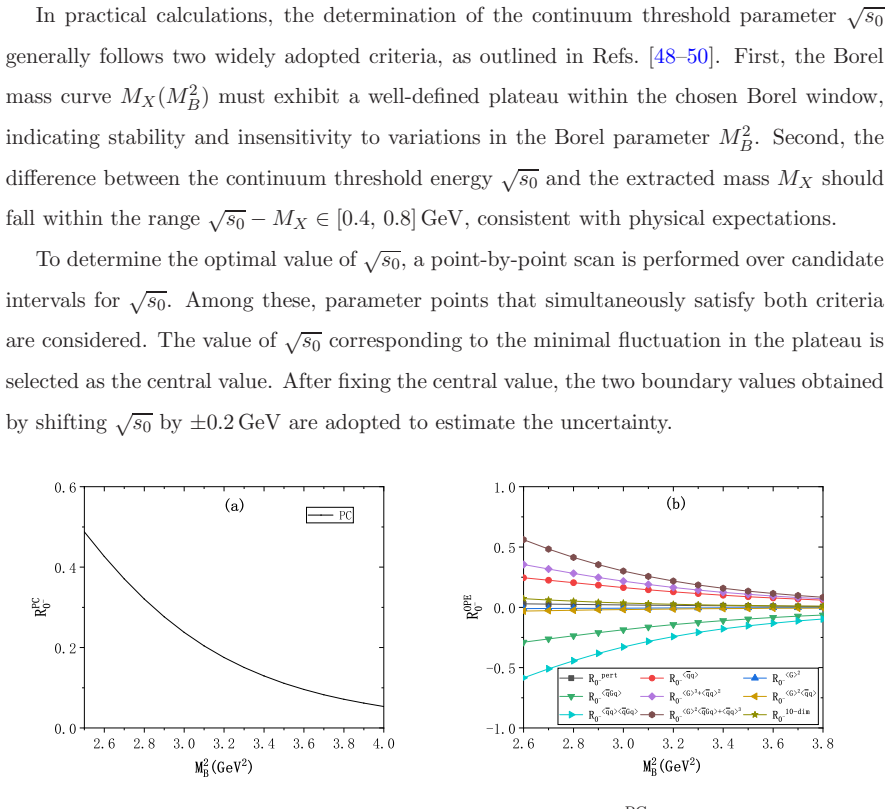
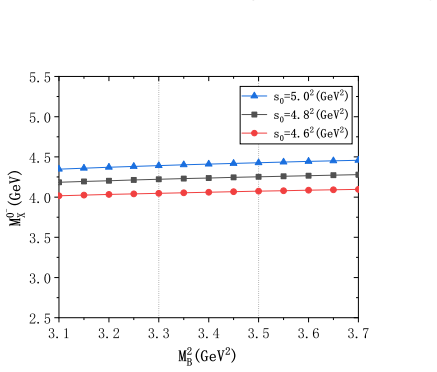
In this work, we study a compact hexaquark configuration motivated by the same quark content as $D^{+} D^{-} K^+$ using QCD sum rules, where the $D D K$ system has been extensively studied within theoretical frameworks of few-body hadronic dynamics and coupled-channel interactions. The state is constructed from three color-octet quark--antiquark clusters coupled to an overall color singlet. We construct six independent local interpolating currents with the quantum numbers $J^{P}=0^{-}$ and analyze the corresponding two-point correlation functions. Both perturbative contributions and nonperturbative condensates up to dimension ten are included in the operator product expansion. Our analysis indicates that, within Borel windows satisfying standard sum rule criteria and with a reasonable choice of continuum threshold, the mass of the $J^{P}=0^{-}$ hidden-charm hexaquark state is estimated to be in the range $3.94$--$4.41~\mathrm{GeV}$. This prediction can provide a valuable theoretical reference for identifying such exotic hidden-charm hexaquark state in future experiments.
Editorial analysis
A structured set of objections, weighed in public.
Referee Report
Summary. The manuscript applies QCD sum rules to six local interpolating currents for a compact hidden-charm hexaquark with J^P=0^- constructed from three color-octet quark-antiquark clusters. Including perturbative terms and condensates up to dimension 10 in the OPE, the authors identify Borel windows satisfying standard criteria and extract a mass in the interval 3.94-4.41 GeV for a reasonable choice of continuum threshold.
Significance. Should the central assumption hold—that the chosen currents have dominant overlap with a compact hexaquark ground state rather than DDK scattering states—the result would provide a useful benchmark for experimental searches of exotic hexaquarks in the hidden-charm sector. The use of multiple currents and high-dimensional condensates adds robustness to the OPE side.
major comments (2)
- [Abstract] Abstract: the reported mass interval 3.94--4.41 GeV spans 0.47 GeV and overlaps the D^+D^-K^+ threshold near 4.2 GeV; this breadth shows that the extracted mass depends sensitively on the adjusted values of the continuum threshold s_0 and Borel mass M^2, both free parameters whose specific choices directly determine the numerical result.
- [Abstract] The analysis assumes the six J^P=0^- currents couple dominantly to a single compact hexaquark pole, yet the same currents create three-meson scattering states whose thresholds lie inside the quoted window; standard sum-rule criteria (pole dominance, OPE convergence to dim 10) do not automatically suppress multi-particle cuts, and no explicit check of the residue against threshold behavior is provided.
Simulated Author's Rebuttal
We thank the referee for the careful reading of the manuscript and the constructive comments. We respond to each major comment below.
read point-by-point responses
-
Referee: [Abstract] Abstract: the reported mass interval 3.94--4.41 GeV spans 0.47 GeV and overlaps the D^+D^-K^+ threshold near 4.2 GeV; this breadth shows that the extracted mass depends sensitively on the adjusted values of the continuum threshold s_0 and Borel mass M^2, both free parameters whose specific choices directly determine the numerical result.
Authors: The quoted interval is obtained by collecting the central mass values extracted from the six independent interpolating currents, each analyzed in its own Borel window with a continuum threshold s_0 chosen so that the pole contribution is at least 50% and the dimension-10 OPE converges. Within each individual window the extracted mass is stable against moderate variations of M^2, as required by the standard sum-rule criteria. The spread therefore reflects the variation across different current choices rather than an uncontrolled sensitivity. We will revise the abstract to state this explicitly and to note the proximity of the predicted window to the D^+D^-K^+ threshold. revision: yes
-
Referee: [Abstract] The analysis assumes the six J^P=0^- currents couple dominantly to a single compact hexaquark pole, yet the same currents create three-meson scattering states whose thresholds lie inside the quoted window; standard sum-rule criteria (pole dominance, OPE convergence to dim 10) do not automatically suppress multi-particle cuts, and no explicit check of the residue against threshold behavior is provided.
Authors: We agree that local interpolating currents can couple to both compact multiquark configurations and to multi-meson scattering states, and that the usual Borel-window criteria do not automatically eliminate the latter. The present analysis is performed under the working assumption of dominant overlap with a compact state, motivated by the color-octet cluster construction of the currents. An explicit decomposition of the spectral density into compact-pole and scattering contributions lies outside the scope of a standard QCD sum-rule study and would require additional techniques. We will add a brief remark in the manuscript acknowledging this inherent limitation of the method. revision: partial
Circularity Check
Mass estimate depends on chosen continuum threshold and Borel window
specific steps
-
fitted input called prediction
[Abstract]
"within Borel windows satisfying standard sum rule criteria and with a reasonable choice of continuum threshold, the mass of the J^{P}=0^{-} hidden-charm hexaquark state is estimated to be in the range 3.94--4.41 GeV. This prediction can provide a valuable theoretical reference"
The mass range is produced only after the continuum threshold is chosen 'reasonably' and Borel windows are selected to satisfy the sum-rule criteria; the extracted mass is therefore determined by these adjustable inputs rather than being fixed by the OPE side without such choices.
full rationale
The derivation uses standard QCD sum-rule machinery: the two-point correlator is computed via OPE (perturbative + condensates to dim-10), Borel-transformed, and matched to a phenomenological pole plus continuum. The mass is then extracted from the ratio of moments after selecting a Borel window (for OPE convergence and pole dominance) and a continuum threshold s0. The quoted range 3.94-4.41 GeV is obtained precisely by varying these inputs within 'reasonable' values that satisfy the criteria; the numerical output is therefore a function of the chosen s0 and window rather than a parameter-free result from the OPE alone. This matches the fitted-input-called-prediction pattern. No self-citation, self-definitional, or uniqueness-theorem steps appear in the supplied text, and the central OPE calculation itself remains independent content. The physical assumption that the currents couple dominantly to a compact hexaquark (rather than DDK scattering states) is a modeling choice, not a circular reduction.
Axiom & Free-Parameter Ledger
free parameters (2)
- continuum threshold s0
- Borel mass M^2
axioms (2)
- domain assumption The operator product expansion of the correlation function is valid and can be truncated at dimension ten
- domain assumption The local interpolating currents couple to the desired compact hexaquark state
invented entities (1)
-
compact D+D-K+ like hidden-charm hexaquark
no independent evidence
Reference graph
Works this paper leans on
-
[1]
are displayed in Fig. 1. On the phenomenological side, after isolating the ground-s tate contribution of the hex- aquark state, the phenomenological representation of the c orrelation function Π i(q2) can be 6 FIG. 1: Shown here are the Feynman diagrams for the hexaquark s tate with three color-octet clusters, where only representative topologies are disp...
-
[2]
A Schematic Model of Baryons and Mesons,
M. Gell-Mann, “A Schematic Model of Baryons and Mesons,” Phys. Lett. 8, 214–215 (1964) 10.1016/S0031-9163(64)92001-3
-
[3]
An SU(3) model for strong interaction symmetry and its breaking. Version 1,
G. Zweig, “An SU(3) model for strong interaction symmetry and its breaking. Version 1,” CERN- TH-401
-
[4]
R. L. Jaffe, “Perhaps a Stable Dihyperon,” Phys. Rev. Lett. 38, 195–198 (1977) [erratum: Phys. Rev. Lett. 38, 617 (1977)] 10.1103/PhysRevLett.38.195
-
[5]
R. F. Lebed, R. E. Mitchell and E. S. Swanson, “Heavy-Quark QC D Exotica,” Prog. Part. Nucl. Phys. 93, 143–194 (2017) 10.1016/j.ppnp.2016.11.003 [arXiv:1610.04528 [hep-ph]]
work page internal anchor Pith review Pith/arXiv arXiv doi:10.1016/j.ppnp.2016.11.003 2017
-
[6]
The hidden-charm pentaquark and tetraquark states
H. X. Chen, W. Chen, X. Liu and S. L. Zhu, “The hidden-charm pen taquark and tetraquark states,” Phys. Rept. 639, 1–121 (2016) 10.1016/j.physrep.2016.05.004 [arXiv:1601.02092 [hep-ph]]
work page internal anchor Pith review Pith/arXiv arXiv doi:10.1016/j.physrep.2016.05.004 2016
-
[7]
Evidence for a New Resonance from Polarized Neutron-Proton Scattering
P. Adlarson et al. [W ASA-at-COSY], “Evidence for a New Resonance from Polarized Neu tron- Proton Scattering,” Phys. Rev. Lett. 112, 202301 (2014) 10.1103/PhysRevLett.112.202301 [arXiv:1402.6844 [nucl-ex]]
work page internal anchor Pith review Pith/arXiv arXiv doi:10.1103/physrevlett.112.202301 2014
-
[8]
Observation of a narrow charmonium-like state in exclusive B+ -> K+ pi+pi- J/psi decays
S. K. Choi et al. [Belle], “Observation of a narrow charmonium-like state in exclusive B± → K ±π +π −J/ψ decays,” Phys. Rev. Lett. 91, 262001 (2003) 10.1103/PhysRevLett.91.262001 [arXiv:hep-ex/0309032 [hep-ex]]
work page internal anchor Pith review Pith/arXiv arXiv doi:10.1103/physrevlett.91.262001 2003
-
[9]
Evidence for exotic hadron contributions to $\Lambda_b^0 \to J/\psi p \pi^-$ decays
R. Aaij et al. [LHCb], “Evidence for exotic hadron contributions to Λ 0 b → J/ψpπ − decays,” Phys. Rev. Lett. 117, 082003 (2016) 10.1103/PhysRevLett.117.082003 [arXiv:1606.06999 [hep-ex]]
work page internal anchor Pith review Pith/arXiv arXiv doi:10.1103/physrevlett.117.082003 2016
-
[10]
R. Aaij et al. [LHCb], “Observation of a narrow pentaquark state, Pc(4312)+, and of two-peak structure of the Pc(4450)+,” Phys. Rev. Lett. 122, 222001 (2019) 10.1103/PhysRevLett.122.222001 [arXiv:1904.03947 [hep-ex]]
work page internal anchor Pith review Pith/arXiv arXiv doi:10.1103/physrevlett.122.222001 2019
-
[11]
Exotics: Heavy Pentaquarks and Tetraquarks
A. Ali, J. S. Lange and S. Stone, “Exotics: Heavy Pentaquarks and Tetraquarks,” Prog. Part. Nucl. Phys. 97, 123–198 (2017) 10.1016/j.ppnp.2017.08.003 [arXiv:1706.00610 [hep-ph]]
work page internal anchor Pith review Pith/arXiv arXiv doi:10.1016/j.ppnp.2017.08.003 2017
-
[12]
A. Esposito, A. Pilloni and A. D. Polosa, “Multiquark Resonances ,” Phys. Rept. 668, 1–97 (2017) 10.1016/j.physrep.2016.11.002 [arXiv:1611.07920 [hep-ph]]
work page internal anchor Pith review Pith/arXiv arXiv doi:10.1016/j.physrep.2016.11.002 2017
-
[13]
Exotic hadrons: review and perspectives
J. M. Richard, “Exotic hadrons: review and perspectives,” Few Body Syst. 57, 1185–1212 (2016) 10.1007/s00601-016-1159-0 [arXiv:1606.08593 [hep-ph]]
work page internal anchor Pith review Pith/arXiv arXiv doi:10.1007/s00601-016-1159-0 2016
-
[14]
Pentaquark and Tetraquark states
Y. R. Liu, H. X. Chen, W. Chen, X. Liu and S. L. Zhu, “Pentaquar k and Tetraquark states,” Prog. Part. Nucl. Phys. 107, 237–320 (2019) 10.1016/j.ppnp.2019.04.003 [arXiv:1903.11976 [hep-ph]]. 19
work page internal anchor Pith review Pith/arXiv arXiv doi:10.1016/j.ppnp.2019.04.003 2019
-
[15]
Observation of a charged charmoniumlike structure in e+e- to pi+pi-J/psi at \sqrt{s}=4.26 GeV
M. Ablikim et al. [BESIII], “Observation of a Charged Charmoniumlike Structure in e+e− → π +π − J/ψ at √ s = 4 . 26 GeV,” Phys. Rev. Lett. 110, 252001 (2013) 10.1103/PhysRevLett.110.252001 [arXiv:1303.5949 [hep-ex]]
work page internal anchor Pith review Pith/arXiv arXiv doi:10.1103/physrevlett.110.252001 2013
-
[16]
The XYZ states: experimental and theoretical status and perspectives ,
N. Brambilla, S. Eidelman, C. Hanhart, A. Nefediev, C. P. Shen, C . E. Thomas, A. Vairo and C. Z. Yuan, “The XYZ states: experimental and theoretical status and perspectives ,” Phys. Rept. 873, 1–154 (2020) 10.1016/j.physrep.2020.05.001 [arXiv:1907.07583 [hep-ex]]
-
[17]
Analysis of the hidden-charm tetraquark mass sp ectrum with the QCD sum rules,
Z. G. Wang, “Analysis of the hidden-charm tetraquark mass sp ectrum with the QCD sum rules,” Phys. Rev. D 102, 014018 (2020) 10.1103/PhysRevD.102.014018 [arXiv:1908.07914 [hep-ph]]
-
[18]
F. K. Guo, C. Hanhart, U. G. Meißner, Q. Wang, Q. Zhao and B. S . Zou, “Hadronic molecules,” Rev. Mod. Phys. 90, 015004 (2018) 10.1103/RevModPhys.90.015004 [arXiv:1705.00141 [hep- ph]]
work page internal anchor Pith review Pith/arXiv arXiv doi:10.1103/revmodphys.90.015004 2018
-
[19]
Heavy quark spin selection rule and the properties of the X(3872)
M. B. Voloshin, “Heavy quark spin selection rule and the propert ies of the X(3872),” Phys. Lett. B 604, 69–73 (2004) 10.1016/j.physletb.2004.11.003 [arXiv:hep-ph/0408321 [hep-ph]]
work page internal anchor Pith review Pith/arXiv arXiv doi:10.1016/j.physletb.2004.11.003 2004
-
[20]
Isospin breaking of the narrow charmonium s tate of Belle at 3872 MeV as a deuson,
N. A. Tornqvist, “Isospin breaking of the narrow charmonium s tate of Belle at 3872 MeV as a deuson,” Phys. Lett. B 590, 209–215 (2004) 10.1016/j.physletb.2004.03.077 [arXiv:hep- ph/0402237 [hep-ph]]
-
[21]
Diquark-Antidiquarks with Hidden or Open Charm and the Nature of X(3872)
L. Maiani, F. Piccinini, A. D. Polosa and V. Riquer, “Diquark-antidiq uarks with hid- den or open charm and the nature of X(3872),” Phys. Rev. D 71, 014028 (2005) 10.1103/PhysRevD.71.014028 [arXiv:hep-ph/0412098 [hep-ph]]
work page internal anchor Pith review Pith/arXiv arXiv doi:10.1103/physrevd.71.014028 2005
-
[22]
Z. G. Wang and T. Huang, “Analysis of the X(3872), Zc(3900) and Zc(3885) as axial-vector tetraquark states with QCD sum rules,” Phys. Rev. D 89, 054019 (2014) 10.1103/PhysRevD.89.054019 [arXiv:1310.2422 [hep-ph]]
work page internal anchor Pith review Pith/arXiv arXiv doi:10.1103/physrevd.89.054019 2014
-
[23]
How to reveal the exotic nature of the P_c(4450)
F. K. Guo, U. G. Meißner, W. Wang and Z. Yang, “How to reveal t he exotic nature of the Pc(4450),” Phys. Rev. D 92, 071502 (2015) 10.1103/PhysRevD.92.071502 [arXiv:1507.04950 [hep-ph]]
work page internal anchor Pith review Pith/arXiv arXiv doi:10.1103/physrevd.92.071502 2015
-
[24]
Triangle Singularities and XYZ Quarkonium Peaks
A. P. Szczepaniak, “Triangle Singularities and XYZ Quarkonium Pe aks,” Phys. Lett. B 747, 410–416 (2015) 10.1016/j.physletb.2015.06.029 [arXiv:1501.01691 [hep-ph]]
work page internal anchor Pith review Pith/arXiv arXiv doi:10.1016/j.physletb.2015.06.029 2015
-
[25]
Analysis of the scalar doubly charmed hexaquark state with QCD sum rules
Z. G. Wang, “Analysis of the scalar doubly charmed hexaquark s tate with QCD sum rules,” Eur. Phys. J. C 77, 642 (2017), doi:10.1140/epjc/s10052-017-5207-9 [arXiv:1707.09767 [hep-ph]]
work page internal anchor Pith review Pith/arXiv arXiv doi:10.1140/epjc/s10052-017-5207-9 2017
-
[26]
Study of Λ cΛ c dibaryon and Λ c ¯Λ c baryonium states via QCD sum rules,
X. W. Wang, Z. G. Wang, and G. L. Yu, “Study of Λ cΛ c dibaryon and Λ c ¯Λ c baryonium states via QCD sum rules,” Eur. Phys. J. A 57, 275 (2021), doi:10.1140/epja/s10050-021-00576-8 [arXiv:2107.04751 [hep-ph]]
-
[27]
Hidden-bottom and -charm hexaquark states in QCD sum rules,
B. D. Wan, L. Tang, and C. F. Qiao, “Hidden-bottom and -charm hexaquark states in QCD sum rules,” Eur. Phys. J. C 80, 121 (2020), doi:10.1140/epjc/s10052-020-7701-8 [arXiv:1912.12046 20 [hep-ph]]
-
[28]
Mass spectra of Λ Q ¯Σ Q hexaquark states in QCD sum rules,
X. H. Zhang and C. F. Qiao, “Mass spectra of Λ Q ¯Σ Q hexaquark states in QCD sum rules,” arXiv:2512.22019 [hep-ph]
-
[29]
Mass spectra of 0 −− and 0 +− hidden-heavy baryoniums,
B. D. Wan, “Mass spectra of 0 −− and 0 +− hidden-heavy baryoniums,” Eur. Phys. J. C 84, 760 (2024), doi:10.1140/epjc/s10052-024-13126-5 [arXiv:2311.13161 [hep-ph]]
-
[30]
Search for the Λ cΣ c and ¯Λ cΣ c dibaryon structures via the QCD sum rules,
X. W. Wang, Z. G. Wang, and G. L. Yu, “Search for the Λ cΣ c and ¯Λ cΣ c dibaryon structures via the QCD sum rules,” arXiv:2604.14597 [hep-ph]
-
[31]
Searching for hidden-charm baryonium signals in QCD sum rules
H. X. Chen, D. Zhou, W. Chen, X. Liu, and S. L. Zhu, “Searching for hidden-charm baryonium signals in QCD sum rules,” Eur. Phys. J. C 76, 602 (2016), doi:10.1140/epjc/s10052-016-4459-0 [arXiv:1605.07453 [hep-ph]]
work page internal anchor Pith review Pith/arXiv arXiv doi:10.1140/epjc/s10052-016-4459-0 2016
-
[32]
Search for the charmed baryonium and dibaryon structures via the QCD sum rules,
X. W. Wang and Z. G. Wang, “Search for the charmed baryonium and dibaryon structures via the QCD sum rules,” Adv. High Energy Phys. 2022, 6224597 (2022), doi:10.1155/2022/6224597 [arXiv:2110.14133 [hep-ph]]
-
[33]
Bound state formation in the $DDK$ system
A. Martinez Torres, K. P. Khemchandani and L. S. Geng, “Bou nd state formation in the DDK system,” Phys. Rev. D 99, 076017 (2019) 10.1103/PhysRevD.99.076017 [arXiv:1809.01059 [hep- ph]]
work page internal anchor Pith review Pith/arXiv arXiv doi:10.1103/physrevd.99.076017 2019
-
[34]
Excited K meson, Kc(4180), with hidden charm as a ¯D ¯DK bound state,
T. W. Wu, M. Z. Liu and L. S. Geng, “Excited K meson, Kc(4180), with hidden charm as a ¯D ¯DK bound state,” Phys. Rev. D 103, L031501 (2021) 10.1103/PhysRevD.103.L031501 [arXiv:2102.08109 [hep-ph]]
-
[35]
DK , DDK , and DDDK molecules—understanding the nature of the D∗ s0(2317),
T. W. Wu, M. Z. Liu, L. S. Geng, E. Hiyama and M. P. Valderrama, “ DK , DDK , and DDDK molecules—understanding the nature of the D∗ s0(2317),” Phys. Rev. D 100, 034029 (2019) 10.1103/PhysRevD.100.034029 [arXiv:1906.11995 [hep-ph]]
-
[36]
T. W. Wu, M. Z. Liu and L. S. Geng, “Implication of the Existence o fJ P C = 0 −− ¯DsDK Bound State on the Nature of D∗ s0(2317), and a New Configuration of Exotic State,” Phys. Rev. Lett . 135, 031902 (2025) 10.1103/3gbb-ms8c [arXiv:2501.11358 [hep-ph]]
-
[37]
Strong decays of the explicitly exotic doubly charmed DDK bound state,
Y. Huang, M. Z. Liu, Y. W. Pan, L. S. Geng, A. Mart ´ ınez Torres and K. P. Khemchandani, “Strong decays of the explicitly exotic doubly charmed DDK bound state,” Phys. Rev. D 101, 014022 (2020) 10.1103/PhysRevD.101.014022 [arXiv:1909.09021 [hep-ph]]
-
[38]
Binding of the three- hadron DD∗K system from the lattice effective field theory,
Z. Zhang, X. Y. Hu, G. He, J. Liu, J. A. Shi, B. N. Lu and Q. Wang, “Binding of the three- hadron DD∗K system from the lattice effective field theory,” Phys. Rev. D 111, 036002 (2025) 10.1103/PhysRevD.111.036002 [arXiv:2409.01325 [hep-ph]]
-
[39]
QCD and Re sonance Physics. Theoretical Foundations,
M. A. Shifman, A. I. Vainshtein and V. I. Zakharov, “QCD and Re sonance Physics. Theoretical Foundations,” Nucl. Phys. B 147, 385–447 (1979) 10.1016/0550-3213(79)90022-1
-
[40]
QCD and Re sonance Physics: Applica- 21 tions,
M. A. Shifman, A. I. Vainshtein and V. I. Zakharov, “QCD and Re sonance Physics: Applica- 21 tions,” Nucl. Phys. B 147, 448–518 (1979) 10.1016/0550-3213(79)90023-3
-
[41]
Hadron Propertie s from QCD Sum Rules,
L. J. Reinders, H. Rubinstein and S. Yazaki, “Hadron Propertie s from QCD Sum Rules,” Phys. Rept. 127, 1 (1985) 10.1016/0370-1573(85)90065-1
-
[42]
Charmonium Exotic States,
R. M. Albuquerque, “Charmonium Exotic States,” arXiv:1306.467 1 [hep-ph]
-
[43]
Hybrid Quarkonia From QCD Sum Rules,
J. Govaerts, L. J. Reinders, H. R. Rubinstein and J. Weyers, “ Hybrid Quarkonia From QCD Sum Rules,” Nucl. Phys. B 258, 215–229 (1985) 10.1016/0550-3213(85)90609-1
-
[44]
QCD Sum Rules, a Modern Perspective
P. Colangelo and A. Khodjamirian, “QCD Sum Rules, a Modern Pers pective,” in At the Frontier of Particle Physics / Handbook of QCD , edited by M. Shifman (World Scientific, Singapore, 2001), Vol. 3, pp. 1495–1576 10.1142/9789812810458_0033 [arXiv:hep-ph/0010175]
work page internal anchor Pith review Pith/arXiv arXiv doi:10.1142/9789812810458_0033 2001
-
[45]
QCD sum rules, a modern pers pective,
P. Colangelo and A. Khodjamirian, “QCD sum rules, a modern pers pective,” arXiv:hep- ph/0010175 [hep-ph]
-
[46]
S. Narison, “QCD spectral sum rules,” World Sci. Lect. Notes Ph ys. 26, 1–527 (1989) 10.1142/9789812799265
-
[47]
R. L. Workman et al. [Particle Data Group], “Review of Particle Physics,” PTEP 2022, 083C01 (2022) 10.1093/ptep/ptac097
-
[48]
Baryons and baryoniums in the pers pective of QCD sum rules,
S. Q. Zhang and C. F. Qiao, “Baryons and baryoniums in the pers pective of QCD sum rules,” arXiv:2512.24706 [hep-ph]
-
[49]
S. I. Finazzo, M. Nielsen and X. Liu, “QCD sum rule calculation for t he charmonium-like structures in the J/ψφ and J/ψω invariant mass spectra,” Phys. Lett. B 701, 101–106 (2011) 10.1016/j.physletb.2011.05.042 [arXiv:1102.2347 [hep-ph]]
work page internal anchor Pith review Pith/arXiv arXiv doi:10.1016/j.physletb.2011.05.042 2011
-
[50]
Estimating the mass of the hidden charm $1^+(1^{+})$ tetraquark state via QCD sum rules
C. F. Qiao and L. Tang, “Estimating the mass of the hidden charm 1+(1+) tetraquark state via QCD sum rules,” Eur. Phys. J. C 74, 3122 (2014) 10.1140/epjc/s10052-014-3122-x [arXiv:1307.6654 [hep-ph]]
work page internal anchor Pith review Pith/arXiv arXiv doi:10.1140/epjc/s10052-014-3122-x 2014
-
[51]
Interpretation of $Z_c(4025)$ as the Hidden Charm Tetraquark States via QCD Sum Rules
C. F. Qiao and L. Tang, “Interpretation of Zc(4025) as the hidden charm tetraquark states via QCD Sum Rules,” Eur. Phys. J. C 74, 2810 (2014) 10.1140/epjc/s10052-014-2810-x [arXiv:1308.3439 [hep-ph]]. 22 Appendix: Spectral density for the current j1 For completeness, we present in this appendix the spectral d ensity ρOPE 1 (s) entering Eq. (
work page internal anchor Pith review Pith/arXiv arXiv doi:10.1140/epjc/s10052-014-2810-x 2014
-
[52]
for the current j1 defined in Eq. ( 2). This expression is given as a representa- tive example; the spectral densities for the other currents have analogous structures and are not displayed explicitly for brevity. The full spectral den sity is decomposed as ρOPE 1 (s) = ρpert 1 (s) +ρ(3) 1 (s) +ρ(4) 1 (s) + · · ·+ρ(10) 1 (s). (30) The short-hand notations ...
discussion (0)
Sign in with ORCID, Apple, or X to comment. Anyone can read and Pith papers without signing in.