Interaction of Fast Magnetoacoustic Wave with the Localized Coronal Null and Generation of the Energetic Alfv\'en Wave Packet
Pith reviewed 2026-06-27 23:37 UTC · model grok-4.3
The pith
Fast magnetoacoustic waves generate energetic Alfvén wave packets via mode conversion at coronal null points.
A machine-rendered reading of the paper's core claim, the machinery that carries it, and where it could break.
Core claim
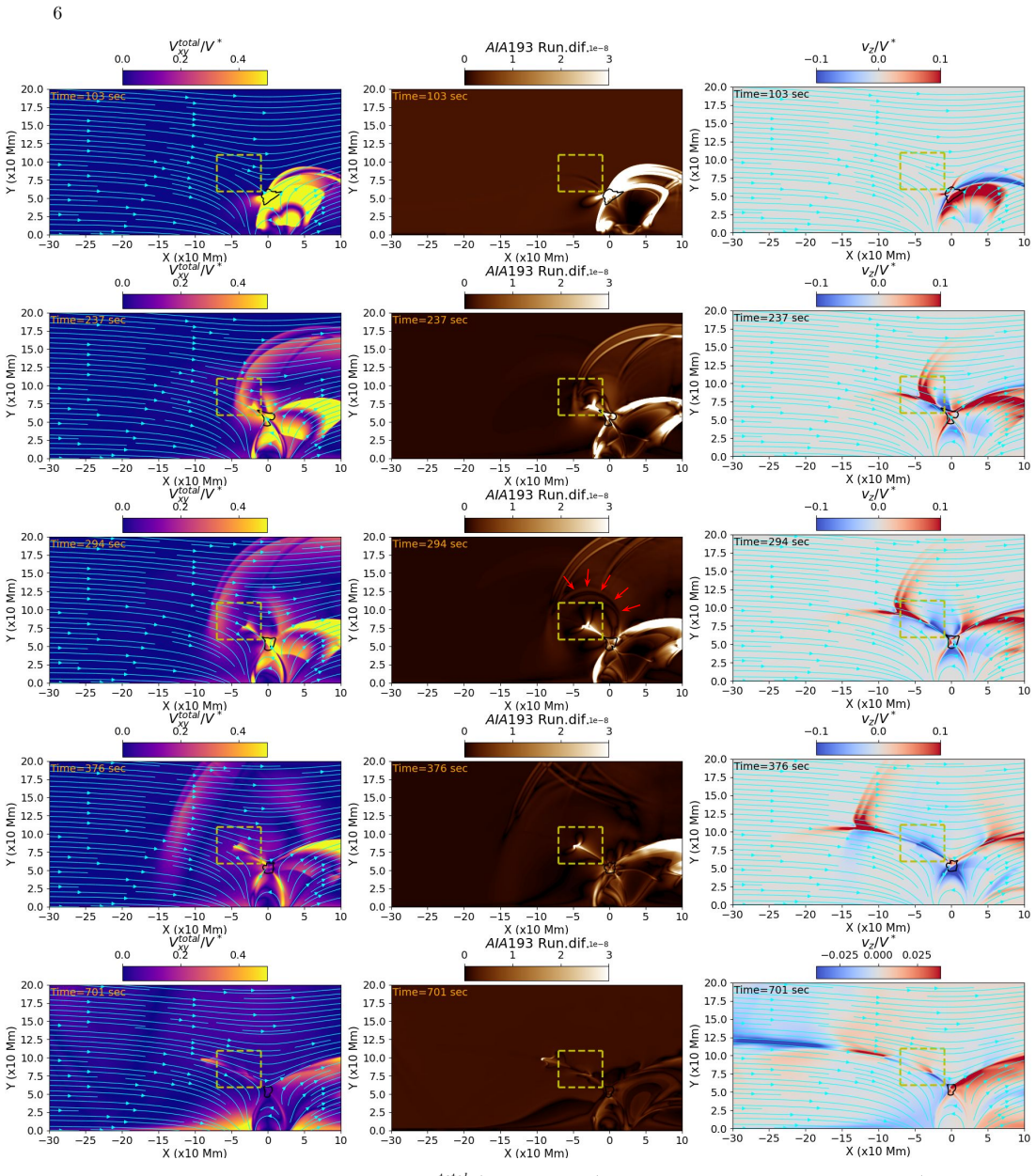
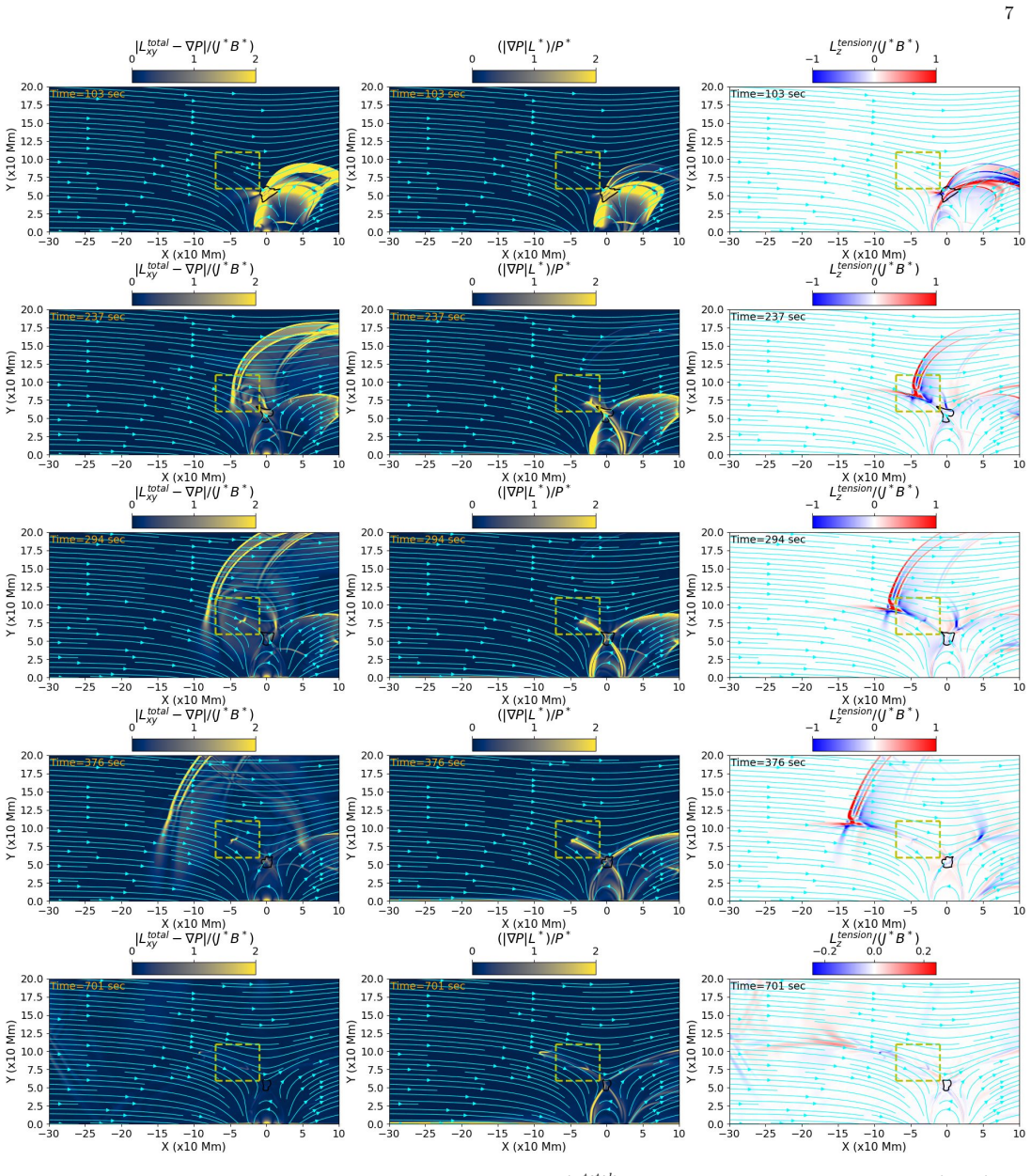
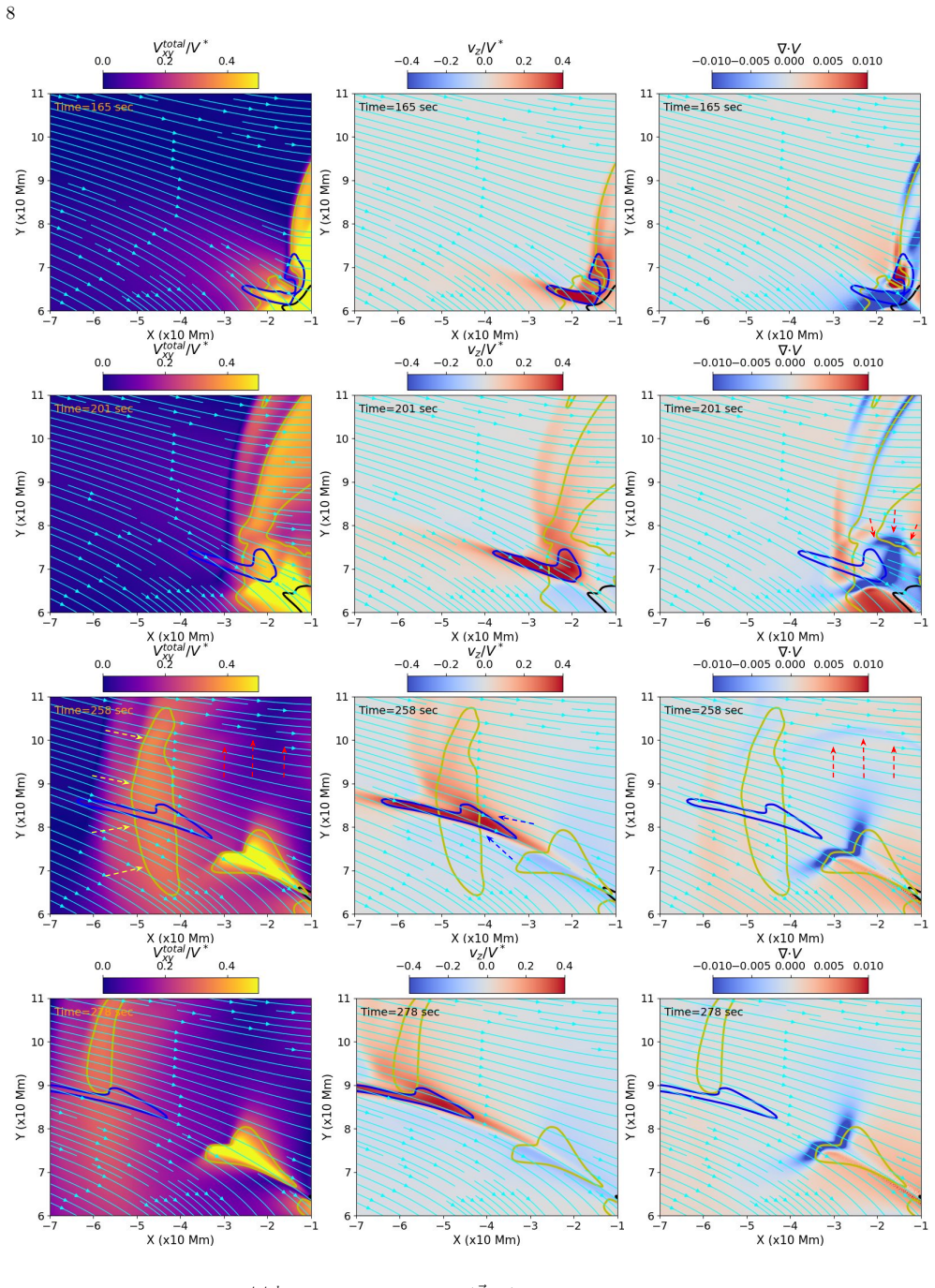
In 2.5D resistive MHD simulations, the interaction of a fast magnetoacoustic wave with a localized coronal null point generates an Alfvén wave packet through mode conversion. Out-of-plane velocity fluctuations and in-phase magnetic field fluctuations propagate along the separatrices with the local Alfvén speed, behaving as an incompressible and energetic disturbance. Some wavefront parts refract around the null while others trap there, and nonlinear effects produce field-aligned flows, with a secondary fast wave also generated.
What carries the argument
Mode conversion at the magnetic null point, where part of the fast magnetoacoustic wavefront produces out-of-plane velocity and magnetic fluctuations that propagate along separatrices as an incompressible Alfvén packet.
Load-bearing premise
The chosen 2.5D resistive MHD setup with its specific initial conditions, resistivity, and null geometry is sufficient to capture the physical mode conversion without 3D or kinetic effects altering the outcome.
What would settle it
High-resolution coronal observations detecting incompressible velocity and magnetic fluctuations propagating along separatrices at Alfvén speed with no intensity signature after a fast wave reaches a null point would support the claim; absence of such signatures would challenge it.
Figures




read the original abstract
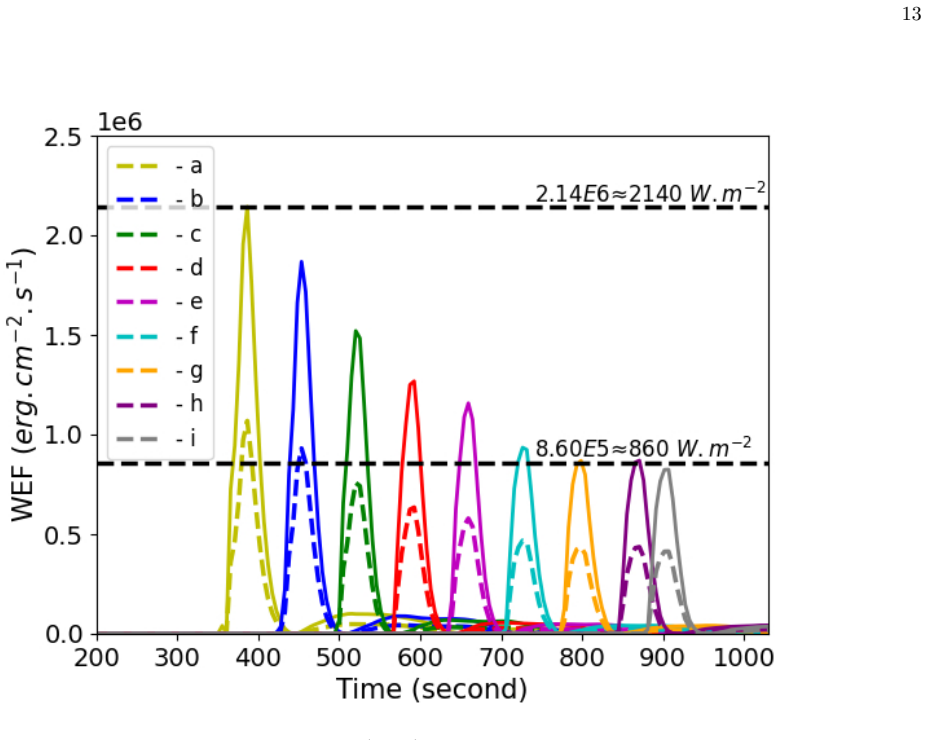
In the present paper, we have performed 2.5D resistive magnetohydrodynamic simulations of the interaction of a fast magnetoacoustic wave with a localized coronal magnetic null point. As a result, an Alfv\'en wave packet is generated by the mode conversion when a fast magnetoacoustic perturbation interacts with the null point. The field-aligned plasma flows are also generated due to the non-linear effects. When the fast mode wavefront interacts with the null, some parts of this wavefront get refracted around it, while some other part is trapped at the null region. Subsequently, the velocity fluctuation out of the plane and in-phase magnetic field fluctuations have evolved and propagated with the local Alfv\'en speed along the separatrixes at one side of the coronal null region. The resulting disturbance behaves as an incompressible and energetic Alfv\'en wave packet. A secondary fast magnetoacoustic wave is also produced and propagates. In the synthetic SDO/AIA observations, no intensity fluctuations are evident in the region where the Alfv\'en wave packet propagates, while the fast magnetoacoustic wave fronts are clearly evident. Our results suggest that given the appropriate physical conditions at the null, when the fast mode wave is incident, Alfv\'en packets can be excited due to the mode conversion, further carrying substantial momentum and energy flux in the solar corona.
Editorial analysis
A structured set of objections, weighed in public.
Referee Report
Summary. The paper claims that 2.5D resistive MHD simulations of a fast magnetoacoustic wave interacting with a localized coronal magnetic null point show mode conversion generating an incompressible energetic Alfvén wave packet (identified via out-of-plane velocity and in-phase magnetic fluctuations propagating at local v_A along separatrices), plus nonlinear field-aligned plasma flows and a secondary fast wave; synthetic SDO/AIA images exhibit no intensity fluctuations where the Alfvén packet propagates.
Significance. If the results hold, the work identifies a concrete mechanism for Alfvén-wave generation and energy/momentum transport in the corona via null-point mode conversion, with the synthetic AIA prediction offering a falsifiable observational test. The direct numerical integration of the MHD equations (low circularity) is a strength, but the absence of reported resolution or convergence data limits immediate impact.
major comments (3)
- [Methods] Methods section: no grid resolution, resistivity value, time-step criterion, or convergence tests are supplied. This is load-bearing for the central claim that the generated disturbance is a robust, incompressible Alfvén packet, because the mode-conversion outcome and its propagation depend on numerical dissipation and the chosen resistive MHD setup.
- [Results/Discussion] Results and Discussion: the entire analysis is performed in 2.5D. The spine-fan topology and additional separatrix surfaces present in 3D can alter current-sheet formation and out-of-plane coupling; the paper provides no test or argument showing that the reported incompressibility, energy flux, or conversion efficiency survive the extra degree of freedom.
- [Results] Results: no comparison is made to linear MHD theory or analytic expectations for fast-to-Alfvén conversion at a null. Without this benchmark, it is difficult to separate physical mode conversion from numerical or initial-condition artifacts.
minor comments (2)
- [Abstract] Abstract and text: the initial wave amplitude, null field strength, and resistivity are free parameters; their specific values and sensitivity should be stated explicitly.
- [Figures] Figure captions and text: clarify how the synthetic AIA intensity is computed (e.g., which emission lines or temperature response) to allow direct comparison with observations.
Simulated Author's Rebuttal
We thank the referee for their constructive and detailed report. We address each major comment below and have revised the manuscript to incorporate additional methodological details and discussion where feasible.
read point-by-point responses
-
Referee: [Methods] Methods section: no grid resolution, resistivity value, time-step criterion, or convergence tests are supplied. This is load-bearing for the central claim that the generated disturbance is a robust, incompressible Alfvén packet, because the mode-conversion outcome and its propagation depend on numerical dissipation and the chosen resistive MHD setup.
Authors: We agree these parameters are necessary for reproducibility and to demonstrate robustness. In the revised manuscript we will add the grid resolution employed, the resistivity value used, the CFL-based time-step criterion, and results of convergence tests performed at multiple resolutions showing that the properties of the generated Alfvén packet (propagation speed, incompressibility, and energy flux) remain consistent. revision: yes
-
Referee: [Results/Discussion] Results and Discussion: the entire analysis is performed in 2.5D. The spine-fan topology and additional separatrix surfaces present in 3D can alter current-sheet formation and out-of-plane coupling; the paper provides no test or argument showing that the reported incompressibility, energy flux, or conversion efficiency survive the extra degree of freedom.
Authors: We acknowledge that full 3D topology introduces additional separatrix surfaces that could modify current-sheet dynamics. Our 2.5D configuration isolates the essential fast-to-Alfvén conversion process along the fan separatrices that are directly relevant to the out-of-plane Alfvénic perturbation. We will add a dedicated paragraph in the Discussion section explicitly noting this limitation, arguing that the local mode-conversion physics at the null is expected to persist, and stating that a 3D extension is reserved for future work. revision: partial
-
Referee: [Results] Results: no comparison is made to linear MHD theory or analytic expectations for fast-to-Alfvén conversion at a null. Without this benchmark, it is difficult to separate physical mode conversion from numerical or initial-condition artifacts.
Authors: We will expand the Results section to include an explicit comparison of the simulated disturbance properties (propagation at the local Alfvén speed, transverse polarization, absence of density fluctuations confirming incompressibility) against standard linear MHD expectations for Alfvén waves. While an exact analytic solution for the nonlinear interaction at a null point is not available in the literature, this benchmark will help distinguish the physical mode conversion from possible artifacts. revision: yes
Circularity Check
No circularity: results from direct numerical integration of MHD equations
full rationale
The paper reports outcomes of 2.5D resistive MHD simulations of wave-null interaction. No analytical derivation chain exists that could reduce predictions to fitted inputs, self-definitions, or self-citation load-bearing steps. Identification of the Alfvén packet follows from the evolved fields and velocities in the simulation output, not from any redefinition or renaming of inputs. Self-citations, if present, are not required to close the central claim.
Axiom & Free-Parameter Ledger
free parameters (3)
- initial wave amplitude
- magnetic resistivity
- null field strength
axioms (2)
- domain assumption Ideal and resistive MHD equations govern the plasma dynamics near the coronal null
- domain assumption 2.5D geometry with translational invariance is adequate to capture the essential mode conversion
Reference graph
Works this paper leans on
-
[1]
Arregui, I. 2015, Philosophical Transactions of the Royal Society of London Series A, 373, 20140261, doi: 10.1098/rsta.2014.0261
-
[2]
Banerjee, D., P´ erez-Su´ arez, D., & Doyle, J. G. 2009, A&A, 501, L15, doi: 10.1051/0004-6361/200912242
-
[3]
Brown, D. S., & Priest, E. R. 2001, A&A, 367, 339, doi: 10.1051/0004-6361:20010016
-
[4]
Cally, P. S. 2011, in Astronomical Society of India Conference Series, Vol. 2, Astronomical Society of India Conference Series, 221–227
2011
-
[5]
Cally, P. S., & Goossens, M. 2008, SoPh, 251, 251, doi: 10.1007/s11207-007-9086-3
-
[6]
2016, ApJ, 822, 106, doi: 10.3847/0004-637X/822/2/106
Uddin, W. 2016, ApJ, 822, 106, doi: 10.3847/0004-637X/822/2/106
-
[7]
F., Fang, C., Chandra, R., & Srivastava, A
Chen, P. F., Fang, C., Chandra, R., & Srivastava, A. K. 2016, SoPh, 291, 3195, doi: 10.1007/s11207-016-0920-3
-
[8]
Srivastava, A. K. 2014, ApJ, 793, 43, doi: 10.1088/0004-637X/793/1/43
-
[9]
Close, R. M., Parnell, C. E., & Priest, E. R. 2004, SoPh, 225, 21, doi: 10.1007/s11207-004-3259-0 De Moortel, I., Ireland, J., Hood, A. W., & Walsh, R. W. 2002a, A&A, 387, L13, doi: 10.1051/0004-6361:20020436 De Moortel, I., Ireland, J., Walsh, R. W., & Hood, A. W. 2002b, SoPh, 209, 61, doi: 10.1023/A:1020956421063 De Pontieu, B., McIntosh, S. W., Carlsso...
-
[10]
Dere, K. P., Landi, E., Young, P. R., et al. 2009, A&A, 498, 915, doi: 10.1051/0004-6361/200911712
-
[11]
P., Keppens, R., & Poedts, S
Goedbloed, J. P., Keppens, R., & Poedts, S. 2010, Advanced Magnetohydrodynamics
2010
-
[12]
2001, Physics of Plasmas, 8, 2371, doi: 10.1063/1.1343090
Goossens, M., & De Groof, A. 2001, Physics of Plasmas, 8, 2371, doi: 10.1063/1.1343090
-
[13]
Goossens, M., Erd´ elyi, R., & Ruderman, M. S. 2011, SSRv, 158, 289, doi: 10.1007/s11214-010-9702-7
-
[14]
Gruszecki, M., Murawski, K., Solanki, S. K., & Ofman, L. 2007, A&A, 469, 1117, doi: 10.1051/0004-6361:20066924
-
[15]
Hansen, S. C., & Cally, P. S. 2012, ApJ, 751, 31, doi: 10.1088/0004-637X/751/1/31
-
[16]
Harten, A. 1997, Journal of Computational Physics, 135, 260, doi: 10.1006/jcph.1997.5713
-
[17]
Heyvaerts, J., & Priest, E. R. 1983, A&A, 117, 220
1983
-
[18]
Hollweg, J. V. 1978, SoPh, 56, 305, doi: 10.1007/BF00152474
-
[19]
Ionson, J. A. 1978, ApJ, 226, 650, doi: 10.1086/156648
-
[20]
Ireland, J., & Priest, E. R. 1997, SoPh, 173, 31, doi: 10.1023/A:1004903128146
-
[21]
Jess, D. B., Jafarzadeh, S., Keys, P. H., et al. 2023, Living Reviews in Solar Physics, 20, 1, doi: 10.1007/s41116-022-00035-6
-
[22]
Keppens, R., Meliani, Z., van Marle, A. J., et al. 2012, Journal of Computational Physics, 231, 718, doi: 10.1016/j.jcp.2011.01.020
-
[23]
2023, A&A, 673, A66, doi: 10.1051/0004-6361/202245359
Keppens, R., Popescu Braileanu, B., Zhou, Y., et al. 2023, A&A, 673, A66, doi: 10.1051/0004-6361/202245359
-
[24]
Kukhianidze, V., Zaqarashvili, T. V., & Khutsishvili, E. 2006, A&A, 449, L35, doi: 10.1051/0004-6361:200600018
-
[25]
Kumar, P., Nakariakov, V. M., Karpen, J. T., & Cho, K.-S. 2024, Nature Communications, 15, 2667, doi: 10.1038/s41467-024-46736-4
-
[26]
2013, ApJ, 766, 55, doi: 10.1088/0004-637X/766/1/55
Kwon, R.-Y., Ofman, L., Olmedo, O., et al. 2013, ApJ, 766, 55, doi: 10.1088/0004-637X/766/1/55
-
[27]
2014, ApJ, 794, 148, doi: 10.1088/0004-637X/794/2/148
Kwon, R.-Y., Zhang, J., & Olmedo, O. 2014, ApJ, 794, 148, doi: 10.1088/0004-637X/794/2/148
-
[28]
2015, ApJL, 799, L29, doi: 10.1088/2041-8205/799/2/L29
Kwon, R.-Y., Zhang, J., & Vourlidas, A. 2015, ApJL, 799, L29, doi: 10.1088/2041-8205/799/2/L29
-
[29]
2025, A&A, 696, A158, doi: 10.1051/0004-6361/202453300
Liakh, V., & Keppens, R. 2025, A&A, 696, A158, doi: 10.1051/0004-6361/202453300
-
[30]
Long, D. M., Bloomfield, D. S., Chen, P. F., et al. 2017, SoPh, 292, 7, doi: 10.1007/s11207-016-1030-y
-
[31]
2017, Scientific Reports, 7, 14820, doi: 10.1038/s41598-017-13660-1
Magyar, N., Van Doorsselaere, T., & Goossens, M. 2017, Scientific Reports, 7, 14820, doi: 10.1038/s41598-017-13660-1
-
[32]
2019, ApJ, 882, 50, doi: 10.3847/1538-4357/ab357c
Magyar, N., Van Doorsselaere, T., & Goossens, M. 2019, ApJ, 882, 50, doi: 10.3847/1538-4357/ab357c
-
[33]
2023, A&A, 675, A129, doi: 10.1051/0004-6361/202346378
Mann, G., Warmuth, A., & ¨Onel, H. 2023, A&A, 675, A129, doi: 10.1051/0004-6361/202346378
-
[34]
McLaughlin, J. A., Ferguson, J. S. L., & Hood, A. W. 2008, SoPh, 251, 563, doi: 10.1007/s11207-007-9107-2
-
[35]
McLaughlin, J. A., & Hood, A. W. 2004, A&A, 420, 1129, doi: 10.1051/0004-6361:20035900
-
[36]
McLaughlin, J. A., & Hood, A. W. 2005, A&A, 435, 313, doi: 10.1051/0004-6361:20042361
-
[37]
McLaughlin, J. A., & Hood, A. W. 2006, A&A, 452, 603, doi: 10.1051/0004-6361:20054575
-
[38]
McLaughlin, J. A., Hood, A. W., & De Moortel, I. 2010, Space Science Reviews, 158, 205–236, doi: 10.1007/s11214-010-9654-y
-
[39]
Mondal, S., Bairagi, A., & Srivastava, A. K. 2025a, ApJ, 979, 207, doi: 10.3847/1538-4357/ada1d6
-
[40]
Mondal, S., Srivastava, A., Bairagi, A., Martinez Sykora, J., & De Pontieu, B. e. a. 2026, ApJL, 000, 00, doi: inpreparation
2026
-
[41]
Mondal, S., Srivastava, A. K., Pontin, D. I., & Priest, E. R. 2025b, ApJ, 989, 222, doi: 10.3847/1538-4357/adf18e
-
[42]
Priest, E. R. 2024, ApJ, 963, 139, doi: 10.3847/1538-4357/ad2079
-
[43]
Moreton, G. E., & Ramsey, H. E. 1960, PASP, 72, 357, doi: 10.1086/127549
-
[44]
1997, SoPh, 175, 571, doi: 10.1023/A:1004902913117
Moses, D., Clette, F., Delaboudini` ere, J.-P., et al. 1997, SoPh, 175, 571, doi: 10.1023/A:1004902913117
-
[45]
Muhr, N., Veronig, A. M., Kienreich, I. W., et al. 2014, SoPh, 289, 4563, doi: 10.1007/s11207-014-0594-7
-
[46]
Murawski, K., Zaqarashvili, T. V., & Nakariakov, V. M. 2011, A&A, 533, A18, doi: 10.1051/0004-6361/201116942
-
[47]
M., Roberts, B., & Murawski, K
Nakariakov, V. M., Roberts, B., & Murawski, K. 1997, SoPh, 175, 93, doi: 10.1023/A:1004965725929
-
[48]
Nakariakov, V. M., & Verwichte, E. 2005, Living Reviews in Solar Physics, 2, 3, doi: 10.12942/lrsp-2005-3
-
[49]
Nitta, N. V., Schrijver, C. J., Title, A. M., & Liu, W. 2013, ApJ, 776, 58, doi: 10.1088/0004-637X/776/1/58
-
[50]
2009, SSRv, 149, 153, doi: 10.1007/s11214-009-9501-1
Ofman, L. 2009, SSRv, 149, 153, doi: 10.1007/s11214-009-9501-1
-
[51]
Ofman, L., & Davila, J. M. 1995, J. Geophys. Res., 100, 23413, doi: 10.1029/95JA02222
-
[52]
2018, ApJ, 860, 54, doi: 10.3847/1538-4357/aac2e8
Ofman, L., & Liu, W. 2018, ApJ, 860, 54, doi: 10.3847/1538-4357/aac2e8
-
[53]
Okamoto, T. J., Tsuneta, S., Berger, T. E., et al. 2007, Science, 318, 1577, doi: 10.1126/science.1145447
-
[54]
Pontin, D. I., Priest, E. R., & Galsgaard, K. 2013, ApJ, 774, 154, doi: 10.1088/0004-637X/774/2/154 19
-
[55]
Porter, L. J., Klimchuk, J. A., & Sturrock, P. A. 1994, ApJ, 435, 482, doi: 10.1086/174830
-
[56]
Porth, O., Xia, C., Hendrix, T., Moschou, S. P., & Keppens, R. 2014, ApJS, 214, 4, doi: 10.1088/0067-0049/214/1/4
-
[57]
2022, ApJ, 924, 126, doi: 10.3847/1538-4357/ac3b5f
Sabri, S., Ebadi, H., & Poedts, S. 2022, ApJ, 924, 126, doi: 10.3847/1538-4357/ac3b5f
-
[58]
2017, A&A, 602, A43, doi: 10.1051/0004-6361/201629729
Vicente, A. 2017, A&A, 602, A43, doi: 10.1051/0004-6361/201629729
-
[59]
2022, A&A, 666, A28, doi: 10.1051/0004-6361/202244152
Sen, S., & Keppens, R. 2022, A&A, 666, A28, doi: 10.1051/0004-6361/202244152
-
[60]
2012, ApJL, 752, L23, doi: 10.1088/2041-8205/752/2/L23
Shen, Y., & Liu, Y. 2012, ApJL, 752, L23, doi: 10.1088/2041-8205/752/2/L23
-
[61]
K., Lagg, A., Woch, J., Krupp, N., & Collados, M
Solanki, S. K., Lagg, A., Woch, J., Krupp, N., & Collados, M. 2003, Nature, 425, 692, doi: 10.1038/nature02035
-
[62]
1962, Physics of Fully Ionized Gases
Spitzer, L. 1962, Physics of Fully Ionized Gases
1962
-
[63]
K., Shetye, J., Murawski, K., et al
Srivastava, A. K., Shetye, J., Murawski, K., et al. 2017, Scientific Reports, 7, 43147, doi: 10.1038/srep43147
-
[64]
Srivastava, A. K., Ballester, J. L., Cally, P. S., et al. 2021, Journal of Geophysical Research (Space Physics), 126, e029097, doi: 10.1029/2020JA029097
-
[65]
The Astrophysical Journal , keywords =
Srivastava, A. K., Mondal, S., Priest, E. R., et al. 2025, ApJ, 984, 36, doi: 10.3847/1538-4357/adc379
-
[66]
Syntelis, P., & Priest, E. R. 2020, ApJ, 891, 52, doi: 10.3847/1538-4357/ab6ffc
-
[67]
Tarr, L. A., Linton, M., & Leake, J. 2017, ApJ, 837, 94, doi: 10.3847/1538-4357/aa5e4e
-
[68]
Thompson, B. J., Plunkett, S. P., Gurman, J. B., et al. 1998, Geophys. Res. Lett., 25, 2465, doi: 10.1029/98GL50429
-
[69]
Thurgood, J. O., & McLaughlin, J. A. 2013, A&A, 555, A86, doi: 10.1051/0004-6361/201321338
-
[70]
1968, SoPh, 4, 30, doi: 10.1007/BF00146996
Uchida, Y. 1968, SoPh, 4, 30, doi: 10.1007/BF00146996
-
[71]
Veronig, A. M., Muhr, N., Kienreich, I. W., Temmer, M., & Vrˇ snak, B. 2010, ApJL, 716, L57, doi: 10.1088/2041-8205/716/1/L57
-
[72]
2004, ApJL, 605, L149, doi: 10.1086/420927
Voitenko, Y., & Goossens, M. 2004, ApJL, 605, L149, doi: 10.1086/420927
-
[73]
2026, arXiv e-prints, arXiv:2603.13456, doi: 10.48550/arXiv.2603.13456
Wang, T., Liu, W., Ofman, L., Sun, X., & Jin, M. 2026, arXiv e-prints, arXiv:2603.13456, doi: 10.48550/arXiv.2603.13456
-
[74]
2015, Living Reviews in Solar Physics, 12, 3, doi: 10.1007/lrsp-2015-3
Warmuth, A. 2015, Living Reviews in Solar Physics, 12, 3, doi: 10.1007/lrsp-2015-3
-
[75]
2011, A&A, 532, A151, doi: 10.1051/0004-6361/201116685
Warmuth, A., & Mann, G. 2011, A&A, 532, A151, doi: 10.1051/0004-6361/201116685
-
[76]
Wentzel, D. G. 1974, SoPh, 39, 129, doi: 10.1007/BF00154975
-
[77]
Withbroe, G. L., & Noyes, R. W. 1977, ARA&A, 15, 363, doi: 10.1146/annurev.aa.15.090177.002051
-
[78]
Wright, A. N. 1991, Geophys. Res. Lett., 18, 1951, doi: 10.1029/91GL02630
-
[79]
2018, ApJS, 234, 30, doi: 10.3847/1538-4365/aaa6c8
Xia, C., Teunissen, J., El Mellah, I., Chan´ e, E., & Keppens, R. 2018, ApJS, 234, 30, doi: 10.3847/1538-4365/aaa6c8
-
[80]
2022, A&A, 660, A21, doi: 10.1051/0004-6361/202142688
Yadav, N., Keppens, R., & Popescu Braileanu, B. 2022, A&A, 660, A21, doi: 10.1051/0004-6361/202142688
discussion (0)
Sign in with ORCID, Apple, or X to comment. Anyone can read and Pith papers without signing in.