A Unified Framework for Uniform-Price Resource Allocation Mechanisms
Pith reviewed 2026-06-27 23:07 UTC · model grok-4.3
The pith
A unified framework generates a family of uniform-price mechanisms that interpolate between the Kelly mechanism and the first-price auction while improving efficiency.
A machine-rendered reading of the paper's core claim, the machinery that carries it, and where it could break.
Core claim
The paper's central claim is that a unified framework for uniform-price resource allocation mechanisms with proportional-style allocations yields a family of mechanisms that interpolate between the Kelly mechanism and the first-price auction. These mechanisms strictly improve upon Kelly's efficiency guarantees, even achieving full efficiency in equilibrium, while also providing revenue guarantees relative to the VCG mechanism.
What carries the argument
The interpolation parameter that continuously connects proportional allocation with uniform pricing to first-price rules, producing the family of mechanisms.
If this is right
- Mechanisms in the family achieve strictly higher social welfare than the Kelly mechanism in equilibrium.
- Particular parameter choices reach full efficiency in equilibrium.
- The mechanisms deliver revenue that is competitive with the VCG mechanism.
Where Pith is reading between the lines
- Designers could select the interpolation parameter to tune the efficiency-revenue tradeoff for a given application.
- The same interpolation idea might apply to other simple mechanism classes beyond single-resource allocation.
Load-bearing premise
The performance claims depend on agents playing according to a specific equilibrium concept with quasi-linear utilities over a perfectly divisible resource.
What would settle it
An explicit instance with known agent valuations where every equilibrium of the interpolated mechanisms yields welfare no higher than the Kelly mechanism would falsify the efficiency improvement claim.
Figures
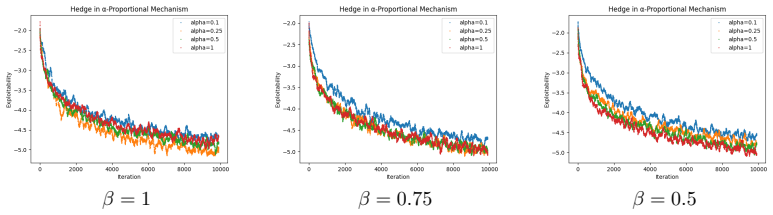
read the original abstract
Mechanisms for allocating a divisible resource among strategic agents have been widely studied. The prominent paradigm is the proportional (Kelly) mechanism, which elicits a scalar bid per agent, allocates the resource proportionally, and charges payments equal to the bids. Follow-up mechanisms improve social welfare, but sacrifice simplicity by introducing complex allocation rules or unintuitive payments. We introduce a unified framework for designing simple resource allocation mechanisms with proportional-style allocations and uniform pricing. Our framework yields a family of mechanisms that interpolate between the Kelly mechanism and the first-price auction. These mechanisms strictly improve upon Kelly's efficiency guarantees, even achieving full efficiency in equilibrium, while also providing revenue guarantees relative to the VCG mechanism.
Editorial analysis
A structured set of objections, weighed in public.
Referee Report
Summary. The paper proposes a unified framework for uniform-price resource allocation mechanisms that use proportional-style allocations. It generates a parameterized family of mechanisms interpolating between the Kelly mechanism and the first-price auction. The central claims are that members of this family strictly improve Kelly's efficiency guarantees, with some achieving full efficiency in equilibrium, while also providing revenue guarantees relative to VCG.
Significance. If the equilibrium analysis and efficiency claims hold, the framework would offer a simple, parameterized approach to improving welfare over the Kelly mechanism without introducing complex allocation rules, while retaining uniform pricing. This could be useful for practical divisible-resource settings such as network bandwidth allocation.
major comments (1)
- [Abstract] Abstract: The headline claim that certain interpolated mechanisms achieve full efficiency in equilibrium requires that the equilibrium bids produce an allocation solving max sum v_i(x_i) s.t. sum x_i =1. The provided text supplies no explicit derivation showing that the uniform-price first-order condition imposes the required marginal-valuation relation for general quasi-linear valuations once the interpolation parameter departs from the Kelly endpoint; this step is load-bearing for the efficiency improvement result.
Simulated Author's Rebuttal
We thank the referee for the careful reading and for identifying a load-bearing step in the efficiency argument. We address the comment below and will revise accordingly.
read point-by-point responses
-
Referee: [Abstract] Abstract: The headline claim that certain interpolated mechanisms achieve full efficiency in equilibrium requires that the equilibrium bids produce an allocation solving max sum v_i(x_i) s.t. sum x_i =1. The provided text supplies no explicit derivation showing that the uniform-price first-order condition imposes the required marginal-valuation relation for general quasi-linear valuations once the interpolation parameter departs from the Kelly endpoint; this step is load-bearing for the efficiency improvement result.
Authors: We agree that an explicit derivation of the first-order condition is necessary to substantiate the full-efficiency claim for interpolated mechanisms. In the revised manuscript we will insert a dedicated subsection (immediately following the equilibrium characterization) that derives the marginal-valuation relation from the uniform-price payment rule and the parameterized proportional allocation. The derivation shows that, for any interpolation parameter θ ∈ (0,1], the equilibrium condition reduces to v_i'(x_i*) = λ for all i with x_i*>0, which is precisely the KKT condition for the social-welfare maximization problem under the resource constraint. We will also add a short remark clarifying why the same relation holds for general quasi-linear valuations and does not require the specific functional form used in the Kelly endpoint. revision: yes
Circularity Check
No circularity detected; derivation self-contained
full rationale
The abstract and claims describe a framework interpolating between the Kelly mechanism and first-price auction, deriving efficiency and revenue properties from the defined allocation and payment rules under standard equilibrium concepts. No quoted equations or steps reduce the claimed full-efficiency result to a fitted parameter, self-definition, or load-bearing self-citation by construction. The central results are presented as following from the mechanism design and equilibrium analysis without the patterns of self-referential reduction enumerated in the guidelines. This is the expected outcome for a mechanism-design paper whose properties are externally verifiable via the stated rules.
Axiom & Free-Parameter Ledger
axioms (2)
- domain assumption Agents have quasi-linear utilities and play in (Bayes-)Nash equilibrium
- domain assumption The resource is perfectly divisible with no minimum-size constraints
Reference graph
Works this paper leans on
-
[1]
Matthew Weinberg
Nick Arnosti and S. Matthew Weinberg. Bitcoin: A Natural Oligopoly. InProceedings of the 10th Innovations in Theoretical Computer Science Conference (ITCS), pages 5:1–5:1, 2019
2019
-
[2]
Centralization in block-building and proposer-builder separation
Maryam Bahrani, Pranav Garimidi, and Tim Roughgarden. Centralization in block-building and proposer-builder separation. InProceedings of the 28th International Conference in Financial Cryptography and Data Security (FC), pages 331–349, 2024
2024
-
[3]
V oudouris
Ioannis Caragiannis and Alexandros A. V oudouris. Welfare guarantees for proportional alloca- tions.Theory of Computing Systems, 59(4):581–599, 2016
2016
-
[4]
V oudouris
Ioannis Caragiannis and Alexandros A. V oudouris. The efficiency of resource allocation mechanisms for budget-constrained users.Mathematics of Operations Research, 46(2):503– 523, 2021
2021
-
[5]
On the efficiency of the proportional allocation mechanism for divisible resources.Theory of Computing Systems, 59(4):600–618, 2016
George Christodoulou, Alkmini Sgouritsa, and Bo Tang. On the efficiency of the proportional allocation mechanism for divisible resources.Theory of Computing Systems, 59(4):600–618, 2016
2016
-
[6]
Correa, Andreas S
José R. Correa, Andreas S. Schulz, and Nicolás E. Stier Moses. The price of anarchy of the proportional allocation mechanism revisited. InProceedings of the 9th International Conference on Web and Internet Economics (WINE), pages 109–120, 2013
2013
-
[7]
The complexity of constrained min-max optimization
Constantinos Daskalakis, Stratis Skoulakis, and Manolis Zampetakis. The complexity of constrained min-max optimization. InProceedings of the 53rd Annual ACM SIGACT Symposium on Theory of Computing (STOC), pages 1466–1478. ACM, 2021
2021
-
[8]
Tullock contests in the wild: Appli- cations in blockchains.SIGecom Exchanges, 23(1), 2025
Pranav Garimidi, Michael Neuder, and Tim Roughgarden. Tullock contests in the wild: Appli- cations in blockchains.SIGecom Exchanges, 23(1), 2025
2025
-
[9]
Tsitsiklis
Ramesh Johari and John N. Tsitsiklis. Efficiency loss in a network resource allocation game. Mathematics of Operations Research, 29(3):407–435, 2004
2004
-
[10]
Tsitsiklis
Ramesh Johari and John N. Tsitsiklis. Efficiency of scalar-parameterized mechanisms.Opera- tions Research, 57(4):823–839, 2009
2009
-
[11]
Frank P. Kelly. Charging and rate control for elastic traffic.European Transactions on Telecommunications, 8:33–37, 1997
1997
-
[12]
Kelly, A.K
Frank P. Kelly, A.K. Maulloo, and D. Tan. Rate control for communication networks:shadow prices, proportional fairness and stability.Journal of the Operational Research Society, 49(3):237–252, 1998
1998
-
[13]
La and Venkat Anantharam
Richard J. La and Venkat Anantharam. Charge-sensitive TCP and rate control in the internet. In Proceedings of the 19th Annual Joint Conference of the IEEE Computer and Communications Societies (INFOCOM), volume 3, pages 1166–1175, 2000
2000
-
[14]
Rajiv Maheswaran and Tamer Basar. Efficient signal proportional allocation (ESPA) mecha- nisms: decentralized social welfare maximization for divisible resources.IEEE Journal on Selected Areas in Communications, 24(5):1000–1009, 2006
2006
-
[15]
Churchill Lectures in Economics
Paul Milgrom.Vickrey–Clarke–Groves Mechanisms, page 45–63. Churchill Lectures in Economics. Cambridge University Press, 2004
2004
-
[16]
Optimal allocation of a divisible good to strategic buyers
Sujay Sanghavi and Bruce Hajek. Optimal allocation of a divisible good to strategic buyers. In Proceedings of the 43rd IEEE Conference on Decision and Control (CDC), pages 2748–2753, 2004. 10
2004
-
[17]
Stoica, H
I. Stoica, H. Abdel-Wahab, K. Jeffay, S.K. Baruah, J.E. Gehrke, and C.G. Plaxton. A propor- tional share resource allocation algorithm for real-time, time-shared systems. InProceedings of the 17th IEEE Real-Time Systems Symposium (RTSS), pages 288–299, 1996
1996
-
[18]
Composable and efficient mechanisms
Vasilis Syrgkanis and Éva Tardos. Composable and efficient mechanisms. In Dan Boneh, Tim Roughgarden, and Joan Feigenbaum, editors,Proceedings of the 45th Annual ACM Symposium on Theory of Computing (STOC), pages 211–220, 2013
2013
-
[19]
On the efficient organization of trials.Kyklos, 28(4):745–762, 1975
Gordon Tullock. On the efficient organization of trials.Kyklos, 28(4):745–762, 1975
1975
-
[20]
Efficient rent seeking
Gordon Tullock. Efficient rent seeking. In Victor P. Goldberg, editor,Readings in the Economics of Contract Law, page 35–42. Cambridge University Press, 1982
1982
-
[21]
Cambridge University Press, 2016
Milan V ojnovi´c.Contest Theory: Incentive Mechanisms and Ranking Methods. Cambridge University Press, 2016
2016
-
[22]
VCG-Kelly mechanisms for allocation of divisible goods: Adapting VCG mechanisms to one-dimensional signals
Sichao Yang and Bruce Hajek. VCG-Kelly mechanisms for allocation of divisible goods: Adapting VCG mechanisms to one-dimensional signals. InProceedings of the 40th Annual Conference on Information Sciences and Systems (CISS), pages 1391–1396, 2006. 11 A Related Work In Table 3, we summarize the properties of the α-proportional mechanism, the mechanism of J...
2006
-
[23]
There existsµ >0such that for any agenti∈[n]withx ⋆ i >0, µ=v ′ i+(x⋆ i )· 1−x ⋆ i 1−(1−α)x ⋆ i
-
[24]
The strategy profile s⋆ ∈R n + defined as s⋆ i =x ⋆ i ·µ 1/α is a Nash Equilibrium of the α-proportional mechanism. Proof. Let a strategy profile s= (s 1, . . . , sn) and consider S:= Pn i=1 si. Then, the α-proportional mechanism allocates to each agenti∈[n] xi(s) = si/SifS >0, 0ifS= 0, and charges payment pi(s) = si/S1−α ifS >0, 0ifS= 0. By the definitio...
-
[25]
Hence the double sum is simplified to(n−1) Pn i=1 gixi
Moreover, we observe that each term gjxj appears exactly n−1 times in the double sumPn i=1 P j̸=i gjxj . Hence the double sum is simplified to(n−1) Pn i=1 gixi . Corollary 2.Let ⃗ x= (x1, . . . , xn) be the equilibrium allocation of the α-proportional mechanism, where the players are indexed so thatx 1 ≥x 2 ≥ · · · ≥x n. Then, RevVCG ≤Rev α " 1 +α x2 1−x ...
discussion (0)
Sign in with ORCID, Apple, or X to comment. Anyone can read and Pith papers without signing in.