Detecting Tidal Resonances in Binary Neutron Stars
Pith reviewed 2026-06-28 00:01 UTC · model grok-4.3
The pith
The Einstein Telescope can detect tidal resonances in binary neutron stars by measuring gravitational-wave phase shifts as small as 0.03 radians.
A machine-rendered reading of the paper's core claim, the machinery that carries it, and where it could break.
Core claim
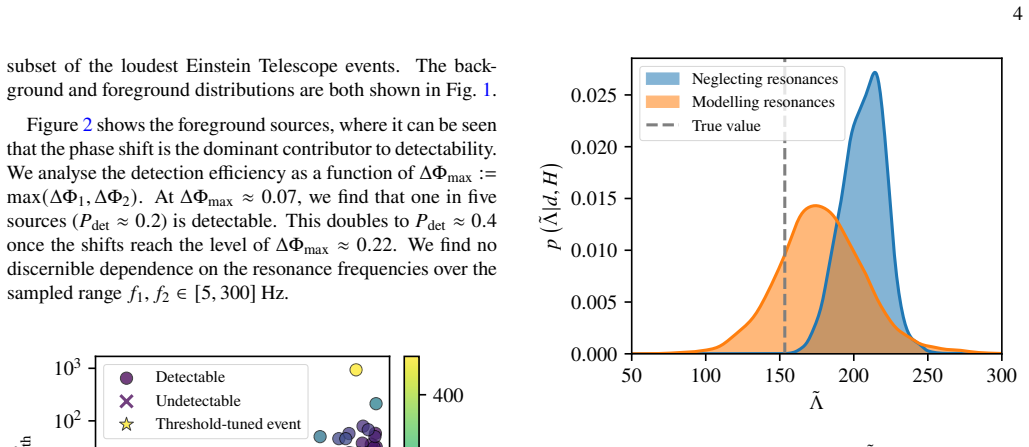
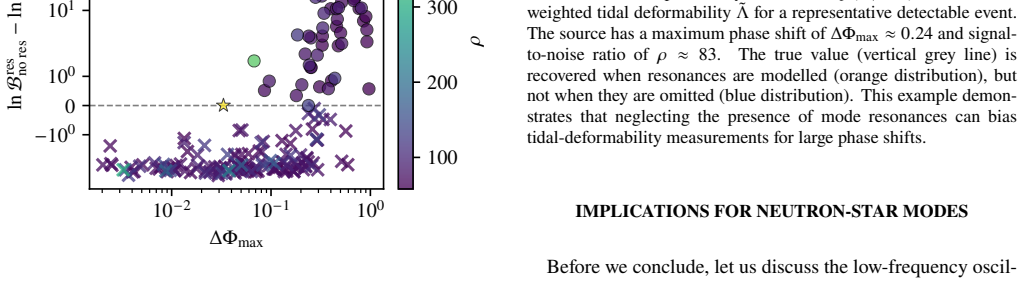
The Einstein Telescope can identify resonant modes and is sensitive to gravitational-wave phase shifts as small as ΔΦ ≈ 0.03 for favourable events. Neglecting resonances can bias the inferred tidal deformabilities. These results establish tidal resonances as a measurable route for asteroseismology with future detectors.
What carries the argument
Resonant excitation of stellar vibrational modes by the rising tidal frequency during binary inspiral, which imprints measurable phase shifts onto the gravitational waveform.
If this is right
- Resonance detections would supply an independent observable for neutron-star interior structure beyond tidal deformability.
- Tidal deformability measurements extracted from gravitational-wave data must include resonance effects to remain unbiased.
- Asteroseismology of neutron stars becomes feasible using gravitational-wave signals from binary mergers.
- The same phase-shift sensitivity sets a practical target for waveform modeling in future detector analyses.
Where Pith is reading between the lines
- Resonance measurements could be combined with existing tidal deformability constraints to map specific oscillation frequencies to density profiles inside neutron stars.
- The approach could be applied to data from other planned detectors once their sensitivity reaches comparable levels in the relevant frequency band.
- Population-level studies of neutron-star binaries would need to incorporate resonance modeling to avoid systematic offsets in inferred parameters across catalogs.
Load-bearing premise
The simulated waveforms and noise realizations accurately capture the real detector response and that the Bayesian pipeline can distinguish resonance-induced phase shifts from other waveform features without significant false positives or model mismatch.
What would settle it
Absence of any preference for resonance-inclusive models over resonance-free models in the Bayesian analysis of the 200 loudest binary neutron-star events recorded in one year of Einstein Telescope data.
Figures

read the original abstract
As a binary neutron star inspirals due to the emission of gravitational waves, the rising tidal frequency resonantly excites vibrational modes. These oscillations are seismological probes of the rich stellar interior, yet it remains to be established whether gravitational-wave interferometers can measure them. Here, we present the first fully Bayesian study of the capability of the Einstein Telescope to detect tidal resonances. We simulate one year of observations and analyse the 200 loudest signals. We find that the Einstein Telescope can identify resonant modes and is sensitive to gravitational-wave phase shifts as small as $\Delta \Phi \approx 0.03$ for favourable events. We further show that neglecting resonances can bias the inferred tidal deformabilities. These results establish tidal resonances as a measurable route for asteroseismology with future detectors.
Editorial analysis
A structured set of objections, weighed in public.
Referee Report
Summary. The manuscript presents the first fully Bayesian study of tidal resonance detectability in binary neutron star inspirals with the Einstein Telescope. It simulates one year of observations, selects the 200 loudest signals, and claims that ET can identify resonant modes with sensitivity to gravitational-wave phase shifts as small as ΔΦ ≈ 0.03 for favourable events, while also showing that neglecting resonances biases inferred tidal deformabilities.
Significance. If the simulation and recovery results hold under more realistic conditions, this would establish tidal resonances as a quantitative asteroseismological probe accessible to future detectors, extending GW science beyond standard tidal deformability measurements. The fully Bayesian treatment of 200 events and the explicit sensitivity threshold provide a statistical foundation that strengthens the central claims.
major comments (2)
- [Abstract] Abstract and simulation setup: The claim of sensitivity to ΔΦ ≈ 0.03 and bias in tidal deformabilities rests on the Bayesian pipeline applied to 200 simulated signals, yet the text provides no details on the waveform family (injection vs. recovery), priors, or explicit validation tests against injected signals with controlled resonance strength. This prevents verification that resonance phase shifts are isolated from other effects.
- [Methods] Methods describing the waveform model and noise realization: The forward simulation and recovery must embed the resonance exactly as modeled while drawing noise from the ET PSD; without reported cross-validation using independent resonance implementations or inclusion of unmodeled physics (higher-order tides, spin effects), the reported detectability and bias results risk being artifacts of the shared model rather than genuine sensitivity.
Simulated Author's Rebuttal
We thank the referee for their constructive report and recommendation for major revision. We address each major comment below, indicating where revisions will be made to improve clarity and verifiability.
read point-by-point responses
-
Referee: [Abstract] Abstract and simulation setup: The claim of sensitivity to ΔΦ ≈ 0.03 and bias in tidal deformabilities rests on the Bayesian pipeline applied to 200 simulated signals, yet the text provides no details on the waveform family (injection vs. recovery), priors, or explicit validation tests against injected signals with controlled resonance strength. This prevents verification that resonance phase shifts are isolated from other effects.
Authors: We agree that the manuscript would be strengthened by explicit details on these elements. In the revised version we will expand the Methods section to specify the waveform family employed for both injection and recovery, enumerate the priors used in the Bayesian analysis, and report validation tests in which signals with controlled resonance strengths (ΔΦ ranging from 0 to 0.1 rad) were injected and recovered to confirm that the phase-shift signature is isolated from other parameters. revision: yes
-
Referee: [Methods] Methods describing the waveform model and noise realization: The forward simulation and recovery must embed the resonance exactly as modeled while drawing noise from the ET PSD; without reported cross-validation using independent resonance implementations or inclusion of unmodeled physics (higher-order tides, spin effects), the reported detectability and bias results risk being artifacts of the shared model rather than genuine sensitivity.
Authors: The simulations embed the resonance identically in the forward model and recovery while drawing noise from the ET PSD. We acknowledge that the study does not include cross-validation against independent resonance implementations or additional unmodeled effects such as higher-order tides and spin. We will revise the text to state these modeling assumptions explicitly and to note that extending the analysis to more realistic conditions remains an important avenue for future work. revision: partial
Circularity Check
No circularity: results follow from independent forward simulation and Bayesian recovery
full rationale
The paper conducts a simulation study by generating one year of Einstein Telescope observations with injected resonant tidal effects, then performs fully Bayesian parameter estimation on the 200 loudest events to measure detectability of phase shifts and bias in tidal deformabilities. These outcomes are produced by the forward modeling plus inference pipeline and do not reduce to any fitted input, self-defined quantity, or self-citation chain by the paper's own equations. The abstract and described methodology contain no load-bearing steps that equate the claimed sensitivity (ΔΦ ≈ 0.03) or bias result to the simulation inputs by construction.
Axiom & Free-Parameter Ledger
Reference graph
Works this paper leans on
-
[1]
Chatziioannou, H
K. Chatziioannou, H. T. Cromartie, S. Gandolfi, I. Tews, D. Radice, A. W. Steiner, and A. L. Watts, Rev. Mod. Phys. 97, 045007 (2025)
2025
-
[2]
A. G. Abacet al.(LIGO Scientific, Virgo, KAGRA), arXiv:2508.18082 [gr-qc] (2025)
Pith/arXiv arXiv 2025
-
[3]
B. P. Abbottet al.(LIGO Scientific, Virgo), Phys. Rev. Lett. 119, 161101 (2017)
2017
-
[4]
B. P. Abbottet al.(LIGO Scientific, Virgo), Phys. Rev. X9, 011001 (2019)
2019
-
[5]
B. P. Abbottet al.(LIGO Scientific, Virgo), Phys. Rev. Lett. 121, 161101 (2018)
2018
-
[6]
T. E. Rileyet al., Astrophys. J.887, L21 (2019)
2019
-
[7]
M. C. Milleret al., Astrophys. J.887, L24 (2019)
2019
-
[8]
T. E. Rileyet al., Astrophys. J.918, L27 (2021)
2021
-
[9]
M. C. Milleret al., Astrophys. J.918, L28 (2021)
2021
-
[10]
A.Abacet al.(ET),J.Cosmol.Astropart.Phys.03,081(2026)
2026
-
[11]
Evanset al., arXiv:2306.13745 [astro-ph.IM] (2023)
M. Evanset al., arXiv:2306.13745 [astro-ph.IM] (2023)
arXiv 2023
-
[12]
Guptaet al., Class
I. Guptaet al., Class. Quantum Gravity41, 245001 (2024)
2024
-
[13]
E.E.FlanaganandT.Hinderer,Phys.Rev.D77,021502(2008)
2008
-
[14]
Hinderer, Astrophys
T. Hinderer, Astrophys. J.677, 1216 (2008), [Erratum: Astro- phys. J.697, 964 (2009)]
2008
-
[15]
Binnington and E
T. Binnington and E. Poisson, Phys. Rev. D80, 084018 (2009)
2009
-
[16]
Damour and A
T. Damour and A. Nagar, Phys. Rev. D80, 084035 (2009)
2009
-
[17]
A.ReiseneggerandP.Goldreich,Astrophys.J.426,688(1994)
1994
-
[18]
Lai, Mon
D. Lai, Mon. Not. R. Astron. Soc.270, 611 (1994)
1994
-
[19]
E. E. Flanagan and E. Racine, Phys. Rev. D75, 044001 (2007)
2007
-
[20]
J.Steinhoff,T.Hinderer,A.Buonanno,andA.Taracchini,Phys. Rev. D94, 104028 (2016)
2016
-
[21]
Poisson, Phys
E. Poisson, Phys. Rev. D103, 064023 (2021)
2021
-
[22]
Pitre and E
T. Pitre and E. Poisson, Phys. Rev. D109, 064004 (2024)
2024
-
[23]
Hegade K
A. Hegade K. R., J. L. Ripley, and N. Yunes, Phys. Rev. D109, 104064 (2024)
2024
-
[24]
Hegade K
A. Hegade K. R., K. J. Kwon, T. Venumadhav, H. Yu, and N. Yunes, Phys. Rev. Lett.136, 071401 (2026)
2026
-
[25]
Hindereret al., Phys
T. Hindereret al., Phys. Rev. Lett.116, 181101 (2016)
2016
-
[26]
Schmidt and T
P. Schmidt and T. Hinderer, Phys. Rev. D100, 021501 (2019)
2019
-
[27]
A.Abac,T.Dietrich,A.Buonanno,J.Steinhoff,andM.Ujevic, Phys. Rev. D109, 024062 (2024)
2024
-
[28]
G.Pratten,P.Schmidt,andT.Hinderer,Nat.Commun.11,2553 (2020)
2020
-
[29]
Williams, G
N. Williams, G. Pratten, and P. Schmidt, Phys. Rev. D105, 123032 (2022)
2022
-
[30]
Pratten, P
G. Pratten, P. Schmidt, and N. Williams, Phys. Rev. Lett.129, 081102 (2022)
2022
-
[31]
P. Balachandran and E. E. Flanagan, arXiv:gr-qc/0701076 (2007)
Pith/arXiv arXiv 2007
-
[32]
H.YuandN.N.Weinberg,Mon.Not.R.Astron.Soc.464,2622 (2017)
2017
-
[33]
Vallisneri, Phys
M. Vallisneri, Phys. Rev. D77, 042001 (2008)
2008
-
[34]
W. C. G. Ho and N. Andersson, Phys. Rev. D108, 043003 (2023)
2023
-
[35]
A.Revilla-Peña,R.Bondarescu,A.P.Lundgren,andJ.Miralda- Escudé, arXiv:2601.21086 [gr-qc] (2026)
Pith/arXiv arXiv 2026
-
[36]
Poisson, Phys
E. Poisson, Phys. Rev. D101, 104028 (2020)
2020
-
[37]
Pratten, S
G. Pratten, S. Husa, C. Garcia-Quiros, M. Colleoni, A. Ramos- Buades, H. Estelles, and R. Jaume, Phys. Rev. D102, 064001 (2020)
2020
-
[38]
LIGO Scientific Collaboration, Virgo Collaboration, and KA- GRA Collaboration, LVK Algorithm Library - LALSuite, Free software (GPL) (2018)
2018
-
[39]
J.672, 479 (2008)
R.W.O’Shaughnessy,C.Kim,V.Kalogera,andK.Belczynski, 6 Astrophys. J.672, 479 (2008)
2008
-
[40]
J.325, 725 (1988)
P.N.McDermott,H.M.vanHorn,andC.J.Hansen,Astrophys. J.325, 725 (1988)
1988
-
[41]
Koehnet al., Phys
H. Koehnet al., Phys. Rev. X15, 021014 (2025)
2025
-
[42]
Iorioet al., Mon
G. Iorioet al., Mon. Not. R. Astron. Soc.524, 426 (2023)
2023
-
[43]
Astrophys.652, C4 (2021)]
N.Aghanimet al.(Planck),Astron.Astrophys.641,A6(2020), [Erratum: Astron. Astrophys.652, C4 (2021)]
2020
-
[44]
Hildet al., Class
S. Hildet al., Class. Quantum Gravity28, 094013 (2011)
2011
-
[45]
J. S. Speagle, Mon. Not. R. Astron. Soc.493, 3132 (2020)
2020
-
[46]
Ashtonet al., Astrophys
G. Ashtonet al., Astrophys. J. Suppl. Ser.241, 27 (2019)
2019
-
[47]
B. Zackay, L. Dai, and T. Venumadhav, arXiv:1806.08792 [astro-ph.IM] (2018)
Pith/arXiv arXiv 2018
-
[48]
Narola, J
H. Narola, J. Janquart, Q. Meijer, K. Haris, and C. Van Den Broeck, Phys. Rev. D110, 084085 (2024)
2024
-
[49]
Leslie, L
N. Leslie, L. Dai, and G. Pratten, Phys. Rev. D104, 123030 (2021)
2021
-
[50]
A. H. Nitz and T. Dal Canton, Astrophys. J.917, L27 (2021)
2021
-
[51]
Veitch and A
J. Veitch and A. Vecchio, Phys. Rev. D81, 062003 (2010)
2010
-
[52]
A.ReiseneggerandP.Goldreich,Astrophys.J.395,240(1992)
1992
-
[53]
Counsell, F
R. Counsell, F. Gittins, N. Andersson, and P. Pnigouras, Mon. Not. R. Astron. Soc.536, 1967 (2024)
1967
-
[54]
K. H. Lockitch and J. L. Friedman, Astrophys. J.521, 764 (1999)
1999
-
[55]
D.Tsang,J.S.Read,T.Hinderer,A.L.Piro,andR.Bondarescu, Phys. Rev. Lett.108, 011102 (2012)
2012
-
[56]
Y.Gao,H.-J.Kuan,C.-J.Xia,H.O.Silva,andM.Shibata,Phys. Rev. D112, 123006 (2025)
2025
-
[57]
Z. Miao, E. Zhou, and A. Li, Astrophys. J.964, 31 (2024)
2024
-
[58]
Lett.135, 081402 (2025)
A.R.Counsell,F.Gittins,N.Andersson,andI.Tews,Phys.Rev. Lett.135, 081402 (2025)
2025
-
[59]
J.P.Pereira,L.Tonetto,M.Bejger,J.L.Zdunik,andP.Haensel, Phys. Rev. Lett.135, 231401 (2025)
2025
-
[60]
H. Yu, P. Arras,and N.N. Weinberg,Phys. Rev.D110,024039 (2024)
2024
-
[61]
P.Pnigouras,N.Andersson,F.Gittins,andA.R.Counsell,Mon. Not. R. Astron. Soc.542, 1375 (2025)
2025
discussion (0)
Sign in with ORCID, Apple, or X to comment. Anyone can read and Pith papers without signing in.