Field-rigid Ising antiferromagnetism with giant spin-flip fields in Van der Waals UOTe
Pith reviewed 2026-06-27 23:04 UTC · model grok-4.3
The pith
UOTe realizes a field-rigid Ising antiferromagnet with spin-flip fields above 50 T in a van der Waals metal.
A machine-rendered reading of the paper's core claim, the machinery that carries it, and where it could break.
Core claim
UOTe establishes a field-rigid Ising antiferromagnet with giant spin-flip fields in a compensated Van der Waals metal, where high-temperature c-axis order, quasi-two-dimensional magnetic criticality, Kondo-associated uranium 5f hybridization, metallic transport, and symmetry-enabled topology coexist in a single material.
What carries the argument
Ising-like field rigidity of the c-axis antiferromagnetic order, shown by the metamagnetic instability depending only on the parallel field component in angle-dependent measurements.
If this is right
- The antiferromagnetic state persists to fields above 50 T along the ordering axis before a broad metamagnetic regime appears.
- The order-parameter exponent beta approximately 0.14 indicates quasi-two-dimensional Ising criticality.
- Metallic transport and uranium 5f hybridization remain present throughout the ordered phase.
- Symmetry-enabled topological features coexist with the rigid magnetic order in the same crystal.
Where Pith is reading between the lines
- Thin flakes of UOTe could retain the same high-field stability, allowing thickness-tuned studies of the rigid order without loss of metallicity.
- The demonstrated rigidity suggests the material could serve as a reference platform for examining how Kondo screening and topology respond to fields that would destroy order in conventional antiferromagnets.
- Related uranium van der Waals compounds may exhibit analogous rigidity, providing a family in which the link between 5f hybridization and field threshold can be varied systematically.
Load-bearing premise
The metamagnetic threshold is controlled solely by the c-axis field projection, with no significant role for in-plane anisotropy, domains, or misalignment.
What would settle it
A measurement in which the transition field changes when the total field magnitude varies while the c-axis component is held fixed would show that rigidity does not hold.
Figures



read the original abstract
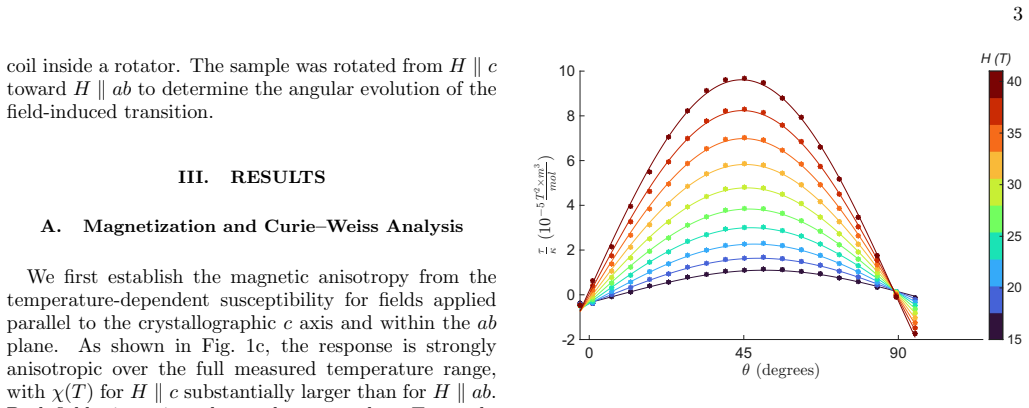
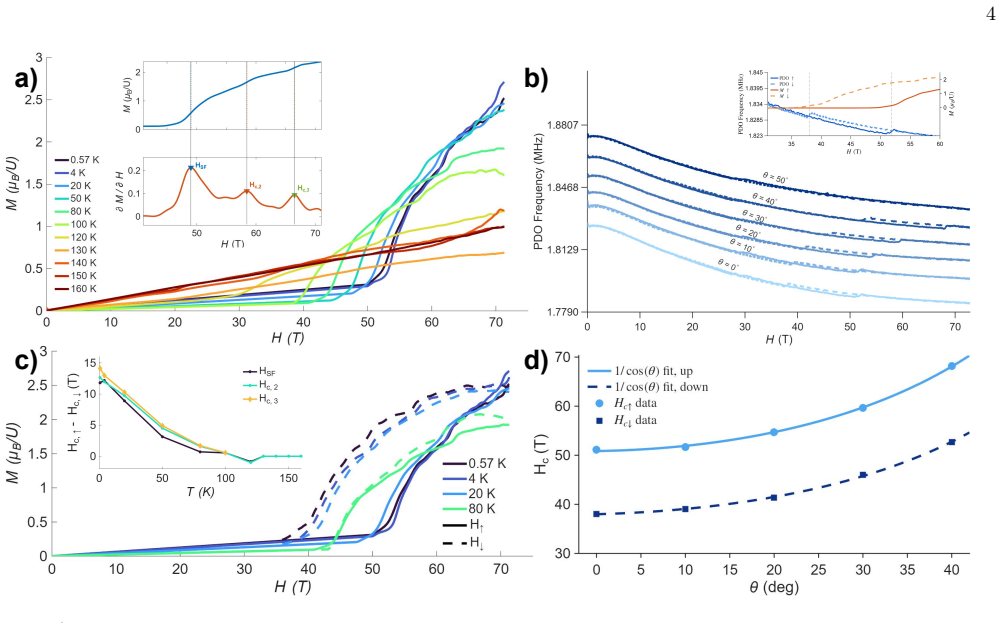
Van der Waals antiferromagnets provide a route to thickness-controlled magnetic order, but few combine high-temperature Ising order with conducting, correlated, and topological electronic structure. Here we show that UOTe realizes this combination. Magnetic susceptibility reveals a strongly anisotropic paramagnetic response, while neutron diffraction establishes c-axis antiferromagnetic order below $T_N \simeq 150$ K with an order-parameter exponent $\beta = 0.14$, close to the two-dimensional Ising value. Torque magnetometry further shows that the ordered state remains well described by a uniaxial antiferromagnet below the high-field transition. Pulsed-field magnetization up to 73 T shows that the ordered state survives to very large fields applied along the c axis before entering a broad metamagnetic regime that begins near 50 T, and remains unsaturated at the highest measured field. Angle-dependent proximity detector oscillator measurements show that the metamagnetic instability is set by the field component along the ordered moment direction, providing direct evidence for Ising-like field rigidity. UOTe therefore establishes a field-rigid Ising antiferromagnet with giant spin-flip fields in a compensated Van der Waals metal, where high-temperature c-axis order, quasi-two-dimensional magnetic criticality, Kondo-associated uranium 5f hybridization, metallic transport, and symmetry-enabled topology coexist in a single material.
Editorial analysis
A structured set of objections, weighed in public.
Referee Report
Summary. The manuscript characterizes UOTe as a compensated van der Waals metal that realizes c-axis antiferromagnetic order below T_N ≃ 150 K with order-parameter exponent β = 0.14 (near the 2D Ising value), strongly anisotropic susceptibility, uniaxial torque response, metallic transport with Kondo-associated 5f hybridization, and a field-rigid Ising antiferromagnetism in which the ordered state persists to ~50 T along the c axis before a broad metamagnetic regime that remains unsaturated at 73 T; angle-dependent proximity-detector-oscillator data are presented as evidence that the metamagnetic threshold is set exclusively by the field component parallel to the ordered moments.
Significance. If substantiated, the work identifies a single material platform in which high-temperature quasi-two-dimensional Ising order, giant spin-flip fields, compensated metallic conduction, and symmetry-enabled topology coexist, offering a rare experimental arena for studying dimensionality-tuned magnetism, field-induced phases, and Kondo physics in van der Waals systems. The deployment of complementary probes (susceptibility, neutron diffraction, torque magnetometry, pulsed-field magnetization, and angle-dependent PDO) is a methodological strength that supports the multi-faceted characterization.
major comments (1)
- [Angle-dependent proximity detector oscillator measurements] The central claim of field-rigid Ising antiferromagnetism rests on the assertion that the metamagnetic instability is determined exclusively by the c-axis field component. The angle-dependent PDO data are invoked for this conclusion, yet the manuscript supplies no quantitative fits (e.g., cos θ scaling with uncertainties), error analysis, or explicit controls for in-plane anisotropy, domain effects, or sample tilt; without these, the exclusivity required for “field rigidity” is not rigorously established.
minor comments (1)
- [Neutron diffraction and order-parameter analysis] The abstract states β = 0.14 but provides neither the fitting temperature range nor reduced-temperature interval used to extract the exponent, making it difficult to assess proximity to the 2D Ising value.
Simulated Author's Rebuttal
We thank the referee for the constructive report and the recommendation for major revision. The single major comment concerns the quantitative rigor of the angle-dependent PDO data used to support field-rigid Ising antiferromagnetism. We address this point directly below and commit to revisions that strengthen the evidence without altering the central conclusions.
read point-by-point responses
-
Referee: The central claim of field-rigid Ising antiferromagnetism rests on the assertion that the metamagnetic instability is determined exclusively by the c-axis field component. The angle-dependent PDO data are invoked for this conclusion, yet the manuscript supplies no quantitative fits (e.g., cos θ scaling with uncertainties), error analysis, or explicit controls for in-plane anisotropy, domain effects, or sample tilt; without these, the exclusivity required for “field rigidity” is not rigorously established.
Authors: We agree that the current presentation would benefit from explicit quantitative analysis. The angle-dependent PDO traces show the metamagnetic onset tracking the parallel field component, but the manuscript indeed omits fitted cos θ curves, associated uncertainties, and a dedicated discussion of possible confounding factors. In the revised version we will add (i) least-squares fits of the threshold field versus angle to a cos θ form together with fit uncertainties, (ii) an assessment of in-plane anisotropy limits drawn from the torque data, and (iii) a note on sample alignment precision and domain population inferred from the neutron and torque results. These additions will make the exclusivity of the c-axis component more rigorously documented while leaving the physical interpretation unchanged. revision: yes
Circularity Check
No circularity: experimental characterization with no derivations or fitted predictions
full rationale
The paper reports direct experimental results from magnetic susceptibility, neutron diffraction (order parameter exponent β=0.14), torque magnetometry, pulsed-field magnetization up to 73 T, and angle-dependent proximity detector oscillator measurements. No equations, derivations, parameter fits renamed as predictions, or self-citation chains appear in the provided text. The field-rigidity claim rests on raw angle-dependent data, not on any self-referential construction. This is a standard experimental report; the derivation chain is empty and self-contained.
Axiom & Free-Parameter Ledger
axioms (2)
- domain assumption Neutron diffraction can determine the direction and nature of antiferromagnetic order and extract the critical exponent beta.
- domain assumption Torque magnetometry and angle-dependent PDO measurements can isolate the uniaxial character of the ordered state and the directional dependence of the metamagnetic transition.
Reference graph
Works this paper leans on
-
[1]
N. D. Mermin and H. Wagner, Absence of ferromag- netism or antiferromagnetism in one- or two-dimensional isotropic heisenberg models, Physical Review Letters17, 1133 (1966)
1966
-
[2]
Hou and R
Y. Hou and R. Wu, Magnetic anisotropy in 2D van der Waals magnetic materials and their heterostructures: Importance, mechanisms, and opportunities, Advanced Functional Materials35, e09453 (2025)
2025
-
[3]
K. S. Burch, D. Mandrus, and J.-G. Park, Magnetism in two-dimensional van der Waals materials, Nature563, 47 (2018)
2018
-
[4]
K. F. Mak, J. Shan, and D. C. Ralph, Probing and con- trolling magnetic states in 2D layered magnetic materials, Nature Reviews Physics1, 646 (2019)
2019
-
[5]
Gong and X
C. Gong and X. Zhang, Two-dimensional magnetic crys- tals and emergent heterostructure devices, Science363, eaav4450 (2019)
2019
-
[6]
M. Blei, J. L. Lado, Q. Song, D. Dey, O. Erten, V. Pardo, R. Comin, S. Tongay, and A. S. Botana, Synthesis, engi- neering, and theory of 2D van der Waals magnets, Ap- plied Physics Reviews8, 021301 (2021)
2021
-
[7]
Kurebayashi, J
H. Kurebayashi, J. H. Garcia, S. Khan, J. Sinova, and S. Roche, Magnetism, symmetry and spin transport in van der Waals layered systems, Nature Reviews Physics 4, 150 (2022)
2022
-
[8]
Z. Zhao, Y. Lin, and A. Avsar, Novel spintronic effects in two-dimensional van der Waals heterostructures, npj 2D Materials and Applications9, 30 (2025)
2025
-
[9]
P. Liu, Y. Zhang, K. Li, Y. Li, and Y. Pu, Recent ad- vances in 2D van der Waals magnets: Detection, modu- lation, and applications, iScience26, 107584 (2023)
2023
-
[10]
Le Flem, R
G. Le Flem, R. Brec, G. Ouvard, A. Louisy, and P. Seg- ransan, Magnetic interactions in the layer compounds MPX3 (M = Mn, Fe, Ni; X = S, Se), Journal of Physics and Chemistry of Solids43, 455 (1982)
1982
-
[11]
P. A. Joy and S. Vasudevan, Magnetism in the layered transition-metal thiophosphates MPS3 (M = Mn, Fe, and Ni), Physical Review B46, 5425 (1992)
1992
-
[12]
Samal, G
R. Samal, G. Sanyal, B. Chakraborty, and C. S. Rout, Two-dimensional transition metal phosphorous trichalco- genides (MPX3): A review on emerging trends, current state and future perspectives, Journal of Materials Chem- 9 istry A9, 2560 (2021)
2021
-
[13]
Kurosawa, S
K. Kurosawa, S. Saito, and Y. Yamaguchi, Neutron diffraction study on MnPS3 and FePS3, Journal of the Physical Society of Japan52, 3919 (1983)
1983
-
[14]
Lan¸ con, H
D. Lan¸ con, H. C. Walker, E. Ressouche, B. Oulad- diaf, K. C. Rule, G. J. McIntyre, T. J. Hicks, H. M. Rønnow, and A. R. Wildes, Magnetic structure and magnon dynamics of the quasi-two-dimensional antifer- romagnet FePS3, Physical Review B94, 214407 (2016)
2016
-
[16]
A. R. Wildes, D. Lan¸ con, M. K. Chan, F. Weickert, N. Harrison, V. Simonet, M. E. Zhitomirsky, M. V. Gvozdikova, T. Ziman, and H. M. Rønnow, High field magnetization of FePS3, Physical Review B101, 024415 (2020)
2020
-
[17]
G. Long, H. Henck, M. Gibertini, D. Dumcenco, Z. Wang, T. Taniguchi, K. Watanabe, E. Giannini, and A. F. Morpurgo, Persistence of magnetism in atomically thin MnPS3 crystals, Nano Letters20, 2452 (2020)
2020
-
[18]
K. Kim, S. Y. Lim, J.-U. Lee, S. Lee, T. Y. Kim, K. Park, G. S. Jeon, C.-H. Park, J.-G. Park, and H. Cheong, Sup- pression of magnetic ordering in XXZ-type antiferromag- netic monolayer NiPS3, Nature Communications10, 345 (2019)
2019
-
[19]
Lan¸ con, R
D. Lan¸ con, R. A. Ewings, T. Guidi, F. Formisano, and A. R. Wildes, Magnetic exchange parameters and anisotropy of the quasi-two-dimensional antiferromagnet NiPS3, Physical Review B98, 134414 (2018)
2018
-
[20]
Basnet, A
R. Basnet, A. Wegner, K. Pandey, S. Storment, and J. Hu, Highly sensitive spin-flop transition in antiferro- magnetic van der waals material MPS3 (M = Ni and Mn), Physical Review Materials5, 064413 (2021)
2021
-
[21]
Basnet, K
R. Basnet, K. M. Kotur, M. Rybak, C. Stephenson, S. Bishop, C. Autieri, M. Birowska, and J. Hu, Control- ling magnetic exchange and anisotropy by nonmagnetic ligand substitution in layered MPX3 (M = Ni, Mn; X = S, Se), Physical Review Research4, 023256 (2022)
2022
-
[22]
S. M. Nair and R. S. Patel, Spin-flop phase transitions in vdw antiferromagnet MnPSe3, Applied Physics Letters 125, 092405 (2024)
2024
-
[23]
Onsager, Crystal statistics
L. Onsager, Crystal statistics. i. a two-dimensional model with an order-disorder transition, Physical Review65, 117 (1944)
1944
-
[24]
L. J. de Jongh and A. R. Miedema, Experiments on sim- ple magnetic model systems, Advances in Physics23, 1 (1974)
1974
-
[25]
W. P. Wolf, The Ising model and real magnetic materials, Brazilian Journal of Physics30, 794 (2000)
2000
-
[26]
E. J. Samuelsen, Experimental study of the two- dimensional Ising antiferromagnet Rb2CoF4, Physical Review Letters31, 936 (1973)
1973
-
[27]
J.-U. Lee, S. Lee, J. H. Ryoo, S. Kang, T. Y. Kim, P. Kim, C.-H. Park, J.-G. Park, and H. Cheong, Ising- type magnetic ordering in atomically thin FePS3, Nano Letters16, 7433 (2016)
2016
-
[29]
A. N. Bogdanov, A. V. Zhuravlev, and U. K. R¨ oßler, Spin-flop transition in uniaxial antiferromagnets: Mag- netic phases, reorientation effects, and multidomain states, Physical Review B75, 094425 (2007)
2007
-
[30]
Rahman, J
S. Rahman, J. F. Torres, A. R. Khan, and Y. Lu, Re- cent developments in van der Waals antiferromagnetic 2D materials: Synthesis, characterization, and device imple- mentation, ACS Nano15, 17175 (2021)
2021
-
[31]
Olsen, Antiferromagnetism in two-dimensional mate- rials: progress and computational challenges, 2D Mate- rials11, 033005 (2024)
T. Olsen, Antiferromagnetism in two-dimensional mate- rials: progress and computational challenges, 2D Mate- rials11, 033005 (2024)
2024
-
[32]
Z. Wang, M. Gibertini, D. Dumcenco, T. Taniguchi, K. Watanabe, E. Giannini, and A. F. Morpurgo, De- termining the phase diagram of atomically thin layered antiferromagnet CrCl3, Nature Nanotechnology14, 1116 (2019)
2019
-
[33]
J. Y. Seo, S. Lim, H. J. Shin, K. W. Jeong, J. M. Hong, K. Moon, M. K. Kim, N. Lee, and Y. J. Choi, Probing the weak limit of magnetocrystalline anisotropy through a spin-flop transition in the van der waals antiferromagnet CrPS4, NPG Asia Materials16, 39 (2024)
2024
-
[34]
X.-G. Zhou, H. Li, Y. H. Matsuda,et al., Possible in- termediate quantum spin liquid phase inα-RuCl 3 under high magnetic fields up to 100 T, Nature Communica- tions14, 5613 (2023)
2023
-
[35]
Hovanˇ c´ ık, M
D. Hovanˇ c´ ık, M. Kratochv´ ılov´ a, T. Haidamak, P. Doleˇ zal, K. Carva, A. Bendov´ a, J. Prokleˇ ska, P. Proschek, M. M´ ıˇ sek, D. I. Gorbunov, J. Kotek, V. Sechovsk´ y, and J. Posp´ ıˇ sil, Robust intralayer anti- ferromagnetism and tricriticality in the van der waals compound VBr3, Physical Review B108, 104416 (2023)
2023
-
[36]
Katsumata, H
K. Katsumata, H. A. Katori, S. Kimura, Y. Narumi, M. Hagiwara, and K. Kindo, Phase transition of a trian- gular lattice ising antiferromagnet FeI2, Physical Review B82, 104402 (2010)
2010
-
[37]
J. Yan, Q. Zhang, T. Heitmann, Z. Huang, K. Y. Chen, J.-G. Cheng, W. Wu, D. Vaknin, B. C. Sales, and R. J. McQueeney, Crystal growth and magnetic structure of MnBi2Te4, Physical Review Materials3, 064202 (2019)
2019
-
[38]
J. Yan, Y. Liu, D. S. Parker, Y. Wu, A. A. Aczel, M. Mat- suda, M. A. McGuire, and B. C. Sales, A-type antiferro- magnetic order in MnBi 4Te7 and MnBi6Te10 single crys- tals, Physical Review Materials4, 054202 (2020)
2020
-
[39]
V. V. Val’kov, A. O. Zlotnikov, A. Gamov, N. A. Fe- dorova, and F. N. Tomilin, Quantum effects at a spin-flop transition in the antiferromagnetic topological insulator MnBi2Te4, JETP Letters120, 499 (2024)
2024
-
[40]
C. Tian, F. Pan, L. Wang, D. Ye, J. Sheng, J. Wang, J. Liu, J. Huang, H. Zhang, D. Xu, J. Qin, L. Hao, Y. Xia, H. Li, X. Tong, L. Wu, J.-H. Chen, S. Jia, P. Cheng, J. Yang, and Y. Zheng, DyOCl: A rare-earth based two- dimensional van der waals material with strong magnetic anisotropy, Physical Review B104, 214410 (2021)
2021
-
[41]
O. S. Volkova, A. Hadj-Azzem, G. Remenyi, J. E. Lorenzo, P. Monceau, A. A. Sinchenko, and A. N. Vasiliev, Magnetic phase diagram of van der waals an- tiferromagnet TbTe3, Materials15, 8772 (2022)
2022
-
[42]
Akatsuka, S
S. Akatsuka, S. Esser, S. Okumura, R. Yambe, R. Ya- mada, M. M. Hirschmann, S. Aji, J. S. White, S. Gao, Y. Onuki, T.-h. Arima, T. Nakajima, and M. Hirschberger, Non-coplanar helimagnetism in the lay- ered van der waals metal DyTe3, Nature Communications 15, 4291 (2024)
2024
-
[43]
Y. M. Wan, E.-J. Cheng, H.-Y. Ma, X. F. Yang,et al., Magnetic field induced weyl state in the van der waals- type antiferromagnet GdTe 3, Physical Review B108, 205132 (2023). 10
2023
-
[44]
A. F. May, M. A. McGuire, and B. C. Sales, Effect of Eu magnetism on the electronic properties of the candidate Dirac material EuMnBi 2, Physical Review B90, 075109 (2014)
2014
-
[45]
Masuda, H
H. Masuda, H. Sakai, M. Tokunaga, Y. Yamasaki, A. Miyake, J. Shiogai, S. Nakamura, S. Awaji, A. Tsukazaki, H. Nakao, Y. Murakami, T.-h. Arima, Y. Tokura, and S. Ishiwata, Quantum hall effect in a bulk antiferromagnet EuMnBi 2 with magnetically con- fined two-dimensional Dirac fermions, Science Advances 2, e1501117 (2016)
2016
-
[46]
Masuda, H
H. Masuda, H. Sakai, M. Tokunaga, Y. Yamasaki, A. Miyake, J. Shiogai, S. Nakamura, S. Awaji, A. Tsukazaki, H. Nakao, Y. Murakami, T.-h. Arima, Y. Tokura, and S. Ishiwata, Impact of antiferromagnetic order on Landau-level splitting of quasi-two-dimensional Dirac fermions in EuMnBi 2, Physical Review B98, 161108 (2018)
2018
-
[47]
F. Zhu, X. Wang, M. Meven, J. Song, T. Mueller, C. Yi, W. Ji, Y. Shi, J. Ma, K. Schmalzl, W. Schmidt, Y. Su, and T. Br¨ uckel, Magnetic structures, spin-flop transi- tion, and coupling of Eu and Mn magnetism in the Dirac semimetal EuMnBi 2, Physical Review Research2, 043100 (2020)
2020
-
[48]
Leciejewicz, R
J. Leciejewicz, R. Troc, A. Murasik, and A. Zygmunt, Neutron-diffraction study of antiferromagnetism in USb2 and UBi2, physica status solidi (b)22, 517 (1967)
1967
-
[49]
Wawryk, Magnetic and transport properties of UBi 2 and USb 2 single crystals, Philosophical Magazine86, 1775 (2006)
R. Wawryk, Magnetic and transport properties of UBi 2 and USb 2 single crystals, Philosophical Magazine86, 1775 (2006)
2006
-
[50]
Giannakis, J
I. Giannakis, J. Leshen, M. Kavai, S. Ran, C.-J. Kang, S. R. Saha, Y. Zhao, Z. Xu, J. W. Lynn, L. Miao, L. A. Wray, G. Kotliar, N. P. Butch, and P. Aynajian, Orbital- selective Kondo lattice and enigmaticfelectrons emerg- ing from inside the antiferromagnetic phase of a heavy fermion, Science Advances5, eaaw9061 (2019)
2019
-
[51]
Q. Chen, Y. Liu, Q. Hao, Y. Zhang, W. Feng, Q. Liu, D. Xie, X. Luo, W. Xie, S. Tan, and X. Lai, Orbital- selective Kondo entanglement and antiferromagnetic or- der in USb2, Physical Review Letters123, 106402 (2019)
2019
-
[52]
R. L. Stillwell, I.-L. Liu, N. Harrison, M. Jaime, J. R. Jef- fries, and N. P. Butch, Tricritical point of thef-electron antiferromagnet USb 2 driven by high magnetic fields, Physical Review B95, 014414 (2017)
2017
-
[53]
Sandratskii, Magnetic phase transitions induced by pressure and magnetic field: The case of antiferromag- netic USb2, Physical Review B99, 094411 (2019)
L. Sandratskii, Magnetic phase transitions induced by pressure and magnetic field: The case of antiferromag- netic USb2, Physical Review B99, 094411 (2019)
2019
-
[54]
Siddiquee, C
H. Siddiquee, C. Broyles, E. Kotta, S. Liu, S. Peng, T. Kong, B. Kang, Q. Zhu, Y. Lee, L. Ke, H. Weng, J. D. Denlinger, L. A. Wray, and S. Ran, Breakdown of the scaling relation of anomalous hall effect in kondo lattice ferromagnet USbTe, Nature Communications14, 527 (2023)
2023
-
[55]
Q. Xu, H. Siddiquee, S. Gould, J. A. Zhu, D. A. Martinez, C. Broyles, G. Ni, T. Kong, and S. Ran, Tunable giant anomalous hall effect in the kondo-lattice ferromagnet UBiTe, Physical Review B110, 165162 (2024)
2024
-
[56]
Broyles, X
C. Broyles, X. Wan, W. Cheng, D. Wu, H. Tan, Q. Xu, S. L. Gould, H. Siddiquee, L. Xiao, R. Chen, W. Lin, Y. Wu, P. Regmi, Y. S. Eo, J. Liu, Y. Chen, B. Yan, K. Sun, and S. Ran, High-temperature surface state in kondo insulator U 3Bi4Ni3, Science Advances11, eadq9952 (2025)
2025
-
[57]
W. Lin, Y. Wu, C. Broyles, T. Kong, and S. Ran, A single crystal study of kagome metals U 2Mn3Ge and U 2Fe3Ge, Journal of Physics: Condensed Matter36, 345602 (2024)
2024
-
[58]
Broyles, S
C. Broyles, S. Mardanya, M. Liu, J. Ahn, T. Dinh, G. Alqasseri, J. Garner, Z. Rehfuss, K. Guo, J. Zhu, D. Martinez, D. Li, Y. Hao, H. Cao, M. Boswell, W. Xie, J. G. Philbrick, T. Kong, L. Yang, A. Vishwanath, P. Kim, S.-Y. Xu, J. E. Hoffman, J. D. Denlinger, S. Chowdhury, and S. Ran, UOTe: Kondo-interacting topological antiferromagnet in a van der waals l...
2025
-
[59]
Mardanya, B
S. Mardanya, B. Ghosh, M. Liu, C. Broyles, J. Ahn, K. Sun, J. E. Hoffman, S. Ran, A. Bansil, S.-Y. Xu, and S. Chowdhury, Layer-dependent antiferromagnetic chern and axion insulating states in UOTe, Advanced Science 13, e10247 (2026)
2026
-
[60]
J. Shotton, J. Zhu, D. Martinez, D. Golovanova, D. Chaudhuri, X. Guo, P. Abbamonte, F. Ye, Y. Hao, H. Cao, S. H. Sung, C. Grossman, I. El Baggari, G. Tu- via, M. Liu, R. Kang, M. Boswell, W. Xie, D. Pal, A. Ku- mar, Y. S. Eo, B. Yan, K. Sun, J. Denlinger, and S. Ran, Kondo driven suppression of charge density wave in van der waals material UTe3 (2026), ar...
arXiv 2026
-
[61]
S. M. Thomas, A. E. Llacsahuanga Allcca, W. Simeth, C. S. Kengle, Z. W. Riedel, F. Orlandi, D. Khalyavin, P. Manuel, F. Ronning, E. D. Bauer, J. D. Thomp- son, J.-X. Zhu, A. O. Scheie, Y. P. Chen, and P. F. S. Rosa, Enhanced two-dimensional ferromagnetism in van der waalsβ-UTe 3 monolayers, Science Advances12, eaea6436 (2026)
2026
-
[62]
B. C. Chakoumakos, H. Cao, F. Ye, A. D. Stoica, M. Popovici, M. Sundaram, W. Zhou, J. S. Hicks, G. W. Lynn, and R. A. Riedel, Four-circle single-crystal neutron diffractometer at the high flux isotope reactor, Journal of Applied Crystallography44, 655 (2011)
2011
-
[63]
H. Cao, B. C. Chakoumakos, K. M. Andrews, Y. Wu, R. A. Riedel, J. Hodges, W. Zhou, R. Gregory, B. Haberl, J. Molaison, and G. W. Lynn, DEMAND, a dimensional extreme magnetic neutron diffractometer at the high flux isotope reactor, Crystals9, 5 (2019)
2019
-
[64]
Y. Hao, E. Feng, D. Lu, L. Zimmer, Z. Morgan, B. C. Chakoumakos, G. Zhang, and H. Cao, Machine-learning- assisted automation of single-crystal neutron diffraction, Journal of Applied Crystallography56, 519 (2023)
2023
-
[65]
M. I. Aroyo, J. M. Perez-Mato, C. Capillas, E. Kroumova, S. Ivantchev, G. Madariaga, A. Kirov, and H. Won- dratschek, Bilbao crystallographic server: I. databases and crystallographic computing programs, Zeitschrift f¨ ur Kristallographie - Crystalline Materials221, 15 (2006)
2006
-
[66]
Rodr´ ıguez-Carvajal, Recent advances in magnetic structure determination by neutron powder diffraction, Physica B: Condensed Matter192, 55 (1993)
J. Rodr´ ıguez-Carvajal, Recent advances in magnetic structure determination by neutron powder diffraction, Physica B: Condensed Matter192, 55 (1993)
1993
-
[67]
Kittel, Theory of antiferromagnetic resonance, Physi- cal Review82, 565 (1951)
C. Kittel, Theory of antiferromagnetic resonance, Physi- cal Review82, 565 (1951)
1951
-
[68]
Nagamiya, K
T. Nagamiya, K. Yosida, and R. Kubo, Antiferromag- netism, Advances in Physics4, 1 (1955)
1955
-
[69]
Hovanˇ c´ ık, M
D. Hovanˇ c´ ık, M. Kratochv´ ılov´ a, P. Doleˇ zal, A. Bendov´ a, J. Posp´ ıˇ sil, and V. Sechovsk´ y, UI3: 5f-electron magnetic van der waals material, Journal of Solid State Chemistry 316, 123580 (2022)
2022
-
[70]
Yumigeta, J
K. Yumigeta, J. Kopaczek, Y. Attarde, M. Y. Sayyad, M. Blei, S. T. R. Moosavy, A. Yarra, H. Ruddick, B. Povilus, R. Banerjee, Y. Ou, and S. Tongay, Alloy- 11 ing effect of rare-earth tritellurides on the charge density wave and magnetic properties, Applied Physics Reviews 11, 011407 (2024)
2024
-
[71]
D. Aoki, W. Knafo, and I. Sheikin, Heavy fermions in a high magnetic field, Comptes Rendus Physique14, 53 (2013)
2013
-
[72]
Miyata, H
A. Miyata, H. Ueda, and S. Takeyama, Magnetic super- fluid state in the frustrated spinel oxide CdCr 2O4 re- vealed by ultrahigh magnetic fields, Physical Review B 87, 214424 (2013)
2013
-
[73]
H. Ueda, H. Mitamura, T. Goto, and Y. Ueda, Successive field-induced transitions in a frustrated antiferromagnet HgCr2O4, Physical Review B73, 094415 (2006)
2006
-
[74]
Miyata, H
A. Miyata, H. Ueda, Y. Ueda, H. Sawabe, and S. Takeyama, Magnetic phases of a highly frustrated magnet, ZnCr 2O4, up to an ultrahigh magnetic field of 600 T, Physical Review Letters107, 207203 (2011)
2011
-
[75]
Miyata, H
A. Miyata, H. Ueda, and S. Takeyama, Canted 2:1:1 mag- netic supersolid phase in a frustrated magnet MgCr 2O4 as a small limit of the biquadratic spin interaction, Jour- nal of the Physical Society of Japan83, 063702 (2014)
2014
-
[76]
Okamoto, G
Y. Okamoto, G. J. Nilsen, J. P. Attfield, and Z. Hiroi, Breathing pyrochlore lattice realized in A-site ordered spinel oxides LiGaCr 4O8 and LiInCr 4O8, Physical Re- view Letters110, 097203 (2013)
2013
-
[77]
Okamoto, D
Y. Okamoto, D. Nakamura, A. Miyake, S. Takeyama, M. Tokunaga, A. Matsuo, K. Kindo, and Z. Hiroi, Mag- netic transitions under ultrahigh magnetic fields of up to 130 T in the breathing pyrochlore antiferromagnet LiInCr4O8, Physical Review B95, 134438 (2017)
2017
-
[78]
M. Gen, D. Nakamura, Y. Okamoto, Y. Kohama, Y. H. Matsuda, K. Kindo, and S. Takeyama, Spin-lattice- coupled superstructure induced by ultrahigh magnetic fields in a breathing pyrochlore antiferromagnet, Pro- ceedings of the National Academy of Sciences120, e2302756120 (2023)
2023
-
[79]
Okamoto, M
Y. Okamoto, M. Mori, N. Katayama, A. Miyake, M. Tokunaga, A. Matsuo, K. Kindo, and K. Take- naka, Magnetic and structural properties of A-site or- dered chromium spinel sulfides: Alternating antiferro- magnetic and ferromagnetic interactions in the breath- ing pyrochlore lattice, Journal of the Physical Society of Japan87, 034709 (2018)
2018
-
[80]
M. Gen, Y. Okamoto, M. Mori, K. Takenaka, and Y. Ko- hama, Magnetization process of the breathing pyrochlore magnet CuInCr4S8 in ultrahigh magnetic fields up to 150 T, Physical Review B101, 054434 (2020)
2020
-
[81]
G. P. Felcher and R. Kleb, Antiferromagnetic domains and the spin-flop transition of MnF2, Europhysics Letters 36, 455 (1996)
1996
-
[82]
I. S. Jacobs, Spin-flopping in MnF 2 by high magnetic fields, Journal of Applied Physics32, S61 (1961)
1961
discussion (0)
Sign in with ORCID, Apple, or X to comment. Anyone can read and Pith papers without signing in.