An optimized tidal-trigger model of the QBO, and some implications for the Carrington event
Pith reviewed 2026-06-27 20:57 UTC · model grok-4.3
The pith
Optimizing the magnetic-field dependence in a tidal QBO model raises its correlation with 109 extreme solar events to 0.8.
A machine-rendered reading of the paper's core claim, the machinery that carries it, and where it could break.
Core claim
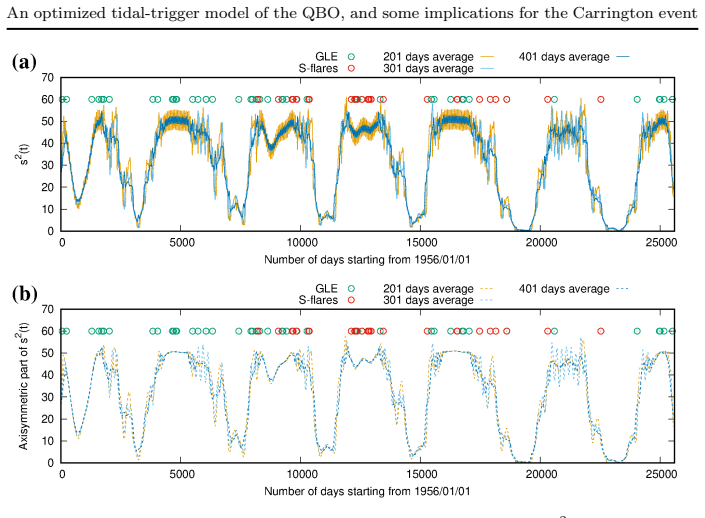
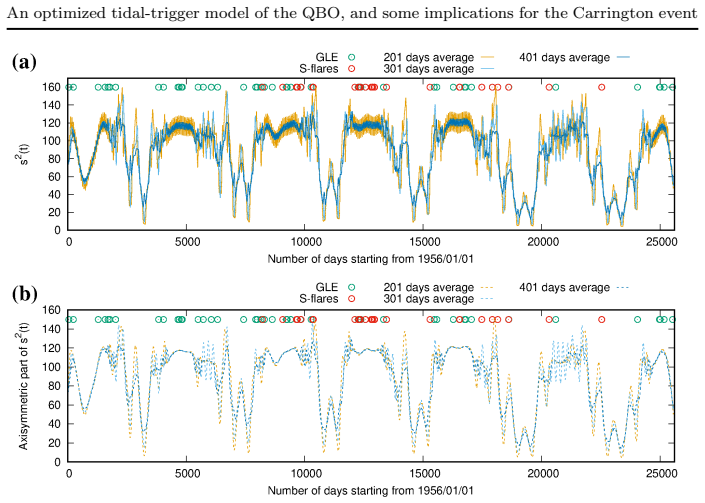
By parameterizing the dependence of the three tidally-triggered magneto-Rossby waves on the actual strength of the toroidal field at the tachocline and optimizing those parameters, the tidal-forcing function achieves correlations up to 0.8 with the 109 extreme solar events. This exceeds both the field-independent tidal forcing (approximately 0.4) and the correlation with sunspot number (approximately 0.56). The improved model is used to identify parallels between the Carrington event and the 1989 clustering of strong events and to issue cautious forecasts for the remainder of cycle 25.
What carries the argument
The magnetic-field dependence of the three tidally-triggered magneto-Rossby waves, parameterized from sunspot numbers and optimized on the event dataset.
If this is right
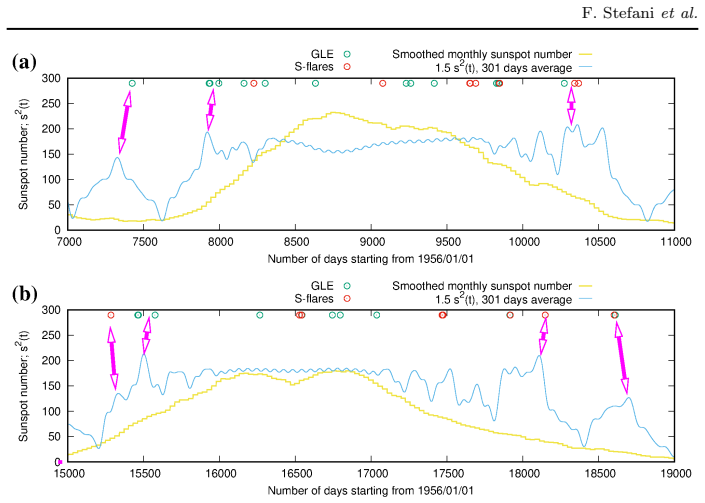
- The optimized model identifies parallels between the 1859 Carrington event and the clustering of strong solar events in summer and autumn 1989.
- Cautious forecasts become possible for the timing of extreme events in the remainder of solar cycle 25.
- The tidal-forcing function with field dependence outperforms both the simpler tidal model and sunspot numbers as a descriptor of extreme-event timing.
- The dominant 1.723-year period of the QBO aligns with the beat between the two-planet spring tides of Venus, Earth, and Jupiter.
Where Pith is reading between the lines
- If the model is correct, the same tidal-plus-field framework could be tested on independent datasets of solar events collected after the optimization window.
- Planetary tidal influences on the tachocline might be added as an external driver in existing solar dynamo simulations to check for improved reproduction of observed periodicities.
- The approach could be extended to examine whether similar tidal beats appear in other solar or stellar activity records that also show quasi-biennial signals.
Load-bearing premise
That the magnetic-field dependence can be parameterized and its parameters optimized on the same 109-event dataset without the optimization introducing overfitting that inflates the reported correlation.
What would settle it
Whether the model's forecasts for extreme solar events in the remainder of cycle 25 align with the actual timing and occurrence of such events.
Figures



read the original abstract
Magneto-Rossby waves in the solar tachocline are currently being discussed as a potential cause of the quasi-biennial oscillation (QBO). By analyzing sequences of ground-level enhancement (GLE) events and S-flares, the dominant period of the QBO was recently shown to be close to 1.723 years, which is the dominant beat between the periods of the two-planet spring tides of Venus, Earth and Jupiter. We improve upon this model by taking into account the dependence of the three tidally-triggered magneto-Rossby waves on the actual strength of the toroidal field at the tachocline, which we infer from the averaged monthly sunspot number. When optimizing the parameters of this magnetic-field dependence, the correlation of the tidal-forcing function with the 109 extreme solar events reaches values of up to 0.8. This is much higher than the corresponding value for the field-independent tidal forcing function (appr. 0.4), and also higher than the correlation with the sunspot number (appr. 0.56). Based on this improved model, we discuss some interesting parallels between the Carrington event of 1859 and the clustering of strong solar events in summer and autumn 1989. We also make some cautious forecasts for the remainder of cycle 25.
Editorial analysis
A structured set of objections, weighed in public.
Referee Report
Summary. The paper claims that an optimized tidal-trigger model for the solar QBO, which incorporates a parameterized dependence of three tidally-triggered magneto-Rossby waves on toroidal-field strength (inferred from monthly sunspot number), yields a correlation of up to 0.8 with a set of 109 extreme solar events (GLEs and S-flares). This is presented as a substantial improvement over the field-independent tidal forcing (~0.4) and over sunspot number alone (~0.56). The optimized model is then used to identify parallels between the 1859 Carrington event and 1989 activity clusters and to offer cautious forecasts for the remainder of cycle 25.
Significance. If the reported correlation improvement can be shown to survive independent validation, the work would provide quantitative support for a tidal mechanism acting through magneto-Rossby waves whose efficiency depends on the ambient toroidal field. The explicit numerical comparison to both the unoptimized tidal model and to sunspot number is a methodological strength that allows readers to assess the incremental contribution.
major comments (2)
- [Abstract] Abstract: the parameters of the magnetic-field dependence are optimized on the identical 109-event dataset whose correlation is then reported as reaching 0.8. No cross-validation, hold-out set, or independent test period is described, so the improvement from ~0.4 to 0.8 is at least partly a direct consequence of the fitting procedure rather than an out-of-sample test of the model.
- [Abstract] Abstract (optimization procedure): the functional form relating the three magneto-Rossby waves to toroidal-field strength is not stated to have been pre-registered or derived from first principles; its free parameters are tuned to maximize agreement with the same events used for the final correlation statistic. This leaves open the possibility that the chosen dependence absorbs sample-specific variance rather than capturing a general physical effect.
minor comments (1)
- [Abstract] The abstract reports correlations to two decimal places (0.8, 0.4, 0.56) without accompanying uncertainties or p-values; adding these would help readers judge whether the reported differences are statistically distinguishable.
Simulated Author's Rebuttal
We thank the referee for the detailed and constructive report. The two major comments both concern the optimization procedure and its implications for the reported correlations. We address each point directly below, acknowledging the methodological limitations while providing the strongest honest defense of the work as presented.
read point-by-point responses
-
Referee: [Abstract] Abstract: the parameters of the magnetic-field dependence are optimized on the identical 109-event dataset whose correlation is then reported as reaching 0.8. No cross-validation, hold-out set, or independent test period is described, so the improvement from ~0.4 to 0.8 is at least partly a direct consequence of the fitting procedure rather than an out-of-sample test of the model.
Authors: We agree that the optimization was performed on the full 109-event set and that this means the reported gain from ~0.4 to 0.8 cannot be interpreted as a fully independent validation. The comparison to sunspot number (~0.56) on the same events provides a relative benchmark, but does not remove the overfitting concern. In revision we will add an explicit statement in the methods and abstract noting that the parameters were tuned to the full dataset and that future work should test the model on independent intervals or via cross-validation. We retain the current numbers as an in-sample illustration of the possible improvement when field dependence is included. revision: yes
-
Referee: [Abstract] Abstract (optimization procedure): the functional form relating the three magneto-Rossby waves to toroidal-field strength is not stated to have been pre-registered or derived from first principles; its free parameters are tuned to maximize agreement with the same events used for the final correlation statistic. This leaves open the possibility that the chosen dependence absorbs sample-specific variance rather than capturing a general physical effect.
Authors: The functional form was selected on the basis of a simple physical argument that stronger toroidal fields should increase the efficiency of tidally triggered waves, but it is not derived from first principles and was not pre-registered. The parameters were indeed adjusted to improve agreement with the 109 events. We will revise the text to state this motivation and limitation more clearly and to label the model as exploratory. No change is made to the numerical results themselves, as they are presented as the outcome of the chosen parameterization. revision: partial
Circularity Check
Optimization of magnetic-field dependence parameters on the identical 109-event dataset produces the reported 0.8 correlation by construction.
specific steps
-
fitted input called prediction
[Abstract]
"When optimizing the parameters of this magnetic-field dependence, the correlation of the tidal-forcing function with the 109 extreme solar events reaches values of up to 0.8. This is much higher than the corresponding value for the field-independent tidal forcing function (appr. 0.4), and also higher than the correlation with the sunspot number (appr. 0.56)."
The parameters of the magnetic-field dependence are tuned on the 109-event dataset; the correlation is then evaluated on the identical dataset. The reported 0.8 value is therefore the maximized output of the fitting procedure itself, not an independent verification of the model.
full rationale
The paper's central result is obtained by fitting the functional form of the toroidal-field dependence (inferred from sunspot number) directly to the 109 GLE/S-flare events and then reporting the resulting correlation coefficient on those same events. This matches the fitted_input_called_prediction pattern: the improvement from ~0.4 to 0.8 is a direct statistical consequence of the optimization step rather than an independent test. No cross-validation, pre-specified functional form, or out-of-sample evaluation is described that would separate the fit from the claimed performance. The abstract explicitly states the optimization and the achieved correlation on the same data, making the reduction explicit.
Axiom & Free-Parameter Ledger
free parameters (1)
- parameters of magnetic-field dependence
axioms (1)
- domain assumption Magneto-Rossby waves in the solar tachocline are triggered by the two-planet spring tides of Venus, Earth and Jupiter.
Reference graph
Works this paper leans on
-
[1]
barticle Abreu , J.A. , Beer , J. , Ferriz-Mas , A. , McCracken , K.G. , Steinhilber , F. : 2012 , Is there a planetary influence on solar activity? Astron. Astrophys. 548 , A88 . 10.1051/0004-6361/201219997 . barticle
-
[2]
barticle Bazilevskaya , G. , Broomhall , A.-M. , Elsworth , Y. , Nakariakov , V.M. : 2014 , A combined analysis of the observational aspects of the quasi-biennial oscillation in solar magnetic activity. Space Sci. Rev. 186 , 358 . 10.1007/s11214-014-0068-0 . barticle
-
[3]
: 2020 , Manifestation of Rossby waves in the global magnetic field of the Sun during cycles 21-24
barticle Bilenko , I.A. : 2020 , Manifestation of Rossby waves in the global magnetic field of the Sun during cycles 21-24 . Astrophys. J. 897 , L24 . 10.3847/2041-8213/ab9fa4 . barticle
-
[4]
: 2022 , External forcing of the solar dynamo
botherref Charbonneau , P. : 2022 , External forcing of the solar dynamo . Front. Astron. Space Sci. 9 , 853676 . 10.3389/fspas.2022.853676 . botherref
-
[5]
barticle Cliver , E.W. , Schrijver , C.J. , Shibata , K. , Usoskin , I.G. : 2022 , Extreme solar events . Liv. Rev. Sol. Phys. 19 , 2 . 10.1007/s41116-022-00033-8 . barticle
-
[6]
barticle Dikpati , M. : 2012 , Nonlinear evolution of the globale hydrodynami shallow-water instability in the solar tachocline . Astrophys. J. 745 , 128 . 10.1088/0004-637X/745/2/128 . barticle
-
[7]
barticle Dikpati , M. , McIntosh , S.W. , Bothun , G. , Cally , P.S. , Ghosh , S.S. , Gilman , P.A. , Umurhan , O.M. : 2018 , Role of interaction between magnetic Rossby waves and tachocline differential rotation in producing solar seasons . Astrophys. J. 853 , 144 . 10.3847/1538-4357/aaa70d . barticle
-
[8]
barticle Dikpati , M. , Gilman , P.A. , Chatterjee , S. , McIntosh , S.W. , Zaqarashvili , T.V. : 2020 , Physics of magnetohydrodynamic Rossby waves in the sun . Astrophys. J. 896 , 141 . 10.3847/1538-4357/ab8b63 . barticle
-
[9]
barticle Gachechiladze , T. , Zaqarashvili , T.V. , Gurgenashvili , E. , Rameshvili , G. , Carbonell , M. , Oliver , R. , Ballester , J.L. 2019 , Magneto-Rossby waves in the solar tachocline and the annular variations in solar activity . Astrophys. J. 874 , 162 . 10.3847/1538-4357/ab0955 . barticle
-
[10]
barticle Horstmann , G. , Mamatsashvili , G. , Giesecke , A. , Zaqarashvili , T.V. , Stefani , F. : 2023 , Tidally forced planetary waves in the tachocline of solar-like stars . Astrophys. J. 944 , 48 . 10.3847/1538-4357/aca278 . barticle
-
[11]
: 2007 , Apparent relations between solar activity and solar tides caused by the planets
barticle Hung , C.-C. : 2007 , Apparent relations between solar activity and solar tides caused by the planets. NASA/TM-2007-214817 . barticle
2007
-
[12]
barticle Klevs , M. , Stefani , F. , Jouve , L. : 2023 , A synchronized two-dimensional - model of the solar dynamo . Solar Phys. , 298 , 90 . 10.1007/s11207-023-02173-y . barticle
-
[13]
barticle Marquez-Artavia , X. , Jones , C.A. , Tobias , S.M. : 2017 , Rotating magnetic shallow water waves and instabilities in a sphere . Geophys. Astrophys. Fluid Dyn. 111 , 282 . 10.1080/03091929.2017.1301937 . barticle
-
[14]
barticle McIntosh , P.S. , Thompson , R.J. , Willock , E.C. : 1992 , A 600-day periodicity in solar coronal holes. Nature 360 , 322 . 10.1038/360322a0 . barticle
-
[15]
barticle Okhlopkov , V.P. : 2016 , The gravitational influence of Venus, the Earth, and Jupiter on the 11-year cycle of solar activity . Mosc. Univ. Phys. B. 71 , 440 . 10.3103/S0027134916040159 . barticle
-
[16]
barticle Raphaldini , B. , Teruya , A.S. , Raupp , C.F.M. , Bustamante , M.D. : 2019 , Nonlinear Rossby wave-wave and wave-mean flow theory for long-term solar cycle modulations . Astrophys. J. 887 , 1 . 10.3847/1538-4357/ab5067 . barticle
-
[17]
: 1939 , Relation between variations in the intensity of the zonal circulation of the atmosphere and the displacements of the semi-permanent centers of action
barticle Rossby , C.-G. : 1939 , Relation between variations in the intensity of the zonal circulation of the atmosphere and the displacements of the semi-permanent centers of action . J. Mar. Res. 2 , 38--55 , barticle
1939
-
[18]
barticle Rouillard , A. , Lockwood , M. : 2004 , Oscillations in the open solar magnetic flux with a period of 1.68 years: imprint on galactic cosmic rays and implications for heliospheric shielding . Ann. Geophys. 22 , 4381 . 10.5194/angeo-22-4381-2004 . barticle
-
[19]
barticle Scafetta , N. : 2012 , Does the Sun work as a nuclear fusion amplifier of planetary tidal forcing? A proposal for a physical mechanism based on the mass-luminosity relation . J. Atmos. Sol.-Terr. Phys. 81-82 , 27 . 10.1016/j.jastp.2012.04.002 . barticle
-
[20]
barticle Scafetta , N. , Bianchini , A. , 2022 , The planetary theory of solar activity variability: A review. Front. Astron. Space Sci. 9 , 937930 . 10.3389/fspas.2022.937930 . barticle
-
[21]
barticle Stefani , F. , Giesecke , A. , Weber , N. , Weier , T. : 2016 , Synchronized helicity oscillations: a link between planetary tides and the solar cycle? Solar Phys. 291 , 2197 . 10.1007/s11207-016-0968-0 . barticle
-
[22]
barticle Stefani , F. , Giesecke , A. , Weier , T. : 2019 , A model of a tidally synchronized solar dynamo . Solar Phys. 294 , 60 . 10.1007/s11207-019-1447-1 . barticle
-
[23]
barticle Stefani , F. , Giesecke , A. , Seilmayer , M. , Stepanov , R. , Weier , T. : 2020a , Schwabe, Gleissberg, Suess-de Vries: Towards a consistent model of planetary synchronization of solar cycles . Magnetohydrodynamics , 56 , 269 . 10.22364/mhd.56.2-3.18 . barticle
-
[24]
barticle Stefani , F. , Stepanov , W. , Weier , T. : 2021 , Shaken and stirred: When Bond meets Suess-de Vries and Gnevyshev-Ohl . Solar Phys. 296 , 88 . 10.1007/s11207-021-01822-4 . barticle
-
[25]
barticle Stefani , F. , Horstmann , G.M. , Mamatsashvili , G. , Weier , T. : 2024 , Rieger, Schwabe, Suess-de Vries: The sunny beats of resonance . Solar Phys. 299 , 51 . 10.1007/s11207-024-02295-x . barticle
-
[26]
barticle Stefani , F. , Horstmann , G.M. , Mamatsashvili , G. , Weier , T. : 2025 , Adding further pieces to the synchronization puzzle: QBO, bimodality, and phase jumps . Solar Phys. 300 , 110 . 10.1007/s11207-025-02521-0 . barticle
-
[27]
barticle Stefani , F. , Horstmann , G.M. , Mamatsashvili , G. , Weier , T. : 2026 , Tidal triggers and the predictability of solar activity . Astrophys. J. in press , arXiv:2602.11227 . barticle
Pith/arXiv arXiv 2026
-
[28]
barticle Tan , B. , Zhang , Y. , Huang , J. , Ji , K. : 2025 , The occurrence of powerful flares stronger than X10 class in solar cycles . Astrophys. J. Lett. 979 , L16 . 10.3847/2041-8213/ada611 . barticle
-
[29]
, P \'e rez-Enr \'i quz , R
barticle Vald\' e s-Galicia , J.F. , P \'e rez-Enr \'i quz , R. , Otaola , J.A. 1996 , The cosmic-ray 1.68-year variation: A clue to understand the nature of the solar cycle? Solar Phys. 167 , 409 . barticle
1996
-
[30]
barticle Velasco Herrera , V.M. , P\' e rez-Peraza , J. , Soon , W. , M\' a rquez-Adame , J.C. : 2018 , The quasi-biennial oscillation of 1.7 years in ground level enhancement events. New Astron. 60 , 7-18 . 10.1016/j.newast.2017.09.007 . barticle
-
[31]
, Velasco Herrera , G , Soon , W
barticle Velasco Herrera , V.M. , Velasco Herrera , G , Soon , W. , \"Ozg\"uc , A. , Babynets , N. , Tlatov , A , Svanda , M. , Qiu , S. , Baliunas , S. , Kotan , B , Gonzalez Gonzalez , G. , Bautista Flores , L.A. , Pazos , M. : 2026 , A New Method for Probabilistic Spatiotemporal Forecasts of Solar Soft X-Ray ``S-Class '' (>X10) Superflares. J. Geophys....
-
[32]
: 2013 , The Venus-Earth-Jupiter spin-orbit coupling model
barticle Wilson , I.R.G. : 2013 , The Venus-Earth-Jupiter spin-orbit coupling model . Pattern Recogn. Phys. 1 , 147 . barticle
2013
-
[33]
barticle Zaqarashvili , T. , Carbonell , M. , Oliver , R. , Ballester , J.L. : 2010a , Quasi-biennial oscillations in the solar tachocline caused by magnetic Rossby wave instabilities . Astrophys. J. Lett. 724 , L95-L98 . 10.1088/2041-8205/724/1/L95 . barticle
-
[34]
barticle Zaqarashvili , T. , Carbonell , M. , Oliver , R. , Ballester , J.L. : 2010b , Magnetic Rossby waves in the solar tachocline and Rieger-type periodicities . Astrophys. J. 709 , 749 . 10.1088/0004-637X/709/2/749 . barticle
-
[35]
: 2018 , Equatorial magnetohydrodynamic shallow water waves in the solar tachocline
barticle Zaqarashvili , T. : 2018 , Equatorial magnetohydrodynamic shallow water waves in the solar tachocline . Astrophys. J. 856 , 32 . 10.3847/1538-4357/aab26f . barticle
-
[36]
barticle Zaqarashvili , T. , Albekioni , M. , Ballester , J.L. , Bekki , Y. , Biancofiero , L. , Birch , A.C. , Dikpati , M. , Gizon , L. , Gurgenashvili , E. , Heifetz , E. , Lanca , A.F. , McIntosh , S.W. , Ofman , L. , Oliver , R. , Proxauf , B. , Umurhan , O.M. , Yellin-Bergovoy , R. , 2021 , Rossby waves in astrophysics . Space Sci. Rev. 217 , 15 . 1...
discussion (0)
Sign in with ORCID, Apple, or X to comment. Anyone can read and Pith papers without signing in.