A Model of Integrated Information Processing in Human-AI Interaction
Pith reviewed 2026-06-27 20:54 UTC · model grok-4.3
The pith
The IIP model characterizes shared-task efficacy by three integration qualities that shape AI interface design for transparency and controllability.
A machine-rendered reading of the paper's core claim, the machinery that carries it, and where it could break.
Core claim
The IIP model conceptualizes humans, machines, and their joint activity as coupled control loops expressed in a unified vocabulary. Within this framework, efficacy in a shared task is defined by three integration qualities: input adequacy (whether the human receives sufficient information), reference consonance (whether the human's and machine's goals or references align), and output operativity (whether the human can act effectively on the machine's outputs). These qualities directly influence human-centeredness benchmarks such as transparency and controllability. The model further maps concrete interface choices to expected changes in user behavior, thereby extending prior automation frame
What carries the argument
The three integration qualities (input adequacy, reference consonance, output operativity) inside a cybernetic model of humans and machines as coupled control loops that applies the same language to both agents.
If this is right
- Interface options such as XAI methods can be chosen according to which of the three qualities they most directly support.
- Evaluation of human-AI systems can shift from isolated metrics toward assessment of how well the three qualities are realized in a given task.
- Psychological theories of action regulation become applicable to predict user responses before a system is built.
- Design iterations can be guided by checking whether changes improve input adequacy, reference consonance, or output operativity.
Where Pith is reading between the lines
- The same three qualities might be used to compare human-AI teams against human-only teams on identical tasks.
- AI systems could be engineered to monitor and adjust their own contributions to the three qualities during operation.
- The model offers a route to test whether improvements in one quality can compensate for shortfalls in another.
Load-bearing premise
A unified modeling language that treats humans and machines as coupled control loops can make psychological models of action regulation directly usable for AI system design and evaluation.
What would settle it
A controlled study in which interfaces engineered to maximize the three integration qualities produce no measurable gain in user-reported transparency or controllability relative to standard designs on the same task.
Figures


read the original abstract
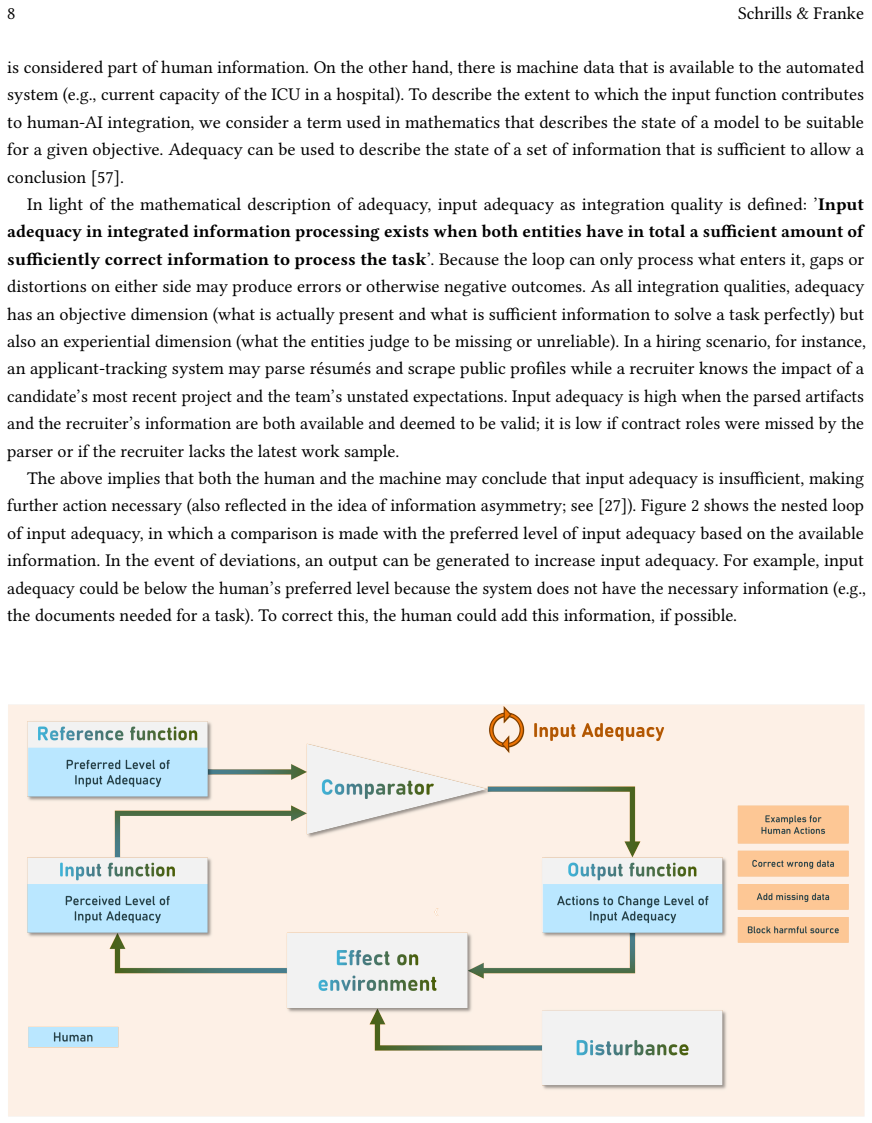
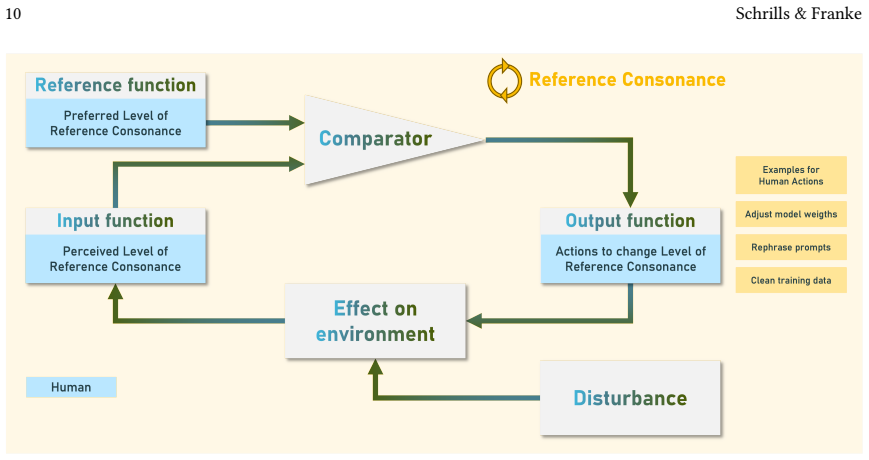
For Human-AI Interaction (HAII) research to move forward, theoretical work linking psychological mechanisms to interface design is needed. Such work should extend rather than replace established HCI and automation research, adapting to the increasing autonomy and agency of AI systems. Building on prior frameworks focused on roles and levels in human interaction with automation, a gap remains from a psychological view: a task-centered, process-oriented account that links mechanisms of action regulation to concrete design and evaluation levers for human-AI coupling, expressed in a unified vocabulary for human and machine. Moreover, existing models may describe how a system is designed (e.g., function allocation in automation) but fall short in showing how this design affects human behavior. We present the Integrated Information Processing (IIP) model, a task-centered, cybernetic model that conceptualizes humans, machines, and their joint activity as coupled control loops. The IIP model uses a unified modeling language for human and artificial agents, making psychological models of action regulation accessible for AI system design. As a core feature, we argue that efficacy within a shared task is characterized by three integration qualities, input adequacy, reference consonance, and output operativity, which critically influence benchmarks of human-centeredness such as transparency and controllability. The model maps interface choices (e.g., XAI techniques) to theory-driven expectations of user behavior, guiding interface design and evaluation. To this end, we present (1) a continuity-preserving theoretical discourse that extends HAII to agency in AI; (2) the IIP model with three information-processing qualities; and (3) applications of the IIP model to exemplary use cases demonstrating implications for interface design.
Editorial analysis
A structured set of objections, weighed in public.
Referee Report
Summary. The manuscript proposes the Integrated Information Processing (IIP) model as a task-centered cybernetic framework for Human-AI Interaction. It conceptualizes humans, machines, and joint activity as coupled control loops expressed in a unified modeling language, extending prior automation and HCI frameworks. The core contribution is the introduction of three integration qualities—input adequacy, reference consonance, and output operativity—as characterizing efficacy in shared tasks and critically influencing human-centeredness benchmarks such as transparency and controllability. The model is claimed to map interface choices (e.g., XAI techniques) to theory-driven expectations of user behavior via psychological action-regulation mechanisms, with applications to exemplary use cases.
Significance. If the derivation and operational mappings were provided, the IIP model could offer a process-oriented bridge between psychological theories of action regulation and concrete AI interface design levers, addressing a noted gap in existing role- and level-based frameworks. The unified vocabulary for human and machine agents is a potentially useful extension. However, the current version rests on conceptual assertion without formal links or validation, limiting its significance to a high-level proposal.
major comments (2)
- [§3] §3 (IIP model description): The three integration qualities (input adequacy, reference consonance, output operativity) are introduced as core features characterizing efficacy, yet no equations, state-transition rules, or explicit translation procedure are supplied showing how they emerge from the coupled control-loop formalism or from psychological constructs such as goal hierarchies and feedback comparison. This renders the claimed mapping from interface choices to user behavior expectations declarative rather than operational.
- [§3, §5] §3 and §5 (applications): The central claim that the qualities 'critically influence' benchmarks like transparency requires a concrete procedure for how an XAI technique alters one of the qualities and thereby affects behavior; the use-case illustrations do not supply this link or any falsifiable prediction derived from the control-loop structure.
minor comments (1)
- [Abstract, §1] The abstract and introduction could more explicitly separate the novel elements of the IIP model from the cited prior frameworks on roles and levels in automation.
Simulated Author's Rebuttal
We appreciate the referee's detailed review and the opportunity to clarify the scope and contributions of the IIP model. Below we respond point-by-point to the major comments, indicating planned revisions where appropriate.
read point-by-point responses
-
Referee: [§3] §3 (IIP model description): The three integration qualities (input adequacy, reference consonance, output operativity) are introduced as core features characterizing efficacy, yet no equations, state-transition rules, or explicit translation procedure are supplied showing how they emerge from the coupled control-loop formalism or from psychological constructs such as goal hierarchies and feedback comparison. This renders the claimed mapping from interface choices to user behavior expectations declarative rather than operational.
Authors: The IIP model is presented as a conceptual framework that extends existing cybernetic and HCI models using a unified vocabulary. The three qualities are conceptually derived from the information processing in the coupled loops: input adequacy concerns the match between available data and the agent's comparator needs, reference consonance involves alignment of goal references across agents, and output operativity relates to the executability of actions. We will revise the manuscript in §3 to include a more explicit textual procedure describing the emergence from the control-loop elements and psychological action-regulation mechanisms (e.g., goal hierarchies and feedback loops), without introducing mathematical formalisms at this stage. This will make the mapping less declarative. revision: partial
-
Referee: [§3, §5] §3 and §5 (applications): The central claim that the qualities 'critically influence' benchmarks like transparency requires a concrete procedure for how an XAI technique alters one of the qualities and thereby affects behavior; the use-case illustrations do not supply this link or any falsifiable prediction derived from the control-loop structure.
Authors: We agree that the applications section would benefit from a more concrete link. In the revision, we will expand one of the use cases in §5 to provide a step-by-step example: for instance, how providing local explanations in an XAI system increases reference consonance by better aligning the AI's decision reference with the user's goal hierarchy, which in turn is predicted to enhance perceived transparency and reduce the need for user intervention. This will include a specific falsifiable prediction, such as improved performance in a controlled user study measuring trust and controllability metrics. revision: yes
Circularity Check
No significant circularity; model introduces constructs declaratively without reduction to inputs.
full rationale
The IIP model is described as conceptualizing agents as coupled control loops and arguing that efficacy is characterized by three integration qualities which influence human-centeredness benchmarks. The abstract states these qualities as a 'core feature' via 'we argue' without equations, state transitions, or fitted parameters that would reduce the qualities back to the control-loop formalism by construction. No self-citations are invoked as load-bearing uniqueness theorems, no ansatz is smuggled, and no renaming of known results occurs. The mapping to interface choices is presented as theory-driven expectations rather than a closed derivation loop, leaving the framework self-contained against external benchmarks.
Axiom & Free-Parameter Ledger
axioms (1)
- domain assumption Humans, machines, and their joint activity can be conceptualized as coupled control loops using a unified modeling language for human and artificial agents.
invented entities (3)
-
Input adequacy
no independent evidence
-
Reference consonance
no independent evidence
-
Output operativity
no independent evidence
Reference graph
Works this paper leans on
-
[1]
Christiane Attig, Patricia Wollstadt, Tim Schrills, Thomas Franke, and Christiane B. Wiebel-Herboth. 2024. More than Task Performance: Developing New Criteria for Successful Human-AI Teaming Using the Cooperative Card Game Hanabi. InExtended Abstracts of the CHI Conference on Human Factors in Computing Systems. ACM, 1–11. https://doi.org/10.1145/3613905.3...
-
[2]
Lisanne Bainbridge. 1983. Ironies of automation.Automatica19, 6 (Nov. 1983), 775–779. https://doi.org/10.1016/0005-1098(83)90046-8
-
[3]
Natalie C Benda, Carrie Reale, JS Ancker, J Ribeiro, CG Walsh, and LL Novak. 2021. Purpose, process, performance: Designing for appropriate trust of AI in healthcare. InProceedings of the CHI conference on human factors in computing systems, yokohama. 1–5
2021
-
[4]
Charlotte R Blease, Cosima Locher, Jens Gaab, Maria Hägglund, and Kenneth D Mandl. 2024. Generative artificial intelligence in primary care: an online survey of UK general practitioners.BMJ Health & Care Informatics31, 1 (Aug. 2024), e101102. https://doi.org/10.1136/bmjhci-2024-101102
-
[5]
Matthew L. Bolton. 2022. Trust is Not a Virtue: Why We Should Not Trust Trust.Ergonomics in Design(Nov. 2022), 10648046221130171. https://doi.org/10.1177/10648046221130171 Publisher: SAGE Publications Inc. Manuscript submitted to ACM 20 Schrills & Franke
-
[6]
Zana Buçinca, Maja Barbara Malaya, and Krzysztof Z. Gajos. 2021. To trust or to think: Cognitive forcing functions can reduce overreliance on AI in AI-assisted decision-making.Proceedings of the ACM on Human-Computer Interaction5, CSCW1 (April 2021), 188:1–188:21. https: //doi.org/10.1145/3449287 Publisher: Association for Computing Machinery tex.articleno: 188
work page internal anchor Pith review doi:10.1145/3449287 2021
-
[7]
Carrie J. Cai, Emily Reif, Narayan Hegde, Jason Hipp, Been Kim, Daniel Smilkov, Martin Wattenberg, Fernanda Viegas, Greg S. Corrado, Martin C. Stumpe, and Michael Terry. 2019. Human-Centered Tools for Coping with Imperfect Algorithms During Medical Decision-Making. InProceedings of the 2019 CHI Conference on Human Factors in Computing Systems. ACM, Glasgo...
-
[8]
Charles S. Carver and Michael F. Scheier. 1982. Control theory: A useful conceptual framework for personality-social, clinical, and health psychology. Psychological Bulletin92, 1 (1982), 111–135. https://doi.org/10.1037/0033-2909.92.1.111
-
[9]
Charles S. Carver and Michael F. Scheier. 2000. On the Structure of Behavioral Self-Regulation. InHandbook of Self-Regulation. Elsevier, 41–84. https://doi.org/10.1016/B978-012109890-2/50032-9
-
[10]
Wilson Ceron, Gabriela Gruszynski Sanseverino, Mathias-Felipe de Lima-Santos, and Marcos G. Quiles. 2021. COVID-19 fake news diffusion across Latin America.Social network analysis and mining11, 1 (2021), 47. https://doi.org/10.1007/s13278-021-00753-z
-
[11]
Erin K. Chiou and John D. Lee. 2023. Trusting Automation: Designing for Responsivity and Resilience.Human Factors65, 1 (Feb. 2023), 137–165. https://doi.org/10.1177/00187208211009995 Publisher: SAGE Publications Inc
-
[12]
2022.Human-AI Teaming: State-of-the-Art and Research Needs
Committee on Human-System Integration Research Topics for the 711th Human Performance Wing of the Air Force Research Laboratory, Board on Human-Systems Integration, Division of Behavioral and Social Sciences and Education, and National Academies of Sciences, Engineering, and Medicine. 2022.Human-AI Teaming: State-of-the-Art and Research Needs. National Ac...
-
[13]
Authors of the Corona-Warn-App. 2023. Corona-Warn-App: Documentation. tex.copyright: Apache-2.0 tex.howpublished: Corona-Warn-App
2023
-
[14]
Aroyo, Kerstin Dautenhahn, and Stephen L
Abhinav Dahiya, Alexander M. Aroyo, Kerstin Dautenhahn, and Stephen L. Smith. 2023. A survey of multi-agent Human–Robot Interaction systems. Robotics and Autonomous Systems161 (March 2023), 104335. https://doi.org/10.1016/j.robot.2022.104335
-
[15]
Mica R. Endsley and David B. Kaber. 1999. Level of automation effects on performance, situation awareness and workload in a dynamic control task. Ergonomics42, 3 (1999), 462–492. https://doi.org/10.1080/001401399185595
-
[16]
Mica R. Endsley and Esin O. Kiris. 1995. The out-of-the-loop performance problem and level of control in automation.Human Factors37, 2 (1995), 381–394. https://doi.org/10.1518/001872095779064555
-
[17]
Sarah Fakhoury, Aaditya Naik, Georgios Sakkas, Saikat Chakraborty, and Shuvendu K. Lahiri. 2024. LLM-Based Test-Driven Interactive Code Generation: User Study and Empirical Evaluation.IEEE Transactions on Software Engineering50, 9 (Sept. 2024), 2254–2268. https://doi.org/10.1109/ TSE.2024.3428972
arXiv 2024
-
[18]
Christopher Flathmann, Beau G Schelble, Rui Zhang, and Nathan J McNeese. 2021. Modeling and guiding the creation of ethical human-AI teams. In Proceedings of the 2021 AAAI/ACM conference on AI, ethics, and society. 469–479
2021
-
[19]
Luciano Floridi. 2025. AI as Agency without Intelligence: On Artificial Intelligence as a New Form of Artificial Agency and the Multiple Realisability of Agency Thesis.Philosophy & Technology38, 1 (March 2025), 30, s13347–025–00858–9. https://doi.org/10.1007/s13347-025-00858-9
-
[20]
Luciano Floridi and J.W. Sanders. 2004. On the Morality of Artificial Agents.Minds and Machines14, 3 (Aug. 2004), 349–379. https://doi.org/10.1023/B: MIND.0000035461.63578.9d
work page doi:10.1023/b: 2004
-
[21]
Ray Fuller. 2005. Towards a general theory of driver behaviour.Accident Analysis & Prevention37, 3 (May 2005), 461–472. https://doi.org/10.1016/j. aap.2004.11.003
work page doi:10.1016/j 2005
-
[22]
2016.Deep learning
Ian Goodfellow, Yoshua Bengio, and Aaron Courville. 2016.Deep learning. MIT Press, Cambridge, MA. http://www.deeplearningbook.org Pages: 800
2016
-
[23]
2019.People + AI guidebook
Google PAIR. 2019.People + AI guidebook. Design guidelines. Google Research. https://pair.withgoogle.com/guidebook/
2019
-
[24]
David Gunning and David W. Aha. 2019. DARPA’s Explainable Artificial Intelligence Program.AI Magazine40, 2 (June 2019), 44–58. https: //doi.org/10.1609/aimag.v40i2.2850
-
[25]
Aaron Halfaker and R. Stuart Geiger. 2020. ORES: Lowering Barriers with Participatory Machine Learning in Wikipedia.Proceedings of the ACM on Human-Computer Interaction4, CSCW2 (Oct. 2020), 1–37. https://doi.org/10.1145/3415219
-
[26]
Hipp, Yun Liu, Michael Emmert-Buck, Emily Reif, Daniel Smilkov, Michael Terry, Carrie J
Narayan Hegde, Jason D. Hipp, Yun Liu, Michael Emmert-Buck, Emily Reif, Daniel Smilkov, Michael Terry, Carrie J. Cai, Mahul B. Amin, Craig H. Mermel, Phil Q. Nelson, Lily H. Peng, Greg S. Corrado, and Martin C. Stumpe. 2019. Similar image search for histopathology: SMILY.npj Digital Medicine2, 1 (June 2019), 56. https://doi.org/10.1038/s41746-019-0131-z
-
[27]
Patrick Hemmer, Max Schemmer, Niklas Kühl, Michael Vössing, and Gerhard Satzger. 2022. On the Effect of Information Asymmetry in Human-AI Teams. http://arxiv.org/abs/2205.01467 arXiv:2205.01467 [cs]
arXiv 2022
-
[28]
Kevin Anthony Hoff and Masooda Bashir. 2015. Trust in automation: integrating empirical evidence on factors that influence trust.Human Factors 57, 3 (May 2015), 407–434. https://doi.org/10.1177/0018720814547570
-
[29]
Andreas Holzinger, André Carrington, and Heimo Müller. 2020. Measuring the Quality of Explanations: The System Causability Scale (SCS).KI - Künstliche Intelligenz34, 2 (June 2020), 193–198. https://doi.org/10.1007/s13218-020-00636-z
-
[30]
Yue Huang, Borke Obada-Obieh, Satya Lokam, and Konstantin (Kosta) Beznosov. 2022. Users’ Expectations, Experiences, and Concerns With COVID Alert, an Exposure-Notification App.Proceedings of the ACM on Human-Computer Interaction6, CSCW2 (Nov. 2022), 1–33. https: //doi.org/10.1145/3555770 Manuscript submitted to ACM A Model of Integrated Information Proces...
-
[31]
Phillips, Erica L
Gary Klein, Jennifer K. Phillips, Erica L. Rall, and Deborah A. Peluso. 2007. A Data–Frame Theory of Sensemaking. InExpertise Out of Context. Psychology Press. tex.pagetotal: 43
2007
-
[32]
G. Klein, D.D. Woods, J.M. Bradshaw, R.R. Hoffman, and P.J. Feltovich. 2004. Ten Challenges for Making Automation a "Team Player" in Joint Human-Agent Activity.IEEE Intelligent Systems19, 06 (Nov. 2004), 91–95. https://doi.org/10.1109/MIS.2004.74
-
[33]
Todd Kulesza, Margaret Burnett, Weng-Keen Wong, and Simone Stumpf. 2015. Principles of Explanatory Debugging to Personalize Interactive Machine Learning. InProceedings of the 20th International Conference on Intelligent User Interfaces. ACM, Atlanta Georgia USA, 126–137. https: //doi.org/10.1145/2678025.2701399
-
[34]
Tzu-Sheng Kuo, Aaron Lee Halfaker, Zirui Cheng, Jiwoo Kim, Meng-Hsin Wu, Tongshuang Wu, Kenneth Holstein, and Haiyi Zhu. 2024. Wikibench: Community-Driven Data Curation for AI Evaluation on Wikipedia. InProceedings of the CHI Conference on Human Factors in Computing Systems. ACM, Honolulu HI USA, 1–24. https://doi.org/10.1145/3613904.3642278
-
[35]
Moritz Körber. 2019. Theoretical Considerations and Development of a Questionnaire to Measure Trust in Automation. InProceedings of the 20th Congress of the International Ergonomics Association (IEA 2018), Sebastiano Bagnara, Riccardo Tartaglia, Sara Albolino, Thomas Alexander, and Yushi Fujita (Eds.). Springer International Publishing, Cham, 13–30. https...
-
[36]
Lazarus and Susan Folkman
Richard S. Lazarus and Susan Folkman. 1984.Stress, appraisal, and coping. Springer Publishing Company, New York. Pages: 444
1984
-
[37]
Madsen and S
M. Madsen and S. Gregor. 2000. Measuring Human-Computer Trust. https://www.semanticscholar.org/paper/Measuring-Human-Computer-Trust- Madsen-Gregor/b8eda9593fbcb63b7ced1866853d9622737533a2
2000
-
[38]
Tim Miller. 2023. Explainable AI is Dead, Long Live Explainable AI!: Hypothesis-driven Decision Support using Evaluative AI. In2023 ACM Conference on Fairness, Accountability, and Transparency. ACM, Chicago IL USA, 333–342. https://doi.org/10.1145/3593013.3594001
-
[39]
Hussein Mozannar, Gagan Bansal, Adam Fourney, and Eric Horvitz. 2024. Reading Between the Lines: Modeling User Behavior and Costs in AI-Assisted Programming. InProceedings of the CHI Conference on Human Factors in Computing Systems. ACM, Honolulu HI USA, 1–16. https://doi.org/10.1145/3613904.3641936
-
[40]
Wickens, Huiyang Li, and Dietrich Manzey
Linda Onnasch, Christopher D. Wickens, Huiyang Li, and Dietrich Manzey. 2014. Human Performance Consequences of Stages and Levels of Automation: An Integrated Meta-Analysis.Human Factors: The Journal of the Human Factors and Ergonomics Society56, 3 (May 2014), 476–488. https://doi.org/10.1177/0018720813501549
-
[41]
Raja Parasuraman, Raymond Molloy, and Inderjit S. Singh. 1993. Performance consequences of automation-induced ‘complacency’.The International Journal of A viation Psychology3, 1 (1993), 1–23. https://doi.org/10.1207/s15327108ijap0301_1
-
[42]
R. Parasuraman, T.B. Sheridan, and C.D. Wickens. 2000. A model for types and levels of human interaction with automation.IEEE Transactions on Systems, Man, and Cybernetics - Part A: Systems and Humans30, 3 (May 2000), 286–297. https://doi.org/10.1109/3468.844354
-
[43]
Raja Parasuraman, Thomas B. Sheridan, and Christopher D. Wickens. 2008. Situation Awareness, Mental Workload, and Trust in Automation: Viable, Empirically Supported Cognitive Engineering Constructs.Journal of Cognitive Engineering and Decision Making2, 2 (June 2008), 140–160. https://doi.org/10.1518/155534308X284417
-
[44]
William T. Powers. 1973.Behavior: The control of perception. Aldine Publishing Company, Chicago. Pages: 296
1973
-
[45]
Tobias Rieger, Hanna Schindler, Linda Onnasch, and Eileen Roesler. 2025. Explaining AI weaknesses improves human–AI performance in a dynamic control task.International Journal of Human-Computer Studies199 (May 2025), 103505. https://doi.org/10.1016/j.ijhcs.2025.103505
-
[46]
Eileen Roesler*, Tobias Rieger*, and Dietrich Manzey. 2022. Trust towards Human vs. Automated Agents: Using a Multidimensional Trust Questionnaire to Assess The Role of Performance, Utility, Purpose, and Transparency.Proceedings of the Human Factors and Ergonomics Society Annual Meeting66, 1 (Sept. 2022), 2047–2051. https://doi.org/10.1177/1071181322661065
-
[47]
Tim Schrills and Thomas Franke. 2023. How Do Users Experience Traceability of AI Systems? Examining Subjective Information Processing Awareness in Automated Insulin Delivery (AID) Systems.ACM Transactions on Interactive Intelligent Systems13, 4 (Dec. 2023), 25:1–25:34. https://doi.org/10.1145/3588594
-
[48]
Tim Schrills, Leon Schmid, Hans-Christian Jetter, and Thomas Franke. 2021. An Explainability Case-Study for Conversational User Interfaces in Walk-Up-And-Use Contexts. Gesellschaft für Informatik e.V., 10.18420/muc2021. https://dl.gi.de/handle/20.500.12116/37352 tex.eventtitle: Mensch und Computer 2021 - Workshopband
-
[49]
2025.Integrating humans and artificial intelligence in diagnostic tasks
Tim Philipp Peter Schrills. 2025.Integrating humans and artificial intelligence in diagnostic tasks. Doctoral thesis. Universität zu Lübeck, Lübeck. https://epub.uni-luebeck.de/handle/zhb_hl/3417 tex.urn: urn:nbn:de:gbv:841-202504101
2025
-
[50]
Sheridan
Thomas B. Sheridan. 1992.Telerobotics, automation, and human supervisory control. MIT Press, Cambridge, Mass
1992
-
[51]
Thomas B. Sheridan. 2000. Function allocation: Algorithm, alchemy or apostasy?International Journal of Human-Computer Studies52, 2 (2000), 203–216. https://doi.org/10.1006/ijhc.1999.0285
-
[52]
Ben Shneiderman. 2020. Human-Centered Artificial Intelligence: Reliable, Safe & Trustworthy.International Journal of Human–Computer Interaction 36, 6 (April 2020), 495–504. https://doi.org/10.1080/10447318.2020.1741118
-
[53]
2025.Generative AI and news report 2025: How people think about ai’s role in journalism and society
Felix Simon, Rasmus Kleis Nielsen, and Richard Fletcher. 2025.Generative AI and news report 2025: How people think about ai’s role in journalism and society. Technical Report. Reuters Institute for the Study of Journalism, University of Oxford, Oxford, UK. https://doi.org/10.60625/risj-5bjv-yt69
-
[54]
Ronal Singh, Tim Miller, Liz Sonenberg, Eduardo Velloso, Frank Vetere, and Piers Howe. 2025. An Actionability Assessment Tool for Enhancing Algorithmic Recourse in Explainable AI.IEEE Transactions on Human-Machine Systems55, 4 (Aug. 2025), 519–528. https://doi.org/10.1109/THMS. 2025.3582285 Manuscript submitted to ACM 22 Schrills & Franke
-
[55]
Alison Smith-Renner, Ron Fan, Melissa Birchfield, Tongshuang Wu, Jordan Boyd-Graber, Daniel S. Weld, and Leah Findlater. 2020. No Explainability without Accountability: An Empirical Study of Explanations and Feedback in Interactive ML. InProceedings of the 2020 CHI Conference on Human Factors in Computing Systems. ACM, Honolulu HI USA, 1–13. https://doi.o...
-
[56]
Sarath Sreedharan. 2023. Human-aware AI —A foundational framework for human–AI interaction.AI Magazine44, 4 (2023), 460–466. https: //doi.org/10.1002/aaai.12142
-
[57]
Luis Orlindo Tedeschi. 2006. Assessment of the adequacy of mathematical models.Agricultural Systems89, 2-3 (Sept. 2006), 225–247. https: //doi.org/10.1016/j.agsy.2005.11.004
-
[58]
European Union. 2024. Regulation (EU) 2024/1689 of the European Parliament and of the Council of 13 June 2024 on the harmonisation of laws, regu- lations, and administrative provisions of the Member States as regards artificial intelligence (AI Act). tex.howpublished: <a href="{">{</a>https://eur- lex.europa.eu/legal-content/EN/TXT/?uri=CELEX
2024
-
[59]
Berk Ustun, Alexander Spangher, and Yang Liu. 2019. Actionable Recourse in Linear Classification. InProceedings of the Conference on Fairness, Accountability, and Transparency. ACM, Atlanta GA USA, 10–19. https://doi.org/10.1145/3287560.3287566
-
[60]
1948.Cybernetics: Or control and communication in the animal and the machine
Norbert Wiener. 1948.Cybernetics: Or control and communication in the animal and the machine. The Technology Press (MIT) and John Wiley & Sons; Hermann & Cie, Cambridge, MA; New York; Paris. Pages: 194
1948
-
[61]
Yao Xie, Melody Chen, David Kao, Ge Gao, and Xiang ’Anthony’ Chen. 2020. CheXplain: Enabling Physicians to Explore and Understand Data-Driven, AI-Enabled Medical Imaging Analysis. InProceedings of the 2020 CHI Conference on Human Factors in Computing Systems. ACM, Honolulu HI USA, 1–13. https://doi.org/10.1145/3313831.3376807
-
[62]
Yu Zhang, Jingwei Sun, Li Feng, Cen Yao, Mingming Fan, Liuxin Zhang, Qianying Wang, Xin Geng, and Yong Rui. 2024. See Widely, Think Wisely: Toward Designing a Generative Multi-agent System to Burst Filter Bubbles. InProceedings of the CHI Conference on Human Factors in Computing Systems. ACM, Honolulu HI USA, 1–24. https://doi.org/10.1145/3613904.3642545
-
[63]
Qingxiao Zheng, Yiliu Tang, Yiren Liu, Weizi Liu, and Yun Huang. 2022. UX Research on Conversational Human-AI Interaction: A Literature Review of the ACM Digital Library. InCHI Conference on Human Factors in Computing Systems. ACM, New Orleans LA USA, 1–24. https: //doi.org/10.1145/3491102.3501855
-
[64]
Chaim Zins. 2007. Conceptual approaches for defining data, information, and knowledge.Journal of the American Society for Information Science and Technology58, 4 (Feb. 2007), 479–493. https://doi.org/10.1002/asi.20508 Manuscript submitted to ACM
discussion (0)
Sign in with ORCID, Apple, or X to comment. Anyone can read and Pith papers without signing in.