Fixed point compositionality via low-rank gluing rules in inhibition-dominated threshold-linear networks
Pith reviewed 2026-06-27 20:05 UTC · model grok-4.3
The pith
Low-rank gluings constrain global fixed points in inhibition-dominated threshold-linear networks to combinations of local module fixed points.
A machine-rendered reading of the paper's core claim, the machinery that carries it, and where it could break.
Core claim
Global fixed points of low-rank gluing networks are constrained to be combinations of the local fixed points of their constituent modules; for rank-1 gluings a complete characterization determines exactly which combinations yield global fixed points.
What carries the argument
Low-rank gluings: a modular assembly rule in which arbitrary subnetworks are joined by low-rank coupling matrices that enforce fixed-point compositionality.
If this is right
- Fixed-point sets of the composite network can be enumerated directly from the fixed-point sets of the modules without solving the full system.
- Decomposition rules previously derived for combinatorial threshold-linear networks remain valid for the larger class of generalized CTLNs.
- Networks with combinatorially many predictable attractors can be assembled by reusing a small collection of component motifs.
- The same gluing construction yields both compositional fixed points and compositional limit cycles.
Where Pith is reading between the lines
- The result supplies a concrete design principle for scaling modular networks while preserving analytic control over their attractors.
- If cortical circuits implement analogous low-rank inter-area couplings, their global activity patterns may be predictable from local circuit motifs.
- The rank condition could be tested by measuring effective connectivity matrices between recorded sub-populations and checking whether their singular values decay rapidly.
Load-bearing premise
The couplings between modules must be exactly low-rank (or rank-1) as constructed and the network must remain inhibition-dominated; any deviation removes the compositionality guarantee.
What would settle it
Construct a low-rank gluing network whose inter-module matrices satisfy the rank condition yet contains a global fixed point whose support pattern is not a valid combination of any local module fixed points.
Figures








read the original abstract
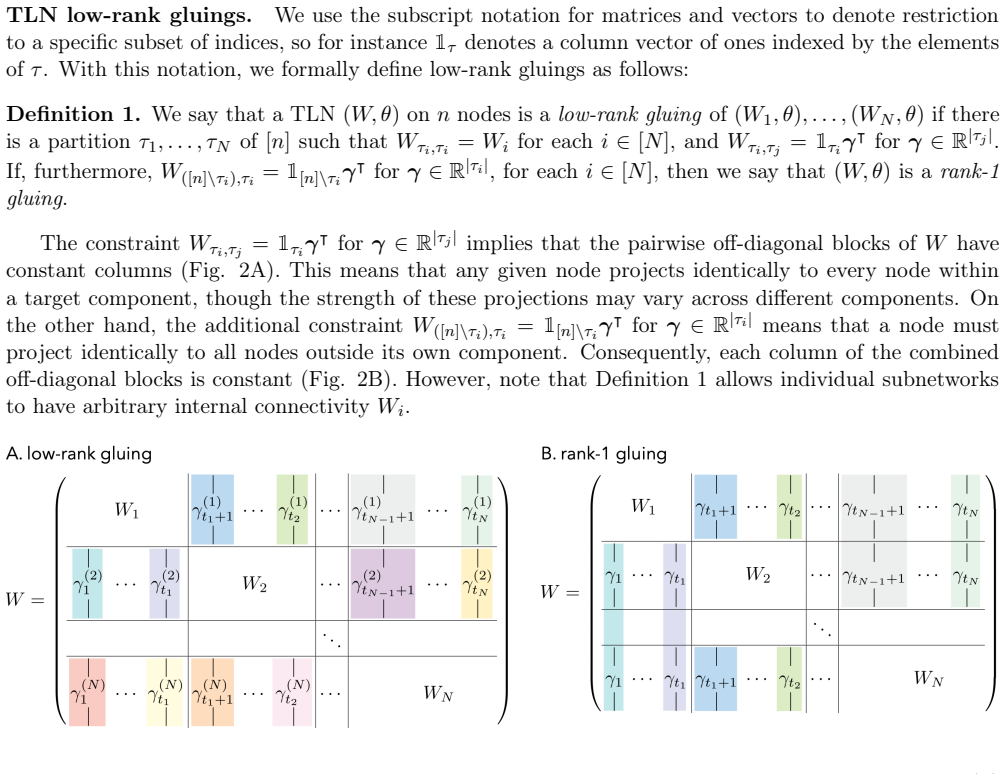
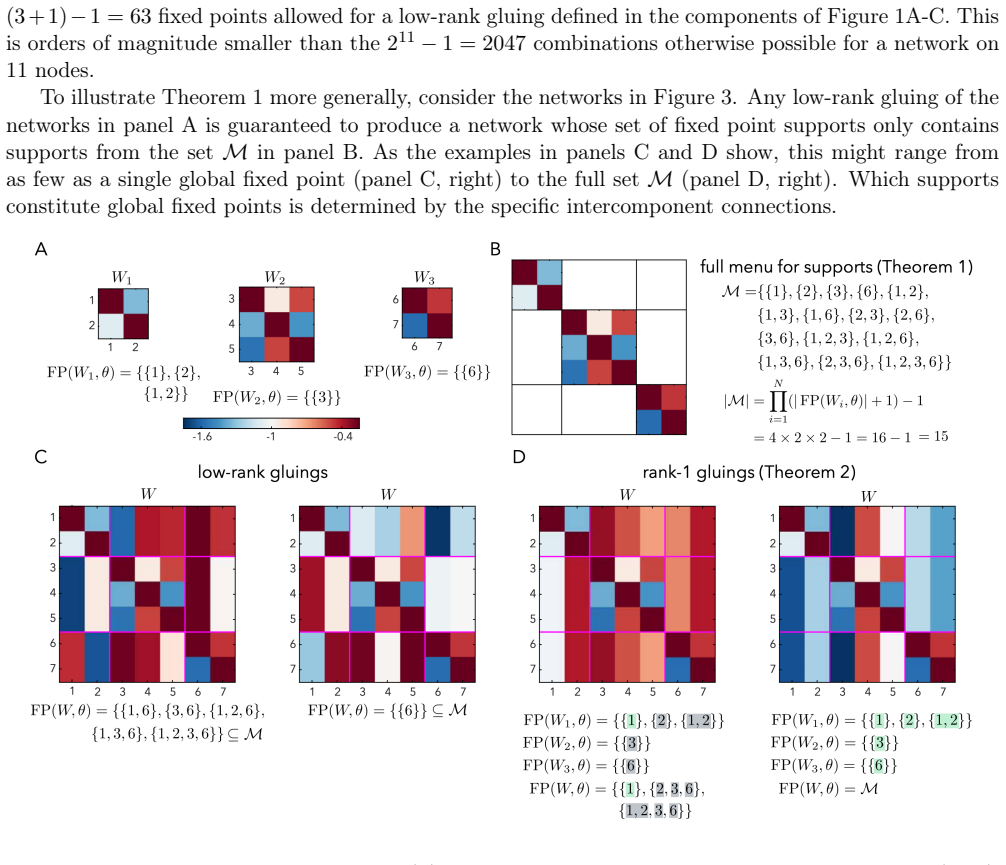
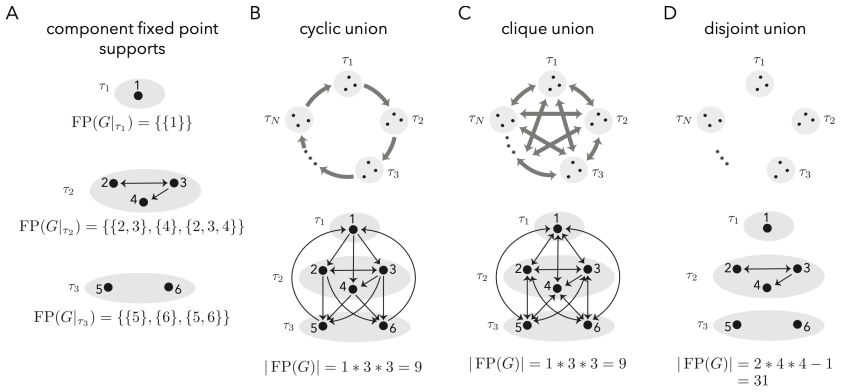
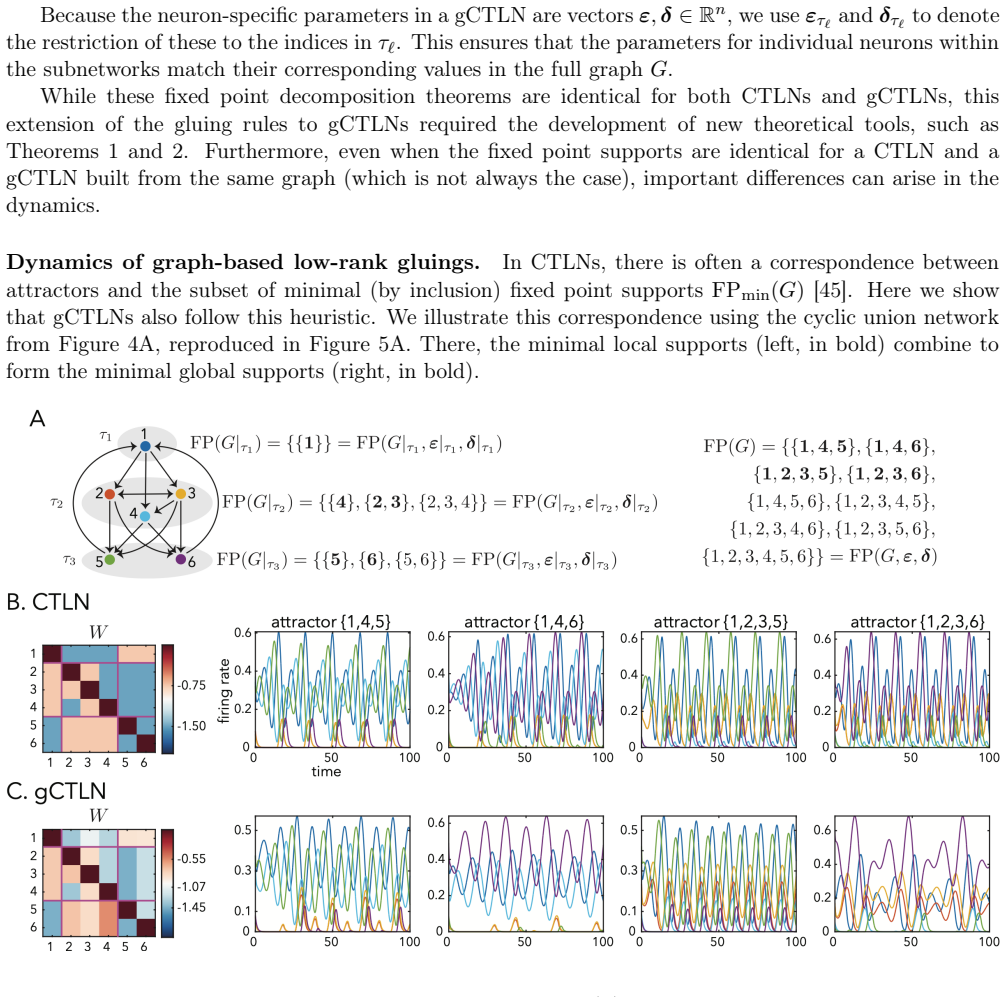
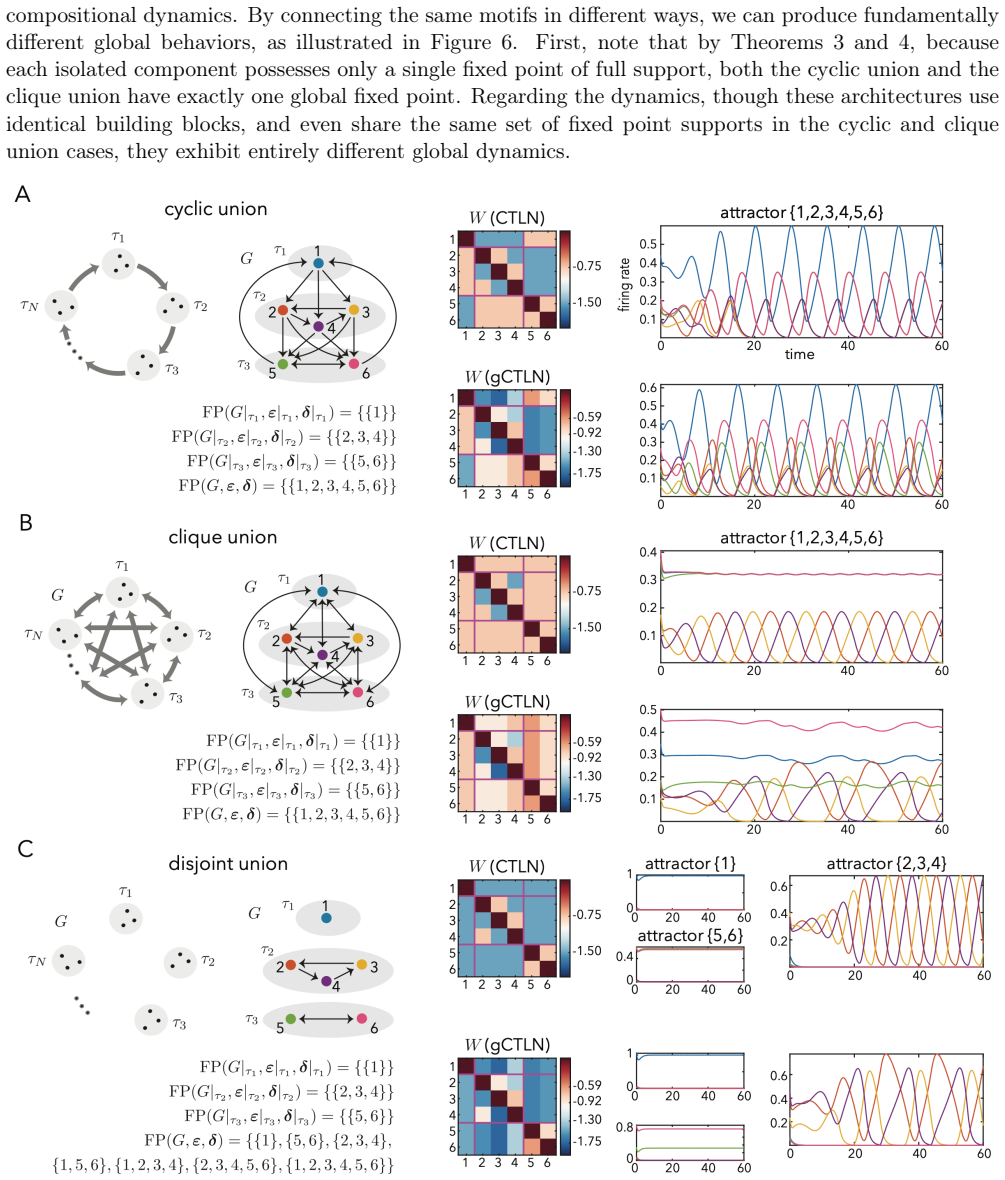
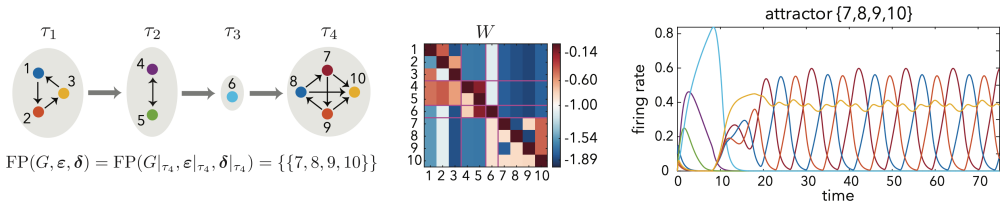
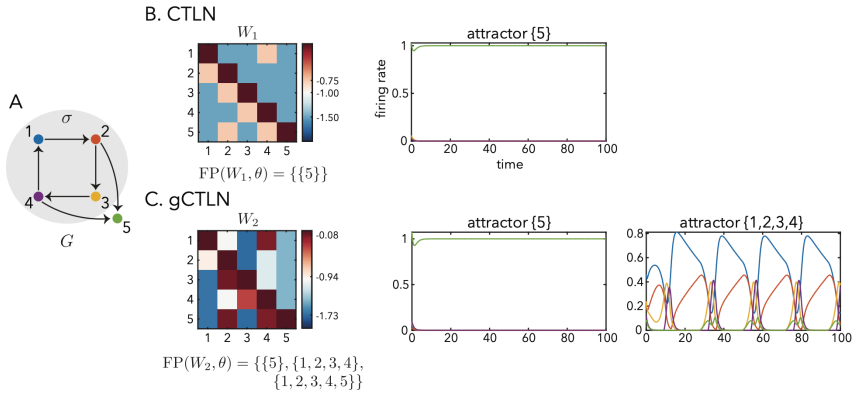
Brains routinely generate highly flexible and complex behaviors on a relatively stable structure and limited resources. A key mechanism underlying this ability is compositionality, which allows the brain to efficiently decompose complex tasks into simpler, reusable primitives. While network modularity has often been linked to compositionality in biological and artificial networks, a rigorous mathematical characterization of this relationship in nonlinear networks is still lacking. In this work, we formally investigate how structural modularity supports functional compositionality in inhibition-dominated threshold-linear networks (TLNs). We introduce a novel class of modular network assembly called low-rank gluings, where component subnetworks with arbitrary internal connectivity are connected via specific low-rank couplings. We prove that the global fixed points of these networks are constrained to be combinations of the local fixed points of their constituent modules. For a more structured subclass, called rank-1 gluings, we provide a complete characterization that determines which combinations of local fixed points yield global ones. We apply these results to graph-based networks, extending fixed point decomposition rules from combinatorial threshold-linear networks (CTLNs) to the more flexible family of generalized CTLNs (gCTLNs), thereby proving that these structural rules are more robust than initially posited. Finally, we demonstrate that these gluing rules provide a mathematically tractable recipe for engineering compositional dynamics, enabling the construction of networks with a combinatorially large repertoire of predictable attractors that can be understood from simpler component motifs, ranging from compositions of fixed points to compositional limit cycles.
Editorial analysis
A structured set of objections, weighed in public.
Referee Report
Summary. The manuscript introduces low-rank gluings for assembling inhibition-dominated threshold-linear networks (TLNs) from modular subnetworks with arbitrary internal connectivity. It proves that global fixed points are constrained to combinations of the local fixed points of the modules. For the subclass of rank-1 gluings, a complete characterization is provided determining which combinations yield global fixed points. The results are applied to graph-based generalized combinatorial TLNs (gCTLNs), extending fixed-point decomposition rules and proving greater robustness than initially posited. The gluing rules are also presented as a recipe for engineering networks with combinatorially large repertoires of predictable attractors, including compositional limit cycles.
Significance. If the proofs hold, the work supplies a rigorous, conditional mathematical characterization linking structural modularity to functional compositionality in nonlinear dynamical systems. This is significant for theoretical neuroscience. Credit is due for the explicit low-rank gluing construction, the machine-checkable-style proofs for the stated class of networks, the complete rank-1 characterization, and the extension to gCTLNs that demonstrates robustness of the structural rules without data-fitting or circularity.
minor comments (3)
- [Abstract] Abstract: the phrase 'low-rank gluings' and 'rank-1 gluings' are introduced without a one-sentence definition or forward reference to the precise matrix condition (e.g., the form of the inter-module coupling matrix); adding this would improve immediate readability.
- [§2] The manuscript would benefit from an early, self-contained statement (perhaps in §2) of the exact low-rank condition on the coupling matrices before the main theorems are stated.
- [Engineering examples] Figure captions and axis labels in the engineering-examples section could be expanded to indicate which local fixed points are being combined in each panel.
Simulated Author's Rebuttal
We thank the referee for the positive summary, significance assessment, and recommendation of minor revision. No specific major comments were raised in the report.
Circularity Check
No significant circularity identified
full rationale
The paper defines low-rank gluings as a new construction on inhibition-dominated TLNs and proves (via direct mathematical argument) that global fixed points are combinations of local module fixed points precisely when the inter-module couplings satisfy the stated low-rank form. This is a conditional theorem on explicitly constructed objects; the low-rank condition is the hypothesis, not a derived or fitted quantity. No self-citations are invoked as load-bearing uniqueness theorems, no parameters are fitted to data and then relabeled as predictions, and no known empirical patterns are merely renamed. The derivation chain is therefore self-contained within the paper's own definitions and proofs.
Axiom & Free-Parameter Ledger
axioms (1)
- domain assumption Inhibition-dominated threshold-linear dynamics
invented entities (1)
-
low-rank gluing
no independent evidence
Reference graph
Works this paper leans on
-
[1]
Strogatz
Steven H. Strogatz. Exploring complex networks.Nature, 410(6825):268–276, March 2001
2001
-
[2]
Complex networks: Structure and dynamics.Physics Reports, 424(4):175–308, February 2006
Stefano Boccaletti, Vito Latora, Yamir Moreno, Mario Chavez, and Dong-uk Hwang. Complex networks: Structure and dynamics.Physics Reports, 424(4):175–308, February 2006
2006
-
[3]
Structure and function of complex brain networks.Dialogues in Clinical Neuroscience, 15(3):247–262, September 2013
Olaf Sporns. Structure and function of complex brain networks.Dialogues in Clinical Neuroscience, 15(3):247–262, September 2013
2013
-
[4]
Structural and Functional Brain Networks: From Connections to Cognition.Science, 342(6158):1238411, November 2013
Hae-Jeong Park and Karl Friston. Structural and Functional Brain Networks: From Connections to Cognition.Science, 342(6158):1238411, November 2013
2013
-
[5]
Bassett and Olaf Sporns
Danielle S. Bassett and Olaf Sporns. Network neuroscience.Nature Neuroscience, 20(3):353–364, March 2017
2017
-
[6]
Olaf Sporns and Richard F. Betzel. Modular Brain Networks.Annual Review of Psychology, 67:613– 640, January 2016
2016
-
[7]
David Papo and Javier M. Buldú. Biological detail and graph structure in network neuroscience. Frontiers in Network Physiology, 5, October 2025
2025
-
[8]
The balance between integration and segregation drives network dynamics maximizing multistability and metastability.Scientific Reports, 15(1):18811, May 2025
Javier Palma-Espinosa, Sebastián Orellana-Villota, Carlos Coronel-Oliveros, Jean Paul Maidana, and Patricio Orio. The balance between integration and segregation drives network dynamics maximizing multistability and metastability.Scientific Reports, 15(1):18811, May 2025
2025
-
[9]
Jacob J. W. Bakermans, Joseph Warren, James C. R. Whittington, and Timothy E. J. Behrens. Constructing future behavior in the hippocampal formation through composition and replay.Nature Neuroscience, 28(5):1061–1072, May 2025
2025
-
[10]
Compositionality of Rule Representations in Human Prefrontal Cortex.Cerebral Cortex, 22(6):1237–1246, June 2012
Carlo Reverberi, Kai Görgen, and John-Dylan Haynes. Compositionality of Rule Representations in Human Prefrontal Cortex.Cerebral Cortex, 22(6):1237–1246, June 2012
2012
-
[11]
Joglekar, H
Guangyu Robert Yang, Madhura R. Joglekar, H. Francis Song, William T. Newsome, and Xiao-Jing Wang. Task representations in neural networks trained to perform many cognitive tasks.Nature Neuroscience, 22(2):297–306, February 2019
2019
-
[12]
Driscoll, Krishna Shenoy, and David Sussillo
Laura N. Driscoll, Krishna Shenoy, and David Sussillo. Flexible multitask computation in recurrent networks utilizes shared dynamical motifs.Nature Neuroscience, 27(7):1349–1363, July 2024
2024
-
[13]
Neural Module Networks
Jacob Andreas, Marcus Rohrbach, Trevor Darrell, and Dan Klein. Neural Module Networks. In Proceedings of the IEEE Conference on Computer Vision and Pattern Recognition, pages 39–48, 2016
2016
-
[14]
Break It Down: Evidence for Structural Composi- tionality in Neural Networks.Advances in Neural Information Processing Systems, 36:42623–42660, December 2023
Michael Lepori, Thomas Serre, and Ellie Pavlick. Break It Down: Evidence for Structural Composi- tionality in Neural Networks.Advances in Neural Information Processing Systems, 36:42623–42660, December 2023. 35
2023
-
[15]
Willett, Darrel R
Francis R. Willett, Darrel R. Deo, Donald T. Avansino, Paymon Rezaii, Leigh R. Hochberg, Jaimie M. Henderson, and Krishna V. Shenoy. Hand Knob Area of Premotor Cortex Represents the Whole Body in a Compositional Way.Cell, 181(2):396–409.e26, April 2020
2020
-
[16]
Bouchacourt, Adel Ardalan, Nikola T
Sina Tafazoli, Flora M. Bouchacourt, Adel Ardalan, Nikola T. Markov, Motoaki Uchimura, Marcelo G. Mattar, Nathaniel D. Daw, and Timothy J. Buschman. Building compositional tasks with shared neural subspaces.Nature, 650(8100):164–172, February 2026
2026
-
[17]
Kymn, Sonia Mazelet, Anthony Thomas, Denis Kleyko, E
Christopher J. Kymn, Sonia Mazelet, Anthony Thomas, Denis Kleyko, E. Paxon Frady, Friedrich T. Sommer, and Bruno A. Olshausen. Binding in hippocampal-entorhinal circuits enables composition- ality in cognitive maps. InProceedings of the 38th International Conference on Neural Information Processing Systems, volume 37 ofNIPS ’24, pages 39128–39157, Red Hoo...
-
[18]
Curran Associates Inc
-
[19]
Amematsro, Eric M
Elom A. Amematsro, Eric M. Trautmann, Najja J. Marshall, L. F. Abbott, Michael N. Shadlen, Daniel M. Wolpert, and Mark M. Churchland. Motor cortex flexibly deploys a high-dimensional repertoire of subskills. bioRxiv: 2025.09.07.674717, September 2025
2025
-
[20]
Human hippocampal ripples coordinate planning sequences and compositional representations in neocortex.Nature Neuroscience, pages 1–11, May 2026
Li He, Xiongfei Wang, Jinbo Zhang, Zhibing Xiao, Xiangyu Hu, Philipp Schwartenbeck, Jacob Bak- ermans, Tim Behrens, and Yunzhe Liu. Human hippocampal ripples coordinate planning sequences and compositional representations in neocortex.Nature Neuroscience, pages 1–11, May 2026
2026
-
[21]
Schaub.Modularity and Dynamics on Complex Networks
Renaud Lambiotte and Michael T. Schaub.Modularity and Dynamics on Complex Networks. Ele- ments in the Structure and Dynamics of Complex Networks. Cambridge University Press, Cambridge, 2022
2022
-
[22]
Schaub, Jean-Charles Delvenne, Martin Rosvall, and Renaud Lambiotte
Michael T. Schaub, Jean-Charles Delvenne, Martin Rosvall, and Renaud Lambiotte. The many facets of community detection in complex networks.Applied Network Science, 2(1):4, February 2017
2017
-
[23]
O. Sporns. Theoretical Neuroanatomy: Relating Anatomical and Functional Connectivity in Graphs and Cortical Connection Matrices.Cerebral Cortex, 10(2):127–141, February 2000
2000
-
[24]
Shaping Dynamics With Multiple Populations in Low-Rank Recurrent Networks.Neural Computa- tion, 33(6):1572–1615, May 2021
Manuel Beiran, Alexis Dubreuil, Adrian Valente, Francesca Mastrogiuseppe, and Srdjan Ostojic. Shaping Dynamics With Multiple Populations in Low-Rank Recurrent Networks.Neural Computa- tion, 33(6):1572–1615, May 2021
2021
-
[25]
Clark and Manuel Beiran
David G. Clark and Manuel Beiran. Structure of activity in multiregion recurrent neural networks. Proceedings of the National Academy of Sciences, 122(10):e2404039122, March 2025
2025
-
[26]
Attractor neural network models of spatial maps in hippocampus.Hippocampus, 9(4):481–489, 1999
Misha Tsodyks. Attractor neural network models of spatial maps in hippocampus.Hippocampus, 9(4):481–489, 1999
1999
-
[27]
Richard H. R. Hahnloser. Emergence of neural integration in the head-direction system by visual supervision.Neuroscience, 120(3):877–891, September 2003
2003
-
[28]
Hulse, Vivek Jayaraman, Sandro Romani, and Ann M
Marcella Noorman, Brad K. Hulse, Vivek Jayaraman, Sandro Romani, and Ann M. Hermundstad. Maintaining and updating accurate internal representations of continuous variables with a handful of neurons.Nature Neuroscience, 27(11):2207–2217, November 2024
2024
-
[29]
Cell Assembly Sequences Arising from Spike Threshold Adaptation Keep Track of Time in the Hippocampus.Journal of Neuroscience, 31(8):2828–2834, February 2011
Vladimir Itskov, Carina Curto, Eva Pastalkova, and György Buzsáki. Cell Assembly Sequences Arising from Spike Threshold Adaptation Keep Track of Time in the Hippocampus.Journal of Neuroscience, 31(8):2828–2834, February 2011
2011
-
[30]
Xiaohui Xie, Richard H. R. Hahnloser, and H. Sebastian Seung. Selectively Grouping Neurons in Recurrent Networks of Lateral Inhibition.Neural Computation, 14(11):2627–2646, November 2002. 36
2002
-
[31]
Richard H. R. Hahnloser, H. Sebastian Seung, and Jean-Jacques Slotine. Permitted and Forbidden Sets in Symmetric Threshold-Linear Networks.Neural Computation, 15(3):621–638, March 2003
2003
-
[32]
Encoding Binary Neural Codes in Networks of Threshold-Linear Neurons.Neural Computation, 25(11):2858–2903, November 2013
Carina Curto, Anda Degeratu, and Vladimir Itskov. Encoding Binary Neural Codes in Networks of Threshold-Linear Neurons.Neural Computation, 25(11):2858–2903, November 2013
2013
-
[33]
PatternCompletioninSymmetricThreshold-LinearNetworks
CarinaCurtoandKatherineMorrison. PatternCompletioninSymmetricThreshold-LinearNetworks. Neural Computation, 28(12):2825–2852, December 2016
2016
-
[34]
Diversity of Emergent Dynamics in Competitive Threshold-Linear Networks.SIAM Journal on Applied Dynamical Systems, 23(1):855–884, March 2024
Katherine Morrison, Anda Degeratu, Vladimir Itskov, and Carina Curto. Diversity of Emergent Dynamics in Competitive Threshold-Linear Networks.SIAM Journal on Applied Dynamical Systems, 23(1):855–884, March 2024
2024
-
[35]
Linking Connectivity, Dynamics, and Computations in Low-Rank Recurrent Neural Networks.Neuron, 99(3):609–623.e29, August 2018
Francesca Mastrogiuseppe and Srdjan Ostojic. Linking Connectivity, Dynamics, and Computations in Low-Rank Recurrent Neural Networks.Neuron, 99(3):609–623.e29, August 2018
2018
-
[36]
Dynamics of random recurrent networks with correlated low-rank structure.Physical Review Re- search, 2(1):013111, February 2020
Friedrich Schuessler, Alexis Dubreuil, Francesca Mastrogiuseppe, Srdjan Ostojic, and Omri Barak. Dynamics of random recurrent networks with correlated low-rank structure.Physical Review Re- search, 2(1):013111, February 2020
2020
-
[37]
Hopfield
John J. Hopfield. Neural networks and physical systems with emergent collective computational abilities.Proceedings of the National Academy of Sciences, 79(8):2554–2558, April 1982
1982
-
[38]
Sebastian Seung
H. Sebastian Seung. How the brain keeps the eyesstill.Proceedings of the National Academy of Sciences, 93(23):13339–13344, November 1996
1996
-
[39]
McNaughton
Alexei Samsonovich and Bruce L. McNaughton. Path Integration and Cognitive Mapping in a Con- tinuous Attractor Neural Network Model.Journal of Neuroscience, 17(15):5900–5920, August 1997
1997
-
[40]
Battaglia and Alessandro Treves
Francesco P. Battaglia and Alessandro Treves. Attractor neural networks storing multiple space representations: Amodelforhippocampalplacefields.Physical Review E,58(6):7738–7753, December 1998
1998
-
[41]
Yoram Burak and Ila R. Fiete. Accurate Path Integration in Continuous Attractor Network Models of Grid Cells.PLOS Computational Biology, 5(2):e1000291, February 2009
2009
-
[42]
Gardner, Erik Hermansen, Marius Pachitariu, Yoram Burak, Nils A
Richard J. Gardner, Erik Hermansen, Marius Pachitariu, Yoram Burak, Nils A. Baas, Benjamin A. Dunn, May-Britt Moser, and Edvard I. Moser. Toroidal topology of population activity in grid cells. Nature, 602(7895):123–128, February 2022
2022
-
[43]
McNaughton, Francesco P
Bruce L. McNaughton, Francesco P. Battaglia, Ole Jensen, Edvard I. Moser, and May-Britt Moser. Path integration and the neural basis of the ’cognitive map’.Nature Reviews Neuroscience, 7(8):663– 678, August 2006
2006
-
[44]
Cohen and Stephen Grossberg
Michael A. Cohen and Stephen Grossberg. Absolute stability of global pattern formation and par- allel memory storage by competitive neural networks.IEEE Transactions on Systems, Man, and Cybernetics, SMC-13(5):815–826, September 1983
1983
-
[45]
Fixed Points of Competitive Threshold-Linear Networks.Neural Computation, 31(1):94–155, January 2019
Carina Curto, Jesse Geneson, and Katherine Morrison. Fixed Points of Competitive Threshold-Linear Networks.Neural Computation, 31(1):94–155, January 2019
2019
-
[46]
Core motifs predict dynamic attractors in combinatorial threshold-linear networks.PLOS ONE, 17(3):e0264456, March 2022
Caitlyn Parmelee, Samantha Moore, Katherine Morrison, and Carina Curto. Core motifs predict dynamic attractors in combinatorial threshold-linear networks.PLOS ONE, 17(3):e0264456, March 2022. 37
2022
-
[47]
Rotstein
Andrea Bel, Romina Cobiaga, Walter Reartes, and Horacio G. Rotstein. Periodic Solutions in Threshold-Linear Networks and Their Entrainment.SIAM Journal on Applied Dynamical Systems, 20(3):1177–1208, January 2021
2021
-
[48]
Sequential At- tractors in Combinatorial Threshold-Linear Networks.SIAM Journal on Applied Dynamical Systems, 21(2):1597–1630, June 2022
Caitlyn Parmelee, Juliana Londono Alvarez, Carina Curto, and Katherine Morrison. Sequential At- tractors in Combinatorial Threshold-Linear Networks.SIAM Journal on Applied Dynamical Systems, 21(2):1597–1630, June 2022
2022
-
[49]
Carina Curto. On graphical domination for threshold-linear networks with recurrent excitation and global inhibition. arXiv: 2510.05098, October 2025
-
[50]
Graph Rules for Recurrent Neural Network Dynamics.Notices of the American Mathematical Society, 70(04):1, April 2023
Carina Curto and Katherine Morrison. Graph Rules for Recurrent Neural Network Dynamics.Notices of the American Mathematical Society, 70(04):1, April 2023
2023
-
[51]
The binding problem.Current Opinion in Neurobiology, 6(2):171–178, April 1996
Anne Treisman. The binding problem.Current Opinion in Neurobiology, 6(2):171–178, April 1996
1996
-
[52]
Adina L. Roskies. The Binding Problem.Neuron, 24(1):7–9, September 1999
1999
-
[53]
Long and Michale S
Michael A. Long and Michale S. Fee. Using temperature to analyse temporal dynamics in the songbird motor pathway.Nature, 456(7219):189–194, November 2008
2008
-
[54]
Tang, Marie L
Lamont S. Tang, Marie L. Goeritz, Jonathan S. Caplan, Adam L. Taylor, Mehmet Fisek, and Eve Marder. Precise Temperature Compensation of Phase in a Rhythmic Motor Pattern.PLOS Biology, 8(8):e1000469, August 2010
2010
-
[55]
Traub, Nancy J
Miles Adrian Whittington, Roger D. Traub, Nancy J. Kopell, G. Bard Ermentrout, and Eberhard H. Buhl. Inhibition-based rhythms: Experimental and mathematical observations on network dynamics. International Journal of Psychophysiology, 38(3):315–336, December 2000
2000
-
[56]
Karnani, Masakazu Agetsuma, and Rafael Yuste
Mahesh M. Karnani, Masakazu Agetsuma, and Rafael Yuste. A blanket of inhibition: Functional inferences from dense inhibitory connectivity.Current Opinion in Neurobiology, 26:96–102, June 2014
2014
-
[57]
Moises Arriaga and Edward B. Han. Dedicated Hippocampal Inhibitory Networks for Locomotion and Immobility.Journal of Neuroscience, 37(38):9222–9238, September 2017
2017
-
[58]
Dense Inhibitory Connectivity in Neocortex.Neuron, 69(6):1188–1203, March 2011
Elodie Fino and Rafael Yuste. Dense Inhibitory Connectivity in Neocortex.Neuron, 69(6):1188–1203, March 2011
2011
-
[59]
Dirk M. Bucher. Central Pattern Generators. In Larry R. Squire, editor,Encyclopedia of Neuro- science, pages 691–700. Academic Press, Oxford, January 2009
2009
-
[60]
Attractor-based models for sequences and pattern generation in neural circuits
Juliana Londono Alvarez. Attractor-based models for sequences and pattern generation in neural circuits. arXiv: 2410.11012, October 2024
-
[61]
Chapter 8 - Predicting Neural Network Dynamics via Graph- ical Analysis
Katherine Morrison and Carina Curto. Chapter 8 - Predicting Neural Network Dynamics via Graph- ical Analysis. In Raina Robeva and Matthew Macauley, editors,Algebraic and Combinatorial Com- putational Biology, MSE/Mathematics in Science and Engineering, pages 241–277. Academic Press, January 2019
2019
-
[62]
Attractor-Based Models for Se- quences and Pattern Generation in Neural Circuits.Neural Computation, 38(3):257–291, February 2026
Juliana Londono Alvarez, Katherine Morrison, and Carina Curto. Attractor-Based Models for Se- quences and Pattern Generation in Neural Circuits.Neural Computation, 38(3):257–291, February 2026. 38
2026
-
[63]
van der Weele and Erik J
Jacobus P. van der Weele and Erik J. Banning. Mode interaction in horses, tea, and other nonlinear oscillators: The universal role of symmetry.American Journal of Physics, 69(9):953–965, September 2001
2001
-
[64]
Rabinovich, Allen I
Pablo Varona, Mikhail I. Rabinovich, Allen I. Selverston, and Yuri I. Arshavsky. Winnerless competi- tion between sensory neurons generates chaos: A possible mechanism for molluscan hunting behavior. Chaos: An Interdisciplinary Journal of Nonlinear Science, 12(3):672–677, September 2002
2002
-
[65]
Yu. V. Panchin, Yuri I. Arshavsky, Tatiana G. Deliagina, Lyudmila Borisovna Popova, and Grigori N. Orlovsky. Control of locomotion in marine mollusk Clione Limacina. IX. Neuronal mechanisms of spatial orientation.Journal of Neurophysiology, 73(5):1924–1937, May 1995
1924
-
[66]
Gallego, Matthew G
Juan A. Gallego, Matthew G. Perich, Lee E. Miller, and Sara A. Solla. Neural Manifolds for the Control of Movement.Neuron, 94(5):978–984, June 2017
2017
-
[67]
Neuralcircuitsascomputationaldynamicalsystems.Current Opinion in Neurobiology, 25:156–163, April 2014
DavidSussillo. Neuralcircuitsascomputationaldynamicalsystems.Current Opinion in Neurobiology, 25:156–163, April 2014
2014
-
[68]
Dynamics on the manifold: Identifying computational dynamical activity from neural population recordings.Current Opinion in Neurobiology, 70:163–170, October 2021
Lea Duncker and Maneesh Sahani. Dynamics on the manifold: Identifying computational dynamical activity from neural population recordings.Current Opinion in Neurobiology, 70:163–170, October 2021
2021
-
[69]
Perich, Devika Narain, and Juan A
Matthew G. Perich, Devika Narain, and Juan A. Gallego. A neural manifold view of the brain.Nature Neuroscience, 28(8):1582–1597, August 2025
2025
-
[70]
Golub, David Sussillo, and Krishna V
Saurabh Vyas, Matthew D. Golub, David Sussillo, and Krishna V. Shenoy. Computation Through Neural Population Dynamics.Annual Review of Neuroscience, 43(Volume 43, 2020):249–275, July 2020
2020
-
[71]
Valentin Schmutz, Ali Haydaroğlu, Shuqi Wang, Yixiao Feng, Matteo Carandini, and Kenneth D. Harris. High-dimensional neuronal activity from low-dimensional latent dynamics: A solvable model. bioRxiv: 2025.06.03.657632, January 2026
2025
-
[72]
Rabinovich, Valentin S
Mikhail I. Rabinovich, Valentin S. Afraimovich, and Pablo Varona. Heteroclinic binding.Dynamical Systems, 25(3):433–442, September 2010
2010
-
[73]
Rabinovich and Pablo Varona
Mikhail I. Rabinovich and Pablo Varona. Discrete Sequential Information Coding: Heteroclinic Cognitive Dynamics.Frontiers in Computational Neuroscience, 12, September 2018
2018
-
[74]
Modularityofbiologicalsystems: Alinkbetweenstructureandfunction.Journal of The Royal Society Interface, 20(207):20230505, October 2023
Claus Kadelka, Matthew Wheeler, Alan Veliz-Cuba, David Murrugarra, and Reinhard Laubenbacher. Modularityofbiologicalsystems: Alinkbetweenstructureandfunction.Journal of The Royal Society Interface, 20(207):20230505, October 2023
2023
-
[75]
ical foundations of discrete dynamical systems
Daniel Carranza, Chris Kapulkin, Nathan Kershaw, Reinhard Laubenbacher, and Matthew Wheeler. ical foundations of discrete dynamical systems. arXiv: 2506.05190, June 2025
-
[76]
Diverse Mean-Field Dynamics of Clustered, Inhibition-Stabilized Hawkes Net- works via Combinatorial Threshold-Linear Networks.PRX Life, 3(4), 2025
Caitlin Lienkaemper. Diverse Mean-Field Dynamics of Clustered, Inhibition-Stabilized Hawkes Net- works via Combinatorial Threshold-Linear Networks.PRX Life, 3(4), 2025. 39
2025
discussion (0)
Sign in with ORCID, Apple, or X to comment. Anyone can read and Pith papers without signing in.