Origin of monolithic high-z galaxies and UV luminosity of mergering high-z galaxies in the cosmological model with non-standard spectrum of density perturbations
Pith reviewed 2026-06-27 21:21 UTC · model grok-4.3
The pith
A small-scale cutoff in the perturbation spectrum lets a bump at galaxy scales explain JWST's excess high-redshift galaxies without overproducing ionizing radiation.
A machine-rendered reading of the paper's core claim, the machinery that carries it, and where it could break.
Core claim
A primordial perturbation spectrum containing both a bump at the 10^10 solar-mass scale and a cutoff at smaller scales produces more monolithic early galaxies, yields a UV luminosity function consistent with observations under the merger-starburst assumption, and avoids excess reionization by limiting the formation of low-mass halos that would otherwise supply too many ionizing photons.
What carries the argument
A modified primordial density perturbation spectrum with a bump at galaxy scales and a cutoff at smaller scales, inserted into the extended Press-Schechter theory to obtain halo abundances and merger-rate distributions.
If this is right
- Fewer low-mass halos form, cutting the supply of ionizing UV photons and keeping reionization timing consistent with existing limits.
- The UV luminosity function of galaxies at high redshift matches current observational data.
- The fraction of early galaxies that form through monolithic single-collapse events rises markedly compared with standard Lambda CDM.
- The first stars form inside halos of mass at least 10^8 solar masses and carry primordial chemical composition as Population IV stars.
Where Pith is reading between the lines
- The required spectrum shape could be realized by warm dark matter or by a specific feature in the inflationary potential.
- High-redshift spectroscopy might reveal chemical signatures unique to Population IV stars formed in the monolithic channel.
- The timing and duration of reionization become sharper diagnostics that can separate this model from both standard Lambda CDM and bump-only variants.
Load-bearing premise
Mergers trigger starbursts, which converts the calculated halo merger-rate distribution into a UV luminosity function.
What would settle it
A direct count of low-mass halos or ionizing-photon production rate at z greater than 10 that matches the no-cutoff bump model instead of the suppressed version.
Figures


read the original abstract
The James Webb Space Telescope (JWST) has detected an unexpectedly large number of galaxies at redshifts $z\geq 10$ compared to the predictions of the standard $\Lambda$CDM model. One of possible explanations is the presence of an excess (bump) in the power spectrum of perturbations at the mass scale of these galaxies, which is about $10^{10}M_\odot$. This excess simultaneously shifts the epoch of cosmic reionization to significantly earlier times, in contradiction with observations. Here we show that this defect of the bump model can be avoided if the perturbation spectrum has a cutoff (suppression) at smaller scales, which can be realized by lowering the amplitude of the primordial perturbation spectrum or by considering warm dark matter. With a cutoff present, fewer low-mass halos form and, consequently, fewer stars producing ionizing UV radiation. We also derive the halo merger-rate distribution in the presence of a bump using the extended Press--Schechter (EPS) theory, and verify this distribution against direct $N$-body simulations. Based on this distribution, and under the assumption that mergers trigger starbursts, we compute the UV luminosity function of early galaxies and demonstrate its agreement with available observational data. In the model under consideration, the fraction of early galaxies forming via the monolithic mechanism (through a single large-scale collapse) is significantly increased in comparison with the standard $\Lambda$CDM model, and the first stars appear directly in halos with masses $\geq10^8M_\odot$. We refer to such stars with primordial chemical composition as ``Population~IV stars,'' to distinguish them from the evolutionary different stellar populations.
Editorial analysis
A structured set of objections, weighed in public.
Referee Report
Summary. The paper claims that a non-standard primordial power spectrum featuring a bump at scales ~10^10 M_⊙ (to boost high-z galaxy abundance) plus a cutoff at smaller scales (to suppress low-mass halos and avoid early reionization) resolves JWST tensions with ΛCDM. It derives the halo merger-rate distribution via extended Press-Schechter theory (verified vs. N-body simulations), assumes mergers trigger starbursts to compute a UV luminosity function matching observations, and concludes that the fraction of monolithic high-z galaxies increases while first stars form directly in halos ≥10^8 M_⊙ (termed Population IV).
Significance. If the central mapping holds, the work supplies a concrete mechanism to reconcile JWST galaxy counts with reionization constraints via a modified initial spectrum, and the N-body verification of the EPS merger rates is a clear strength that grounds the merger distribution. The increased monolithic fraction and direct formation of stars in 10^8 M_⊙ halos would be noteworthy predictions if the starburst link can be made quantitative.
major comments (2)
- [Abstract] Abstract, final paragraph: the UV luminosity function is obtained from the merger-rate distribution solely 'under the assumption that mergers trigger starbursts,' with no calibration, efficiency factor, starburst duration, or dependence on mass ratio/redshift supplied. Because the bump enhances 10^10 M_⊙ mergers while the cutoff suppresses lower-mass halos, this unelaborated link is load-bearing for the claimed agreement with JWST data; altering the assumed UV output per merger by a factor of two would shift the LF amplitude and potentially remove the match.
- [Abstract] Abstract: the bump amplitude/wavenumber and cutoff scale are introduced to reproduce the observed high-z galaxy abundance and to suppress the reionization excess, respectively. This choice makes the resulting UV LF a tuned fit to the same observations it is said to explain, weakening the claim that the model provides an independent explanation rather than a post-hoc adjustment.
minor comments (1)
- [Abstract] The term 'Population IV stars' is introduced without a clear operational definition or comparison to existing Population III literature; a brief clarification of the distinction would aid readability.
Simulated Author's Rebuttal
We thank the referee for their insightful comments on our manuscript. We address the major comments point by point below, providing clarifications and indicating where we will make revisions to improve the presentation.
read point-by-point responses
-
Referee: [Abstract] Abstract, final paragraph: the UV luminosity function is obtained from the merger-rate distribution solely 'under the assumption that mergers trigger starbursts,' with no calibration, efficiency factor, starburst duration, or dependence on mass ratio/redshift supplied. Because the bump enhances 10^10 M_⊙ mergers while the cutoff suppresses lower-mass halos, this unelaborated link is load-bearing for the claimed agreement with JWST data; altering the assumed UV output per merger by a factor of two would shift the LF amplitude and potentially remove the match.
Authors: We agree that the assumption linking mergers to starbursts requires more elaboration to strengthen the manuscript. While the full text motivates this assumption based on lower-redshift observations of merger-induced star formation, we will revise the abstract and relevant sections to include a brief description of the assumed parameters, such as a typical starburst duration of ~50 Myr and an efficiency calibrated to reproduce the observed UV LF amplitude at z~10 as a consistency check. This will address the sensitivity concern by noting the range of UV output that maintains agreement within observational uncertainties. We plan to add this in the revised version. revision: yes
-
Referee: [Abstract] Abstract: the bump amplitude/wavenumber and cutoff scale are introduced to reproduce the observed high-z galaxy abundance and to suppress the reionization excess, respectively. This choice makes the resulting UV LF a tuned fit to the same observations it is said to explain, weakening the claim that the model provides an independent explanation rather than a post-hoc adjustment.
Authors: The bump and cutoff scales are selected to simultaneously satisfy the JWST high-z galaxy counts and the reionization optical depth constraints from CMB and other observations. With these fixed, the UV luminosity function is then derived from the EPS merger rates under the starburst assumption, without additional tuning. This provides a non-trivial consistency test of the model. We will revise the abstract to better highlight that the LF agreement is a derived result rather than an input, thereby strengthening the claim of an explanatory mechanism. However, we maintain that the overall approach offers a physically motivated alternative to standard ΛCDM. revision: partial
Circularity Check
No significant circularity; derivation uses explicit assumptions and external verification.
full rationale
The paper proposes a bump-plus-cutoff perturbation spectrum to address JWST high-z galaxy counts while avoiding reionization tension. Halo merger rates are derived via extended Press-Schechter theory and verified against independent N-body simulations. The UV luminosity function is then computed explicitly 'under the assumption that mergers trigger starbursts' (abstract), without any claim of first-principles derivation or calibration from the spectrum alone. No quoted equations reduce the LF output to the bump/cutoff parameters by construction, nor is any self-citation used as load-bearing uniqueness proof. The monolithic fraction increase follows directly from the modified spectrum suppressing small halos. This is a standard model-building exercise with stated assumptions; the derivation chain remains self-contained against external benchmarks.
Axiom & Free-Parameter Ledger
free parameters (2)
- bump amplitude and wavenumber
- cutoff scale or suppression amplitude
axioms (2)
- domain assumption Extended Press-Schechter formalism remains valid for a spectrum containing both a bump and a cutoff.
- ad hoc to paper Galaxy mergers trigger starbursts that dominate the UV output at these redshifts.
invented entities (1)
-
Population IV stars
no independent evidence
Reference graph
Works this paper leans on
-
[1]
INTRODUCTION The development of observational cosmology over the past two decades has significantly improved the precision of cosmological parameters determination. A joint anal- ysis of data from Planck and BICEP/Keck [1] substan- tially weakened the viability of many inflationary models, since the measured local tilt of the density perturbation spectrum n...
work page internal anchor Pith review Pith/arXiv arXiv 2023
-
[2]
We consider a cosmolog- ical model with A = 20, k0 = 4
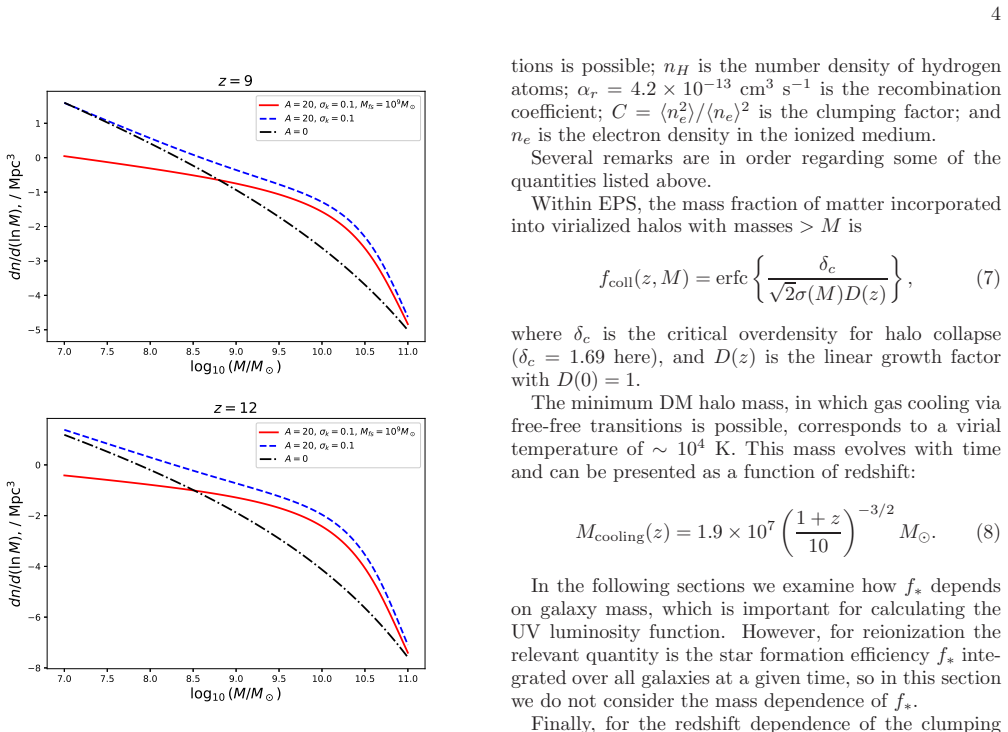
POWER SPECTRUM WITH A BUMP AND A CUTOFF, AND EARLY FORMATION OF MASSIVE GALAXY HALOS The power spectrum with a bump is conveniently pa- rameterized as Pbump(k) PΛ CDM (k) = 1 + A ·exp ( − (log(k) − log(k0))2 σ 2 k ) , (1) where PΛ CDM (k) is the density perturbation power spec- trum of the standard ΛCDM model, k is the wavenumber, and A, k0, and σk are co...
-
[3]
In contrast, WDM models typically involve particles with masses of order keV that decoupled while still relativistic
considered massive ( ∼ 70 GeV) particles (WIMPs) that underwent kinetic decoupling while already non- relativistic. In contrast, WDM models typically involve particles with masses of order keV that decoupled while still relativistic. For this case, [30] found the relation between the characteristic scale and the particle mass: kfs ∼ 13(mχ / keV)1. 15 Mpc−...
-
[4]
Analogous calculations can be performed for a model with a non-standard spec- trum containing a bump and a cutoff
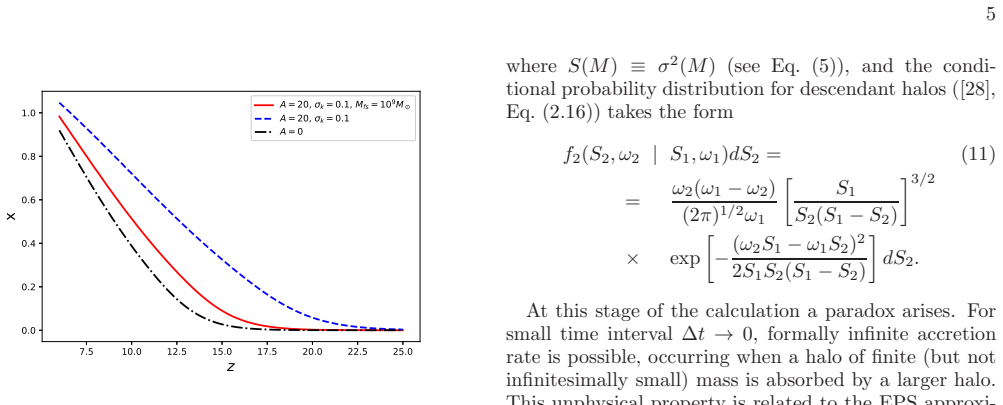
EVOLUTION OF THE INTERGALACTIC GAS IONIZATION FRACTION The evolution of the ionization fraction x in the case of the standard density perturbation spectrum has been studied, for example, in [33, 34]. Analogous calculations can be performed for a model with a non-standard spec- trum containing a bump and a cutoff. The ionization fraction x evolves with time...
-
[5]
GALAXY MERGER RATE The early galaxies, a significant fraction of which may have formed via the monolithic mechanism, subsequently merge with other galaxies and build up their mass. Thus, in later generations of galaxies the hierarchical merger 5 7.5 10.0 12.5 15.0 17.5 20.0 22.5 25.0 z 0.0 0.2 0.4 0.6 0.8 1.0 x A = 20, σ k = 0.1, M f s = 10 9 M ⊙ A = 20, σ...
-
[6]
Thus, gas can be retained in the small halo for galaxies at redshifts z ≥ 1, and the merger-driven starburst mechanism described above can operate at high z
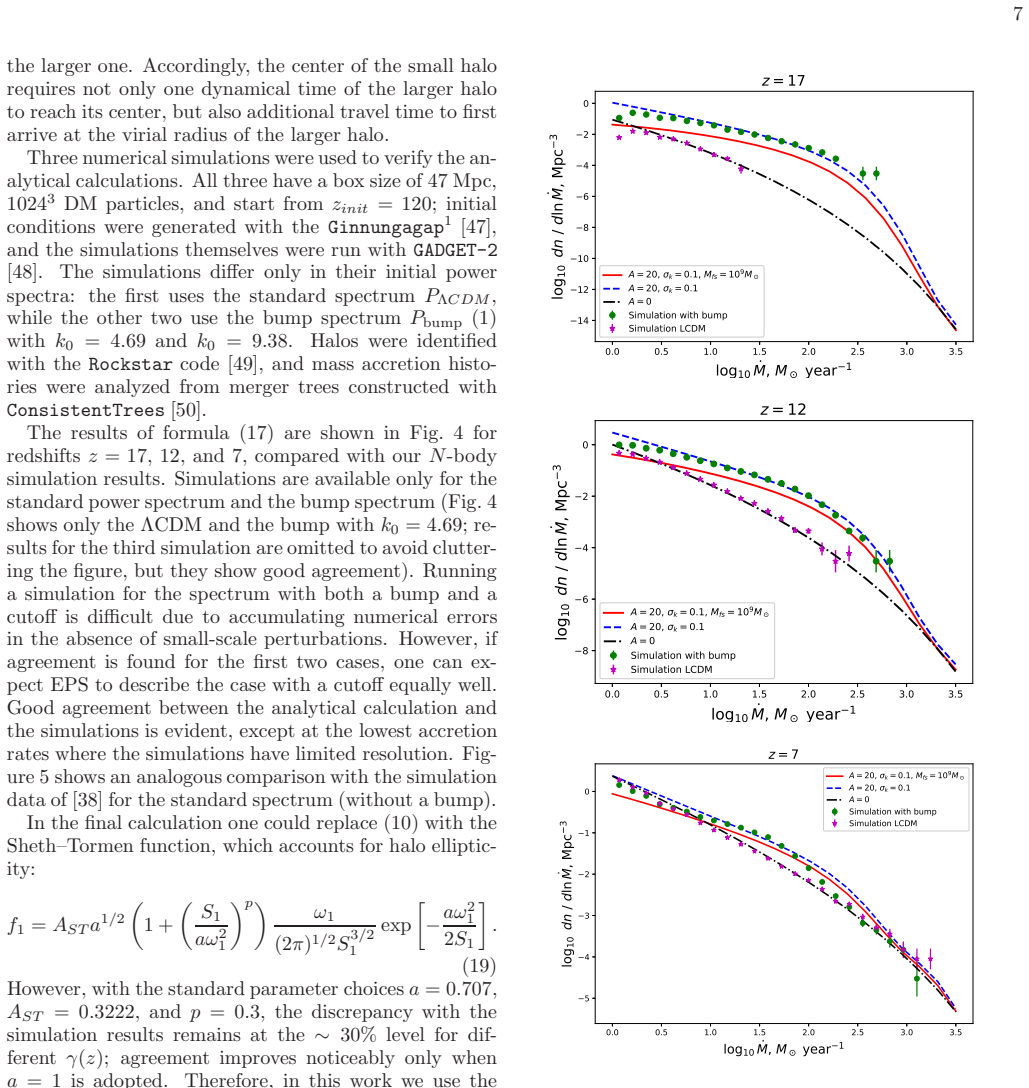
1 ) 1/ 2 (16) × ( v 200 km s − 1 ) 1/ 2 ( M1 109M⊙ ) − 1/ 6 , where Milky Way parameters have been substituted for the large halo in the estimates. Thus, gas can be retained in the small halo for galaxies at redshifts z ≥ 1, and the merger-driven starburst mechanism described above can operate at high z. The delivery of the baryonic disk of the small halo...
-
[7]
reports the distribution per decade in accretion rate, dn/d log10
-
[8]
The UV emis- sion of a galaxy is dominated by young massive stars, so the UV luminosity function traces the star forma- tion rate
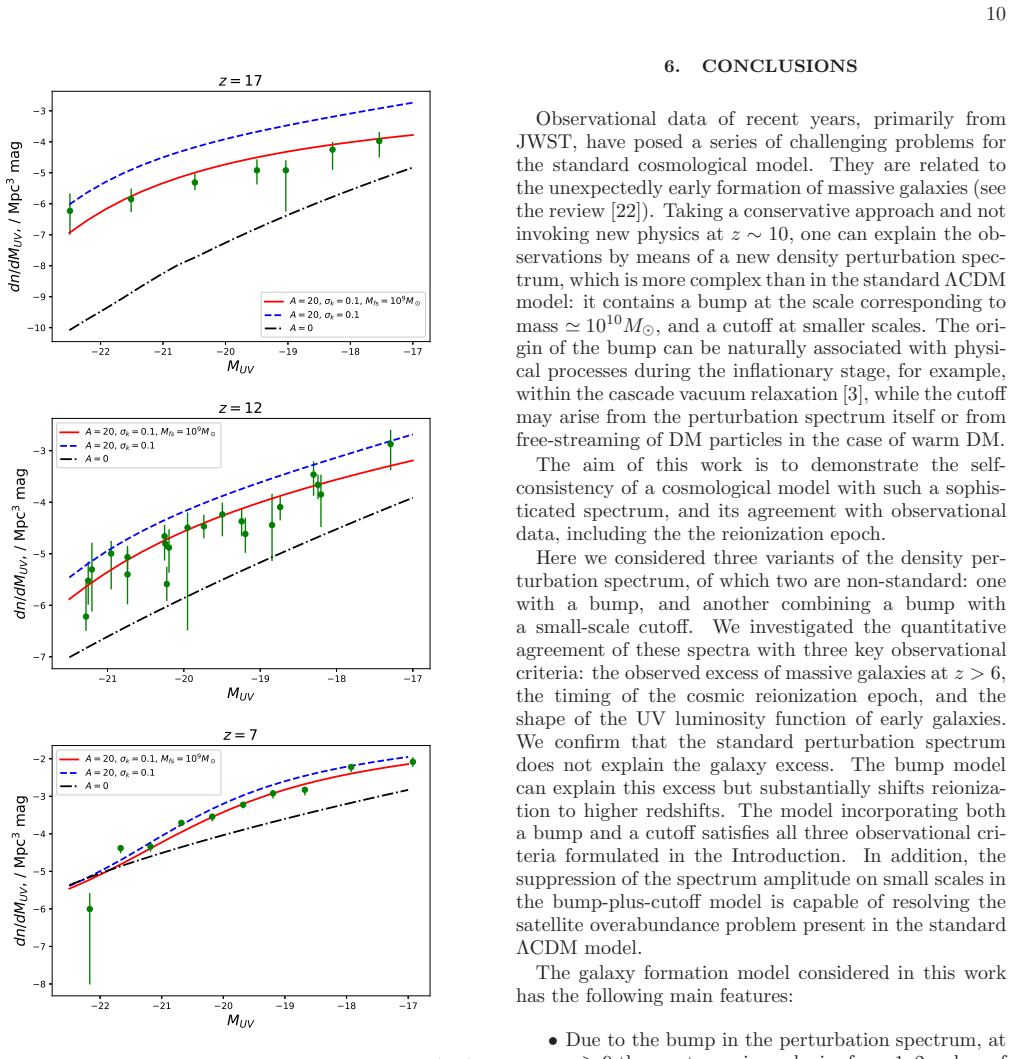
EVOLUTION OF THE GALAXY UV LUMINOSITY FUNCTION With the launch of the JWST, which observes in the in- frared, the rest-frame UV emission of galaxies at redshifts z ≥ 10 became accessible, while the optical emission of these galaxies is cosmologically redshifted to longer wave- lengths that are not yet easily observed. The UV emis- sion of a galaxy is domi...
-
[9]
2 × 10²e− 0
1 ) − 1 M⊙ , (24) ˙M = 1. 2 × 10²e− 0. 92(MU V +19) ( f∗
-
[10]
(25) These two quantities are related by Eq
1 ) − 1 M⊙ yr . (25) These two quantities are related by Eq. (13). The galaxy halo mass growth rate ˙M is often estimated as exponential, ˙Mh ∝ exp(− a∗ z) [53, 54], where the con- stant a∗ is determined from large simulations since theory does not fix its value (see [40]). In the present work we cannot use this recipe, since for our non-standard spec- tru...
-
[11]
They are related to the unexpectedly early formation of massive galaxies (see the review [22])
CONCLUSIONS Observational data of recent years, primarily from JWST, have posed a series of challenging problems for the standard cosmological model. They are related to the unexpectedly early formation of massive galaxies (see the review [22]). Taking a conservative approach and not invoking new physics at z ∼ 10, one can explain the ob- servations by me...
2024
-
[12]
Ade, et al., Improved constraints on primor- dial gravitational waves using Planck, WMAP, and BI- CEP/Keck observations through the 2018 observing sea- son, Phys
P.A.R. Ade, et al., Improved constraints on primor- dial gravitational waves using Planck, WMAP, and BI- CEP/Keck observations through the 2018 observing sea- son, Phys. Rev. Lett. 127, 151301 (2021)
2018
-
[13]
Linde, Alexei Starobinsky and modern cosmology, arXiv:2509.01675
A. Linde, Alexei Starobinsky and modern cosmology, arXiv:2509.01675
-
[14]
Lukash, E.V
V.N. Lukash, E.V. Mikheeva, Cascade relaxation of the gravitating vacuum as a generator of the evolving Uni- verse, JETP Lett. 121, 421 (2025)
2025
-
[15]
Fomin, S.V
I.V. Fomin, S.V. Chervon, L.K. Duchaniya, B. Mishra, The scalar-torsion gravity corrections in the first-order inflationary models, Physics of the Dark Universe 48, 101895 (2025)
2025
-
[16]
E. Camphuis et al., SPT-3G D1: CMB temperature and polarization power spectra and cosmology from 2019 and 2020 observations of the SPT-3G Main field, arXiv:2506.20707
work page internal anchor Pith review Pith/arXiv arXiv 2019
-
[17]
Louis et al., The Atacama Cosmology Telescope: DR6 power spectra, likelihoods and ΛCDM parameters, J
T. Louis et al., The Atacama Cosmology Telescope: DR6 power spectra, likelihoods and ΛCDM parameters, J. Cosmol. Astropart. Phys. 062 (2025)
2025
-
[18]
Naidu, et al., Two remarkably luminous galaxy can- didates at z ≃ 10 − 12 revealed by JWST, Astrophys
R.P. Naidu, et al., Two remarkably luminous galaxy can- didates at z ≃ 10 − 12 revealed by JWST, Astrophys. J. Lett. 940, L14 (2022)
2022
-
[19]
Castellano, et al., Early results from GLASS-JWST
M. Castellano, et al., Early results from GLASS-JWST. III. Galaxy candidates at z ≃ 9 − 15, Astrophys. J. Lett. 938, L15 (2022)
2022
-
[20]
S. L. Finkelstein, et al., A long time ago in a galaxy far, far away: a candidate z ≃ 12 galaxy in early JWST CEERS imaging, Astrophys. J. Lett. 940, L55 (2022)
2022
-
[21]
Donnan, et al., The evolution of the galaxy UV lu- minosity function at redshifts z ≃ 8− 15 from deep JWST and ground-based near-infrared imaging, Mon
C.T. Donnan, et al., The evolution of the galaxy UV lu- minosity function at redshifts z ≃ 8− 15 from deep JWST and ground-based near-infrared imaging, Mon. Not. R. Astron. Soc. 518, 6011 (2023). 12
2023
-
[22]
Labb´ e, et al., A population of red candidate massive galaxies 600 Myr after the Big Bang, Nature 616, 266 (2023)
I. Labb´ e, et al., A population of red candidate massive galaxies 600 Myr after the Big Bang, Nature 616, 266 (2023)
2023
-
[23]
Li, et al., Tip of the iceberg: overmassive black hole s at 4 < z < 7 found by JWST are not inconsistent with the Local MBH — M⋆ relation, Astrophys
J. Li, et al., Tip of the iceberg: overmassive black hole s at 4 < z < 7 found by JWST are not inconsistent with the Local MBH — M⋆ relation, Astrophys. J. 981, 19 (2025)
2025
-
[24]
Aghanim, et al
N. Aghanim, et al. (Planck Collaboration), Planck 2018 results. VI. Cosmological parameters, Astron. Astrophys. 641, A6 (2020)
2018
-
[25]
Tkachev, S.V
M.V. Tkachev, S.V. Pilipenko, E.V. Mikheeva, V.N. Lukash, Mon. Not. R. Astron. Soc. 527, 1381 (2024)
2024
-
[26]
Yu. N. Eroshenko, V.N. Lukash, E.V. Mikheeva, S.V. Pilipenko, M.V. Tkachev, Properties of central regions of the dark matter halos in the model with a bump in the power spectrum of density perturbations, JETP Lett. 120, 83 (2024)
2024
-
[27]
Tkachev, S.V
M.V. Tkachev, S.V. Pilipenko, E.V. Mikheeva, V.N. Lukash, Inner structure of dark matter halos at high z in cosmological models with non-power-law primordial spectra, Phys. Rev. D 110, 083530 (2024)
2024
-
[28]
Tkachev, S.V
M.V. Tkachev, S.V. Pilipenko, E.V. Mikheeva, V.N. Lukash, High-z SMBHs in cosmological models with en- hanced power spectra, Phys. Rev. D 112, 063527 (2025)
2025
-
[29]
Eroshenko, V.N
Yu.N. Eroshenko, V.N. Lukash, E.V. Mikheeva, S.V. Pilipenko, and M.V. Tkachev, Absorption in the 21 cm hydrogen line at z > 10 as a sensitive tool for the con- struction of a cosmological model on small scales, Astron. Lett. 51, 189 (2025)
2025
- [30]
-
[31]
Moore, T
B. Moore, T. Quinn, F. Governato, J. Stadel, G. Lake, Cold collapse and the core catastrophe, Mon. Not. R. Astron. Soc. 310, 1147 (1999)
1999
-
[32]
McGaugh, J.M
S.S. McGaugh, J.M. Schombert, F. Lelli, and J. Franck, Accelerated structure formation: the early emergence of massive galaxies and clusters of galaxies, Astrophys. J. 976, 13 (2024)
2024
-
[33]
Sil’chenko, Galaxies in the first billion years of t he Universe’s expansion, Phys
O.K. Sil’chenko, Galaxies in the first billion years of t he Universe’s expansion, Phys. Usp. 68, 177 (2025)
2025
-
[34]
Ferrara, A
A. Ferrara, A. Pallottini, P. Dayal, On the stunning abundance of super-early, luminous galaxies revealed by JWST, Mon. Not. R. Astron. Soc. 522, 3986 (2023)
2023
-
[35]
M. Blamart, A. Liu, R. Brandenberger, J.B. Mu˜ noz, B. Cyr, UV luminosity functions from HST and JWST: a possible resolution to the high-redshift galaxy abundance puzzle and implications for cosmic strings, arXiv:2512.09980
-
[36]
P.G. Perez-Gonz´ alez, et al., The rise of the galactic e m- pire: ultraviolet luminosity functions at z ∼ 17 and z ∼ 25 estimated with the MIDIS+NGDEEP ultra-deep JWST/NIRCam data set, Astrophys. J. 991, 179 (2025)
2025
-
[37]
Yung, R.S
L.Y.A. Yung, R.S. Somerville, K.G. Iyer, ΛCDM is still not broken: empirical constraints on the star formation efficiency at z ∼ 12 − 30, Mon. Not. R. Astron. Soc. , 3802 (2025)
2025
-
[38]
J.R. Bond, S. Cole, G. Efstathiou, N. Kaiser, Excursion set mass functions for hierarchical Gaussian fluctuations, Astrophys. J. 379, 440 (1991)
1991
-
[39]
Lacey and S
C. Lacey and S. Cole, Merger rates in hierarchical model s of galaxy formation, Mon. Not. R. Astron. Soc. 262, 627 (1993)
1993
-
[40]
Berezinsky, V
V. Berezinsky, V. Dokuchaev, Yu. Eroshenko, Small-sca le clumps in the galactic halo and dark matter annihilation, Phys. Rev. D 68, 103003 (2003)
2003
-
[41]
P. Bode, J. Ostriker, N. Turok, Halo formation in warm dark matter models, Astrophys. J. 556, 93 (2001)
2001
-
[42]
Sheth, G
R.K. Sheth, G. Tormen, Large-scale bias and the peak background split, Mon. Not. R. Astron. Soc. 308, 119 (1999)
1999
-
[43]
White, M.J
S.D.M. White, M.J. Rees, Core condensation in heavy halos: a two-stage theory for galaxy formation and clus- tering, Mon. Not. R. Astron. Soc. 183, 341 (1978)
1978
-
[44]
Furlanetto, The global 21-centimeter background fr om high redshifts, Mon
S. Furlanetto, The global 21-centimeter background fr om high redshifts, Mon. Not. Roy. Astron. Soc. 371, 867 (2006)
2006
-
[45]
Furlanetto, S.P
S.R. Furlanetto, S.P. Oh, and F.H. Briggs, Cosmology at low frequencies: the 21 cm transition and the high- redshift Universe, Physics Reports 433, 181 (2006)
2006
-
[46]
Mellema, I.T
G. Mellema, I.T. Iliev, U.-L. Pen, P.R. Shapiro, Simu- lating cosmic reionization at large scales - II. The 21-cm emission features and statistical signals, Mon. Not. R. Astron. Soc. 372, 679 (2006)
2006
-
[47]
Stewart, J.S
K.R. Stewart, J.S. Bullock, R.H. Wechsler, A.H. Maller , A.R. Zentner, Merger histories of galaxy halos and impli- cations for disk survival, Astrophys. J. 683, 597 (2008)
2008
-
[48]
Genel, R
S. Genel, R. Genzel, N. Bouch´ e, T. Naab, A. Sternberg, The halo merger rate in the Millennium simulation and implications for observed galaxy merger fractions, Astro- phys. J. 701, 2002 (2009)
2002
-
[49]
H. Trac, R. Cen, P. Mansfield, SCORCH I: the galaxy- halo connection in the first billion years, Astrophys. J. 813, 54 (2015)
2015
-
[50]
Somerville, T.S
R.S. Somerville, T.S. Kolatt, How to plant a merger tree , Mon. Not. R. Astron. Soc. 305, 1 (1999)
1999
-
[51]
Neistein, F.C
E. Neistein, F.C. van den Bosch, A. Dekel, Natural down- sizing in hierarchical galaxy formation, Mon. Not. R. As- tron. Soc. 372, 933 (2006)
2006
-
[52]
Neistein, A
E. Neistein, A. Dekel, Merger rates of dark matter haloe s, Mon. Not. R. Astron. Soc. 388, 1792 (2008)
2008
-
[53]
Moreno, C
J. Moreno, C. Giocoli, R.K. Sheth, Merger history trees of dark matter haloes in moving barrier models, Mon. Not. R. Astron. Soc. 391, 1729 (2008)
2008
-
[54]
Parkinson, S
H. Parkinson, S. Cole, J. Helly, Generating dark matter halo merger trees, Mon. Not. R. Astron. Soc. 383, 557 (2008)
2008
-
[55]
Nadler, A
E.O. Nadler, A. Benson, T. Driskell, X. Du, V. Gluscevic , Growing the first galaxies’ merger trees, Mon. Not. R. Astron. Soc. 521, 3201 (2023)
2023
-
[56]
Dekel, Y
A. Dekel, Y. Birnboim, G. Engel, J. Freundlich, T. Go- erdt, M. Mumcuoglu, E. Neistein, C. Pichon, R. Teyssier, E. Zinger, Cold streams in early massive hot haloes as the main mode of galaxy formation, Nature 457, 451 (2009)
2009
-
[57]
M. Stiavelli, M. Ricotti, How bursty is star formation a t z > 5?, arXiv:2602.16706
-
[58]
Pilipenko, G
S. Pilipenko, G. Yepes, S. Gottl¨ ober, S. Knollmann, Ginnungagap — A massively parallel cosmological ini- tial conditions generator, Astron. Comput. 55, 101082 (2026)
2026
-
[59]
Springel, The cosmological simulation code GADGET-2, Mon
V. Springel, The cosmological simulation code GADGET-2, Mon. Not. R. Astron. Soc. 364, 1105 (2005)
2005
-
[60]
Behroozi, R.S
P.S. Behroozi, R.S. Wechsler, H.-Y. Wu, The ROCK- STAR phase-space temporal halo finder and the velocity offsets of cluster cores, Astrophys. J. 762, 109 (2013)
2013
-
[61]
Behroozi, R.S
P.S. Behroozi, R.S. Wechsler, H.-Y. Wu et al., Gravi- tationally consistent halo catalogs and merger trees for precision cosmology, Astrophys. J. 763, 18 (2013). 13
2013
-
[62]
H. Zhu, B. Yue, Y. Xu, X. Chen, and Z. Huang, Probing power spectrum enhancement at small scales with the SKA, Astrophys. J. 1001, 25 (2026)
2026
-
[63]
Mirocha, S.R
J. Mirocha, S.R. Furlanetto, G. Sun, The global 21-cm signal in the context of the high- z galaxy luminosity func- tion, Mon. Not. R. Astron. Soc. 464, 1365 (2017)
2017
-
[64]
Wechsler, J.S
R.H. Wechsler, J.S. Bullock, J.R. Primack, A.V. Kravtsov, A. Dekel, Concentrations of dark halos from their assembly histories, Astrophys. J. 568, 52 (2002)
2002
-
[65]
Dekel, A
A. Dekel, A. Zolotov, D. Tweed, M. Cacciato, D. Cev- erino, J.R. Primack, Toy models for galaxy formation versus simulations, Mon. Not. R. Astron. Soc. 435, 999 (2013)
2013
discussion (0)
Sign in with ORCID, Apple, or X to comment. Anyone can read and Pith papers without signing in.