Non-Abelian braiding in Abelian Fractional Quantum Hall Phases from realistic interactions
Pith reviewed 2026-06-27 20:23 UTC · model grok-4.3
The pith
Low-lying excitations near filling factor 1/3 consist almost entirely of non-Abelian quasiholes from the Moore-Read null space.
A machine-rendered reading of the paper's core claim, the machinery that carries it, and where it could break.
Core claim
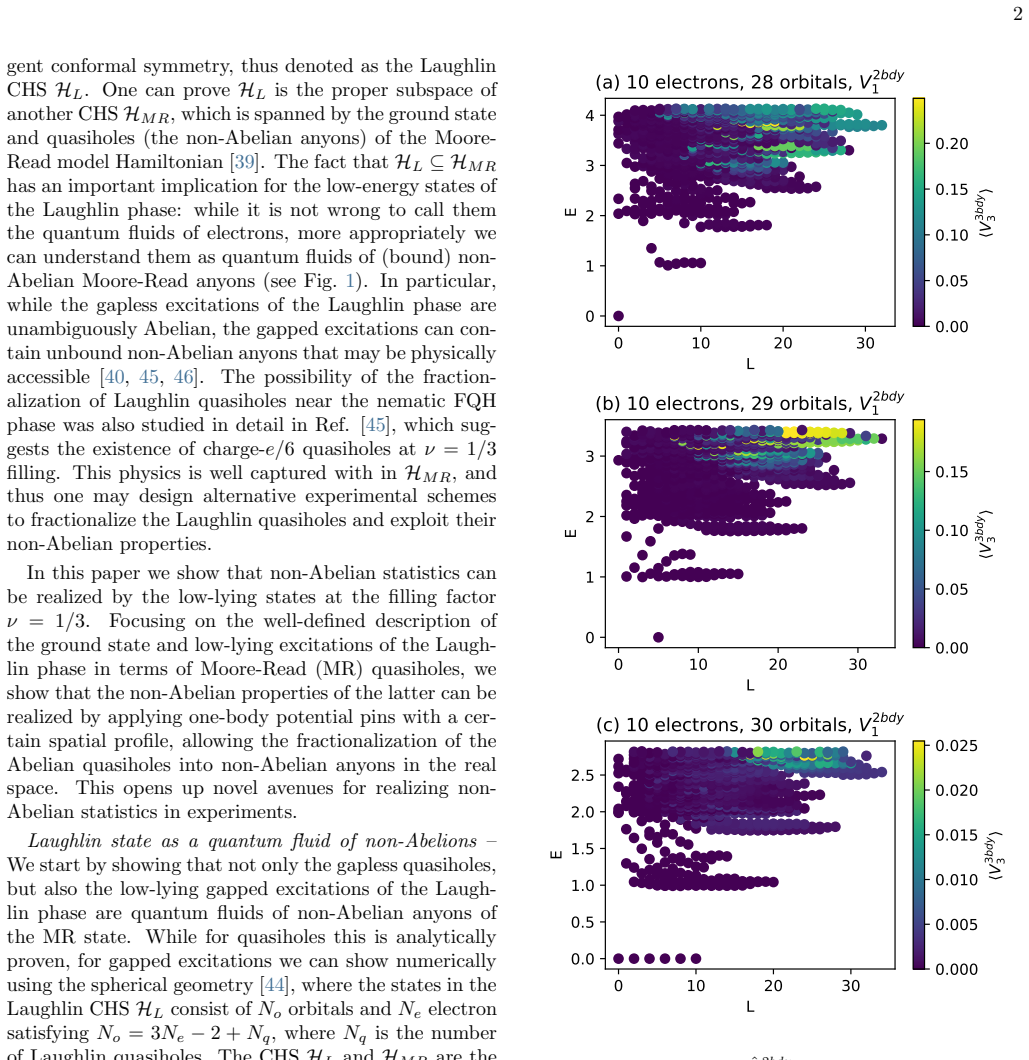
Low-lying gapped excitations near ν=1/3 are contained almost entirely within the null space of the three-body Moore-Read model Hamiltonian. They are thus quantum fluids of non-Abelian quasiholes that are in principle physically accessible with realistic interactions. The Laughlin ground state can be described as a fluid of ψ-type quasiholes formed by binding a magnetic flux with a Majorana fermion, and the Laughlin quasiholes are 1-type quasiholes consisting of magnetic fluxes without a Majorana fermion attached. Within the Laughlin phase, these can be fractionalized using one-body electrostatic trapping potentials.
What carries the argument
The null space of the three-body Moore-Read model Hamiltonian, which encodes the non-Abelian quasihole states and allows decomposition into ψ-type and 1-type quasiholes.
If this is right
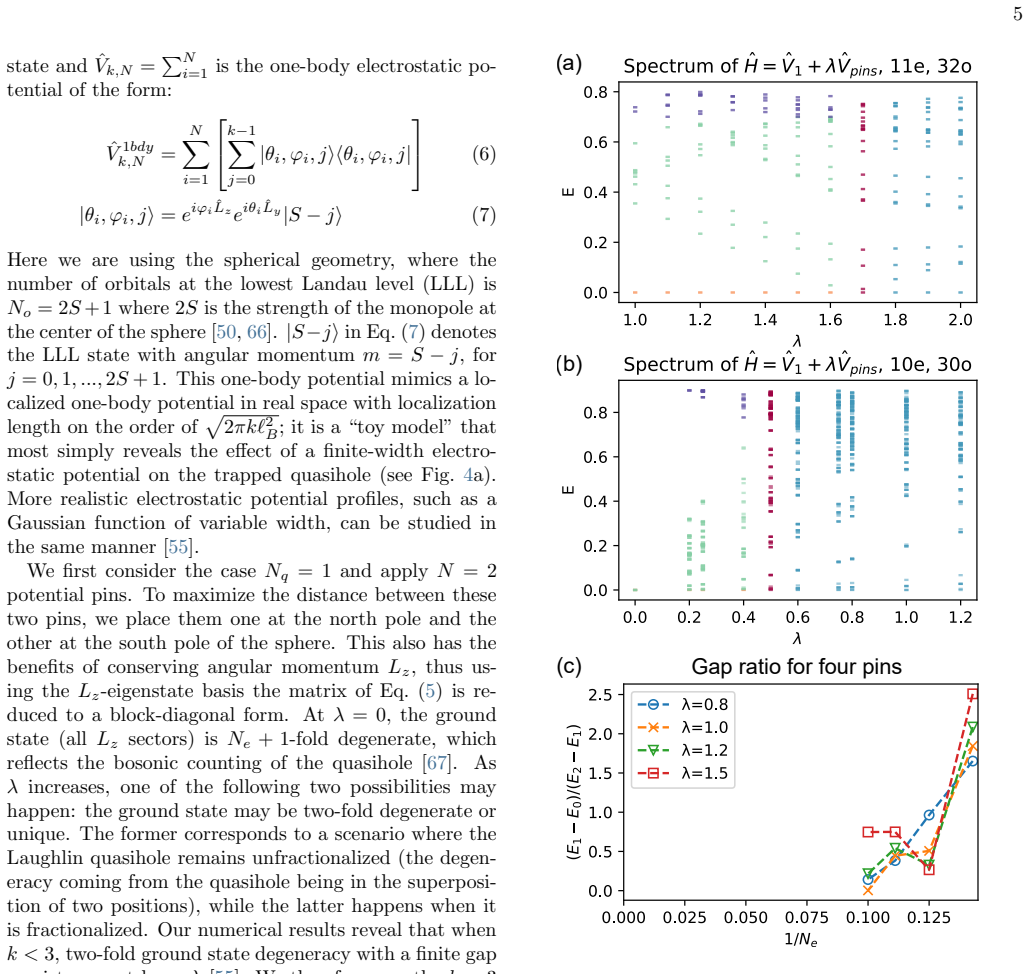
- Laughlin quasiholes can be locally fractionalized into non-Abelian quasiholes by overcoming their attraction with designed one-body trapping potentials.
- Non-Abelian braiding becomes possible within an Abelian topological phase without fine-tuning the electron-electron interaction.
- The physical accessibility of these states is supported by extensive numerics including finite-size scaling.
Where Pith is reading between the lines
- This method could extend to other Abelian fractional quantum Hall states for accessing non-Abelian features.
- Experimental setups with electrostatic gates might allow direct observation of the braiding statistics.
- The approach avoids the need for the full non-Abelian parent state like the Moore-Read Pfaffian.
Load-bearing premise
That membership in the Moore-Read null space together with realistic two-body interactions implies the excitations are physically accessible non-Abelian quasiholes whose attraction can be overcome by trapping potentials without destroying the Laughlin order.
What would settle it
Exact diagonalization calculations for larger systems showing that the overlap of low-lying states with the Moore-Read null space becomes small or that the states mix significantly with other sectors under realistic interactions.
Figures

read the original abstract
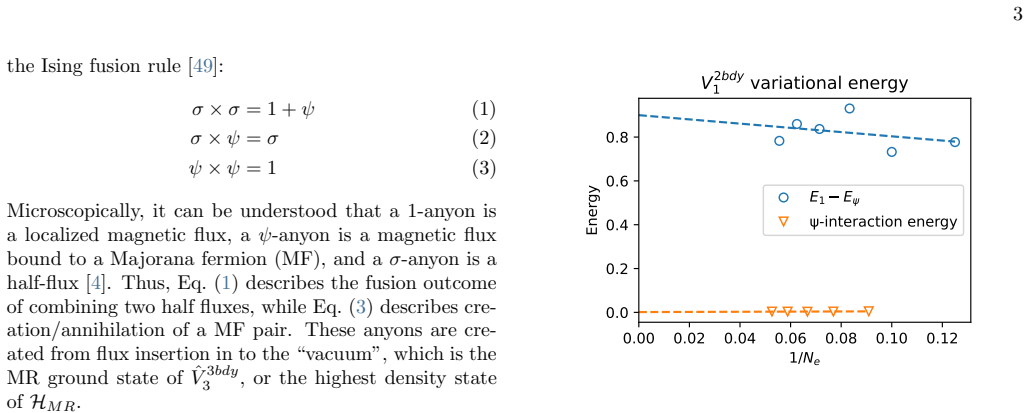
We propose a method of realizing non-Abelian braiding of fractionalized quasiholes in the Laughlin fractional quantum Hall phase at $\nu=1/3$ with realistic two-body interactions within the lowest Landau level. It is numerically shown that low-lying gapped excitations near $\nu=1/3$ are contained almost entirely within the null space of the three-body Moore-Read model Hamiltonian. They are thus quantum fluids of non-Abelian quasiholes that are in principle physically accessible. In particular, Laughlin ground state can be described as a fluid of ``$\psi$-type" quasiholes formed by binding a magnetic flux with a Majorana fermion (MF), and the Laughlin quasiholes are described by the ``$1$-type'' quasiholes, which are magnetic fluxes without a MF attached. Within the Laughlin phase, Laughlin quasiholes can be locally fractionalized into non-Abelian quasiholes, when the strong attraction between them is overcome by properly designed one-body electronstatic trapping potentials. Extensive numerics with proper finite-size scaling corroborate this physical picture, and our study points to the possibility of realizing non-Abelian braiding within an Abelian topological phase in experiment without the need for fine-tuning realistic electron-electron interaction.
Editorial analysis
A structured set of objections, weighed in public.
Referee Report
Summary. The manuscript claims that low-lying gapped excitations near ν=1/3 in the Laughlin FQH phase with realistic two-body interactions lie almost entirely within the null space of the three-body Moore-Read Hamiltonian, allowing interpretation as non-Abelian quasiholes. It further proposes that one-body electrostatic trapping potentials can overcome attraction between 1-type quasiholes to enable their fractionalization and non-Abelian braiding within the Abelian phase, with this picture supported by extensive numerics and finite-size scaling.
Significance. If substantiated, the result would provide a route to non-Abelian anyons in experimentally standard Abelian FQH states using only realistic interactions, advancing prospects for topological quantum computation. The work merits credit for the numerical demonstration that excitations lie in the Moore-Read null space together with the application of finite-size scaling.
major comments (1)
- [Abstract, paragraph on numerical results and trapping potentials] Abstract, paragraph on numerical results and trapping potentials: the claim that one-body trapping potentials can overcome quasihole attraction while preserving Laughlin order lacks direct verification; the reported numerics address only the unperturbed case, leaving gap stability and null-space fidelity under the explicit trap Hamiltonian unquantified in the scaling limit.
minor comments (1)
- The abstract would benefit from including concrete details on system sizes, Hilbert-space dimensions, overlap values, and error bars to support the central numerical claim.
Simulated Author's Rebuttal
We thank the referee for their careful reading, positive assessment of the work's significance, and constructive feedback. We address the major comment below.
read point-by-point responses
-
Referee: Abstract, paragraph on numerical results and trapping potentials: the claim that one-body trapping potentials can overcome quasihole attraction while preserving Laughlin order lacks direct verification; the reported numerics address only the unperturbed case, leaving gap stability and null-space fidelity under the explicit trap Hamiltonian unquantified in the scaling limit.
Authors: We agree that the primary numerical evidence (finite-size scaling, gap analysis, and null-space projection) is presented for the unperturbed Laughlin phase with realistic two-body interactions, showing that low-lying gapped excitations lie almost entirely in the Moore-Read null space. The one-body trapping potentials are introduced as a theoretical mechanism to overcome the attraction between 1-type quasiholes and enable local fractionalization while remaining inside the Laughlin phase. We acknowledge that explicit calculations that include the trap Hamiltonian, quantify the stability of the gap, and confirm null-space fidelity in the scaling limit are not reported. We will add these targeted simulations in the revised manuscript. revision: yes
Circularity Check
No circularity: numerical overlap with independent Moore-Read null space
full rationale
The paper's central numerical result establishes that low-lying gapped states at ν=1/3 under realistic two-body interactions lie almost entirely in the kernel of the three-body Moore-Read Hamiltonian. This is a direct comparison to an externally defined model space rather than a self-referential fit, self-definition, or load-bearing self-citation chain. No equations reduce the claimed non-Abelian character or physical accessibility to parameters defined by the same data, and the trapping-potential discussion is presented as an unverified physical picture rather than a derived equality. The derivation is therefore self-contained against external benchmarks.
Axiom & Free-Parameter Ledger
axioms (2)
- domain assumption Projection onto the lowest Landau level
- domain assumption Null space of Moore-Read Hamiltonian corresponds to non-Abelian quasiholes
discussion (0)
Sign in with ORCID, Apple, or X to comment. Anyone can read and Pith papers without signing in.