PyCBC Live Search for Compact Binary Mergers in Advanced LIGO and Virgo's Fourth Observing Run
Pith reviewed 2026-06-27 23:13 UTC · model grok-4.3
The pith
PyCBC Live O4 upgrades recover 79 percent of two-detector injections at false alarm rates below one per year, up from 51 percent in the prior configuration.
A machine-rendered reading of the paper's core claim, the machinery that carries it, and where it could break.
Core claim
The O4 configuration of PyCBC Live identified 1979 of 2495 two-detector injections with decisive SNR greater than 6 at a false alarm rate below one per year (79.3 percent), compared to 1262 (50.6 percent) with the O3 configuration. For single-detector time injections, the O4 configuration identified 218 of 1174 (18.6 percent), compared to 170 (14.5 percent) previously. The pipeline implements an Early Warning search for binary neutron star and neutron star-black hole systems that provides alerts with 2.5-3.5 seconds latency and warning times up to 60 seconds before coalescence, while maintaining a median latency of 15.94 seconds from merger to candidate upload.
What carries the argument
The enhanced ranking statistic that incorporates time-dependent background modeling using data quality streams and daily updates of the noise model.
If this is right
- The Early Warning search can issue pre-merger alerts for binary neutron star and neutron star-black hole systems up to 60 seconds before coalescence.
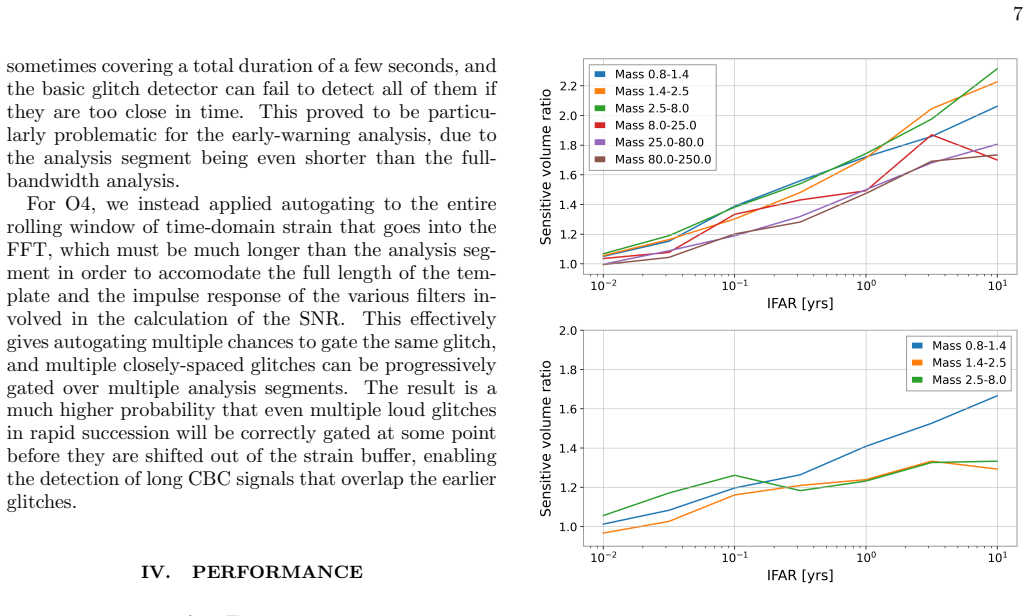
- Sensitivity improves by factors of 1.7 to 2.3 for the coincident search at an inverse false alarm rate of 10 years.
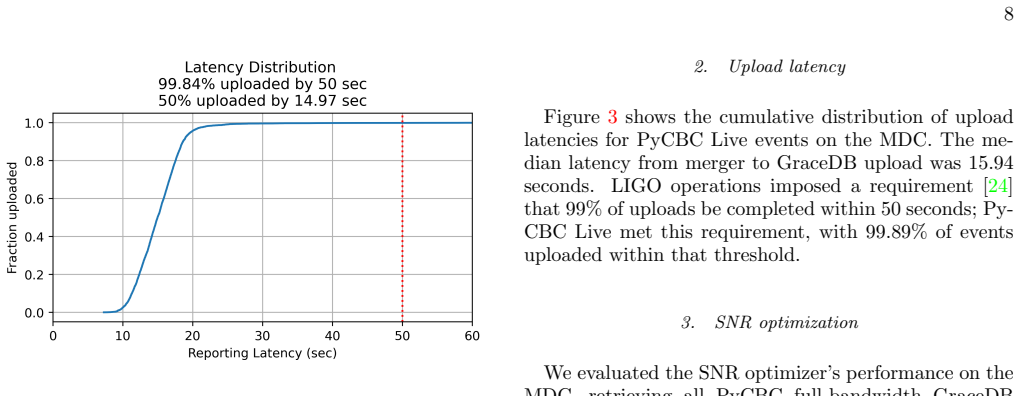
- The pipeline maintains a median latency of 15.94 seconds from merger to candidate upload.
- Virgo can be included as a sky-map-only detector without contributing to the ranking statistic.
Where Pith is reading between the lines
- If the mock data performance holds on real observations, the pipeline should produce more multi-messenger events with electromagnetic counterparts during O4.
- The single-detector improvements could raise the overall detection count in periods when only one interferometer is operating.
- The extended autogating may reduce losses from clusters of loud glitches that previously affected multiple segments.
Load-bearing premise
The Mock Data Challenge accurately reproduces the statistical properties of real O4 detector noise, glitches, and data quality variations that affect the ranking statistic and false alarm rate estimates.
What would settle it
Running the O4 pipeline configuration on actual O4 observing run data and comparing recovered events and false alarm rates against the Mock Data Challenge predictions.
Figures

read the original abstract
PyCBC Live is a low-latency search pipeline that identifies gravitational waves from compact binary coalescences and provides alerts for electromagnetic follow-up. This paper presents improvements to PyCBC Live that were implemented for the fourth observing run (O4) of the LIGO-Virgo-KAGRA network, which operated from May 2023 to November 2025. The ranking statistic was enhanced to incorporate time-dependent background modeling using data quality streams and daily updates of the noise model. Follow-up capabilities were improved through refined probability of astrophysical origin calculations, optimized SNR recovery with reduced computational cost, and a method to incorporate Virgo as a sky-map-only detector. An Early Warning search was implemented to detect binary neutron star and neutron star-black hole systems before merger, providing pre-merger alerts with a pipeline latency of 2.5-3.5 seconds and warning times up to 60 seconds before coalescence. The autogating procedure was extended to apply to the full strain buffer rather than individual analysis segments, improving rejection of loud and rapidly successive glitches. Performance validation using the Mock Data Challenge showed sensitivity improvements of factors of 1.7 to 2.3 for the coincident search depending on source mass at an inverse false alarm rate of 10 years, and factors of 1.3 to 1.7 for the single-detector search. For injections in two-detector time, the O4 configuration identified 1979 of 2495 injections with a decisive SNR greater than 6 at a false alarm rate below one per year (79.3%), compared to 1262 (50.6%) with the O3 configuration. For injections in single-detector time, the O4 configuration identified 218 of 1174 injections (18.6%), compared to 170 (14.5%) with the O3 configuration. The search maintained a median latency of 15.94 seconds from merger to candidate upload.
Editorial analysis
A structured set of objections, weighed in public.
Referee Report
Summary. The manuscript describes updates to the PyCBC Live low-latency pipeline for O4, including time-dependent background modeling in the ranking statistic via data quality streams and daily noise model updates, refined astrophysical origin probabilities, an Early Warning search for pre-merger alerts (2.5-3.5 s latency, up to 60 s warning), Virgo as sky-map-only, and extended autogating on the full strain buffer. Validation via Mock Data Challenge reports sensitivity gains of 1.7-2.3 (coincident) and 1.3-1.7 (single-detector) at IFAR=10 yr, with 1979/2495 (79.3%) two-detector injections recovered at FAR<1/yr vs. 1262/2495 (50.6%) for O3, and 218/1174 (18.6%) vs. 170/1174 (14.5%) for single-detector; median latency is 15.94 s.
Significance. If the MDC results translate to real O4 data, the enhancements would meaningfully increase the number of low-latency detections available for electromagnetic follow-up and enable pre-merger alerts for BNS/NSBH systems. The work provides concrete, operational improvements to an existing pipeline used in multi-messenger astronomy.
major comments (1)
- [Performance validation using the Mock Data Challenge] Performance validation using the Mock Data Challenge: the headline recovery rates (1979/2495 at FAR<1/yr for two-detector injections; 218/1174 for single-detector) and improvement factors (1.7-2.3 coincident, 1.3-1.7 single-detector) rest entirely on MDC results. The manuscript provides no quantitative assessment of how the MDC's glitch populations, non-stationarity, or data-quality variations compare to actual O4 observations, which directly affects whether the time-dependent ranking statistic and FAR estimates will deliver the claimed performance in live search.
minor comments (2)
- The abstract states the Early Warning search provides 'warning times up to 60 seconds before coalescence'; the full text should specify the distribution of warning times and the fraction of events achieving >10 s or >30 s warnings.
- Clarify whether the reported median latency of 15.94 s applies only to the standard search or also to the Early Warning configuration, and how autogating on the full buffer affects this latency.
Simulated Author's Rebuttal
We appreciate the referee's thorough review and their recognition of the potential impact of our work on multi-messenger astronomy. We address the major comment point by point below.
read point-by-point responses
-
Referee: Performance validation using the Mock Data Challenge: the headline recovery rates (1979/2495 at FAR<1/yr for two-detector injections; 218/1174 for single-detector) and improvement factors (1.7-2.3 coincident, 1.3-1.7 single-detector) rest entirely on MDC results. The manuscript provides no quantitative assessment of how the MDC's glitch populations, non-stationarity, or data-quality variations compare to actual O4 observations, which directly affects whether the time-dependent ranking statistic and FAR estimates will deliver the claimed performance in live search.
Authors: We thank the referee for highlighting this important point. The current manuscript focuses on describing the O4 updates to PyCBC Live and validating them using the Mock Data Challenge (MDC), which incorporates time-dependent noise models and glitch populations informed by O3 and early O4 data. However, we agree that the manuscript lacks an explicit quantitative assessment of the MDC's fidelity to actual O4 observations in terms of glitch populations, non-stationarity, and data quality. We will revise the manuscript to include a more detailed description of the MDC construction and a discussion of its limitations, noting that the reported sensitivity improvements are based on this simulation and that real-world performance will be evaluated using the live O4 search results. This revision will help readers better contextualize the MDC results. revision: yes
Circularity Check
No circularity; performance metrics obtained from independent MDC injections
full rationale
The paper's central performance claims (e.g., 1979/2495 injections recovered at FAR < 1/yr) are direct empirical counts from the Mock Data Challenge, an external test set constructed separately from the ranking-statistic tuning. No equation reduces a reported gain to a fitted parameter by construction, no self-citation supplies a uniqueness theorem or ansatz that the present work then treats as given, and the derivation of the O4 ranking statistic (time-dependent background, data-quality streams, autogating) is presented as an independent engineering change whose effect is then measured on the MDC. The chain is therefore self-contained against external benchmarks.
Axiom & Free-Parameter Ledger
axioms (1)
- domain assumption The Mock Data Challenge accurately simulates real detector conditions including glitches and noise.
Reference graph
Works this paper leans on
-
[1]
For lower- mass templates, which correspond to the systems most relevant for electromagnetic follow-up, we findα c = 6 is a good approximation of the distribution
Modelling event PDFs over ranking statistic We model the background PDF with an exponential in ρc following [34]: fN(ρc|θ)≃α c exp(−αc(ρc −ρ th)) (ρ c > ρ th),(9) whereα c is a slope parameter (see also [38]). For lower- mass templates, which correspond to the systems most relevant for electromagnetic follow-up, we findα c = 6 is a good approximation of t...
-
[2]
For O4, we increased the number of bins (indexed byp) to 8, each with a signal trigger rater S,p and noise trigger rater N,p
Template dependence For the O3p astro estimate, the template bank was di- vided into 3 chirp mass bins [40], which provided only a coarse approximation of the signal distribution. For O4, we increased the number of bins (indexed byp) to 8, each with a signal trigger rater S,p and noise trigger rater N,p. The signal rate in each bin is estimated from O1–O3...
-
[3]
For electromagnetic follow-up plan- ning, the relative probabilities of these classes are also needed
Binary source type classification The resultingp astro value covers all astrophysical com- pact binary source classes (BNS, binary black hole (BBH), and NSBH). For electromagnetic follow-up plan- ning, the relative probabilities of these classes are also needed. In PyCBC Live, these are estimated from the template chirp mass and a redshift estimate based ...
2018
-
[4]
Coincident searchThe updated ranking statistic described in this paper improved the sensitivity of the coincident search compared to O3
Search sensitivity a. Coincident searchThe updated ranking statistic described in this paper improved the sensitivity of the coincident search compared to O3. The top of Figure 2 shows the ratio of sensitive volume during two-detector 8 FIG. 3. Cumulative distribution of merger-to-upload latencies on the MDC. Median: 15.94 s; 99.89% of events within 50 s....
1979
-
[5]
The me- dian latency from merger to GraceDB upload was 15.94 seconds
Upload latency Figure 3 shows the cumulative distribution of upload latencies for PyCBC Live events on the MDC. The me- dian latency from merger to GraceDB upload was 15.94 seconds. LIGO operations imposed a requirement [24] that 99% of uploads be completed within 50 seconds; Py- CBC Live met this requirement, with 99.89% of events uploaded within that threshold
-
[6]
Of 10,270 GraceDB events retrieved, 5,091 were uploaded by the SNR optimizer
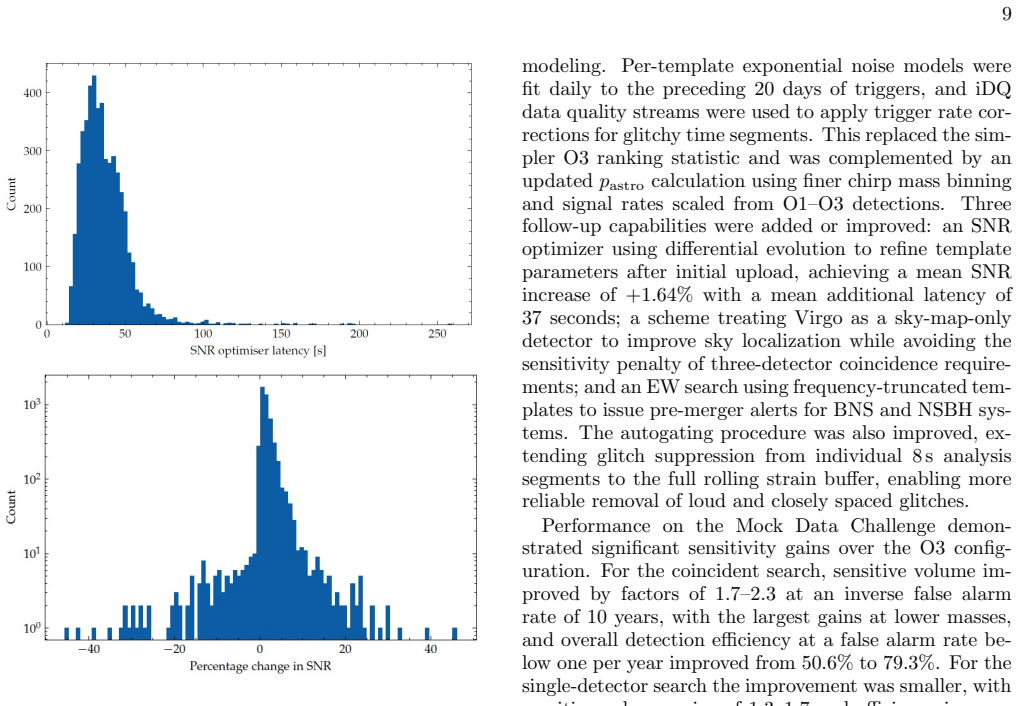
SNR optimization We evaluated the SNR optimizer’s performance on the MDC, retrieving all PyCBC full-bandwidth GraceDB events uploaded between 2024 May 30 and 2024 July 16 [50]. Of 10,270 GraceDB events retrieved, 5,091 were uploaded by the SNR optimizer. In 91.85% of cases, the optimized event was preferred over the original PyCBC Live upload. The mean SN...
2024
-
[7]
Early warning search The EW search was evaluated using a dedicated in- jection campaign separate from the main MDC [50]. A set of 32,599 simulated BNS and NSBH signals were injected into 40 days of simulated colored Gaussian noise, with component masses 1–3M ⊙, near-zero spins (z-components drawn uniformly from±0.05), and net- work SNRs distributed unifor...
-
[8]
B. P. Abbottet al.(LIGO Scientific, Virgo), GW150914: First results from the search for binary black hole coa- lescence with Advanced LIGO, Phys. Rev. D93, 122003 (2016), arXiv:1602.03839 [gr-qc]
Pith/arXiv arXiv 2016
-
[9]
Aasiet al.(LIGO Scientific), Advanced LIGO, Class
J. Aasiet al.(LIGO Scientific), Advanced LIGO, Class. Quant. Grav.32, 074001 (2015), arXiv:1411.4547 [gr-qc]
Pith/arXiv arXiv 2015
-
[10]
F. Acerneseet al.(Virgo), Advanced Virgo: a second- generation interferometric gravitational wave detector, Class. Quant. Grav.32, 024001 (2015), arXiv:1408.3978 [gr-qc]
Pith/arXiv arXiv 2015
-
[11]
T. Akutsuet al.(KAGRA), Overview of KAGRA: Detec- tor design and construction history, PTEP2021, 05A101 (2021), arXiv:2005.05574 [physics.ins-det]
arXiv 2021
-
[12]
K. Somiya (KAGRA), Detector configuration of KA- GRA: The Japanese cryogenic gravitational-wave de- tector, Class. Quant. Grav.29, 124007 (2012), arXiv:1111.7185 [gr-qc]
arXiv 2012
-
[13]
Y. Aso, Y. Michimura, K. Somiya, M. Ando, O. Miyakawa, T. Sekiguchi, D. Tatsumi, and H. Ya- mamoto (KAGRA), Interferometer design of the KA- GRA gravitational wave detector, Phys. Rev. D88, 043007 (2013), arXiv:1306.6747 [gr-qc]
Pith/arXiv arXiv 2013
-
[14]
GWTC-5.0: Observations from the Second Part of the Fourth LIGO-Virgo-KAGRA Observing Run and Updates to the Gravitational-Wave Transient Catalog, arXiv (2026), arXiv:2605.27225 [gr-qc]
Pith/arXiv arXiv 2026
-
[15]
B. P. Abbottet al.(LIGO Scientific, Virgo, Fermi GBM, INTEGRAL, IceCube, AstroSat Cadmium Zinc Telluride Imager Team, IPN, Insight-Hxmt, ANTARES, Swift, AGILE Team, 1M2H Team, Dark Energy Camera GW-EM, DES, DLT40, GRAWITA, Fermi-LAT, ATCA, ASKAP, Las Cumbres Observatory Group, OzGrav, DWF (Deeper Wider Faster Program), AST3, CAAS- TRO, VINROUGE, MASTER, J...
Pith/arXiv arXiv 2017
- [16]
-
[17]
B. Ewinget al., Performance of the low-latency Gst- LAL inspiral search towards LIGO, Virgo, and KAGRA’s fourth observing run, Phys. Rev. D109, 042008 (2024), arXiv:2305.05625 [gr-qc]
arXiv 2024
-
[18]
C. All´ en´ eet al., The MBTA pipeline for detecting compact binary coalescences in the fourth LIGO-Virgo- KAGRA observing run, Class. Quant. Grav.42, 105009 (2025), arXiv:2501.04598 [gr-qc]
arXiv 2025
-
[19]
A. H. Nitz, T. Dal Canton, D. Davis, and S. Reyes, Rapid detection of gravitational waves from compact bi- nary mergers with PyCBC Live, Phys. Rev. D98, 024050 (2018), arXiv:1805.11174 [gr-qc]
Pith/arXiv arXiv 2018
-
[20]
T. Dal Canton, A. H. Nitz, B. Gadre, G. S. Cabourn Davies, V. Villa-Ortega, T. Dent, I. Harry, and L. Xiao, Real-time Search for Compact Binary Merg- ers in Advanced LIGO and Virgo’s Third Observing Run Using PyCBC Live, Astrophys. J.923, 254 (2021), arXiv:2008.07494 [astro-ph.HE]
arXiv 2021
-
[21]
Q. Chuet al., SPIIR online coherent pipeline to search for gravitational waves from compact binary coalescences, Phys. Rev. D105, 024023 (2022), arXiv:2011.06787 [gr- qc]
arXiv 2022
-
[22]
L. P. Singer and L. R. Price, Rapid Bayesian position reconstruction for gravitational-wave transients, Phys. Rev. D93, 024013 (2016), arXiv:1508.03634 [gr-qc]
Pith/arXiv arXiv 2016
-
[23]
Capoteet al., Advanced LIGO detector performance in the fourth observing run, Phys
E. Capoteet al., Advanced LIGO detector performance in the fourth observing run, Phys. Rev. D111, 062002 (2025), arXiv:2411.14607 [gr-qc]
arXiv 2025
-
[24]
Acerneseet al.(Virgo), Increasing the Astrophysical Reach of the Advanced Virgo Detector via the Appli- cation of Squeezed Vacuum States of Light, Phys
F. Acerneseet al.(Virgo), Increasing the Astrophysical Reach of the Advanced Virgo Detector via the Appli- cation of Squeezed Vacuum States of Light, Phys. Rev. Lett.123, 231108 (2019)
2019
-
[25]
A. G. Abacet al.(LIGO Scientific, VIRGO, KAGRA), GWTC-4.0: Updating the Gravitational-Wave Transient Catalog with Observations from the First Part of the Fourth LIGO-Virgo-KAGRA Observing Run, Astrophys. J. Lett. (2025), arXiv:2508.18082 [gr-qc]
Pith/arXiv arXiv 2025
-
[26]
A. G. Abacet al.(LIGO Scientific, KAGRA, VIRGO), GWTC-4.0: An Introduction to Version 4.0 of the Gravitational-Wave Transient Catalog, Astrophys. J. Lett.995, L18 (2025), arXiv:2508.18080 [gr-qc]
Pith/arXiv arXiv 2025
-
[27]
A. G. Abacet al.(LIGO Scientific, KAGRA, VIRGO), Observation of Gravitational Waves from the Coalescence of a 2.5–4.5 M ⊙ Compact Object and a Neutron Star, Astrophys. J. Lett.970, L34 (2024), arXiv:2404.04248 [astro-ph.HE]
arXiv 2024
-
[28]
A. G. Abacet al.(LIGO Scientific, VIRGO, KAGRA), GW231123: A Binary Black Hole Merger with Total Mass 190–265 M ⊙, Astrophys. J. Lett.993, L25 (2025), arXiv:2507.08219 [astro-ph.HE]
Pith/arXiv arXiv 2025
-
[29]
A. G. Abacet al.(LIGO Scientific, Virgo, KAGRA), GW241011 and GW241110: Exploring Binary Forma- tion and Fundamental Physics with Asymmetric, High- 11 spin Black Hole Coalescences, Astrophys. J. Lett.993, L21 (2025), arXiv:2510.26931 [astro-ph.HE]
arXiv 2025
-
[30]
A. G. Abacet al.(LIGO Scientific, Virgo, KAGRA), GW250114: Testing Hawking’s Area Law and the Kerr Nature of Black Holes, Phys. Rev. Lett.135, 111403 (2025), arXiv:2509.08054 [gr-qc]
Pith/arXiv arXiv 2025
-
[33]
Mageeet al., First demonstration of early warning gravitational wave alerts, Astrophys
R. Mageeet al., First demonstration of early warning gravitational wave alerts, Astrophys. J. Lett.910, L21 (2021), arXiv:2102.04555 [astro-ph.HE]
arXiv 2021
-
[34]
S. Soniet al.(LIGO), LIGO Detector Characterization in the first half of the fourth Observing run, Class. Quant. Grav.42, 085016 (2025), arXiv:2409.02831 [astro-ph.IM]
arXiv 2025
-
[35]
Z. Yarbrough, A. Guimaraes, P. Joshi, G. Gonz´ alez, A. Valentini, and U. Shah, PINCH: pipeline-informed noise characterization in LIGO’s third observing run, Class. Quant. Grav.42, 165014 (2025), arXiv:2505.14949 [gr-qc]
arXiv 2025
- [36]
-
[37]
Allen,χ 2 time-frequency discriminator for gravita- tional wave detection, Phys
B. Allen,χ 2 time-frequency discriminator for gravita- tional wave detection, Phys. Rev. D71, 062001 (2005), arXiv:gr-qc/0405045
Pith/arXiv arXiv 2005
-
[38]
A. H. Nitz, Distinguishing short duration noise transients in LIGO data to improve the PyCBC search for gravita- tional waves from high mass binary black hole mergers, Class. Quant. Grav.35, 035016 (2018), arXiv:1709.08974 [gr-qc]
Pith/arXiv arXiv 2018
- [39]
-
[40]
G. S. Davies, T. Dent, M. T´ apai, I. Harry, C. McIsaac, and A. H. Nitz, Extending the PyCBC search for gravitational waves from compact binary mergers to a global network, Phys. Rev. D102, 022004 (2020), arXiv:2002.08291 [astro-ph.HE]
arXiv 2020
-
[41]
A. H. Nitz, T. Dent, T. Dal Canton, S. Fairhurst, and D. A. Brown, Detecting binary compact-object mergers with gravitational waves: Understanding and Improving the sensitivity of the PyCBC search, Astrophys. J.849, 118 (2017), arXiv:1705.01513 [gr-qc]
Pith/arXiv arXiv 2017
-
[42]
S. A. Usmanet al., The PyCBC search for gravitational waves from compact binary coalescence, Class. Quant. Grav.33, 215004 (2016), arXiv:1508.02357 [gr-qc]
Pith/arXiv arXiv 2016
-
[43]
G. S. Cabourn Davies and I. W. Harry, Establishing significance of gravitational-wave signals from a single observatory in the PyCBC offline search, Class. Quant. Grav.39, 215012 (2022), arXiv:2203.08545 [gr-qc]
arXiv 2022
-
[44]
B. P. Abbottet al.(LIGO Scientific, Virgo), The Rate of Binary Black Hole Mergers Inferred from Advanced LIGO Observations Surrounding GW150914, Astrophys. J. Lett.833, L1 (2016), arXiv:1602.03842 [astro-ph.HE]
Pith/arXiv arXiv 2016
-
[45]
R. Lynch, M. Coughlin, S. Vitale, C. W. Stubbs, and E. Katsavounidis, Observational implications of lowering the LIGO-Virgo alert threshold, Astrophys. J. Lett.861, L24 (2018), arXiv:1803.02880 [astro-ph.HE]
Pith/arXiv arXiv 2018
-
[46]
B. F. Schutz, Networks of gravitational wave detectors and three figures of merit, Class. Quant. Grav.28, 125023 (2011), arXiv:1102.5421 [astro-ph.IM]
Pith/arXiv arXiv 2011
-
[47]
R. Abbottet al.(LIGO Scientific, VIRGO), GWTC-2.1: Deep extended catalog of compact binary coalescences observed by LIGO and Virgo during the first half of the third observing run, Phys. Rev. D109, 022001 (2024), arXiv:2108.01045 [gr-qc]
Pith/arXiv arXiv 2024
-
[48]
Dent, Technical note: PyCBC Live p astro for O4, DCC LIGO-T2300168-v2 (2023)
T. Dent, Technical note: PyCBC Live p astro for O4, DCC LIGO-T2300168-v2 (2023)
2023
-
[49]
V. Villa-Ortega, T. Dent, and A. C. Barroso, Rapid source classification and distance estimation for compact binary mergers with PyCBC live, Mon. Not. Roy. Astron. Soc.515, 5718 (2022), arXiv:2203.10080 [astro-ph.HE]
arXiv 2022
-
[50]
LVK, IGWN Public Alerts User Guide, https://emfollow.docs.ligo.org/userguide/content.html#inference (2026)
2026
-
[51]
B. D. Metzger, Kilonovae, Living Rev. Rel.23, 1 (2020), arXiv:1910.01617 [astro-ph.HE]
arXiv 2020
-
[52]
Burns, Neutron Star Mergers and How to Study Them, Living Rev
E. Burns, Neutron Star Mergers and How to Study Them, Living Rev. Rel.23, 4 (2020), arXiv:1909.06085 [astro- ph.HE]
arXiv 2020
-
[53]
A. H. Nitz, M. Sch¨ afer, and T. Dal Canton, Gravitational-wave Merger Forecasting: Scenarios for the Early Detection and Localization of Compact-binary Mergers with Ground-based Observatories, ApJL902, L29 (2020), arXiv:2009.04439 [astro-ph.HE]
arXiv 2020
-
[54]
A. Tohuvavohu, J. A. Kennea, C. J. Roberts, J. De- Launay, S. Ronchini, S. B. Cenko, B. Ewing, R. Magee, C. Messick, S. Sachdev, and L. P. Singer, Swiftly Chasing Gravitational Waves across the Sky in Real Time, ApJL 975, L19 (2024), arXiv:2410.05720 [astro-ph.HE]
arXiv 2024
-
[55]
D. A. Brown, I. Harry, A. Lundgren, and A. H. Nitz, Detecting binary neutron star systems with spin in ad- vanced gravitational-wave detectors, Phys. Rev. D86, 084017 (2012), arXiv:1207.6406 [gr-qc]
Pith/arXiv arXiv 2012
-
[56]
LIGO Scientific Collaboration, Advanced LIGO antici- pated sensitivities, LIGO Document T0900288-v3 (2010)
2010
-
[57]
Tolley,Improving the Detection of Gravitational- Wave Signals in Real Time, Ph.D
A. Tolley,Improving the Detection of Gravitational- Wave Signals in Real Time, Ph.D. thesis, University of Portsmouth (2024), arXiv:2503.21417 [gr-qc]
arXiv 2024
-
[58]
B. P. Abbottet al.(LIGO Scientific, Virgo), GW170817: Observation of Gravitational Waves from a Binary Neu- tron Star Inspiral, Phys. Rev. Lett.119, 161101 (2017), arXiv:1710.05832 [gr-qc]
Pith/arXiv arXiv 2017
-
[59]
Storn and K
R. Storn and K. Price, Differential Evolution – A Sim- ple and Efficient Heuristic for Global Optimization over Continuous Spaces, Journal of Global Optimization11, 341 (1997)
1997
-
[60]
Virtanenet al., SciPy 1.0–Fundamental Algorithms for Scientific Computing in Python, Nat
P. Virtanenet al., SciPy 1.0–Fundamental Algorithms for Scientific Computing in Python, Nat. Meth.17, 261 (2020), arXiv:1907.10121 [cs.MS]
Pith/arXiv arXiv 2020
-
[61]
S. S. Chaudharyet al., Low-latency gravitational wave alert products and their performance at the time of the fourth LIGO-Virgo-KAGRA observing run, Proc. Nat. Acad. Sci.121, e2316474121 (2024), arXiv:2308.04545 [astro-ph.HE]
arXiv 2024
-
[62]
M. Hannam, P. Schmidt, A. Boh´ e, L. Haegel, S. Husa, F. Ohme, G. Pratten, and M. P¨ urrer, Simple Model of Complete Precessing Black-Hole-Binary Gravitational 12 Waveforms, Phys. Rev. Lett.113, 151101 (2014), arXiv:1308.3271 [gr-qc]
Pith/arXiv arXiv 2014
-
[63]
T. Dietrich, A. Samajdar, S. Khan, N. K. Johnson- McDaniel, R. Dudi, and W. Tichy, Improving the NR- Tidal model for binary neutron star systems, Phys. Rev. D100, 044003 (2019), arXiv:1905.06011 [gr-qc]
arXiv 2019
-
[64]
F. Douchin and P. Haensel, A unified equation of state of dense matter and neutron star structure, Astron. As- trophys.380, 151 (2001), arXiv:astro-ph/0111092
Pith/arXiv arXiv 2001
-
[65]
Aghanimet al.(Planck), Planck 2018 results
N. Aghanimet al.(Planck), Planck 2018 results. VI. Cosmological parameters, Astron. Astrophys.641, A6 (2020), [Erratum: Astron.Astrophys. 652, C4 (2021)], arXiv:1807.06209 [astro-ph.CO]
Pith/arXiv arXiv 2018
-
[66]
S. Insley, M. J. Williams, R. Dhurkunde, and I. Harry, Normalizing flows for density estimation in multi- detector gravitational-wave searches, arXiv (2026), arXiv:2604.26581 [astro-ph.HE]
Pith/arXiv arXiv 2026
-
[67]
Nitzet al., PyCBC: A Python toolkit for gravitational-wave astronomy,https://pycbc.org/ (2026)
A. Nitzet al., PyCBC: A Python toolkit for gravitational-wave astronomy,https://pycbc.org/ (2026)
2026
discussion (0)
Sign in with ORCID, Apple, or X to comment. Anyone can read and Pith papers without signing in.