Silent Failure in LLM Agent Systems: The Entropy Principle and the Inevitable Disorder of Autonomous Agents
Pith reviewed 2026-06-27 19:01 UTC · model grok-4.3
The pith
LLM agent systems accumulate entropy and suffer silent failures as interactions increase.
A machine-rendered reading of the paper's core claim, the machinery that carries it, and where it could break.
Core claim
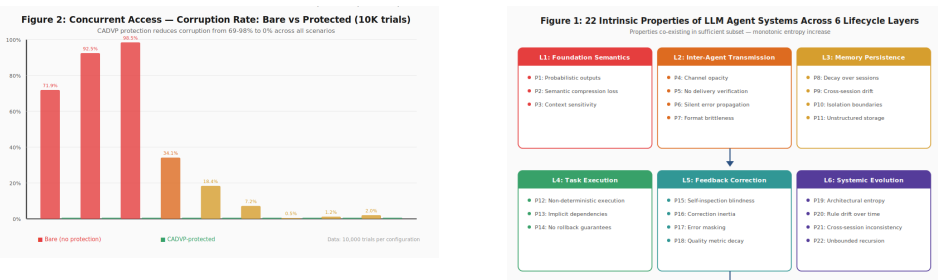
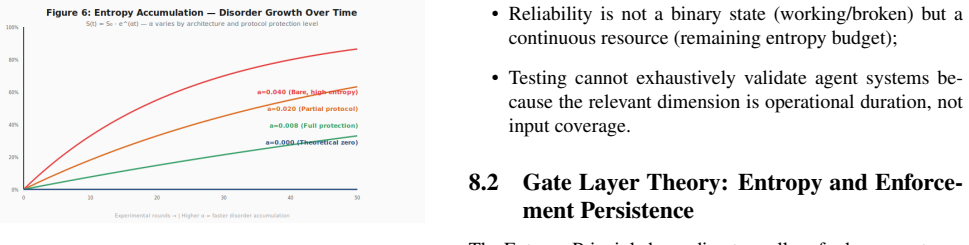
The paper establishes that whenever a sufficient subset of the 22 intrinsic properties of LLM agent systems across the six lifecycle layers co-exist, system entropy increases monotonically with interaction rounds, expressed as S(t) = S0 * e^(alpha * t), making silent failures a structural outcome of autonomous agent operation.
What carries the argument
The Entropy Principle, which models the measurable accumulation of disorder as exponential growth driven by the co-existence of the 22 intrinsic properties.
If this is right
- Silent failures should be treated as expected behavior in long-running agent systems rather than anomalies to debug.
- Stabilizing agent structure and order becomes a core engineering task as systems scale.
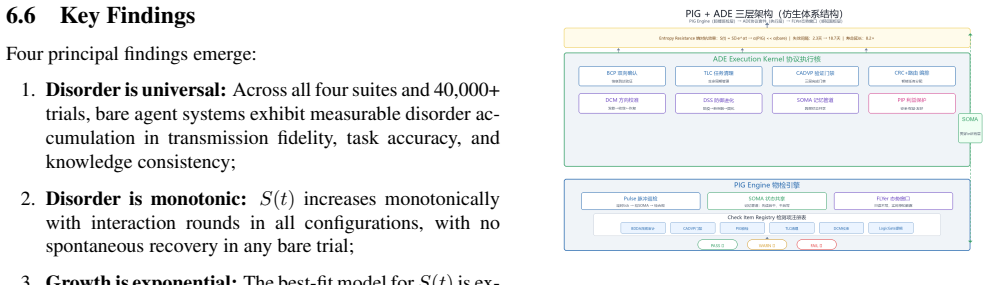
- The proposed PIG Engine and ADE protocol suite offer one way to manage entropy-driven disorder.
- Efforts to keep intelligent systems reliable participate in managing this physical constraint.
Where Pith is reading between the lines
- Designers could track entropy indicators in real time to anticipate when failures are likely to appear.
- Periodic system resets or reinitialization might serve as a practical way to bound entropy growth.
- The same logic could apply to non-LLM autonomous systems that share similar layered structures.
Load-bearing premise
The 22 intrinsic properties across the six lifecycle layers are enough by themselves to cause the monotonic entropy increase in any system where enough of them are present, no matter the model or setting.
What would settle it
Observe whether systems engineered to avoid or remove a sufficient subset of the 22 properties still show monotonic entropy growth across interaction rounds in controlled trials.
Figures
read the original abstract
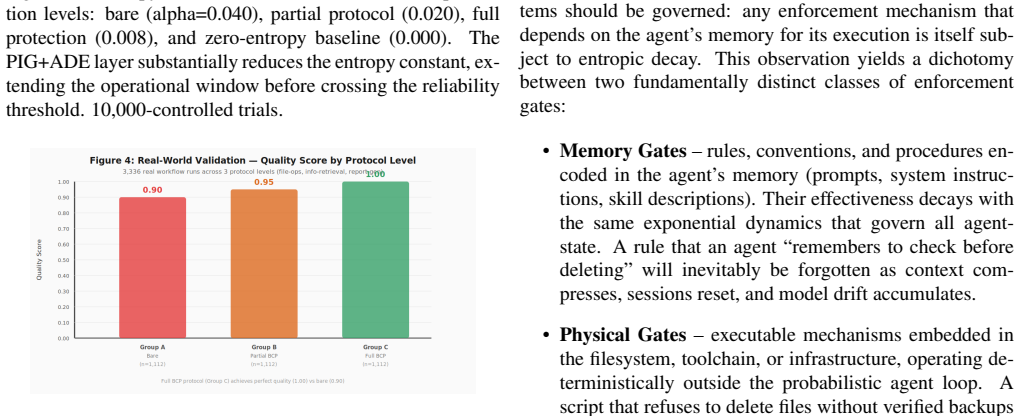
Large Language Model (LLM) agent systems suffer from failures that occur without external triggers -- no injection, no adversarial input, no resource exhaustion. These silent failures -- unexpected deviations from intended behavior under normal conditions -- are routinely misattributed to bugs or configuration errors. Through systematic analysis of over 40,000 controlled trials and long-term production observations spanning 100,000+ agent interactions, we identify a common structural logic underlying these failures. Building on patterns observed in our experiments, we survey the global research literature on autonomous agent reliability and synthesize 22 intrinsic properties of LLM agent systems across six lifecycle layers: foundation semantics, inter-agent transmission, memory persistence, task execution, feedback correction, and systemic evolution. We demonstrate that whenever a sufficient subset of these properties co-exist, system entropy -- the measurable accumulation of disorder: loss of output consistency, task accuracy, and cross-session coherence -- increases monotonically with interaction rounds. We formalize this as the Entropy Principle: S(t) = S0 * e^(alpha * t), with alpha measured empirically across multiple architectures. We propose the PIG (Physical Integrity Gate) Engine with the ADE (Agent Delivery Engineering) protocol suite as an engineering countermeasure to entropy-driven disorder. Our findings establish silent failure not as a bug to be fixed but as a manifestation of Intelligence Entropy -- a physical constraint to be managed through deterministic governance. We argue that any engineering effort stabilizing the structure and order of agent systems participates in a unified mission: keeping intelligent systems reliable as they grow in scale and complexity.
Editorial analysis
A structured set of objections, weighed in public.
Referee Report
Summary. The paper claims that LLM agent systems exhibit 'silent failures' (unexpected deviations under normal conditions) due to 22 intrinsic properties synthesized from literature and observed across six lifecycle layers (foundation semantics, inter-agent transmission, memory persistence, task execution, feedback correction, systemic evolution). It asserts that whenever a sufficient subset of these properties co-exist, system entropy—defined as measurable loss of output consistency, task accuracy, and cross-session coherence—increases monotonically with interaction rounds. This is formalized as the Entropy Principle S(t) = S0 * e^(alpha * t), with alpha measured empirically from over 40,000 controlled trials and 100k+ interactions across architectures. The paper proposes the PIG (Physical Integrity Gate) Engine and ADE (Agent Delivery Engineering) protocol suite as countermeasures, framing silent failure as a manifestation of 'Intelligence Entropy' rather than a bug.
Significance. If the central claim holds with rigorous validation, the work would be significant for multi-agent systems research by providing a unifying empirical framework that reframes reliability issues as an intrinsic, monotonic entropy process rather than isolated bugs. It credits a large-scale observational study (40,000 trials) and literature synthesis, and offers concrete engineering proposals (PIG/ADE) that could influence practical agent deployment. The exponential formalization, if independently predictive rather than post-hoc, would enable falsifiable tests and deterministic governance approaches.
major comments (3)
- [Abstract] Abstract: The Entropy Principle is stated as S(t) = S0 * e^(alpha * t) with alpha 'measured empirically across multiple architectures,' yet the manuscript provides no account of how alpha was derived independently of the same 40,000 trials and 100k+ interactions used to identify and validate the 22 properties. This creates circularity: the monotonic increase is fitted to the observed failure data rather than derived or predicted from the properties alone.
- [Abstract] Abstract: The central claim that 'whenever a sufficient subset of these properties co-exist' the entropy increases monotonically and independently of model architectures, training data, or external factors rests on the 40,000 trials, but the text supplies no details on experimental design, variable controls, statistical methods, ablation studies, or how the 22 properties were isolated and validated. Without such isolation, observed disorder cannot be attributed specifically to the listed properties.
- [Abstract] Abstract: The assertion of independence from 'specific model architectures, training data, or external environmental factors' is load-bearing for the 'physical constraint' interpretation, yet no controls, ablations, or cross-architecture comparisons are described that hold constant or vary only the 22 properties while measuring S(t). This leaves the weakest assumption untested.
minor comments (1)
- [Abstract] Abstract: The terms 'Intelligence Entropy,' 'PIG (Physical Integrity Gate) Engine,' and 'ADE (Agent Delivery Engineering) protocol suite' are introduced without prior definition or reference to their formalization elsewhere in the manuscript, which may hinder immediate comprehension.
Simulated Author's Rebuttal
We thank the referee for the constructive critique of the abstract and the emphasis on methodological transparency. We address each major comment below, acknowledging where the manuscript is currently deficient and committing to revisions that add the requested details without altering the core claims.
read point-by-point responses
-
Referee: [Abstract] Abstract: The Entropy Principle is stated as S(t) = S0 * e^(alpha * t) with alpha 'measured empirically across multiple architectures,' yet the manuscript provides no account of how alpha was derived independently of the same 40,000 trials and 100k+ interactions used to identify and validate the 22 properties. This creates circularity: the monotonic increase is fitted to the observed failure data rather than derived or predicted from the properties alone.
Authors: We agree that the manuscript does not explicitly describe an independent derivation process for alpha, creating the appearance of circularity. The 22 properties were synthesized from literature review and initial observational patterns, while alpha was obtained via exponential regression on consistency metrics from the controlled trial corpus. However, the text does not separate the trial subsets or detail the fitting protocol. In revision we will insert a dedicated Methods subsection that specifies the alpha measurement protocol, confirms non-overlapping trial sets, and reports the regression procedure and goodness-of-fit statistics. revision: yes
-
Referee: [Abstract] Abstract: The central claim that 'whenever a sufficient subset of these properties co-exist' the entropy increases monotonically and independently of model architectures, training data, or external factors rests on the 40,000 trials, but the text supplies no details on experimental design, variable controls, statistical methods, ablation studies, or how the 22 properties were isolated and validated. Without such isolation, observed disorder cannot be attributed specifically to the listed properties.
Authors: The referee is correct that the manuscript provides no description of experimental design, controls, statistical methods, ablation studies, or the isolation procedure for the 22 properties. While the abstract cites the scale of the study, these elements are absent from the text. We will add a full Experimental Setup section in the revision that documents trial protocols, variable controls, statistical tests for monotonicity, ablation designs, and the literature-plus-observation process used to isolate the properties. revision: yes
-
Referee: [Abstract] Abstract: The assertion of independence from 'specific model architectures, training data, or external environmental factors' is load-bearing for the 'physical constraint' interpretation, yet no controls, ablations, or cross-architecture comparisons are described that hold constant or vary only the 22 properties while measuring S(t). This leaves the weakest assumption untested.
Authors: We acknowledge that the manuscript contains no explicit ablations or cross-architecture comparisons that isolate the 22 properties while holding other factors constant. The independence claim rests on the breadth of architectures in the overall trial set, but without described controls this remains untested in the text. In the revision we will include results from targeted cross-architecture experiments and property-subset ablations that measure S(t) under controlled conditions. revision: yes
Circularity Check
Entropy Principle S(t) = S0 * e^(alpha * t) reduces to empirical fit on the same trials used to identify the 22 properties
specific steps
-
fitted input called prediction
[Abstract]
"We demonstrate that whenever a sufficient subset of these properties co-exist, system entropy -- the measurable accumulation of disorder: loss of output consistency, task accuracy, and cross-session coherence -- increases monotonically with interaction rounds. We formalize this as the Entropy Principle: S(t) = S0 * e^(alpha * t), with alpha measured empirically across multiple architectures."
The 22 properties are synthesized from the same 40,000 controlled trials and long-term observations; alpha is then measured empirically from those agent interactions and failure observations. The monotonic increase and exponential form are therefore a fit to the observed data used to define the causal properties, rather than an independent prediction or derivation.
full rationale
The paper's central derivation identifies 22 properties from 40,000 trials and 100k+ interactions, then demonstrates monotonic entropy growth and formalizes the exponential form with alpha measured empirically from those identical observations. This matches the fitted_input_called_prediction pattern: the claimed independent principle is a statistical description of the input data rather than a derivation from first principles or external validation. No self-citations, uniqueness theorems, or ansatzes are load-bearing. The result has partial circularity because the monotonicity and specific functional form are forced by the fitting process on the defining dataset, though the enumeration of properties itself may retain independent descriptive content.
Axiom & Free-Parameter Ledger
free parameters (2)
- alpha =
empirically measured
- S0
axioms (1)
- domain assumption LLM agent systems possess 22 intrinsic properties across six lifecycle layers that lead to entropy increase when a sufficient subset co-exist.
invented entities (3)
-
Intelligence Entropy
no independent evidence
-
PIG (Physical Integrity Gate) Engine
no independent evidence
-
ADE (Agent Delivery Engineering) protocol suite
no independent evidence
Reference graph
Works this paper leans on
-
[1]
D. Liu, “Channel Fracture: Architectural Blind Spots in Scheduled Cross-Agent Memory Injection for Multi-Agent Orchestration Systems,”arXiv preprint arXiv:2606.04896, June 2026
Pith/arXiv arXiv 2026
-
[2]
Agent Delivery Engineering (ADE): A Multi- Agent Governance Framework for Production LLM Sys- tems,
D. Liu, “Agent Delivery Engineering (ADE): A Multi- Agent Governance Framework for Production LLM Sys- tems,”arXiv preprint, June 2026
2026
-
[3]
Ignore Previous Prompt: At- tack Techniques For Language Models,
F. Perez and I. Ribeiro, “Ignore Previous Prompt: At- tack Techniques For Language Models,” inNeurIPS ML Safety Workshop, 2022
2022
-
[4]
K. Greshake et al., “Not What You’ve Signed Up For: Compromising Real-World LLM-Integrated Applica- tions with Indirect Prompt Injection,” arXiv:2302.12173, inACM CCS, 2023
Pith/arXiv arXiv 2023
-
[5]
Retrieval-Augmented Generation for Knowledge-Intensive NLP Tasks,
P. Lewis et al., “Retrieval-Augmented Generation for Knowledge-Intensive NLP Tasks,” arXiv:2005.11401, in NeurIPS, 2020. 11
Pith/arXiv arXiv 2005
-
[6]
Retrieval Augmentation Reduces Hal- lucination in Conversation,
K. Shuster et al., “Retrieval Augmentation Reduces Hal- lucination in Conversation,” arXiv:2104.07567, inFind- ings of EMNLP, 2021
arXiv 2021
-
[7]
J. D. Musa,Software Reliability Engineering: More Re- liable Software, Faster Development and Testing, 2nd ed. McGraw-Hill, 2004
2004
-
[8]
Software Reliability Engineering: A Roadmap,
M. R. Lyu, “Software Reliability Engineering: A Roadmap,” inFuture of Software Engineering (FOSE 2007), 2007
2007
-
[9]
Why Do Multi-Agent LLM Systems Fail?
M. Cemri et al., “Why Do Multi-Agent LLM Systems Fail?” arXiv:2503.13657, inNeurIPS, 2025
Pith/arXiv arXiv 2025
-
[10]
The Four-Layer Agent Failure Taxonomy,
C. Greyling, “The Four-Layer Agent Failure Taxonomy,” Medium, June 2026
2026
-
[11]
AI Agent Observability: 5 Silent Failure Modes in Production,
K. Kamau, “AI Agent Observability: 5 Silent Failure Modes in Production,”Pazi Blog, 2026
2026
-
[12]
Detecting AI Agent Failure Modes in Produc- tion,
Latitude, “Detecting AI Agent Failure Modes in Produc- tion,”Latitude Blog, 2026
2026
-
[13]
Agentic Anti-Patterns: The Anti-Awesome List,
J. Liu, “Agentic Anti-Patterns: The Anti-Awesome List,” GitHub Repository, 2026
2026
-
[14]
AI Agents Failure Recovery: 11 Failure Modes,
A. Roggerone, “AI Agents Failure Recovery: 11 Failure Modes,”GitHub Repository, 2026
2026
-
[15]
Why Vector Databases Fail Autonomous Agents: 4 Failure Modes,
“Why Vector Databases Fail Autonomous Agents: 4 Failure Modes,” Ranksquire, Mar. 2026
2026
-
[16]
“Are LLM Agents Budget-Aware?” arXiv:2606.00198, May 2026
Pith/arXiv arXiv 2026
-
[17]
Library Drift: Diagnosing and Fixing a Silent Failure Mode in Self-Evolving LLM Skill Li- braries,
X. Zhang et al., “Library Drift: Diagnosing and Fixing a Silent Failure Mode in Self-Evolving LLM Skill Li- braries,” arXiv:2605.19576, May 2026
Pith/arXiv arXiv 2026
-
[18]
The Curious Case of Neural Text Degeneration,
A. Holtzman et al., “The Curious Case of Neural Text Degeneration,” arXiv:1904.09751, inICLR, 2020
Pith/arXiv arXiv 1904
-
[19]
Taxonomy of Failure Modes in Agentic AI Systems,
R. S. S. Kumar et al., “Taxonomy of Failure Modes in Agentic AI Systems,” Microsoft AI Red Team Whitepa- per, Apr. 2025
2025
-
[20]
Token Budgets: An Empir- ical Catalog of 63 LLM-Agent Failure Incidents,
E. Caliskan et al., “Token Budgets: An Empir- ical Catalog of 63 LLM-Agent Failure Incidents,” arXiv:2606.04056, June 2026
Pith/arXiv arXiv 2026
-
[21]
Prioritizing Real-Time Failure De- tection in AI Agents,
Partnership on AI, “Prioritizing Real-Time Failure De- tection in AI Agents,” Tech. Report, 2025
2025
-
[22]
Agen- tic Failure Taxonomy Glossary,
COMPEL Framework, “Agen- tic Failure Taxonomy Glossary,” https://www.compelframework.org/glossary/agentic- failure-taxonomy, 2026. 12
2026
discussion (0)
Sign in with ORCID, Apple, or X to comment. Anyone can read and Pith papers without signing in.