Murmurations in the Depth Aspect for Maass and Modular Forms
Pith reviewed 2026-06-27 19:05 UTC · model grok-4.3
The pith
Murmuration density for cusp forms of conductor ℓ^{2a} matches the odd-exponent case as a goes to infinity, giving a uniform density for all powers ℓ^n.
A machine-rendered reading of the paper's core claim, the machinery that carries it, and where it could break.
Core claim
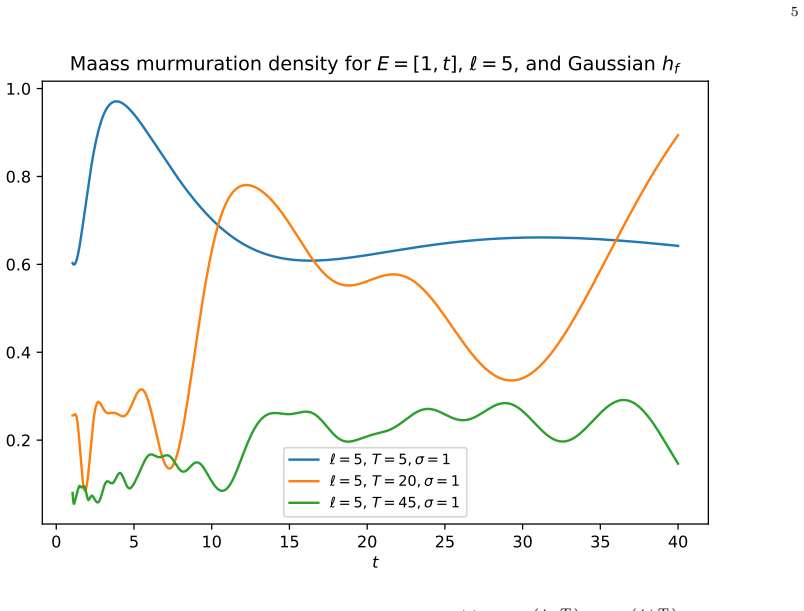
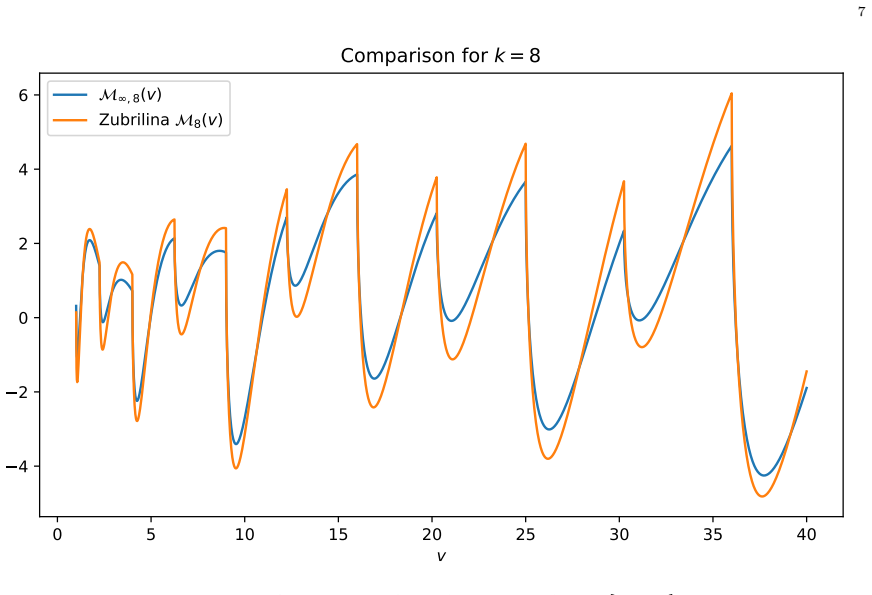
For both GL_2 and the definite quaternion algebra ramified at {∞,ℓ}, the murmuration density in the depth aspect is determined as a→∞ with ℓ fixed; the resulting density agrees with the density previously obtained for odd conductor exponents, and hence gives a uniform density for cusp forms of conductor ℓ^n as n→∞. The same conclusion is reached for Maass forms of conductor ℓ^n. The murmuration density is also computed in the regime where ℓ→∞ with n≥3 fixed.
What carries the argument
Murmuration density computed via trace formulas in the depth aspect for even conductor exponents.
If this is right
- A single limiting murmuration density applies to all cusp forms of conductor ℓ^n as n tends to infinity, independent of whether n is even or odd.
- The same uniform density holds for Maass forms of conductor ℓ^n.
- The density can be computed explicitly when the prime ℓ tends to infinity while the exponent n stays fixed and at least 3.
- The result applies uniformly to both the GL_2 and quaternion-algebra settings.
Where Pith is reading between the lines
- The uniformity suggests that parity of the conductor exponent does not affect the leading murmuration bias once the conductor is a sufficiently high power of ℓ.
- Similar density computations might be possible in other aspects, such as when weight or level varies simultaneously with the depth parameter.
- The result supplies a concrete prediction that could be checked against databases of newforms once sufficiently many forms of high even powers are tabulated.
Load-bearing premise
The murmuration density computed for even exponents is assumed to exist and to match the odd-exponent density without extra correction terms that depend on the parity of the exponent.
What would settle it
Numerical computation of the average sign or bias for a large even exponent 2a that deviates from the previously reported odd-exponent density by more than the expected error term.
Figures

read the original abstract
We study murmurations in the depth aspect for holomorphic cusp forms of conductor $\ell^{2a}$ and fixed weight, where $\ell$ is an odd prime. For both $\mathrm{GL}_2$ and the definite quaternion algebra ramified at $\{\infty,\ell\}$, we determine the murmuration density as $a\to\infty$ with $\ell$ fixed. The resulting density agrees with the one previously obtained for odd conductor exponents, and hence gives a uniform density for cusp forms of conductor $\ell^n$ as $n\to\infty$. We also consider the case of Maass forms of conductor $\ell^n$. Finally, we compute the murmuration density in conductor $\ell^n$ as $\ell\to\infty$ with $n\geq3$ fixed.
Editorial analysis
A structured set of objections, weighed in public.
Referee Report
Summary. The manuscript determines the murmuration density in the depth aspect for holomorphic cusp forms of conductor ℓ^{2a} (ℓ odd prime fixed, a→∞) on GL_2 and on the definite quaternion algebra ramified at {∞,ℓ}. The resulting density is shown to coincide with the density previously obtained for odd exponents, yielding a uniform density for all positive exponents n in conductors ℓ^n. The work also treats Maass forms of conductor ℓ^n and computes the density when ℓ→∞ with n≥3 fixed.
Significance. If the derivations hold, the result establishes that the murmuration density is independent of the parity of the conductor exponent, furnishing a uniform description across the full depth aspect. This extends earlier odd-exponent computations and incorporates Maass forms, strengthening the evidence that murmurations are a robust feature of these families. The explicit agreement obtained via trace formulas supplies a concrete, falsifiable prediction for the large-a limit.
major comments (1)
- [§3.2] §3.2, after the application of the trace formula for even exponents: the cancellation of all parity-dependent correction terms in the a→∞ limit is asserted but the explicit identity equating the even-exponent main term to the odd-exponent expression (previously derived for odd n) is not displayed; exhibiting this identity would confirm that no residual ℓ-dependent or parity-dependent factors survive.
minor comments (2)
- [Introduction] The notation for the murmuration density function (e.g., the precise normalization of the sum over forms) is introduced only in the introduction and should be restated once in each computational section for readability.
- [Table 1] Table 1 (numerical checks for small a) reports agreement to three decimal places; adding the number of forms sampled in each row would allow readers to assess statistical significance of the observed convergence.
Simulated Author's Rebuttal
We thank the referee for their careful reading and for recommending minor revision. We address the major comment below.
read point-by-point responses
-
Referee: [§3.2] §3.2, after the application of the trace formula for even exponents: the cancellation of all parity-dependent correction terms in the a→∞ limit is asserted but the explicit identity equating the even-exponent main term to the odd-exponent expression (previously derived for odd n) is not displayed; exhibiting this identity would confirm that no residual ℓ-dependent or parity-dependent factors survive.
Authors: We agree that explicitly displaying the identity would improve the exposition. The cancellation of parity-dependent correction terms follows directly from the trace formula and the a→∞ asymptotic analysis already present in the section, but we will add the explicit equating identity in the revised §3.2 to make the agreement with the odd-exponent case fully transparent and to confirm the absence of residual factors. revision: yes
Circularity Check
Minor self-citation on density agreement; central trace-formula derivation independent
full rationale
The paper computes the murmuration density for even conductor exponents ℓ^{2a} independently using trace formulas in the depth aspect for both GL_2 and the quaternion algebra case, then observes agreement with the prior odd-exponent density. This agreement is reported as an empirical finding rather than a definitional identity or a fitted parameter renamed as a prediction. No self-definitional loops, uniqueness theorems imported from the same authors, or ansatz smuggling via citation are exhibited. The load-bearing analytic steps remain self-contained against external trace-formula methods.
Axiom & Free-Parameter Ledger
Reference graph
Works this paper leans on
-
[1]
Applications of the trace formula
Providence, Rhode Island: American Mathematical Society, 2012. [Kni25] A. Knightly.Counting locally supercuspidal newforms. 2025.url:https://arxiv. org/abs/2310.17047. [KR97] A. W. Knapp and Rogawski. “Applications of the trace formula”. In:Representation Theory and Automorphic Forms. Vol. 61. Proceedings of Symposia in Pure Mathe- matics. Providence, Rho...
arXiv 2012
-
[2]
Letter to Drew Sutherland and Nina Zubrilina
Berlin ; Springer, 2007. [Sar23] P. Sarnak. “Letter to Drew Sutherland and Nina Zubrilina”. 2023.url:https : / / publications.ias.edu/sites/default/files/Nina%20and%20Drew%20letter_0. pdf. [Sch02] R. Schmidt. “Some remarks on local newforms for GL(2)”. In:J. Ramanujan Math. Soc.17.2 (2002). [SST16] P. Sarnak, S. W. Shin, and N. Templier. “Families of L-Fu...
2007
-
[3]
Murmurations
Springer International Publishing, 2021. [Zub25] N. Zubrilina. “Murmurations”. In:Inventiones mathematicae241.3 (July 2025). Department of Mathematics, Ev ans Hall, University of California, Berkeley, CA 94720, USA Email address:leonard.tomczak@berkeley.edu
2021
discussion (0)
Sign in with ORCID, Apple, or X to comment. Anyone can read and Pith papers without signing in.