OctaOctree Neural Radiosity for Real-time Glossy Material Rendering
Pith reviewed 2026-06-27 17:52 UTC · model grok-4.3
The pith
OctaOctree combines an adaptive octree with octahedral directional maps to encode indirect illumination effects including sharp glossy reflections using a single network query.
A machine-rendered reading of the paper's core claim, the machinery that carries it, and where it could break.
Core claim
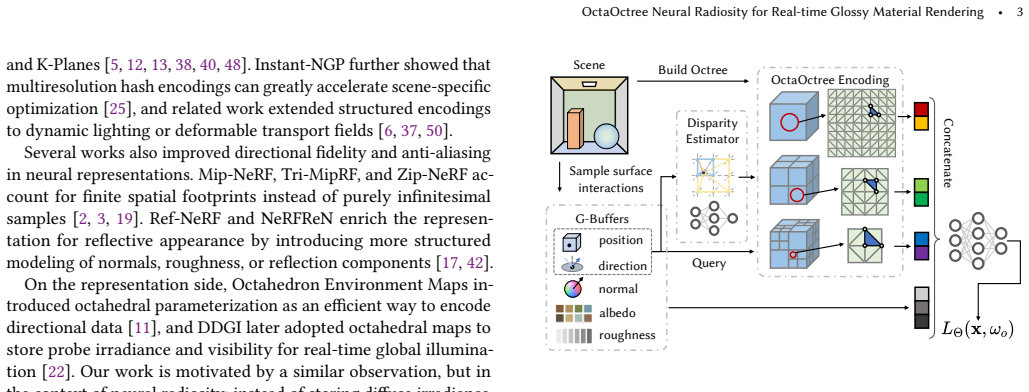
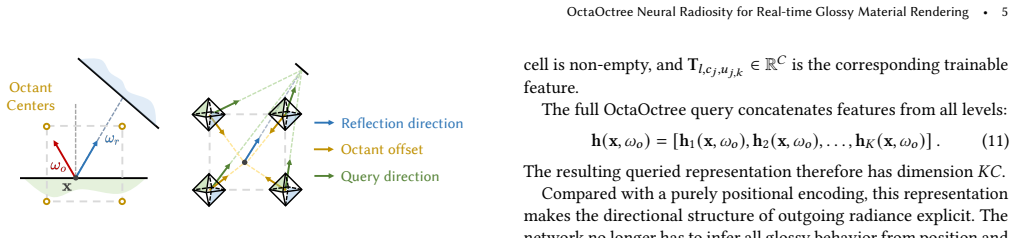
OctaOctree organizes outgoing radiance with an adaptive octree in 3D space and associates each spatial node with an octahedral directional map. Coupling the spatial hierarchy with direction-dependent storage allocates fine spatial resolution to local illumination and visibility changes while using coarser spatial levels with richer angular resolution to capture glossy and specular radiance distributions. This embeds a reflectance-aware spatial-angular prior directly into the radiance representation, reducing the burden on neural networks to recover high-frequency view-dependent effects from positional features alone and providing a compact encoding for indirect illumination from diffuse to s
What carries the argument
The OctaOctree structure that pairs an adaptive 3D octree hierarchy with per-node octahedral directional maps to couple spatial and angular storage of radiance.
If this is right
- High-quality direction-aware global illumination is produced with a single network query at primary intersections.
- Real-time performance is achieved compared to baseline neural radiosity and radiance caching approaches.
- Indirect illumination effects from diffuse interreflection to sharp glossy reflections are represented effectively.
- The neural encoding becomes more compact by embedding the reflectance-aware prior in the representation structure.
Where Pith is reading between the lines
- This representation could support extensions to dynamic scenes by updating the octree structure incrementally.
- Similar spatial-angular hierarchies might apply to other transport problems such as volume rendering with view-dependent scattering.
- The single-query property may enable its use in interactive applications like games where multiple bounces are needed without high cost.
Load-bearing premise
That the specific coupling of octree spatial nodes with octahedral maps embeds a reflectance-aware prior reducing the neural network's task of recovering high-frequency directional effects.
What would settle it
Measuring PSNR or SSIM error and milliseconds per frame on glossy material test scenes against a positional-encoding neural radiosity baseline to verify the claimed fidelity and speed improvements.
Figures





read the original abstract
Modeling high-frequency outgoing radiance distributions remains a fundamental challenge in global illumination, especially for glossy and specular materials. Existing neural-based radiance caching methods commonly rely on positional feature encodings or spatially organized caches, which makes it difficult to represent sharp directional radiance variations without increasing the model complexity or sampling cost. To address this challenge, we propose OctaOctree, an efficient spatial-angular radiance representation for global illumination. OctaOctree organizes outgoing radiance with an adaptive octree in 3D space, and associates each spatial node with an octahedral directional map. By coupling the spatial hierarchy with direction-dependent storage, our representation allocates fine spatial resolution to local illumination and visibility changes, while using coarser spatial levels with richer angular resolution to capture glossy and specular radiance distributions. This design embeds a reflectance-aware spatial-angular prior directly into the radiance representation, reducing the burden on neural networks or reconstruction modules to recover high-frequency view-dependent effects from positional features alone. As a result, OctaOctree provides a compact and expressive neural encoding for a wide range of indirect illumination effects, from diffuse interreflection to sharp glossy reflections. Experiments demonstrate that our method produces high-quality, direction-aware global illumination with single network query at primary intersections, achieving improved fidelity and real-time performance compared with baseline neural radiosity and radiance caching approaches.
Editorial analysis
A structured set of objections, weighed in public.
Referee Report
Summary. The paper proposes OctaOctree, a neural radiance representation for global illumination that couples an adaptive spatial octree hierarchy in 3D with per-node octahedral directional maps. This design is claimed to embed a reflectance-aware spatial-angular prior, enabling compact encoding of effects from diffuse interreflections to sharp glossy reflections. The method requires only a single network query at primary intersections and is reported to achieve improved fidelity and real-time performance over baseline neural radiosity and radiance caching approaches.
Significance. If the experimental claims hold, the approach could provide a practical advance in real-time glossy global illumination by reducing the modeling burden on neural networks through an explicit spatial-angular structure. The combination of octree adaptivity with octahedral storage is a concrete design choice that directly targets high-frequency directional variation without proportional increases in network capacity or sampling cost.
minor comments (2)
- The abstract states that experiments demonstrate improved fidelity and real-time performance, but the provided text contains no quantitative metrics, baseline comparisons, or scene descriptions. Adding a results section with specific numbers (e.g., PSNR, timing, memory) would strengthen the claims.
- The description of how the octahedral maps are queried and how the network is trained is high-level; explicit pseudocode or a diagram of the forward pass would clarify the single-query claim.
Simulated Author's Rebuttal
We thank the referee for their positive evaluation of OctaOctree and for recommending minor revision. The report raises no specific major comments, so our response below is correspondingly brief. We will incorporate any minor editorial or presentation suggestions in the revised manuscript.
Circularity Check
No significant circularity identified
full rationale
The paper proposes OctaOctree as an architectural design coupling an adaptive octree with per-node octahedral directional maps to embed a reflectance-aware spatial-angular prior. No equations, fitted parameters, predictions, or derivation steps appear in the provided abstract or description. The central claim is a direct statement of the representation's properties and benefits, with no reduction of outputs to inputs by construction, no self-citation load-bearing premises, and no renaming of known results. Experiments are described as comparisons to baselines, leaving the method self-contained against external evaluation.
Axiom & Free-Parameter Ledger
invented entities (1)
-
OctaOctree
no independent evidence
Reference graph
Works this paper leans on
-
[1]
Steve Bako, Thijs Vogels, Brian McWilliams, Mark Meyer, Jan Novák, Alex Harvill, Pradeep Sen, Tony DeRose, and Fabrice Rousselle. 2017. Kernel-Predicting Con- volutional Networks for Denoising Monte Carlo Renderings.ACM Transactions on Graphics36, 4, Article 97 (2017). doi:10.1145/3072959.3073708
-
[2]
In: 2021 IEEE/CVF International Conference on Computer Vision (ICCV)
Jonathan T. Barron, Ben Mildenhall, Matthew Tancik, Peter Hedman, Ricardo Martin-Brualla, and Pratul P. Srinivasan. 2021. Mip-NeRF: A Multiscale Represen- tation for Anti-Aliasing Neural Radiance Fields. InProceedings of the IEEE/CVF International Conference on Computer Vision. 5855–5864. doi:10.1109/ICCV48922. 2021.00580
-
[3]
InProceedings of the SIGGRAPH Asia 2025 Conference Papers (SA Conference Papers ’25)
Jonathan T. Barron, Ben Mildenhall, Dor Verbin, Pratul P. Srinivasan, and Peter Hedman. 2023. Zip-NeRF: Anti-Aliased Grid-Based Neural Radiance Fields. In Proceedings of the IEEE/CVF International Conference on Computer Vision. 19697– 19705. doi:10.1109/ICCV51070.2023.01804
-
[4]
Chakravarty R. Alla Chaitanya, Anton S. Kaplanyan, Christoph Schied, Marco Salvi, Aaron Lefohn, Derek Nowrouzezahrai, and Timo Aila. 2017. Interactive Reconstruction of Monte Carlo Image Sequences using a Recurrent Denoising Autoencoder.ACM Transactions on Graphics36, 4, Article 98 (2017). doi:10.1145/ 3072959.3073601
arXiv 2017
-
[5]
Anpei Chen, Zexiang Xu, Andreas Geiger, Jingyi Yu, and Hao Su. 2022. TensoRF: Tensorial Radiance Fields. InEuropean Conference on Computer Vision. 333–350. doi:10.1007/978-3-031-19824-3_20
-
[6]
Dominici, Christian Döring, Joerg H
Arno Coomans, Edoardo A. Dominici, Christian Döring, Joerg H. Mueller, Jozef Hladky, and Markus Steinberger. 2024. Real-time Neural Rendering of Dynamic Light Fields.Computer Graphics Forum43, 2 (2024). doi:10.1111/cgf.15014
-
[7]
Mikhail Dereviannykh, Dmitrii Klepikov, Johannes Hanika, and Carsten Dachs- bacher. 2025. Neural Two-Level Monte Carlo Real-Time Rendering.Computer Graphics Forum44, 2 (2025). doi:10.1111/cgf.70050
-
[8]
Stavros Diolatzis, Julien Philip, and George Drettakis. 2022. Active Exploration for Neural Global Illumination of Variable Scenes.ACM Transactions on Graphics 41, 4, Article 129 (2022)
2022
-
[9]
Honghao Dong, Rui Su, Guoping Wang, and Sheng Li. 2024. Efficient Neural Path Guiding with 4D Modeling. InSIGGRAPH Asia 2024 Conference Papers. doi:10.1145/3680528.3687687
-
[10]
Honghao Dong, Guoping Wang, and Sheng Li. 2023. Neural Parametric Mixtures for Path Guiding. InSIGGRAPH ’23 Conference Proceedings. doi:10.1145/3588432. 3591533
-
[11]
Thomas Engelhardt and Carsten Dachsbacher. 2008. Octahedron Environment Maps. InVision, Modeling, and Visualization. 343–349
2008
-
[12]
Sara Fridovich-Keil, Giacomo Meanti, Frederik Rahbæk Warburg, Benjamin Recht, and Angjoo Kanazawa. 2023. K-Planes: Explicit Radiance Fields in Space, Time, and Appearance. InProceedings of the IEEE/CVF Conference on Computer Vision and Pattern Recognition. 12479–12488. doi:10.1109/CVPR52729.2023.01201
-
[13]
Sara Fridovich-Keil, Alex Yu, Matthew Tancik, Qinhong Chen, Benjamin Recht, and Angjoo Kanazawa. 2022. Plenoxels: Radiance Fields without Neural Net- works. InProceedings of the IEEE/CVF Conference on Computer Vision and Pattern Recognition. 5501–5510. doi:10.1109/CVPR52688.2022.00542
-
[14]
Duan Gao, Haoyuan Mu, and Kun Xu. 2023. Neural Global Illumination: In- teractive Indirect Illumination Prediction Under Dynamic Area Lights.IEEE Transactions on Visualization and Computer Graphics29, 12 (2023), 5325–5341. doi:10.1109/TVCG.2022.3209963
-
[15]
Jonathan Granskog, Fabrice Rousselle, Marios Papas, and Jan Novák. 2020. Com- positional Neural Scene Representations for Shading Inference.ACM Transactions on Graphics39, 4, Article 137 (2020). doi:10.1145/3386569.3392405
-
[16]
Jie Guo, Zijing Zong, Yadong Song, Xihao Fu, Chengzhi Tao, Yanwen Guo, and Ling-Qi Yan. 2022. Efficient Light Probes for Real-Time Global Illumination.ACM Transactions on Graphics41, 6, Article 202 (2022). doi:10.1145/3550454.3555452
-
[17]
Yuan-Chen Guo, Di Kang, Linchao Bao, Yu He, and Song-Hai Zhang. 2022. NeR- FReN: Neural Radiance Fields with Reflections. InProceedings of the IEEE/CVF Conference on Computer Vision and Pattern Recognition. 18409–18418. doi:10.1109/ CVPR52688.2022.01786
arXiv 2022
-
[18]
Saeed Hadadan, Karol Myszkowski, Hans-Peter Seidel, Tobias Ritschel, and Martin Weier. 2021. Neural Radiosity.ACM Transactions on Graphics40, 6, Article 215 (2021). doi:10.1145/3478513.3480491
-
[19]
Wenbo Hu, Yuling Wang, Lin Ma, Bangbang Yang, Lin Gao, Xiao Liu, and Yuewen Ma. 2023. Tri-MipRF: Tri-Mip Representation for Efficient Anti-Aliasing Neu- ral Radiance Fields. InProceedings of the IEEE/CVF International Conference on 10•Jierui Ren, Haojie Jin, Bo Pang, Meng Gai, Fei Zhu, Yisong Chen, and Sheng Li ReferenceFull modelRT depthNo dir.shiftOutgo...
-
[20]
Mustafa Işık, Krishna Mullia, Matthew Fisher, Jonathan Eisenmann, and Michaël Gharbi. 2021. Interactive Monte Carlo Denoising using Affinity of Neural Features. ACM Transactions on Graphics40, 4, Article 37 (2021). doi:10.1145/3450626.3459793
-
[21]
Lingjie Liu, Jiatao Gu, Kyaw Zaw Lin, Tat-Seng Chua, and Christian Theobalt
-
[22]
InAdvances in Neural Information Processing Systems, Vol
Neural Sparse Voxel Fields. InAdvances in Neural Information Processing Systems, Vol. 33. 15651–15663
-
[23]
Zander Majercik, Cyril Crassin, Peter Shirley, and Morgan McGuire. 2019. Dy- namic Diffuse Global Illumination with Ray-Traced Irradiance Fields.Journal of Computer Graphics Techniques8, 2 (2019), 1–30
2019
-
[24]
Srinivasan, Matthew Tancik, Jonathan T
Ben Mildenhall, Pratul P. Srinivasan, Matthew Tancik, Jonathan T. Barron, Ravi Ramamoorthi, and Ren Ng. 2021. NeRF: Representing Scenes as Neural Radiance Fields for View Synthesis. InCommunications of the ACM, Vol. 65. 99–106. doi:10. 1145/3503250 ReferenceFull modelNo octreeNo octa. MAPELPIPS 0.0560.0720.0610.0870.0630.077 0.1420.2340.1490.2380.1380.218...
arXiv 2021
-
[25]
Shaohua Mo, Chuankun Zheng, Zihao Lin, Dianbing Xi, Qi Ye, Rui Wang, Hujun Bao, and Yuchi Huo. 2025. Dual-Band Feature Fusion for Neural Global Illumi- nation with Multi-Frequency Reflections. InSIGGRAPH 2025 Conference Papers. Article 49. doi:10.1145/3721238.3730733
-
[26]
Thomas Müller, Alex Evans, Christoph Schied, and Alexander Keller. 2022. In- stant Neural Graphics Primitives with a Multiresolution Hash Encoding.ACM Transactions on Graphics41, 4, Article 102 (2022). doi:10.1145/3528223.3530127
-
[27]
Thomas Müller, Brian McWilliams, Fabrice Rousselle, Markus Gross, and Jan Novák. 2019. Neural Importance Sampling.ACM Transactions on Graphics38, 5, Article 145 (2019). doi:10.1145/3341156
-
[28]
Thomas Müller, Fabrice Rousselle, Alexander Keller, and Jan Novák. 2020. Neural Control Variates.ACM Transactions on Graphics39, 6, Article 243 (2020). doi:10. 1145/3414685.3417819
arXiv 2020
-
[29]
Thomas Müller, Fabrice Rousselle, Jan Novák, and Alexander Keller. 2021. Real- Time Neural Radiance Caching for Path Tracing.ACM Transactions on Graphics 40, 4, Article 36 (2021). doi:10.1145/3450626.3459812
-
[30]
Oliver Nalbach, Elena Arabadzhiyska, Deepak Mehta, Hans-Peter Seidel, and Tobias Ritschel. 2017. Deep Shading: Convolutional Neural Networks for Screen- Space Shading.Computer Graphics Forum36, 4 (2017), 65–78. doi:10.1111/cgf. 13225
work page doi:10.1111/cgf 2017
-
[31]
Christian Reiser, Songyou Peng, Yiyi Liao, and Andreas Geiger. 2021. KiloNeRF: Speeding up Neural Radiance Fields with Thousands of Tiny MLPs. InProceedings of the IEEE/CVF International Conference on Computer Vision. 14335–14345. doi:10. 1109/ICCV48922.2021.01407
arXiv 2021
-
[32]
Haocheng Ren, Yuchi Huo, Yifan Peng, Hongtao Sheng, Weidong Xue, Hongxiang Huang, Jingzhen Lan, Rui Wang, and Hujun Bao. 2024. LightFormer: Light- Oriented Global Neural Rendering in Dynamic Scene.ACM Transactions on OctaOctree Neural Radiosity for Real-time Glossy Material Rendering•11 Graphics(2024). doi:10.1145/3658229
-
[33]
Jierui Ren, Haojie Jin, Bo Pang, Yisong Chen, Guoping Wang, and Sheng Li. 2025. Neural Cone Radiosity for Interactive Global Illumination with Glossy Materials. arXiv preprint arXiv:2509.07522(2025). doi:10.48550/arXiv.2509.07522
-
[34]
Juan Canés Rodriguez, Manuel Thomas, Tomáš Davidovič, Tobias Ritschel, Karol Myszkowski, Hans-Peter Seidel, Thorsten Grosch, Jaroslav Křivánek, and Martin Weier. 2020. Glossy Probe Reprojection for Interactive Global Illumination.ACM Transactions on Graphics39, 4, Article 122 (2020). doi:10.1145/3386569.3392483
-
[35]
Alla Chaitanya, John Burgess, Shiqiu Liu, Carsten Dachsbacher, Aaron Lefohn, and Marco Salvi
Christoph Schied, Anton Kaplanyan, Chris Wyman, Anjul Patney, Chakravarty R. Alla Chaitanya, John Burgess, Shiqiu Liu, Carsten Dachsbacher, Aaron Lefohn, and Marco Salvi. 2017. Spatiotemporal Variance-Guided Filtering: Real-Time Reconstruction for Path-Traced Global Illumination. InProceedings of High Per- formance Graphics. 1–12. doi:10.1145/3105762.3105770
-
[36]
Peter-Pike Sloan, Jan Kautz, and John Snyder. 2002. Precomputed Radiance Trans- fer for Real-Time Rendering in Dynamic, Low-Frequency Lighting Environments. ACM Transactions on Graphics21, 3 (2002), 527–536. doi:10.1145/566570.566612
-
[37]
Rui Su, Honghao Dong, Haojie Jin, Yisong Chen, Guoping Wang, and Sheng Li. 2025. Vertex Features for Neural Global Illumination. InProceedings of the SIGGRAPH Asia 2025 Conference Papers. 1–11
2025
-
[38]
Rui Su, Honghao Dong, Jierui Ren, Haojie Jin, et al . 2024. Dynamic Neural Radiosity with Multi-grid Decomposition.ACM SIGGRAPH Asia 2024 Conference Papers(2024). doi:10.1145/3680528.3687685
-
[39]
Cheng Sun, Min Sun, and Hwann-Tzong Chen. 2022. Direct Voxel Grid Optimiza- tion: Super-fast Convergence for Radiance Fields Reconstruction. InProceedings of the IEEE/CVF Conference on Computer Vision and Pattern Recognition. 5450–5459. doi:10.1109/CVPR52688.2022.00538
-
[40]
Srinivasan, Ben Mildenhall, Sara Fridovich-Keil, Nithin Raghavan, Utkarsh Singhal, Ravi Ramamoorthi, Jonathan T
Matthew Tancik, Pratul P. Srinivasan, Ben Mildenhall, Sara Fridovich-Keil, Nithin Raghavan, Utkarsh Singhal, Ravi Ramamoorthi, Jonathan T. Barron, and Ren Ng
-
[41]
Fourier Features Let Networks Learn High Frequency Functions in Low Dimensional Domains.Advances in Neural Information Processing Systems33 (2020), 7537–7547
2020
-
[42]
Jiaxiang Tang, Xiaokang Chen, Jingbo Wang, and Gang Zeng. 2022. Compressible- composable NeRF via Rank-residual Decomposition.Advances in Neural Informa- tion Processing Systems35 (2022), 14798–14809
2022
-
[43]
Manuel Thomas and Angus G. Forbes. 2017. Deep Illumination: Approximating Dynamic Global Illumination with Generative Adversarial Networks.Computer Graphics Forum36, 8 (2017), 111–120. doi:10.1111/cgf.13333
-
[44]
Dor Verbin, Peter Hedman, Ben Mildenhall, Todd Zickler, Jonathan T. Barron, and Pratul P. Srinivasan. 2022. Ref-NeRF: Structured View-Dependent Appearance for Neural Radiance Fields. InProceedings of the IEEE/CVF Conference on Computer Vision and Pattern Recognition. 5481–5490. doi:10.1109/CVPR52688.2022.00541
-
[45]
Thijs Vogels, Fabrice Rousselle, Brian McWilliams, Mark Meyer, Jan Novák, Alex Harvill, Pradeep Sen, Tony DeRose, and Nima Khademi Kalantari. 2018. Denoising with Kernel Prediction and Asymmetric Loss Functions.ACM Transactions on Graphics37, 4, Article 124 (2018). doi:10.1145/3197517.3201388
-
[46]
Peng-Shuai Wang, Yang Liu, Yu-Xiao Guo, Chun-Yu Sun, and Xin Tong. 2017. O-cnn: Octree-based convolutional neural networks for 3d shape analysis.ACM Transactions On Graphics (TOG)36, 4 (2017), 1–11
2017
-
[47]
Songyin Wu, Sungye Kim, Zheng Zeng, Deepak Vembar, Sangeeta Jha, Anton Kaplanyan, and Ling-Qi Yan. 2023. ExtraSS: A Framework for Joint Spatial Super Sampling and Frame Extrapolation. InSIGGRAPH Asia 2023 Conference Papers. Article 92. doi:10.1145/3610548.3618224
-
[48]
Jia Xin, Michael McCool, Kayvon Fatahalian, Stephen Hill, Aaron Lefohn, and Jonathan Ragan-Kelley. 2022. Lightweight Bilateral Convolutional Neural Networks for Interactive Single-Bounce Diffuse Indirect Illumination.IEEE Transactions on Visualization and Computer Graphics28, 4 (2022), 1911–1923. doi:10.1109/TVCG.2020.3023129
-
[49]
Kun Xu, Yan-Pei Cao, Li-Qian Ma, Zhao Dong, Rui Wang, and Shi-Min Hu. 2014. A Practical Algorithm for Rendering Interreflections with All-frequency BRDFs. ACM Transactions on Graphics33, 1, Article 10 (2014). doi:10.1145/2533687
-
[50]
Alex Yu, Ruilong Li, Matthew Tancik, Hao Li, Ren Ng, and Angjoo Kanazawa. 2021. PlenOctrees for Real-Time Rendering of Neural Radiance Fields. InProceedings of the IEEE/CVF International Conference on Computer Vision. 5752–5761
2021
-
[51]
Efros, Eli Shechtman, and Oliver Wang
Richard Zhang, Phillip Isola, Alexei A. Efros, Eli Shechtman, and Oliver Wang
-
[52]
The Unreasonable Effectiveness of Deep Features as a Perceptual Metric. In Proceedings of the IEEE/CVF Conference on Computer Vision and Pattern Recognition. 586–595. doi:10.1109/CVPR.2018.00068
-
[53]
Chuankun Zheng, Yuchi Huo, Hongxiang Huang, Hongtao Sheng, Junrong Huang, Rui Tang, Hao Zhu, Rui Wang, and Hujun Bao. 2024. Neural Global Illumination via Superposed Deformable Feature Fields. InSIGGRAPH Asia 2024 Conference Papers. doi:10.1145/3680528.3687680
-
[54]
Chuankun Zheng, Yuchi Huo, Shaohua Mo, Zhihua Zhong, et al . 2023. NeLT: Object-oriented Neural Light Transfer.ACM Transactions on Graphics42, 5, Article 152 (2023). doi:10.1145/3596491
-
[55]
Zhihua Zhong, Jingsen Zhu, Yuxin Dai, Chuankun Zheng, Guanlin Chen, Yuchi Huo, Hujun Bao, and Rui Wang. 2023. FuseSR: Super Resolution for Real-Time Rendering through Efficient Multi-resolution Fusion. InSIGGRAPH Asia 2023 Conference Papers. doi:10.1145/3610548.3618209
discussion (0)
Sign in with ORCID, Apple, or X to comment. Anyone can read and Pith papers without signing in.