X-rated Compliance Theater: An Empirical Evaluation of European Age Verification Systems in Adult Websites
Pith reviewed 2026-06-27 17:55 UTC · model grok-4.3
The pith
Age verification systems on adult websites in Europe fail against low-cost attacks.
A machine-rendered reading of the paper's core claim, the machinery that carries it, and where it could break.
Core claim
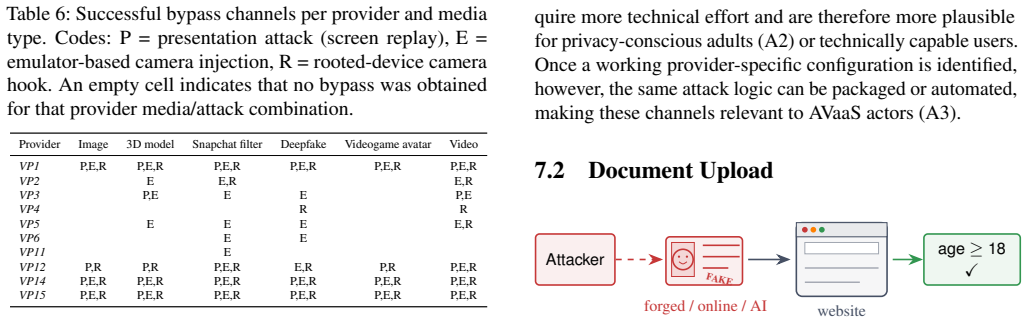
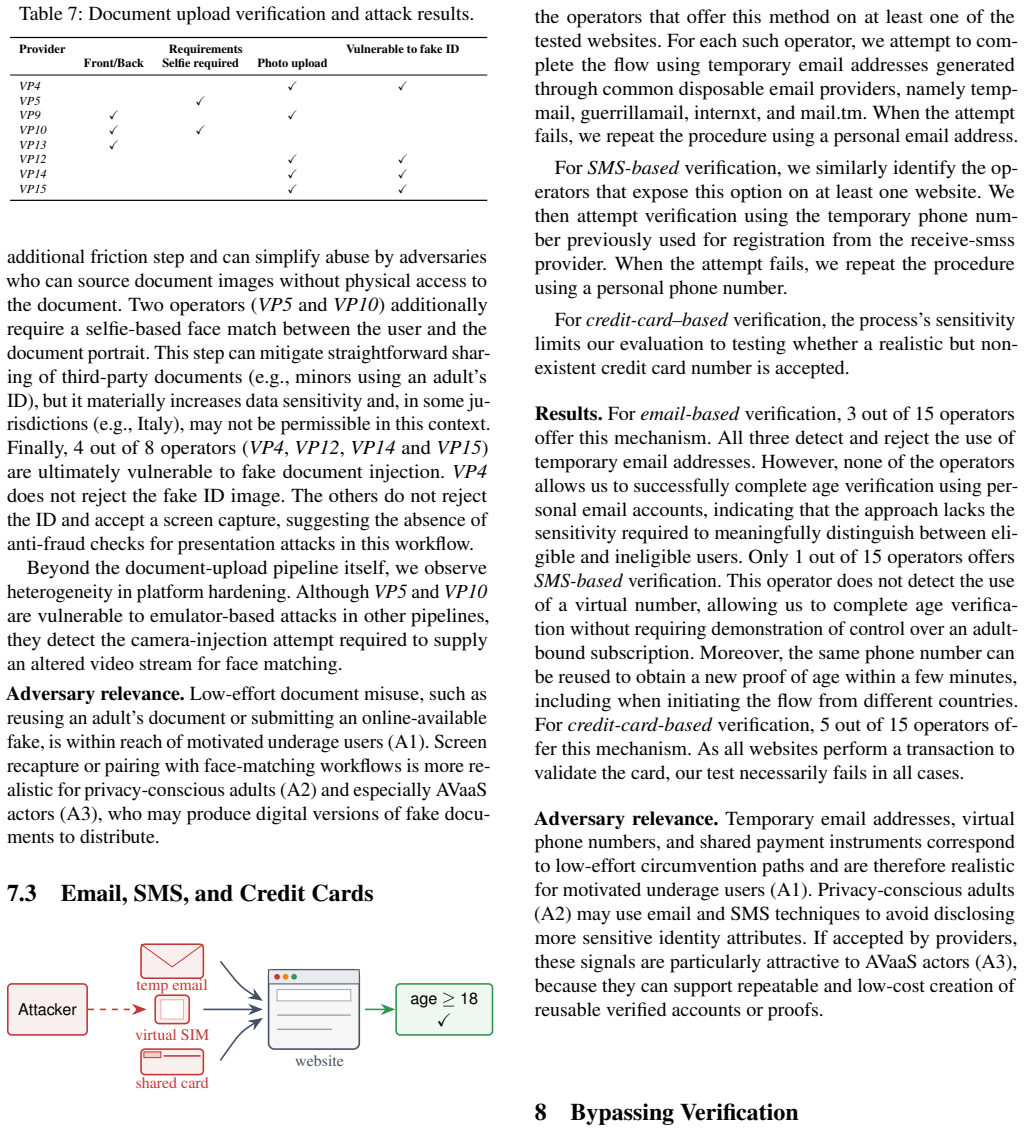
Regulation-mandated age-verification mechanisms on adult websites show systemic weaknesses across mechanisms and integrations under realistic threat assumptions, failing against low-cost, widely accessible attacks, based on testing in four countries covering document-based verification, biometric age estimation, indirect signals, and website workflows.
What carries the argument
Empirical testing methodology that combines ecosystem mapping, adversary modeling, and hands-on evaluation of verification processes outsourced to third parties.
Load-bearing premise
The tested mechanisms, websites, and adversary models represent typical regulation-mandated deployments and practical real-world threats.
What would settle it
A test showing that the described low-cost attacks fail to bypass age verification on representative adult websites would falsify the claim of systemic weaknesses.
Figures





read the original abstract
Age verification is rapidly emerging as a central regulatory instrument for protecting minors online, with several jurisdictions mandating its deployment for access to adult and pornographic content. This regulatory direction raises significant privacy concerns, as it risks binding sensitive content access to identity-related attributes. It also introduces security risks, since age-verification mechanisms are often outsourced to third-party providers with limited transparency into the robustness of their verification processes. In this work, we conduct, to the best of our knowledge, the first exploratory security assessment of regulation-mandated age-verification mechanisms deployed by adult websites. Rather than treating age verification as a purely regulatory question, we empirically examine whether current deployments provide security guarantees commensurate with the privacy risks of relying on sensitive identity-related data. Our methodology combines ecosystem mapping, adversary modeling, and empirical testing across four countries, covering document-based verification, biometric age estimation, indirect signals, and website-workflow integration. Our results reveal systemic weaknesses across mechanisms and integrations under realistic threat assumptions, including failures against low-cost, widely accessible attacks. Finally, we derive concrete guidelines and design directions for mitigating the security and privacy risks exposed by current age-verification deployments.
Editorial analysis
A structured set of objections, weighed in public.
Referee Report
Summary. The paper conducts an exploratory empirical security assessment of regulation-mandated age-verification mechanisms on adult websites across four European countries. It combines ecosystem mapping, adversary modeling, and testing of document-based, biometric, and indirect verification methods plus their website integrations. The central claim is that these deployments exhibit systemic weaknesses against low-cost, widely accessible attacks, with privacy and security risks that exceed the guarantees provided; the authors conclude with mitigation guidelines.
Significance. If the empirical results hold and the sampled mechanisms prove representative, the work would offer timely evidence on the practical limitations of age-verification systems introduced by recent regulations. The first-of-its-kind exploratory mapping of real deployments and the focus on integration-level failures are strengths that could inform both policy and engineering practice in privacy-sensitive domains.
major comments (2)
- [Abstract / Methodology] Abstract and Methodology: The headline claim of 'systemic weaknesses across mechanisms and integrations under realistic threat assumptions' requires that the four-country sample of document-based, biometric, and indirect mechanisms is representative of actual regulation-mandated deployments. No explicit sampling frame, coverage statistics against national regulator lists, or justification that the chosen low-cost adversary models match production threat surfaces is provided, which directly undermines the generalizability of the systemic conclusion.
- [Results] Results section: The abstract states that results 'reveal systemic weaknesses... including failures against low-cost, widely accessible attacks,' yet the provided description contains no quantitative data, attack success rates, or verification of specific test vectors. Without these details, it is not possible to assess whether the observed failures are load-bearing for the security claims or merely anecdotal.
minor comments (2)
- [Abstract] The abstract refers to 'four countries' without naming them or providing a table summarizing the mechanisms tested per jurisdiction; adding this would improve clarity.
- [Introduction / Methodology] Terminology such as 'indirect signals' and 'website-workflow integration' is introduced without a concise definition or reference to prior work on age-verification taxonomies.
Simulated Author's Rebuttal
We thank the referee for the constructive feedback on our exploratory empirical assessment. We address the major comments point-by-point below, clarifying the study's scope while committing to revisions that strengthen transparency without overstating representativeness.
read point-by-point responses
-
Referee: [Abstract / Methodology] Abstract and Methodology: The headline claim of 'systemic weaknesses across mechanisms and integrations under realistic threat assumptions' requires that the four-country sample of document-based, biometric, and indirect mechanisms is representative of actual regulation-mandated deployments. No explicit sampling frame, coverage statistics against national regulator lists, or justification that the chosen low-cost adversary models match production threat surfaces is provided, which directly undermines the generalizability of the systemic conclusion.
Authors: We position the work explicitly as exploratory (see abstract: 'first exploratory security assessment'), not a statistically representative survey of all deployments. The four-country sample was chosen for diversity of mechanisms (document, biometric, indirect) and regulatory contexts where mandates are active; selection prioritized publicly accessible adult sites implementing the required flows. We agree that an explicit sampling frame and limitations discussion would improve clarity. In revision we will add a methodology subsection detailing selection criteria, data sources for ecosystem mapping, and explicit caveats on generalizability. The low-cost adversary models are justified in the paper as matching realistic, unsophisticated attackers (e.g., using consumer devices and publicly available forgery techniques) rather than nation-state capabilities. revision: partial
-
Referee: [Results] Results section: The abstract states that results 'reveal systemic weaknesses... including failures against low-cost, widely accessible attacks,' yet the provided description contains no quantitative data, attack success rates, or verification of specific test vectors. Without these details, it is not possible to assess whether the observed failures are load-bearing for the security claims or merely anecdotal.
Authors: The full Results section contains per-mechanism test descriptions, specific attack vectors applied, and observed outcomes. However, the abstract summarizes at a high level without numbers. We will revise the abstract to include concise quantitative indicators (e.g., attack success rates across categories) drawn from the detailed results, making the claims more concrete while preserving the exploratory framing. revision: yes
Circularity Check
No circularity: purely empirical evaluation with no derivations or self-referential logic
full rationale
This is an empirical security assessment paper that performs ecosystem mapping, adversary modeling, and direct testing of deployed age-verification mechanisms across sampled websites. The abstract and methodology describe data collection and attack testing without any equations, fitted parameters, predictions derived from inputs, uniqueness theorems, or self-citations that bear the central claim. The strongest claim (systemic weaknesses under realistic threats) rests on the empirical results from the chosen sample and test vectors rather than reducing to a definitional or fitted tautology. No load-bearing step matches any of the enumerated circularity patterns.
Axiom & Free-Parameter Ledger
Reference graph
Works this paper leans on
-
[1]
Technical Report PIPEDA Report of Findings #2016- 005, Office of the Privacy Commissioner of Canada; Office of the Australian Information Commissioner,
Joint investigation of ashley madison by the privacy com- missioner of canada and the australian privacy commis- sioner and acting australian information commissioner. Technical Report PIPEDA Report of Findings #2016- 005, Office of the Privacy Commissioner of Canada; Office of the Australian Information Commissioner,
2016
-
[2]
Accessed 11 December 2025. URL: https: //web.archive.org/web/20251213025934/https: //www.priv.gc.ca/en/opc-actions-and-decis ions/investigations/investigations-into-b usinesses/2016/pipeda-2016-005/
arXiv 2025
-
[3]
Decalogue of principles: Age verification and protec- tion of minors from inappropriate content
Agencia Española de Protección de Datos (AEPD). Decalogue of principles: Age verification and protec- tion of minors from inappropriate content. Regulatory guidance / principles, December 2023. Accessed 2025- 12-12. URL: https://www.aepd.es/guides/decal ogue-principles-age-verification-minors-p rotection.pdf
2023
-
[5]
Noura Alomar and Serge Egelman. Developers say the darnedest things: Privacy compliance processes fol- lowed by developers of child-directed apps.Proc. Priv. Enhancing Technol., 2022(4):250–273, 2022. URL: https://doi.org/10.56553/popets-2022-0108 , doi:10.56553/POPETS-2022-0108
-
[6]
Online age gating: An interdisciplinary evalua- tion
Noah Apthorpe, Brett Frischmann, and Yan Shvartzsh- naider. Online age gating: An interdisciplinary evalua- tion. SSRN preprint, 2025. URL: https://papers.s 15 srn.com/sol3/papers.cfm?abstract_id=493732 8
2025
-
[7]
Technical guidelines on age verification for the protection of persons under 18 from online pornog- raphy
ARCOM. Technical guidelines on age verification for the protection of persons under 18 from online pornog- raphy. Regulatory technical reference (France), 2024. URL: https://www.arcom.fr/en/find-out-more/ legal-area/legal-resources/technical-guide lines-age-verification-protection-persons -under-18-online-pornography
2024
-
[8]
Delibera n
Autorità per le Garanzie nelle Comunicazioni. Delibera n. 96/25/CONS: Modalità tecniche e di processo per l’accertamento della maggiore età degli utenti, April
-
[9]
123/2023, converted by Legge n
Regulatory instrument implementing Article 13- bis of Decreto-legge n. 123/2023, converted by Legge n. 159/2023. URL: https://www.agcom.it/compe tenze/consumatori/interventi-regolamentari -tutela-degli-utenti-finali-attuazione-del -nuovo/tutela-minori-age-verification
2023
-
[10]
Technical reference framework on age verification for the protection of mi- nors against online pornography
Autorité de régulation de la communication audiovi- suelle et numérique (ARCOM). Technical reference framework on age verification for the protection of mi- nors against online pornography. Regulatory techni- cal reference, 11 October 2024. Accessed 2025-12-12. URL: https://www.arcom.fr/se-documenter/es pace-juridique/textes-juridiques/referent iel-techni...
2024
-
[11]
When PETs mis- behave: A contextual integrity analysis
Ero Balsa and Yan Shvartzshnaider. When PETs mis- behave: A contextual integrity analysis. arXiv preprint,
-
[12]
URL: https://arxiv.org/abs/2312.02509 , arXiv:2312.02509
-
[13]
Age verification for online porn: more harm than good?Porn Studies, 6(2):228–237, 2019
Pandora Blake. Age verification for online porn: more harm than good?Porn Studies, 6(2):228–237, 2019. doi:10.1080/23268743.2018.1555054
-
[14]
Technical report: Ageverif
Paul Bouchaud. Technical report: Ageverif. Technical report, AI Forensics, October 2025. Accessed 11 De- cember 2025. URL: https://aiforensics.org/up loads/AgeVerif.pdf
2025
-
[15]
Design and implementation of theidemixanonymous creden- tial system
Jan Camenisch and Els Van Herreweghen. Design and implementation of theidemixanonymous creden- tial system. In Vijayalakshmi Atluri, editor,Proceed- ings of the 9th ACM Conference on Computer and Communications Security, CCS 2002, Washington, DC, USA, November 18-22, 2002, pages 21–30. ACM, 2002. doi:10.1145/586110.586114
-
[16]
Michele Campobasso and Luca Allodi. Impersonation- as-a-service: Characterizing the emerging criminal in- frastructure for user impersonation at scale. In Jay Lig- atti, Xinming Ou, Jonathan Katz, and Giovanni Vigna, editors,CCS ’20: 2020 ACM SIGSAC Conference on Computer and Communications Security, Virtual Event, USA, November 9-13, 2020, pages 1665–168...
-
[17]
Video injection attacks on remote digital identity verification solution using face recognition
Kévin Carta, Claude Barral, Nadia El Mrabet, and Sté- fane Mouille. Video injection attacks on remote digital identity verification solution using face recognition. In 13th International Multi-Conference on Complexity, In- formatics and Cybernetics, pages 92–97, 2022
2022
-
[18]
How video injection attacks can even challenge state-of-the-art face presentation attack detection systems
Kévin Carta, A Huynh, S Mouille, N El Mrabet, C Bar- ral, and S Brangoulo. How video injection attacks can even challenge state-of-the-art face presentation attack detection systems. InProceedings IMCIC-International Multi-Conference on Complexity, Informatics and Cy- bernetics, pages 105–112, 2023
2023
-
[19]
Algebraic macs and keyed-verification anonymous cre- dentials
Melissa Chase, Sarah Meiklejohn, and Greg Zaverucha. Algebraic macs and keyed-verification anonymous cre- dentials. In Gail-Joon Ahn, Moti Yung, and Ninghui Li, editors,Proceedings of the 2014 ACM SIGSAC Confer- ence on Computer and Communications Security, Scotts- dale, AZ, USA, November 3-7, 2014, pages 1205–1216. ACM, 2014.doi:10.1145/2660267.2660328
-
[20]
Limitations and pitfalls of integrating PETs in online age verification
Sylavin Chatel, Christian Knabenhans, Wouter Lueks, Mathilde Raynal, Carmela Troncoso, and Adám Vécsi. Limitations and pitfalls of integrating PETs in online age verification. IAB/W3C Workshop on Age-Based Restrictions on Content and Services (agews), IETF,
-
[21]
URL: https://www.ietf.org/slides/slid es-agews-limitations-and-pitfalls-of-integ rating-pets-in-online-age-verification-00. pdf
-
[22]
A VS-Raster
Commission for the Protection of Minors in the Me- dia (KJM). “A VS-Raster” (Age Verification Systems Benchmark Criteria), valid since 12.05.2022 (English). Regulatory criteria / benchmark, 2022. Accessed 2025- 12-12. URL: https://www.kjm-online.de/filea dmin/user_upload/KJM/Themen/Technischer_Ju gendmedienschutz/AVS-Raster_gueltig_seit_1 2.05.2022-ENG.pdf
2022
-
[23]
Why parents help their children lie to facebook about age: Unintended consequences of the ’children’s online privacy protection act’.First Monday, 16(11),
danah boyd, Eszter Hargittai, Jason Schultz, and John Palfrey. Why parents help their children lie to facebook about age: Unintended consequences of the ’children’s online privacy protection act’.First Monday, 16(11),
-
[24]
URL: https://doi.org/10.5210/fm.v16i1 1.3850,doi:10.5210/FM.V16I11.3850
-
[25]
Privacy pass: By- passing internet challenges anonymously.Proc
Alex Davidson, Ian Goldberg, Nick Sullivan, George Tankersley, and Filippo Valsorda. Privacy pass: By- passing internet challenges anonymously.Proc. Priv. Enhancing Technol., 2018(3):164–180, 2018. URL: 16 https://doi.org/10.1515/popets-2018-0026 , doi:10.1515/POPETS-2018-0026
-
[27]
Deepfacelive
DeepfakeVFX.com. Deepfacelive. https://www.de epfakevfx.com/downloads/deepfacelive/ , 2025. Accessed: 2025-12-05
2025
-
[28]
Hack of age verification company shows privacy danger of social media laws, June 2024
Electronic Frontier Foundation. Hack of age verification company shows privacy danger of social media laws, June 2024. Accessed 11 December 2025. URL: https: //web.archive.org/web/20251230134049/https: //www.eff.org/deeplinks/2024/06/hack-age-v erification-company-shows-privacy-danger-s ocial-media-laws
arXiv 2024
-
[29]
Fatmaelzahraa Eltaher, Rahul Krishna Gajula, Luis Miralles-Pechuán, Christina Thorpe, and Susan McK- eever. The digital loophole: Evaluating the effective- ness of child age verification methods on social me- dia. In Roberto Di Pietro, Karen Renaud, and Paolo Mori, editors,Proceedings of the 11th International Conference on Information Systems Security an...
-
[30]
Research report: Mapping age assurance typologies and requirements
European Commission. Research report: Mapping age assurance typologies and requirements. Technical re- port, Publications Office of the European Union, 2024. English research report surveying typologies and regu- latory requirements.doi:10.2759/455338
-
[31]
Guidelines on measures to en- sure a high level of privacy, safety and security for mi- nors online pursuant to Article 28(4) of Regulation (EU) 2022/2065
European Commission. Guidelines on measures to en- sure a high level of privacy, safety and security for mi- nors online pursuant to Article 28(4) of Regulation (EU) 2022/2065. Commission communication / decision,
2022
-
[32]
URL: https://eur-lex.europa.eu/legal-content/EN/ TXT/PDF/?uri=OJ%3AC_202505519
C(2025) 4764 final, Brussels, 14 July 2025. URL: https://eur-lex.europa.eu/legal-content/EN/ TXT/PDF/?uri=OJ%3AC_202505519
2025
-
[33]
Statement 1/2025 on age assurance
European Data Protection Board. Statement 1/2025 on age assurance. EDPB Statement, 2025. URL: https: //www.edpb.europa.eu/our-work-tools/our-d ocuments/statements/statement-12025-age-a ssurance_en
2025
-
[34]
Online age verification and children’s rights
European Digital Rights (EDRi). Online age verification and children’s rights. Technical report, EDRi, October
-
[35]
Position paper, published in Brussels, 4 October
-
[36]
URL: https://web.archive.org/web/2026 0114050620/https://edri.org/wp-content/upl oads/2023/10/Online-age-verification-and-c hildrens-rights-EDRi-position-paper.pdf
2026
-
[37]
European Parliament and Council of the European Union. Directive (EU) 2018/1808 of the European Parliament and of the Council of 14 November 2018 amending Directive 2010/13/EU on the coordination of certain provisions laid down by law, regulation or administrative action in Member States concerning the provision of audiovisual media services (Audiovisual ...
2018
-
[38]
European Parliament and Council of the European Union. Regulation (EU) 2022/2065 of the European Parliament and of the Council of 19 October 2022 on a Single Market For Digital Services and amending Direc- tive 2000/31/EC (Digital Services Act). Official Journal of the European Union, October 2022. Available via EUR-Lex. URL: https://eur-lex.europa.eu/eli...
2022
-
[39]
Regulation (eu) 2024/1183 amending regulation (eu) no 910/2014 as regards establishing the european digital identity framework
European Union. Regulation (eu) 2024/1183 amending regulation (eu) no 910/2014 as regards establishing the european digital identity framework. Official Journal of the European Union, 2024. URL: https://eur-lex .europa.eu/eli/reg/2024/1183/oj
2024
-
[40]
zk- cookies: Continuous anonymous authentication for the web, 2025
Alexander Frolov, Hal Triedman, and Ian Miers. zk- cookies: Continuous anonymous authentication for the web, 2025. URL: https://eprint.iacr.org/2025 /1938
2025
-
[41]
Diogo C. Garcia and Ricardo L. de Queiroz. Face- spoofing 2d-detection based on moiré-pattern analysis. IEEE Trans. Inf. Forensics Secur., 10(4):778–786, 2015. doi:10.1109/TIFS.2015.2411394
-
[42]
De- centralized anonymous credentials
Christina Garman, Matthew Green, and Ian Miers. De- centralized anonymous credentials. InProceedings of the Network and Distributed System Security Sympo- sium (NDSS), 2014
2014
-
[43]
Eric Goldman. The “Segregate-and-Suppress” Ap- proach to Regulating Child Safety Online.Stanford Technology Law Review, 28:173, April 2025. Santa Clara Univ. Legal Studies Research Paper No. 5208739. URL: https://ssrn.com/abstract=5208739 , doi:10.2139/ssrn.5208739. 17
-
[44]
Hack brief: 412 million accounts exposed in friendfinder network breach, November 2016
Andy Greenberg. Hack brief: 412 million accounts exposed in friendfinder network breach, November 2016. Accessed 11 December 2025. URL: https://web.ar chive.org/web/20251001092436/https://www.wi red.com/2016/11/hack-brief-412m-accounts-b reached-friendfinder-sex-sites/
arXiv 2016
-
[45]
Chelsea Jarvie and Karen Renaud. Online age verifica- tion: government legislation, supplier responsibilization, and public perceptions.Children, 11(9):1068, 2024. doi:10.3390/children11091068
-
[46]
Digital child protection in social networks: age verification and age-tiered regulation in europe
Franziska Köhler-Dauner, Lena Peter, Emily Sitarski, Katrin Chauviré-Geib, Ann-Christin Haag, and Jörg M Fegert. Digital child protection in social networks: age verification and age-tiered regulation in europe. Child and Adolescent Psychiatry and Mental Health, 19(1):143, 2025
2025
-
[47]
Kfoury, Jorge Crichigno, and Elias Bou-Harb
Hareesh Mandalapu, Aravinda Reddy P. N., Raghaven- dra Ramachandra, Krothapalli Sreenivasa Rao, Pabitra Mitra, S. R. Mahadeva Prasanna, and Christoph Busch. Audio-visual biometric recognition and presentation at- tack detection: A comprehensive survey.IEEE Access, 9:37431–37455, 2021. doi:10.1109/ACCESS.2021. 3063031
-
[48]
Elena Maris, Timothy Libert, and Jennifer Henrichsen. Tracking sex: The implications of widespread sexual data leakage and tracking on porn websites.New Media Soc., 22(11), 2020. doi:10.1177/14614448209246 32
-
[49]
Data protection and it security issues with age verification app “yoti”, June 2025
Mint Secure GmbH. Data protection and it security issues with age verification app “yoti”, June 2025. Ac- cessed 11 December 2025. URL: https://mint-sec ure.de/dataprotection-it-security-risks-w ith-ageverificationapp-yoti/
2025
-
[50]
Digi- tal identity guidelines
National Institute of Standards and Technology. Digi- tal identity guidelines. Technical Report Special Pub- lication SP 800-63-4, NIST, 2025. URL: https: //nvlpubs.nist.gov/nistpubs/SpecialPubli cations/NIST.SP.800-63-4.pdf
2025
-
[51]
The legal and policy landscape of age assurance online for child safety and well-being
OECD. The legal and policy landscape of age assurance online for child safety and well-being. Technical paper, OECD Publishing, June 2025. URL: https://web.ar chive.org/web/20260101103457/https://www.oe cd.org/en/publications/the-legal-and-polic y-landscape-of-age-assurance-online-for-c hild-safety-and-well-being_4a1878aa-en.ht ml,doi:10.1787/4a1878aa-en
-
[52]
Adult users’ attitudes to age verification on adult sites
Ofcom. Adult users’ attitudes to age verification on adult sites. Technical report, Ofcom (UK Commu- nications Regulator), October 2022. URL: https: //web.archive.org/web/20260109060342/https: //www.ofcom.org.uk/siteassets/resources/do cuments/research-and-data/online-research/ vsp/attitudes-to-age-verification/2022-adu lt-attitudes-to-age-verification-ad...
arXiv 2022
-
[53]
Guidance on highly effective age assurance and other part 5 duties
Ofcom. Guidance on highly effective age assurance and other part 5 duties. Regulatory guidance, 2025. Accessed 2025-12-12. URL: https://web.archive. org/web/20251202114005/https://www.ofcom.or g.uk/siteassets/resources/documents/consul tations/category-1-10-weeks/statement-age -assurance-and-childrens-access/guidance-o n-highly-effective-age-assurance-and...
arXiv 2025
-
[54]
U-prove crypto- graphic specification v1
Christian Paquin and Greg Zaverucha. U-prove crypto- graphic specification v1. 1. Technical report, Microsoft Corporation, 2011. URL: https://www.microsoft. com/en-us/research/wp-content/uploads/2016/ 02/U-Prove20Cryptographic20Specification20 V1.1.pdf
2011
-
[55]
Liliana Pasquale, Paola Zippo, Cliona Curley, Brian O’Neill, and Marina Mongiello. Digital age of consent and age verification: Can they protect children?IEEE Softw., 39(3):50–57, 2022. doi:10.1109/MS.2020.30 44872
-
[56]
Biometric bound cre- dentials for age verification, 2025
Norman Poh and Daryl Burns. Biometric bound cre- dentials for age verification, 2025. URL: https: //doi.org/10.48550/arXiv.2509.07465 , arXiv: 2509.07465,doi:10.48550/ARXIV.2509.07465
-
[57]
Women-only US dating advice app tea suspends messaging following breaches, July 2025
Raphael Satter. Women-only US dating advice app tea suspends messaging following breaches, July 2025. Updated July 29, 2025. URL: https://www.reuters. com/sustainability/boards-policy-regulatio n/women-only-us-dating-advice-app-tea-sus pends-messaging-following-breaches-2025-0 7-29/
2025
-
[58]
Exploring Privacy in ID-Based Age Verification Architectures
Sarah Scheffler and Shuang Liu. Exploring Privacy in ID-Based Age Verification Architectures. IAB/W3C Workshop on Age-Based Restrictions on Content Ac- cess (agews), August 2025. Version 00. URL: https: //datatracker.ietf.org/doc/slides-agews-p aper-exploring-privacy-in-id-based-age-ver ification-architectures/
2025
-
[59]
Joint Statement of Security and Privacy Scientists and Re- searchers on Age Assurance
Security and Privacy Scientists and Researchers. Joint Statement of Security and Privacy Scientists and Re- searchers on Age Assurance. https://csa-scienti st-open-letter.org/ageverif-Feb2026 , March
-
[60]
Accessed May 21, 2026
Open letter; signatures closed March 9, 2026, 18 with 438 signatories from 32 countries. Accessed May 21, 2026
2026
-
[61]
A survey on face presentation attack detection mechanisms: hitherto and future perspectives.Multim
Deepika Sharma and Arvind Selwal. A survey on face presentation attack detection mechanisms: hitherto and future perspectives.Multim. Syst., 29(3):1527–1577,
-
[62]
URL: https://doi.org/10.1007/s00530-0 23-01070-5,doi:10.1007/S00530-023-01070-5
-
[63]
Exploring the CAM4 data breach: Security vulnerabili- ties and response strategies
Jacob Sorn, Patrick Carroll, Zachary Pang, Suman Bhu- nia, Mohammad Salman, and Paulo Alexandre Regis. Exploring the CAM4 data breach: Security vulnerabili- ties and response strategies. In24th IEEE International Symposium on Cluster, Cloud and Internet Computing, CCGrid 2024 - Workshops, Philadelphia, PA, USA, May 6-9, 2024, pages 174–179. IEEE, 2024. UR...
-
[64]
Mandatory age verification for pornogra- phy access: Why it can’t and won’t ’save the children’
Zahra Stardust, Abdul Karim Obeid, Alan McKee, and Daniel Angus. Mandatory age verification for pornogra- phy access: Why it can’t and won’t ’save the children’. Big Data Soc., 11(2), 2024. doi:10.1177/20539517 241252129
-
[65]
Face flashing: a secure liveness detection protocol based on light reflections, 2018
Di Tang, Zhe Zhou, Yinqian Zhang, and Kehuan Zhang. Face flashing: a secure liveness detection protocol based on light reflections, 2018. URL: https://www.ndss -symposium.org/wp-content/uploads/2019/02/n dss2018_03B-5_Tang_paper-updated.pdf
2018
-
[66]
Reddit and Discord’s UK age verification can be defeated by Death Stranding’s photo mode, 2025
The Verge. Reddit and Discord’s UK age verification can be defeated by Death Stranding’s photo mode, 2025. URL: https://www.theverge.com/report/714402 /uk-age-verification-bypass-death-strandi ng-reddit-discord
2025
-
[67]
Misinfor- mation, fraud, and stereotyping: Towards a typology of harm caused by deepfakes
Paulina Trifonova and Sukrit Venkatagiri. Misinfor- mation, fraud, and stereotyping: Towards a typology of harm caused by deepfakes. In Rosta Farzan, Claudia López, Daniel Cardoso Llach, Daniele Quercia, Maryam Mustafa, Shuo Niu, and Marisol Wong-Villacrés, edi- tors,Companion Publication of the 2024 Conference on Computer-Supported Cooperative Work and S...
-
[68]
Martin Tschirsich. Praktischer Angriff auf Video- Ident: Demonstration inhärenter Schwächen der videobasierten Echtheitsprüfung physischer ID- Dokumente. Technical report, Chaos Computer Club, August 2022. Version 1.2. URL: https: //web.archive.org/web/20251222204421/https: //www.ccc.de/system/uploads/329/original/A ngriff_auf_Video-Ident_v1.2.pdf
arXiv 2022
-
[69]
Keeping children safe online: changes to the Online Safety Act explained, 2025
UK Government. Keeping children safe online: changes to the Online Safety Act explained, 2025. URL: https: //www.gov.uk/government/news/keeping-child ren-safe-online-changes-to-the-online-saf ety-act-explained
2025
-
[70]
Tech savvy teens bypass online safety barriers, hand over sensitive information, 4 March
UNICEF Australia. Tech savvy teens bypass online safety barriers, hand over sensitive information, 4 March
-
[71]
URL: www.unicef.org.au/me dia-release/tech-savvy-teens-bypass-onlin e-safety-barriers-hand-over-sensitive-inf ormation
Media release. URL: www.unicef.org.au/me dia-release/tech-savvy-teens-bypass-onlin e-safety-barriers-hand-over-sensitive-inf ormation
-
[72]
Online Safety Act 2023
United Kingdom. Online Safety Act 2023. UK Public General Act 2023 c. 50, 2023. Royal Assent: 26 Oct
2023
-
[73]
URL: https://www.legislation.gov.uk/u kpga/2023/50
2023
-
[74]
Australian teen voices on age verification and age assur- ance measures.Policy & Internet, 17(4):e70019, 2025
Giselle Woodley, Harrison W See, Brian O’Neill, Lelia Green, Elisabeth Staksrud, and Paul Haskell-Dowland. Australian teen voices on age verification and age assur- ance measures.Policy & Internet, 17(4):e70019, 2025
2025
-
[75]
Easy as child’s play: An empirical study on age verification of adult-oriented android apps
Yifan Yao, Shawn McCollum, Zhibo Sun, and Yue Zhang. Easy as child’s play: An empirical study on age verification of adult-oriented android apps. In Lujo Bauer and Giancarlo Pellegrino, editors,34th USENIX Security Symposium, USENIX Security 2025, Seattle, WA, USA, August 13-15, 2025, pages 21–39. USENIX Association, 2025. URL: https://www.usenix.org /con...
2025
-
[76]
’i make up a silly name’: Understanding children’s per- ception of privacy risks online
Jun Zhao, Ge Wang, Carys Dally, Petr Slovák, Julian Edbrooke-Childs, Max Van Kleek, and Nigel Shadbolt. ’i make up a silly name’: Understanding children’s per- ception of privacy risks online. In Stephen A. Brew- ster, Geraldine Fitzpatrick, Anna L. Cox, and Vassilis Kostakos, editors,Proceedings of the 2019 CHI Con- ference on Human Factors in Computing ...
2019
-
[77]
ACM, 2019.doi:10.1145/3290605.3300336. Ethical Considerations This paper adopts an offensive security perspective to evalu- ate deployed age-verification systems on adult websites. Be- cause these systems aim to protect minors while processing highly sensitive personal data, we conducted the study using a stakeholder-based ethics analysis aligned with the...
discussion (0)
Sign in with ORCID, Apple, or X to comment. Anyone can read and Pith papers without signing in.