Evaluating Operators for Acoustic Wave Simulation Correction
Pith reviewed 2026-06-27 17:30 UTC · model grok-4.3
The pith
Twelve correction architectures are benchmarked for fixing dispersion errors in two-dimensional anisotropic acoustic wave simulations.
A machine-rendered reading of the paper's core claim, the machinery that carries it, and where it could break.
Core claim
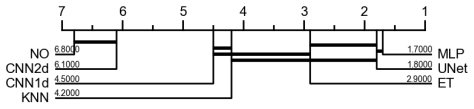
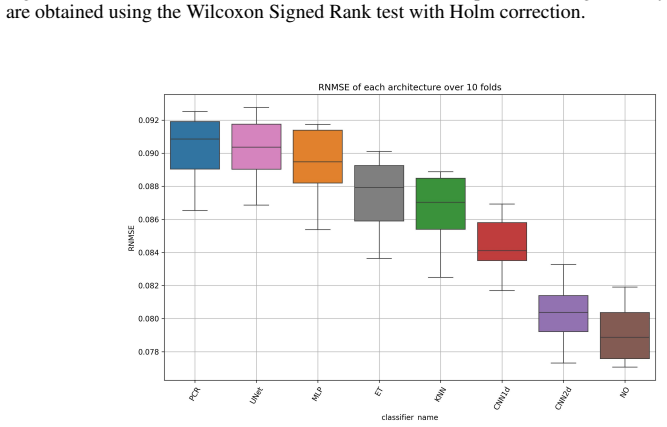
The Deep Finite Difference framework is instantiated for two-dimensional anisotropic acoustic wave propagation by pairing a fourth-order Finite Difference proxy with a Pseudo-Spectral reference over 27,000 heterogeneous velocity fields and benchmarking twelve correction architectures from linear regression to Fourier Neural Operators under a unified 10-fold cross-validation protocol.
What carries the argument
The Deep Finite Difference framework, which trains an auxiliary operator to map the output of a low-order finite difference solver onto a higher-accuracy reference solution.
If this is right
- Direct performance numbers become available for linear, convolutional, and Fourier-based correctors on the same acoustic data.
- The same protocol can now be reused for other wave types or dimensions without redesigning the evaluation pipeline.
- Correction quality can be measured separately on heterogeneous versus homogeneous velocity fields.
- The ranking of architectures indicates which model families are worth further architectural refinement for wave problems.
Where Pith is reading between the lines
- If the top-ranked operators generalize, production codes could replace high-order stencils with a cheap low-order step plus a learned post-correction layer.
- The benchmark setup supplies a ready-made test bed for any new operator-learning method that claims to handle wave physics.
- Failure of all twelve operators on certain velocity models would highlight the need for physics-informed constraints rather than purely data-driven corrections.
Load-bearing premise
The pseudo-spectral solutions serve as an error-free ground truth for every velocity field in the test set.
What would settle it
A side-by-side check on a simple homogeneous anisotropic medium where both the finite difference and pseudo-spectral results can be compared against an exact analytic solution, revealing systematic deviation in the pseudo-spectral output.
Figures

read the original abstract
Correcting numerical dispersion artifacts from Finite Difference solvers is a well-identified challenge in computational wave physics, but existing approaches evaluate only a restricted family of CNN-based architectures and have been applied exclusively to the elastic wave equation. We instantiate the Deep Finite Difference framework on two-dimensional anisotropic acoustic wave propagation, pairing a fourth-order Finite Difference proxy with a Pseudo-Spectral reference over 27,000 heterogeneous velocity fields. We benchmark twelve correction architectures, from linear regression to Fourier Neural Operators, under a unified 10-fold cross-validation protocol.
Editorial analysis
A structured set of objections, weighed in public.
Referee Report
Summary. The manuscript evaluates twelve correction architectures (linear regression through Fourier Neural Operators) for mitigating numerical dispersion in fourth-order finite-difference simulations of two-dimensional anisotropic acoustic wave propagation. It instantiates the Deep Finite Difference framework, pairs the FD proxy with a pseudo-spectral reference solution, and reports results over 27,000 heterogeneous velocity fields under a unified 10-fold cross-validation protocol.
Significance. If the reported benchmarks hold, the work supplies a systematic, large-scale comparison of correction operators that extends prior CNN-only studies and moves the application domain from elastic to anisotropic acoustic waves. The scale of the dataset and the standardized evaluation protocol constitute a useful reference point for the community.
minor comments (3)
- [Abstract] Abstract: the claim that the protocol is 'unified' would be strengthened by an explicit statement of the loss function, the precise definition of the correction operator output, and the error metric(s) used to rank the twelve architectures.
- The manuscript should clarify whether the pseudo-spectral reference is treated as exact ground truth or whether its own dispersion and aliasing errors are quantified and propagated into the reported correction performance.
- A summary table listing the twelve architectures together with their parameter counts, training times, and cross-validation error statistics would improve readability and allow direct comparison.
Simulated Author's Rebuttal
We thank the referee for the positive assessment of the manuscript, the recognition of its scale and standardized protocol, and the recommendation for minor revision. No major comments were raised in the report.
Circularity Check
No significant circularity
full rationale
The paper describes an empirical benchmarking protocol that pairs a fourth-order finite-difference proxy with an independent pseudo-spectral reference solution across 27,000 velocity fields under 10-fold cross-validation. No derivation chain, fitted parameter renamed as prediction, or self-citation load-bearing step is present in the abstract or described framework instantiation. The central claim is a comparative evaluation of correction architectures, which remains self-contained against external benchmarks.
Axiom & Free-Parameter Ledger
axioms (1)
- domain assumption Pseudo-Spectral method serves as accurate reference solution for finite difference correction
Reference graph
Works this paper leans on
-
[1]
Advances in Neural Information Processing Systems 32 , editor =
PyTorch: An Imperative Style, High-Performance Deep Learning Library , author =. Advances in Neural Information Processing Systems 32 , editor =. 2019 , publisher =
2019
-
[2]
and Varoquaux, G
Pedregosa, F. and Varoquaux, G. and Gramfort, A. and Michel, V. and Thirion, B. and Grisel, O. and Blondel, M. and Prettenhofer, P. and Weiss, R. and Dubourg, V. and Vanderplas, J. and Passos, A. and Cournapeau, D. and Brucher, M. and Perrot, M. and Duchesnay, E. , journal=. Scikit-learn: Machine Learning in
-
[3]
Geophysical Journal International , author =
Deep neural. Geophysical Journal International , author =. 2024 , pages =
2024
-
[4]
Journal of the Mechanical Behavior of Biomedical Materials , author =
Physics-informed. Journal of the Mechanical Behavior of Biomedical Materials , author =. 2024 , pages =
2024
-
[5]
IEEE Transactions on Geoscience and Remote Sensing , author =
Seismic. IEEE Transactions on Geoscience and Remote Sensing , author =. 2024 , pages =
2024
-
[6]
2019 , pages =
GEOPHYSICS , author =. 2019 , pages =
2019
-
[7]
Journal of Computational Physics , author =
Wave propagation modeling using machine learning-based finite difference scheme , volume =. Journal of Computational Physics , author =. 2025 , pages =
2025
-
[8]
Franklin Open , author =
Deep. Franklin Open , author =. 2023 , pages =
2023
-
[9]
Geoscience Frontiers , author =
Physics informed machine learning:. Geoscience Frontiers , author =. 2020 , pages =
2020
-
[10]
The Journal of the Acoustical Society of America , author =
Machine learning in acoustics:. The Journal of the Acoustical Society of America , author =. 2019 , pages =
2019
-
[11]
Communications in Nonlinear Science and Numerical Simulation , author =
Deep learning solver for solving advection–diffusion equation in comparison to finite difference methods , volume =. Communications in Nonlinear Science and Numerical Simulation , author =. 2022 , pages =
2022
-
[12]
IEEE Access , author =
Acoustic. IEEE Access , author =. 2025 , pages =
2025
-
[13]
1992 , author =
Finite element simulation of non-linear sound wave propagation , journal =. 1992 , author =
1992
-
[14]
and Jaros, Jiri and Cox, Ben T
Wise, Elliott S. and Jaros, Jiri and Cox, Ben T. and Treeby, Bradley E. , year=. Pseudospectral Time-Domain (PSTD) Methods for the Wave Equation: Realizing Boundary Conditions with Discrete Sine and Cosine Transforms , volume=. Journal of Theoretical and Computational Acoustics , publisher=
-
[15]
2018 , author =
Efficient and accurate numerical simulation of acoustic wave propagation in a 2D heterogeneous media , journal =. 2018 , author =
2018
-
[16]
Alford, R. M. and Kelly, K. R. and Boore, D. M. , title =. Geophysics , volume =. 1974 , month =
1974
-
[17]
Massy , title =
William F. Massy , title =. Journal of the American Statistical Association , volume =. 1965 , publisher =
1965
-
[18]
Statistical Foundations of Machine Learning - The Handbook
Gianluca Bontempi. Statistical Foundations of Machine Learning - The Handbook. 2025
2025
-
[19]
arXiv preprint arXiv:2412.10354 , year =
Jean Kossaifi and Nikola Kovachki and Zongyi Li and David Pitt and Miguel Liu-Schiaffini and Valentin Duruisseaux and Robert Joseph George and Boris Bonev and Kamyar Azizzadenesheli and Julius Berner and Anima Anandkumar , title =. arXiv preprint arXiv:2412.10354 , year =
-
[20]
arXiv preprint arXiv:2512.01421 , year =
Valentin Duruisseaux and Jean Kossaifi and Anima Anandkumar , title =. arXiv preprint arXiv:2512.01421 , year =
-
[21]
JMLR , volume =
Nikola Kovachki and Zongyi Li and Burigede Liu and Kamyar Azizzadenesheli and Kaushik Bhattacharya and Andrew Stuart and Anima Anandkumar , title =. JMLR , volume =
-
[22]
arXiv preprint arXiv:2506.10973 , year =
Julius Berner and Miguel Liu-Schiaffini and Jean Kossaifi and Valentin Duruisseaux and Boris Bonev and Kamyar Azizzadenesheli and Anima Anandkumar , title =. arXiv preprint arXiv:2506.10973 , year =
-
[23]
Second or fourth-order finite difference operators, which one is most effective? , journal =
Owolabi, Kolade , year =. Second or fourth-order finite difference operators, which one is most effective? , journal =
-
[24]
Geophysical Journal International , volume =
Wang, Yanghua , title =. Geophysical Journal International , volume =. 2014 , month =
2014
-
[25]
, title =
Abdi, Hervé and Williams, Lynne J. , title =. WIREs Computational Statistics , volume =
-
[26]
Wiley Interdisciplinary Reviews: Computational Statistics , volume=
Linear regression , author=. Wiley Interdisciplinary Reviews: Computational Statistics , volume=. 2012 , publisher=
2012
-
[27]
Dimensionality reduction with unsupervised nearest neighbors , pages=
K-nearest neighbors , author=. Dimensionality reduction with unsupervised nearest neighbors , pages=. 2013 , publisher=
2013
-
[28]
Test , volume=
A random forest guided tour , author=. Test , volume=. 2016 , publisher=
2016
-
[29]
Wireless Personal Communications , volume=
Development and application of artificial neural network , author=. Wireless Personal Communications , volume=. 2018 , publisher=
2018
-
[30]
National Key Lab for Novel Software Technology
Introduction to convolutional neural networks , author=. National Key Lab for Novel Software Technology. Nanjing University. China , volume=
-
[31]
, author=
Using the Student's" t"-Test with Extremely Small Sample Sizes. , author=. Practical assessment, research & evaluation , volume=. 2013 , publisher=
2013
-
[32]
Nature Reviews Physics , volume=
Physics-informed machine learning , author=. Nature Reviews Physics , volume=. 2021 , publisher=
2021
-
[33]
Machine Learning for Computational Science and Engineering , volume=
When physics meets machine learning: A survey of physics-informed machine learning , author=. Machine Learning for Computational Science and Engineering , volume=. 2025 , publisher=
2025
-
[34]
Physical Review Fluids , volume=
Physics-informed machine learning approach for augmenting turbulence models: A comprehensive framework , author=. Physical Review Fluids , volume=. 2018 , publisher=
2018
-
[35]
Applied Energy , volume=
Physics-informed linear regression is competitive with two Machine Learning methods in residential building MPC , author=. Applied Energy , volume=. 2022 , publisher=
2022
-
[36]
Expert Systems with Applications , volume=
Physics-informed machine learning models for ship speed prediction , author=. Expert Systems with Applications , volume=. 2024 , publisher=
2024
-
[37]
International Conference on Swarm Intelligence , pages=
On mimicking the effects of the reality gap with simulation-only experiments , author=. International Conference on Swarm Intelligence , pages=. 2018 , organization=
2018
-
[38]
2025 , author =
Integrating physics of the problem into data-driven methods to enhance elastic full-waveform inversion with uncertainty quantification , journal =. 2025 , author =
2025
-
[39]
Geophysics , volume =
Gadylshin, Kirill and Vishnevsky, Dmitry and Gadylshina, Ksenia and Lisitsa, Vadim , title =. Geophysics , volume =
-
[40]
, title =
Siahkoohi, Ali and Louboutin, Mathias and Herrmann, Felix J. , title =. Geophysics , volume =
-
[41]
Geophysics , volume =
Ovcharenko, Oleg and others , title =. Geophysics , volume =. 2024 , doi =
2024
-
[42]
2025 , eprint =
Rincon, Miguel and others , title =. 2025 , eprint =
2025
-
[43]
Solver-in-the-Loop: Learning from Differentiable Physics to Interact with Iterative
Um, Kiwon and Brand, Robert and Fei, Yun and Holl, Philipp and Thuerey, Nils , journal =. Solver-in-the-Loop: Learning from Differentiable Physics to Interact with Iterative
-
[44]
International Conference on Learning Representations , year =
Fourier Neural Operator for Parametric Partial Differential Equations , author =. International Conference on Learning Representations , year =
-
[45]
Journal of Computational Physics , volume =
Numerical wave propagation aided by deep learning , author =. Journal of Computational Physics , volume =
-
[46]
Geophysics , year =
Virieux, Jean and Operto, St\'ephane , title =. Geophysics , year =
-
[47]
and Robertsson, Johan O
Blanch, Joakim O. and Robertsson, Johan O. A. and Symes, William W. , title =. Geophysics , year =
-
[48]
Artificial Intelligence in Geosciences , year =
Alkhalifah, Tariq and Wang, Hanchen and Ovcharenko, Oleg , title =. Artificial Intelligence in Geosciences , year =
-
[49]
Tobin, Josh and Fong, Rachel and Ray, Alex and Schneider, Jonas and Zaremba, Wojciech and Abbeel, Pieter , title =. 2017. 2017 , pages =
2017
-
[50]
AMC , volume=
The courant--friedrichs--lewy (cfl) condition , author=. AMC , volume=. 2013 , publisher=
2013
-
[51]
Moczo, Peter and Kristek, Jozef and Halada, Ladislav , title =
-
[52]
Tam, Christopher K. W. and Webb, Jay C. , title =. Journal of Computational Physics , year =
-
[53]
1996 , isbn =
Fornberg, Bengt , title =. 1996 , isbn =
1996
-
[54]
Journal of the Acoustical Society of America , year =
Liu, Qing-Huo and Tao, Jianping , title =. Journal of the Acoustical Society of America , year =
-
[55]
Frontiers in Physics , VOLUME=
Jiang, Tianxi and He, Qingbo , TITLE=. Frontiers in Physics , VOLUME=. 2022 , URL=. doi:10.3389/fphy.2022.1024964 , ISSN=
-
[56]
Machine learning , volume=
Extremely randomized trees , author=. Machine learning , volume=. 2006 , publisher=
2006
-
[57]
Data Mining and Knowledge Discovery , Year =
Deep learning for time series classification: a review , Author =. Data Mining and Knowledge Discovery , Year =
-
[58]
Applied Mathematics Letters , volume=
On analytical solutions of the Black--Scholes equation , author=. Applied Mathematics Letters , volume=. 2009 , publisher=
2009
-
[59]
International Journal of Information Technology and Computer Science , volume=
Performance of machine learning algorithms with different K values in K-fold cross-validation , author=. International Journal of Information Technology and Computer Science , volume=. 2021 , publisher=
2021
discussion (0)
Sign in with ORCID, Apple, or X to comment. Anyone can read and Pith papers without signing in.