Self-Consistent Generative Paths via Admissible Random Variational Transport
Pith reviewed 2026-06-27 17:04 UTC · model grok-4.3
The pith
A generative probability path is self-consistent when it forms a random fixed point of admissible local variational transport corrections.
A machine-rendered reading of the paper's core claim, the machinery that carries it, and where it could break.
Core claim
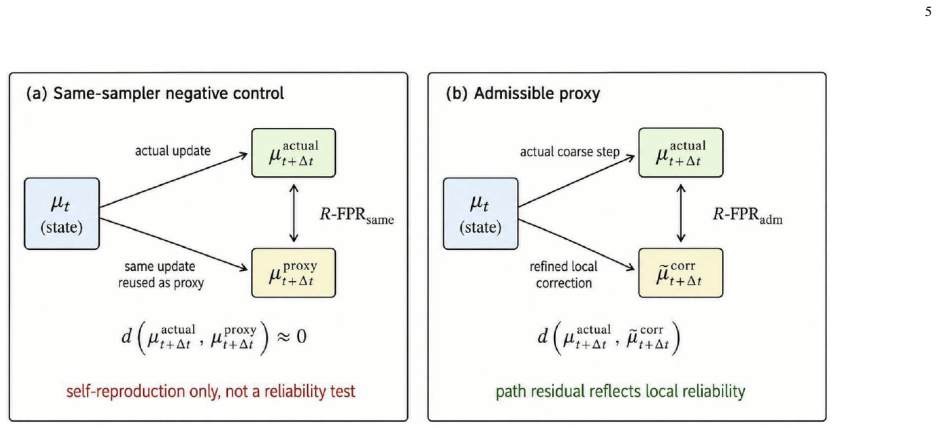
We define a self-consistent generative path as a random fixed point of admissible local variational transport corrections. In this framework, a local correction is specified by a random variational transport operator combining a divergence or geometry term, an energy term, and a structural constraint. The theory yields a random fixed-point path residual (R-FPR), which measures the gap between the actual generated path and an admissible local correction. We prove well-posedness, random fixed-point existence and attraction, non-contractive existence, residual-to-generation error bounds, empirical residual concentration, proxy perturbation bounds, continuous-time limits, and operator-level gene
What carries the argument
The random fixed-point path residual (R-FPR) that quantifies the difference between a generated probability path and the output of an admissible local variational transport correction operator.
If this is right
- Endpoint distribution matching is replaced by explicit path self-consistency testing via the R-FPR.
- Residual control supplies a principle for diagnosing where generative models deviate from admissible corrections.
- Training can be regularized by penalizing the empirical R-FPR rather than only terminal losses.
- Adaptive sampling schedules can be guided by monitoring local residual values along the path.
- The same residual framework applies uniformly to diffusion, flow, one-step, VAE, GAN, and autoregressive generators.
Where Pith is reading between the lines
- The residual could serve as a diagnostic for mode collapse or discretization artifacts that current endpoint metrics miss.
- Model-specific corollaries might yield closed-form R-FPR expressions for common diffusion schedulers, enabling direct comparison of path quality.
- Extending the admissible operators to include causal constraints could link the framework to autoregressive consistency checks.
Load-bearing premise
Admissible local variational transport operators exist and can be specified for the target models by combining a divergence or geometry term, an energy term, and a structural constraint.
What would settle it
Train a diffusion or flow model on a simple dataset, compute the empirical R-FPR along sampled paths at increasing numbers of discretization steps, and check whether the residual fails to decrease toward zero in the continuous-time limit.
Figures



read the original abstract
Modern generative models often define an entire probability path from a simple prior to the data law, rather than only an endpoint map. Diffusion models follow stochastic denoising paths, flow matching learns transport fields, consistency and distillation methods compress paths into one or a few steps, adversarial models match terminal distributions, and VAEs generate through latent kernels. Existing unifying views mainly describe how such paths are constructed. We study a complementary question: when is a generated probability path self-consistent? We define a self-consistent generative path as a random fixed point of admissible local variational transport corrections. In this framework, a local correction is specified by a random variational transport operator combining a divergence or geometry term, an energy term, and a structural constraint. The framework contains random regularized optimal-transport proximal steps as a structured instance, while also allowing non-OT divergences, latent kernels, adversarial constraints, causal discrete kernels, and terminal one-step maps. The theory yields a random fixed-point path residual (R-FPR), which measures the gap between the actual generated path and an admissible local correction. We prove well-posedness, random fixed-point existence and attraction, non-contractive existence, residual-to-generation error bounds, empirical residual concentration, proxy perturbation bounds, continuous-time limits, and operator-level generalization with model-specific corollaries. The resulting theory turns endpoint matching into path self-consistency testing and provides a residual-control principle for diagnosing failures, regularizing training, and guiding adaptive sampling across diffusion, flow, one-step, VAE, GAN/WGAN, and autoregressive generators.
Editorial analysis
A structured set of objections, weighed in public.
Referee Report
Summary. The paper defines a self-consistent generative path as a random fixed point of admissible local variational transport corrections, where each correction combines a divergence/geometry term, energy term, and structural constraint. It introduces the random fixed-point path residual (R-FPR) to measure deviation from such corrections and proves well-posedness, random fixed-point existence/attraction/non-contractivity, residual-to-generation error bounds, empirical concentration, perturbation bounds, continuous-time limits, and operator generalization, with model-specific corollaries for diffusion, flow matching, VAEs, GANs, and autoregressive models. The framework is positioned as containing random regularized OT proximal steps as a special case while extending to non-OT settings.
Significance. If the central claims hold with verifiable operator constructions, the work would supply a residual-control principle that reframes generative modeling around path self-consistency rather than endpoint matching alone, offering a diagnostic and regularization tool applicable across multiple architectures. The explicit inclusion of OT proximal steps and the listed proofs of existence and bounds constitute a coherent theoretical contribution, though its practical reach hinges on whether the admissibility conditions can be instantiated for the named models.
major comments (2)
- [§5] §5 (Model-specific corollaries): No explicit admissible local variational transport operator is constructed for any standard model (e.g., the variance-preserving SDE or a flow-matching vector field). The corollaries therefore rest on the unverified assertion that admissible operators exist by combining the three terms; without these constructions the residual-to-error bounds and attraction results cannot be applied to the models listed in the abstract.
- [§3–4] Theorem statements on random fixed-point existence (likely §3–4): The proofs assume the local correction operator satisfies the admissibility conditions needed for the fixed-point theorems, yet the manuscript provides no verification that any concrete operator for diffusion or flow models meets those conditions. This renders the existence, attraction, and R-FPR bounds formal statements whose hypotheses remain unchecked for the target applications.
minor comments (2)
- [Introduction / §2] Notation for the random variational transport operator is introduced in the abstract but its precise functional form (domain, range, and measurability requirements) should be restated at the beginning of the technical sections for clarity.
- [Continuous-time limits section] The continuous-time limit result would benefit from an explicit statement of the scaling regime under which the discrete R-FPR converges to its continuous counterpart.
Simulated Author's Rebuttal
We thank the referee for the careful reading and for identifying the need for explicit operator constructions to substantiate the model-specific corollaries. We agree that this strengthens the link between the general theory and the listed applications, and we will incorporate the requested material in the revision.
read point-by-point responses
-
Referee: [§5] §5 (Model-specific corollaries): No explicit admissible local variational transport operator is constructed for any standard model (e.g., the variance-preserving SDE or a flow-matching vector field). The corollaries therefore rest on the unverified assertion that admissible operators exist by combining the three terms; without these constructions the residual-to-error bounds and attraction results cannot be applied to the models listed in the abstract.
Authors: We acknowledge that the current §5 sketches how the three-term structure applies to each model class but does not supply fully explicit admissible operators or verify the admissibility conditions for concrete choices (e.g., the variance-preserving SDE drift and diffusion coefficients, or a flow-matching vector field). In the revised manuscript we will add explicit constructions: for the variance-preserving diffusion we define the local correction operator with the KL-divergence term, the energy functional given by the score-matching loss, and the structural constraint enforcing the SDE marginals; analogous explicit operators will be given for flow matching (vector-field geometry term plus terminal matching energy), VAEs (latent-kernel divergence plus reconstruction energy), GANs (adversarial structural constraint), and autoregressive models (causal discrete kernel). Each construction will be shown to satisfy the three admissibility axioms, thereby allowing the residual-to-error bounds and attraction results to be instantiated directly. revision: yes
-
Referee: [§3–4] Theorem statements on random fixed-point existence (likely §3–4): The proofs assume the local correction operator satisfies the admissibility conditions needed for the fixed-point theorems, yet the manuscript provides no verification that any concrete operator for diffusion or flow models meets those conditions. This renders the existence, attraction, and R-FPR bounds formal statements whose hypotheses remain unchecked for the target applications.
Authors: The theorems in §3–4 are correctly stated under the standing admissibility hypotheses; this is the natural level of generality for an abstract fixed-point theory. The manuscript’s claim is that the listed generative models fall inside the framework once admissible operators are chosen. The revision will supply the missing verifications in the expanded §5, after which the existence, attraction, and R-FPR bounds become applicable to the concrete diffusion, flow-matching, VAE, GAN, and autoregressive settings. No change to the general theorems themselves is required. revision: yes
Circularity Check
No circularity; definitional framework with independent mathematical derivations
full rationale
The paper defines self-consistent generative paths as random fixed points of admissible local variational transport operators (combining divergence/geometry, energy, and structural terms) and derives properties including well-posedness, existence, attraction, residual bounds, and model corollaries from this definition using standard fixed-point and transport arguments. No quoted step reduces a claimed result to a fitted input, self-citation chain, or ansatz by construction. The framework explicitly contains OT proximal steps as an instance while allowing others, but the core claims remain independent of any specific model construction. Lack of explicit operator examples for diffusion or flow models is an applicability/verification issue, not a circular reduction in the derivation chain.
Axiom & Free-Parameter Ledger
axioms (1)
- domain assumption Existence of admissible local variational transport operators combining divergence/geometry, energy, and structural constraint terms for the listed model classes
invented entities (1)
-
Random fixed-point path residual (R-FPR)
no independent evidence
Reference graph
Works this paper leans on
-
[1]
Denoising diffusion probabilistic models,
J. Ho, A. Jain, and P. Abbeel, “Denoising diffusion probabilistic models,” inAdvances in Neural Information Processing Systems, 2020
2020
-
[2]
Score-based generative modeling through stochastic differential equations,
Y . Song, J. Sohl-Dickstein, D. P. Kingma, A. Kumar, S. Ermon, and B. Poole, “Score-based generative modeling through stochastic differential equations,” inInternational Conference on Learning Representations, 2021
2021
-
[3]
Flow matching for generative modeling,
Y . Lipman, R. T. Q. Chen, H. Ben-Hamu, M. Nickel, and M. Le, “Flow matching for generative modeling,” inInternational Conference on Learning Representations, 2023
2023
-
[4]
Stochastic Interpolants: A Unifying Framework for Flows and Diffusions
M. S. Albergo, N. M. Boffi, and E. Vanden-Eijnden, “Stochastic in- terpolants: A unifying framework for flows and diffusions,”Journal of Machine Learning Research, 2025; arXiv:2303.08797
work page internal anchor Pith review Pith/arXiv arXiv 2025
-
[5]
Generator matching: Generative modeling with arbitrary Markov processes,
P. Holderrieth, M. Havasi, J. Yim, N. Shaul, I. Gat, T. Jaakkola, B. Karrer, R. T. Q. Chen, and Y . Lipman, “Generator matching: Generative modeling with arbitrary Markov processes,” inInternational Conference on Learning Representations, 2025
2025
-
[6]
Consistency models,
Y . Song, P. Dhariwal, M. Chen, and I. Sutskever, “Consistency models,” inInternational Conference on Machine Learning, 2023
2023
-
[7]
One-step diffusion with distribution matching distillation,
T. Yin, M. Gharbi, R. Zhang, E. Shechtman, F. Durand, W. T. Freeman, and T. Park, “One-step diffusion with distribution matching distillation,” inIEEE/CVF Conference on Computer Vision and Pattern Recognition, 2024
2024
-
[8]
Generative adversarial nets,
I. Goodfellow, J. Pouget-Abadie, M. Mirza, B. Xu, D. Warde-Farley, S. Ozair, A. Courville, and Y . Bengio, “Generative adversarial nets,” in Advances in Neural Information Processing Systems, 2014
2014
-
[9]
Wasserstein generative ad- versarial networks,
M. Arjovsky, S. Chintala, and L. Bottou, “Wasserstein generative ad- versarial networks,” inInternational Conference on Machine Learning, 2017
2017
-
[10]
Auto-Encoding Variational Bayes
D. P. Kingma and M. Welling, “Auto-encoding variational Bayes,” arXiv:1312.6114, 2013
work page internal anchor Pith review Pith/arXiv arXiv 2013
-
[11]
The variational formulation of the Fokker-Planck equation,
R. Jordan, D. Kinderlehrer, and F. Otto, “The variational formulation of the Fokker-Planck equation,”SIAM Journal on Mathematical Analysis, vol. 29, no. 1, pp. 1–17, 1998
1998
-
[12]
Ambrosio, N
L. Ambrosio, N. Gigli, and G. Savare,Gradient Flows in Metric Spaces and in the Space of Probability Measures. Birkhauser, 2005
2005
-
[13]
Villani,Optimal Transport: Old and New
C. Villani,Optimal Transport: Old and New. Springer, 2009
2009
-
[14]
Wasserstein proximal operators describe score-based generative models and resolve memorization,
B. J. Zhang, S. Liu, W. Li, M. A. Katsoulakis, and S. J. Osher, “Wasserstein proximal operators describe score-based generative models and resolve memorization,” arXiv:2402.06162, 2024
-
[15]
Deep equilibrium approaches to diffusion models,
A. Pokle, Z. Geng, and Z. Kolter, “Deep equilibrium approaches to diffusion models,” inAdvances in Neural Information Processing Systems, 2022
2022
-
[16]
Fixed point diffusion models,
X. Bai and L. Melas-Kyriazi, “Fixed point diffusion models,” in IEEE/CVF Conference on Computer Vision and Pattern Recognition, 2024
2024
-
[17]
A fixed- point approach for causal generative modeling,
M. Scetbon, J. Jennings, A. Hilmkil, C. Zhang, and C. Ma, “A fixed- point approach for causal generative modeling,” inInternational Con- ference on Machine Learning, 2024
2024
-
[18]
Arnold,Random Dynamical Systems
L. Arnold,Random Dynamical Systems. Springer, 1998
1998
-
[19]
Random probability measures on Polish spaces,
H. Crauel, “Random probability measures on Polish spaces,”Stochastics and Stochastic Reports, vol. 41, no. 3–4, pp. 153–172, 1992
1992
-
[20]
Sinkhorn distances: Lightspeed computation of optimal transport,
M. Cuturi, “Sinkhorn distances: Lightspeed computation of optimal transport,” inAdvances in Neural Information Processing Systems, 2013
2013
-
[21]
A kernel two-sample test,
A. Gretton, K. Borgwardt, M. Rasch, B. Sch ¨olkopf, and A. Smola, “A kernel two-sample test,”Journal of Machine Learning Research, vol. 13, pp. 723–773, 2012
2012
-
[22]
Flow Straight and Fast: Learning to Generate and Transfer Data with Rectified Flow
X. Liu, C. Gong, and Q. Liu, “Flow straight and fast: Learning to generate and transfer data with rectified flow,” arXiv:2209.03003, 2022
work page internal anchor Pith review Pith/arXiv arXiv 2022
-
[23]
One step diffusion via shortcut models,
K. Frans, D. Hafner, S. Levine, and P. Abbeel, “One step diffusion via shortcut models,” inInternational Conference on Learning Representa- tions, 2025
2025
-
[24]
Mean Flows for One-step Generative Modeling
Z. Geng, M. Deng, X. Bai, J. Z. Kolter, and K. He, “Mean flows for one-step generative modeling,” arXiv:2505.13447, 2025
work page internal anchor Pith review Pith/arXiv arXiv 2025
-
[25]
SANA-Sprint: One-step diffusion with continuous-time consistency distillation,
J. Chen, S. Xue, Y . Zhao, J. Yu, S. Paul, J. Chen, H. Cai, S. Han, and E. Xie, “SANA-Sprint: One-step diffusion with continuous-time consistency distillation,” inIEEE/CVF International Conference on Computer Vision, 2025, pp. 16185–16195
2025
-
[26]
Di[M]O: Distilling masked diffusion models into one-step generator,
Y . Zhu, X. Wang, S. Lathuili`ere, and V . Kalogeiton, “Di[M]O: Distilling masked diffusion models into one-step generator,” inIEEE/CVF Inter- national Conference on Computer Vision, 2025, pp. 18606–18618
2025
-
[27]
FastFlow: Accelerating the generative flow matching models with bandit inference,
D. J. Bajpai, D. Bhardwaj, S. Roy, T. Duseja, H. Agarwal, A. Sandans- ing, and M. K. Hanawal, “FastFlow: Accelerating the generative flow matching models with bandit inference,” arXiv:2602.11105, 2026
-
[28]
Consistency models made easy,
Z. Geng, A. Pokle, W. Luo, J. Lin, and J. Z. Kolter, “Consistency models made easy,” inInternational Conference on Learning Representations, 2025
2025
-
[29]
DPM-Solver: A fast ODE solver for diffusion probabilistic model sampling in around 10 steps,
C. Lu, Y . Zhou, F. Bao, J. Chen, C. Li, and J. Zhu, “DPM-Solver: A fast ODE solver for diffusion probabilistic model sampling in around 10 steps,” inAdvances in Neural Information Processing Systems, 2022
2022
-
[30]
Fast sampling of diffusion models with exponential integrator,
Q. Zhang and Y . Chen, “Fast sampling of diffusion models with exponential integrator,” inInternational Conference on Learning Repre- sentations, 2023
2023
-
[31]
Improving and generalizing flow- based generative models with minibatch optimal transport,
A. Tong, K. Fatras, N. Malkin, G. Huguet, Y . Zhang, J. Rector- Brooks, G. Wolf, and Y . Bengio, “Improving and generalizing flow- based generative models with minibatch optimal transport,”Transactions on Machine Learning Research, 2024
2024
-
[32]
Which training methods for GANs do actually converge?
L. Mescheder, A. Geiger, and S. Nowozin, “Which training methods for GANs do actually converge?” inInternational Conference on Machine Learning, 2018
2018
-
[33]
Y . Zhang, J. Dai, Q. Wu, J. Yang, and L. Luo, “DCNOT: Diffusion- cascaded neural optimal transport for scalable multi-domain image-to- image translation,” inProceedings of the ACM International Conference on Multimedia, 2025, doi: 10.1145/3746027.3754979
-
[34]
Straighten viscous rectified flow via noise optimization,
J. Dai, J. Yan, J. Yang, and L. Luo, “Straighten viscous rectified flow via noise optimization,” inProceedings of the IEEE/CVF International Conference on Computer Vision, 2025, pp. 15005–15014
2025
-
[35]
ERDDCI: Exact reversible diffusion via dual-chain inversion for high-quality image edit- ing,
J. Dai, Y . Zhang, S. Chen, J. Yang, and L. Luo, “ERDDCI: Exact reversible diffusion via dual-chain inversion for high-quality image edit- ing,”IEEE Transactions on Circuits and Systems for Video Technology, 2025, doi: 10.1109/TCSVT.2025.3638406
discussion (0)
Sign in with ORCID, Apple, or X to comment. Anyone can read and Pith papers without signing in.