pith. machine review for the scientific record. sign in

math.FA

Functional Analysis

Banach spaces, function spaces, real functions, integral transforms, theory of distributions, measure theory

0
math.FA 2026-05-13 Recognition

Strongly integrable operator functions generate norm-countably additive measures

Strongly Integrable Operator-Valued Functions, Generated Vector Measures and Compactness of Integrals

The key theorem requires only that X* contain no copy of c0 and yields compactness and spectral-radius results for integrals.

abstract click to expand
Gel'fand integral of a family of compact operators on a Hilbert space is not always compact, even with additional property of positivity and commutativity. We prove that integrals of a family, consisting of compact operators, in the space $L_{s}^1(\Omega,\mu,\mathcal{B}(X, Y))$ of strongly integrable families are compact whenever $X$ does not contain an isomorphic copy of $\ell^1$. In addition, we prove an integral inequality for spectral radius $$r\left(\int_\Omega\mathscr{A} \,d\mu\right)\leqslant\int_\Omega r(\mathscr{A}_t)\,d\mu(t)$$ for a mutually commuting family $\mathscr{A}$ in $L_s^1(\Omega,\mu,\mathcal{B}(X))$, which generalizes a recent result obtained under a stronger assumption of Bochner integrability. We prove also approximation results in $L_s^1(\Omega,\mu,\mathcal{B}(X))$ in the case $X$ has finite dimensional Schauder decomposition. All these results are based on a key theorem of this paper which states that every function in $L_{s}^1(\Omega,\mu, \mathcal{B}(X, Y))$ generates a countably additive, in operator norm, $\mathcal{B}(X, Y)$-valued measure whenever $X^*$ does not contain an isomorphic copy of $c_0$.
0
0
math.FA 2026-05-13 Recognition

ISS open problem resolved via structured maximal regularity

Implications of structured continuous maximal regularity

When spatial norms differ from the supremum norm, estimates improve via weak compactness for abstract systems.

abstract click to expand
We study how maximal regularity estimates with respect to the continuous functions improve automatically in cases where the spatial norm is fundamentally different from the supremum norm. More precisely, we invoke properties such as weak compactness of convolution-type operators related to the mild solutions of the underlying linear evolution equations to sharpen the a priori estimates. These results have several applications: such as a new proof of Guerre-Delabriere's result on $\mathrm{L}^1$-maximal regularity and an extension of Baillon's theorem; a simplification for well-known perturbation theorems for generation of $\mathrm{C}_0$-semigroups; and we resolve an open problem on input-to-state stability from control theory for a general abstract class of systems.
0
0
math.FA 2026-05-13 Recognition

Conditions equate norm attainment and weak continuity for multilinear maps

Norm attainment for multilinear operators and polynomials on Banach Spaces and Banach lattices

Sufficient conditions on Banach spaces make every multilinear operator and polynomial attain its norm if and only if it is weakly sequential

abstract click to expand
We study norm attainment for multilinear operators and homogeneous polynomials between Banach spaces, as well as for positive multilinear operators between Banach lattices. We establish multilinear and polynomial versions of [23, Theorem B] and [35, Theorem 2.12]. More precisely, we provide sufficient conditions on Banach spaces $X_1, \dots, X_n$ and $Y$ ensuring that every $A \in \mathcal{L}(X_1, \dots, X_n; Y)$ (respectively, $P \in \mathcal{P}(^n X_1; Y)$) is weakly sequentially continuous if and only if it attains its norm. We also obtain analogous results for positive $n$-linear operators and positive $n$-homogeneous polynomials in the setting of Banach lattices.
0
0
math.FA 2026-05-13 Recognition

Kannan mappings equate weakest conditions

A comparison of the weakest contractive conditions for Banach and Kannan mappings

Direct proof from fixed points alone for Kannan on complete spaces, counterexample for Banach, equivalence restored on G-complete spaces

abstract click to expand
We study the weakest convergence-type conditions for fixed point results for Banach and Kannan mappings. Building on Suzuki's weakest condition for Banach mappings and our previous result for Kannan mappings, we compare convergence conditions defined along Picard sequences. We give a direct proof that several weakest convergence conditions are equivalent for Kannan-type mappings on complete metric spaces. This proof is achieved without assuming the completeness or the convergence of Picard sequences; it deduces the equivalence only from the existence of fixed points. In contrast, we construct a counterexample showing that the corresponding equivalence fails for Banach contractions. Finally, we prove that this discrepancy disappears on G-complete metric spaces, clarifying the role of completeness in weakest fixed point theory.
0
0
math.FA 2026-05-12 Recognition

Bounded averaging projections hold in nonconvex Lorentz spaces

Boundedness of the averaging projections in nonlocally convex Lorentz sequence spaces and applications to basis theory

They persist for symmetric bases even when local convexity fails, yielding new basis examples.

abstract click to expand
We study the boundedness of averaging projections associated with symmetric Schauder bases in quasi-Banach spaces. Although this property is standard in the Banach setting, it is far from clear in the absence of local convexity and, indeed, fails for a broad class of quasi-Banach spaces with a symmetric basis, including $\ell_p$ for $0<p<1$. Our main result shows that, nevertheless, the canonical basis of an entire class of weighted Lorentz sequence spaces, including the spaces $\ell_{p,q}$ for $0<q<1<p<\infty$, has uniformly bounded averaging projections. Thus, bounded averaging projections do not characterize local convexity among quasi-Banach spaces with symmetric bases. As applications, we obtain new consequences for the structure of special bases. In particular, as a byproduct of our approach, we derive new examples of conditional and almost greedy bases in nonlocally convex spaces.
0
0
math.FA 2026-05-12 2 theorems

Abelian locally von Neumann algebras reduce to direct integral diagonals

Functional Models of Abelian Locally von Neumann Algebras and Direct Integrals of Locally Hilbert Spaces

When indices are sequentially finite and spaces separable, they match the algebra of locally diagonalizable operators on strictly inductive,

abstract click to expand
We obtain a functional model for an arbitrary Abelian locally von Neumann algebra acting on a representing locally Hilbert space under the assumption that the index directed set is countable, in terms of locally essentially bounded functions on strictly inductive systems of measure spaces, which can be viewed as the reduction theory of this kind of operator algebras. Then, we single out the concept of a direct integral of locally Hilbert spaces and the concepts of locally decomposable and locally diagonlisable operators and we show that these form locally von Neumann algebras that are commutant one to each other. Finally, we show that any Abelian locally von Neumann algebra, which acts on separable representing locally Hilbert spaces and such that the index set is a sequentially finite directed set, is spatially isomorphic with the Abelian locally von Neumann algebra of all locally diagonlisable operators on a certain direct integral of locally Hilbert spaces with respect to a certain strictly inductive system of locally finite measure spaces on standard Borel spaces.
0
0
math.FA 2026-05-12 2 theorems

Strip measures with pure-point spectra grow exponentially

Some properties of Fourier quasicrystals and measures on a strip

Squared Fourier coefficients exhibit exponential growth; the spectrum itself does under a local linear-independence condition on frequencies

abstract click to expand
In our paper we extend some results of the theory of Fourier quasicrystals on the real line to a horizontal strip of finite width. For measures in a strip we use a natural generalization of the usual Fourier transform for measures on the line. We consider positive or translation bounded measures $\mu$ on a strip whose Fourier transform is a pure point measure $\hat\mu=\sum_{\gamma\in\Gamma}b_\gamma\delta_\gamma$ (as usual, $\delta_\gamma$ is the unit mass at the point $\gamma$). We prove that the measure $\nu=\sum_{\gamma\in\Gamma}|b_\gamma|^2\delta_\gamma$ has the exponential growth. Moreover, if for some $\eta>0$ the points of $\Gamma$ in every interval of length $\eta$ are linearly independent over integers, then the measure $\hat\mu$ also has the exponential growth.
0
0
math.FA 2026-05-12 Recognition

Equivariant subhomogeneous C* bundles are pullbacks from compact spaces

Obstructed subhomogeneous-bundle extensions and embeddings

Finite-type ones on normal spaces are locally trivial vector bundles or arise from universal compactifications or maps to smooth manifolds

abstract click to expand
We address a number of problems concerning the (im)possibility of either extending locally trivial subbundles of possibly singular Banach/$C^*$ bundles globally, embedding subhomogeneous bundles into homogeneous ones, or recovering locally trivial compact-Lie-group-equivariant Banach or $C^*$ bundles as pullbacks along equivariant maps to compact spaces. The results include (1) the global extensibility of a locally trivial Banach/Hilbert/Banach-algebra/$C^*$ subbundle from a closed subspace of a paracompact space given appropriate homotopy constraints; (2) the homogeneous embeddability of equivariant subhomogeneous Banach/Hilbert bundles locally trivial along the singular locus under the same homotopy constraints, and (3) the characterization of finite-type equivariant locally trivial subhomogeneous $C^*$ bundles on normal spaces as precisely those (a) locally trivial as plain vector bundles, or (b) pulled back from the universal equivariant compactification or (c) pulled back from an equivariant map into a smooth manifold. The latter extends results of Phillips concerning non-equivariant matrix-algebra bundles restricted along the Stone\v{C}ech compactification.
0
0
math.FA 2026-05-11 2 theorems

Extension principles build nonuniform wavelet frames on non-Archimedean fields

Construction of Nonuniform Wavelet Frames on Non-Archimedean Fields

Spectral-pair techniques from the reals adapt to fields of positive characteristic, supplying frames with custom dilations and translations.

abstract click to expand
A constructive algorithm based on the theory of spectral pairs for constructing nonuniform wavelet basis in $L^2(\mathbb R)$ was considered by Gabardo and Nashed (J Funct. Anal. 158:209-241, 1998). In this setting, the associated translation set $\Lambda =\left\{ 0,r/N\right\}+2\,\mathbb Z$ is no longer a discrete subgroup of $\mathbb R$ but a spectrum associated with a certain one-dimensional spectral pair and the associated dilation is an even positive integer related to the given spectral pair. The main objective of this paper is to develop oblique and unitary extension principles for the construction nonuniform wavelet frames over non-Archimedean Local fields of positive characteristic. An example and some potential applications are also presented.
0
0
math.FA 2026-05-11 2 theorems

Hypoelliptic negative powers obey Weyl asymptotics on graded groups

Weyl asymptotic formulas in the nilpotent Lie group setting

The leading term is fixed by the volume of the unit ball in the principal symbol, extending the formula to variable coefficients.

abstract click to expand
The asymptotic properties of negative order pseudo-differential operators have been an important part of the spectral theory since H.Weyl's classical results. In this paper, we derive a spectral asymptotic formula for the negative fractional powers of hypoelliptic operators on graded Lie groups. Such operators have anisotropically homogeneous principal symbols; for these, our results generalize known results of Birman and Solomyak from 1977. Additionally, our work implies a version of Connes' integration formula for hypoelliptic operators on graded Lie groups. Our methods allow us to extend results from constant-coefficient operators to those with smoothly varying coefficients. The principal technique is to adapt the singular value perturbation arguments of Birman and Solomyak to the setting of nilpotent Lie groups. The decomposing of graded Lie groups is inspired by Folland and Stein in their development of harmonic analysis on homogeneous groups.
0
0
math.FA 2026-05-11 Recognition

Banach space is UMD iff tangent processes obey tail bound

Characterizations of the UMD property via tail estimates for tangent processes

The equivalence supplies a probabilistic test that works in discrete, continuous, and jump-time settings.

abstract click to expand
We characterize the UMD property of a Banach space by tail inequalities for maximal functions of tangent conditionally symmetric processes. More precisely, we prove that a Banach space $V$ is UMD if and only if for some (equivalently, for all) $p\in(0,\infty)$ one has that \[ \mathbb P(\sup_{r\geq 0} \| N_r\|>t)\lesssim_{p,V}\Bigl(\frac{s^p}{t^p}+\mathbb P(\sup_{r\geq 0} \| M_r\|>s)\Bigr), \qquad s,t>0, \] for all tangent conditionally symmetric $V$-valued processes $M$ and $N$. We further show that this estimate is equivalent to suitable Lorentz norm inequalities for the associated maximal functions, and obtain analogous characterizations in the discrete-time, continuous-time, and purely discontinuous settings.
0
0
math.FA 2026-05-11 2 theorems

Rank-attaining atomic measures solve moment problem on Weierstrass cubics

A constructive approach to the truncated moment problem on cubic curves in Weierstrass form

The construction gives explicit solutions for smooth curves with one real point at infinity and handles symmetric moments separately.

abstract click to expand
In this paper, we develop a constructive solution for the pure truncated moment problem on cubic curves in Weierstrass form, establishing the existence of a representing measure whose number of atoms equals the rank of the associated moment matrix. By a recent result of Baldi, Blekherman, and Sinn, for projectively smooth curves whose projective closure has exactly one real point at infinity, the existence of such a rank-attaining atomic measure is equivalent to the existence of a representing measure; consequently, the TMP is constructively solved for this class of curves. We also present a numerical degree--$6$ example in which every minimal representing measure supported on the cubic curve requires $\operatorname{rank} M(3)+1$ atoms, where $M(3)$ denotes the moment matrix. Finally, we provide a constructive solution for the symmetric case, i.e., when all moments of odd degree in $y$ vanish.
0
0
math.FA 2026-05-11 Recognition

Chirp conjugation transfers Littlewood-Paley theory to FrFT

Recent progress of Littlewood-paley Theory with chirp function

For fixed non-multiple-of-pi angles, FrFT operators inherit classical square-function and multiplier bounds after one symbol rescaling.

abstract click to expand
Littlewood--Paley theory is a fundamental tool for frequency localization, square-function control, and multiplier analysis, yet a systematic counterpart in the fractional Fourier transform (FrFT) setting has remained incomplete. We develop a unified FrFT Littlewood--Paley framework based on the observation that, for a fixed $\alpha\notin\pi\mathbb Z$, a broad class of FrFT-side operators are exact chirp conjugates of their classical Fourier counterparts through $$ M_{\alpha}f(x)=e^{i\pi |x|^2\cot\alpha}f(x). $$ Within this unified framework we present: the FrFT multiplier identity; Littlewood--Paley square-function estimates and the converse theorem; sharp dyadic interval decompositions; Marcinkiewicz and Mihlin--H"ormander multiplier results; maximal, rough square-function, and almost-orthogonality estimates; twisted dyadic martingale geometry; inhomogeneous Sobolev, Besov, and Triebel--Lizorkin descriptions; Calder\'on reproducing formulae; pullback spaces and FrFT Riesz--Bessel operators; BMO, Carleson, sharp-maximal, and Hardy-space; twisted product estimates, multilinear bounds, and a Kato--Ponce theorem; fractional order-shifting in Lipschitz spaces; and the classical limit and singular boundary laws for the fractional parameter. The recurring theme is that a large class of FrFT operators are exact chirp conjugates of their classical counterparts, so most estimates are inherited with the same constants after one time identification of the rescaled symbols.
0
0
math.FA 2026-05-11 2 theorems

Chirp conjugation transfers FrFT Littlewood-Paley estimates unchanged

Recent progress of Littlewood-paley Theory with chirp function

For any fixed α outside integer multiples of π, classical Fourier bounds on multipliers and square functions carry over directly after one M

abstract click to expand
Littlewood--Paley theory is a fundamental tool for frequency localization, square-function control, and multiplier analysis, yet a systematic counterpart in the fractional Fourier transform (FrFT) setting has remained incomplete. We develop a unified FrFT Littlewood--Paley framework based on the observation that, for a fixed $\alpha\notin\pi\mathbb Z$, a broad class of FrFT-side operators are exact chirp conjugates of their classical Fourier counterparts through $$ M_{\alpha}f(x)=e^{i\pi |x|^2\cot\alpha}f(x). $$ Within this unified framework we present: the FrFT multiplier identity; Littlewood--Paley square-function estimates and the converse theorem; sharp dyadic interval decompositions; Marcinkiewicz and Mihlin--H"ormander multiplier results; maximal, rough square-function, and almost-orthogonality estimates; twisted dyadic martingale geometry; inhomogeneous Sobolev, Besov, and Triebel--Lizorkin descriptions; Calder\'on reproducing formulae; pullback spaces and FrFT Riesz--Bessel operators; BMO, Carleson, sharp-maximal, and Hardy-space; twisted product estimates, multilinear bounds, and a Kato--Ponce theorem; fractional order-shifting in Lipschitz spaces; and the classical limit and singular boundary laws for the fractional parameter. The recurring theme is that a large class of FrFT operators are exact chirp conjugates of their classical counterparts, so most estimates are inherited with the same constants after one time identification of the rescaled symbols.
0
0
math.FA 2026-05-11 1 theorem

Finite point evaluations reconstruct convex Lipschitz functionals

Structure-Preserving Reconstruction of Convex Lipschitz Functionals on Hilbert Spaces from Finite Samples

An explicit formula based on linear measurements achieves arbitrary uniform accuracy while preserving convexity and Lipschitz regularity

Figure from the paper full image
abstract click to expand
Convex functionals are ubiquitous in applied analysis, appearing as value functions, risk measures, super-hedging prices, and loss functionals in machine learning. In many applications, however, the functional is only observed through finitely many exact pointwise evaluations. We ask whether a convex functional on a separable Hilbert space $H$ can be reconstructed, up to arbitrary uniform accuracy, by an explicit formula which preserves convexity and Lipschitz regularity and is finitely computable. We answer this affirmatively. For every compact convex $C\subseteq H$, every $L$-Lipschitz convex functional $\rho:C\to\mathbb{R}$, and every $\varepsilon>0$, we construct an explicit finite-sample reconstruction which is convex, $L$-Lipschitz, and uniformly $\varepsilon$-accurate on $C$. The construction uses only finitely many linear measurements $\langle b,\cdot\rangle_H$, with $b$ lying in a finite-dimensional subspace of $H$, and is exactly implementable by a $\operatorname{ReLU}$-MLP. Building on this, we introduce convex neural functionals (CNFs), a structured trainable architecture class containing our reconstruction, whose every admissible parameter configuration is automatically convex and Lipschitz, providing a principled foundation for learning convex functionals from finite data.
0
0
math.FA 2026-05-11 Recognition

Weights characterized for variable fractional maximal operator

Characterization of weights for the variable fractional maximal operator and weighted inequalities for variable fractional rough operators

Boundedness on variable Lebesgue spaces requires an adapted Muckenhoupt condition that extends fixed-parameter cases.

abstract click to expand
We characterize the class of weights related to the boundedness of variable fractional maximal operator $M_{\beta(\cdot),r(\cdot)}$ on variable Lebesgue spaces. This extend previously known results, including those corresponding to the fractional operator $M_{\beta(\cdot),1}$. In addition, we introduce a class of kernels $K$ satisfying a new variable H\"ormander-type condition $H_{\beta(\cdot),r(\cdot)}$. For the fractional operator $T_{\beta(\cdot)}$ given by a kernel in $H_{\beta(\cdot),r(\cdot)}$, we prove a Coifman-Fefferman inequality and weighted inequalities in variable Lebesgue space. Finally, we provide examples of kernels in this variable H\"ormander class.
0
0
math.FA 2026-05-11 Recognition

Unique recovery from phaseless STLCT holds for Gaussian shift-invariant signals

Stable phase retrieval from short-time linear canonical transforms of signals in Gaussian shift-invariant spaces

Stability constant depends on anchor spacing, not interval length, and an explicit formula supports robust noisy reconstruction.

Figure from the paper full image
abstract click to expand
Gabor phase retrieval for signals has attracted considerable attention in recent years. For the more general short-time linear canonical transform (STLCT), which arises naturally in optical systems and canonical time--frequency analysis, existing work has so far focused mainly on uniqueness and sampling conditions. Explicit reconstruction formulas, quantitative stability estimates, and robust reconstruction algorithms, however, are still missing. In this paper, we study uniqueness, stability, and robust reconstruction for phase retrieval from phaseless STLCT measurements in the complex Gaussian shift-invariant space $V_\beta^\infty(\varphi)$. We first prove that every signal in $V_\beta^\infty(\varphi)$ is uniquely determined, up to a global unimodular constant, by its phaseless STLCT measurements on the semi-discrete set $\frac{\beta}{2}\mathbb Z\times\mathbb R$, and we derive an explicit reconstruction formula. We then establish stability on intervals under an anchor-point condition, showing that the stability constant is governed by the maximal spacing between adjacent anchor points rather than by the radius of the whole interval. This prevents exponential deterioration with respect to the interval size. Motivated by the practical setting in which only finitely many discrete noisy magnitude samples are available, we further develop an explicit reconstruction algorithm with quantitative robustness guarantees, where the reconstruction error is controlled by the discretization parameters, the noise level, and the conditioning induced by the anchor points. In the Fourier case, our results recover the corresponding Gabor phase retrieval results of Grohs and Liehr and provide improved stability constants.
0
0
math.FA 2026-05-11 2 theorems

Schur patterns mark which compact-operator ideals fail submajorisation closure

Schur bounded patterns and submajorisation

The patterns give a two-way test that isolates the non-closed ideals, including all Schatten C_p for p between 0 and 1.

abstract click to expand
We characterise the Schur bounded patterns of ideals of compact operators that are not closed under submajorisation, in particular the Schatten ideals $\mathcal{C}_p$ with $0<p<1.$ Conversely we characterise the ideals that are not closed under submajorisation by their Schur bounded patterns.
0
0
math.FA 2026-05-11 Recognition

Weighted backward shifts admit U-frequent hypercyclic subspaces without frequent vectors

On hypercyclic spaces and (common) mathscr{U}-frequently hypercyclic spaces

If one such subspace exists, a refined version can be built that excludes all frequently hypercyclic vectors; the method also solves an open

abstract click to expand
Let $B$ be an unilateral weighted backward shift on $\ell_p$, $1 \leq p < \infty$, that admits a $\mathscr{U}$-frequently hypercyclic subspace. We prove that $B$ admits such a subspace free of frequently hypercyclic vectors. The proof technique we develop also allows us to prove that $B$ admits a hypercyclic subspace free of $\mathscr{U}$-frequently hypercyclic vectors, and to solve a question posed by B\`es and Menet in 2015 on the existence of common $\mathscr{U}$-frequently hypercyclic subspaces.
0
0
math.FA 2026-05-11 Recognition

Weights make composition-differentiation operators posinormal on H²

On posinormality of weighted composition-differentiation operators on H²(mathbb{D})

The unweighted operator fails posinormality, but specific ψ and φ satisfy the necessary conditions obtained via the adjoint.

abstract click to expand
In this article, the posinormality and coposinormality of weighted composition-differentiation operators on Hardy space $H^2(\mathbb{D})$ are investigated. It is observed that while a composition-differentiation operator $D_{\phi,n}$ fails to be posinormal, the weighted composition-differentiation operator $D_{\psi,\phi,n}$ can be posinormal for specific choices of $\psi, \phi$. Some necessary conditions are obtained for posinormality and coposinormality of the operator $D_{\psi,\phi,n}$. Furthermore, the adjoint formula for this operator is derived which also helped us to examine some results regarding posinormality of this operator.
0
0
math.FA 2026-05-11 2 theorems

Octonion isometries hold exactly when bases map to weak ones

Octonionic isometric isomorphisms and partial isometry

Para-linear operators on Hilbert octonionic bimodules satisfy this basis condition if and only if they are isometric isomorphisms, with a

abstract click to expand
Very recently, two new notions of para-linear mappings and weak associative orthonormal bases were introduced in octonionic functional analysis, which have been proved to be powerful in formulating the basic theory, such as the Riesz representation theorem and the Parseval theorem. In this article, we continue exploring more properties of these two concepts and initiate the study of octonionic para-linear isometric operators. Surprisingly, it is proven that the condition of the para-linear operator on a Hilbert octonionic bimodule being an isometric isomorphism is equivalent to it mapping any associative orthonormal basis to a weak associative orthonormal basis, which implies also that an octonionic matrix is an isometry if and only if the system of its row vectors is a weak associative orthonormal basis. Furthermore, we introduce the concept of para-linear partial isometric operators and establish the aforementioned analogue in this new setting. Based on these facts, we can provide naturally a new viewpoint of James questions by modifying the definition of octonionic Stiefel space.
0
0
math.FA 2026-05-11 Recognition

Octonionic Riesz-Dunford calculus defined for power-associative operators

Octonionic Riesz-Dunford functional calculus

New spectra and regularity conditions overcome nonassociativity to unify functional calculus across complex, quaternionic, and octonionical

abstract click to expand
The Riesz-Dunford functional calculus over the algebra of octonions, denoted by $\mathbb{O}$, has long been an open problem due to the nonassociativity of octonions. Two core obstacles hinder its development: first, the generalization of the resolvent operator series identity produces unexpected associator terms that invalidate standard expansions; second, the nonassociativity spoils the analyticity of the resolvent operator, a key property for defining a functional calculus via Cauchy integrals. In this paper, we initiate the study of the Riesz-Dunford functional calculus for bounded power-associative para-linear operators in Banach octonionic bimodules. To address the above issues, we introduce several pivotal concepts: power-associative operators (to eliminate the unwanted associator terms and recover valid resolvent series expansions), the notions of regular inverse of $R_s-T$ for $s\in \O$ (which serve as the octonionic versions of the resolvent operator), $\mathbb{C}_J$-extendable power-associative operators, and $\mathbb{C}_J$-liftable power-associative operators (to characterize the slice regularity of the resolvent operators). Based on these notions, we define two types of octonionic spectra: the pull-back spectrum $\sigma^*(T)$ and the push-forward spectrum $\sigma_*(T)$. These give rise to the left and right slice regular functional calculi of bounded power-associative para-linear operators, respectively. This theory unifies the Riesz-Dunford functional calculus over division algebras ($ \mathbb{C}, \mathbb{H}, \mathbb{O}$) and fills the six-decade-long gap in octonionic (nonassociative) functional analysis.
0
0
math.FA 2026-05-08

ℓ₁, ℓ∞, c spheres show expand-contract plasticity

On the plasticity of the unit spheres of ell₁, ell_{infty}, c, and Hilbert spaces

Hilbert space spheres possess strong plasticity, distinguishing their geometric flexibility from the sequence spaces.

abstract click to expand
This paper demonstrates the expand-contract plasticity of the unit spheres of $\ell_1$, $\ell_{\infty}$, and $c$. Furthermore, it establishes the strong plasticity of the unit spheres of Hilbert spaces.
0
0
math.FA 2026-05-08

Probabilistic criterion gives common frequently hypercyclic vectors for shift families

Common frequently hypercyclic random vectors

A general existence result shows when countable families of weighted backward shifts on ell_p share a vector whose orbits are dense with pos

abstract click to expand
We study common frequently hypercyclic vectors for countable families of weighted backward shifts acting on $\ell_p$ spaces, $1\leq p<\infty$. Using probabilistic techniques, we develop a general existence criterion, complemented by a non-existence result. These insights are then applied to the specific setting of countable families of polynomials of weighted backward shifts, providing conditions under which they share a common frequently hypercyclic vector.
0
0
math.FA 2026-05-08

Positive Lindenstrauss problem settles open Lipschitz questions

Implications of an affirmative solution to the Lindenstrauss Problem

If every Banach space is a Lipschitz retract of its bidual, several other unresolved questions in the Lipschitz geometry of Banach spaces of

abstract click to expand
The question regarding the location of Banach spaces inside their biduals has been investigated and answered reasonably satisfactorily in the linear theory of Banach spaces. Thus, for instance, whereas it is known that a dual Banach space is complemented inside its bidual, the space of all null sequences is not! However, the latter space is a Lipschitz retract of its bidual. In his famous paper of 1964, Lindenstrauss asked if every Banach space is a Lipschitz retract of its bidual. In this short note, we show how to relate the Lindenstrauss problem (LP) to certain other important and well-known questions that remain open in the Lipschitz theory of Banach spaces and how these latter questions may be settled in the affirmative under the assumption of (LP) having a positive solution.
0
0
math.FA 2026-05-07

Derivatives describe order monotonicity in Banach spaces

Differentiation and Ordered Optimization in Banach Spaces

Gateaux and Frechet derivatives of mappings on partially ordered spaces determine monotonicity and connect to ordered extrema.

abstract click to expand
In this paper, we will define generalized critical point, ordered extreme and order monotone property of single-valued mappings in partially ordered Banach spaces. In particular, we will find the explicit formulas of Gateaux and Frechet derivatives of some single-valued mappings on the Banach spaces lp, for and C[0, 1], such as polynomial type operators and trigonometric type operators. By these concepts, we will investigate the connection between generalized critical points and ordered extrema of single-valued mappings in partially ordered Banach spaces that extends the connection between critical points and extrema of real valued functions in calculus. We will prove that in partially ordered Banach spaces, the order monotone of single-valued mappings can be described by its Gateaux derivatives or Frechet derivatives.
0
0
math.FA 2026-05-07

Multiplicative spectral maps on Banach algebras are point evaluations

Multiplicative spectral functions on some Banach function algebras

On C(X), Lipschitz spaces, absolutely continuous functions and C1 functions, any such map equals evaluation at a single point.

abstract click to expand
In this paper, we study multiplicative functions $\varphi \colon A \to \Bbb C$ on a natural Banach function algebra $A$ on a compact Hausdorff space $X$, such that $\varphi(f)\in \sigma(f)$ for all $f\in A$. It is shown that for certain natural Banach function algebras $A$, either $\ker(\varphi)$ is a maximal ideal of $A$ or $1\in {\rm span}({\rm ker}(\varphi))$ (that is $1=f_1+f_2+\cdots f_n$ for some $f_1,..., f_n \in {\rm ker}(\varphi)$). Then we investigate for the linearity of $\varphi$ in either of cases that $\varphi$ is continuous or $1\notin {\rm span}({\rm ker}(\varphi)$. We show that, for some natural Banach function algebras $A$, in either of these cases, there exists a point $x_0\in X$ such that $\varphi(f)=f(x_0)$ for some family of functions $f\in A$ (including those functions $f\in A$ that $\overline{f}\in A$). In particular, such a multiplicative spectral function on some Banach algebras including $C(X)$, Lipschitz algebras, Banach algebras of absolutely continuous functions on $[0,1]$ and $C^1([0,1])$ is linear and hence it is a character.
0
0
math.FA 2026-05-07

Random contractions on stable sets yield unique fixed points

Random Fixed Point Theorems for Relaxed Asymptotic Contractions in Random Normed Modules

Iteration bounds converging almost surely to a Boyd-Wong function ensure a unique random fixed point and convergent iterates.

abstract click to expand
We introduce the notion of a random relaxed asymptotic contraction in the setting of random normed modules. The contraction condition employs two quasi-metrics that are built directly from the random operator: a lower quasi-metric which adaptively switches between a four-point minimum and the ordinary one-step distance, and an upper quasi-metric which takes the maximum of four fundamental distances. The bounds are allowed to depend on the iteration index and are required to converge locally uniformly almost surely to a Boyd--Wong function. Using the fibre decomposition method based on \(\sigma\)-stability and the local property, we show that any such mapping defined on an essentially bounded, \(\sigma\)-stable and \(L^0\)-closed set admits a unique random fixed point, and all iterates converge in the \((\epsilon,\lambda)\)-topology. Our result strictly generalizes the random analogue of Kirk's asymptotic contraction theorem and unifies several deterministic and random fixed point theorems under a single flexible framework.
0
0
math.FA 2026-05-07

Local scalar moments determine operator moment problems on R

The Local Operator Moment Problem on mathbb{R}

Necessary and sufficient conditions based on inner products with single vectors solve the full operator problem and hold automatically onコンパ

abstract click to expand
We study the connections between operator moment sequences ${\mathcal T}=\displaystyle(T_n)_{n\in\mathbb{Z}_+}$ of self-adjoint operators on a complex Hilbert space $\mathcal{H}$ and the local moment sequences $\langle{\mathcal T}x,x\rangle = (\langle T_nx,x\rangle)_{n\in\mathbb{Z}_+}$ for arbitrary $x\in \mathcal{H}$. We provide necessary and sufficient conditions for solving the operator moment problem on $\mathbb{R}$, and we show that these criteria are automatically valid on compact subsets of $\mathbb{R}$. Applications of the compact case are used to study subnormal operator weighted shifts. A Stampfli-type propagation theorem for subnormal operator weighted shifts is also established. In addition, we discuss the validity of Tchakaloff's Theorem for operator moment sequences with compact support. In the case of a recursively generated sequence of self-adjoint operators, necessary and sufficient conditions for an affirmative answer to the operator recursive moment problem are provided, and the support of the associated representing operator-valued measure is described.
0
0
math.FA 2026-05-07 2 theorems

Operator moments on R solved by local scalar moment checks

The Local Operator Moment Problem on mathbb{R}

Necessary and sufficient conditions hold automatically on compact sets and apply to subnormal operator weighted shifts.

abstract click to expand
We study the connections between operator moment sequences ${\mathcal T}=\displaystyle(T_n)_{n\in\mathbb{Z}_+}$ of self-adjoint operators on a complex Hilbert space $\mathcal{H}$ and the local moment sequences $\langle{\mathcal T}x,x\rangle = (\langle T_nx,x\rangle)_{n\in\mathbb{Z}_+}$ for arbitrary $x\in \mathcal{H}$. We provide necessary and sufficient conditions for solving the operator moment problem on $\mathbb{R}$, and we show that these criteria are automatically valid on compact subsets of $\mathbb{R}$. Applications of the compact case are used to study subnormal operator weighted shifts. A Stampfli-type propagation theorem for subnormal operator weighted shifts is also established. In addition, we discuss the validity of Tchakaloff's Theorem for operator moment sequences with compact support. In the case of a recursively generated sequence of self-adjoint operators, necessary and sufficient conditions for an affirmative answer to the operator recursive moment problem are provided, and the support of the associated representing operator-valued measure is described.
0
0
math.FA 2026-05-06

Random equal-norm frames nearly Parseval with high probability

Geometric Perspective on Concentration Phenomena in Frame Theory

Geometric concentration bounds also run in the reverse direction and supply a probabilistic upper bound for the Paulsen problem.

Figure from the paper full image
abstract click to expand
Parseval and equal-norm frames play a fundamental role in frame theory and signal processing. In this work, we prove non-asymptotic concentration bounds showing that random equal-norm frames are nearly Parseval with high probability, and that random Parseval frames are nearly equal-norm with high probability. Our proofs are geometric in nature, and rely on general measure concentration principles in Riemannian manifolds. As an application, we obtain a novel probabilistic upper bound for the Paulsen problem.
0
0
math.FA 2026-05-06

Rotational symmetrization maximizes convex function approximations

Generalized outer linearizations and extremal properties of rotational epi-symmetrizations

It outperforms other outer linearizations for any monotone concave functional upper semicontinuous under epi-convergence.

Figure from the paper full image
abstract click to expand
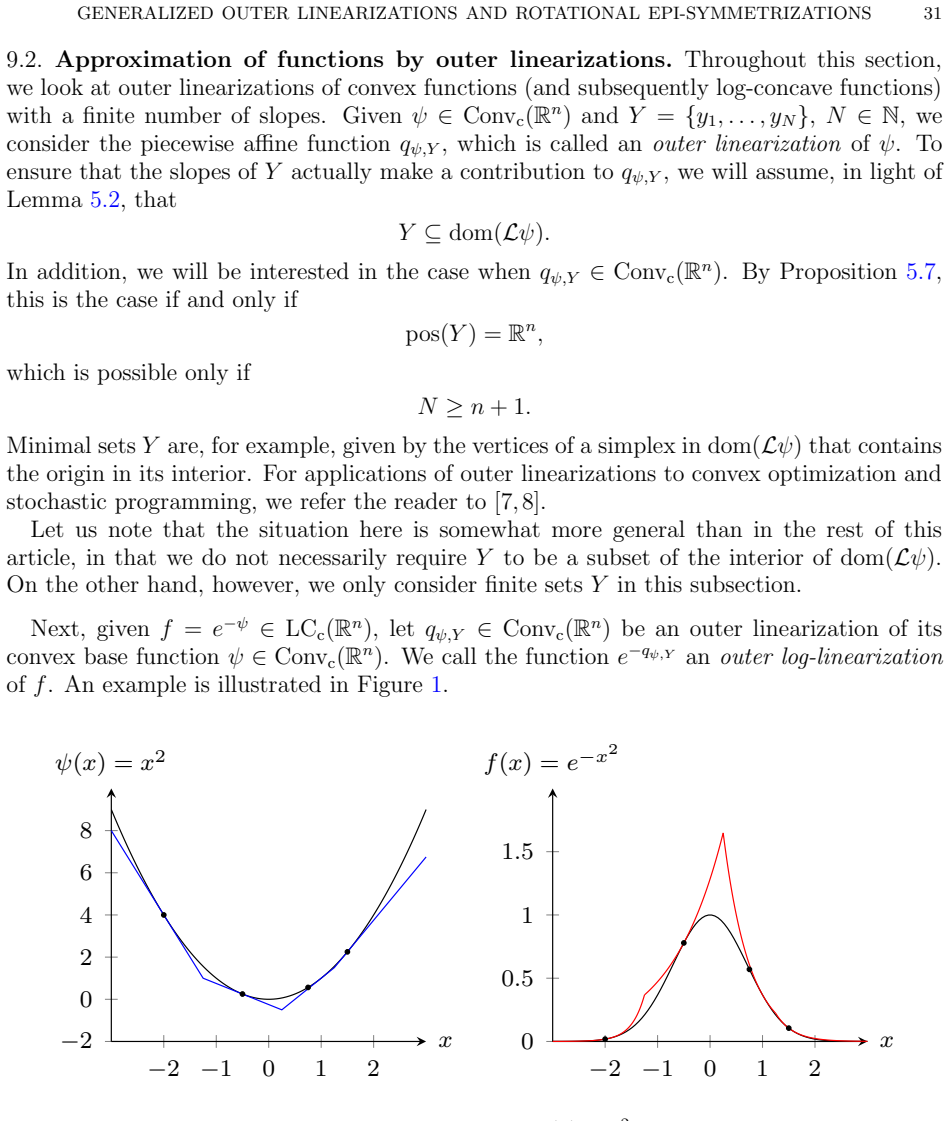
We develop a functional extension of an extremal principle by Schneider (Monatsh. Math., 1967) by introducing generalized outer linearizations of convex functions. Given a coercive convex function on $\mathbb{R}^n$, a generalized outer linearization is defined as a convex minorant represented by a general but function-dependent set of slopes, thereby extending classical outer representations of convex bodies by supporting halfspaces. This representation converts geometric outer approximations by supporting halfspaces into functional approximations by supporting affine functions, and replaces outer normal data by a dual sampling problem in the domain of the Legendre--Fenchel transform. On a standard class of coercive convex functions, we derive a general extremal principle, showing that the rotational epi-symmetrization maximizes best approximations under outer linearizations of any monotone, concave functional that is upper semicontinuous with respect to epi-convergence. A central feature of the analysis is that it is carried out in the natural class of coercive, but not necessarily super-coercive, convex functions. Working in this setting introduces intricate topological and variational difficulties, which are addressed using refined duality and epi-convergence arguments. As an application of our main results, we derive a functional version of Urysohn's inequality, as well as an analytic extension of a classical covering result of Firey and Groemer (J. London Math. Soc., 1964). Finally, we prove an extremal inequality related to the piecewise affine approximation of convex functions.
0
0
math.FA 2026-05-06

Kadison duality extended to regular partially convex sets

Kadison duality for partially convex sets

Compact regular partial convex sets correspond categorically to free order unit modules over C*-algebras.

Figure from the paper full image
abstract click to expand
This paper extends the Kadison duality between compact convex sets and function systems to the setting of partial convexity. A partially convex set is a set that is convex in a designated set of convex variables when the others are held fixed. We introduce the notion of a regular partially convex set and identify its dual as a finitely generated free module over a commutative C*-algebra endowed with a compatible Archimedean order unit structure. We call such spaces free order unit modules. We prove that for any compact regular partially convex set K, the space of continuous functions on K that are affine in the convex variables is the canonical example of such a module. Conversely, we show that the partially convex state space of a free order unit module is a compact regular partially convex set. Our main result establishes a categorical duality between compact regular partially convex sets and free order unit modules. We also establish a Stone-Weierstrass-type theorem, demonstrating that partially affine polynomials are dense in the space of continuous partially affine functions on any compact regular partially convex set. Finally, we prove a Hahn-Banach-type separation theorem of compact partially convex sets from their outer points.
0
0
math.FA 2026-05-06

This paper derives conditions under which bounded zero-free holomorphic functions are…

Cyclicity via weak^ast sequentially cyclicity in Radially weighted Besov spaces

Bounded zero-free holomorphic functions f in radially weighted Besov spaces are cyclic if log f satisfies a condition via weak*…

abstract click to expand
A radially weighted Besov space $H$ is a space of holomorphic functions on the unit ball $\mathbb{B}_d \subseteq \mathbb{C}^d$ whose $N$-th radial derivative is square integrable with respect to a given admissible radial measure. We write $Mult(H)$ for its multiplier algebra. The cyclic vectors in $H$ are those functions $f$ whose multiplier multiples are dense in $H$. We call a multiplier has the complete Pick property. However, in more general radially weighted Besov spaces there may be multipliers that are cyclic, but not weak$^\ast$ sequentially cyclic. For bounded holomorphic functions $f$ with no zeros in $\mathbb{B}_d$, we obtain a condition on $\log f$ that implies the cyclicity of $f$ in $H$ and yields invertibility properties for $1/f$ within an associated Smirnov-type class. This condition is formulated in terms of weak$^\ast$ sequentially cyclic multipliers and can often be verified using a comparison principle: if $f, g \in Mult(H)$ satisfy $|f| \leq |g|$ and if $f$ is weak$^\ast$ sequentially cyclic, then $g$ is also weak$^\ast$ sequentially cyclic. These results provide new insights into cyclicity phenomena in radially weighted Besov spaces in settings, where $H$ fails to be a complete Pick space.
0
0
math.FA 2026-05-05

Contractions in KR metric give unique invariant topological measures

Image transformations, Markov operators, and sample median

Generalized Markov operators on deficient measures extend fractal theory and keep the sample median distribution equivariant under rotations

abstract click to expand
(I.) We consider generalizations of an iterated function system and the associated Markov operators. A Markov operator, defined on the space of (deficient) topological measures on a locally compact space, is an infinite convex linear combination of adjoints of (d-) image transformations. Restricted to measures, this Markov-Feller operator has a nonlinear dual operator given by an infinite convex linear combination of (conic) quasi-homomorphisms. If (d-) image transformations are contractions with respect to the Kantorovich-Rubinstein metric, a Markov operator has the unique invariant (deficient) topological measure. Taking a compact space, finitely many inverses of contractions as image transformations, and restricting the Markov operator to measures gives the classical result from the theory of fractals. There are various relations between Markov operator and the iterated function system where adjoints of (d-) image transformations are contractions on the compact metric space of $\{0,1\}$-valued (deficient) topological measures. For instance, the invariant (deficient) topological measure is the composition of the fixed point of the IFS and the basic (d-) image transformation. (II.) We define a generalized distribution of the sample median (g.d.s.m.) for continuous proper maps using an image transformation. We show that the g.d.s.m. and the inverse on the sample median are equivariant under solid variables, a large collection of transformations. On $\mathbb{R}^n$ such transformations include rotations, translations, symmetries, stretching, projections, monotone maps, etc. (III.) We show that a (signed) topological measure on a locally compact space with the covering dimension $\dim X \le 1$ is a (signed) Radon measure.
0
0
math.FA 2026-05-05

Blaschke products control commutator rank in hyponormal Toeplitz operators

Hyponormal block Toeplitz operators with finite rank self-commutators

The self-commutator has finite rank precisely when a finite Blaschke-Potapov product exists in the set E for the transformed symbol.

abstract click to expand
In this paper, we identify a large class of hyponormal block Toeplitz operators whose self-commutators are of finite rank. \ Recall that an operator $T_\varphi$ is hyponormal and $[T_\varphi^{*}, T_\varphi]$ is a finite rank operator if and only if there exists a finite Blaschke product $b$ in $\mathcal{E}(\varphi)$, where $$ \mathcal{E}(\varphi) := \{k \in H^\infty(\mathbb{T}): \left\|k\right\|_\infty \le 1 \textrm{ and } \varphi-k\cdot \bar{\varphi} \in H^\infty(\mathbb{T})\}. $$ An analogous set $\mathcal{E}(\Phi)$ can be defined for a matrix-valued symbol $\Phi$. \ In the block Toeplitz operator case, we first establish that if a symbol $\Phi$ is in $L^\infty(\mathbb{T}, M_n)$ and if $\mathcal{E}(\Phi)$ contains a constant unitary matrix $U$, then $T_\Phi$ is normal. \ We then obtain a suitable converse, under a mild assumption on the symbol. \ Next, we provide a partial answer to a conjecture recently posed by R.E. Curto, I.S. Hwang, and W.Y. Lee. \ Concretely, assume that $\Phi \in H^{\infty}(\mathbb{T}, M_n)$ is such that $\Phi^{\ast}$ is of bounded type and $T_\Phi$ is hyponormal. \ Then $[T_\Phi^{\ast}, T_\Phi]$ is a finite rank operator if and only if there exists a finite Blaschke-Potapov product in $\mathcal{E}(\widetilde{\Phi})$, where $\widetilde\Phi:=\breve{\Phi}^*$ and $\breve{\Phi}(e^{i\theta}):=\Phi(e^{-i\theta})$.
0
0
math.FA 2026-05-05 1 theorem

Finite Blaschke-Potapov products signal finite-rank self-commutators

Hyponormal block Toeplitz operators with finite rank self-commutators

For analytic matrix symbols whose adjoints are of bounded type, the self-commutator of the hyponormal block Toeplitz operator has finite if

abstract click to expand
In this paper, we identify a large class of hyponormal block Toeplitz operators whose self-commutators are of finite rank. \ Recall that an operator $T_\varphi$ is hyponormal and $[T_\varphi^{*}, T_\varphi]$ is a finite rank operator if and only if there exists a finite Blaschke product $b$ in $\mathcal{E}(\varphi)$, where $$ \mathcal{E}(\varphi) := \{k \in H^\infty(\mathbb{T}): \left\|k\right\|_\infty \le 1 \textrm{ and } \varphi-k\cdot \bar{\varphi} \in H^\infty(\mathbb{T})\}. $$ An analogous set $\mathcal{E}(\Phi)$ can be defined for a matrix-valued symbol $\Phi$. \ In the block Toeplitz operator case, we first establish that if a symbol $\Phi$ is in $L^\infty(\mathbb{T}, M_n)$ and if $\mathcal{E}(\Phi)$ contains a constant unitary matrix $U$, then $T_\Phi$ is normal. \ We then obtain a suitable converse, under a mild assumption on the symbol. \ Next, we provide a partial answer to a conjecture recently posed by R.E. Curto, I.S. Hwang, and W.Y. Lee. \ Concretely, assume that $\Phi \in H^{\infty}(\mathbb{T}, M_n)$ is such that $\Phi^{\ast}$ is of bounded type and $T_\Phi$ is hyponormal. \ Then $[T_\Phi^{\ast}, T_\Phi]$ is a finite rank operator if and only if there exists a finite Blaschke-Potapov product in $\mathcal{E}(\widetilde{\Phi})$, where $\widetilde\Phi:=\breve{\Phi}^*$ and $\breve{\Phi}(e^{i\theta}):=\Phi(e^{-i\theta})$.
0
0
math.FA 2026-05-05 Recognition

Regions for hyponormality properties mapped for 2-variable weighted shifts

Semi-hyponormality of commuting pairs of Hilbert space operators

A reduction to 2x2 matrix positivity gives exact subregions in the unit cube for subnormal, hyponormal, semi-hyponormal, and weakly hyponorm

Figure from the paper full image
abstract click to expand
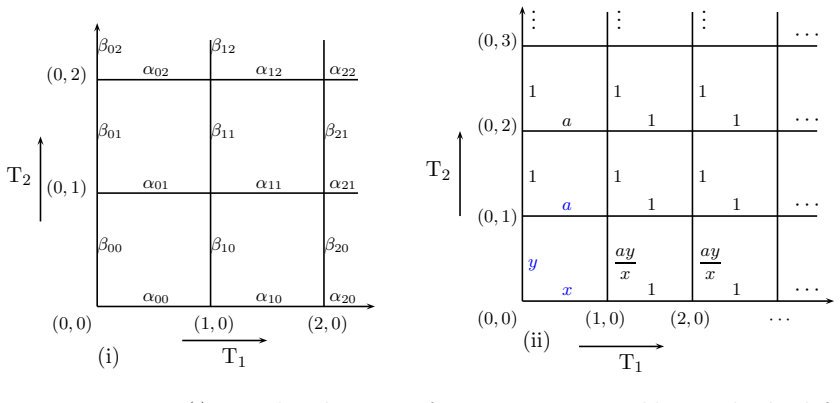
We first find an explicit formula for the square root of positive $2 \times 2$ operator matrices with commuting entries, and then use it to define and study semi-hyponormality for commuting pairs of Hilbert space operators. \ For the well-known $3$--parameter family $W_{(\alpha,\beta)}(a,x,y)$ of $2$--variable weighted shifts, we completely identify the parametric regions in the open unit cube where $W_{(\alpha,\beta)}(a,x,y)$ is subnormal, hyponormal, semi-hyponormal, and weakly hyponormal. As a result, we describe in detail concrete sub-regions where each property holds. For instance, we identify the specific sub-region where weak hyponormality holds but semi-hyponormality does not hold, and vice versa. \ To accomplish this, we employ a new technique emanating from the homogeneous orthogonal decomposition of $\ell^2(\mathbb{Z}_+^2)$. The technique allows us to reduce the study of semi-hyponormality to positivity considerations of a sequence of $2 \times 2$ scalar matrices. It also requires a specific formula for the square root of $2 \times 2$ scalar and operator matrices, and we obtain that along the way. As an application of our main results, we show that the Drury-Arveson shift is {\it not} semi-hyponormal. Taken together, the new results offer a sharp contrast between the above-mentioned properties for unilateral weighted shifts and their $2$--variable counterparts.
0
0
math.FA 2026-05-05

Square root formula maps semi-hyponormality regions for 2-variable shifts

Semi-hyponormality of commuting pairs of Hilbert space operators

The formula converts the condition to scalar matrix positivity and shows the Drury-Arveson shift is not semi-hyponormal.

Figure from the paper full image
abstract click to expand
We first find an explicit formula for the square root of positive $2 \times 2$ operator matrices with commuting entries, and then use it to define and study semi-hyponormality for commuting pairs of Hilbert space operators. \ For the well-known $3$--parameter family $W_{(\alpha,\beta)}(a,x,y)$ of $2$--variable weighted shifts, we completely identify the parametric regions in the open unit cube where $W_{(\alpha,\beta)}(a,x,y)$ is subnormal, hyponormal, semi-hyponormal, and weakly hyponormal. As a result, we describe in detail concrete sub-regions where each property holds. For instance, we identify the specific sub-region where weak hyponormality holds but semi-hyponormality does not hold, and vice versa. \ To accomplish this, we employ a new technique emanating from the homogeneous orthogonal decomposition of $\ell^2(\mathbb{Z}_+^2)$. The technique allows us to reduce the study of semi-hyponormality to positivity considerations of a sequence of $2 \times 2$ scalar matrices. It also requires a specific formula for the square root of $2 \times 2$ scalar and operator matrices, and we obtain that along the way. As an application of our main results, we show that the Drury-Arveson shift is {\it not} semi-hyponormal. Taken together, the new results offer a sharp contrast between the above-mentioned properties for unilateral weighted shifts and their $2$--variable counterparts.
0
0
math.FA 2026-05-05

Subnormal block Toeplitz operators are normal or analytic

Subnormal block Toeplitz operators

For symbols of the form Q Φ* with Q a finite Blaschke-Potapov product, subnormality forces normality or analyticity in several cases and one

abstract click to expand
In this paper we consider the subnormality of block Toeplitz operators $T_\Phi$, where $\Phi$ is an $n\times n$ matrix-valued function on the unit circle $\mathbb T$ of the form $$ \Phi=Q\Phi^* \quad \hbox{($Q$ is a finite Blaschke--Potapov product).} $$ This is related to a matrix-valued version of Halmos's Problem 5 and Nakazi-Takahashi Theorem. We ask whether $T_\Phi$ is either normal or analytic if $T_\Phi$ is subnormal, where $\Phi$ is of the above form. We give answers to this problem for different cases of the symbol. Moreover, we provide a sufficient condition for the answer to be affirmative when $\Phi^*$ is not of bounded type.
0
0
math.FA 2026-05-05 2 theorems

Subnormal block Toeplitz operators are normal or analytic when symbols obey Φ = Q Φ*

Subnormal block Toeplitz operators

The relation with finite Blaschke-Potapov Q lets subnormality imply normality or analyticity for several symbol families and under a further

abstract click to expand
In this paper we consider the subnormality of block Toeplitz operators $T_\Phi$, where $\Phi$ is an $n\times n$ matrix-valued function on the unit circle $\mathbb T$ of the form $$ \Phi=Q\Phi^* \quad \hbox{($Q$ is a finite Blaschke--Potapov product).} $$ This is related to a matrix-valued version of Halmos's Problem 5 and Nakazi-Takahashi Theorem. We ask whether $T_\Phi$ is either normal or analytic if $T_\Phi$ is subnormal, where $\Phi$ is of the above form. We give answers to this problem for different cases of the symbol. Moreover, we provide a sufficient condition for the answer to be affirmative when $\Phi^*$ is not of bounded type.
0
0
math.FA 2026-05-05

Lipschitz operators lift to C(K) operators with near-original norm

A lifting theorem for operators on spaces of Lipschitz functions

Any bounded S on Lip0 spaces extends to a lifting on continuous functions whose norm is at most ||S|| plus epsilon and that preserves the De

abstract click to expand
We prove that every bounded linear operator between Lipschitz spaces admits a lifting along the De Leeuw embedding. More precisely, given pointed metric spaces $M$ and $N$ and $\epsilon>0$, every bounded linear operator $S:\mathrm{Lip}_0(M)\to \mathrm{Lip}_0(N)$ admits a lifting $\mathfrak{S}:C(\beta \tilde{M})\to C(\beta \tilde{N})$ such that $\|\mathfrak{S}\|\leq \|S\|+\epsilon$ and $\mathfrak{S}(\varPhi_M(f))=\varPhi_N(S(f))$ for every $f\in \mathrm{Lip}_0(M)$.
0
0
math.FA 2026-05-04 2 theorems

Analysis operators alone characterize frame-convertible sequences

Continuously Frame-Convertible Sequences

Sequences convertible to Parseval frames via continuous maps are identified directly by operator properties, enabling reconstruction without

abstract click to expand
Frame theory provides a robust method for recovering vectors in a Hilbert space from inner product data, though the associated decomposition formula can be computationally demanding. We relax the frame condition by studying sequences that can be continuously mapped to Parseval frames, yielding a similar reconstruction formula. We characterize such sequences in terms of their analysis operators, without reference to any continuous mapping. We present examples, including sequences that are not complete and those containing no frame sequence. We also give norm-based criteria for when unconditional Schauder sequences and finite unions of bounded unconditional Schauder sequences admit this property. Finally, we classify finite Borel measures on the torus for which the standard exponential system has this property and forms a Riesz Fischer sequence.
0
0
math.FA 2026-05-04

The paper proves that polynomial d-chaoses and tetrahedral chaoses from d-dissociated…

On polynomial d-chaos via d-dissociated character subsystems on compact abelian groups

Polynomial d-chaoses and tetrahedral chaoses from d-dissociated character subsystems on compact abelian groups are q-lacunary and…

abstract click to expand
In this paper, we study polynomial chaoses of degree $d$ constructed from sequences of functions; that is, sets of all possible $d$-fold products of sequence elements, allowing repeated factors. The tetrahedral chaos of degree $d$ is defined as the subset consisting of products with pairwise distinct factors. We prove that polynomial $d$-chaoses (and, consequently, the tetrahedral chaoses) with respect to $d$-dissociated subsystems of characters on compact abelian groups are $q$-lacunary and $2d/(d+1)$-Sidon systems.
0
0
math.FA 2026-05-04

Formulas tie dissipation to node geometry in interpolation systems

Dissipation and c-Entropy in Nevanlinna-Pick Interpolation

c-entropy and dissipation coefficient in L-systems for Nevanlinna-Pick data depend only on node positions, reaching maxima for purely imag

Figure from the paper full image
abstract click to expand
We study interpolation L-systems realizing finite Nevanlinna-Pick data sets and analyze their structural and quantitative characteristics. Explicit formulas are derived for the c-entropy and dissipation coefficient, two intrinsic invariants that describe the dissipative structure of interpolation L-systems. These quantities depend only on the geometric placement of interpolation nodes in $\mathbb{C}_+$, attaining maximal finite values for purely imaginary nodes. The interpolation model $\Theta_\Delta$ and its unitary equivalents reveal that these invariants form a direct link between analytic interpolation data and the dynamical properties of L-systems. Particular attention is given to symmetric configurations, where the impedance function admits an explicit rational representation and a natural physical interpretation in terms of equivalent $LC$-networks.
0
0
math.FA 2026-05-04

Compact perturbation raises minimum modulus on c₀

Weak Minimizing Property and the Compact Perturbation Property for the Minimum Modulus

A rank-one compact operator strictly increases m(T) for a non-attaining T, showing (c₀, c₀) lacks the CPPm.

abstract click to expand
For an operator $T:X\to Y$, denote $m(T)=\inf\{\|Tx\|:x\in S_X\}$. A sequence $(x_n)$ in $S_X$ is said to be minimizing for $T$ if $\|Tx_n\|\to m(T)$. The weak minimizing property (WmP), introduced by Chakraborty, requires that every operator admitting a non-weakly null minimizing sequence attains its minimum modulus. More recently, Han~\cite{Han2026} introduced the Compact Perturbation Property for the minimum modulus (CPPm), which requires that for every operator $T:X\to Y$ that does not attain its minimum modulus, \[ \sup_{K\in\mathcal{K}(X,Y)} m(T+K)=m(T). \] In~\cite{Han2026}, it is shown that $(\ell_1,\ell_1)$ fails both properties, while $(c_0,c_0)$ fails the WmP. However, whether $(c_0,c_0)$ has the CPPm was left open (Problem~3.6). In this paper, we give a negative answer to this question by proving that $(c_0,c_0)$ does not have the CPPm. The proof is constructive, exhibiting a non-min-attaining operator whose minimum modulus is strictly increased by a rank-one compact perturbation. Moreover, we show that this phenomenon is not specific to $c_0$: if $X=\mathbb{K}\oplus_\infty Y$ with $Y$ non-reflexive, then the pair $(X,X)$ fails the CPPm.
0
0
math.FA 2026-05-04 3 theorems

The paper proves existence and convergence for sequences from the proximal point method…

The proximal point method and its two variants for monotone vector fields in Hadamard spaces

The proximal point method and its variants converge for monotone vector fields in Hadamard spaces.

abstract click to expand
We prove existence and convergence of sequences generated by the proximal point method and its two variants for monotone vector fields in Hadamard spaces. Before obtaining our results, we investigate some fundamental properties of tangent spaces, resolvents, and monotone vector fields in such spaces.
0
0
math.FA 2026-05-04

Discrete eigenfunctions span Fourier kernel on L^r-Schwartz spaces

L^r- Schwartz spaces on split rank one semisimple symmetric spaces

On split rank one semisimple symmetric spaces for r up to 2, this determines the non-injective part of the transform.

abstract click to expand
We study the left $K$-invariant $L^r$-Schwartz space and its Fourier transform on split rank one semisimple symmetric spaces $G/H$ for $0<r\leq 2$. We explicitly determine the kernel of the Fourier transform and show that it is spanned by eigenfunctions associated with the discrete spectrum of the Laplace--Beltrami operator on $G/H$.
0
0
math.FA 2026-05-04

Fractional operators extend boundedly on Hardy spaces over ball quasi-Banach spaces

Fractional type operators on Hardy spaces associated with ball quasi-Banach function spaces

T_{α,m} maps H_X boundedly to Y for positive α and to X for α=0, with new results for Orlicz and Lorentz spaces under O(n)-invariance.

abstract click to expand
For $0 \leq \alpha < n$ and $m \in \mathbb{N} \cap \left(1 - \frac{\alpha}{n}, +\infty \right)$, we consider certain fractional type operators $T_{\alpha, m}$ generated by $m$-orthogonal matrices and prove that, for $0 < \alpha < n$, $T_{\alpha, m}$ can be extended to a bounded operator $H_X \to Y$ and, for $\alpha = 0$, $T_{0, m}$ can be extended to a bounded operator $H_X \to X$, where $X$ and $Y$ are certain ball quasi-Banach spaces related to each other and $H_X$ is the Hardy space associated with $X$. In particular, our results apply to weighted Lebesgue spaces, variable Lebesgue spaces, Lorentz spaces and Orlicz spaces, the last two are new. Our proofs rely on the ssumption that $X$ is $\mathcal{O}(n)$-invariant, the theory of weighted Hardy spaces, the Rubio de Francia iteration algorithm and the finite atomic decomposition of $H_X$.
0
0
math.FA 2026-05-04 Recognition

Positive eigenfunctions exist for Caputo fractional equations

Existence of Positive Mild Eigenfunctions for Caputo Fractional Semilinear Evolution Equations with Nonlocal Initial Conditions

Birkhoff-Kellogg theorem in cones gives existence without Lipschitz conditions or compactness on the nonlocal operator, covering periodic, m

abstract click to expand
We study the existence of positive eigenpairs for a class of Caputo fractional autonomous evolution equations with nonlocal initial condition within the framework of Banach lattices. The autonomous linear operator generates a compact strongly continuous semigroup of contractions, while the nonlinearity is a Caratheodory map. The mild eigenfunction is represented via the compact Mittag--Leffler operator families, we work within a positive cone of continuous functions and establish a uniform lower bound for the solution operator on the boundary. We apply the Birkhoff--Kellogg type theorem in cone for the existence of eigenpair. Our approach requires neither Lipschitz continuity of the nonlinearity nor the compactness of nonlocal initial operator, allowing for broad applicability to periodic, multi-point, and integral-type initial conditions. The theoretical results are applied to a parabolic fractional partial differential equation.
0
0
math.FA 2026-05-04

Positive eigenpairs exist for fractional equations with nonlocal conditions

Existence of Positive Mild Eigenfunctions for Caputo Fractional Semilinear Evolution Equations with Nonlocal Initial Conditions

Cone theorem plus Mittag-Leffler families deliver the result without Lipschitz or compactness assumptions on the initial operator.

abstract click to expand
We study the existence of positive eigenpairs for a class of Caputo fractional autonomous evolution equations with nonlocal initial condition within the framework of Banach lattices. The autonomous linear operator generates a compact strongly continuous semigroup of contractions, while the nonlinearity is a Caratheodory map. The mild eigenfunction is represented via the compact Mittag--Leffler operator families, we work within a positive cone of continuous functions and establish a uniform lower bound for the solution operator on the boundary. We apply the Birkhoff--Kellogg type theorem in cone for the existence of eigenpair. Our approach requires neither Lipschitz continuity of the nonlinearity nor the compactness of nonlocal initial operator, allowing for broad applicability to periodic, multi-point, and integral-type initial conditions. The theoretical results are applied to a parabolic fractional partial differential equation.
0
0
math.FA 2026-05-04

Pairs (G,A) classify all gauge-preserving fermion Gaussian semigroups

The structure of gauge invariant Gaussian quantum operations on finite Fermion systems

The parameterization on the gauge subalgebra extends naturally to the full CAR algebra.

abstract click to expand
Let ${\mathcal H}_1$ be a finite dimensional complex Hilbert space. Let $\psi\mapsto Z(\psi)$ be a canonical anti-commutation relations (CAR) field over ${\mathcal H}_1$ acting irreducibly on a Hilbert space ${\mathord{\mathscr K}}$. The $*$-algebra ${\mathscr A}_{{\mathcal H}_1}$ generated by the $Z(\psi)$, $\psi\in {\mathcal H}_1$, is simply all operators on ${\mathscr K}$. However, the CAR field endows ${\mathscr A}_{{\mathcal H}_1}$ with additional structure, and we are concerned with quantum operations acting in harmony with this structure. In particular, there is a {\em gauge automorphism group} generated by ``second quantizing'' $\psi \mapsto e^{it}\psi$. The fixed point algebra of the gauge group, ${\mathscr G}_{{\mathcal H}_1}$, is a sub-algebra of ${\mathscr A}_{{\mathcal H}_1}$ studied by Araki and Wyss. It contains the density matrices of an important class of states, the {\em gauge invariant Gaussian states}, ${\mathfrak S}_{GIG}$. Our focus is on semigroups $\{e^{t{\mathscr L}}\}_{t\geq 0}$ of quantum operations on ${\mathscr A}_{{\mathcal H}_1}$ that map ${\mathfrak S}_{GIG}$ into itself. Each $e^{t{\mathscr L}}$ is one-to-one, and our first main result is a structure theorem for such quantum operations on ${\mathscr G}_{{\mathcal H}_1}$ that map ${\mathfrak S}_{GIG}$ into itself. We apply this to study semigroups of quantum operations on ${\mathscr G}_{{\mathcal H}_1}$ that map ${\mathfrak S}_{GIG}$ into itself. Our second main result is a structure theorem showing that they are parameterized by pairs $(G,A)$ where $G$ is a contraction semigroup generator on ${\mathcal H}_1$, and $0 \leq A \leq -G -G^*$. We then show that each of these semigroups has a natural extension to the full CAR algebra ${\mathscr A}_{{\mathcal H}_1}$. Further results are obtained under further assumptions on the pair $(G,A)$.
0
0
math.FA 2026-05-04

Sion's minimax theorem holds in Hadamard spaces

Sion's minimax theorem and the proximal point algorithm in Hadamard spaces

Convex-concave saddle functions satisfy the minimax equality in complete CAT(0) spaces, enabling proximal algorithms for non-Euclidean cases

abstract click to expand
We obtain Sion's minimax theorem in Hadamard spaces and discuss its applications. Among other things, we study several fundamental properties of resolvents of saddle functions in Hadamard spaces. An application to the proximal point algorithm for minimax problems in Hadamard spaces are also included.
0
0
math.FA 2026-05-04

Compactness of operators survives interpolation in Banach spaces

A new approach to interpolation of compact linear operators

Abstract theorem reduces all proofs to subspaces with common Schauder bases and embedding operators until the final step.

abstract click to expand
We prove an abstract theorem on keeping the compactness property of a linear operator after interpolation in Banach spaces. Our approach consists of two features. Applying the principle "reductio ad absurdum," we obtain a possibility to carry out all proofs only for some specially constructed subspaces of the given spaces, e.g., having a common Schauder basis. As a second feature, we consider in all assertions only embedding operators obtaining the full result just at the end of the paper. No analytical presentation of operators, spaces and interpolation functors is required and the complex method is admissible as a particular case.
0
0
math.FA 2026-05-04

Wasserstein distance equals Sobolev norm of k-plane data

Stability Estimates for the k-plane Transform on Measures and a H\"older-Type Comparison Between Wasserstein and Max-Sliced Wasserstein Distances

For probability measures with bounded densities, the 2-Wasserstein distance is equivalent to a fractional Sobolev norm on the difference of

abstract click to expand
We establish stability estimates for the $k$-plane transform on positive Radon measures, with particular emphasis on Fourier and Wasserstein metrics. We first introduce a metric on $k$-plane data and prove a bi-Lipschitz stability estimate showing that this metric is equivalent to a generalized Fourier metric obtained by combining the $d_2$-distance between centered normalized measures with separate terms accounting for differences in barycenter and total mass. Next, building on a H\"older-type comparison between Fourier and Wasserstein metrics due to Carrillo and Toscani, we prove an analogous estimate for positive Radon measures under uniform bounds on centered moments of order slightly higher than $2$. As a consequence, we obtain a H\"older-type stability estimate for the $k$-plane transform in terms of a generalized $2$-Wasserstein distance. For centered probability measures, this yields a H\"older stability estimate in the $2$-Wasserstein distance $W_2$. We also study the relation between $W_2$ and its max-sliced analogue. For centered probability measures with uniformly bounded moments of order slightly higher than $2$, we prove a two-sided H\"older-type comparison between $W_2$ and max-sliced $W_2$. We then extend this comparison to positive Radon measures by combining the corresponding estimate for centered normalized measures with separate terms accounting for differences in barycenter and total mass. Finally, for absolutely continuous compactly supported probability measures with bounded densities, we obtain a strong equivalence between the $2$-Wasserstein distance of the measures and the $(k/2-1)$-order Sobolev norm of the $k$-plane data of the difference of their densities.
0
0
math.FA 2026-05-01

Nevanlinna counting function decides operator boundedness

Composition-differentiation operators on weighted Dirichlet spaces

The essential norm and compactness of composition-differentiation operators on weighted Dirichlet spaces are read off the asymptotic growth

abstract click to expand
We characterize bounded, compact, and Hilbert-Schmidt composition-differentiation operators on weighted Dirichlet spaces. The essential norm is estimated via the asymptotic behavior of a function that involves the generalized Nevanlinna counting function of the inducing map. Norm estimates for particular inducing maps are given, and examples are provided to demonstrate the applicability of the results.
0
0
math.FA 2026-05-01

Weighted conical transforms receive full range descriptions

Range characterization of the weighted divergent beam and cone integral transforms

Factorization into divergent beam and spherical sections produces consistency conditions for conical Radon and Compton cases.

Figure from the paper full image
abstract click to expand
We establish range characterizations, or data consistency conditions, for an integral transform that maps a function to its weighted integrals over conical surfaces in $\mathbb{R}^n$. We consider two different geometries for the cone vertices, which lead to mathematically distinct range conditions. We use the term \emph{conical Radon transform} when the vertex set is a bounded convex subset of $\mathbb{R}^n$ including support of the unknown function. The second geometry is motivated by Compton camera imaging: the vertex set represents planar detector locations and is disjoint from the support of the radiation density. We refer to the corresponding transform as the \emph{Compton transform}. Our approach is based on a factorization into the $k$-weighted divergent beam transform and the spherical section transform. In the bounded convex vertex geometry, the range of the divergent beam component is described by a higher-order transport boundary-value problem, as studied by Derevtsov, Volkov, and Schuster \cite{Derevtsov2021}. In the planar detector geometry, we derive range conditions for the $k$-weighted divergent beam transform that generalize the planar cone-beam consistency conditions of Clackdoyle and Desbat \cite{ClackdoyleDesbat2013}. Combining these results with the range characterization of the spherical section transform yields complete range descriptions for both the $k$-weighted conical Radon transform and the $k$-weighted Compton transform.
0
0
math.FA 2026-05-01

Module-valued ODE solution spaces are finitely generated submodules

Module-valued ordinary differential equations and structure of solution spaces

Tensor products define derivatives that preserve the algebra action, turning infinite-dimensional function spaces into finite algebraic ones

abstract click to expand
We define and study ordinary differential equations (ODEs) for functions valued in a Banach module $V$ over a finite-dimensional $\Bbbk$-algebra $\mathit{\Lambda}$ by using the tensor of Banach modules. Furthermore, we show that the solution space of a homogeneous linear ODE as above is shown to be a finitely generated $\mathit{\Lambda}$-submodule.
0
0
math.FA 2026-05-01 2 theorems

Module-valued ODE solution spaces are finitely generated

Module-valued ordinary differential equations and structure of solution spaces

Homogeneous linear equations over Banach modules yield solution spaces that are finitely generated over the algebra.

abstract click to expand
We define and study ordinary differential equations (ODEs) for functions valued in a Banach module $V$ over a finite-dimensional $\Bbbk$-algebra $\mathit{\Lambda}$ by using the tensor of Banach modules. Furthermore, we show that the solution space of a homogeneous linear ODE as above is shown to be a finitely generated $\mathit{\Lambda}$-submodule.
0
0
math.FA 2026-05-01

Free Banach lattice over L equals the one over its opposite

On the free Banach lattice generated by a lattice

FBL generated by any distributive lattice L is lattice isometric to FBL of the reversed-order lattice, together with characterizations ofits

abstract click to expand
We study structural properties of the free Banach lattice $FBL\langle L\rangle$ generated by a distributive lattice $L$. We characterize when $FBL\langle L\rangle$ has a strong unit, compute its density character, analyze the density character of order intervals and study when is $FVL\langle L\rangle$ order dense in $FBL\langle L\rangle$. We also study projection bands, quasi-interior points, and Banach lattice homomorphisms induced by lattice homomorphisms. Finally, we show that $FBL\langle L\rangle$ is lattice isometric to $FBL\langle L^{\mathrm{op}}\rangle$, where $L^{\mathrm{op}}$ denotes the opposite lattice.
0
0
math.FA 2026-05-01

Half balls yield better maximal operator bounds on Damek-Ricci spaces

Uncentred maximal operators with respect to half balls on Damek--Ricci spaces

The uncentred variant satisfies an L log L endpoint and is bounded on all L^p for p>1, unlike the classical full-ball version.

Figure from the paper full image
abstract click to expand
In this paper we study a variant of the uncentred Hardy--Littlewood maximal operator on Damek--Ricci spaces in which balls are replaced by suitable half balls. Perhaps surprisingly, such modified maximal operator has better boundedness properties than the classical one. In particular, it satisfies an $L\log L$ endpoint estimate and it is bounded on $L^p$ for every $p$ in $(1,\infty]$.
0
0
math.FA 2026-05-01

Aluthge iterates of affine composition operators converge strongly

Iterated Aluthge transforms of some composition operators on weighted Bergman spaces

Explicit norms, radii, and closed forms are obtained on weighted Bergman spaces and transferred to a related Hardy-space operator via adjug

abstract click to expand
In this paper, we compute the iterated Aluthge transforms $\widetilde{C_\phi}^{(n)}$ of the composition operator $C_\phi$ on the weighted Bergman spaces $\mathcal{A}_\alpha^2(\mathbb{D})$, where $\phi(z)=az+(1-a)$ for $0<a<1$. Also, we obtain the norm and numerical radius of $\widetilde{C_\phi}^{(n)}$ on $\mathcal{A}_\alpha^2(\mathbb{D})$. We establish that $\widetilde{C_\phi}^{(n)}$ converges in the strong operator topology on $\mathcal{A}_\alpha^2(\mathbb{D})$. The purpose of this paper is to examine the results of \cite{jung2015iterated} for the weighted Bergman spaces $\mathcal{A}_\alpha^2(\mathbb{D})$. Additionally, by using the iterated Aluthge transforms of $C_\phi^*$ on $\mathcal{A}_\alpha^2(\mathbb{D})$, we derive the iterated Aluthge transforms of $C_\sigma$, where $\displaystyle\sigma(z)=\frac{az}{-(1-a)z+1}$ for $0<a<1$, on some weighted Hardy space $H^2(\beta_\alpha)$ and study its convergence. Finally, we raise some questions that emerge from these findings.
0
0
math.FA 2026-04-30

Localized operator classes on Fock space are strictly nested

Weakly, sufficiently or strongly localized operators on the Fock space in mathh C^n

Zhu singular convolution operators separate weakly localized from sufficiently localized in the Xia-Zheng sense.

abstract click to expand
We study properties of the following four classes of operators on the Fock space in $\mathbb C^n:$ 1) weakly localized operators; 2) sufficiently localized operators in the sense of Xia and Zheng; 3) sufficiently localized operators; 4) strongly localized operators. In this respect, we examine composition operators, Toeplitz operators with a measure symbol whose total variation measure is a Fock-Carleson measure, and singular operators of convolution type introduced by Zhu, among others. We also provide a bounded operator which is not weakly localized and does not even belong to the Toeplitz algebra. Class 1) contains class 2), class 2) contains class 3), which clearly contains class 4). We prove that the first two inclusions are strict. Our proofs are in terms of singular operators of convolution type introduced by Zhu. The third inclusion was already known to be strict, as Wang, Cao and Zhu exhibited examples of composition operators which are sufficiently localized, but are not strongly localized. %As our main result, we show the existence of a singular operator of convolution type which is weakly localized, but is not sufficiently localized in the sense of Xia and Zheng. %The underlying question is whether the first two classes of operators coincide or not.
0
0
math.FA 2026-04-30

Positive operator polynomials on matrix convex sets factor via sums of squares

Operator-Valued Positivstellens\"atze on Matrix Convex Sets and Free Products of Finite Abelian Groups

The representation uses a unital completely positive map on the defining pencil and yields explicit factorizations for trigonometric cases.

abstract click to expand
We prove a Positivstellensatz for operator-valued noncommutative polynomials that are positive on matrix convex sets. Specifically, let $p$ be an operator-valued polynomial in $B(H)\otimes C<x>$ of degree at most $2d+1$, where $H$ is separable and infinite-dimensional. Let $L(x)=I+\sum_{j=1}^{g} A_j x_j$ be a monic linear operator pencil, and let $D_L=\{X: L(X) \geq 0\}$ be the associated matrix convex set. We show that $p$ is positive on $D_L$ if and only if $p=r^*r+q^*\pi(L)q$, where $q$ and $r$ have degree at most $d$, and $\pi$ is a unital completely positive map on the operator system generated by the coefficients of $L$. The proof combines a Hahn--Banach separation argument with a tailored GNS construction. The main challenge is that the separation occurs in the product ultraweak topology, so boundedness of the resulting GNS operators is not automatic. We first handle bounded matrix convex sets, using closedness of the cone of weighted squares in the product ultraweak topology as the key technical input, and then pass to the general unbounded case by an approximation argument. Finally, we apply this convex Positivstellensatz to prove an operator-valued noncommutative Fejer--Riesz theorem on free products of finite abelian groups. The key additional ingredients are the universal $*$-algebra povm(n) associated with POVMs, a perfect Positivstellensatz for povm(n), and Boca's theorem on free products of completely positive maps. As a consequence, every positive operator-valued trigonometric polynomial on a free product of finite abelian groups admits a sum-of-squares factorization with explicit complexity bounds.
0
0
math.FA 2026-04-30

Maximal algebras of Schur block Toeplitz matrices fully classified

Maximal Algebras of Block Toeplitz Matrices with Entries in the Schur Algebra

Restricting to Schur algebra entries yields a complete list of all maximal algebras for these matrices.

abstract click to expand
The classification of maximal algebras of square block Toeplitz matrices is a considerably more difficult problem and has received relatively little attention in the existing literature. In this work, we approach the problem under the assumption that the entries belong to the Schur algebra. Within these settings, we obtain a complete classification of all maximal algebras of such block Toeplitz matrices.
0
0
math.FA 2026-04-30

Small Hankel operators in Schatten classes yield product BMO symbols

Recovering Product BMO from Schatten Hankel operators

For small Hankel operators on product Hardy spaces, any finite Schatten class S^p suffices to place the symbol in product BMO.

abstract click to expand
We prove that if a small Hankel operator on the product Hardy space belongs to some Schatten class $S^p$, $p < \infty$, then it has a symbol in product BMO. In other words, the conclusion of Nehari's theorem holds under the hypothesis that the operator belongs to a Schatten class.
0
0
math.FA 2026-04-30

Darboux and Riemann integrals coincide on Dedekind complete f-algebras

The Riemann integral on Dedekind complete f-algebras

For locally band preserving functions the two integrals agree and yield a fundamental theorem linking integration to order differentiation.

abstract click to expand
In this paper we develop a theory of integration for locally band preserving functions, introduced by Ercan and Wickstead, on Dedekind complete $f$-algebras. Specifically, we construct Darboux and Riemann integrals and show that they are equal. We then connect the theory of integrable functions to the theory of order differentiable functions, introduced by the third and fourth authors, by proving a Fundamental Theorem of Calculus. Furthermore, we show that a Mean Value Theorem for Integrals holds and that we can integrate by parts and substitutions.
0
0
math.FA 2026-04-30

Norm-additive bijections on C0 positive cones are weighted compositions

Norm additive mappings between the positive cones of continuous function algebras

Any T satisfying ||T(f+g)|| = ||Tf+Tg|| on nonnegative vanishing functions must be Tf(y)=h(y)f(τ(y)) for homeomorphism τ and positive h.

abstract click to expand
We study bijections between the positive cones of spaces of continuous functions vanishing at infinity that satisfy a norm additive condition. Such maps arise naturally in the study of nonlinear functional equations and norm-preserving structures on function spaces. While in the compact (unital) case these maps can often be analyzed via linear extension techniques, the non-unital setting $C_0(X)$ requires a different approach due to the absence of a distinguished unit element. In this paper, we show that every bijection $T:C_0^+(X)\to C_0^+(Y)$ between the positive cones of $C_0(X)$ and $C_0(Y)$ satisfying \[ \|T(f+g)\|=\|Tf+Tg\| \] for all $f,g\in C_0^+(X)$ admits a representation of the form \[ Tf(y)=h(y)f(\tau(y)), \] where $\tau:Y\to X$ is a homeomorphism and $h$ is a bounded continuous function from $Y$ to $(0,\infty)$. This yields a complete characterization of norm additive bijections on positive cones of $C_0^+(X)$.
0
0
math.FA 2026-04-30

Triopoly equilibrium exists and is unique via coupled fixed points

Equilibrium in the Canonical Stackelberg Triopoly via Response Functions and Fixed Point Theory

Reformulating sequential best responses as coupled fixed points proves existence and uniqueness, even though myopic dynamics need not to 0.

Figure from the paper full image
abstract click to expand
We analyze a canonical extension of the Stackelberg duopoly to a sequential framework, where each firm strategically anticipates the reactions of all subsequent players. In a triopoly (three-firm) settings, we obtain existence and uniqueness of market equilibrium via a reformulation of the equilibrium conditions that draws on coupled fixed-point theory. Even with linear demand, convergence of myopic best-response dynamics is not guaranteed. A recursive equilibrium formulation enables the analysis of the limiting case as the number of participants grow.
0
0
math.FA 2026-04-30

Small-norm vectors lie close to kernel for onto operators with located kernels

Closing in on the kernel of an operator between Banach spaces

Constructive proof gives explicit δ for any ε when the operator is surjective and sequentially continuous.

abstract click to expand
This note deals with the question: If T is a linear mapping between Banach spaces X and Y, and x belongs to X and has small norm, is x close to the kernel of T? It draws on notions of Z-stability and provides an affirmative constructive answer when T is onto Y, sequentially continuous, and has located kernel.
0
0
math.FA 2026-04-29

The paper proves that non-stable pure subnormal contractions on Hilbert spaces have…

Non-stable subnormal contractions have nontrivial hyperinvariant subspaces

Non-stable pure subnormal contractions on Hilbert spaces have nontrivial hyperinvariant subspaces.

abstract click to expand
A contraction $T$ on a (complex, separable) Hilbert space is stable, or of class $C_{0\cdot}$, if $T^n\to 0$ in the strong operator topology. It is proved that for a non-stable pure subnormal contraction $T$ there exists a singular inner function $\theta$ such that the range of $\theta(T)$ is not dense. Consequently, $T$ has nontrivial hyperinvariant subspaces. The proof is based on results by Esterle and K\'erchy. Examples of stable subnormal contractions are given for which the range of $\varphi(T)$ is dense for every $\varphi\in H^\infty$ ($\varphi\not\equiv 0$).
0
0
math.FA 2026-04-29

Resolvent holomorphy links Krylov solvability in Banach spaces

Some results on Krylov solvability in Banach space and connections to spectral theory

Spectral tools handle the missing topological complements that block direct subspace arguments.

abstract click to expand
This article contains the first steps in a general analysis of the problem of Krylov solvability of the inverse linear problem in a Banach space. In contrast to the well-studied Hilbert space setting, the Banach space setting presents particular difficulties in creating the connection between Krylov solvability and structural properties of the Krylov subspace itself. At the centre of this is the fact that the closed Krylov subspace may not always have a topological complement. We also develop spectral tools in order to attack the problem using the resolvent operator and exploiting its holomorphic properties on the resolvent set.
0
0
math.FA 2026-04-29

Krylov solvability in Banach spaces blocked by missing complements

Some results on Krylov solvability in Banach space and connections to spectral theory

Closed subspaces lack topological complements unlike in Hilbert spaces, prompting resolvent-based spectral tools to study inverse problem حل

abstract click to expand
This article contains the first steps in a general analysis of the problem of Krylov solvability of the inverse linear problem in a Banach space. In contrast to the well-studied Hilbert space setting, the Banach space setting presents particular difficulties in creating the connection between Krylov solvability and structural properties of the Krylov subspace itself. At the centre of this is the fact that the closed Krylov subspace may not always have a topological complement. We also develop spectral tools in order to attack the problem using the resolvent operator and exploiting its holomorphic properties on the resolvent set.
0
0
math.FA 2026-04-29

Rescaled fractional energies converge to double integrals and Dirichlet on torus

Gamma-convergence, variational analysis and characterisation of minimisers for (s,p)-Gagliardo energies in the flat d-torus

As s to 0 the rescaled energy becomes a double integral of pointwise differences; as s to 1 it recovers the classical Dirichlet integral, at

Figure from the paper full image
abstract click to expand
This paper deals with the variational analysis, for every $s \in (0,1)$ and $p \in [1,+\infty)$, of $(s,p)$-Gagliardo seminorms in a periodic setting. First, we consider the space of $L^p$, $T$-periodic functions and define the energy functional $\mathcal{F}_p^s$ as the density of the \(d\)-dimensional $(s,p)$-Gagliardo seminorm over the periodic cell. Our goal is to rigorously characterise the $\Gamma$-limits of this functional as the fractional parameter $s$ approaches its endpoint values, $0^+$ and $1^-$. We prove that, as $s \to 0^+$, the rescaled energy $s\mathcal{F}_p^s$ $\Gamma$-converges to a functional $\mathcal{F}_p^0$ defined by the double integral of $|u(x)-u(y)|^p$ over the periodic cell. Then, for the limit as $s \to 1^-$, we establish that the rescaled energy $(1-s)\mathcal{F}_p^s$ $\Gamma$-converges to the classical Dirichlet $p$-energy, extending known results from bounded domains to the periodic framework. Finally, we analyse the one-dimensional minimiser of the energy $\mathcal{F}_p^s$ for $s \in (0,1)$ and the limit functional $\mathcal{F}_p^0$ within the special class of piecewise affine periodic functions whose distributional derivative consists of a constant absolutely continuous part and a singular part with opposite sign and quantised jumps. In this setting, the energy depends only on the position of these jump points, and we prove that the absolute minimiser is achieved by their equispaced configuration.
0
0
math.FA 2026-04-28

Partial extended b-metric spaces unify prior generalizations

Partial extended b-metric and some fixed point theorem

The structure with point-dependent controls and non-zero self-distances supports fixed point theorems for contractive maps and applies to dy

abstract click to expand
In this paper, we introduce the concept of partial extended b-metric spaces (PEBMS) as a unification and generalization of extended b-metric spaces and partial b-metric spaces. This new structure incorporates a point-dependent control function together with the possibility of non-zero self-distance, providing a more flexible framework for the study of generalized metric spaces. We establish several fundamental properties of PEBMS, including convergence, Cauchy sequences, and 0-completeness. By introducing the notion of 0-Cauchy sequences, we extend various results from extended b-metric spaces to the PEBMS setting. In particular, we prove fixed point theorems for contractive mappings and show the existence and uniqueness of fixed points under suitable conditions. Furthermore, we demonstrate that every extended b-metric space can be viewed as a special case of a PEBMS. As an application, we study the stability of discrete dynamical systems within this framework. The results presented here generalize and enrich existing theories in metric-type spaces and open new directions for further research.
0
0
math.FA 2026-04-28

Non-complete Daugavet space has fully smooth norm

About smooth and non-poor subspaces of Daugavet spaces

Its dual norm is nowhere differentiable, and quotients by quasilacunary Müntz subspaces lose the Daugavet property but keep slice diameter 2

abstract click to expand
We discuss an example of a non-complete normed space with the Daugavet property such that the norm is G\^ateaux differentiable at every nonzero point. In contrast, we note that the dual norm of a normed space with the Daugavet property is not G\^ateaux differentiable at any point. Furthermore, we show that quasilacunary M\"untz spaces form a natural class of subspaces of $C[0,1]$, isomorphic to $c_0$, for which the corresponding quotient spaces fail to have the Daugavet property. At the same time, the slice diameter two property is preserved under this construction.
0
0
math.FA 2026-04-28

Polynomial local functionals on convex functions admit finite integral forms

Integral representation of polynomial local functionals on convex functions

Representations follow from Paley-Wiener-Schwartz classification of Goodey-Weil distributions plus density of smooth cases, yielding Monge-A

abstract click to expand
Integral representations for continuous polynomial local functionals on convex functions are established in terms of a finite family of polynomials. This result is obtained by approximation from a classification of the dense subspace of smooth polynomial local functionals, which is based on a Paley--Wiener--Schwartz-type classification of the Goodey--Weil distributions associated to these functionals under support restrictions. As an application, density results for various families of Monge--Amp\`ere-type operators are established.
0
0
math.FA 2026-04-28

Lower bound on one semigroup operator yields bounded H infinity calculus

H^infty--functional calculus for generators of semigroups that admit lower bounds

On UMD Banach spaces this produces functional-calculus bounds and explicit exponential lower estimates via group dilation.

Figure from the paper full image
abstract click to expand
We study $C_0$-semigroups on UMD Banach spaces under the assumption that a single semigroup operator admits a lower bound. We establish boundedness of $H^\infty$ functional calculi for the negative generator of such semigroups. Our approach is based on a dilation argument: combining a recent construction due to Madani with transference results for groups on UMD spaces, we embed the semigroup into a $C_0$-group on a larger space and transfer functional calculus estimates back to the original generator. As a byproduct, we obtain quantitative exponential lower bounds for the semigroup. We also show that equivalences due to Batty and Geyer, valid in Hilbert spaces, fail in the general Banach space setting.
0
0
math.FA 2026-04-27

Bourgain's K-closedness method extends to semicommutative setting

Bourgain's method for K-closedness in the semicommmutative setting

Recovers Pisier's result on noncommutative Hardy spaces and produces new interpolation theorems for Sobolev spaces on the torus

abstract click to expand
In the early 1990s, J.Bourgain proved a general result $K$-closedness result in the context of classical harmonic analysis. In this paper, we extend Bourgain's method to the semicommutative setting, making use of the recent semicommutative Calder\'on-Zygmund decomposition introduced by L.Cadilhac, JM.Conde-Alonso and J.Parcet. As an application, we recover Pisier's result about $K$-closedness of noncommutative Hardy spaces on the torus, and we also establish new interpolation results for noncommutative Sobolev spaces on the torus.
0

browse all of math.FA → full archive · search · sub-categories