Seamless Contraction-Control Framework for Unplanned Grid-Connected/Stand-Alone Transitions of Grid-Forming Inverters
Pith reviewed 2026-06-27 15:52 UTC · model grok-4.3
The pith
A contraction-based framework lets grid-forming inverters manage unplanned mode switches using only voltage measurements.
A machine-rendered reading of the paper's core claim, the machinery that carries it, and where it could break.
Core claim
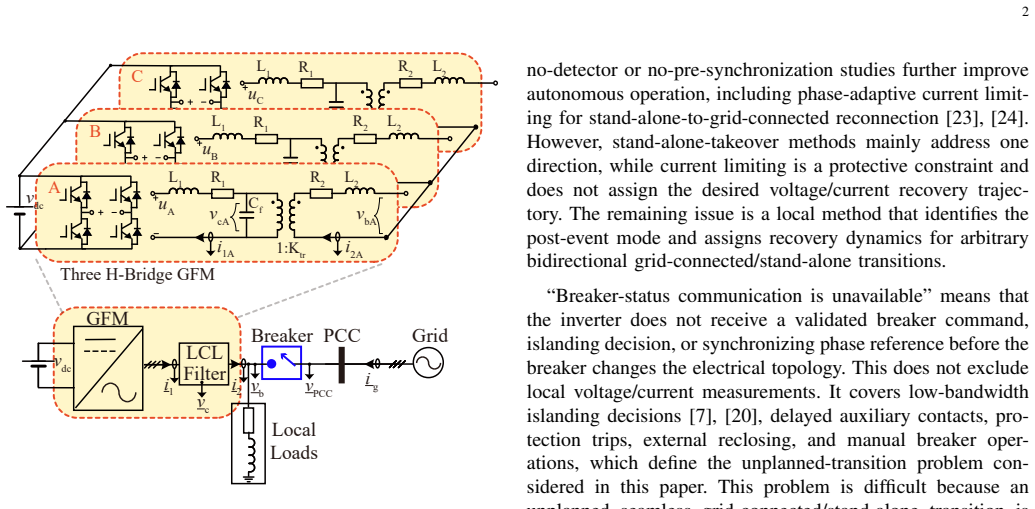
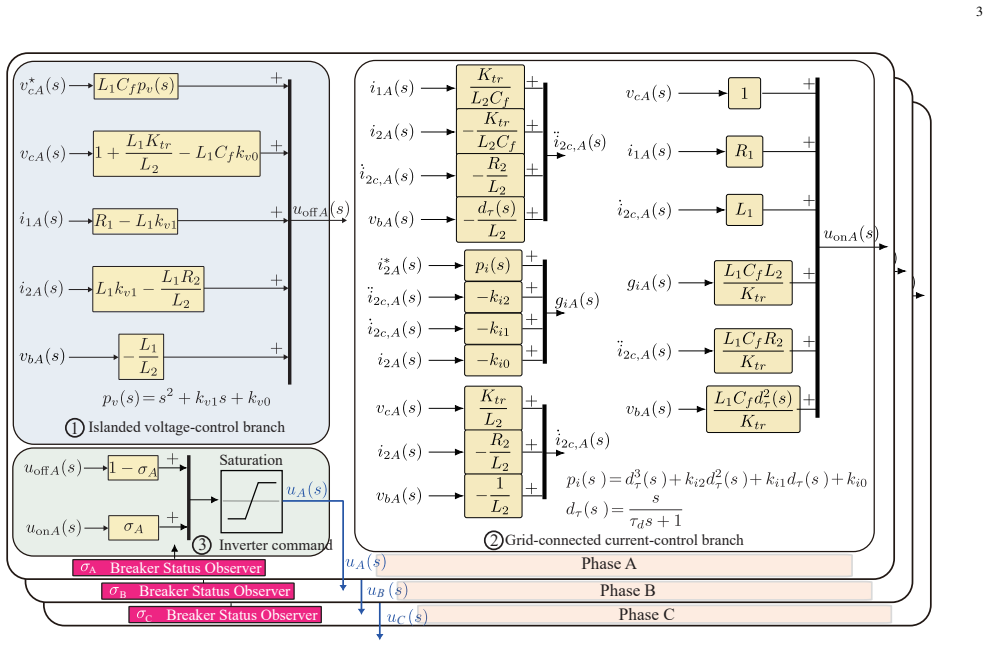
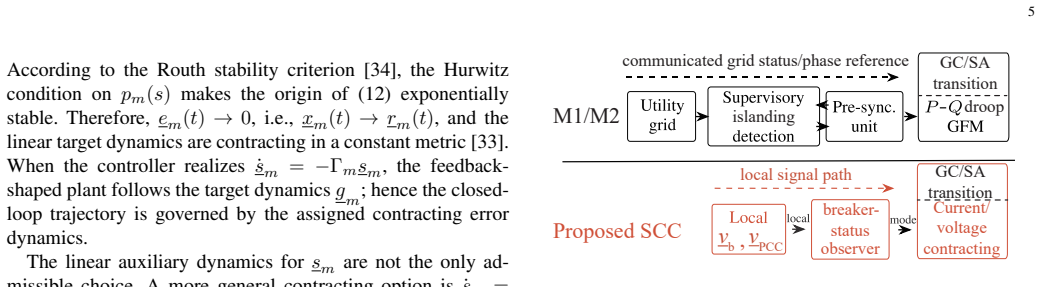
The seamless contraction-control framework supplies contraction-based current-control laws for grid-connected operation and voltage-control laws for stand-alone operation. These laws guarantee transient stability and convergence to the chosen target trajectory at a prescribed rate. A breaker-status observer infers the operating mode directly from voltage measurements on either side of the breaker, removing any requirement for a pre-synchronization interval or supervisory islanding detection and thereby allowing timely support during unplanned bidirectional transitions.
What carries the argument
The seamless contraction-control (SCC) framework together with its contraction-based mode-specific laws and the breaker-status observer that decides mode from cross-breaker voltages.
If this is right
- The inverter supplies local-load voltage in stand-alone operation without prior warning.
- It maintains stable current injection in grid-connected mode under symmetrical and unsymmetrical sags and phase jumps.
- Bidirectional unplanned transitions occur without dedicated pre-synchronization or islanding detection.
- Convergence to the target trajectory occurs at a rate fixed by the control design.
Where Pith is reading between the lines
- The same contraction approach could be applied to other converters that must change regulation objectives on the fly.
- Reduced reliance on communication links would follow in microgrids with many such inverters.
- The observer might be combined with existing protection relays to further shorten detection time.
- Extension to networks with multiple inverters would require checking whether the contraction property still holds when units interact.
Load-bearing premise
The inverter plant must satisfy a contraction condition under the proposed laws, and voltage readings across the breaker must stay distinguishable in the presence of sags, jumps, and unsymmetrical faults.
What would settle it
A test in which the inverter either fails to converge to the target trajectory or the observer misclassifies the mode during an unsymmetrical voltage sag would disprove the central claim.
Figures
read the original abstract
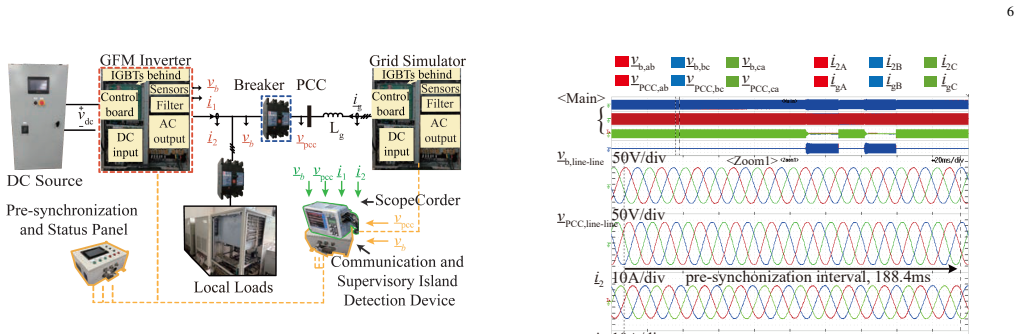
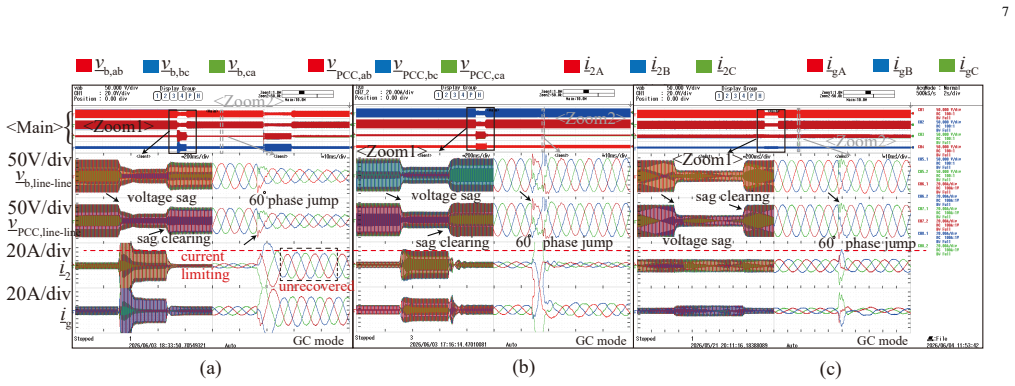
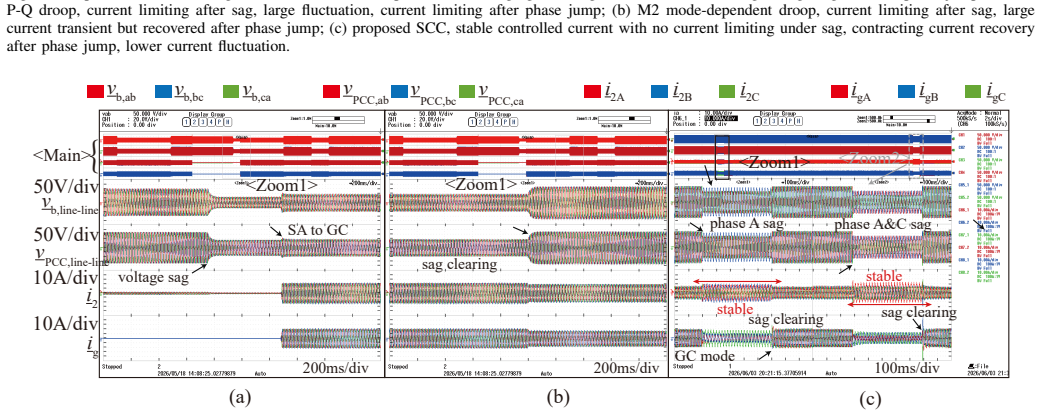
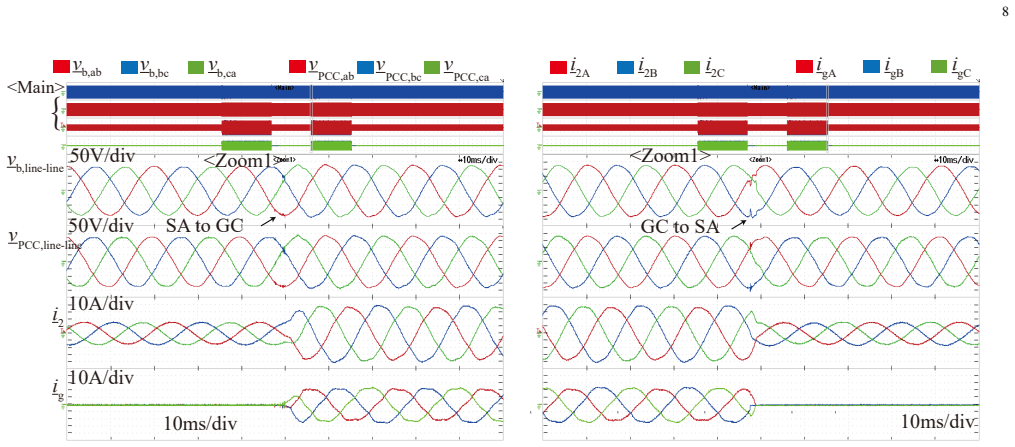
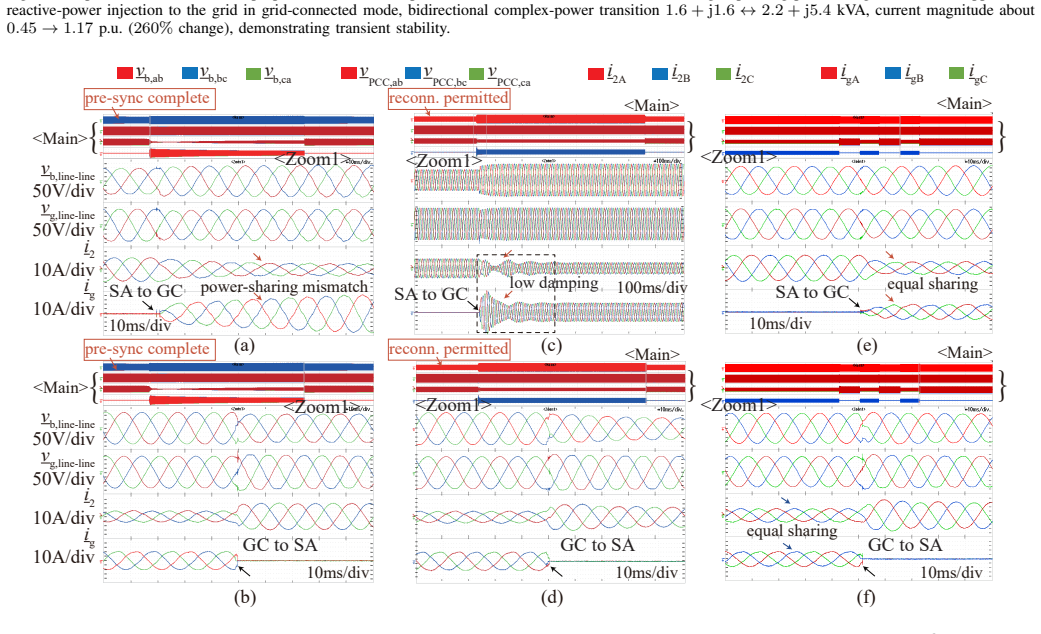
Unplanned grid-connected (GC)/stand-alone (SA) transitions commonly occur in AC microgrids during protection trips, manual breaker operation, or low-bandwidth supervisory communication. Under such unplanned transitions, a grid-forming inverter must support the local-load voltage in stand-alone operation and regulate the desired power/current injection in grid-connected operation. Existing P--Q droop-based seamless-transfer methods often rely on planned transition commands, supervisory islanding detection, or pre-synchronization interval, which may prevent timely voltage/current support during unplanned bidirectional transitions. To address this problem, this paper proposes a seamless contraction-control (SCC) framework for target dynamics. Using the SCC, contraction-based grid-connected current-control and stand-alone voltage-control laws are proposed. With the new control laws, the inverter achieves transient stability and converges to the target trajectory with a prescribed convergence rate. Furthermore, a breaker-status observer is proposed to infer the grid-connected/stand-alone mode from voltage measurements on both sides of the breaker, eliminating the need for a dedicated pre-synchronization interval or supervisory islanding detection process and enabling timely voltage/current support during unplanned transitions. Experimental results validate that the proposed method achieves stand-alone voltage support, stable grid-connected current injection under symmetrical/unsymmetrical grid-voltage sag and phase-jump disturbances, and unplanned bidirectional transitions.
Editorial analysis
A structured set of objections, weighed in public.
Referee Report
Summary. The manuscript proposes a seamless contraction-control (SCC) framework for grid-forming inverters handling unplanned grid-connected (GC)/stand-alone (SA) transitions. Contraction-based current-control laws are derived for GC mode and voltage-control laws for SA mode, with the claim that the closed-loop system is contracting to a target trajectory at a prescribed rate, ensuring transient stability. A breaker-status observer infers the mode from voltage measurements on both sides of the breaker, eliminating pre-synchronization or supervisory detection. Experimental results are presented to validate voltage support, stable current injection under symmetrical/unsymmetrical sags and phase jumps, and bidirectional unplanned transitions.
Significance. If the contraction metric is explicitly constructed and verified for the full closed-loop dynamics (LCL filter currents, capacitor voltages, and mode-dependent controls), the framework would deliver a rigorous, tunable-rate stability guarantee without reliance on planned commands or islanding detection, representing a meaningful advance over droop-based seamless-transfer methods. The observer's disturbance-robust mode inference would further enhance practicality for microgrid protection scenarios. Experimental coverage of unsymmetrical faults adds value, but the overall significance is conditional on resolving the foundational contraction verification.
major comments (1)
- [Theoretical development of SCC laws and stability analysis] The central claim that the inverter achieves transient stability and converges to the target trajectory with a prescribed convergence rate under the SCC laws requires that the plant dynamics (including LCL filter) admit a contraction metric in both GC current-control and SA voltage-control modes. No explicit metric is constructed, nor is a differential Jacobian analysis provided for the full state vector; the property is assumed rather than demonstrated. This assumption is load-bearing for the transient-stability guarantee.
minor comments (1)
- The abstract states that experimental results validate the claims, but without accompanying data tables or quantified convergence-rate metrics in the provided text, it is difficult to assess how closely the observed transients match the prescribed rate.
Simulated Author's Rebuttal
We thank the referee for the constructive report and the identification of the key theoretical requirement. We respond to the major comment below.
read point-by-point responses
-
Referee: [Theoretical development of SCC laws and stability analysis] The central claim that the inverter achieves transient stability and converges to the target trajectory with a prescribed convergence rate under the SCC laws requires that the plant dynamics (including LCL filter) admit a contraction metric in both GC current-control and SA voltage-control modes. No explicit metric is constructed, nor is a differential Jacobian analysis provided for the full state vector; the property is assumed rather than demonstrated. This assumption is load-bearing for the transient-stability guarantee.
Authors: We agree that the transient-stability guarantee requires explicit verification of the contraction property on the full closed-loop dynamics, including LCL filter states. The manuscript derives the SCC laws from contraction theory but does not construct the metric or perform the Jacobian analysis. In the revised manuscript we will add an explicit contraction metric for both modes together with the differential analysis of the Jacobian to confirm the prescribed convergence rate. revision: yes
Circularity Check
No significant circularity; derivation self-contained on contraction theory
full rationale
The paper applies contraction theory to derive new grid-connected current-control and stand-alone voltage-control laws for inverters, claiming transient stability and prescribed convergence rate under these laws, plus a breaker-status observer from voltage measurements. No quoted equations or steps show any result reducing by construction to its own inputs, fitted parameters renamed as predictions, or load-bearing self-citations. The existence of a contraction metric is treated as an assumption from the underlying theory rather than derived internally, and the observer distinguishability is presented as a separate contribution. This matches the default expectation of self-contained work with no circular reduction.
Axiom & Free-Parameter Ledger
free parameters (1)
- prescribed convergence rate
axioms (2)
- domain assumption Inverter system dynamics admit a contraction metric under the proposed grid-connected current-control and stand-alone voltage-control laws.
- domain assumption Voltage measurements on both sides of the breaker remain sufficient to distinguish grid-connected versus stand-alone mode under symmetrical/unsymmetrical sags and phase jumps.
Reference graph
Works this paper leans on
-
[1]
Transient synchronization stability of an islanded ac microgrid considering interactions between grid-forming and grid- following converters,
Z. Tianet al., “Transient synchronization stability of an islanded ac microgrid considering interactions between grid-forming and grid- following converters,”IEEE Journal of Emerging and Selected Topics in Power Electronics, vol. 11, no. 4, pp. 4463–4476, 2023
2023
-
[2]
Inertia and grid impedance emulation of power grid for stability test of grid-forming converter,
J. Wang and K. Ma, “Inertia and grid impedance emulation of power grid for stability test of grid-forming converter,”IEEE Transactions on Power Electronics, vol. 38, no. 2, pp. 2469–2480, 2023
2023
-
[3]
Grid forming in- verter with increased short-circuit contribution to address inverter-based microgrid protection challenges,
M. Ferrari, L. M. Tolbert, and E. C. Piesciorovsky, “Grid forming in- verter with increased short-circuit contribution to address inverter-based microgrid protection challenges,”IEEE Open Journal of the Industrial Electronics Society, vol. 5, pp. 481–500, 2024
2024
-
[4]
Enhanced transient stability strategy for grid-forming converter based on current limiting,
Z. Sun, Z. He, N. Liu,et al., “Enhanced transient stability strategy for grid-forming converter based on current limiting,”CSEE Journal of Power and Energy Systems, vol. 11, no. 3, pp. 960–971, 2025
2025
-
[5]
Transition from islanded to grid-connected mode of microgrids with voltage-based droop control,
T. L. Vandoorn, B. Meersman, J. D. M. De Kooning, and L. Vandevelde, “Transition from islanded to grid-connected mode of microgrids with voltage-based droop control,”IEEE Transactions on Power Systems, vol. 28, no. 3, pp. 2545–2553, Aug. 2013
2013
-
[6]
Resynchronization of distributed generation based on the universal droop controller for seamless transfer between operation modes,
M. Amin and Q.-C. Zhong, “Resynchronization of distributed generation based on the universal droop controller for seamless transfer between operation modes,”IEEE Transactions on Industrial Electronics, vol. 67, no. 9, pp. 7574–7582, Sep. 2020
2020
-
[7]
Seamless transition of critical infrastructures using droop controlled grid-forming inverters,
S. Chakraborty, S. Patel, G. Saraswat,et al., “Seamless transition of critical infrastructures using droop controlled grid-forming inverters,” IEEE Transactions on Industrial Electronics, vol. 71, no. 2, pp. 1535– 1546, 2024
2024
-
[8]
Seamless transition for parallel inverters with novel self-adaptive hybrid controller and presyn- chronization unit,
X. Meng, H. Guo, X. Wang, M. He, and J. Liu, “Seamless transition for parallel inverters with novel self-adaptive hybrid controller and presyn- chronization unit,”IEEE Journal of Emerging and Selected Topics in Power Electronics, vol. 10, no. 5, pp. 5819–5832, 2022
2022
-
[9]
A series flexible transfer converter with reduced cost while keeping functions of instant power support and auto- synchronization for microgrid,
Z. Songet al., “A series flexible transfer converter with reduced cost while keeping functions of instant power support and auto- synchronization for microgrid,”IEEE Transactions on Industry Appli- cations, vol. 62, no. 2, pp. 3068–3082, 2026. 10
2026
-
[10]
An effective smooth transition control strategy using droop-based synchronization for parallel invert- ers,
M. N. Arafat, A. Elrayyah, and Y . Sozer, “An effective smooth transition control strategy using droop-based synchronization for parallel invert- ers,”IEEE Transactions on Industry Applications, vol. 51, no. 3, pp. 2443–2454, 2015
2015
-
[11]
Design of a general- ized control algorithm for parallel inverters for smooth microgrid tran- sition operation,
J. Wang, N. C. P. Chang, X. Feng, and A. Monti, “Design of a general- ized control algorithm for parallel inverters for smooth microgrid tran- sition operation,”IEEE Transactions on Industrial Electronics, vol. 62, no. 8, pp. 4900–4914, Aug. 2015
2015
-
[12]
Integrated synchronization control of grid-forming inverters for smooth microgrid transition,
J. Wang, A. Pratt, and M. Baggu, “Integrated synchronization control of grid-forming inverters for smooth microgrid transition,” inProc. IEEE Power & Energy Society General Meeting (PESGM), Atlanta, GA, USA, 2019, pp. 1–5
2019
-
[13]
Design of a non-PLL grid- forming inverter for smooth microgrid transition operation,
J. Wang, B. Lundstrom, and A. Bernstein, “Design of a non-PLL grid- forming inverter for smooth microgrid transition operation,” inProc. IEEE Power & Energy Society General Meeting (PESGM), Montreal, QC, Canada, 2020, pp. 1–5
2020
-
[14]
Controller hardware-in-the-loop testing of an IEC 61850 GOOSE based control for seamless transition of a microgrid between island and grid-connected modes,
J. Westman, R. Hadidi, C. Fox, J. Leonard, A. Harrell,et al., “Controller hardware-in-the-loop testing of an IEC 61850 GOOSE based control for seamless transition of a microgrid between island and grid-connected modes,”IEEE Transactions on Industry Applications, vol. 57, no. 1, pp. 61–69, Jan./Feb. 2021
2021
-
[15]
Microgrid protection and control schemes for seamless transition to island and grid synchronization,
A. Vukojevic and S. Lukic, “Microgrid protection and control schemes for seamless transition to island and grid synchronization,”IEEE Trans- actions on Smart Grid, vol. 11, no. 4, pp. 2845–2855, Jul. 2020
2020
-
[16]
Distributed hierarchical control of AC microgrid op- erating in grid-connected, islanded and their transition modes,
X. Houet al., “Distributed hierarchical control of AC microgrid op- erating in grid-connected, islanded and their transition modes,”IEEE Access, vol. 6, pp. 77 388–77 401, 2018
2018
-
[17]
Seamless operation of master-slave organized AC microgrid with robust control, islanding detection, and grid synchronization,
P. Buduma, M. K. Das, R. T. Naayagi, S. Mishra, and G. Panda, “Seamless operation of master-slave organized AC microgrid with robust control, islanding detection, and grid synchronization,”IEEE Transac- tions on Industry Applications, vol. 58, no. 5, pp. 6724–6738, Sep./Oct. 2022
2022
-
[18]
Unified control scheme of grid- connected inverters for autonomous and smooth transfer to stand-alone mode,
M. Kwon, S. Park, C.-Y . Oh,et al., “Unified control scheme of grid- connected inverters for autonomous and smooth transfer to stand-alone mode,”IEEE Transactions on Power Electronics, vol. 37, no. 1, pp. 416–425, 2022
2022
-
[19]
Autonomous control of inverters in microgrid,
F. Sadeque, M. Gursoy, D. Sharma,et al., “Autonomous control of inverters in microgrid,”IEEE Transactions on Industry Applications, vol. 60, no. 3, pp. 4313–4323, 2024
2024
-
[20]
Seamless tran- sition of microgrids operation from grid-connected to islanded mode,
M. Ganjian-Aboukheili, M. Shahabi, Q. Shafiee,et al., “Seamless tran- sition of microgrids operation from grid-connected to islanded mode,” IEEE Transactions on Smart Grid, vol. 11, no. 3, pp. 2106–2114, 2020
2020
-
[21]
Transient stability analysis and control design of droop-controlled voltage source converters considering current limitation,
L. Huang, H. Xin, Z. Wang, L. Zhang, K. Wu, and J. Hu, “Transient stability analysis and control design of droop-controlled voltage source converters considering current limitation,”IEEE Transactions on Smart Grid, vol. 10, no. 1, pp. 578–591, 2019
2019
-
[22]
Cur- rent limiting algorithms and transient stability analysis of grid-forming VSCs,
T. Qoria, F. Gruson, F. Colas, X. Kestelyn, and X. Guillaud, “Cur- rent limiting algorithms and transient stability analysis of grid-forming VSCs,”Electric Power Systems Research, vol. 189, p. 106726, Dec. 2020
2020
-
[23]
Seam- less transition between microgrid operation modes using adrc without an islanding detection algorithm nor pll,
N. Yalaoui, L. Dessaint, M. R. Dehbozorgi, and K. Al-Haddad, “Seam- less transition between microgrid operation modes using adrc without an islanding detection algorithm nor pll,”IEEE Access, vol. 12, pp. 127 655–127 673, 2024
2024
-
[24]
Seamless grid-connected/islanded transition in fully grid-forming PV powered microgrids,
Z. Guo and W. Wu, “Seamless grid-connected/islanded transition in fully grid-forming PV powered microgrids,”IEEE Transactions on Sustain- able Energy, 2026, early access
2026
-
[25]
Analysis and design of current control schemes for lcl-type grid-connected inverter based on a general mathematical model,
D. Pan, X. Ruan, X. Wang, H. Yu, and Z. Xing, “Analysis and design of current control schemes for lcl-type grid-connected inverter based on a general mathematical model,”IEEE Transactions on Power Electronics, vol. 32, no. 6, pp. 4395–4410, Jun. 2017
2017
-
[26]
Harmonic instability assessment using state-space modeling and participation analysis in inverter-fed power systems,
Y . Wang, X. Wang, F. Blaabjerg, and Z. Chen, “Harmonic instability assessment using state-space modeling and participation analysis in inverter-fed power systems,”IEEE Transactions on Industrial Electron- ics, vol. 64, no. 1, pp. 806–816, Jan. 2017
2017
-
[27]
A generic multicell network control for three-phase grid-connected inverters,
K. Hu, L. Peng, and W. Wu, “A generic multicell network control for three-phase grid-connected inverters,”IEEE Transactions on Industrial Electronics, vol. 70, no. 4, pp. 3268–3278, Apr. 2023
2023
-
[28]
Load current feedforward control for the inverter with output transformer based on frequency compensation of resonant controller,
B. Lin and L. Peng, “Load current feedforward control for the inverter with output transformer based on frequency compensation of resonant controller,” inProc. IEEE Applied Power Electronics Conference and Exposition (APEC), Houston, TX, USA, 2022, pp. 764–769
2022
-
[29]
Harmonic disturbance suppression based on precise shaping of output impedance at selected frequencies for standalone voltage source inverter,
B. Lin, L. Peng, K. Yu, and H. Xu, “Harmonic disturbance suppression based on precise shaping of output impedance at selected frequencies for standalone voltage source inverter,”IEEE Transactions on Industry Applications, vol. 59, no. 6, pp. 6963–6975, Nov.–Dec. 2023. [30]IEEE Guide for Design, Operation, and Integration of Distributed Re- source Island S...
2023
-
[30]
Adaptive droop control applied to voltage-source inverters operating in grid-connected and islanded modes,
J. C. Vasquez, J. M. Guerrero, A. Luna, P. Rodriguez, and R. Teodorescu, “Adaptive droop control applied to voltage-source inverters operating in grid-connected and islanded modes,”IEEE Transactions on Industrial Electronics, vol. 56, no. 10, pp. 4088–4096, Oct. 2009
2009
-
[31]
Enhanced power flow control for grid-connected droop-controlled inverters with improved sta- bility,
Y . Deng, Y . Tao, G. Chen, G. Li, and X. He, “Enhanced power flow control for grid-connected droop-controlled inverters with improved sta- bility,”IEEE Transactions on Industrial Electronics, vol. 64, no. 7, pp. 5919–5929, Jul. 2017
2017
-
[32]
Contraction theory for nonlinear stability analysis and learning-based control: A tutorial overview,
H. Tsukamoto, S.-J. Chung, and J.-J. E. Slotine, “Contraction theory for nonlinear stability analysis and learning-based control: A tutorial overview,”Annual Reviews in Control, vol. 52, pp. 135–169, 2021
2021
-
[33]
E. J. Routh,A Treatise on the Stability of a Given State of Motion: Particularly Steady Motion. London, U.K.: Macmillan, 1877
-
[34]
Seamless transition of syn- chronous inverters using synchronizing virtual torque and flux linkage,
M. Ramezani, S. Li, F. Musavi,et al., “Seamless transition of syn- chronous inverters using synchronizing virtual torque and flux linkage,” IEEE Transactions on Industrial Electronics, vol. 67, no. 1, pp. 319–328, 2020
2020
-
[35]
Linear quadratic regulator based smooth transition between microgrid operation modes,
M. Ganjian-Aboukheili, M. Shahabi, Q. Shafiee, and J. M. Guerrero, “Linear quadratic regulator based smooth transition between microgrid operation modes,”IEEE Transactions on Smart Grid, vol. 12, no. 6, pp. 4854–4864, Nov. 2021
2021
-
[36]
Supplementary controller for seamless transitions between microgrids operation modes,
S. M. Azimi and S. Lotfifard, “Supplementary controller for seamless transitions between microgrids operation modes,”IEEE Transactions on Smart Grid, vol. 12, no. 3, pp. 2102–2112, May 2021
2021
discussion (0)
Sign in with ORCID, Apple, or X to comment. Anyone can read and Pith papers without signing in.