Internalizing Geometric Law: Learning from Solver Residuals for Precision-Critical Generation
Pith reviewed 2026-06-27 17:00 UTC · model grok-4.3
The pith
Saturating additive rewards prevent one violated constraint from erasing the learning signal across all others in geometric synthesis.
A machine-rendered reading of the paper's core claim, the machinery that carries it, and where it could break.
Core claim
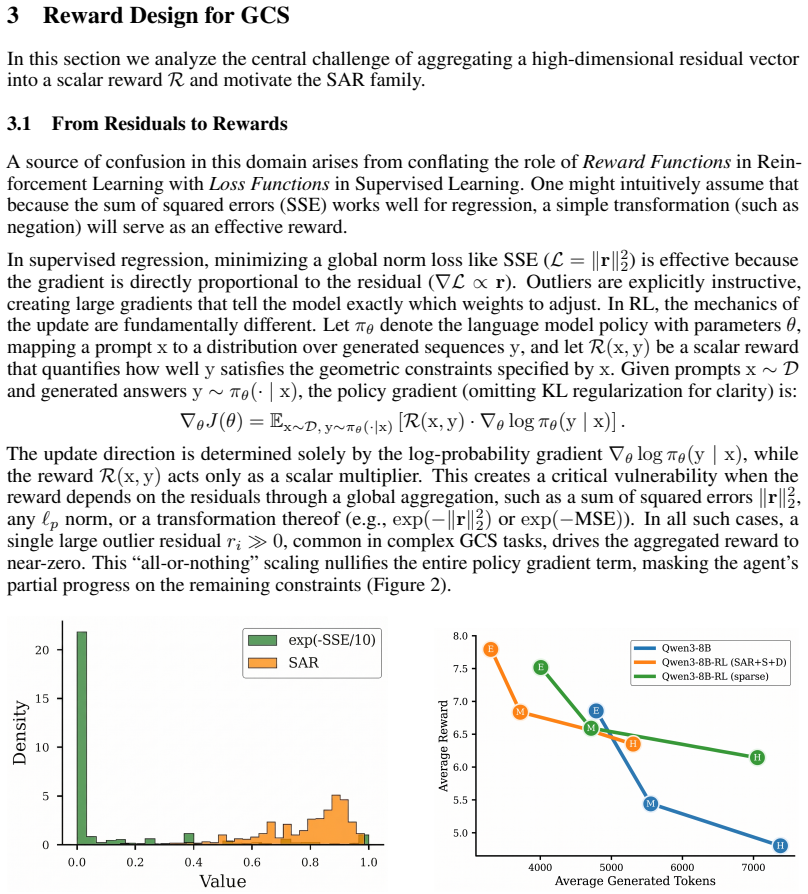
The central claim is that global-norm rewards such as exp(-MSE) allow a single outlier constraint to nullify the learning signal for all other constraints, whereas Saturating Additive Rewards that decompose the total into bounded per-constraint terms preserve partial progress and deliver consistent gradients even under severe violations, producing a 2.3 times higher hard-tier solving rate on PyGeoX-Bench.
What carries the argument
Saturating Additive Rewards (SAR), a reward that sums individually bounded saturating functions of each constraint residual so that no single term can dominate the total.
If this is right
- Models trained with SAR solve a larger fraction of problems that contain dozens of simultaneously active constraints.
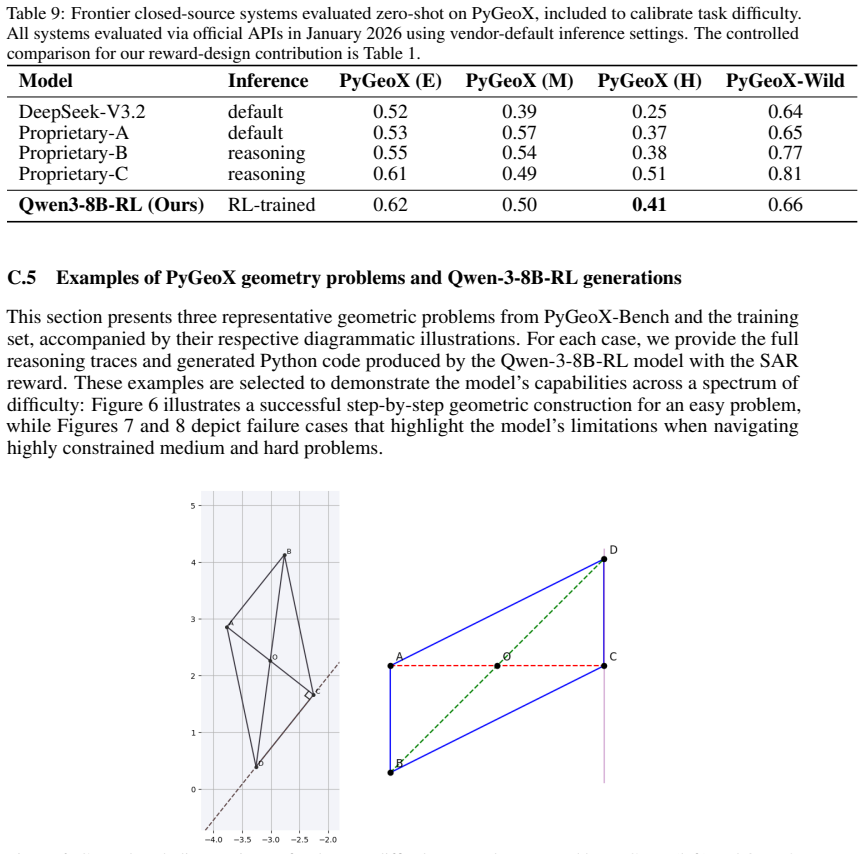
- An 8B-parameter model trained under SAR reaches performance comparable to much larger frontier systems on the benchmark.
- Per-constraint reward terms allow direct inspection of which individual constraints remain unsatisfied during generation.
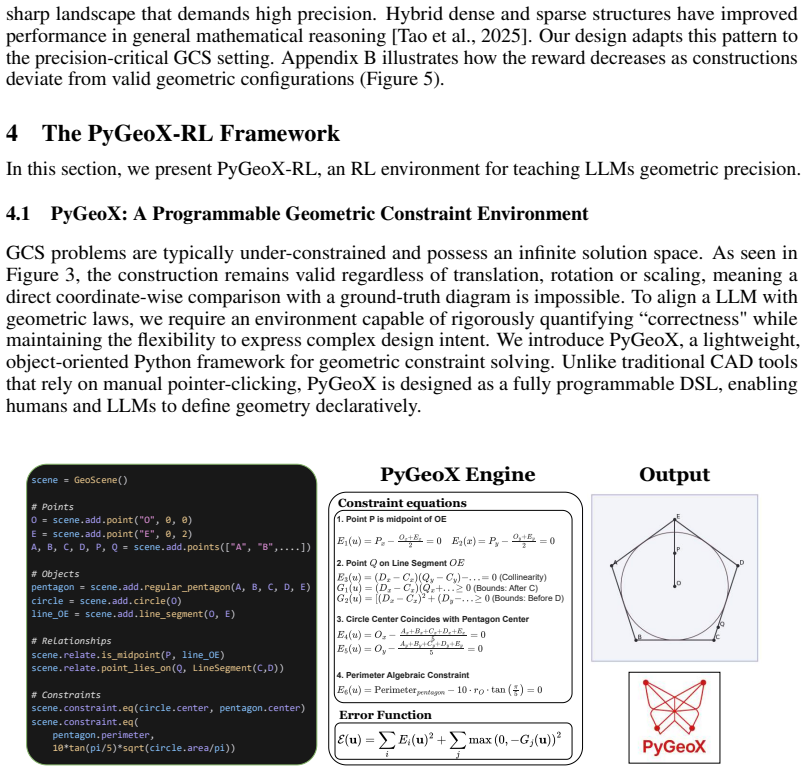
- The released PyGeoX DSL turns declarative geometric constraints into a differentiable loss that can be used for any downstream training method.
Where Pith is reading between the lines
- The same per-component saturation principle could be tested in other multi-constraint domains such as logical theorem proving or physical simulation from text.
- Future benchmarks could measure how the benefit of SAR scales when the typical number of constraints per problem increases beyond the current suite.
- Reward design that isolates and bounds each constraint may matter more than the choice of base loss function for any task that requires simultaneous satisfaction of many independent conditions.
Load-bearing premise
The 300 problems and their constraint interactions in PyGeoX-Bench are representative of the precision-critical geometric synthesis tasks that arise in real technical diagramming and mechanical design.
What would settle it
An experiment that retrains the same model on a fresh collection of geometric problems drawn from actual engineering drawings and finds that SAR produces no improvement over MSE-based rewards would falsify the central claim.
Figures



read the original abstract
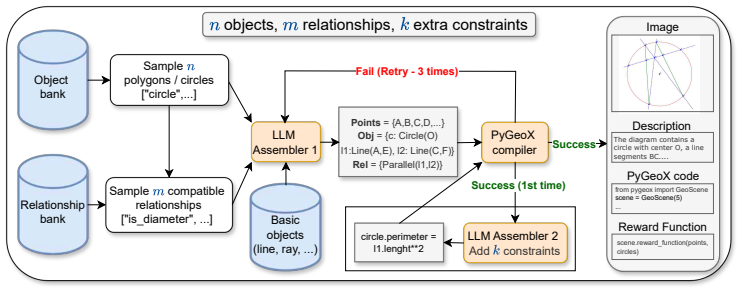
Large Language Models frequently hallucinate in precision-critical domains such as technical diagramming and mechanical design, where outputs must satisfy strict geometric constraints. We study open-ended geometric synthesis from natural language: translating free-form descriptions into precise constructions whose entities must simultaneously satisfy dozens of interacting constraints. To make this tractable, we release PyGeoX, a programmable geometric DSL that compiles declarative constraints into a differentiable loss, and PyGeoX-Bench, a stratified suite of 300 problems with per-constraint verifiable rewards. Using PyGeoX as a verifier, we identify a failure mode we call Outlier Gradient Masking: under global-norm rewards (any scheme that aggregates residuals through a single norm, for example, $\exp(-\mathrm{MSE})$), a single outlier constraint can nullify the learning signal across all others. To address this, we propose Saturating Additive Rewards (SAR), which decompose the reward into bounded per-constraint terms, preserving partial progress and ensuring consistent gradients even under severe violations. Against MSE-based rewards, the natural baseline for geometry solvers, SAR improves the hard-tier solving rate by $2.3\times$, and the resulting 8B model is competitive with much larger frontier systems on this benchmark. We release the engine, benchmark, and data at https://github.com/Huawei-AI4Math/PyGeoX.
Editorial analysis
A structured set of objections, weighed in public.
Referee Report
Summary. The manuscript introduces PyGeoX, a programmable geometric DSL that compiles declarative constraints into a differentiable loss, and PyGeoX-Bench, a stratified 300-problem suite with per-constraint verifiable rewards. It diagnoses an 'Outlier Gradient Masking' failure mode under global-norm rewards (e.g., exp(-MSE)) and proposes Saturating Additive Rewards (SAR) that decompose the reward into bounded per-constraint terms. The central empirical claim is that SAR yields a 2.3× higher hard-tier solving rate than MSE-based rewards on the benchmark, with the resulting 8B model competitive with larger frontier systems; the DSL compiler, benchmark, and training code are released.
Significance. If the reported performance gains hold under detailed scrutiny, the work supplies a targeted reward-design technique for training LLMs on precision-critical geometric synthesis, directly addressing a diagnosed gradient issue in constraint aggregation. The explicit release of the engine, benchmark artifacts, and code constitutes a clear strength, supporting reproducibility and follow-on work in technical diagramming and mechanical design applications.
minor comments (3)
- Abstract: the notation exp(-MSE) is used without an accompanying equation or explicit definition of the aggregation; a one-line formal statement of the baseline reward would improve immediate readability.
- Abstract: the phrase 'hard-tier solving rate' is introduced without a parenthetical definition or reference to the stratification criteria used in PyGeoX-Bench; a brief clarification would help readers interpret the 2.3× figure.
- The manuscript would benefit from an explicit statement in the experimental section (or a dedicated reproducibility paragraph) confirming that the released training code exactly reproduces the reported 2.3× delta under the same random seeds and hyper-parameters.
Simulated Author's Rebuttal
We thank the referee for the accurate summary of our work and the recommendation for minor revision. The assessment correctly captures the PyGeoX DSL, the 300-problem benchmark, the identification of outlier gradient masking, and the SAR reward design. No specific major comments were raised in the report.
Circularity Check
No significant circularity; empirical result on released benchmark
full rationale
The paper's core contribution is an empirical comparison: SAR yields a 2.3× higher hard-tier solve rate than MSE-based rewards on the newly introduced, released PyGeoX-Bench. The method (per-constraint bounded rewards vs. global-norm aggregation) and the identified failure mode (Outlier Gradient Masking) are presented as observations from running the solver, not as derivations that reduce to fitted parameters or self-citations. No equations, uniqueness theorems, or ansatzes are invoked that loop back to the inputs by construction. The benchmark, DSL compiler, and training code are released, making the numerical claim directly falsifiable outside any internal loop. This is a standard non-circular empirical paper.
Axiom & Free-Parameter Ledger
axioms (1)
- domain assumption PyGeoX-Bench problems capture the interacting constraints typical of real precision-critical geometric tasks
invented entities (1)
-
Saturating Additive Rewards (SAR)
no independent evidence
Reference graph
Works this paper leans on
-
[1]
Nature , volume=
AlphaGeometry: An Automatic Theorem Prover for High-School Geometry , author=. Nature , volume=
-
[2]
Proceedings of the International Conference on Learning Representations (ICLR) , year=
GeometryZero: Generating Geometry Proofs by Searching with Group Contrastive Policy Optimization , author=. Proceedings of the International Conference on Learning Representations (ICLR) , year=
-
[3]
Science Robotics , volume=
INGRID: Instructing Generative Robots with Kinematic Mechanism Design , author=. Science Robotics , volume=
-
[4]
2025 , eprint=
RLCAD: Reinforcement Learning Training Gym for Revolution Involved CAD Command Sequence Generation , author=. 2025 , eprint=
2025
-
[5]
ArXiv , year=
ReCAD: Reinforcement Learning Enhanced Parametric CAD Model Generation with Vision-Language Models , author=. ArXiv , year=
-
[6]
Proceedings of the IEEE/CVF Conference on Computer Vision and Pattern Recognition (CVPR) , year=
GeoCoder: Fine-tuning VLMs for Visual Geometric Code Synthesis , author=. Proceedings of the IEEE/CVF Conference on Computer Vision and Pattern Recognition (CVPR) , year=
-
[7]
arXiv preprint arXiv:2501.00001 , year=
AlphaGeometry 2: Advancing Automated Geometric Theorem Proving , author=. arXiv preprint arXiv:2501.00001 , year=
-
[8]
Nature Machine Intelligence , year=
BIRM: Bridging Intermediate Reasoning and Master Models for Complex Task Solving , author=. Nature Machine Intelligence , year=
-
[9]
Proceedings of the International Conference on Machine Learning (ICML) , year=
PIRF: Physics-Informed Reward Fine-Tuning for Generative Models , author=. Proceedings of the International Conference on Machine Learning (ICML) , year=
-
[10]
ASME Journal of Mechanical Design , year=
Creative Synthesis of Kinematic Mechanisms via Variational Autoencoders , author=. ASME Journal of Mechanical Design , year=
-
[11]
Wang, Junxiao and Zhang, Ting and Yu, Heng and Wang, Jingdong and Huang, Hua , journal=
-
[12]
Wei, Jingxuan and Jia, Caijun and Bai, Xi and Xu, Xinglong and Li, Siyuan and Sun, Linzhuang and Yu, Bihui and He, Conghui and Wu, Lijun and Tan, Cheng , journal=
-
[13]
2025 , note=
Aligning Constraint Generation with Design Intent in Parametric CAD , author=. 2025 , note=
2025
-
[14]
2023 , eprint=
FormalGeo: An Extensible Formalized Framework for Olympiad Geometric Problem Solving , author=. 2023 , eprint=
2023
-
[15]
ArXiv , title =
Jian Hu and Xibin Wu and Weixun Wang and Dehao Zhang and Yu Cao and OpenLLMAI Team and Netease Fuxi and AI Lab and Alibaba Group , booktitle =. ArXiv , title =
-
[16]
Nature645(8081), 633–638 (Sep 2025)
DeepSeek-R1 incentivizes reasoning in LLMs through reinforcement learning , volume=. Nature , publisher=. 2025 , month=sep, pages=. doi:10.1038/s41586-025-09422-z , number=
-
[17]
Curves and Surfaces in Unigraphics and Parasolid , ISBN=
Sears, Ken and Allen, George , year=. Curves and Surfaces in Unigraphics and Parasolid , ISBN=. doi:10.1007/978-3-322-86773-5_8 , booktitle=
-
[18]
SolveSpace: Parametric 2d/3d CAD , url =
Westhues, Jonathan and. SolveSpace: Parametric 2d/3d CAD , url =
-
[19]
Ziatdinov, Rushan and Valles, James R. , year=. Synthesis of Modeling, Visualization, and Programming in GeoGebra as an Effective Approach for Teaching and Learning STEM Topics , volume=. Mathematics , publisher=. doi:10.3390/math10030398 , number=
-
[20]
PeerJ Computer Science , issn =
SymPy: symbolic computing in Python , author =. PeerJ Computer Science , issn =
-
[21]
Z3: An Efficient SMT Solver
de Moura, Leonardo and Bj rner, Nikolaj. Z3: An Efficient SMT Solver. Tools and Algorithms for the Construction and Analysis of Systems. 2008
2008
-
[22]
An introduction to geometry expert
Chou, Shang-Ching and Gao, Xiao-Shan and Zhang, Jing-Zhong. An introduction to geometry expert. Automated Deduction --- Cade-13. 1996
1996
-
[23]
2025 , eprint=
GeoLoom: High-quality Geometric Diagram Generation from Textual Input , author=. 2025 , eprint=
2025
-
[24]
ArXiv , title =
Zhibin Gou and Zhihong Shao and Yeyun Gong and Yelong Shen and Yujiu Yang and Minlie Huang and Nan Duan and Weizhu Chen , booktitle =. ArXiv , title =
-
[25]
Raissi and P
M. Raissi and P. Perdikaris and G. Karniadakis , booktitle =. ArXiv , title =
-
[26]
Olympiad-level formal mathematical reasoning with reinforcement learning
Hubert, Thomas and Mehta, Rishi and Sartran, Laurent and Horv. Olympiad-level formal mathematical reasoning with reinforcement learning , journal =. 2025 , month =. doi:10.1038/s41586-025-09833-y , url =
-
[27]
2025 , eprint=
Reinforcement Learning with Verifiable Rewards Implicitly Incentivizes Correct Reasoning in Base LLMs , author=. 2025 , eprint=
2025
-
[28]
Leike and John Schulman and I
Hunter Lightman and Vineet Kosaraju and Yura Burda and Harrison Edwards and Bowen Baker and Teddy Lee and J. Leike and John Schulman and I. Sutskever and K. Cobbe , booktitle =. ArXiv , title =
-
[29]
2025 , eprint=
Hybrid Reinforcement: When Reward Is Sparse, It's Better to Be Dense , author=. 2025 , eprint=
2025
-
[30]
2025 , eprint=
Aligning Constraint Generation with Design Intent in Parametric CAD , author=. 2025 , eprint=
2025
-
[31]
2025 , eprint=
CAD-Llama: Leveraging Large Language Models for Computer-Aided Design Parametric 3D Model Generation , author=. 2025 , eprint=
2025
-
[32]
2024 , eprint=
CAD-GPT: Synthesising CAD Construction Sequence with Spatial Reasoning-Enhanced Multimodal LLMs , author=. 2024 , eprint=
2024
-
[33]
2025 , eprint=
CAD-MLLM: Unifying Multimodality-Conditioned CAD Generation With MLLM , author=. 2025 , eprint=
2025
-
[34]
2025 , eprint=
CrystalFormer-RL: Reinforcement Fine-Tuning for Materials Design , author=. 2025 , eprint=
2025
-
[35]
2026 , eprint=
GGBench: A Geometric Generative Reasoning Benchmark for Unified Multimodal Models , author=. 2026 , eprint=
2026
-
[36]
2018 , eprint=
Equivalence Between Policy Gradients and Soft Q-Learning , author=. 2018 , eprint=
2018
-
[37]
2022 , eprint=
RL with KL penalties is better viewed as Bayesian inference , author=. 2022 , eprint=
2022
-
[38]
Hinton, Geoffrey E. , title =. Neural Computation , volume =. 2002 , month =. doi:10.1162/089976602760128018 , url =
-
[39]
2022 , eprint=
GeoQA: A Geometric Question Answering Benchmark Towards Multimodal Numerical Reasoning , author=. 2022 , eprint=
2022
-
[40]
2022 , eprint=
UniGeo: Unifying Geometry Logical Reasoning via Reformulating Mathematical Expression , author=. 2022 , eprint=
2022
-
[41]
2024 , eprint=
GeoEval: Benchmark for Evaluating LLMs and Multi-Modal Models on Geometry Problem-Solving , author=. 2024 , eprint=
2024
-
[42]
2024 , eprint=
FGeo-DRL: Deductive Reasoning for Geometric Problems through Deep Reinforcement Learning , author=. 2024 , eprint=
2024
-
[43]
International Joint Conference on Artificial Intelligence , year=
A Multi-Modal Neural Geometric Solver with Textual Clauses Parsed from Diagram , author=. International Joint Conference on Artificial Intelligence , year=
-
[44]
ArXiv , year=
GeoSense: Evaluating Identification and Application of Geometric Principles in Multimodal Reasoning , author=. ArXiv , year=
-
[45]
2024 , eprint=
SWIFT:A Scalable lightWeight Infrastructure for Fine-Tuning , author=. 2024 , eprint=
2024
-
[46]
arXiv preprint arXiv:2405.11143 , year=
OpenRLHF: An Easy-to-use, Scalable and High-performance RLHF Framework , author=. arXiv preprint arXiv:2405.11143 , year=
discussion (0)
Sign in with ORCID, Apple, or X to comment. Anyone can read and Pith papers without signing in.