Predictive Assistance and the Temporal Dynamics of Exploratory Compression
Pith reviewed 2026-06-27 16:14 UTC · model grok-4.3
The pith
Predictive assistance stabilizes trajectories before self-generated exploration broadens strategy space.
A machine-rendered reading of the paper's core claim, the machinery that carries it, and where it could break.
Core claim
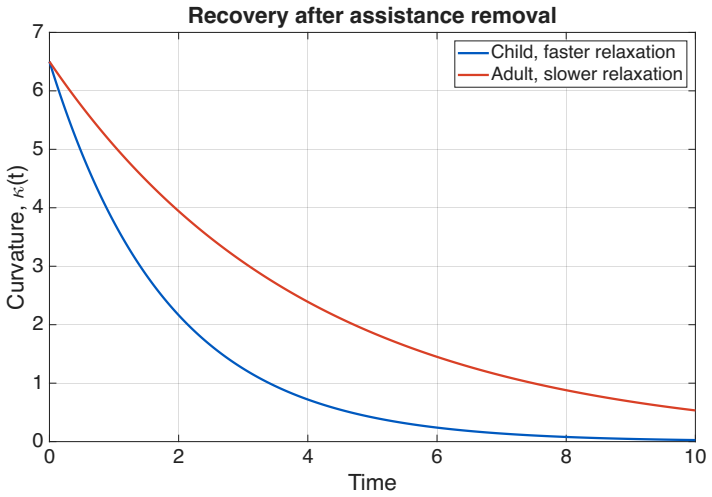
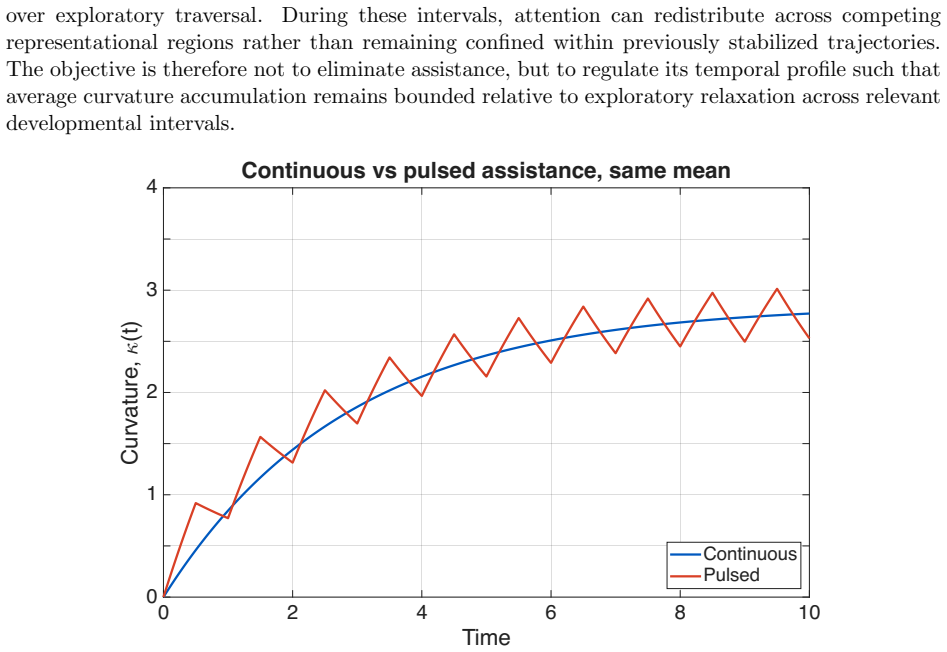
Predictive assistance modeled as exogenous exploratory compression stabilizes trajectories before self-generated exploration broadens the accessible regions of strategy space, yielding reduced exploratory responsiveness through attenuated perturbation influence, asymmetric curvature accumulation that produces hysteresis and delayed mobility recovery, and timing-dependent developmental narrowing when early stabilization occurs before representational diversification.
What carries the argument
Geometric dynamical framework in which attention evolves over a strategy landscape shaped by stabilizing drift, endogenous exploratory perturbation, and responsiveness-gated learning.
Load-bearing premise
Predictive assistance can be modeled as a process of exogenous exploratory compression that stabilizes trajectories before self-generated exploration broadens the accessible regions of strategy space.
What would settle it
A controlled developmental task showing that early predictive stabilization produces no measurable narrowing of later exploratory traversal or entropy would falsify the timing-dependent outcome.
Figures

read the original abstract
Classical theories of cognition describe problem solving as exploratory search through structured problem spaces in which repeated interaction gradually compresses search into efficient representational structures. Predictive artificial intelligence systems introduce a distinct regime in which stabilization may occur before exploratory diversification unfolds, supplying solutions and decision trajectories prior to internally generated search. This paper develops a geometric dynamical framework in which attention evolves over a landscape of strategies shaped by stabilizing drift, endogenous exploratory perturbation, and responsiveness-gated learning. Predictive assistance is modeled as a process of exogenous exploratory compression that stabilizes trajectories before self-generated exploration broadens the accessible regions of strategy space. The framework yields three main results. First, sustained predictive stabilization reduces exploratory responsiveness by attenuating the effective influence of intrinsic perturbations even when exploratory variability remains present. Second, curvature accumulates and relaxes asymmetrically, producing hysteresis and delayed recovery of exploratory mobility after assistance withdrawal. Third, developmental outcomes depend critically on the timing of stabilization, with early intervention narrowing future exploratory traversal before broad representational diversification has occurred. The framework generates empirically testable predictions concerning exploratory entropy, premature convergence, and delayed recovery following predictive stabilization. More broadly, the results suggest that predictive systems may reshape the geometry of exploratory cognition itself.
Editorial analysis
A structured set of objections, weighed in public.
Referee Report
Summary. The paper develops a geometric dynamical framework in which attention evolves over a strategy landscape under stabilizing drift, endogenous exploratory perturbation, and responsiveness-gated learning. Predictive assistance is modeled as exogenous exploratory compression that stabilizes trajectories prior to self-generated broadening of accessible regions. The framework is asserted to yield three results: (1) sustained stabilization attenuates the effective influence of intrinsic perturbations, reducing exploratory responsiveness even when variability remains; (2) curvature accumulates and relaxes asymmetrically, producing hysteresis and delayed recovery of mobility after assistance withdrawal; (3) timing of stabilization is critical, with early intervention narrowing future exploratory traversal before representational diversification. The paper states that these generate testable predictions on exploratory entropy, premature convergence, and delayed recovery.
Significance. If an explicit dynamical system were supplied and the three results were shown to follow rigorously from the stated components, the work would offer a potentially significant geometric perspective on how predictive AI systems can reshape the temporal structure of human exploration, including hysteresis and sensitive-period effects, with direct implications for cognitive modeling and the design of assistive technologies.
major comments (1)
- [Abstract] Abstract (third paragraph): The manuscript states that the framework 'yields three main results' on attenuated responsiveness, asymmetric curvature/hysteresis, and timing-dependent narrowing, yet supplies no vector field on the strategy landscape, no functional form for the exogenous compression term, no metric for curvature, and no derivations showing how the claimed behaviors are entailed by the dynamics of drift, perturbation, and gated learning. Without these elements the results cannot be verified as consequences rather than restatements of the modeling assumptions.
minor comments (1)
- [Abstract] Abstract (final paragraph): The claim that the framework 'generates empirically testable predictions concerning exploratory entropy, premature convergence, and delayed recovery' is not accompanied by any concrete operational definitions, quantitative measures, or experimental protocols that would allow those predictions to be tested.
Simulated Author's Rebuttal
We thank the referee for their review and for identifying the need for greater formalization. The central concern is that the three results are not shown to follow rigorously from an explicit dynamical system. We address this below and commit to revisions that supply the missing elements.
read point-by-point responses
-
Referee: [Abstract] Abstract (third paragraph): The manuscript states that the framework 'yields three main results' on attenuated responsiveness, asymmetric curvature/hysteresis, and timing-dependent narrowing, yet supplies no vector field on the strategy landscape, no functional form for the exogenous compression term, no metric for curvature, and no derivations showing how the claimed behaviors are entailed by the dynamics of drift, perturbation, and gated learning. Without these elements the results cannot be verified as consequences rather than restatements of the modeling assumptions.
Authors: We agree that the present manuscript describes the framework at a conceptual level and does not supply an explicit vector field, functional forms for the compression term or curvature metric, or derivations that demonstrate the three results follow from the stated components. This limitation means the behaviors are asserted rather than derived in the current text. In revision we will add a dedicated formal section that (i) defines the vector field governing attention evolution on the strategy landscape under stabilizing drift, endogenous perturbation, and responsiveness-gated learning; (ii) specifies the exogenous compression term as a time-dependent stabilizing operator; (iii) introduces a curvature metric derived from the landscape geometry; and (iv) provides analytic or simulation-based derivations showing how sustained stabilization attenuates effective perturbation influence, how curvature accumulates and relaxes asymmetrically, and how early timing narrows subsequent traversal. These additions will make the claimed results verifiable consequences of the dynamics rather than modeling assumptions. revision: yes
Circularity Check
No equations or derivations supplied; no load-bearing mathematical steps to inspect.
full rationale
The provided manuscript text consists entirely of verbal descriptions of a 'geometric dynamical framework' with no equations, vector fields, functional forms, or derivation steps. The three results are asserted to follow from the model, but without any explicit mathematics there is no derivation chain that can be walked or checked for reduction to inputs by construction. No self-citations, fitted parameters, or ansatzes appear in the text. The paper is therefore self-contained at the narrative level with no circularity detectable under the specified criteria.
Axiom & Free-Parameter Ledger
axioms (1)
- domain assumption Attention evolves over a landscape of strategies shaped by stabilizing drift, endogenous exploratory perturbation, and responsiveness-gated learning.
invented entities (1)
-
exogenous exploratory compression
no independent evidence
Reference graph
Works this paper leans on
-
[1]
Harvard University Press, 1994
Allen Newell.Unified Theories of Cognition. Harvard University Press, 1994
1994
-
[2]
A behavioral model of rational choice.The Quarterly Journal of Economics, 69(1):99–118, 1955
Herbert A Simon. A behavioral model of rational choice.The Quarterly Journal of Economics, 69(1):99–118, 1955
1955
-
[3]
Oxford University Press, 1999
Gerd Gigerenzer, Peter M Todd, and the ABC Research Group.Simple Heuristics That Make Us Smart. Oxford University Press, 1999
1999
-
[4]
Perception in chess.Cognitive Psychology, 4(1):55–81, 1973
William G Chase and Herbert A Simon. Perception in chess.Cognitive Psychology, 4(1):55–81, 1973
1973
-
[5]
Prentice-Hall, Englewood Cliffs, NJ, 1972
Allen Newell and Herbert A Simon.Human Problem Solving. Prentice-Hall, Englewood Cliffs, NJ, 1972
1972
-
[6]
Bennett, Kori Inkpen, et al
Saleema Amershi, Daniel Weld, Mihaela Vorvoreanu, Adam Fourney, Besmira Nushi, Penny Collisson, Jina Suh, Shamsi Iqbal, Paul N. Bennett, Kori Inkpen, et al. Guidelines for human- ai interaction. InProceedings of the 2019 CHI Conference on Human Factors in Computing Systems, pages 1–13, 2019
2019
-
[7]
Zana Bu¸ cinca, Maja Barbara Malaya, and Krzysztof Z Gajos. To trust or to think: Cognitive forcing functions can reduce overreliance on AI in AI-assisted decision-making.Proceedings of the ACM on Human-Computer Interaction, 5(CSCW1):1–21, 2021
2021
-
[8]
Cenk C ¸ avu¸ so˘ glu, Elizabeth A Krupinski, Naren Nallapareddy, Noelle E Nelson, Philip J Smith, Amy L Wilson-Delfosse, and Soumya Ray
Brooke N Macnamara, Ibrahim Berber, M. Cenk C ¸ avu¸ so˘ glu, Elizabeth A Krupinski, Naren Nallapareddy, Noelle E Nelson, Philip J Smith, Amy L Wilson-Delfosse, and Soumya Ray. Does using artificial intelligence assistance accelerate skill decay and hinder skill development without performers’ awareness?Cognitive Research: Principles and Implications, 9(1...
2024
-
[9]
A model for types and levels of human interaction with automation.IEEE Transactions on Systems, Man, and Cybernetics-Part A: Systems and Humans, 30(3):286–297, 2000
Raja Parasuraman, Thomas B Sheridan, and Christopher D Wickens. A model for types and levels of human interaction with automation.IEEE Transactions on Systems, Man, and Cybernetics-Part A: Systems and Humans, 30(3):286–297, 2000
2000
-
[10]
Farrar, Straus and Giroux, 2011
Daniel Kahneman.Thinking, Fast and Slow. Farrar, Straus and Giroux, 2011
2011
-
[11]
On the dangers of stochastic parrots: Can language models be too big? InProceedings of the 2021 ACM Conference on Fairness, Accountability, and Transparency, pages 610–623, 2021
Emily M Bender, Timnit Gebru, Angelina McMillan-Major, and Shmargaret Shmitchell. On the dangers of stochastic parrots: Can language models be too big? InProceedings of the 2021 ACM Conference on Fairness, Accountability, and Transparency, pages 610–623, 2021
2021
-
[12]
On the Opportunities and Risks of Foundation Models
Rishi Bommasani, Drew A Hudson, Ehsan Adeli, et al. On the opportunities and risks of foundation models.arXiv preprint arXiv:2108.07258, 2021
work page internal anchor Pith review Pith/arXiv arXiv 2021
-
[13]
Ai, human cognition and knowledge collapse
Daron Acemoglu, Dingwen Kong, and Asuman Ozdaglar. Ai, human cognition and knowledge collapse. Technical report, National Bureau of Economic Research, 2026
2026
-
[14]
Habitual use of gps negatively impacts spatial memory during self-guided navigation.Scientific Reports, 10(1):6310, 2020
Louisa Dahmani and V´ eronique D Bohbot. Habitual use of gps negatively impacts spatial memory during self-guided navigation.Scientific Reports, 10(1):6310, 2020
2020
-
[15]
Potential cognitive risks of generative transformer-based ai chat- bots on higher order executive functions.Neuropsychology, 38(4):293–308, 2024
Umberto Le´ on-Dom´ ınguez. Potential cognitive risks of generative transformer-based ai chat- bots on higher order executive functions.Neuropsychology, 38(4):293–308, 2024. 20
2024
-
[16]
Making things hard on yourself, but in a good way: Creating desirable difficulties to enhance learning
Robert A Bjork and Elizabeth L Bjork. Making things hard on yourself, but in a good way: Creating desirable difficulties to enhance learning. InPsychology and the Real World: Essays Illustrating Fundamental Contributions to Society, pages 56–64. Worth Publishers, 2011
2011
-
[17]
Productive failure.Cognition and Instruction, 26(3):379–424, 2008
Manu Kapur. Productive failure.Cognition and Instruction, 26(3):379–424, 2008
2008
-
[18]
Information- seeking, curiosity, and attention: Computational and neural mechanisms.Trends in Cognitive Sciences, 17(11):585–593, 2013
Jacqueline Gottlieb, Pierre-Yves Oudeyer, Manuel Lopes, and Adrien Baranes. Information- seeking, curiosity, and attention: Computational and neural mechanisms.Trends in Cognitive Sciences, 17(11):585–593, 2013
2013
-
[19]
States of curiosity modulate hippocampus-dependent learning via the dopaminergic circuit.Neuron, 84(2):486–496, 2014
Matthias J Gruber, Bernard D Gelman, and Charan Ranganath. States of curiosity modulate hippocampus-dependent learning via the dopaminergic circuit.Neuron, 84(2):486–496, 2014
2014
-
[20]
The restless mind.Psychological Bulletin, 132(6):946–958, 2006
Jonathan Smallwood and Jonathan W Schooler. The restless mind.Psychological Bulletin, 132(6):946–958, 2006
2006
-
[21]
Kalina Christoff, Zachary C Irving, Kieran C. R. Fox, R Nathan Spreng, and Jessica R Andrews-Hanna. Mind-wandering as spontaneous thought: A dynamic framework.Nature Reviews Neuroscience, 17(11):718–731, 2016
2016
-
[22]
The free-energy principle: A unified brain theory?Nature Reviews Neuroscience, 11(2):127–138, 2010
Karl Friston. The free-energy principle: A unified brain theory?Nature Reviews Neuroscience, 11(2):127–138, 2010
2010
-
[23]
Whatever next? predictive brains, situated agents, and the future of cognitive science.Behavioral and Brain Sciences, 36(3):181–204, 2013
Andy Clark. Whatever next? predictive brains, situated agents, and the future of cognitive science.Behavioral and Brain Sciences, 36(3):181–204, 2013
2013
-
[24]
MIT Press, 1994
Esther Thelen and Linda B Smith.A Dynamic Systems Approach to the Development of Cognition and Action. MIT Press, 1994
1994
-
[25]
MIT Press, 1995
J A Scott Kelso.Dynamic Patterns: The Self-Organization of Brain and Behavior. MIT Press, 1995
1995
-
[26]
Neural networks and physical systems with emergent collective computational abilities.Proceedings of the National Academy of Sciences, 79(8):2554–2558, 1982
John J Hopfield. Neural networks and physical systems with emergent collective computational abilities.Proceedings of the National Academy of Sciences, 79(8):2554–2558, 1982
1982
-
[27]
Cambridge University Press, Cambridge, 1989
Daniel J Amit.Modeling Brain Function: The World of Attractor Neural Networks. Cambridge University Press, Cambridge, 1989
1989
-
[28]
Attractor networks.Wiley Interdisciplinary Reviews: Cognitive Science, 1(1):119–134, 2010
Edmund T Rolls. Attractor networks.Wiley Interdisciplinary Reviews: Cognitive Science, 1(1):119–134, 2010
2010
-
[29]
Experience and brain development.Child Development, 58(3):539–559, 1987
William T Greenough, James E Black, and Christopher S Wallace. Experience and brain development.Child Development, 58(3):539–559, 1987
1987
-
[30]
Critical period plasticity in local cortical circuits.Nature Reviews Neuro- science, 6(11):877–888, 2005
Takao K Hensch. Critical period plasticity in local cortical circuits.Nature Reviews Neuro- science, 6(11):877–888, 2005
2005
-
[31]
Sensitive periods in the development of the brain and behavior.Journal of Cognitive Neuroscience, 16(8):1412–1425, 2004
Eric I Knudsen. Sensitive periods in the development of the brain and behavior.Journal of Cognitive Neuroscience, 16(8):1412–1425, 2004
2004
-
[32]
The double-edged sword of pedagogy: Instruction limits spontaneous exploration and discovery.Cognition, 120(3):322–330, 2011
Elizabeth Bonawitz, Patrick Shafto, Hyowon Gweon, Noah D Goodman, Elizabeth Spelke, and Laura Schulz. The double-edged sword of pedagogy: Instruction limits spontaneous exploration and discovery.Cognition, 120(3):322–330, 2011. 21
2011
-
[33]
Childhood as a solution to explore–exploit tradeoff.Philosophical Transactions of the Royal Society B: Biological Sciences, 372(1711):20160050, 2017
Alison Gopnik, Sophie O’Grady, Christopher G Lucas, et al. Childhood as a solution to explore–exploit tradeoff.Philosophical Transactions of the Royal Society B: Biological Sciences, 372(1711):20160050, 2017
2017
-
[34]
Context and behavioral processes in extinction.Learning & Memory, 11(5):485–494, 2004
Mark E Bouton. Context and behavioral processes in extinction.Learning & Memory, 11(5):485–494, 2004
2004
-
[35]
Uncertainty-based competition between prefrontal and dorsolateral striatal systems for behavioral control.Nature Neuroscience, 8(12):1704–1711, 2005
Nathaniel D Daw, Yael Niv, and Peter Dayan. Uncertainty-based competition between prefrontal and dorsolateral striatal systems for behavioral control.Nature Neuroscience, 8(12):1704–1711, 2005
2005
-
[36]
London taxi drivers: A review of neurocognitive studies and an exploration of how they build their cognitive map of london.Hippocampus, 32(1):3–20, 2022
Eva-Maria Griesbauer, Ed Manley, Jan M Wiener, and Hugo J Spiers. London taxi drivers: A review of neurocognitive studies and an exploration of how they build their cognitive map of london.Hippocampus, 32(1):3–20, 2022
2022
-
[37]
A mathematical theory of communication.The Bell System Technical Journal, 27(3):379–423, 1948
Claude Elwood Shannon. A mathematical theory of communication.The Bell System Technical Journal, 27(3):379–423, 1948. Author Contributions BBdesigned the research, developed the model, and wrote the manuscript. Acknowledgements and Disclosures The author declares no relevant financial relationships or other potential conflicts of interest. 22 A A Mathemat...
1948
discussion (0)
Sign in with ORCID, Apple, or X to comment. Anyone can read and Pith papers without signing in.