HE-DAP: Homomorphic Encryption-based Dynamic Adaptive Parameter Optimization for Statistical Computation
Pith reviewed 2026-06-27 12:54 UTC · model grok-4.3
The pith
HE-DAP profiles an environment's costs to choose polynomial degree versus bootstrapping iterations, speeding encrypted inverse square root up to 2.35x.
A machine-rendered reading of the paper's core claim, the machinery that carries it, and where it could break.
Core claim
By measuring the relative cost of polynomial evaluation against bootstrapping on a given platform, HE-DAP selects the polynomial degree and iteration count that together minimize runtime for a stated accuracy bound; this yields up to 2.35x faster inverse-square-root evaluation than the static parameters used in prior PP-STAT work, with the same numerical fidelity, on Lattigo, HEaaN-CPU, and HEaaN-GPU.
What carries the argument
Environment profiler that records the cost ratio between Chebyshev polynomial evaluation and bootstrapping to pick the optimal degree-iteration pair for a target accuracy.
If this is right
- End-to-end privacy-preserving statistical analyses complete faster when the inverse-square-root primitive is replaced by the profiled configuration.
- The same adaptive selection works across CPU and GPU back-ends and across different HE libraries.
- Numerical accuracy stays within the reported MRE bound for the chosen accuracy targets.
- The framework removes the need for manual retuning when moving the same workload to new hardware.
Where Pith is reading between the lines
- The same cost-ratio profiling could be applied to other HE numerical kernels that trade polynomial work against noise management.
- Cloud deployments that span heterogeneous nodes would see the largest benefit because fixed parameters cannot be optimal everywhere.
- If the profiler were made lightweight and incremental, it could react to runtime changes in load or noise growth without a separate offline phase.
Load-bearing premise
A single profiling run on the target library and hardware captures stable relative costs that remain optimal for an entire statistical workload.
What would settle it
Execute a full end-to-end statistical analysis (multiple operations beyond inverse square root) once with the adaptive parameters and once with the fixed PP-STAT parameters; the 2.35x speedup must appear in wall-clock time or the claim fails.
Figures

read the original abstract
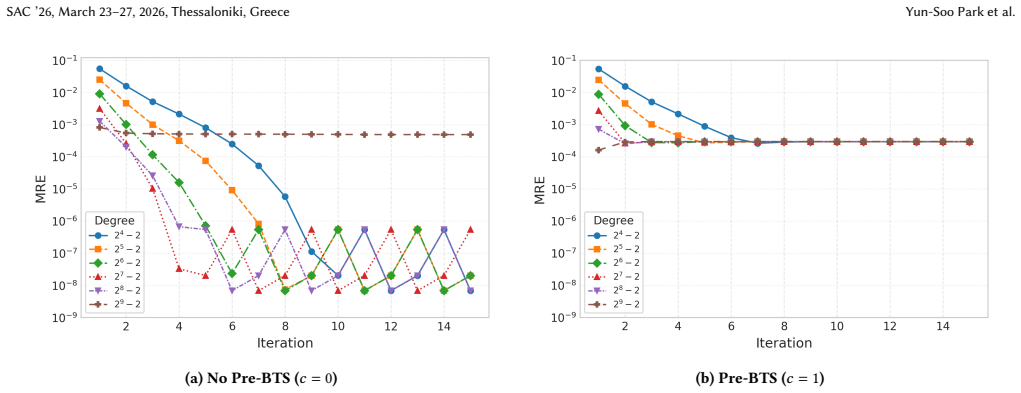
Homomorphic encryption (HE) enables privacy-preserving analytics but remains hindered by high computational overhead. We find that the inverse square root-a key primitive in many statistical and machine learning workloads-exhibits inconsistent and often suboptimal performance across HE libraries and hardware. This stems from a core trade-off between two costly HE operations: evaluating high-degree Chebyshev polynomials to speed up Newton's method versus performing bootstrapping to manage ciphertext noise. Because their relative costs vary by up to 6x across environments, any fixed configuration proves inherently inefficient. To address this challenge, we present HE-DAP, a cross-platform optimization framework that automatically navigates this trade-off. By profiling an environment's unique performance characteristics, HE-DAP finds the optimal balance between polynomial degree and iteration count to accelerate the encrypted inverse square root computation for a given accuracy target. Our evaluation on Lattigo, HEaaN-CPU, and HEaaN-GPU shows that HE-DAP's adaptive approach yields significant performance gains. It accelerates the core inverse square root computation by up to 2.35x over the fixed configuration in PP-STAT while maintaining high numerical accuracy (MRE <= 3.1 x 10^-8). We further demonstrate that optimizing this fundamental building block directly enhances the end-to-end performance of complex statistical analyses, confirming the practical benefits of our environment-aware approach. By automatically adapting to heterogeneous execution environments, HE-DAP demonstrates that principled parameter optimization can make privacy-preserving statistical analytics practical at scale.
Editorial analysis
A structured set of objections, weighed in public.
Referee Report
Summary. The paper introduces HE-DAP, a cross-platform framework that profiles an HE environment once to select the optimal polynomial degree and iteration count for inverse-square-root evaluation via Chebyshev approximation and Newton's method. It reports up to 2.35x speedup versus the fixed configuration used in PP-STAT on Lattigo, HEaaN-CPU and HEaaN-GPU while keeping mean relative error ≤ 3.1 imes 10^{-8}, and claims that the same optimized primitive improves end-to-end performance of statistical workloads.
Significance. If the empirical gains are reproducible and the one-time profile remains stable, the work supplies a practical, environment-aware method for mitigating the polynomial-evaluation versus bootstrapping trade-off that currently limits HE-based statistics. The explicit cross-library evaluation and the end-to-end demonstration are concrete strengths.
major comments (2)
- [Evaluation / §4] The central performance claim (2.35x) rests on a single profiling run whose optimality is asserted for the full statistical workload. No section demonstrates that the chosen (degree, iteration) pair remains optimal when data volume, memory pressure, or library internals change the relative cost of Chebyshev evaluation versus bootstrapping (the abstract itself notes up to 6x variation across environments).
- [§4 / Abstract] The manuscript provides no experimental protocol, error-bar methodology, or data-exclusion rules for the reported speedups and MRE figures. Without these, it is impossible to determine whether the 2.35x figure is robust or affected by post-hoc configuration selection.
minor comments (2)
- [§3.2] Define MRE explicitly and state the number of independent runs used to obtain the reported maximum.
- [§3.1] Clarify whether the profiling phase measures exactly the same operations that appear in the target statistical analyses or only micro-benchmarks.
Simulated Author's Rebuttal
We thank the referee for the constructive comments. We address each major point below and will revise the manuscript to strengthen the evaluation section.
read point-by-point responses
-
Referee: [Evaluation / §4] The central performance claim (2.35x) rests on a single profiling run whose optimality is asserted for the full statistical workload. No section demonstrates that the chosen (degree, iteration) pair remains optimal when data volume, memory pressure, or library internals change the relative cost of Chebyshev evaluation versus bootstrapping (the abstract itself notes up to 6x variation across environments).
Authors: The HE-DAP profiling measures the relative costs of polynomial evaluation versus bootstrapping, which are the dominant factors in the trade-off and are determined by the HE library, hardware, and parameter set rather than workload data volume. We therefore expect the selected configuration to generalize within a given environment. That said, the manuscript does not currently include explicit tests under varying data volumes or memory pressure. In the revision we will add such experiments to §4 to confirm stability of the gains or identify any needed re-profiling triggers. revision: yes
-
Referee: [§4 / Abstract] The manuscript provides no experimental protocol, error-bar methodology, or data-exclusion rules for the reported speedups and MRE figures. Without these, it is impossible to determine whether the 2.35x figure is robust or affected by post-hoc configuration selection.
Authors: We agree that the experimental protocol is insufficiently documented. The reported 2.35x and MRE figures derive directly from the single profiling run per library/hardware combination followed by end-to-end workload measurements; no post-hoc selection on final results occurred. In the revised manuscript we will add a dedicated experimental methodology subsection in §4 that specifies timing measurement procedure, number of repetitions, error computation (where applicable), and data inclusion criteria. revision: yes
Circularity Check
No circularity: empirical speedup measured after independent profiling step
full rationale
The paper's central claim is an empirical measurement: after a one-time profiling run that records relative costs of Chebyshev evaluation vs. bootstrapping on the target platform, HE-DAP selects a (degree, iteration) pair and the authors then time the resulting inverse-square-root routine, reporting up to 2.35× over a fixed baseline while keeping MRE ≤ 3.1×10^{-8}. No equation in the provided abstract or described method reduces the reported speedup to the profiled numbers by algebraic identity; the speedup is an observed quantity, not a fitted parameter renamed as a prediction. No self-citation chain, uniqueness theorem, or ansatz smuggling is invoked to justify the result. The derivation chain is therefore self-contained against external benchmarks (wall-clock timings on Lattigo/HEaaN).
Axiom & Free-Parameter Ledger
Reference graph
Works this paper leans on
-
[1]
Saba Akram and Quarrat Ul Ann. 2015. Newton Raphson method.International Journal of Scientific & Engineering Research6, 7 (2015), 1748–1752
2015
-
[2]
Nahida Akter and Ashadun Nobi. 2018. Investigation of the financial stability of S&P 500 using realized volatility and stock returns distribution.Journal of Risk and Financial Management11, 2 (2018), 22
2018
-
[3]
2023.Homomorphic Encryption for Private Learning
Apple Machine Learning Research. 2023.Homomorphic Encryption for Private Learning. Apple Inc. https://machinelearning.apple.com/research/homomorphic- encryption Accessed: 2025-12-09
2023
-
[4]
Barry Becker and Ronny Kohavi. 1996. Adult. UCI Machine Learning Repository. DOI: https://doi.org/10.24432/C5XW20
-
[5]
Jean-Philippe Bossuat, Rosario Cammarota, Ilaria Chillotti, Benjamin R Curtis, Wei Dai, Huijing Gong, Erin Hales, Duhyeong Kim, Bryan Kumara, Changmin Lee, et al. 2024. Security guidelines for implementing homomorphic encryption. Cryptology ePrint Archive(2024). https://eprint.iacr.org/2024/463
2024
-
[6]
Zvika Brakerski, Craig Gentry, and Vinod Vaikuntanathan. 2014. (Leveled) fully homomorphic encryption without bootstrapping.ACM Transactions on Computation Theory (TOCT)6, 3 (2014), 1–36
2014
-
[7]
Nishanth Chandran, Divya Gupta, Sai Lakshmi Bhavana Obbattu, and Akash Shah. 2022. SIMC:ML inference secure against malicious clients at Semi-Honest cost. In31st USENIX Security Symposium (USENIX Security 22). 1361–1378
2022
-
[8]
Junghee Cheon, Kyoohyung Han, Andrew Kim, Miran Kim, and Yongsoo Song
-
[9]
InAdvances in Cryptology–EUROCRYPT 2018
Bootstrapping for Approximate Homomorphic Encryption. InAdvances in Cryptology–EUROCRYPT 2018. Springer, 360–384
2018
-
[10]
Jung Hee Cheon, Andrey Kim, Miran Kim, and Yongsoo Song. 2017. Homo- morphic encryption for arithmetic of approximate numbers. InAdvances in Cryptology–ASIACRYPT 2017. Springer, 409–437
2017
-
[11]
Seonyoung Cheon, Youngwoo Lee, Ju Min Lee, Sunchul Jung, Taekyung Kim, Dongyoon Lee, and Hanjun Kim. 2024. DaCapo: Automatic Bootstrapping Man- agement for Efficient Fully Homomorphic Encryption. InProceedings of the 33rd USENIX Conference on Security Symposium. 6693–7010
2024
-
[12]
Seonyoung Cheon, Yongwoo Lee, Hoyun Youm, Dongkwan Kim, Sungwoo Yun, Kunmo Jeong, Dongyoon Lee, and Hanjun Kim. 2025. HALO: Loop-aware Boot- strapping Management for Fully Homomorphic Encryption. InProceedings of the 30th ACM International Conference on Architectural Support for Programming Languages and Operating Systems (ASPLOS). ACM, 572–585
2025
-
[13]
Ilaria Chillotti, Nicolas Gama, Mariya Georgieva, and Malika Izabachène. 2016. Faster fully homomorphic encryption: bootstrapping in less than 0.1 seconds. In Advances in Cryptology–ASIACRYPT 2016. Springer, 3–33
2016
-
[14]
Hyunmin Choi. 2025. PP-STAT: An Efficient Privacy-Preserving Statistical Anal- ysis Framework using Homomorphic Encryption. InProceedings of the 34th ACM International Conference on Information and Knowledge Management. 448–457
2025
-
[15]
Hyunmin Choi, Jiwon Kim, Chiyoung Song, Simon S Woo, and Hyoungshick Kim. 2024. Blind-match: efficient homomorphic encryption-based 1: N matching for privacy-preserving biometric identification. InProceedings of the 33rd ACM International Conference on Information and Knowledge Management. 4423–4430
2024
-
[16]
Hyunmin Choi, Simon S Woo, and Hyoungshick Kim. 2024. Blind-touch: Ho- momorphic encryption-based distributed neural network inference for privacy- preserving fingerprint authentication. InProceedings of the AAAI conference on artificial intelligence, Vol. 38. 21976–21985
2024
-
[17]
Junfeng Fan and Frederik Vercauteren. 2012. Somewhat practical fully homomor- phic encryption.Cryptology ePrint Archive144 (2012). https://eprint.iacr.org/ 2012/144
2012
-
[18]
Craig Gentry. 2009. Fully homomorphic encryption using ideal lattices. InProceed- ings of the forty-first annual ACM symposium on Theory of computing. 169–178
2009
-
[19]
HEaaN 2025. HEaaN. Online: https://heaan.it. CryptoLab, Accessed: 2025-12-09
2025
-
[20]
HEaaN.Stat-gpu v1.0.0
HEaaN.Stat SDK 2025. HEaaN.Stat-gpu v1.0.0. Online: https://hub.docker.com/r/ cryptolabinc/heaan-stat. CryptoLab, Accessed: 2025-12-09
2025
-
[21]
M. A. Hernandez. 2001. Chebyshev’s approximation algorithms and applications. Computers & Mathematics with Applications41, 3–4 (2001), 433–445
2001
-
[22]
2024.Intesa Sanpaolo and IBM Use Fully Homomorphic Encryption to Enable Secure Digital Transactions
IBM. 2024.Intesa Sanpaolo and IBM Use Fully Homomorphic Encryption to Enable Secure Digital Transactions. IBM Newsroom. https://www.ibm.com/case-studies/ blog/intesa-sanpaolo-ibm-secure-digital-transactions-fhe Accessed: 2025-12-09
2024
-
[23]
Lattigo v6
Lattigo 2025. Lattigo v6. Online: https://github.com/tuneinsight/lattigo. EPFL- LDS, Tune Insight SA, Accessed: 2025-12-09
2025
-
[24]
Seewoo Lee, Garam Lee, Jung Woo Kim, Junbum Shin, and Mun-Kyu Lee. 2023. HETAL: Efficient privacy-preserving transfer learning with homomorphic en- cryption. InInternational conference on machine learning. PMLR, 19010–19035
2023
-
[25]
Younho Lee, Jinyeong Seo, Yujin Nam, Jiseok Chae, and Jung Hee Cheon. 2023. HEaaN-STAT: a privacy-preserving statistical analysis toolkit for large-scale numerical, ordinal, and categorical data.IEEE Transactions on Dependable and Secure Computing21, 3 (2023), 1224–1241
2023
-
[26]
Yan Liu, Jianxin Lai, Long Li, Tianxiang Sui, Linjie Xiao, Peng Yuan, Xiaojing Zhang, Qing Zhu, Wenguang Chen, and Jingling Xue. 2025. ReSBM: Region-based Scale and Minimal-Level Bootstrapping Management for FHE via Min-Cut. In Proceedings of the 30th ACM International Conference on Architectural Support for Programming Languages and Operating Systems (AS...
2025
-
[27]
2021.Password Monitor: Safeguarding Passwords in Microsoft Edge
Microsoft Research Blog. 2021.Password Monitor: Safeguarding Passwords in Microsoft Edge. Microsoft. https://www.microsoft.com/en-us/research/blog/ password-monitor-safeguarding-passwords-in-microsoft-edge/ Accessed: 2025- 12-09
2021
-
[28]
Marie Paindavoine and Bastien Vialla. 2015. Minimizing the Number of Bootstrap- pings in Fully Homomorphic Encryption. InProceedings of the 22nd International Conference on Selected Areas in Cryptography. 25–43
2015
-
[29]
Samanvaya Panda. 2022. Polynomial approximation of inverse sqrt function for FHE. InInternational Symposium on Cyber Security, Cryptology, and Machine Learning. Springer, 366–376
2022
-
[30]
Hongyuan Qu and Guangwu Xu. 2023. Improvements of homomorphic secure evaluation of inverse square root. InInternational Conference on Information and Communications Security. Springer, 110–127
2023
-
[31]
2024.Privacy in the Cloud: Speeding Up Homomorphic Encryp- tion with FPGAs
Red Hat Research. 2024.Privacy in the Cloud: Speeding Up Homomorphic Encryp- tion with FPGAs. Red Hat Research. https://research.redhat.com/blog/article/ SAC ’26, March 23–27, 2026, Thessaloniki, Greece Yun-Soo Park et al. privacy-in-the-cloud-speeding-up-homomorphic-encryption-with-fpgas/ Ac- cessed: 2025-12-09
2024
-
[32]
Microsoft SEAL (release 3.7)
SEAL 2021. Microsoft SEAL (release 3.7). https://github.com/Microsoft/SEAL. Microsoft Research, Redmond, WA., Accessed: 2025-12-09
2021
discussion (0)
Sign in with ORCID, Apple, or X to comment. Anyone can read and Pith papers without signing in.