Stop Early, Spend Less: Hidden-State Probes as a Practical Recipe for Streaming Moderation of LLM Outputs
Pith reviewed 2026-06-27 13:41 UTC · model grok-4.3
The pith
Probes on a single mid-layer of hidden states recover most safety decisions of a full guard model at negligible added cost.
A machine-rendered reading of the paper's core claim, the machinery that carries it, and where it could break.
Core claim
The signal needed for moderation is already present in the model hidden states. Lightweight token-level probes trained on these internal activations produce per-token safety scores with no extra forward pass. A probe applied to a single mid layer recovers most decisions of a strong guard model, acting as a low cost surrogate optimized for latency rather than accuracy. In streaming settings, it can halt or modify unsafe outputs before they are fully generated, replacing end of sequence moderation with continuous token level monitoring.
What carries the argument
Lightweight token-level probes on mid-layer hidden-state activations that output per-token safety scores, aggregate for decisions, and enable activation steering via their linear component in residual space.
If this is right
- Can halt or modify unsafe outputs before they are fully generated.
- Achieves orders of magnitude lower compute overhead with minimal latency cost compared to post hoc and streaming guard models.
- The probe linear component corresponds to a direction in residual space, enabling both detection and activation steering at negligible cost.
- Replaces end-of-sequence moderation with continuous token-level monitoring.
Where Pith is reading between the lines
- The same probe direction could be used to steer generation toward safer trajectories without retraining the base model.
- This method could extend to monitoring other properties encoded in hidden states, such as factuality or style.
- Integration into inference engines would allow safety checks at every decoding step with almost zero added wall-clock time.
Load-bearing premise
The signal needed for moderation is already present in the model hidden states.
What would settle it
A held-out test comparing the probe's safety flags against those of the full guard model on new generations, or an experiment where probe-triggered early stopping fails to reduce the rate of unsafe final outputs.
Figures
read the original abstract
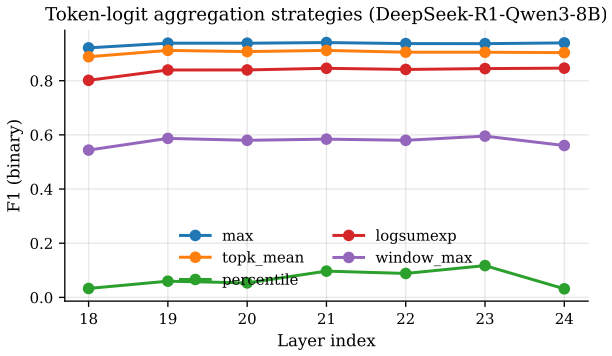
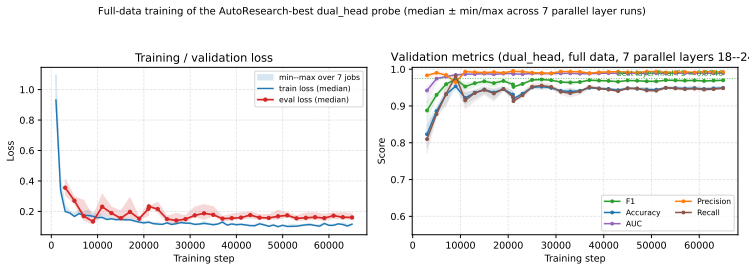
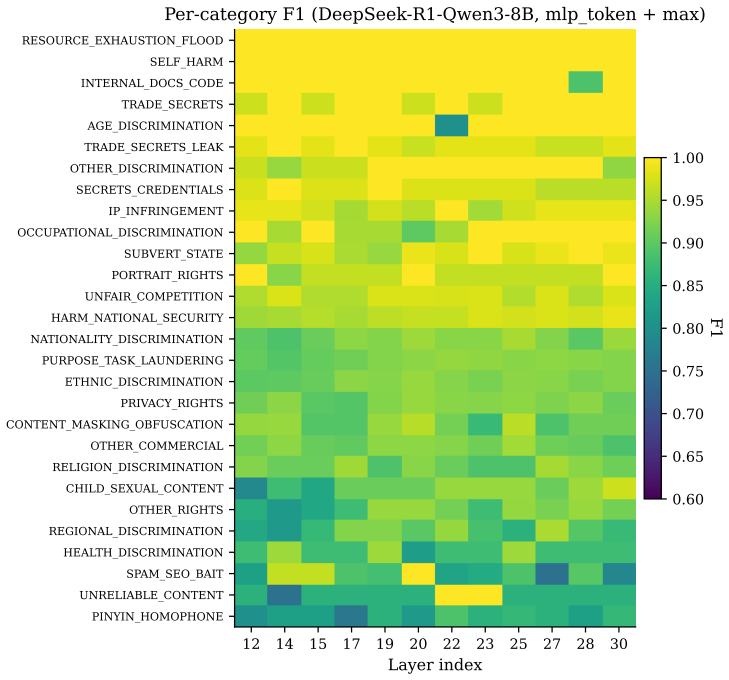
Deploying large language models in user-facing systems requires efficient output safety filtering. Existing approaches typically rely on a separate moderation model applied after generation, which doubles inference cost and only detects violations after generation completes. We observe that the signal needed for moderation is already present in the model hidden states. Based on this, we train lightweight token-level probes that operate directly on internal activations, producing per-token safety scores that can be aggregated for both offline evaluation and online intervention. The probe reuses activations from the generator and requires no additional forward pass, enabling sub millisecond per-token safety checks inside the decoding loop. A probe applied to a single mid layer recovers most decisions of a strong guard model, acting as a low cost surrogate optimized for latency rather than accuracy. In streaming settings, it can halt or modify unsafe outputs before they are fully generated, replacing end of sequence moderation with continuous token level monitoring. Compared to post hoc and streaming guard models, our method achieves orders of magnitude lower compute overhead with minimal latency cost. We also provide a practical deployment recipe, including layer selection, aggregation strategy, probing frequency, and triggering thresholds. Finally, we show that the probe linear component corresponds to a direction in residual space, enabling both detection and activation steering at negligible cost.
Editorial analysis
A structured set of objections, weighed in public.
Referee Report
Summary. The manuscript claims that moderation signals for LLM outputs are already encoded in the model's hidden states. It proposes training lightweight token-level probes on these activations (specifically from a single mid-layer) to generate per-token safety scores that can be aggregated for both offline evaluation and online streaming intervention. The probes reuse existing activations with no extra forward pass, enabling sub-millisecond checks inside the decoding loop to halt or steer unsafe generations early. A probe recovers most decisions of a strong guard model at low cost; the work also supplies a practical deployment recipe (layer selection, aggregation, probing frequency, thresholds) and shows the probe's linear component aligns with a residual direction usable for activation steering.
Significance. If the empirical claims hold, the work has clear practical significance for production LLM safety: it replaces post-generation guard-model calls with continuous low-overhead monitoring, achieving orders-of-magnitude compute savings while supporting early intervention. The observation that the moderation signal is already present in hidden states, the reuse of activations, and the explicit link to steering are strengths. The provision of a concrete recipe aids reproducibility and deployment.
major comments (2)
- [Experiments] Experiments section: no quantitative results, baselines, accuracy/F1 metrics, or latency tables are presented to support the central claim that a single mid-layer probe 'recovers most decisions' of a guard model or delivers 'orders of magnitude lower compute overhead'. This evidence is load-bearing for the empirical contribution.
- [Practical deployment recipe] Deployment recipe (mentioned in abstract and § on practical considerations): the free parameters (triggering thresholds, probing frequency, layer selection) are listed but no sensitivity analysis, selection procedure, or ablation is shown; without this the recipe cannot be evaluated or reproduced.
minor comments (1)
- [Abstract] Abstract: the phrase 'we also provide a practical deployment recipe' does not indicate the section or appendix where the concrete choices (e.g., exact layer index, aggregation function) appear.
Simulated Author's Rebuttal
We thank the referee for the constructive review and for identifying the need for stronger empirical grounding and reproducibility details. We address each major comment below and will incorporate the requested evidence and analyses into a revised manuscript.
read point-by-point responses
-
Referee: [Experiments] Experiments section: no quantitative results, baselines, accuracy/F1 metrics, or latency tables are presented to support the central claim that a single mid-layer probe 'recovers most decisions' of a guard model or delivers 'orders of magnitude lower compute overhead'. This evidence is load-bearing for the empirical contribution.
Authors: We agree that the current manuscript version presents the central empirical claims primarily through qualitative description and high-level statements rather than with explicit quantitative tables, baselines, accuracy/F1 scores, or latency measurements in the main Experiments section. While the abstract and practical-considerations section reference the performance advantages, the load-bearing numbers are not displayed in tabular form. In the revision we will add a dedicated results table (and associated figures) reporting F1/recovery rates against the guard model, direct latency comparisons (including sub-millisecond per-token overhead), and baseline comparisons to post-hoc and streaming guard models. This will make the evidence immediately verifiable. revision: yes
-
Referee: [Practical deployment recipe] Deployment recipe (mentioned in abstract and § on practical considerations): the free parameters (triggering thresholds, probing frequency, layer selection) are listed but no sensitivity analysis, selection procedure, or ablation is shown; without this the recipe cannot be evaluated or reproduced.
Authors: The manuscript enumerates the recipe components (mid-layer choice, score aggregation method, probing frequency, and threshold selection) but does not include sensitivity curves, ablation tables, or an explicit selection procedure. We acknowledge this limits reproducibility and evaluation. In the revision we will add a new subsection (or appendix) containing (i) an ablation over layer indices, (ii) sensitivity plots for threshold and probing-frequency choices on held-out data, and (iii) the concrete selection procedure used (validation-set F1 versus latency trade-off). These additions will allow readers to reproduce and adapt the recipe. revision: yes
Circularity Check
No significant circularity identified
full rationale
The paper presents an empirical method: training lightweight linear probes on existing LLM hidden-state activations to approximate decisions from a separate guard model. The central claim—that moderation signals are already present in hidden states—is tested directly by measuring probe accuracy against the guard model on held-out data, with no mathematical derivation, first-principles prediction, or fitted parameter that is then renamed as a prediction. No equations reduce the result to its inputs by construction. No load-bearing self-citations or uniqueness theorems are invoked. The approach reuses activations without extra forward passes and reports latency/accuracy trade-offs via standard train/test splits, making the argument self-contained against external benchmarks.
Axiom & Free-Parameter Ledger
free parameters (2)
- triggering thresholds
- probing frequency and layer selection
axioms (1)
- domain assumption Safety-relevant information is linearly extractable from mid-layer hidden states of the generator model.
Reference graph
Works this paper leans on
-
[1]
Advances in Neural Information Processing Systems , year=
Attention is All You Need , author=. Advances in Neural Information Processing Systems , year=
-
[2]
2025 , eprint=
Qwen3 Technical Report , author=. 2025 , eprint=
2025
-
[3]
Guo, Daya and Yang, Dejian and Zhang, Haowei and Song, Junxiao and Wang, Peiyi and Zhu, Qihao and Xu, Runxin and Zhang, Ruoyu and Ma, Shirong and Bi, Xiao and Zhang, Xiaokang and Yu, Xingkai and Wu, Yu and Wu, Z. F. and Gou, Zhibin and Shao, Zhihong and Li, Zhuoshu and Gao, Ziyi and Liu, Aixin and Xue, Bing and Wang, Bingxuan and Wu, Bochao and Feng, Bei ...
-
[4]
ICLR Workshop Track , year=
Understanding intermediate layers using linear classifier probes , author=. ICLR Workshop Track , year=
-
[5]
Tenney, Ian and Das, Dipanjan and Pavlick, Ellie , booktitle=
-
[6]
ICLR , year=
Discovering latent knowledge in language models without supervision , author=. ICLR , year=
-
[7]
NeurIPS , year=
Inference-time intervention: Eliciting truthful answers from a language model , author=. NeurIPS , year=
-
[8]
Representation Engineering: A Top-Down Approach to
Zou, Andy and Phan, Long and Chen, Sarah and Campbell, James and Guo, Phillip and Ren, Richard and Pan, Alexander and Yin, Xuwang and Mazeika, Mantas and Dombrowski, Ann-Kathrin and others , journal=. Representation Engineering: A Top-Down Approach to
-
[9]
Anthropic Technical Report , year=
Simple probes can catch sleeper agents , author=. Anthropic Technical Report , year=
-
[10]
Inan, Hakan and Upasani, Kartikeya and Chi, Jianfeng and Rungta, Rashi and Iyer, Krithika and Mao, Yuning and Tontchev, Michael and Hu, Qing and Fuller, Brian and Testuggine, Davide and Khabsa, Madian , booktitle=
-
[11]
AAAI , year=
A Holistic Approach to Undesired Content Detection in the Real World , author=. AAAI , year=
-
[12]
Ji, Jiaming and Liu, Mickel and Dai, Juntao and Pan, Xuehai and Zhang, Chi and Bian, Ce and Sun, Ruiyang and Wang, Yizhou and Yang, Yaodong , booktitle=
-
[13]
Lin, Zi and Wang, Zihan and Tong, Yongqi and Wang, Yangkun and Guo, Yuxin and Wang, Yujia and Shang, Jingbo , booktitle=
-
[14]
Rebedea, Traian and Dinu, Razvan and Sreedhar, Makesh Narsimhan and Parisien, Christopher and Cohen, Jonathan , booktitle=
-
[15]
Preprint , year=
Universal Jailbreak Prevention via Layer-wise Activation Probing , author=. Preprint , year=
-
[16]
Karpathy, Andrej , year =
-
[17]
arXiv preprint arXiv:2501.18837 , year =
Constitutional Classifiers: Defending against Universal Jailbreaks across Thousands of Hours of Red Teaming , author =. arXiv preprint arXiv:2501.18837 , year =
-
[18]
arXiv preprint arXiv:2601.04603 , year =
Constitutional Classifiers++: Efficient Production-Grade Defenses against Universal Jailbreaks , author =. arXiv preprint arXiv:2601.04603 , year =
-
[19]
Efficient Memory Management for Large Language Model Serving with
Kwon, Woosuk and Li, Zhuohan and Zhuang, Siyuan and Sheng, Ying and Zheng, Lianmin and Yu, Cody Hao and Gonzalez, Joseph E and Zhang, Hao and Stoica, Ion , booktitle=. Efficient Memory Management for Large Language Model Serving with
-
[20]
2026 , eprint=
CSSBench: Evaluating the Safety of Lightweight LLMs against Chinese-Specific Adversarial Patterns , author=. 2026 , eprint=
2026
-
[21]
2025 , eprint=
Qwen3Guard Technical Report , author=. 2025 , eprint=
2025
discussion (0)
Sign in with ORCID, Apple, or X to comment. Anyone can read and Pith papers without signing in.