Intrinsic plasmon canalization in the biaxial van der Waals crystal MoOCl₂
Pith reviewed 2026-06-27 12:29 UTC · model grok-4.3
The pith
MoOCl₂ crystal supports natural plasmon-polariton canalization at room temperature without fabrication.
A machine-rendered reading of the paper's core claim, the machinery that carries it, and where it could break.
Core claim
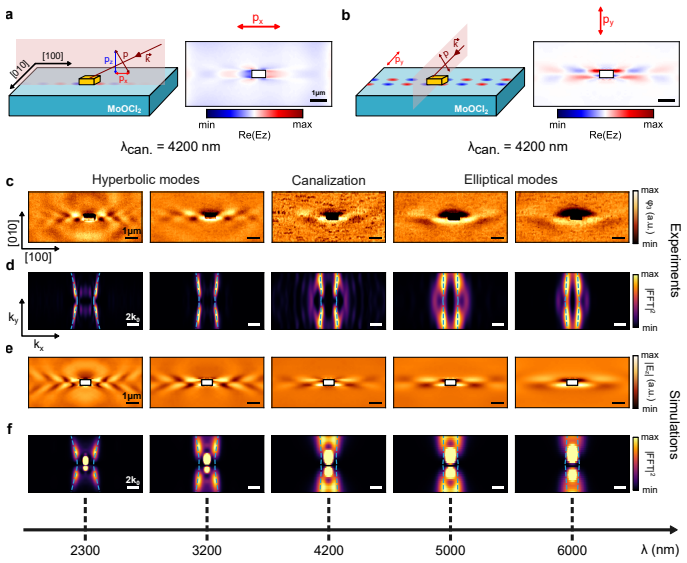
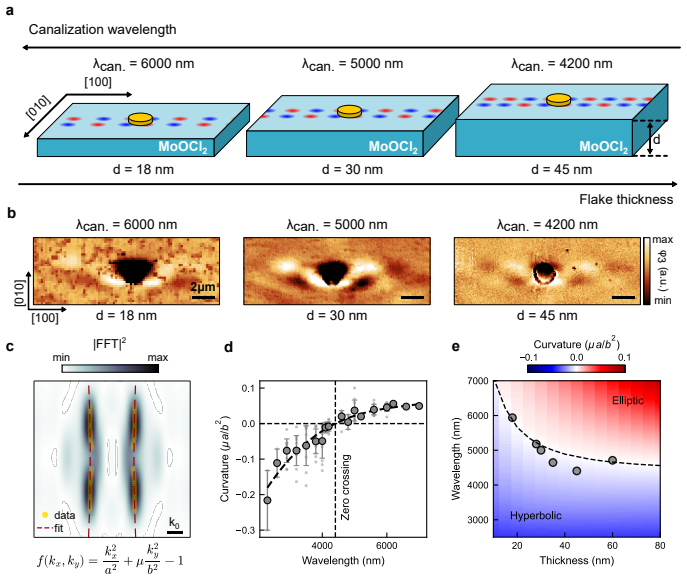
Natural canalization is achieved in MoOCl₂ by exploiting the intrinsic elliptical-to-hyperbolic transition at the low-loss Drude crossing point along the [010] crystal axis. Near-field imaging visualizes the highly directional polaritons, which remain directional across a broad spectral window due to weak dispersion and can be tuned by flake thickness.
What carries the argument
The intrinsic elliptical-to-hyperbolic transition at the Drude crossing point along the [010] axis, where isofrequency contours collapse into parallel lines.
If this is right
- The resulting polaritons remain highly directional across a broad spectral window.
- The canalization wavelength can be adjusted by more than 1 μm by varying the flake thickness.
- Canalized polariton propagation reaches the 4.5–6 μm range.
- New opportunities arise for mid-IR nanophotonics and sensing.
Where Pith is reading between the lines
- Eliminating the need for twisted layers or metasurfaces could simplify fabrication of directional polariton devices.
- Thickness tuning offers a direct handle to align the canalization wavelength with specific molecular absorption bands.
- Other biaxial van der Waals crystals may host similar intrinsic canalization at different infrared windows.
Load-bearing premise
The moderate slope of the Drude permittivity produces a low-loss crossing point that specifically yields canalization rather than other anisotropy effects.
What would settle it
Near-field images taken inside versus outside the predicted broad directional window to test whether high directionality appears only at the Drude crossing.
Figures

read the original abstract
Anisotropic polaritons in low-symmetry crystals allow for subwavelength confinement and directional routing of light. The most extreme form of such anisotropy arises at the topological transition between elliptical and hyperbolic dispersion, where the isofrequency contours collapse into parallel lines and polaritons propagate in a diffractionless, beam-like fashion. This canalization regime has previously been accessed through twisted heterostructures or engineered metasurfaces. Here we show that natural canalization can be achieved without any fabrication or structuring by exploiting the intrinsic elliptical-to-hyperbolic transition in the van der Waals crystal MoOCl$_2$ at room temperature. Using near-field imaging, we directly visualize plasmon-polariton canalization emerging at the low-loss Drude crossing point along the [010] crystal axis. Owing to the moderate slope of the Drude permittivity, the resulting polaritons remain highly directional across a broad spectral window. This weak dispersion also enables robust thickness-dependent tuning, and we demonstrate, both experimentally and theoretically, that the canalization wavelength can be adjusted by more than 1 {\mu}m simply by varying the flake thickness. This work brings canalized polariton propagation into the 4.5 - 6 {\mu}m range, beyond the frequency limits of phonon-polariton platforms and overlapping with important molecular vibrations, opening new opportunities for mid-IR nanophotonics and sensing.
Editorial analysis
A structured set of objections, weighed in public.
Referee Report
Summary. The paper claims that natural canalization of plasmon-polaritons occurs intrinsically in the biaxial van der Waals crystal MoOCl₂ at room temperature via the elliptical-to-hyperbolic transition at the low-loss Drude crossing along [010], visualized by near-field imaging. The moderate Drude slope yields a broad directional spectral window, and thickness variation tunes the canalization wavelength by >1 μm into the 4.5–6 μm range without fabrication or structuring.
Significance. If the central claim holds, the result demonstrates a fabrication-free route to diffractionless, beam-like polariton propagation in the mid-IR using intrinsic material anisotropy, extending beyond phonon-polariton limits and overlapping molecular vibrations. This could enable new nanophotonics and sensing applications. The experimental visualization and thickness tunability are potentially strong if the topological mechanism is rigorously isolated from generic anisotropy.
major comments (2)
- [theoretical analysis and results sections] The manuscript does not report calculated isofrequency contours at multiple frequencies across the claimed broad window, nor a control calculation in which the zero-crossing is shifted while holding the anisotropy ratio fixed. Without these, the data cannot distinguish canalization arising specifically from the topological transition (parallel-line contours at the Drude crossing) from ordinary biaxial anisotropy effects that can also produce directional propagation in elliptic regimes.
- [experimental results on thickness dependence] The thickness-tunability claim (canalization wavelength adjustable by >1 μm) rests on the weak dispersion from the moderate Drude slope, but no explicit comparison is shown between measured near-field patterns and simulated dispersion for different thicknesses to confirm that the observed directionality tracks the topological crossing rather than thickness-dependent anisotropy alone.
minor comments (2)
- [abstract] The abstract states the spectral range as 4.5–6 μm but does not specify the exact frequency points at which canalization is observed or the corresponding permittivity values.
- [introduction] Notation for crystal axes ([010]) and permittivity tensor components should be defined explicitly in the main text on first use for clarity.
Simulated Author's Rebuttal
We thank the referee for the detailed and constructive report. The comments highlight important points for clarifying the distinction between topological canalization and generic anisotropy effects. We address each major comment below and have made revisions to the manuscript accordingly.
read point-by-point responses
-
Referee: [theoretical analysis and results sections] The manuscript does not report calculated isofrequency contours at multiple frequencies across the claimed broad window, nor a control calculation in which the zero-crossing is shifted while holding the anisotropy ratio fixed. Without these, the data cannot distinguish canalization arising specifically from the topological transition (parallel-line contours at the Drude crossing) from ordinary biaxial anisotropy effects that can also produce directional propagation in elliptic regimes.
Authors: We agree that explicit isofrequency contours would better illustrate the broad window. In the revised version, we add calculated isofrequency contours at multiple frequencies (4.7, 5.0, 5.3, 5.6 μm) demonstrating the collapse to parallel lines near the Drude crossing and the persistence of directionality. For the control calculation, while shifting the zero-crossing independently is challenging due to the coupled nature of the permittivity tensor in this material, we provide additional analysis in the supplement showing how the canalization is tied to the crossing by comparing to a hypothetical case with altered Drude parameters. This helps isolate the topological effect. revision: yes
-
Referee: [experimental results on thickness dependence] The thickness-tunability claim (canalization wavelength adjustable by >1 μm) rests on the weak dispersion from the moderate Drude slope, but no explicit comparison is shown between measured near-field patterns and simulated dispersion for different thicknesses to confirm that the observed directionality tracks the topological crossing rather than thickness-dependent anisotropy alone.
Authors: We appreciate this point. The revised manuscript now includes direct comparisons of experimental near-field images with simulated polariton dispersions and propagation patterns for flakes of varying thicknesses (e.g., 80 nm, 120 nm, 180 nm). These show that the wavelength of maximum directionality shifts consistently with the thickness-dependent position of the Drude crossing, as predicted by the model, rather than being dominated by changes in anisotropy ratio alone. This confirms the role of the weak dispersion from the moderate Drude slope. revision: yes
Circularity Check
No circularity; experimental visualization and material properties stand independently
full rationale
The manuscript's central claims rest on near-field imaging of polariton propagation in MoOCl2 and direct comparison to the material's measured permittivity tensor. No equations, fitted parameters, or self-citations are presented that reduce the reported canalization wavelength, directional window, or thickness tunability back to the same inputs by construction. The derivation chain is therefore self-contained against external benchmarks (optical constants and imaging data) and receives the default non-finding.
Axiom & Free-Parameter Ledger
Reference graph
Works this paper leans on
-
[1]
Science337(6098), 1072–1074 (2012)
Cirac` ı, C., Hill, R., Mock, J., Urzhumov, Y., Fern´ andez-Dom´ ınguez, A., Maier, S., Pendry, J., Chilkoti, A., Smith, D.: Probing the ultimate limits of plasmonic enhancement. Science337(6098), 1072–1074 (2012)
2012
-
[2]
Nature communications6(1), 7507 (2015)
Li, P., Lewin, M., Kretinin, A.V., Caldwell, J.D., Novoselov, K.S., Taniguchi, T., Watanabe, K., Gaussmann, F., Taubner, T.: Hyperbolic phonon-polaritons in boron nitride for near-field optical imaging and focusing. Nature communications6(1), 7507 (2015)
2015
-
[3]
Science360(6386), 291–295 (2018)
Alcaraz Iranzo, D., Nanot, S., Dias, E.J., Epstein, I., Peng, C., Efe- tov, D.K., Lundeberg, M.B., Parret, R., Osmond, J., Hong, J.-Y.,et al.: Probing the ultimate plasmon confinement limits with a van der waals heterostructure. Science360(6386), 291–295 (2018)
2018
-
[4]
Nature materials23(4), 499–505 (2024)
Herzig Sheinfux, H., Orsini, L., Jung, M., Torre, I., Ceccanti, M., Mar- coni, S., Maniyara, R., Barcons Ruiz, D., H¨ otger, A., Bertini, R.,et al.: High-quality nanocavities through multimodal confinement of hyperbolic polaritons in hexagonal boron nitride. Nature materials23(4), 499–505 (2024)
2024
-
[5]
Nature Materials24(11), 1735–1741 (2025)
Kowalski, R.A., Mueller, N.S., ´Alvarez-P´ erez, G., Obst, M., Diaz- Granados, K., Carini, G., Senarath, A., Dixit, S., Niemann, R., Iyer, R.B., et al.: Ultraconfined terahertz phonon polaritons in hafnium dichalco- genides. Nature Materials24(11), 1735–1741 (2025)
2025
-
[6]
Nature591(7848), 61–65 61 (2021)
Zhang, L., Wu, F., Hou, S., Zhang, Z., Chou, Y.-H., Watanabe, K., Taniguchi, T., Forrest, S.R., Deng, H.: Van der waals heterostructure polaritons with moir´ e-induced nonlinearity. Nature591(7848), 61–65 61 (2021). https://doi.org/10.1038/s41586-021-03228-5
-
[7]
Nature communications13(1), 6341 (2022)
Datta, B., Khatoniar, M., Deshmukh, P., Thouin, F., Bushati, R., De Liberato, S., Cohen, S.K., Menon, V.M.: Highly nonlinear dipolar exciton-polaritons in bilayer mos2. Nature communications13(1), 6341 (2022)
2022
-
[8]
Nature 487(7405), 77–81 (2012)
Chen, J., Badioli, M., Alonso-Gonz´ alez, P., Thongrattanasiri, S., Huth, F., Osmond, J., Spasenovi´ c, M., Centeno, A., Pesquera, A., Godignon, P., et al.: Optical nano-imaging of gate-tunable graphene plasmons. Nature 487(7405), 77–81 (2012)
2012
-
[9]
Nature487(7405), 82–85 (2012)
Fei, Z., Rodin, A., Andreev, G.O., Bao, W., McLeod, A., Wagner, M., Zhang, L., Zhao, Z., Thiemens, M., Dominguez, G.,et al.: Gate-tuning of graphene plasmons revealed by infrared nano-imaging. Nature487(7405), 82–85 (2012)
2012
-
[10]
Science354(6309), 1992 (2016)
Basov, D.N., Fogler, M.M., Garc´ ıa de Abajo, F.J.: Polaritons in van der waals materials. Science354(6309), 1992 (2016). https://doi.org/10.1126/ science.aag1992
1992
-
[11]
Nature 597(7875), 187–195 (2021)
Zhang, Q., Hu, G., Ma, W., Li, P., Krasnok, A., Hillenbrand, R., Al` u, A., Qiu, C.-W.: Interface nano-optics with van der waals polaritons. Nature 597(7875), 187–195 (2021)
2021
-
[12]
Nature materials16(2), 182–194 (2017)
Low, T., Chaves, A., Caldwell, J.D., Kumar, A., Fang, N.X., Avouris, P., Heinz, T.F., Guinea, F., Martin-Moreno, L., Koppens, F.: Polaritons in layered two-dimensional materials. Nature materials16(2), 182–194 (2017)
2017
-
[13]
Science advances8(29), 8486 (2022)
´Alvarez-P´ erez, G., Duan, J., Taboada-Guti´ errez, J., Ou, Q., Nikulina, 62 E., Liu, S., Edgar, J.H., Bao, Q., Giannini, V., Hillenbrand, R.,et al.: Negative reflection of nanoscale-confined polaritons in a low-loss natural medium. Science advances8(29), 8486 (2022)
2022
-
[14]
Science379(6632), 558–561 (2023)
Hu, H., Chen, N., Teng, H., Yu, R., Xue, M., Chen, K., Xiao, Y., Qu, Y., Hu, D., Chen, J.,et al.: Gate-tunable negative refraction of mid-infrared polaritons. Science379(6632), 558–561 (2023)
2023
-
[15]
Science379(6632), 555–557 (2023)
Sternbach, A., Moore, S., Rikhter, A., Zhang, S., Jing, R., Shao, Y., Kim, B., Xu, S., Liu, S., Edgar, J.,et al.: Negative refraction in hyperbolic hetero-bicrystals. Science379(6632), 555–557 (2023)
2023
-
[16]
Nature Communications15(1), 4463 (2024)
Teng, H., Chen, N., Hu, H., Garc´ ıa de Abajo, F.J., Dai, Q.: Steering and cloaking of hyperbolic polaritons at deep-subwavelength scales. Nature Communications15(1), 4463 (2024)
2024
-
[17]
Nature Nanotechnology, 1–6 (2025)
Zhang, S., Ma, P., You, O., Zhou, S., Feng, K., Yuan, H., Zhang, J., Wu, C., Luo, Y., Yang, B., et al.: Phonon engineering enables hyperbolic asymptotic line polaritons. Nature Nanotechnology, 1–6 (2025)
2025
-
[18]
arXiv preprint arXiv:2504.18418 (2025)
J¨ ackering, L., Moos, A., Conrads, L., Li, Y., Rothstein, A., Malik, D., Watanabe, K., Taniguchi, T., Wuttig, M., Stampfer, C., et al.: Tailor- ing hbn’s phonon polaritons with the plasmonic phase-change material in3sbte2. arXiv preprint arXiv:2504.18418 (2025)
arXiv 2025
-
[19]
Advanced Optical Materials8(5), 1901393 (2020)
Hu, G., Shen, J., Qiu, C.-W., Al` u, A., Dai, S.: Phonon polaritons and hyperbolic response in van der waals materials. Advanced Optical Materials8(5), 1901393 (2020)
2020
-
[20]
Acs photonics 9(4), 1078–1095 (2022)
He, M., Folland, T.G., Duan, J., Alonso-Gonz´ alez, P., De Liberato, S., Paarmann, A., Caldwell, J.D.: Anisotropy and modal hybridization 63 in infrared nanophotonics using low-symmetry materials. Acs photonics 9(4), 1078–1095 (2022)
2022
-
[21]
Nature602(7898), 595–600 (2022)
Passler, N.C., Ni, X., Hu, G., Matson, J.R., Carini, G., Wolf, M., Schu- bert, M., Al` u, A., Caldwell, J.D., Folland, T.G.,et al.: Hyperbolic shear polaritons in low-symmetry crystals. Nature602(7898), 595–600 (2022)
2022
-
[22]
Nature nanotechnology21(1), 23–38 (2026)
Zhou, Y., Guo, Z., Tarazaga Mart´ ın-Luengo, A., Lanza, C.,´Alvarez-P´ erez, G., Yu, C., Li, C., Xia, W., ´Alvarez Cuervo, J., Duan, X.,et al.: Fun- damental optical phenomena of strongly anisotropic polaritons at the nanoscale. Nature nanotechnology21(1), 23–38 (2026)
2026
-
[23]
Science343(6175), 1125–1129 (2014)
Dai, S., Fei, Z., Ma, Q., Rodin, A.S., Wagner, M., McLeod, A.S., Liu, M., Gannett, W., Regan, W., Watanabe, K., Taniguchi, T., Thiemens, M., Dominguez, G., Castro Neto, A.H., Zettl, A., Keilmann, F., Jarillo- Herrero, P., Fogler, M.M., Basov, D.N.: Tunable phonon polaritons in atomically thin van der waals crystals of boron nitride. Science343(6175), 1125...
-
[24]
Nature562(7728), 557–562 (2018)
Ma, W., Alonso-Gonz´ alez, P., Li, S., Nikitin, A.Y., Yuan, J., Mart´ ın- S´ anchez, J., Taboada-Guti´ errez, J., Amenabar, I., Li, P., V´ elez, S., Tollan, C., Dai, Z., Zhang, Y., Sriram, S., Kalantar-Zadeh, K., Lee, S.-T., Hil- lenbrand, R., Bao, Q.: In-plane anisotropic and ultra-low-loss polaritons in a natural van der waals crystal. Nature562(7728), ...
-
[25]
Science advances5(5), 8690 (2019) 64
Zheng, Z., Xu, N., Oscurato, S.L., Tamagnone, M., Sun, F., Jiang, Y., Ke, Y., Chen, J., Huang, W., Wilson, W.L.,et al.: A mid-infrared biaxial hyperbolic van der waals crystal. Science advances5(5), 8690 (2019) 64
2019
-
[26]
Nature Communications15(1), 9727 (2024)
Venturi, G., Mancini, A., Melchioni, N., Chiodini, S., Ambrosio, A.: Visible-frequency hyperbolic plasmon polaritons in a natural van der waals crystal. Nature Communications15(1), 9727 (2024). https://doi. org/10.1038/s41467-024-53988-7
-
[28]
Nature Communications16(1), 6172 (2025)
Li, Y., Zhang, Y., Zhang, W., Li, X., Tang, J., Xiao, J., Zhang, G., Liao, X., Jiang, P., Liu, Q.,et al.: Broadband near-infrared hyperbolic polaritons in moocl2. Nature Communications16(1), 6172 (2025)
2025
-
[29]
Nano Letters 25(43), 15534–15541 (2025)
Zhang, Y., Li, Y., Xiao, J., Luo, Y., Li, X., Tang, J., Xu, X., Jiang, P., Zhang, G., Tang, H.,et al.: Manipulating hyperbolic plasmon polaritons at near-infrared in an anisotropic van der waals crystal. Nano Letters 25(43), 15534–15541 (2025)
2025
-
[30]
Nature Communications (2026)
Ghosh, A., Raab, C., Spellberg, J.L., Mohan, A., Munawar, M., Rieger, J., King, S.B.: Spatiotemporal visualization of long-range anisotropic plasmon polaritons in hyperbolic moocl2. Nature Communications (2026)
2026
-
[31]
Physical review letters 114(23), 233901 (2015)
Gomez-Diaz, J.S., Tymchenko, M., Alu, A.: Hyperbolic plasmons and topological transitions over uniaxial metasurfaces. Physical review letters 114(23), 233901 (2015)
2015
-
[32]
Physical Review B96(7), 075436 (2017)
Correas-Serrano, D., Al` u, A., Gomez-Diaz, J.S.: Plasmon canalization and tunneling over anisotropic metasurfaces. Physical Review B96(7), 075436 (2017). https://doi.org/10.1103/PhysRevB.96.075436
-
[33]
Nature Communications11(1), 3663 (2020)
Li, P., Hu, G., Dolado, I., Tymchenko, M., Qiu, C.-W., Alfaro-Mozaz, 65 F.J., Casanova, F., Hueso, L.E., Liu, S., Edgar, J.H., V´ elez, S., Alu, A., Hillenbrand, R.: Collective near-field coupling and nonlocal phe- nomena in infrared-phononic metasurfaces for nano-light canalization. Nature Communications11(1), 3663 (2020). https://doi.org/10.1038/ s41467...
2020
-
[34]
Science Advances12(2), 0072 (2026)
Xu, Y., Su, X., Deng, F., Wang, Y., Yang, Y., Alonso-Gonz´ alez, P., Chen, H., Li, J., Duan, J., Guo, Z.: Programmable polariton canalization in reconfigurable metasurfaces. Science Advances12(2), 0072 (2026)
2026
-
[35]
Nature582(7811), 209–213 (2020)
Hu, G., Ou, Q., Si, G., Wu, Y., Wu, J., Dai, Z., Krasnok, A., Mazor, Y., Zhang, Q., Bao, Q.,et al.: Topological polaritons and photonic magic angles in twistedα-moo3 bilayers. Nature582(7811), 209–213 (2020)
2020
-
[36]
Nano Letters20(7), 5323–5329 (2020)
Duan, J., Capote-Robayna, N., Taboada-Guti´ errez, J.,´Alvarez-P´ erez, G., Prieto, I., Mart´ ın-S´ anchez, J., Nikitin, A.Y., Alonso-Gonz´ alez, P.: Twisted nano-optics: manipulating light at the nanoscale with twisted phonon polaritonic slabs. Nano Letters20(7), 5323–5329 (2020)
2020
-
[37]
Nature materials19(12), 1307–1311 (2020)
Chen, M., Lin, X., Dinh, T.H., Zheng, Z., Shen, J., Ma, Q., Chen, H., Jarillo-Herrero, P., Dai, S.: Configurable phonon polaritons in twisted α-moo3. Nature materials19(12), 1307–1311 (2020)
2020
-
[38]
ACS nano17(19), 19313–19322 (2023)
Obst, M., Nooerenberg, T., ´Alvarez-P´ erez, G., de Oliveira, T.V., Taboada- Guti´ errez, J., Feres, F.H., Kaps, F.G., Hatem, O., Luferau, A., Nikitin, A.Y.,et al.: Terahertz twistoptics–engineering canalized phonon polari- tons. ACS nano17(19), 19313–19322 (2023)
2023
-
[39]
Nature Materials22(7), 867–872 (2023)
Duan, J., ´Alvarez-P´ erez, G., Lanza, C., Voronin, K., Tresguerres-Mata, A.I., Capote-Robayna, N., ´Alvarez-Cuervo, J., Tarazaga Mart´ ın-Luengo, 66 A., Mart´ ın-S´ anchez, J., Volkov, V.S.,et al.: Multiple and spectrally robust photonic magic angles in reconfigurableα-moo3 trilayers. Nature Materials22(7), 867–872 (2023)
2023
-
[40]
Nature Communications16(1), 2953 (2025)
Zhou, L., Ni, X., Wang, Z., Renzi, E.M., Xu, J., Zhou, Z., Yin, Y., Yin, Y., Song, R., Zhao, Z., Yu, K., Huang, D., Wang, Z., Cheng, X., Al` u, A., Jiang, T.: Engineering shear polaritons in 2d twisted heterostruc- tures. Nature Communications16(1), 2953 (2025). https://doi.org/10. 1038/s41467-025-58197-4
2025
-
[41]
Science advances7(14), 2690 (2021)
Duan, J., ´Alvarez-P´ erez, G., Voronin, K.V., Prieto, I., Taboada-Guti´ errez, J., Volkov, V.S., Mart´ ın-S´ anchez, J., Nikitin, A.Y., Alonso-Gonz´ alez, P.: Enabling propagation of anisotropic polaritons along forbidden directions via a topological transition. Science advances7(14), 2690 (2021)
2021
-
[42]
Nature Nanotechnology17(9), 940–946 (2022)
Hu, H., Chen, N., Teng, H., Yu, R., Qu, Y., Sun, J., Xue, M., Hu, D., Wu, B., Li, C., Chen, J., Liu, M., Sun, Z., Liu, Y., Li, P., Fan, S., Garc´ ıa de Abajo, F.J., Dai, Q.: Doping-driven topological polaritons in graphene/α- moo3 heterostructures. Nature Nanotechnology17(9), 940–946 (2022). https://doi.org/10.1038/s41565-022-01185-2
-
[43]
Science advances 11(7), 0569 (2025)
Duan, J., Mart´ ın-Luengo, A.T., Lanza, C., Partel, S., Voronin, K., Tresguerres-Mata, A.I.F., ´Alvarez-P´ erez, G., Nikitin, A.Y., Mart´ ın- S´ anchez, J., Alonso-Gonz´ alez, P.: Canalization-based super-resolution imaging using an individual van der waals thin layer. Science advances 11(7), 0569 (2025)
2025
-
[44]
Nano Letters25(7), 67 2610–2617 (2025)
Zhu, J., Gong, Y., Liang, J., Zhao, Y., Cui, Z., Li, D., Ou, Q., Zhang, Y., Wang, G.P.: Multiple hyperbolic dispersion branches and broadband canalization in a phonon-polaritonic heterostructure. Nano Letters25(7), 67 2610–2617 (2025)
2025
-
[45]
Science Advances11(50), 6278 (2025)
Zhang, L., Ding, X., Dong, J., Fan, J., Wu, W., Ren, M., Luo, W., Cai, W., Xu, J.: Ultimate tuning of hyperbolic phonon polaritons. Science Advances11(50), 6278 (2025)
2025
-
[46]
npj 2D Materials and Applications6(1), 5 (2022)
Chang, P.-H., Lin, C., Helmy, A.S.: Field canalization using anisotropic 2d plasmonics. npj 2D Materials and Applications6(1), 5 (2022)
2022
-
[47]
The Journal of Physical Chemistry A125(17), 3776–3784 (2021) https://doi.org/10.1021/acs
Ter´ an-Garc´ ıa, E., Lanza, C., Voronin, K., Mart´ ın-S´ anchez, J., Nikitin, A.Y., Tarazaga Mart´ ın-Luengo, A., Alonso-Gonz´ alez, P.: Real-space visu- alization of canalized ray polaritons in a single van der waals thin slab. Nano Letters25(6), 2203–2209 (2025). https://doi.org/10.1021/acs. nanolett.4c05277
work page doi:10.1021/acs 2025
-
[48]
Optica12(3), 343–349 (2025)
Wang, K., Huang, Z., Xiong, L., Wang, K., Bai, Y., Long, H., Deng, N., Wang, B., Hu, G., Lu, P.: Observation of canalized phonon polaritons in a singleα-moo 3 flake. Optica12(3), 343–349 (2025). https://doi.org/10. 1364/OPTICA.547698
2025
-
[49]
Nature Communications15(1), 2696 (2024)
Tresguerres-Mata, A.I.F., Lanza, C., Taboada-Guti´ errez, J., Matson, J.R., ´Alvarez-P´ erez, G., Isobe, M., Tarazaga Mart´ ın-Luengo, A., Duan, J., Partel, S., V´ elez, M., Mart´ ın-S´ anchez, J., Nikitin, A.Y., Caldwell, J.D., Alonso-Gonz´ alez, P.: Observation of naturally canalized phonon polari- tons in liv 2o5 thin layers. Nature Communications15(1)...
-
[50]
Science Advances11(29), 3452 (2025)
D´ ıaz-N´ u˜ nez, P., Lanza, C., Wang, Z., Kravets, V.G., Duan, J.,´Alvarez- Cuervo, J., Tarazaga Mart´ ın-Luengo, A., Grigorenko, A.N., Yang, Q., 68 Paarmann, A., Caldwell, J., Alonso-Gonz´ alez, P., Mishchenko, A.: Visu- alization of topological shear polaritons in gypsum thin films. Science Advances11(29), 3452 (2025). https://doi.org/10.1126/sciadv.adw3452
-
[51]
Nature Communications 15(1), 7047 (2024)
Zheng, C., Hu, G., Wei, J., Ma, X., Li, Z., Chen, Y., Ni, Z., Li, P., Wang, Q., Qiu, C.-W.: Hyperbolic-to-hyperbolic transition at exceptional rest- strahlen point in rare-earth oxyorthosilicates. Nature Communications 15(1), 7047 (2024)
2024
-
[52]
arXiv preprint arXiv:2604.12174 (2026)
Shiravi, H., Zheng, W., Rhodes, D., Balicas, L., Zhou, H., Ni, G.: Tun- able polariton canalization in natural van der waals oxide. arXiv preprint arXiv:2604.12174 (2026)
Pith/arXiv arXiv 2026
-
[53]
Advanced Materials, 2504526 (2025)
Ou, Q., Xue, S., Ma, W., Yang, J., Si, G., Liu, L., Zhong, G., Liu, J., Xie, Z., Xiao, Y., et al.: Natural van der waals canalization lens for non-destructive nanoelectronic circuit imaging and inspection. Advanced Materials, 2504526 (2025)
2025
-
[54]
Liu, L., Xiong, L., Wang, C., Bai, Y., Ma, W., Wang, Y., Li, P., Li, G., Wang, Q.J., Garcia-Vidal, F.J., Dai, Z., Hu, G.: Long-range hyperbolic polaritons on a non-hyperbolic crystal surface. Nature644(8075), 76–82 (2025). https://doi.org/10.1038/s41586-025-09288-1
-
[55]
Nature Communications15, 2623 (2024)
Xing, Q., Zhang, J., Fang, Y., Song, C., Zhao, T., Mou, Y., Wang, C., Ma, J., Xie, Y., Huang, S., Mu, L., Lei, Y., Shi, W., Huang, F., Yan, H.: Tunable anisotropic van der waals films of 2m-ws2 for plasmon canaliza- tion. Nature Communications15, 2623 (2024). https://doi.org/10.1038/ s41467-024-46963-9
2024
-
[56]
Physical Review Materials4(4), 041001 (2020)
Wang, Z., Huang, M., Zhao, J., Chen, C., Huang, H., Wang, X., Liu, P., 69 Wang, J., Xiang, J., Feng, C.,et al.: Fermi liquid behavior and colossal magnetoresistance in layered mooc l 2. Physical Review Materials4(4), 041001 (2020)
2020
-
[57]
ACS Nano19(27), 25413– 25421 (2025)
Melchioni, N., Mancini, A., Nan, L., Efimova, A., Venturi, G., Ambrosio, A.: Giant optical anisotropy in a natural van der waals hyperbolic crystal for visible light low-loss polarization control. ACS Nano19(27), 25413– 25421 (2025). https://doi.org/10.1021/acsnano.5c07323
-
[58]
Nano Letters26(13), 4329–4338 (2026)
Ermolaev, G., Toksumakov, A., Slavich, A., Minnekhanov, A., Tselikov, G., Mazitov, A., Kruglov, I., Tikhonowski, G., Mironov, M., Radko, I.P., et al.: Giant optical anisotropy and visible-frequency epsilon-near-zero in hyperbolic van der waals moocl2. Nano Letters26(13), 4329–4338 (2026)
2026
-
[59]
arXiv preprint arXiv:2602.01072 (2026)
Melchioni, N., Mancini, A., Ambrosio, A.: Anisotropic electron gas in a hyperbolic van der waals material. arXiv preprint arXiv:2602.01072 (2026)
arXiv 2026
-
[60]
Physical Review B102(24), 245419 (2020)
Zhao, J., Wu, W., Zhu, J., Lu, Y., Xiang, B., Yang, S.A.: Highly anisotropic two-dimensional metal in monolayer moocl 2. Physical Review B102(24), 245419 (2020)
2020
-
[61]
Physical Review B100(23), 235408 (2019)
´Alvarez-P´ erez, G., Voronin, K.V., Volkov, V.S., Alonso-Gonz´ alez, P., Nikitin, A.Y.: Analytical approximations for the dispersion of electro- magnetic modes in slabs of biaxial crystals. Physical Review B100(23), 235408 (2019)
2019
-
[62]
Journal of the Optical 70 Society of America B34(10), 2128–2139 (2017)
Passler, N.C., Paarmann, A.: Generalized 4×4 matrix formalism for light propagation in anisotropic stratified media: study of surface phonon polaritons in polar dielectric heterostructures. Journal of the Optical 70 Society of America B34(10), 2128–2139 (2017)
2017
-
[63]
Nanophotonics9(2), 509–522 (2020)
Kaltenecker, K.J., Krauss, E., Casses, L., Geisler, M., Hecht, B., Mortensen, N.A., Jepsen, P.U., Stenger, N.: Mono-crystalline gold platelets: a high-quality platform for surface plasmon polaritons. Nanophotonics9(2), 509–522 (2020)
2020
-
[64]
ACS Photonics9(11), 3696– 3704 (2022)
Mancini, A., Nan, L., Wendisch, F.J., Bert´ e, R., Ren, H., Cort´ es, E., Maier, S.A.: Near-field retrieval of the surface phonon polariton dispersion in free-standing silicon carbide thin films. ACS Photonics9(11), 3696– 3704 (2022)
2022
-
[65]
Applied Physics Letters89(10) (2006)
Ocelic, N., Huber, A., Hillenbrand, R.: Pseudoheterodyne detection for background-free near-field spectroscopy. Applied Physics Letters89(10) (2006)
2006
-
[66]
Cambridge university press, ??? (2002)
Dressel, M., Gr¨ uner, G.: Electrodynamics of Solids: Optical Properties of Electrons in Matter. Cambridge university press, ??? (2002)
2002
-
[67]
Science387(6735), 786–791 (2025)
Ruta, F.L., Shao, Y., Acharya, S., Mu, A., Jo, N.H., Ryu, S.H., Balatsky, D., Su, Y., Pashov, D., Kim, B.S.,et al.: Good plasmons in a bad metal. Science387(6735), 786–791 (2025)
2025
-
[68]
Cambridge university press, Cambridge (2012)
Novotny, L., Hecht, B.: Principles of Nano-optics. Cambridge university press, Cambridge (2012)
2012
-
[69]
Elight3(1), 14 (2023)
Hu, C., Sun, T., Zeng, Y., Ma, W., Dai, Z., Yang, X., Zhang, X., Li, P.: Source-configured symmetry-broken hyperbolic polaritons. Elight3(1), 14 (2023)
2023
-
[70]
Light: Science & Applications7(1), 27 (2018)
Ambrosio, A., Tamagnone, M., Chaudhary, K., Jauregui, L.A., Kim, P., 71 Wilson, W.L., Capasso, F.: Selective excitation and imaging of ultraslow phonon polaritons in thin hexagonal boron nitride crystals. Light: Science & Applications7(1), 27 (2018)
2018
-
[71]
Science advances8(28), 0627 (2022) 72
Menabde, S.G., Boroviks, S., Ahn, J., Heiden, J.T., Watanabe, K., Taniguchi, T., Low, T., Hwang, D.K., Mortensen, N.A., Jang, M.S.: Near- field probing of image phonon-polaritons in hexagonal boron nitride on gold crystals. Science advances8(28), 0627 (2022) 72
2022
discussion (0)
Sign in with ORCID, Apple, or X to comment. Anyone can read and Pith papers without signing in.