Dynamical Partition Functions of Stochastic Dynamics via Variational Flows
Pith reviewed 2026-06-27 11:43 UTC · model grok-4.3
The pith
Generative flow models realize the Feynman-Kac theorem to compute dynamical partition functions for high-dimensional stochastic dynamics.
A machine-rendered reading of the paper's core claim, the machinery that carries it, and where it could break.
Core claim
The dynamical partition function of arbitrary path observables in continuous-state stochastic dynamics can be obtained by training generative flow models to solve a time-dependent variational problem that implements the Feynman-Kac theorem for tilted evolution.
What carries the argument
Generative flow models trained variationally to represent the solution of the time-dependent optimization problem for the tilted dynamics.
If this is right
- The method applies to general observables including work, entropy production, and current fluctuations.
- It computes both finite-time and asymptotic trajectory thermodynamics in a single framework.
- It scales to high-dimensional continuous-state systems where mesh-based or replica methods fail.
- It provides direct access to generating functions without sampling exponentially many trajectories.
Where Pith is reading between the lines
- The same variational flows could be used to estimate large-deviation functions for other rare-event observables not explicitly demonstrated.
- Hybridizing the flows with physics-informed constraints might reduce training cost for systems with known symmetries.
- The approach opens a route to on-the-fly estimation of thermodynamic quantities during molecular-dynamics runs.
Load-bearing premise
Generative flow models can be trained to accurately represent the solution to the time-dependent optimization problem for the tilted dynamics in high-dimensional spaces.
What would settle it
A direct numerical comparison in a high-dimensional solvable model where the trained flows produce partition-function values that deviate systematically from exact results.
Figures

read the original abstract
Nonequilibrium thermodynamics is governed by the dynamical partition function, and its computation in high-dimensional continuous-state dynamics is a longstanding challenge. The Feynman-Kac formalism provides a rigorous representation for generating functions of arbitrary path observables; however, practical evaluation beyond low dimensions or the weak-noise limit is hindered by the curse of dimensionality and the exponentially growing replica demands of trajectory-based methods. Here we develop a mesh-free neural variational framework that realizes the Feynman-Kac theorem with generative flow models, recasting tilted stochastic evolution as a time-dependent optimization problem. This approach enables the direct computation of both finite-time and asymptotic trajectory thermodynamics in a unified manner. The method applies to general observables, enabling the evaluation of work, entropy production, and current fluctuations. We demonstrate the accuracy and scalability of this method in various nonequilibrium systems including high-dimensional cases.
Editorial analysis
A structured set of objections, weighed in public.
Referee Report
Summary. The manuscript develops a mesh-free neural variational framework that uses generative flow models to realize the Feynman-Kac theorem for dynamical partition functions of stochastic dynamics. It recasts tilted stochastic evolution as a time-dependent optimization problem, enabling unified computation of finite-time and asymptotic trajectory thermodynamics for general observables including work, entropy production, and currents. The approach is demonstrated on various nonequilibrium systems, including high-dimensional cases, with claims of accuracy and scalability.
Significance. If the central claims hold, the work provides a scalable alternative to replica-based and mesh-based methods for computing path observables in high-dimensional continuous-state systems, addressing the curse of dimensionality in nonequilibrium thermodynamics. The unified finite/asymptotic treatment and applicability to general observables represent a potential advance over existing techniques limited to low dimensions or weak noise.
minor comments (2)
- [Results/Demonstrations] The abstract states that demonstrations of accuracy and scalability were performed, but the main text should include explicit error metrics, baseline comparisons, and convergence diagnostics for the flow training in the high-dimensional examples to substantiate the claims.
- [Methods] Notation for the time-dependent variational objective and the flow parameterization should be introduced with explicit definitions early in the methods section to improve readability for readers unfamiliar with generative flows.
Simulated Author's Rebuttal
We thank the referee for their positive summary of our work and for recommending minor revision. The assessment that the method offers a scalable alternative for high-dimensional trajectory thermodynamics is encouraging. No specific major comments were listed in the report.
Circularity Check
No significant circularity detected
full rationale
The paper introduces a mesh-free neural variational framework realizing the Feynman-Kac theorem via generative flow models for computing dynamical partition functions in stochastic dynamics. The provided abstract and description frame this as a new time-dependent optimization approach applicable to general observables, with reported demonstrations of accuracy in high-dimensional cases. No load-bearing steps reduce by construction to fitted inputs, self-citations, or renamed known results; the central claim rests on the variational realization itself rather than tautological reparameterization. The derivation chain appears self-contained against external benchmarks such as the Feynman-Kac formalism.
Axiom & Free-Parameter Ledger
axioms (1)
- standard math Feynman-Kac formalism provides a rigorous representation for generating functions of arbitrary path observables
Reference graph
Works this paper leans on
-
[1]
Dynamical Partition Functions of Stochastic Dynamics via Variational Flows
provides a fundamental description for systems rang- ing from molecular motor transport [2, 3], active mat- ter [4–7], stochastic thermodynamics [8, 9], and machine learning[10–13]. Theirevolutionistypicallydescribedby stochastic differential equations (SDEs) or Fokker-Planck equations (FPEs). To fully characterize these dynamics, it is essential to use t...
work page internal anchor Pith review Pith/arXiv arXiv 2026
-
[2]
Applying our variational framework to these inferred FPEs allows us to directly extract macroscopic thermodynamics
directly from single-cell snapshots. Applying our variational framework to these inferred FPEs allows us to directly extract macroscopic thermodynamics. Acknowledgments—We thank Prof. Hong Qian and Ms. Miao Chen for helpful discussions. This work is sup- ported by the National Natural Science Foundation of China(Projects12322501and12575035)andtheNatural S...
-
[3]
Duan,An introduction to stochastic dynamics, Vol
J. Duan,An introduction to stochastic dynamics, Vol. 51 (Cambridge University Press, 2015)
2015
-
[4]
Jülicher, A
F. Jülicher, A. Ajdari, and J. Prost, Modeling molecular motors, Rev. Mod. Phys.,69, 1269 (1997)
1997
-
[5]
Zhang, H
X.-J. Zhang, H. Qian, and M. Qian, Stochastic theory of nonequilibrium steady states and its applications. part i, Phys. Rep.510, 1 (2012)
2012
-
[6]
Bechinger, R
C. Bechinger, R. Di Leonardo, H. Löwen, C. Reichhardt, G. Volpe, and G. Volpe, Active particles in complex and crowded environments, Rev. Mod. Phys.88, 045006 (2016)
2016
-
[7]
Romanczuk, M
P. Romanczuk, M. Bär, W. Ebeling, B. Lindner, and L. Schimansky-Geier, Active brownian particles: From individual to collective stochastic dynamics, Eur. Phys. J.: Spec. Top.202, 1 (2012)
2012
-
[8]
L. L. Bonilla, Active ornstein-uhlenbeck particles, Phys. Rev. E100, 022601 (2019)
2019
-
[9]
Tailleur and M
J. Tailleur and M. E. Cates, Statistical mechanics of in- teracting run-and-tumble bacteria, Phys. Rev. Lett.100, 218103 (2008)
2008
-
[10]
Seifert, Stochastic thermodynamics: principles and perspectives, Eur
U. Seifert, Stochastic thermodynamics: principles and perspectives, Eur. Phys. J. B64, 423 (2008)
2008
-
[11]
Seifert, Stochastic thermodynamics, fluctuation the- orems and molecular machines, Rep
U. Seifert, Stochastic thermodynamics, fluctuation the- orems and molecular machines, Rep. Prog. Phys.75, 126001 (2012)
2012
-
[12]
Feng and Y
Y. Feng and Y. Tu, The inverse variance–flatness relation in stochastic gradient descent is critical for finding flat minima, Proc. Natl. Acad. Sci. USA118, e2015617118 (2021)
2021
-
[13]
N. Yang, C. Tang, and Y. Tu, Stochastic gradient descent introduces an effective landscape-dependent regulariza- tion favoring flat solutions, Phys. Rev. Lett.130, 237101 (2023)
2023
-
[14]
Zhang and C
X.-Y. Zhang and C. Tang, Heavy-tailed update distribu- tions arise from information-driven self-organization in nonequilibriumlearning,Proc.Natl.Acad.Sci.USA122, e2523012122 (2025)
2025
-
[15]
Ikeda, T
K. Ikeda, T. Uda, D. Okanohara, and S. Ito, Speed- accuracy relations for diffusion models: Wisdom from nonequilibrium thermodynamics and optimal transport, Phys. Rev. X15, 031031 (2025)
2025
-
[16]
P.Ao,Potentialinstochasticdifferentialequations: novel construction, J. Phys. A37, L25 (2004)
2004
-
[17]
J. Wang, L. Xu, and E. Wang, Potential landscape and flux framework of nonequilibrium networks: Robustness, dissipation, and coherence of biochemical oscillations, Proc. Natl. Acad. Sci. USA105, 12271 (2008)
2008
-
[18]
Y. Tang, S. Xu, and P. Ao, Escape rate for nonequilib- rium processes dominated by strong non-detailed balance force, J. Chem. Phys.148, 064102 (2018)
2018
-
[19]
Chen, X.-H
M. Chen, X.-H. Zhao, and Y.-H. Ma, Coercivity land- scape characterizes dynamic hysteresis, Phys. Rev. Lett. 136, 117102 (2026)
2026
-
[20]
G. E. Crooks, Entropy production fluctuation theorem and the nonequilibrium work relation for free energy dif- ferences, Phys. Rev. E60, 2721 (1999)
1999
-
[21]
S.-W. Wang, K. Kawaguchi, S.-i. Sasa, and L.-H. Tang, Entropy production of nanosystems with time scale sep- aration, Phys. Rev. Lett.117, 070601 (2016). 6
2016
-
[22]
Yang and H
Y.-J. Yang and H. Qian, Unified formalism for entropy production and fluctuation relations, Phys. Rev. E101, 022129 (2020)
2020
-
[23]
Aguilera, S
M. Aguilera, S. Ito, and A. Kolchinsky, Inferring entropy production in many-body systems using nonequilibrium maximum entropy, Phys. Rev. Lett.136, 077101 (2026)
2026
-
[24]
Ferré and H
G. Ferré and H. Touchette, Adaptive sampling of large deviations, J. Stat. Phys172, 1525 (2018)
2018
-
[25]
Jarzynski, Nonequilibrium equality for free energy dif- ferences, Phys
C. Jarzynski, Nonequilibrium equality for free energy dif- ferences, Phys. Rev. Lett.78, 2690 (1997)
1997
-
[26]
Touchette, The large deviation approach to statistical mechanics, Phys
H. Touchette, The large deviation approach to statistical mechanics, Phys. Rep.478, 1 (2009)
2009
-
[27]
Ge and H
H. Ge and H. Qian, Analytical mechanics in stochastic dynamics: Mostprobablepath, large-deviationratefunc- tion and hamilton–jacobi equation, Int. J. Mod. Phys. B 26, 1230012 (2012)
2012
-
[28]
Risken, Fokker-planck equation, inThe Fokker-Planck equation: methods of solution and applications(Springer,
H. Risken, Fokker-planck equation, inThe Fokker-Planck equation: methods of solution and applications(Springer,
-
[29]
Giardina, J
C. Giardina, J. Kurchan, and L. Peliti, Direct evaluation of large-deviation functions, Phys. Rev. Lett.96, 120603 (2006)
2006
-
[30]
Grassberger, Go with the winners: A general monte carlo strategy, Comp
P. Grassberger, Go with the winners: A general monte carlo strategy, Comp. Phys. Comm.147, 64 (2002)
2002
-
[31]
Lecomte and J
V. Lecomte and J. Tailleur, A numerical approach to large deviations in continuous time, J. Stat. Mech.2007, P03004 (2007)
2007
-
[32]
J. Yan, H. Touchette, and G. M. Rotskoff, Learning nonequilibrium control forces to characterize dynamical phase transitions, Phys. Rev. E105, 024115 (2022)
2022
-
[33]
Reh and M
M. Reh and M. Gärttner, Variational monte carlo ap- proach to partial differential equations with neural net- works, Mach. Learn.: Sci. Technol. (2022)
2022
-
[34]
N. M. Boffi and E. Vanden-Eijnden, Probability flow so- lution of the fokker–planck equation, Mach. Learn.: Sci. Technol.4, 035012 (2023)
2023
-
[35]
Y. Tang, J. Liu, J. Zhang, and P. Zhang, Learn- ing nonequilibrium statistical mechanics and dynamical phase transitions, Nat. Commun.15, 1117 (2024)
2024
-
[36]
Y. Tang, J. Weng, and P. Zhang, Neural-network solu- tions to stochastic reaction networks, Nat. Mach. Intell 5, 376 (2023)
2023
-
[37]
Klinger and G
J. Klinger and G. M. Rotskoff, Computing nonequilib- rium responses with score-shifted stochastic differential equations, Phys. Rev. Lett.134, 097101 (2025)
2025
-
[38]
L. Dinh, J. Sohl-Dickstein, and S. Bengio, Density esti- mation using real nvp, arXiv preprint arXiv:1605.08803 (2016)
work page internal anchor Pith review Pith/arXiv arXiv 2016
- [39]
- [40]
-
[41]
M. Reh, M. Schmitt, and M. Gärttner, Time-dependent variational principle for open quantum systems with ar- tificial neural networks, Phys. Rev. Lett.127, 230501 (2021)
2021
-
[42]
Hummer and A
G. Hummer and A. Szabo, Free energy reconstruction fromnonequilibriumsingle-moleculepullingexperiments, Proc. Natl. Acad. Sci. USA98, 3658 (2001)
2001
-
[43]
Chetrite and H
R. Chetrite and H. Touchette, Nonequilibrium markov processes conditioned on large deviations, inAnn. Henri Poincaré, Vol. 16 (Springer, 2015) pp. 2005–2057
2015
-
[44]
Z. Wu, R. Raquépas, J. Xin, and Z. Zhang, Comput- ing large deviation rate functions of entropy production for diffusion processes by an interacting particle method, SIAM J. Sci. Comput.47, A3330 (2025)
2025
-
[45]
Hatano and S.-i
T. Hatano and S.-i. Sasa, Steady-state thermodynamics of langevin systems, Phys. Rev. lett.86, 3463 (2001)
2001
-
[46]
Quantum Dynamics via Score Matching on Bohmian Trajectories
L. Wang, Quantum dynamics via score matching on bohmian trajectories, arXiv preprint arXiv:2604.25137 (2026)
work page internal anchor Pith review Pith/arXiv arXiv 2026
-
[47]
N. M. Boffi and E. Vanden-Eijnden, Deep learning proba- bilityflowsandentropyproductionratesinactivematter, Proc. Natl. Acad. Sci. USA121, e2318106121 (2024)
2024
-
[48]
Lipman, R
Y. Lipman, R. T. Q. Chen, H. Ben-Hamu, M. Nickel, and M. Le, Flow matching for generative modeling, inInter- national Conference on Learning Representations(2023)
2023
-
[49]
Y. Song, J. Sohl-Dickstein, D. P. Kingma, A. Kumar, S. Ermon, and B. Poole, Score-based generative modeling through stochastic differential equations, inInternational Conference on Learning Representations(2021)
2021
-
[50]
Asghar, Q.-X
S. Asghar, Q.-X. Pei, G. Volpe, and R. Ni, Efficient rare eventsamplingwithunsupervisednormalizingflows,Nat. Mach. Intell6, 1370 (2024)
2024
-
[51]
F. Noé, S. Olsson, J. Köhler, and H. Wu, Boltzmann gen- erators: Sampling equilibrium states of many-body sys- tems with deep learning, Science365, eaaw1147 (2019)
2019
-
[52]
Gabrié, G
M. Gabrié, G. M. Rotskoff, and E. Vanden-Eijnden, Adaptive monte carlo augmented with normalizing flows, Proc. Natl. Acad. Sci. USA119, e2109420119 (2022)
2022
- [53]
-
[54]
Zhang, T
Z. Zhang, T. Li, and P. Zhou, Learning stochastic dy- namics from snapshots through regularized unbalanced optimal transport, inThe Thirteenth International Con- ference on Learning Representations(2025)
2025
-
[55]
Durkan, A
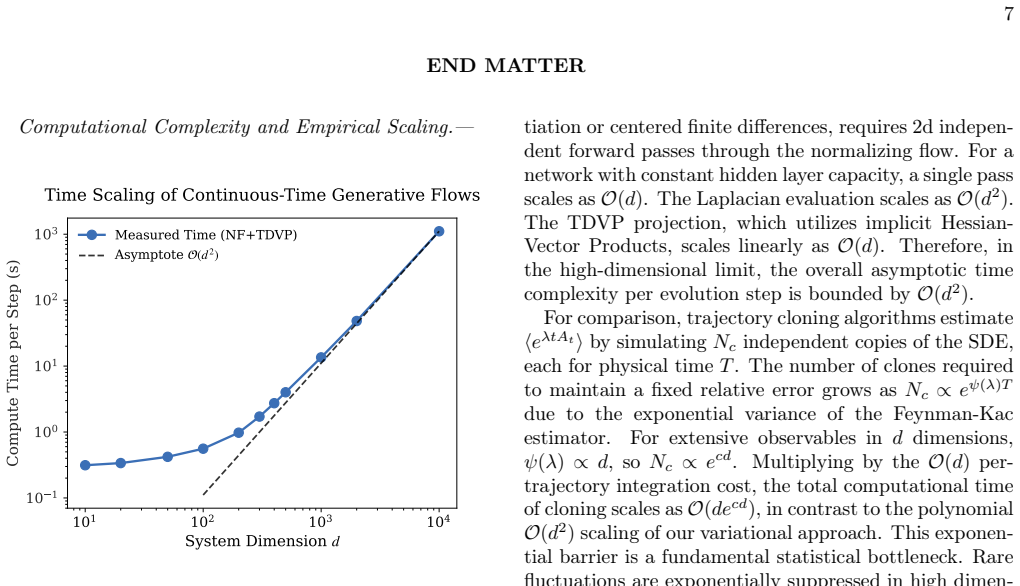
C. Durkan, A. Bekasov, I. Murray, and G. Papamakarios, Neural spline flows, NeurIPS32(2019). 7 END MA TTER Computational Complexity and Empirical Scaling.— 101 102 103 104 System Dimension d 10 1 100 101 102 103 Compute Time per Step (s) Time Scaling of Continuous-Time Generative Flows Measured Time (NF+TDVP) Asymptote (d2) FIG. 5. Scaling behavior of the...
2019
discussion (0)
Sign in with ORCID, Apple, or X to comment. Anyone can read and Pith papers without signing in.