Spatial Model Selection and Uncertainty Quantification: Comparing Continuous and Discrete Wound Healing Models
Pith reviewed 2026-06-27 10:53 UTC · model grok-4.3
The pith
Mean-field PDE models are often selected over true generative ABMs for spatial wound healing data.
A machine-rendered reading of the paper's core claim, the machinery that carries it, and where it could break.
Core claim
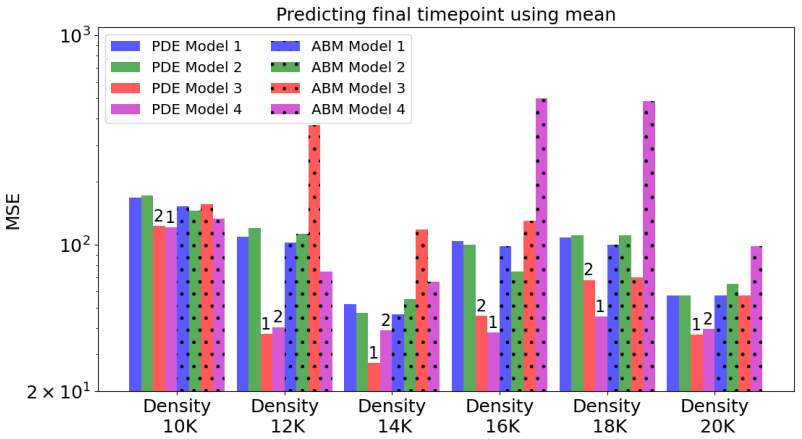
We created a model selection pipeline that uses approximate Bayesian computations to perform parameter estimation, uncertainty quantification, and model selection using both information criteria and out-of-sample forecasting. Applying the pipeline to artificial datasets generated from ABMs reveals that while both modalities yield comparable parameter estimation performance, the ABM estimates exhibit higher uncertainty, and the PDE models compute more than 1,000× faster. Surprisingly, the mean-field PDE is often selected over the true generative ABM model using both information criteria and data forecasting. Applying the pipeline to public wound healing data indicates that a PDE model with ce
What carries the argument
The approximate Bayesian computation pipeline that estimates parameters, quantifies uncertainty, and ranks PDE versus ABM models via information criteria and out-of-sample forecasting.
If this is right
- PDE and ABM modalities produce comparable parameter estimates on artificial data.
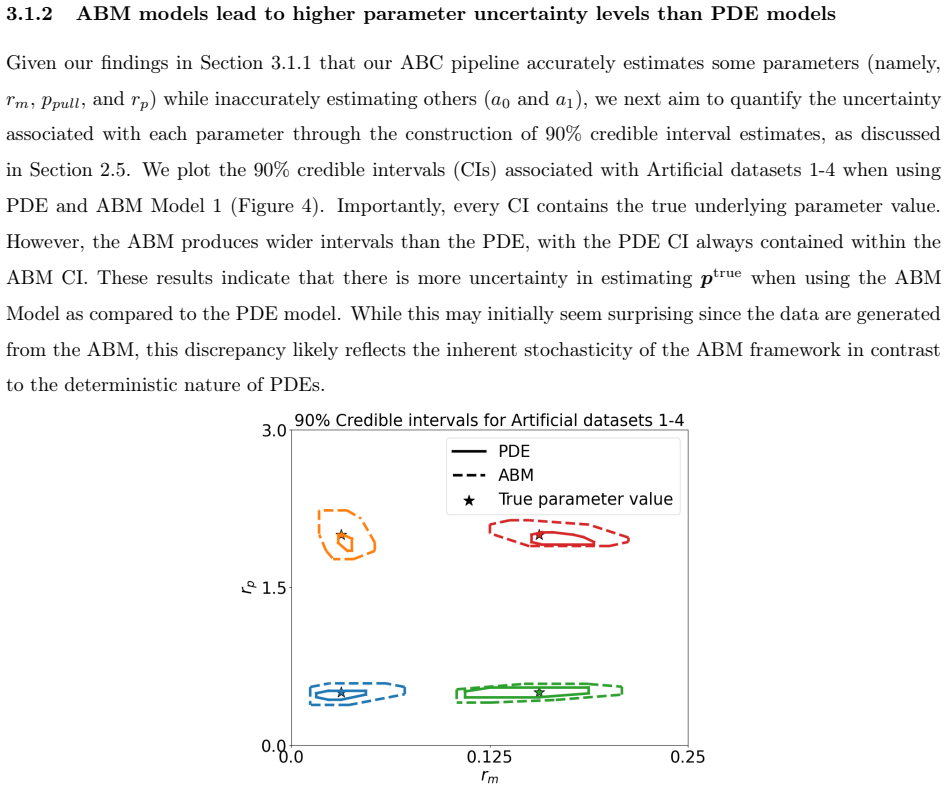
- ABM parameter uncertainty is higher than PDE uncertainty for the same data.
- PDE models run more than 1000 times faster than equivalent ABMs.
- A PDE that includes cell pulling and a time delay is selected for public wound healing data.
- The selected PDE model for wound data carries high parametric uncertainty.
Where Pith is reading between the lines
- The computational speed advantage of PDEs could allow routine exploration of larger spatial domains or longer time scales in biological modeling.
- High parametric uncertainty in the best-ranked model suggests that additional experimental measurements at specific spatial locations would most effectively reduce ambiguity.
- The pipeline could be applied to other spatial processes such as tumor invasion or bacterial colony growth to test whether the PDE preference is general.
- Cases with high residual uncertainty may motivate development of hybrid models that retain discrete cell rules only where continuous approximations break down.
Load-bearing premise
Artificial data generated from ABMs are representative of real spatial biological processes and the pipeline compares the two modalities without systematic bias.
What would settle it
Re-running the pipeline on a fresh collection of ABM-generated artificial datasets and finding that information criteria and forecasting accuracy no longer favor the PDE would directly test whether the reported selection pattern holds.
Figures




read the original abstract
All data-driven modeling tasks (e.g., parameter estimation, uncertainty quantification, and data forecasting) require the selection of a mathematical model. An overlooked aspect of model selection is modality; for example, there are no guidelines on when to use a partial differential equation (PDE) model or an agent-based model (ABM) for spatial processes. To address this, we created a model selection pipeline that uses approximate Bayesian computations to perform parameter estimation, uncertainty quantification, and model selection (using both information criteria and out-of-sample forecasting). Applying the pipeline to artificial datasets (generated from ABMs) reveals that while both modalities yield comparable parameter estimation performance, the ABM estimates exhibit higher uncertainty, and the PDE models compute more than 1,000$\times$ faster. Surprisingly, the mean-field PDE is often selected over the true generative ABM model using both information criteria and data forecasting. Applying the pipeline to public wound healing data indicates that a PDE model with cell pulling and a time delay is the most appropriate model for this data, however, this model has high levels of parametric uncertainty. This methodology establishes a preliminary framework for selecting the appropriate modeling modality for spatial biological data.
Editorial analysis
A structured set of objections, weighed in public.
Referee Report
Summary. The paper introduces an ABC-based pipeline for parameter estimation, uncertainty quantification, and modality selection (via information criteria and out-of-sample forecasting) between PDE and ABM models of spatial wound healing. On synthetic data generated from ABMs, it reports comparable parameter recovery but higher uncertainty and slower computation for ABMs, with the mean-field PDE frequently selected over the true generative ABM; on public wound-healing data it selects a PDE variant with cell pulling and time delay, albeit with high parametric uncertainty. The work positions this as a preliminary framework for choosing modeling modality in spatial biology.
Significance. If the comparability of the selection criteria between deterministic PDE and stochastic ABM modalities can be established, the pipeline would supply a concrete, reproducible method for modality choice that quantifies both predictive performance and computational cost, directly addressing an under-studied decision in spatial biological modeling.
major comments (2)
- [Model selection pipeline and Results on synthetic data] The headline result that the mean-field PDE is often selected over the true generative ABM (Abstract) rests on the unverified assumption that ABC-derived information criteria and forecasting scores place deterministic PDE and stochastic ABM likelihood approximations on a commensurate scale. Because ABM simulations retain intrinsic noise while PDE solutions are deterministic, any mismatch in how residual variability or effective degrees of freedom enter the ABC proxy likelihood or penalty terms could systematically favor the smoother PDE; the manuscript must demonstrate that this bias is absent or corrected before the “surprisingly” claim can be interpreted as evidence about biological modeling choice.
- [Methods and synthetic-data experiments] The artificial datasets are generated exclusively from ABMs (Abstract). While this tests recovery of the true modality, it leaves open whether the pipeline’s preference for PDE would persist if the data-generating process were itself a PDE with added observation noise; an additional cross-modality simulation study is required to confirm that the selection procedure does not embed an intrinsic modality bias.
minor comments (1)
- [Abstract and Results] The abstract states that PDE models compute “more than 1,000× faster,” but no corresponding timing table or hardware specification is referenced; a supplementary table reporting wall-clock times, number of ABC particles, and hardware would make the computational claim reproducible.
Simulated Author's Rebuttal
We thank the referee for their constructive comments, which help clarify the scope and limitations of our model selection pipeline. We address each major comment below and indicate the revisions we will make.
read point-by-point responses
-
Referee: [Model selection pipeline and Results on synthetic data] The headline result that the mean-field PDE is often selected over the true generative ABM (Abstract) rests on the unverified assumption that ABC-derived information criteria and forecasting scores place deterministic PDE and stochastic ABM likelihood approximations on a commensurate scale. Because ABM simulations retain intrinsic noise while PDE solutions are deterministic, any mismatch in how residual variability or effective degrees of freedom enter the ABC proxy likelihood or penalty terms could systematically favor the smoother PDE; the manuscript must demonstrate that this bias is absent or corrected before the “surprisingly” claim can be interpreted as evidence about biological modeling choice.
Authors: We agree that establishing commensurability of the ABC-based information criteria and forecasting scores between the deterministic PDE and stochastic ABM is essential for interpreting the modality selection results. Although both modalities are evaluated under the identical ABC framework (using simulation-based likelihood approximations for parameter estimation, WAIC-style criteria, and out-of-sample prediction error), the intrinsic noise in ABM trajectories versus the deterministic PDE solutions could indeed affect the scale of the approximated likelihoods and penalty terms. In the revision we will add an explicit discussion of this issue, together with sensitivity analyses that vary the ABC tolerance and summary statistics to test whether the observed preference for PDEs persists under different noise-handling regimes. These additions will qualify the “surprisingly” claim and provide the required demonstration that the selection is not an artifact of scale mismatch. revision: yes
-
Referee: [Methods and synthetic-data experiments] The artificial datasets are generated exclusively from ABMs (Abstract). While this tests recovery of the true modality, it leaves open whether the pipeline’s preference for PDE would persist if the data-generating process were itself a PDE with added observation noise; an additional cross-modality simulation study is required to confirm that the selection procedure does not embed an intrinsic modality bias.
Authors: The referee correctly notes that the current synthetic experiments only probe recovery when the ground truth is an ABM. While this design directly tests the surprising result that PDEs can be preferred even when the data are generated by an ABM, a symmetric experiment with PDE-generated data (plus realistic observation noise) is needed to confirm the absence of an intrinsic bias favoring PDEs. We will therefore add a cross-modality simulation study in the revised manuscript. We note that this will increase computational cost, but the additional experiments are feasible within the ABC pipeline already implemented. revision: yes
Circularity Check
No circularity; pipeline applies external criteria to independently generated data
full rationale
The paper generates artificial datasets from ABMs, then applies ABC for parameter estimation, UQ, and selection via information criteria plus out-of-sample forecasting to compare PDE vs. ABM modalities. No derivation step reduces by construction to its inputs (no self-definitional relations, no fitted parameters renamed as predictions, no load-bearing self-citations, no uniqueness theorems or ansatzes imported from prior author work). The central claim is an empirical outcome of applying the pipeline to external data, not a closed loop. The result is therefore self-contained against the stated benchmarks.
Axiom & Free-Parameter Ledger
Reference graph
Works this paper leans on
-
[1]
Smith.Uncertainty quantification: theory, implementation, and applications
Ralph C. Smith.Uncertainty quantification: theory, implementation, and applications. Computational science and engineering series. Society for Industrial and Applied Mathematics, Philadelphia, 2013
2013
-
[2]
Xu Wu, Ziyu Xie, Farah Alsafadi, and Tomasz Kozlowski. A comprehensive survey of inverse uncer- tainty quantification of physical model parameters in nuclear system thermal–hydraulics codes.Nuclear Engineering and Design, 384:111460, 2021
2021
-
[3]
Alnaif, Lu Huang, Tarek A
Yougan Cheng, Ronny Straube, Abed E. Alnaif, Lu Huang, Tarek A. Leil, and Brian J. Schmidt. Virtual Populations for Quantitative Systems Pharmacology Models. In Jane P.F. Bai and Junguk Hur, editors,Systems Medicine, volume 2486, pages 129–179. Springer US, New York, NY, 2022. Series Title: Methods in Molecular Biology
2022
-
[4]
Brookes, David Jordan, Stephen Davis, Michael P
Victoria J. Brookes, David Jordan, Stephen Davis, Michael P. Ward, and Jane Heller. Saltelli Global Sensitivity Analysis and Simulation Modelling to Identify Intervention Strategies to Reduce the Preva- lence of Escherichia coli O157 Contaminated Beef Carcasses.PLOS ONE, 10(12):e0146016, December 2015
2015
-
[5]
Gevertz, Irina Kareva, and Kathleen P
Morgan Craig, Jana L. Gevertz, Irina Kareva, and Kathleen P. Wilkie. A practical guide for the generation of model-based virtual clinical trials.Frontiers in Systems Biology, 3:1174647, June 2023
2023
-
[6]
Komarova and Dominik Wodarz
Natalia L. Komarova and Dominik Wodarz. Ode models for oncolytic virus dynamics.Journal of Theoretical Biology, 263(4):530–543, 2010
2010
-
[7]
Moros, Kujtim Latifi, Jimmy J
Jan Poleszczuk, Rachel Walker, Eduardo G. Moros, Kujtim Latifi, Jimmy J. Caudell, and Heiko En- derling. Predicting patient-specific radiotherapy protocols based on mathematical model choice for proliferation saturation index.Bulletin of Mathematical Biology, 80:1195–1206, 2018
2018
-
[8]
Kutuva1, Jimmy J
Achyudhan R. Kutuva1, Jimmy J. Caudell, Kosj Yamoah, Heiko Enderling, and Mohammad U. Zahid. Mathematical modeling of radiotherapy: impact of model selection on estimating minimum radiation dose for tumor control.Frontiers in Oncology, 13:1130966, 2023. 25
2023
-
[9]
Changin Oh and Kathleen P. Wilkie. How mathematical forms of chemotherapy and radiotherapy bias model-optimized predictions: Implications for model selection, 2025
2025
-
[10]
Dziak, Donna L
John J. Dziak, Donna L. Coffman, Stephanie T. Lanza, Runze Li, and Lars S. Jermiin. Sensitivity and specificity of information criteria.Briefings in Bioinformatics, 21(2):553–565, 03 2019
2019
-
[11]
Warne, Ruth E
David J. Warne, Ruth E. Baker, and Matthew J. Simpson. Using Experimental Data and Information Criteria to Guide Model Selection for Reaction–Diffusion Problems in Mathematical Biology.Bulletin of Mathematical Biology, 81(6):1760–1804, June 2019
2019
-
[12]
Ford Versypt
Ashlee N. Ford Versypt. Multiscale modeling in disease.Current Opinion in Systems Biology, 27:100340, 2021
2021
-
[13]
A Review of Cell-Based Computational Modeling in Cancer Biology.JCO Clinical Cancer Informatics, February 2019
John Metzcar, Yafei Wang, Randy Heiland, and Paul Macklin. A Review of Cell-Based Computational Modeling in Cancer Biology.JCO Clinical Cancer Informatics, February 2019
2019
-
[14]
Simpson, Ruth E
Matthew J. Simpson, Ruth E. Baker, Pascal R. Buenzli, Ruanui Nicholson, and Oliver J. Maclaren. Reliable and efficient parameter estimation using approximate continuum limit descriptions of stochastic models.Journal of Theoretical Biology, 549:111201, September 2022
2022
-
[15]
Jain, Kerri-Ann Norton, Bernardo B
Harsh V. Jain, Kerri-Ann Norton, Bernardo B. Prado, and Trachette L. Jackson. SMoRe ParS: A novel methodology for bridging modeling modalities and experimental data applied to 3D vascular tumor growth.Frontiers in Molecular Biosciences, 9:1056461, December 2022
2022
-
[16]
John T. Nardini, Ruth E. Baker, Matthew J. Simpson, and Kevin B. Flores. Learning differential equation models from stochastic agent-based model simulations.Journal of The Royal Society Interface, 18(176):rsif.2020.0987, 20200987, March 2021
arXiv 2020
-
[17]
Rocha, Boris Aguilar, Michael Getz, Ilya Shmulevich, and Paul Macklin
Heber L. Rocha, Boris Aguilar, Michael Getz, Ilya Shmulevich, and Paul Macklin. A multiscale model of immune surveillance in micrometastases gives insights on cancer patient digital twins.npj Systems Biology and Applications, 10(1):144, December 2024
2024
-
[18]
High- Performance and Scalable Agent-Based Simulation with BioDynaMo
Lukas Breitwieser, Ahmad Hesam, Fons Rademakers, Juan Gómez Luna, and Onur Mutlu. High- Performance and Scalable Agent-Based Simulation with BioDynaMo. InProceedings of the 28th ACM SIGPLAN Annual Symposium on Principles and Practice of Parallel Programming, pages 174–188, Montreal QC Canada, February 2023. ACM
2023
-
[19]
Mortveit, Bryan L
Jiangzhuo Chen, Stefan Hoops, Henning S. Mortveit, Bryan L. Lewis, Dustin Machi, Parantapa Bhat- tacharya, Srinivasan Venkatramanan, Mandy L. Wilson, Chris L. Barrett, and Madhav V. Marathe. A high performance computational modeling framework to support epidemic science.PNAS Nexus, 4(1):557, December 2024. 26
2024
-
[20]
Shah, Catherine J
Wang Jin, Esha T. Shah, Catherine J. Penington, Scott W. McCue, Lisa K. Chopin, and Matthew J. Simpson. Reproducibility of scratch assays is affected by the initial degree of confluence: Experiments, modelling and model selection.Journal of Theoretical Biology, 390:136–145, February 2016
2016
-
[21]
Lagergren, John T
John H. Lagergren, John T. Nardini, Ruth E. Baker, Matthew J. Simpson, and Kevin B. Flores. Biologically-informed neural networks guide mechanistic modeling from sparse experimental data.PLOS Computational Biology, 16(12):e1008462, December 2020
2020
-
[22]
VandenHeuvel, Christopher Drovandi, and Matthew J
Daniel J. VandenHeuvel, Christopher Drovandi, and Matthew J. Simpson. Computationally efficient mechanism discovery for cell invasion with uncertainty quantification.PLOS Computational Biology, 18(11):e1010599, November 2022. Publisher: Public Library of Science
2022
-
[23]
Ang, Simon P
Sunyoung Park, Richard R. Ang, Simon P. Duffy, Jenny Bazov, Kim N. Chi, Peter C. Black, and Hong- shen Ma. Morphological Differences between Circulating Tumor Cells from Prostate Cancer Patients and Cultured Prostate Cancer Cells.PLOS ONE, 9(1):e85264, January 2014. Publisher: Public Library of Science
2014
-
[24]
Gillespie
Daniel T. Gillespie. Exact stochastic simulation of coupled chemical reactions.The Journal of Physical Chemistry, 81(25):2340–2361, 1977
1977
-
[25]
George Chappelle and Christian A. Yates. Pulling in models of cell migration.Physical Review E, 99(6):062413, June 2019
2019
-
[26]
John T. Nardini. Forecasting and Predicting Stochastic Agent-Based Model Data with Biologically- Informed Neural Networks.Bulletin of Mathematical Biology, 86(11):130, November 2024
2024
-
[27]
Vo, Christopher C
Brenda N. Vo, Christopher C. Drovandi, Anthony N. Pettitt, and Matthew J. Simpson. Quantifying uncertainty in parameter estimates for stochastic models of collective cell spreading using approximate Bayesian computation.Mathematical Biosciences, 263:133–142, May 2015
2015
-
[28]
Malik, Kyle C
Adam A. Malik, Kyle C. Nguyen, John T. Nardini, Cecilia C. Krona, Kevin B. Flores, and Sven Nelander. Mathematical modeling of multicellular tumor spheroids quantifies inter-patient and intra- tumor heterogeneity.npj Systems Biology and Applications, 11(1):20, February 2025
2025
-
[29]
H. T. Banks and Michele L. Joyner. AIC under the framework of least squares estimation.Applied Mathematics Letters, 74:33–45, December 2017
2017
-
[30]
Baker, Rebecca M
Ruth E. Baker, Rebecca M. Crossley, Carles Falcó, and Simon F. Martina-Perez. Modeling Collective Cell Migration in a Data-Rich Age: Challenges and Opportunities for Data-Driven Modeling.Cold Spring Harbor Perspectives in Biology, page a041757, April 2026
2026
-
[31]
Oxford University Press, New York, 2 edition, 2025
Nathan Kutz.Data-driven modeling & scientific computation: methods for complex systems & big data. Oxford University Press, New York, 2 edition, 2025. 27
2025
-
[32]
MacLean, Alexander G
Ben Lambert, Adam L. MacLean, Alexander G. Fletcher, Alexander N. Combes, Melissa H. Little, and Helen M. Byrne. Bayesian inference of agent-based models: a tool for studying kidney branching morphogenesis.Journal of Mathematical Biology, 76(7):1673–1697, June 2018
2018
-
[33]
Efficient exact inference for dynamical systems with noisy measure- ments using sequential approximate Bayesian computation.Bioinformatics, 36:i551–i559, July 2020
Yannik Schälte and Jan Hasenauer. Efficient exact inference for dynamical systems with noisy measure- ments using sequential approximate Bayesian computation.Bioinformatics, 36:i551–i559, July 2020
2020
-
[34]
Calibra- tion of stochastic, agent-based neuron growth models with approximate Bayesian computation.Journal of Mathematical Biology, 89(5):50, November 2024
Tobias Duswald, Lukas Breitwieser, Thomas Thorne, Barbara Wohlmuth, and Roman Bauer. Calibra- tion of stochastic, agent-based neuron growth models with approximate Bayesian computation.Journal of Mathematical Biology, 89(5):50, November 2024
2024
-
[35]
Beaumont
Mark A. Beaumont. Approximate Bayesian Computation.Annual Review of Statistics and Its Appli- cation, 6(1):379–403, March 2019
2019
-
[36]
Frazier, Worapree Maneesoonthorn, Gael M
Henri Pesonen, Umberto Simola, Alvaro Köhn-Luque, Henri Vuollekoski, Xiaoran Lai, Arnoldo Frigessi, Samuel Kaski, David T. Frazier, Worapree Maneesoonthorn, Gael M. Martin, and Jukka Corander. ABC of the future.International Statistical Review, 91(2):243–268, August 2023
2023
-
[37]
Warne, Ruth E
David J. Warne, Ruth E. Baker, and Matthew J. Simpson. Multilevel rejection sampling for approximate Bayesian computation.Computational Statistics & Data Analysis, 124:71–86, August 2018
2018
-
[38]
Weaver, Solène Hegarty-Cremer, Cailan Jeynes-Smith, Am- ber M
Fatemeh Beigmohammadi, Jordan J.A. Weaver, Solène Hegarty-Cremer, Cailan Jeynes-Smith, Am- ber M. Smith, and Morgan Craig. Trajectory-matching ABC-MCMC for simulating heterogeneous dynamics in mechanistic models, September 2025
2025
-
[39]
Warne, Thomas P
David J. Warne, Thomas P. Prescott, Ruth E. Baker, and Matthew J. Simpson. Multifidelity multilevel Monte Carlo to accelerate approximate Bayesian parameter inference for partially observed stochastic processes.Journal of Computational Physics, 469:111543, November 2022
2022
-
[40]
Using machine learning as a surrogate model for agent-based simulations.PLOS ONE, 17(2):e0263150, February 2022
Claudio Angione, Eric Silverman, and Elisabeth Yaneske. Using machine learning as a surrogate model for agent-based simulations.PLOS ONE, 17(2):e0263150, February 2022
2022
-
[41]
Surrogate Modelling in (and of) Agent-Based Models: A Prospectus.Computa- tional Economics, 53(3):1245–1263, March 2019
Sander Van Der Hoog. Surrogate Modelling in (and of) Agent-Based Models: A Prospectus.Computa- tional Economics, 53(3):1245–1263, March 2019
2019
-
[42]
Quetzalcóatl Toledo-Marín, Tina Comlekoglu, Douglas W
Tien Comlekoglu, J. Quetzalcóatl Toledo-Marín, Tina Comlekoglu, Douglas W. DeSimone, Shayn M. Peirce, Geoffrey Fox, and James A. Glazier. Surrogate modeling of Cellular-Potts agent-based models as a segmentation task using the U-Net neural network architecture.PLOS Computational Biology, 21(11):e1013626, November 2025
2025
-
[43]
Bergman, Kerri-Ann Norton, Harsh V
Daniel R. Bergman, Kerri-Ann Norton, Harsh V. Jain, and Trachette Jackson. Connecting Agent- Based Models with High-Dimensional Parameter Spaces to Multidimensional Data Using SMoRe ParS: A Surrogate Modeling Approach.Bulletin of Mathematical Biology, 86(1):11, January 2024. 28
2024
-
[44]
Jain, and Trachette Jackson
Kerri-Ann Norton, Daniel Bergman, Harsh V. Jain, and Trachette Jackson. Advances in surrogate modeling for biological agent-based simulations: trends, challenges, and future prospects.Journal of Mathematical Biology, 92(1):6, January 2026
2026
-
[45]
Banga, and Eva Balsa-Canto
Oana-Teodora Chis, Julio R. Banga, and Eva Balsa-Canto. Structural Identifiability of Systems Biology Models: A Critical Comparison of Methods.PLOS ONE, 6(11):e27755, November 2011
2011
-
[46]
S. A. Murphy and A. W. Van Der Vaart. On Profile Likelihood.Journal of the American Statistical Association, 95(450):449–465, June 2000
2000
-
[47]
Eisenberg and Harsh V
Marisa C. Eisenberg and Harsh V. Jain. A confidence building exercise in data and identifiability: Modeling cancer chemotherapy as a case study.Journal of Theoretical Biology, 431:63–78, October 2017
2017
-
[48]
A. Raue, C. Kreutz, T. Maiwald, J. Bachmann, M. Schilling, U. Klingmüller, and J. Timmer. Structural and practical identifiability analysis of partially observed dynamical models by exploiting the profile likelihood.Bioinformatics, 25(15):1923–1929, August 2009
1923
-
[49]
A. Raue, V. Becker, U. Klingmüller, and J. Timmer. Identifiability and observability analysis for experimental design in nonlinear dynamical models.Chaos: An Interdisciplinary Journal of Nonlinear Science, 20(4):045105, December 2010
2010
-
[50]
Experimental Design for Param- eter Estimation of Gene Regulatory Networks.PLOS ONE, 7(7):e40052, July 2012
Bernhard Steiert, Andreas Raue, Jens Timmer, and Clemens Kreutz. Experimental Design for Param- eter Estimation of Gene Regulatory Networks.PLOS ONE, 7(7):e40052, July 2012
2012
-
[51]
Muñoz-Tamayo, L
R. Muñoz-Tamayo, L. Puillet, J.B. Daniel, D. Sauvant, O. Martin, M. Taghipoor, and P. Blavy. To be or not to be an identifiable model. Is this a relevant question in animal science modelling?Animal, 12(4):701–712, 2018
2018
-
[52]
Hauber, Marcus Rosenblatt, Christian Tönsing, and Jens Timmer
Franz-Georg Wieland, Adrian L. Hauber, Marcus Rosenblatt, Christian Tönsing, and Jens Timmer. On structural and practical identifiability.Current Opinion in Systems Biology, 25:60–69, March 2021
2021
-
[53]
Gevertz and Irina Kareva
Jana L. Gevertz and Irina Kareva. Minimally sufficient experimental design using identifiability analysis. npj Systems Biology and Applications, 10(1):2, January 2024
2024
-
[54]
Sherratt, Kevin J
Stephen Turner, Jonathan A. Sherratt, Kevin J. Painter, and Nicholas J. Savill. From a discrete to a continuous model of biological cell movement.Physical Review E, 69(2):021910, February 2004
2004
-
[55]
G. An, B. G. Fitzpatrick, S. Christley, P. Federico, A. Kanarek, R. Miller Neilan, M. Oremland, R. Sali- nas, R. Laubenbacher, and S. Lenhart. Optimization and Control of Agent-Based Models in Biology: A Perspective.Bulletin of Mathematical Biology, 79(1):63–87, January 2017
2017
-
[56]
DeAngelis and Stephanie G
Donald L. DeAngelis and Stephanie G. Diaz. Decision-Making in Agent-Based Modeling: A Current Review and Future Prospectus.Frontiers in Ecology and Evolution, 6:237, January 2019. 29
2019
-
[57]
Glen, Melissa L
Chad M. Glen, Melissa L. Kemp, and Eberhard O. Voit. Agent-based modeling of morphogenetic systems: Advantages and challenges.PLOS Computational Biology, 15(3):e1006577, March 2019
2019
-
[58]
Gallaher, Pedro M
Jill A. Gallaher, Pedro M. Enriquez-Navas, Kimberly A. Luddy, Robert A. Gatenby, and Alexander R.A. Anderson. Spatial heterogeneity and evolutionary dynamics modulate time to recurrence in continuous and adaptive cancer therapies.Cancer Research, 78(8):2127–2139, April 2018
2018
-
[59]
M. R. D’Orsogna, Y. L. Chuang, A. L. Bertozzi, and L. S. Chayes. Self-Propelled Particles with Soft- Core Interactions: Patterns, Stability, and Collapse.Physical Review Letters, 96(10):104302, March 2006
2006
-
[60]
Linking genotype, cell behavior, and phenotype: multidisciplinary perspectives with a basis in zebrafish patterns.Current Opinion in Genetics & Development, 63:78–85, August 2020
Alexandria Volkening. Linking genotype, cell behavior, and phenotype: multidisciplinary perspectives with a basis in zebrafish patterns.Current Opinion in Genetics & Development, 63:78–85, August 2020
2020
-
[61]
Alexandria Volkening. Methods for quantifying self-organization in biology: a forward-looking survey and tutorial, July 2024. arXiv:2407.10832 [q-bio.QM]
arXiv 2024
-
[62]
Colon, D
C. Colon, D. Claessen, and M. Ghil. Bifurcation analysis of an agent-based model for predator–prey interactions.Ecological Modelling, 317:93–106, December 2015. 30 Supplementary Information S1 Supplementary Figures Figure S10: Uncertainty quantification for Artificial dataset 6. We compute 90% credible intervals (see Section 2.5) for Artificial datasets u...
2015
discussion (0)
Sign in with ORCID, Apple, or X to comment. Anyone can read and Pith papers without signing in.