The link between obscured accretion and mildly relativistic precessing jets
Pith reviewed 2026-06-27 12:12 UTC · model grok-4.3
The pith
Obscured X-ray binary systems launch slower precessing jets due to dense environments near the compact object.
A machine-rendered reading of the paper's core claim, the machinery that carries it, and where it could break.
Core claim
We demonstrate an additional clear link between highly obscured systems and these lower-velocity, precessing jets. We speculate that this link may be due to mass-loading of the jets close to their launch sites, since these obscured systems are likely to be examples of (sometimes persistent, other times transient) super-Eddington accretion. The fastest relativistic jets are now seen to be both locked to a fixed direction, likely the black hole spin axis, and to be launched in low-density environments, while jets launched in dense environments are generally slower and very likely to precess.
What carries the argument
The observed association between highly obscured accretion systems and mildly relativistic precessing jets, interpreted through mass-loading in dense launch environments.
If this is right
- Fastest jets require both black hole spin alignment and low-density launch conditions.
- Mildly relativistic jets precess when launched into dense, obscured environments.
- Obscured phases correspond to super-Eddington accretion that supplies the mass loading.
- Jet velocity and stability separate into two populations based on local environment density.
Where Pith is reading between the lines
- Jet launch physics may be governed more by immediate surrounding density than by the compact object type alone.
- The distinction offers a way to identify super-Eddington episodes through radio jet monitoring even when X-ray data are absorbed.
- Similar environment-dependent jet behavior could appear in other accreting systems such as active galactic nuclei if scaled appropriately.
Load-bearing premise
The association between obscured systems and precessing jets is caused by mass-loading from super-Eddington accretion rather than some other correlated property of those systems.
What would settle it
Discovery of a fast, non-precessing jet (Lorentz factor greater than 2) in a persistently highly obscured system, or repeated precessing jets in confirmed low-obscuration systems, would undermine the proposed link.
Figures

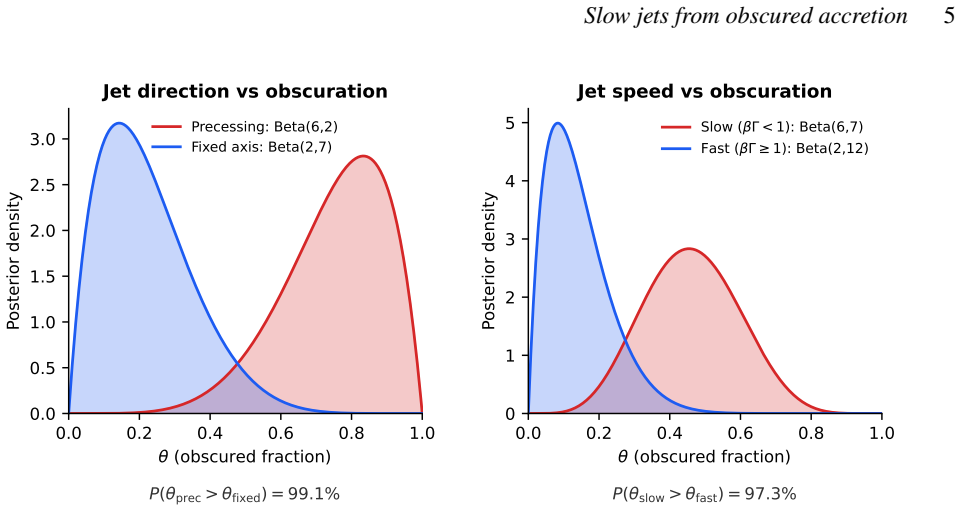
read the original abstract
We have recently shown evidence that the most relativistic jets (with Lorentz factor >2) from stellar-mass black holes in X-ray binary systems may be locked to a fixed axis, likely the spin axis of the black hole. Slower, mildly relativistic jets (with velocities typically ~ 0.3c) are often seen to precess and can be associated with both neutron stars and black holes. In this paper we demonstrate an additional clear link between highly obscured systems and these lower-velocity, precessing jets. We speculate that this link may be due to mass-loading of the jets close to their launch sites, since these obscured systems are likely to be examples of (sometimes persistent, other times transient) super-Eddington accretion. The fastest relativistic jets are now seen to be both locked to a fixed direction, likely the black hole spin axis, and to be launched in low-density environments, while jets launched in dense environments are generally slower and very likely to precess.
Editorial analysis
A structured set of objections, weighed in public.
Referee Report
Summary. The paper reports an observational association between highly obscured X-ray binary systems and mildly relativistic (~0.3c) precessing jets, contrasting this with faster (Gamma>2), fixed-axis jets in low-density environments. It speculates that the link arises from mass-loading near launch sites due to super-Eddington accretion in the obscured systems.
Significance. If the reported association is robust after controlling for potential confounders, the result would strengthen the empirical connection between accretion environment and jet kinematics, helping to explain why some jets precess while others remain aligned with the black-hole spin axis. The explicit framing of the mass-loading mechanism as speculation is a strength, as is the use of existing multi-wavelength data to identify the pattern.
major comments (2)
- [Discussion (speculative mechanism paragraph)] The central association is presented as a 'clear link' but the manuscript provides no quantitative estimate (analytic or numerical) of the baryon loading required to reduce jet velocity from Gamma>2 to ~0.3c; without this, the mass-loading interpretation remains untested even as speculation.
- [Sample selection and results sections] Binary inclination is a plausible confounder that can simultaneously increase observed column density and modulate the apparent precession signature via Doppler or geometric effects; the manuscript does not report any control or stratification by inclination when claiming the obscured-precessing association.
minor comments (1)
- [Abstract] The abstract states the velocities are 'typically ~0.3c' but does not cite the specific measurements or references used to establish this value for the precessing sample.
Simulated Author's Rebuttal
We thank the referee for their constructive report and positive assessment of the paper's significance. We address the two major comments below.
read point-by-point responses
-
Referee: [Discussion (speculative mechanism paragraph)] The central association is presented as a 'clear link' but the manuscript provides no quantitative estimate (analytic or numerical) of the baryon loading required to reduce jet velocity from Gamma>2 to ~0.3c; without this, the mass-loading interpretation remains untested even as speculation.
Authors: The phrase 'clear link' in the manuscript refers to the observational association between highly obscured systems and mildly relativistic precessing jets, which is the empirical result supported by the compiled multi-wavelength data. The mass-loading mechanism is already presented explicitly as speculation ('We speculate that this link may be due to mass-loading...'). We agree that a quantitative estimate of the required baryon loading would strengthen the plausibility of this idea, but such an estimate would necessitate new hydrodynamic modeling or detailed assumptions about the launch-region density profile that lie outside the scope of this observational study. We therefore do not plan to add a calculation; the speculation is offered only to motivate future theoretical work. revision: no
-
Referee: [Sample selection and results sections] Binary inclination is a plausible confounder that can simultaneously increase observed column density and modulate the apparent precession signature via Doppler or geometric effects; the manuscript does not report any control or stratification by inclination when claiming the obscured-precessing association.
Authors: We acknowledge that inclination is a potential confounder. In the revised manuscript we will add a dedicated paragraph in the results section that stratifies the sample by available inclination estimates (where known from orbital parameters or jet geometry) and discusses whether the obscured-precessing association persists across inclination bins. We will also note the limitations of the current inclination data and argue that the association is supported by multiple independent indicators (X-ray column, radio morphology, and timing) that are not solely driven by inclination. revision: yes
Circularity Check
No significant circularity; observational correlation with explicit speculation
full rationale
The paper presents an observational association between obscured accretion systems and mildly relativistic precessing jets, extending a prior finding on jet axis locking. The causal mass-loading interpretation is labeled as speculation without quantitative modeling or equations. No derivations, fitted parameters renamed as predictions, self-definitional constructs, or load-bearing self-citation chains appear in the provided text. The central claim rests on data correlation rather than any reduction to inputs by construction.
Axiom & Free-Parameter Ledger
axioms (2)
- domain assumption Highly obscured systems correspond to super-Eddington accretion
- ad hoc to paper Mass-loading from dense environments causes slower precessing jets
Reference graph
Works this paper leans on
-
[1]
Abdalla, H. and Abramowski, A. and Aharonian, F. and Ait Benkhali, F. and Ang. Astronomy. 2018 , Bdsk-Url-1 =. doi:10.1051/0004-6361/201732098 , issn =
-
[2]
Abdo, A. A. and Ackermann, M. and Ajello, M. and Anderson, B. and Atwood, W. B. and Axelsson, M. and Baldini, L. and Ballet, J. and Barbiellini, G. and Baring, M. G. and Bastieri, D. and Baughman, B. M. and Bechtol, K. and Bellazzini, R. and Berenji, B. and Bignami, G. F. and Blandford, R. D. and Bloom, E. D. and Bonamente, E. and Borgland, A. W. and Breg...
-
[3]
1988, ApJ, 332, 646, doi: 10.1086/166683
1988 , Bdsk-Url-1 =. doi:10.1086/166683 , journal =
-
[4]
, keywords =. 2001 , Bdsk-Url-1 =. doi:10.1051/0004-6361:20010791 , eprint =
-
[5]
astro-ph/0401464 , journal =
-
[6]
Leaving the ISCO: the inner edge of a black-hole accretion disk at various luminosities
2010 , Bdsk-Url-1 =. doi:10.1051/0004-6361/201014467 , eid =. arXiv , author =:1003.3887 , journal =
work page internal anchor Pith review Pith/arXiv arXiv doi:10.1051/0004-6361/201014467 2010
-
[7]
Acero, F. and Djannati-Ata. 2012 , Bdsk-Url-1 =. doi:10.7529/ICRC2011/V07/0928 , month =
-
[8]
Agazie, G. Y. and Mingyar, M. G. and McLaughlin, M. A. and Swiggum, J. K. and Kaplan, D. L. and Blumer, H. and Chawla, P. and DeCesar, M. and Demorest, P. B. and Fiore, W. and Fonseca, E. and Gelfand, J. D. and Kaspi, V. M. and Kondratiev, V. I. and LaRose, M. and van Leeuwen, J. and Levin, L. and Lewis, E. F. and Lynch, R. S. and McEwen, A. E. and Al Noo...
-
[9]
doi:10.1016/j.asr.2006.03.038 , journal =
2006 , Bdsk-Url-1 =. doi:10.1016/j.asr.2006.03.038 , journal =
-
[10]
, keywords =. 2006 , Bdsk-Url-1 =. doi:10.1086/501163 , eprint =
-
[11]
Radio Properties of Tidal Disruption Events. , keywords =. doi:10.1007/s11214-020-00702-w , archivePrefix =. 2006.01159 , primaryClass =
-
[12]
Ultra-high-energy gamma-ray bubble around microquasar V4641 Sgr. , keywords =. doi:10.1038/s41586-024-07995-9 , archivePrefix =. 2410.16117 , primaryClass =
-
[13]
Nuclear obscuration in active galactic nuclei , volume =
Nature Astronomy , keywords =. doi:10.1038/s41550-017-0232-z , eprint =
-
[14]
1982 , Bdsk-Url-1 =. doi:10.1038/300728a0 , journal =
-
[15]
X-ray time variability across the atoll source states of 4U 1636--53
doi:10.1086/590897 , eid =. arXiv , author =:0806.0962 , journal =
work page internal anchor Pith review Pith/arXiv arXiv doi:10.1086/590897
-
[16]
The Astronomer's Telegram , month = oct, owner =
-
[17]
M., 2011, @doi [ ] 10.1111/j.1365-2966.2010.17821.x , 411, 1917
, keywords =. 2010 , Bdsk-Url-1 =. doi:10.1111/j.1365-2966.2010.17369.x , eprint =
-
[18]
The faint "heartbeats" of IGR J17091-3624: an exceptional black-hole candidate
2011 , Bdsk-Url-1 =. doi:10.1088/2041-8205/742/2/L17 , eid =. arXiv , author =:1112.2393 , journal =
work page internal anchor Pith review Pith/arXiv arXiv doi:10.1088/2041-8205/742/2/l17 2011
-
[19]
Discovery of high-frequency quasi-periodic oscillations in the black-hole candidate IGR J17091-3624
2012 , Bdsk-Url-1 =. doi:10.1088/2041-8205/747/1/L4 , eid =. arXiv , author =:1201.2106 , journal =
work page internal anchor Pith review Pith/arXiv arXiv doi:10.1088/2041-8205/747/1/l4 2012
-
[20]
Low-frequency QPO from the 11 Hz accreting pulsar in Terzan 5: not frame dragging
2012 , Bdsk-Url-1 =. doi:10.1088/2041-8205/759/1/L20 , eid =. arXiv , author =:1210.1494 , journal =
work page internal anchor Pith review Pith/arXiv arXiv doi:10.1088/2041-8205/759/1/l20 2012
-
[21]
Anderson, L. D. and Wang, Y. and Bihr, S. and Rugel, M. and Beuther, H. and Bigiel, F. and Churchwell, E. and Glover, S. C.O. and Goodman, A. A. and Henning, Th and Heyer, M. and Klessen, R. S. and Linz, H. and Longmore, S. N. and Menten, K. M. and Ott, J. and Roy, N. and Soler, J. D. and Stil, J. M. and Urquhart, J. S. , date-added =. Astronomy and Astro...
-
[22]
, keywords =. 2003 , Bdsk-Url-1 =. doi:10.1086/374682 , eprint =
-
[23]
doi:10.1146/annurev.aa.31.090193.002353 , journal =
1993 , Bdsk-Url-1 =. doi:10.1146/annurev.aa.31.090193.002353 , journal =
-
[24]
, keywords =. 2006 , Bdsk-Url-1 =. doi:10.1111/j.1365-2966.2006.10871.x , eprint =
-
[25]
, keywords =. 2011 , Bdsk-Url-1 =. doi:10.1111/j.1365-2966.2011.19308.x , eprint =
-
[26]
, keywords =. 1998 , Bdsk-Url-1 =. doi:10.1086/305149 , eprint =
-
[27]
Astronomical Data Analysis Software and Systems V , editor =
-
[28]
Asad, K. M. B. and Girard, J. N. and de Villers, M. and Ansah-Narh, T. and Iheanetu, K. and Smirnov, O. and Santos, M. G. and Lehmensiek, R. and Jonas, J. and de Villiers, D. I. L. and Thorat, K. and Hugo, B. and Makhathini, S. and Jozsa, G. I. G. and Sirothia, S. K. , date-added =. 2019 , Bdsk-Url-1 =. doi:10.1093/mnras/stab104 , month =
-
[29]
A radio parallax to the black hole X-ray binary MAXI J1820+070. , keywords =. doi:10.1093/mnrasl/slaa010 , archivePrefix =. 1912.04525 , primaryClass =
-
[30]
Atwood, W. B. and Abdo, A. A. and Ackermann, M. and Althouse, W. and Anderson, B. and Axelsson, M. and Baldini, L. and Ballet, J. and Band, D. L. and Barbiellini, G. and Bartelt, J. and Bastieri, D. and Baughman, B. M. and Bechtol, K. and B. The Astrophysical Journal , month =. 2009 , Bdsk-Url-1 =. doi:10.1088/0004-637X/697/2/1071 , issn =
-
[31]
Baade, W. and Zwicky, F. , booktitle =. 1934 , Bdsk-Url-1 =. doi:10.1103/PhysRev.46.76.2 , issn =
-
[32]
, month = apr, owner =
-
[33]
, month = oct, pages =. 2014 , Bdsk-Url-1 =. doi:10.1038/nature13791 , eprint =
-
[34]
No Time for Dead Time: Timing analysis of bright black hole binaries with NuSTAR
doi:10.1088/0004-637X/800/2/109 , eid =. arXiv , author =:1409.3248 , journal =
work page internal anchor Pith review Pith/arXiv arXiv doi:10.1088/0004-637x/800/2/109
-
[35]
Backer, D. C. and Wong, T. and Valanju, J. , date-added =. The Astrophysical Journal , number =. 2000 , Bdsk-Url-1 =. doi:10.1086/317150 , issn =
-
[36]
International Journal of Modern Physics D , number =
Bagchi, Manjari , date-added =. International Journal of Modern Physics D , number =. 2013 , Bdsk-Url-1 =. doi:10.1142/S0218271813300218 , issn =
-
[37]
, keywords =. 2015 , Bdsk-Url-1 =. doi:10.1093/mnrasl/slv045 , eprint =
-
[38]
Bailes, M. and Jameson, A. and Abbate, F. and Barr, E. D. and Bhat, N. D. R. and Bondonneau, L. and Burgay, M. and Buchner, S. J. and Camilo, F. and Champion, D. J. and Cognard, I. and Demorest, P. B. and Freire, P. C. C. and Gautam, T. and Geyer, M. and Griessmeier, J. M. and Guillemot, L. and Hu, H. and Jankowski, F. and Johnston, S. and Karastergiou, A...
-
[39]
doi:10.1038/378157a0 , journal =
1995 , Bdsk-Url-1 =. doi:10.1038/378157a0 , journal =
-
[40]
doi:10.1038/374701a0 , journal =
1995 , Bdsk-Url-1 =. doi:10.1038/374701a0 , journal =
-
[41]
The Astronomer's Telegram , keywords =
-
[42]
arXiv , author =:2012.15033 , journal =
arXiv 2012
-
[43]
doi:10.1086/170270 , journal =
1991 , Bdsk-Url-1 =. doi:10.1086/170270 , journal =
-
[44]
Astrophysical Journal Letters , keywords =
Bamba, Aya and Anada, Takayasu and Dotani, Tadayasu and Mori, Koji and Yamazaki, Ryo and Ebisawa, Ken and Vink, Jacco , date-added =. Astrophysical Journal Letters , keywords =. 2010 , Bdsk-Url-1 =. doi:10.1088/2041-8205/719/2/L116 , issn =
-
[45]
2012 , Bdsk-Url-1 =. doi:10.1088/1475-7516/2012/09/014 , eid =. arXiv , author =:1205.6348 , journal =
work page internal anchor Pith review Pith/arXiv arXiv doi:10.1088/1475-7516/2012/09/014 2012
-
[46]
Physics Letters B , month = mar, pages =. 2014 , Bdsk-Url-1 =. doi:10.1016/j.physletb.2014.01.037 , eprint =
- [47]
-
[48]
, year = 1975, month = jan, volume =
The Lense-Thirring Effect and Accretion Disks around Kerr Black Holes. , year = 1975, month = jan, volume =. doi:10.1086/181711 , adsurl =
-
[49]
MAXI J1848-015: The First Detection of Relativistically Moving Outflows from a Globular Cluster X-Ray Binary. , keywords =. doi:10.3847/2041-8213/accde1 , archivePrefix =. 2305.03764 , primaryClass =
-
[50]
A timing-based estimate of the spin of the black hole in MAXI J1820+070. , keywords =. doi:10.1093/mnras/stab2848 , archivePrefix =. 2109.14371 , primaryClass =
-
[51]
doi:10.1051/0004-6361:20030539 , eprint =
, keywords =. doi:10.1051/0004-6361:20030539 , eprint =
-
[52]
Barr, Ewan D. and Champion, David J. and Kramer, Michael and Eatough, Ralph P. and Freire, Paulo C. C. and Karuppusamy, Ramesh and Lee, K. J. and Verbiest, Joris P. W. and Bassa, Cees G. and Lyne, Andrew G. and Stappers, Benjamin and Lorimer, Duncan R. and Klein, Bernd , date-added =. 2013 , Bdsk-Url-1 =. doi:10.1093/mnras/stt1440 , month =
-
[53]
Barr, Ewan D. , date-added =. Proceedings of the International Astronomical Union , number =. 2017 , Bdsk-Url-1 =. doi:10.1017/S1743921317009036 , issn =
-
[54]
Advances in Space Research , pages =. 2001 , Bdsk-Url-1 =. doi:10.1016/S0273-1177(01)00414-8 , eprint =
-
[55]
, keywords =. doi:10.1086/341626 , eprint =
-
[56]
doi:10.1088/0004-637X/753/1/84 , eid =. arXiv , author =:1205.0564 , journal =
work page internal anchor Pith review Pith/arXiv arXiv doi:10.1088/0004-637x/753/1/84
-
[57]
, keywords =. 2010 , Bdsk-Url-1 =. doi:10.1088/0004-637X/709/1/251 , eprint =
-
[58]
Becker, R. H. and White, R. L. and Helfand, D. J. , booktitle =. 2006 , Bdsk-Url-1 =. doi:10.1063/1.2216612 , issn =
-
[59]
2002, title The epoch of helium reionization , , 332, 601, 10.1046/j.1365-8711.2002.05291.x
, keywords =. 2002 , Bdsk-Url-1 =. doi:10.1046/j.1365-8711.2002.05189.x , eprint =
-
[60]
doi:10.1086/161178 , journal =
1983 , Bdsk-Url-1 =. doi:10.1086/161178 , journal =
-
[61]
The nature of SS433 and the ultraluminous X-ray sources. , keywords =. doi:10.1111/j.1365-2966.2006.10469.x , archivePrefix =. astro-ph/0604497 , primaryClass =
-
[62]
A mechanism for hysteresis in black hole binary state transitions
2014 , Bdsk-Url-1 =. doi:10.1088/2041-8205/782/2/L18 , eid =. arXiv , author =:1401.5475 , journal =
work page internal anchor Pith review Pith/arXiv arXiv doi:10.1088/2041-8205/782/2/l18 2014
-
[63]
Accretion disk dynamo as the trigger for X-ray binary state transitions
2015 , Bdsk-Url-1 =. doi:10.1088/0004-637X/809/2/118 , eid =. arXiv , author =:1507.03996 , journal =
work page internal anchor Pith review Pith/arXiv arXiv doi:10.1088/0004-637x/809/2/118 2015
-
[64]
doi:10.1086/310369 , journal =
1996 , Bdsk-Url-1 =. doi:10.1086/310369 , journal =
-
[65]
, keywords =. 1997 , Bdsk-Url-1 =. doi:10.1086/310595 , eprint =
-
[66]
astro-ph/0001103 , journal =
-
[67]
, keywords =. 2001 , Bdsk-Url-1 =. doi:10.1051/0004-6361:20010480 , eprint =
-
[68]
2002, ApJ, 572, 392, doi: 10.1086/340290
, keywords =. 2002 , Bdsk-Url-1 =. doi:10.1086/340290 , eprint =
-
[69]
, keywords =. 2002 , Bdsk-Url-1 =. doi:10.1051/0004-6361:20020703 , eprint =
-
[70]
Interacting Binaries: Accretion, Evolution, and Outcomes, AIP Conference Proceedings, Volume 797, pp. 197-204 , keywords =. 2005 , Bdsk-Url-1 =. doi:10.1063/1.2130233 , editor =
-
[71]
, keywords =. 2005 , Bdsk-Url-1 =. doi:10.1051/0004-6361:20042457 , eprint =
-
[72]
, keywords =. 2006 , Bdsk-Url-1 =. doi:10.1111/j.1365-2966.2006.09999.x , eprint =
-
[73]
, keywords =. 2007 , Bdsk-Url-1 =. doi:10.1111/j.1365-2966.2007.11943.x , eprint =
-
[74]
American Institute of Physics Conference Series , doi =. 2009 , Bdsk-Url-1 =. arXiv , author =:0908.3077 , keywords =
Pith/arXiv arXiv 2009
-
[75]
States and transitions in black-hole binaries
2010 , Bdsk-Url-1 =. doi:10.1007/978-3-540-76937-8_3 , editor =. arXiv , author =:0909.2474 , journal =
work page internal anchor Pith review Pith/arXiv arXiv doi:10.1007/978-3-540-76937-8_3 2010
-
[76]
arXiv , author =:1109.3388 , journal =
-
[77]
Astronomische Nachrichten , keywords =. 2011 , Bdsk-Url-1 =. doi:10.1002/asna.201011492 , eprint =
-
[78]
, keywords =. 2012 , Bdsk-Url-1 =. doi:10.1111/j.1365-2966.2012.21634.x , eprint =
-
[79]
, keywords =. 2013 , Bdsk-Url-1 =. doi:10.1093/mnras/stt285 , eprint =
-
[80]
, keywords =. 2013 , Bdsk-Url-1 =. doi:10.1093/mnras/stt500 , eprint =
discussion (0)
Sign in with ORCID, Apple, or X to comment. Anyone can read and Pith papers without signing in.