Physically Constrained Ensemble Gaussian Process Modelling for Expensive Quantum Systems with Heteroskedastic Noise
Pith reviewed 2026-06-28 19:15 UTC · model grok-4.3
The pith
Physically constrained ensemble Gaussian processes model noisy quantum simulations with better accuracy and physical consistency than standard approaches.
A machine-rendered reading of the paper's core claim, the machinery that carries it, and where it could break.
Core claim
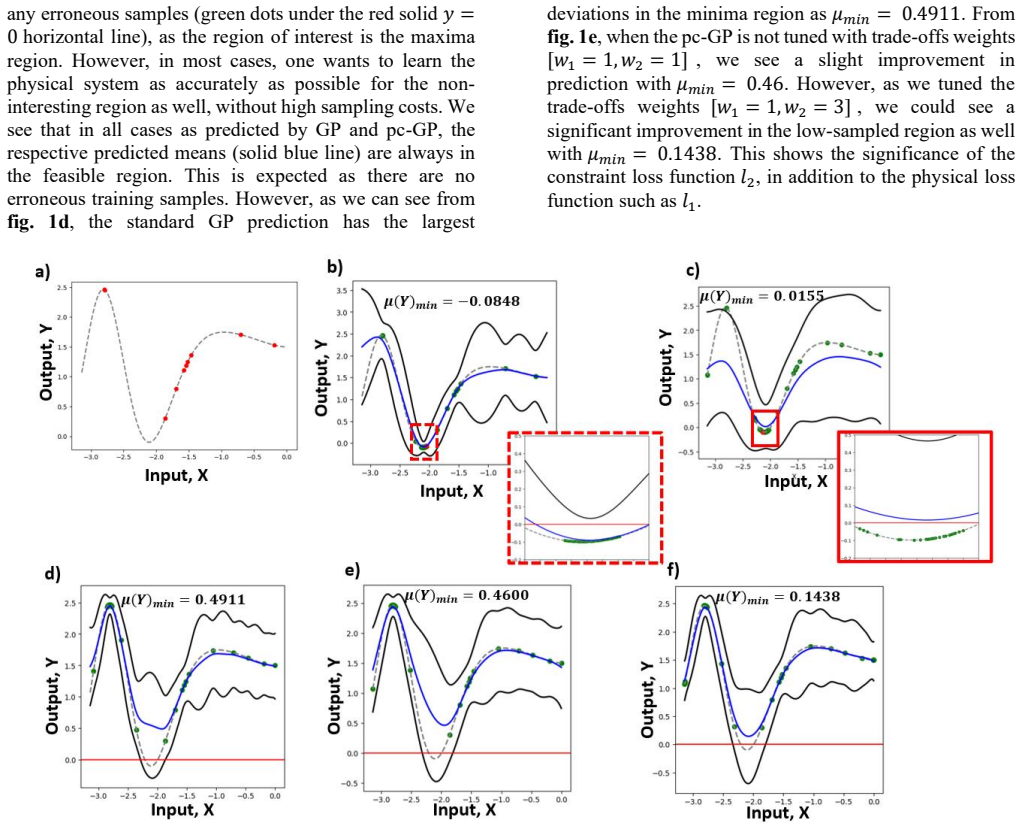
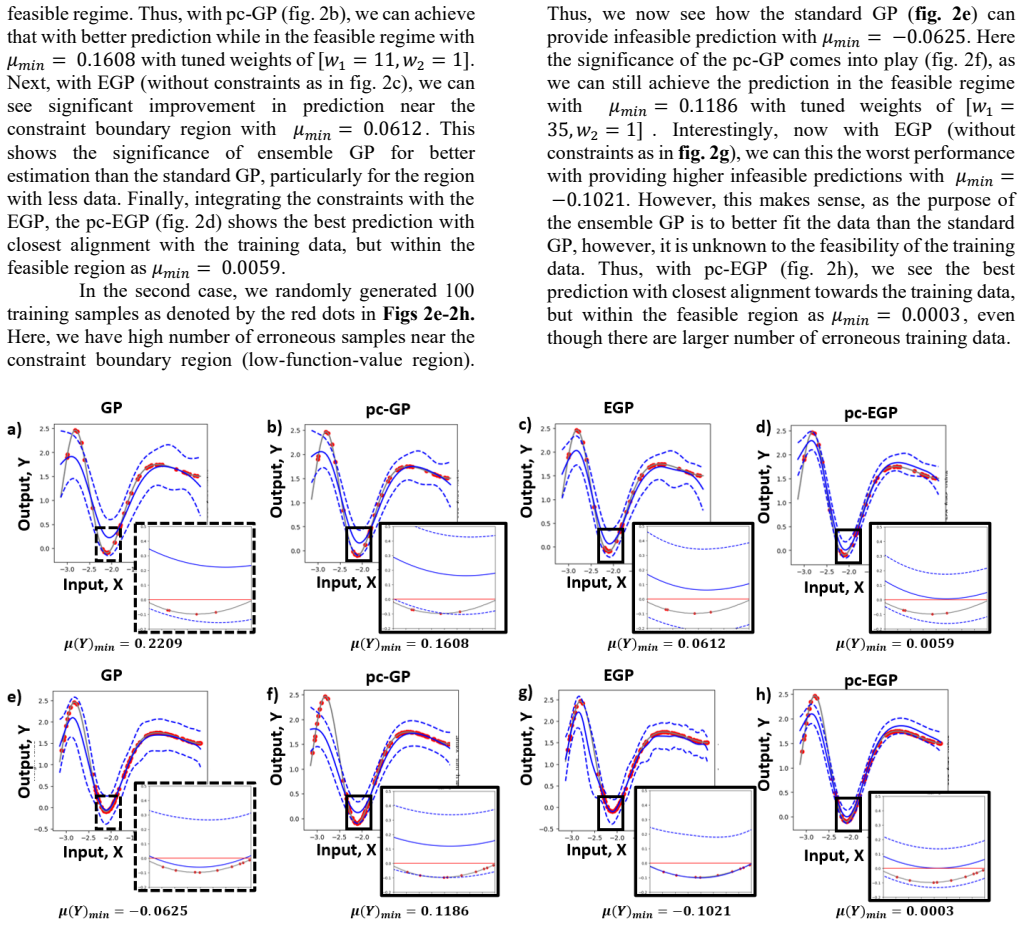
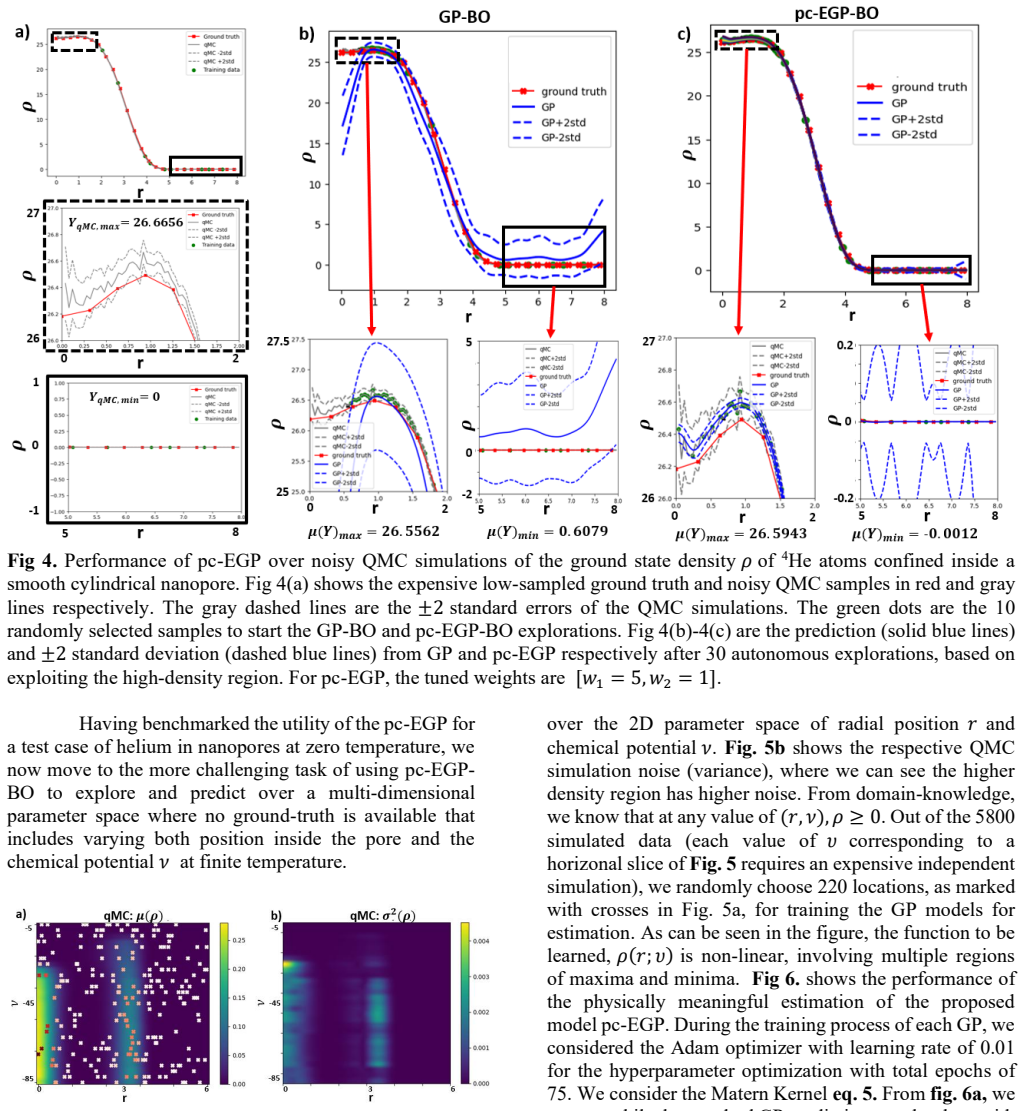
The pc-EGP framework enforces physical constraints as a user controlled weighted penalty to the data-driven loss function of the Gaussian Process (GP) surrogates. Then an ensemble of such GP models is trained with variable noisy simulations via numerical quadrature method where these multiple GP(s) at different nodes is integrated as a quadrature weighted average. Applied first to synthetic data and then to DMRG simulations of the Bose-Hubbard Model for predicting the critical Uc and to QMC simulations of a quantum liquid in a nanoporous silicate for optimizing a chemical environment, the method achieves a better balance of accuracy and physically meaningful predictions than conventional GP.
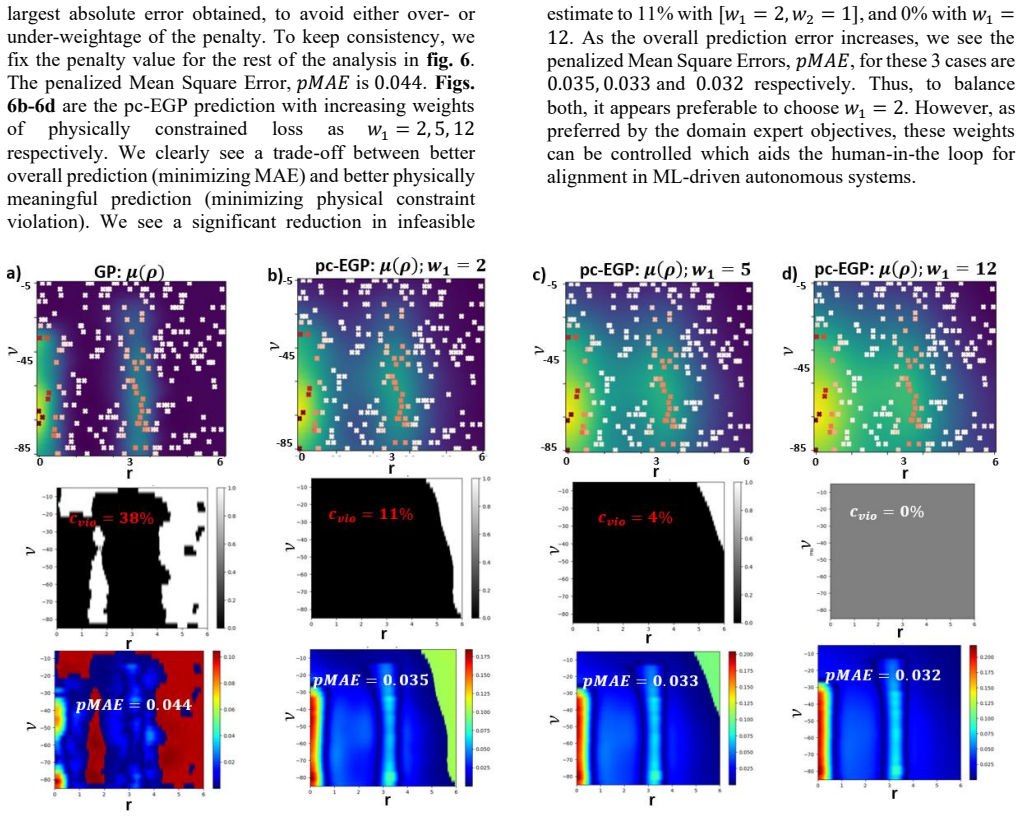
What carries the argument
Physically Constrained Ensemble Gaussian Process (pc-EGP) that adds a user-controlled weighted penalty for physical consistency to the GP loss function and integrates an ensemble of GPs trained on noisy data via numerical quadrature weighting.
If this is right
- The critical interaction parameter Uc for the superfluid-to-Mott-insulator transition can be estimated reliably from limited DMRG runs.
- Chemical environments realizing one-dimensional superfluidity can be optimized from fewer QMC simulations while respecting physical laws.
- Expensive quantum many-body calculations with heteroskedastic noise can be replaced by surrogates that remain physically plausible over unsampled regions.
- Parameter-space exploration of quantum systems becomes feasible with sparsely sampled, noisy simulation data.
Where Pith is reading between the lines
- The same penalty-plus-quadrature construction could be applied to other expensive simulation families if suitable physical constraints are supplied.
- An automated procedure for selecting the penalty weight would remove a manual step that currently limits ease of use.
- Direct comparisons against other physics-informed machine-learning surrogates would isolate the contribution of the ensemble quadrature step.
Load-bearing premise
Adding a user-controlled weighted penalty to the Gaussian process loss function enforces physical consistency without introducing new fitting artifacts or degrading predictive accuracy on the underlying data.
What would settle it
A case in which raising the penalty weight produces either predictions that violate the imposed physical constraints or measurably higher error on held-out simulation points would falsify the premise.
Figures

read the original abstract
Accurate modeling of quantum many-body systems often requires computationally expensive simulations such as Density Matrix Renormalization Group (DMRG) or Quantum Monte Carlo (QMC) calculations. These methods, while precise, impose significant time and resource constraints, limiting their use in exhaustive parameter exploration. Moreover, these expensive simulations can contain variable errors over the large unknown parameter space, which needs to be quantified and propagated. Thus, predictive modelling is required to estimate the functional space accurately over scarcely sampled data with heteroskedastic noise, while preserving the physical relevance of the estimation. Therefore, we present a Physically Constrained Ensemble Gaussian Process (pc-EGP) framework designed to efficiently model complex and noisy quantum systems under physical consistency constraints. The proposed method first enforces physical constraints as a user controlled weighted penalty to the data-driven loss function of the Gaussian Process (GP) surrogates. Then an ensemble of such GP models is trained with variable noisy simulations via numerical quadrature method where these multiple GP(s) at different nodes is integrated as a quadrature weighted average. We first demonstrate the framework on synthetically generated data before applying to quantum systems. In the first case study, we leverage DMRG simulations of the Bose-Hubbard Model to predict the critical interaction parameter Uc governing the superfluid-to-Mott-insulator transition. In the second case study, we demonstrate our method on QMC simulations, of a quantum liquid confined inside a nanoporous silicate with the goal of optimizing a chemical environment to realize a one-dimensional superfluid. Compared to conventional GP, pc-EGP achieves a better balance of accuracy and physically meaningful predictions.
Editorial analysis
A structured set of objections, weighed in public.
Referee Report
Summary. The manuscript proposes a Physically Constrained Ensemble Gaussian Process (pc-EGP) framework for surrogate modeling of expensive quantum many-body simulations (DMRG and QMC) that exhibit heteroskedastic noise. Physical constraints are incorporated by adding a user-controlled weighted penalty term to the standard GP loss; an ensemble of such GPs is then trained on noisy data and combined via numerical quadrature to produce integrated predictions. The method is first validated on synthetic data and then applied to (i) DMRG data for the Bose-Hubbard model to predict the critical interaction Uc of the superfluid-Mott transition and (ii) QMC data for a quantum liquid in a nanopore to optimize conditions for a one-dimensional superfluid. The central claim is that pc-EGP achieves a superior accuracy-versus-physical-consistency trade-off relative to conventional GP.
Significance. If the central claim is substantiated, the pc-EGP construction would provide a practical surrogate-modeling tool for quantum many-body problems where direct simulation is prohibitive and physical consistency must be preserved. The combination of a penalty-based constraint mechanism with quadrature-based ensemble integration for heteroskedastic noise is a technically coherent extension of existing GP methods and could accelerate parameter-space exploration in condensed-matter applications.
major comments (2)
- [Method description] Method description (abstract and §2): the framework adds physical constraints 'as a user controlled weighted penalty' to the GP loss, yet supplies no procedure for selecting or validating the penalty weight, no ablation study over weight values, and no trade-off curves relating constraint violation to predictive error on the DMRG or QMC data. Without this quantitative evidence the claim that pc-EGP 'achieves a better balance of accuracy and physically meaningful predictions' cannot be assessed and may reflect manual tuning rather than an intrinsic property of the construction.
- [Results (case studies)] Results sections (case studies 1 and 2): the reported improvements over conventional GP are stated without accompanying error bars, statistical significance tests, or explicit comparison tables that isolate the contribution of the penalty term versus the ensemble quadrature component. This omission leaves the load-bearing claim of improved accuracy-plus-consistency unsupported by the presented evidence.
minor comments (2)
- [Abstract] The abstract and introduction would benefit from a concise statement of the precise physical constraints enforced in each case study (e.g., positivity of density, monotonicity of energy, etc.).
- [Method] Notation for the quadrature weights and the ensemble integration formula should be introduced with an equation number to facilitate reproducibility.
Simulated Author's Rebuttal
We thank the referee for the constructive and detailed comments. We address each major point below and agree that the manuscript would benefit from additional quantitative support for the penalty-weight selection and for the performance claims. Revisions will be made accordingly.
read point-by-point responses
-
Referee: [Method description] Method description (abstract and §2): the framework adds physical constraints 'as a user controlled weighted penalty' to the GP loss, yet supplies no procedure for selecting or validating the penalty weight, no ablation study over weight values, and no trade-off curves relating constraint violation to predictive error on the DMRG or QMC data. Without this quantitative evidence the claim that pc-EGP 'achieves a better balance of accuracy and physically meaningful predictions' cannot be assessed and may reflect manual tuning rather than an intrinsic property of the construction.
Authors: We agree that the current manuscript lacks an explicit procedure for penalty-weight selection and the associated ablation/trade-off analyses. In the revised version we will add (i) a cross-validation-based protocol for choosing the weight that balances data fidelity against constraint violation, (ii) ablation results over a range of weights, and (iii) trade-off curves of predictive error versus constraint violation for both the DMRG and QMC case studies. These additions will allow readers to assess whether the reported balance is systematic rather than the result of manual tuning. revision: yes
-
Referee: [Results (case studies)] Results sections (case studies 1 and 2): the reported improvements over conventional GP are stated without accompanying error bars, statistical significance tests, or explicit comparison tables that isolate the contribution of the penalty term versus the ensemble quadrature component. This omission leaves the load-bearing claim of improved accuracy-plus-consistency unsupported by the presented evidence.
Authors: We acknowledge that the present results do not include error bars, statistical tests, or component-isolating tables. The revised manuscript will report error bars on all quantitative metrics, include paired statistical significance tests (e.g., Wilcoxon or t-tests) between pc-EGP and baseline GP, and add comparison tables that separately quantify the effect of the penalty term and the quadrature ensemble integration on both accuracy and physical-consistency metrics. revision: yes
Circularity Check
No significant circularity detected
full rationale
The pc-EGP method is presented as a standard modeling procedure: a user-weighted penalty term is added to the GP loss to enforce physical constraints, followed by ensemble training via numerical quadrature on noisy simulation data. No equation or step in the abstract or method description reduces a reported prediction or result to a quantity already fitted to the same data by construction. No self-citations are invoked as load-bearing uniqueness theorems, no ansatz is smuggled via prior work, and no fitted parameter is relabeled as an independent prediction. The comparison to conventional GP is framed as an empirical demonstration on DMRG and QMC data rather than a definitional identity. This places the work in the normal non-circular category.
Axiom & Free-Parameter Ledger
Reference graph
Works this paper leans on
-
[1]
To accelerate the search for optimal parameter regimes, much effort has been focused on designing autonomous workflows via machine learning (ML)-driven selection (active learning)
INTRODUCTION The modern era of scientific discovery brings forth the challenge of exploring complex, large and time-consuming multidimensional domain specific parameter and function spaces. To accelerate the search for optimal parameter regimes, much effort has been focused on designing autonomous workflows via machine learning (ML)-driven selection (acti...
-
[2]
These quantum phases can be defined as a function of several tuning parameters of the microscopic model
are required to explore transitions between different quantum phases. These quantum phases can be defined as a function of several tuning parameters of the microscopic model. In order to explore over these tuning parameters to find an optimal point where a phase transition occurs , it may require millions of CPU core hours even to tune a single parameter ...
-
[3]
METHODOLOGY The proposed pc -EGP model has two key developments -
-
[4]
the injection of physical constraints during the training process by jointly optimizing the model hyper parameters via a user-controlled integrated physical loss function, and
-
[5]
an ensemble modelling approach via numerical quadrature method to propagate and quantify heteroskedastic noise present in physical systems. 2.1. Physical Loss Integration into a Standard Gaussian Process (GP) model: The general form of the GP model is as follows: 𝑦(𝑥) = ∆(𝑥)+ 𝜀 (1) where 𝜀~𝑁(0, 𝜎𝑒 2𝐼) is the standard fixed noise model with zero mean and v...
-
[6]
RESULTS From the above analysis over the synthetically generated functions, we can see promising results where the proposed method has the ability 1) to rectify the estimation from the enormous sampled data, 2) gaining higher confidence in estimation from the data with heteroskedastic noise and 3) balancing the physical and data -driven constraints for an...
-
[7]
We consider the Matern Kernel eq. 5. From fig. 6a, we can see while the standard GP prediction matches best with the ground truth QMC simulation in Fig. 5a , it provides unphysical function predictions over as much as 38% of the overall parameter space. Thus, to define a better performance metric , we penalize the mean absolute error with constraint viola...
-
[8]
Thus, to balance both, it appears preferable to choose 𝑤1 = 2
As the overall prediction error increases, we see the penalized Mean Square Errors, 𝑝𝑀𝐴𝐸, for these 3 cases are 0.035, 0.033 and 0.032 respectively. Thus, to balance both, it appears preferable to choose 𝑤1 = 2. However, as preferred by the domain expert objectives, the se weights can be controlled which aids the human -in-the loop for alignment in ML-dri...
-
[9]
CONCLUSION To summarize, we have proposed a physically-constrained ensemble Gaussian Process model for improved and physically meaningful learning of computationally expensive quantum systems. The two key developments in the proposed approach, during the model training process, are, designing 1) a pathway for inclusion of physical constraint validation an...
-
[10]
& Del Maestro, A
Barghathi, H., Usadi, C., Beck, M. & Del Maestro, A. Compact unary coding for bosonic states as efficient as conventional binary encoding for fermionic states. Phys. Rev. B 105, L121116 (2022)
2022
-
[11]
The density-matrix renormalization group in the age of matrix product states
Schollwöck, U. The density-matrix renormalization group in the age of matrix product states. Ann. Phys. 326, 96–192 (2011)
2011
-
[12]
White, S. R. Density matrix formulation for quantum renormalization groups. Phys. Rev. Lett. 69, 2863– 2866 (1992)
1992
-
[13]
Thamm, M. et al. Berezinskii-Kosterlitz-Thouless Renormalization Group Flow at a Quantum Phase Transition. Phys. Rev. Lett. 135, 116002 (2025)
2025
-
[14]
Casiano-Diaz, E., Herdman, C. M. & Del Maestro, A. A path integral ground state Monte Carlo algorithm for entanglement of lattice bosons. SciPost Phys. 14, 054 (2023)
2023
-
[15]
& Sorella, S
Becca, F. & Sorella, S. Quantum Monte Carlo Approaches for Correlated Systems. (Cambridge University Press, 2017)
2017
-
[16]
Shahriari, B., Swersky, K., Wang, Z., Adams, R. P. & de Freitas, N. Taking the Human Out of the Loop: A Review of Bayesian Optimization. Proc. IEEE 104, 148–175 (2016)
2016
-
[17]
R., Schonlau, M
Jones, D. R., Schonlau, M. & Welch, W. J. Efficient Global Optimization of Expensive Black-Box Functions. J. Glob. Optim. 13, 455–492 (1998)
1998
-
[18]
& Hoyle, C
Biswas, A. & Hoyle, C. An Approach to Bayesian Optimization for Design Feasibility Check on Discontinuous Black-Box Functions. J. Mech. Des. 143, (2021)
2021
-
[19]
Quadrianto, N., Kersting, K. & Xu, Z. Gaussian Process. in Encyclopedia of Machine Learning (eds. Sammut, C. & Webb, G. I.) 428–439 (Springer US, Boston, MA, 2010). doi:10.1007/978-0-387-30164- 8_324
-
[20]
Deringer, V. L. et al. Gaussian Process Regression for Materials and Molecules. Chem. Rev. 121, 10073–10141 (2021)
2021
-
[21]
Noack, M. M. et al. Autonomous materials discovery driven by Gaussian process regression with inhomogeneous measurement noise and anisotropic kernels. Sci. Rep. 10, 17663 (2020)
2020
-
[22]
Brochu, E., Cora, V. M. & de Freitas, N. A Tutorial on Bayesian Optimization of Expensive Cost Functions, with Application to Active User Modeling and Hierarchical Reinforcement Learning. Preprint at https://doi.org/10.48550/arXiv.1012.2599 (2010)
work page internal anchor Pith review Pith/arXiv arXiv doi:10.48550/arxiv.1012.2599 2010
-
[23]
Cox, D. D. & John, S. A statistical method for global optimization. in [Proceedings] 1992 IEEE International Conference on Systems, Man, and Cybernetics 1241–1246 vol.2 (1992). doi:10.1109/ICSMC.1992.271617
-
[24]
Jones, D. R. A Taxonomy of Global Optimization Methods Based on Response Surfaces. J. Glob. Optim. 21, 345–383 (2001)
2001
-
[25]
Kushner, H. J. A New Method of Locating the Maximum Point of an Arbitrary Multipeak Curve in the Presence of Noise. J. Basic Eng. 86, 97–106 (1964)
1964
-
[26]
Sanchez, S. L. et al. Physics-driven discovery and bandgap engineering of hybrid perovskites. Digit. Discov. 3, 1577–1590 (2024)
2024
-
[27]
Chang, J. et al. Efficient Closed-loop Maximization of Carbon Nanotube Growth Rate using Bayesian Optimization. Sci. Rep. 10, 9040 (2020)
2020
-
[28]
D., Hou, Z., Mizoguchi, T
Ueno, T., Rhone, T. D., Hou, Z., Mizoguchi, T. & Tsuda, K. COMBO: An efficient Bayesian optimization library for materials science. Mater. Discov. 4, 18–21 (2016)
2016
-
[29]
V., Ziatdinov, M
Kalinin, S. V., Ziatdinov, M. & Vasudevan, R. K. Guided search for desired functional responses via Bayesian optimization of generative model: Hysteresis loop shape engineering in ferroelectrics. J. Appl. Phys. 128, 024102 (2020). 12
2020
-
[30]
N., Ziatdinov, M., Eliseev, E
Biswas, A., Morozovska, A. N., Ziatdinov, M., Eliseev, E. A. & Kalinin, S. V. Multi-objective Bayesian optimization of ferroelectric materials with interfacial control for memory and energy storage applications. J. Appl. Phys. 130, 204102 (2021)
2021
-
[31]
Morozovska, A. N. et al. Chemical control of polarization in thin strained films of a multiaxial ferroelectric: Phase diagrams and polarization rotation. Phys. Rev. B 105, 094112 (2022)
2022
-
[32]
N., Eliseev, E
Morozovska, A. N., Eliseev, E. A., Biswas, A., Morozovsky, N. V. & Kalinin, S. V. Effect of Surface Ionic Screening on Polarization Reversal and Phase Diagrams in Thin Antiferroelectric Films for Information and Energy Storage. Phys. Rev. Appl. 16, 044053 (2021)
2021
-
[33]
Tao, S., van Beek, A., Apley, D. W. & Chen, W. Multi-Model Bayesian Optimization for Simulation- Based Design. J. Mech. Des. 143, (2021)
2021
-
[34]
& Ziatdinov, M
Narasimha, G., Hus, S., Biswas, A., Vasudevan, R. & Ziatdinov, M. Autonomous convergence of STM control parameters using Bayesian optimization. APL Mach. Learn. 2, 016121 (2024)
2024
-
[35]
Liu, Y. et al. Experimental discovery of structure– property relationships in ferroelectric materials via active learning. Nat. Mach. Intell. 4, 341–350 (2022)
2022
-
[36]
& Hernández-Lobato, J
Griffiths, R.-R. & Hernández-Lobato, J. M. Constrained Bayesian optimization for automatic chemical design using variational autoencoders. Chem. Sci. 11, 577–586 (2020)
2020
-
[37]
Burger, B. et al. A mobile robotic chemist. Nature 583, 237–241 (2020)
2020
-
[38]
Kusne, A. G. et al. On-the-fly closed-loop materials discovery via Bayesian active learning. Nat. Commun. 11, 5966 (2020)
2020
-
[39]
Dave, A. et al. Autonomous optimization of non- aqueous Li-ion battery electrolytes via robotic experimentation and machine learning coupling. Nat. Commun. 13, 5454 (2022)
2022
-
[40]
Harris, S. B. et al. Autonomous Synthesis of Thin Film Materials with Pulsed Laser Deposition Enabled by In Situ Spectroscopy and Automation. Small Methods n/a, 2301763
-
[41]
Garnett, R. Bayesian Optimization. Cambridge Core https://www.cambridge.org/core/books/bayesian- optimization/11AED383B208E7F22A4CE1B5BCB ADB44 (2023) doi:10.1017/9781108348973
-
[42]
Balandat, M. et al. BOTORCH: a framework for efficient monte-carlo Bayesian optimization. in Proceedings of the 34th International Conference on Neural Information Processing Systems 21524– 21538 (Curran Associates Inc., Red Hook, NY, USA, 2020)
2020
-
[43]
Ziatdinov, M. A. et al. Hypothesis Learning in Automated Experiment: Application to Combinatorial Materials Libraries. Adv. Mater. 34, 2201345 (2022)
2022
-
[44]
Paul, S., Lakoba, T., Sokol, P. E. & Del Maestro, A. Localization and wetting of $^{4}\mathrm{He}$ inside preplated nanopores. Phys. Rev. B 113, 075433 (2026)
2026
-
[45]
S., Prisk, T
Nichols, N. S., Prisk, T. R., Warren, G., Sokol, P. & Del Maestro, A. Dimensional reduction of helium-4 inside argon-plated MCM-41 nanopores. Phys. Rev. B 102, 144505 (2020)
2020
-
[46]
& Affleck, I
Del Maestro, A., Boninsegni, M. & Affleck, I. $^{4}\mathrm{He}$ Luttinger Liquid in Nanopores. Phys. Rev. Lett. 106, 105303 (2011). 13 Supplementary Materials of the paper titled Physically Constrained Ensemble Gaussian Process Modelling for Expensive Quantum Systems with Heteroskedastic Noise Arpan Biswas1,2, Sutirtha Paul2,3, Joseph Agada4, Matthias Tha...
2011
-
[47]
Randomly select 𝑚 samples from the parameter space 𝑿
Initialization for BO: State maximum BO iteration, 𝑀. Randomly select 𝑚 samples from the parameter space 𝑿. Assuming 𝑓 is the expensive objective function. Set 𝑘 = 1. Evaluate 𝑚 samples for objective as, 𝒀(𝑿). Build training data matrices, 𝑫𝒌 = {𝑿𝒌, 𝒀𝒌}. For 𝑘 ≤ 𝑀
-
[48]
Here, we have integrated our proposed pc-EGP model
Surrogate Modelling: Develop or update GP models, given the training data, as ∆(𝑫𝒌). Here, we have integrated our proposed pc-EGP model
-
[49]
Here, 𝒋 GP models of the pc - EGP provide parallel estimations and then we calculate the weighted mean and variances as per eq
Posterior Predictions : Given the surrogate model, compute posterior means and variances for the unexplored locations, 𝑿𝒌̂, as 𝝁(𝒀(𝑿𝒌̂ )|∆𝒋 and 𝝈𝟐(𝒀(𝑿𝒌̂ )|∆𝒋 respectively. Here, 𝒋 GP models of the pc - EGP provide parallel estimations and then we calculate the weighted mean and variances as per eq. 19-20
-
[50]
Acquisition function: Compute and maximize acquisition function, max 𝑥𝑏𝑒𝑠𝑡∈𝑿𝒌̂ Υ(𝑓|∆) to select next best location, 𝒙𝒃𝒆𝒔𝒕 for evaluations
-
[51]
Augment data, 𝐷𝑘+1 = [𝐷𝑘; {𝒙𝒃𝒆𝒔𝒕, 𝑦}
Augmentation: Evaluate 𝑦(𝒙𝒃𝒆𝒔𝒕). Augment data, 𝐷𝑘+1 = [𝐷𝑘; {𝒙𝒃𝒆𝒔𝒕, 𝑦} . Repeat Step 2 -5 till convergence. 14 Appendix B. Additional Figures Figure A1. Test function with heteroskedastic noise as denoted from the shaded region. The red dots are the sampled training data. Figure A2. Additional Analysis: Performance of pc-EGP over noisy QMC simulations of t...
discussion (0)
Sign in with ORCID, Apple, or X to comment. Anyone can read and Pith papers without signing in.