PHASE: Pauli Hierarchical Assembly on Subdivided Elements for Quantum-Compatible Operator Synthesis
Pith reviewed 2026-06-27 12:54 UTC · model grok-4.3
The pith
A hierarchical mesh-partitioning algorithm assembles Pauli coefficients for finite-element stiffness matrices at sub-quadratic exponential cost.
A machine-rendered reading of the paper's core claim, the machinery that carries it, and where it could break.
Core claim
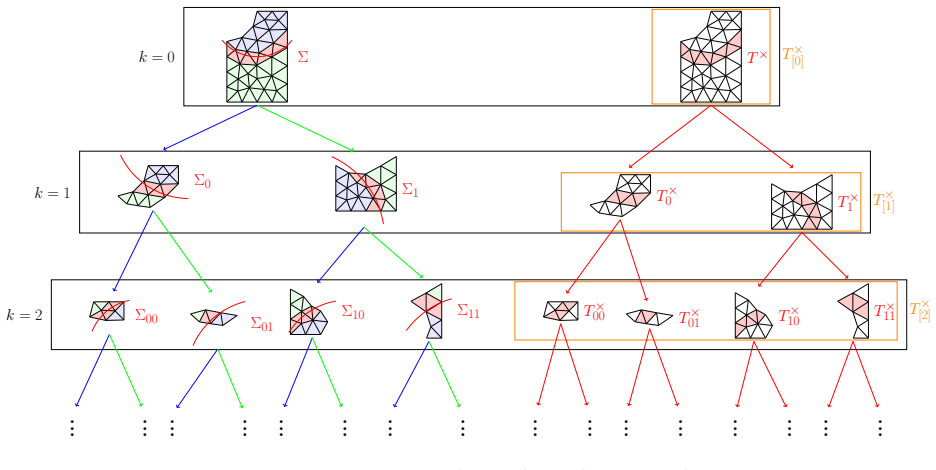
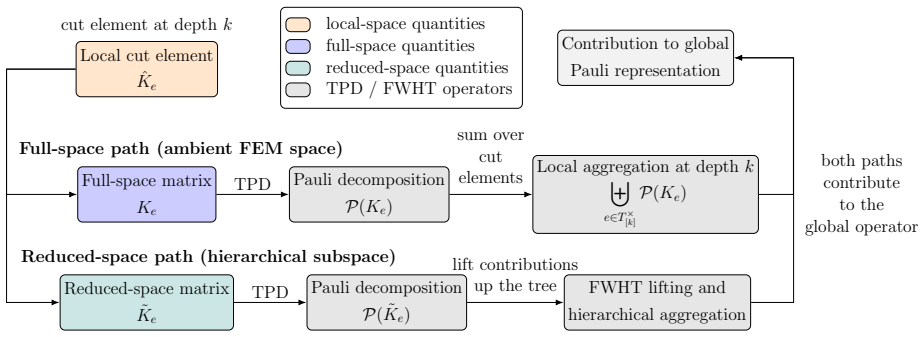
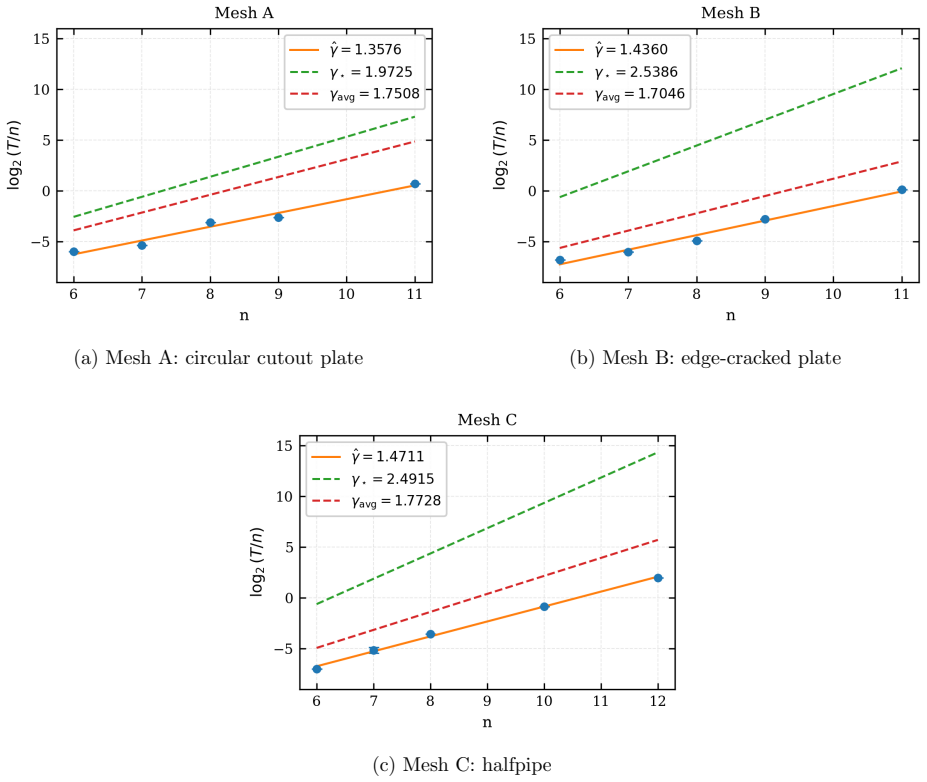
PHASE is a hierarchical, geometry-aware Pauli decomposition algorithm that leverages recursive mesh partitioning to organize element contributions across multiple spatial scales, employs a hybrid strategy of full- and reduced-space Tensorized Pauli Decomposition with Fast Walsh-Hadamard Transform-based aggregation, and yields a dimension-dependent reduction in the exponential scaling exponent of Pauli assembly asymptotic complexity from 2^{2⌈log₂N⌉} to 2^{γ_d ⌈log₂N⌉} with γ_d < 2 under standard mesh regularity and balanced partition assumptions.
What carries the argument
Recursive mesh partitioning that organizes element contributions across spatial scales, combined with hybrid Tensorized Pauli Decomposition and Fast Walsh-Hadamard Transform aggregation to assemble global Pauli coefficients.
If this is right
- Pauli decomposition of stiffness matrices becomes feasible for substantially larger finite-element models than with naive or algebraically sparse methods.
- Quantum-compatible operator synthesis for large-scale finite-element models improves in asymptotic cost under the stated mesh assumptions.
- The exponential base in the complexity bound now depends explicitly on spatial dimension rather than remaining fixed at 2.
- Hybrid full- and reduced-space tensorized decompositions plus Walsh-Hadamard aggregation replace direct enumeration of all Pauli strings.
Where Pith is reading between the lines
- The same hierarchical organization could be applied to other local operators that arise in quantum algorithms for PDEs, such as mass matrices or load vectors.
- If the exponent reduction holds in practice, it lowers the barrier to testing whether quantum linear-system solvers can outperform classical ones on realistic continuum problems.
- Dimension-dependent scaling suggests that three-dimensional engineering models may benefit more than one- or two-dimensional toy problems.
- The approach opens the possibility of geometry-aware circuit synthesis that respects the underlying discretization rather than treating the operator as an unstructured matrix.
Load-bearing premise
Recursive mesh partitioning must deliver the claimed dimension-dependent exponent reduction when the mesh satisfies standard regularity and balanced-partition conditions.
What would settle it
A measured assembly cost on a sequence of uniformly refined meshes whose fitted exponent remains at or above 2 would show that the reduction does not occur.
Figures



read the original abstract
Efficiently decomposing finite element stiffness matrices into the Pauli basis is challenging due to the exponential growth of Pauli strings with problem size. A naive Pauli expansion requires $\Theta(8^{\lceil \log_2 N \rceil})$ operations, where $N$ denotes the number of degrees of freedom, rendering direct decomposition infeasible for large systems. Existing approaches exploit algebraic sparsity or operator structure but do not incorporate the geometric organization intrinsic to finite element discretizations, and consequently exhibit poor scaling for stiffness matrices. To address this problem, we introduce PHASE, a hierarchical, geometry-aware Pauli decomposition algorithm that leverages recursive mesh partitioning to organize element contributions across multiple spatial scales. PHASE employs a hybrid strategy that combines full- and reduced-space Tensorized Pauli Decomposition with Fast Walsh-Hadamard Transform-based aggregation to assemble global Pauli coefficients efficiently. We show that this approach yields a dimension-dependent reduction in the exponential scaling exponent of Pauli assembly asymptotic complexity relative to existing methods, reducing the cost from $2^{2{\lceil \log_2 N \rceil}}$ to $2^{\gamma_d{\lceil \log_2 N \rceil}}$ with $\gamma_d < 2$ under standard mesh regularity and balanced partition assumptions. These results substantially improve the feasibility of quantum-compatible operator synthesis for large-scale finite element models.
Editorial analysis
A structured set of objections, weighed in public.
Referee Report
Summary. The paper introduces PHASE, a hierarchical geometry-aware algorithm for decomposing finite element stiffness matrices into the Pauli basis. It combines recursive mesh partitioning with a hybrid strategy of full- and reduced-space Tensorized Pauli Decomposition and Fast Walsh-Hadamard Transform aggregation. The central claim is an asymptotic complexity reduction from 2^{2⌈log₂N⌉} to 2^{γ_d ⌈log₂N⌉} with γ_d < 2 under standard mesh regularity and balanced partition assumptions, improving feasibility of quantum-compatible operator synthesis for large-scale models.
Significance. If the claimed dimension-dependent exponent reduction is rigorously derived and the hybrid strategy is shown to be dominated by the improved term rather than reverting to baseline cost, the work would meaningfully advance scalable Pauli synthesis for finite-element operators by exploiting geometric structure absent from prior algebraic approaches.
major comments (2)
- [Abstract] Abstract: the naive baseline is stated both as Θ(8^{⌈log₂N⌉}) and as 2^{2⌈log₂N⌉}; these are inconsistent because 8^k = 2^{3k}. The claimed reduction cannot be evaluated until the baseline is stated uniformly.
- [Abstract] Abstract: the central claim that recursive mesh partitioning yields a recurrence whose solution is 2^{γ_d k} with γ_d < 2 is unsupported; no recurrence, master-theorem application, or explicit derivation of γ_d appears. Without this analysis it is impossible to confirm that the hybrid Tensorized Pauli Decomposition + FWHT term is dominated by the improved exponent rather than the baseline 2^{2k} cost.
Simulated Author's Rebuttal
We thank the referee for the detailed review and for identifying issues in the abstract that require clarification. We address each major comment below and will revise the manuscript accordingly.
read point-by-point responses
-
Referee: [Abstract] Abstract: the naive baseline is stated both as Θ(8^{⌈log₂N⌉}) and as 2^{2⌈log₂N⌉}; these are inconsistent because 8^k = 2^{3k}. The claimed reduction cannot be evaluated until the baseline is stated uniformly.
Authors: We agree that the abstract contains an inconsistency in the baseline complexity expression. The Θ(8^{⌈log₂N⌉}) phrasing was an inadvertent error; the intended naive cost is 2^{2⌈log₂N⌉} (equivalent to 4^{⌈log₂N⌉}), which is the correct count of operations for a direct Pauli decomposition of an N×N matrix without exploiting structure. We will revise the abstract to use a single, uniform expression for the baseline throughout. revision: yes
-
Referee: [Abstract] Abstract: the central claim that recursive mesh partitioning yields a recurrence whose solution is 2^{γ_d k} with γ_d < 2 is unsupported; no recurrence, master-theorem application, or explicit derivation of γ_d appears. Without this analysis it is impossible to confirm that the hybrid Tensorized Pauli Decomposition + FWHT term is dominated by the improved exponent rather than the baseline 2^{2k} cost.
Authors: The full derivation of the recurrence, its solution via the master theorem, and the explicit bound γ_d < 2 (under the standard mesh regularity and balanced partition assumptions stated in the paper) appears in Section 4. The analysis there also shows that the hybrid full/reduced-space TPD + FWHT aggregation is dominated by the improved 2^{γ_d k} term rather than reverting to the 2^{2k} baseline. To make this immediately verifiable from the abstract, we will add a concise statement of the recurrence and the resulting exponent bound in the revised abstract. revision: yes
Circularity Check
No derivation chain or equations visible; no circularity identified
full rationale
The abstract asserts a dimension-dependent complexity reduction to 2^{γ_d ⌈log₂N⌉} with γ_d < 2 under mesh regularity and balanced partition assumptions, but supplies no equations, recurrences, master theorem applications, or derivation steps. Without any exhibited mathematical chain in the provided text, no load-bearing step can be quoted that reduces by construction to fitted inputs, self-citations, or ansatzes. The result is therefore treated as self-contained against external benchmarks, yielding no circularity.
Axiom & Free-Parameter Ledger
axioms (1)
- domain assumption standard mesh regularity and balanced partition assumptions
Reference graph
Works this paper leans on
-
[1]
Zienkiewicz, Robert L
Olek C. Zienkiewicz, Robert L. Taylor, and Jian Z. Zhu.The Finite Element Method: Its Basis and Fundamentals. Elsevier / Butterworth-Heinemann, Oxford, UK, 7th edition, 2005
2005
-
[2]
Zienkiewicz, Robert L
Olek C. Zienkiewicz, Robert L. Taylor, and David D. Fox.The Finite Element Method for Solid and Structural Mechanics. Elsevier / Butterworth-Heinemann, Oxford, UK, 7th edition, 2013
2013
-
[3]
Brenner and L
Susanne C. Brenner and L. Ridgway Scott.The Mathematical Theory of Finite Element Methods, volume 15 ofTexts in Applied Mathematics. Springer, Princeton, NJ, 3rd edition, 2007
2007
-
[4]
Thomas J. R. Hughes.The Finite Element Method: Linear Static and Dynamic Finite Element Analysis. Dover Civil and Mechanical Engineering. Dover Publications, Garden City, NY, 1st edition, 2000
2000
-
[5]
Davis.Direct Methods for Sparse Linear Systems
Timothy A. Davis.Direct Methods for Sparse Linear Systems. Fundamentals of Algorithms. Society for Industrial and Applied Mathematics, Philadelphia, PA, 2006
2006
-
[6]
January 1994
Alan George, Joseph Liu, and Esmond Ng.Computer Solution of Sparse Linear Systems. January 1994. Unpublished manuscript updates to the 1981 Prentice-Hall text. Features the SPARSPAK software package platform layout
1994
-
[7]
Society for Industrial and Applied Mathematics, Philadelphia, PA, 2nd edition, 2003
Yousef Saad.Iterative Methods for Sparse Linear Systems. Society for Industrial and Applied Mathematics, Philadelphia, PA, 2nd edition, 2003
2003
-
[8]
Oosterlee, and Anton Sch¨ uller.Multigrid
Ulrich Trottenberg, Cornelis W. Oosterlee, and Anton Sch¨ uller.Multigrid. Elsevier / Academic Press, San Diego, CA, 2001
2001
-
[9]
The future of computing beyond Moore’s Law.Philosophical Transactions of the Royal Society A, 378(2166):20190061, March 2020
John Shalf. The future of computing beyond Moore’s Law.Philosophical Transactions of the Royal Society A, 378(2166):20190061, March 2020
2020
-
[10]
The opportunities and challenges of exascale computing: Summary report of the ASCAC subcommittee
Advanced Scientific Computing Advisory Committee (ASCAC) Subcommittee on Exascale Computing. The opportunities and challenges of exascale computing: Summary report of the ASCAC subcommittee. Technical report, U.S. Department of Energy, Office of Science, 2010. Robert Rosner, Chair. 28
2010
-
[11]
Harrow, Avinatan Hassidim, and Seth Lloyd
Aram W. Harrow, Avinatan Hassidim, and Seth Lloyd. Quantum algorithm for linear systems of equations.Physical Review Letters, 103(15), October 2009
2009
-
[12]
Childs, Robin Kothari, and Rolando D
Andrew M. Childs, Robin Kothari, and Rolando D. Somma. Quantum algorithm for systems of linear equations with exponentially improved dependence on precision.SIAM Journal on Computing, 46(6):1920–1950, January 2017
1920
-
[13]
Cerezo, Yigit Subasi, Lukasz Cincio, and Patrick J
Carlos Bravo-Prieto, Ryan LaRose, M. Cerezo, Yigit Subasi, Lukasz Cincio, and Patrick J. Coles. Variational quantum linear solver.Quantum, 7:1188, November 2023
2023
-
[14]
Quantum algorithms and the finite element method
Ashley Montanaro and Sam Pallister. Quantum algorithms and the finite element method. Physical Review A, 93(3), March 2016
2016
-
[15]
Quantum realization of the finite element method
Matthias Deiml and Daniel Peterseim. Quantum realization of the finite element method. Mathematics of Computation, August 2025
2025
-
[16]
Ward, and Caglar Oskay
Abhishek Arora, Benjamin M. Ward, and Caglar Oskay. An implementation of the finite element method in hybrid classical/quantum computers, 2025
2025
-
[17]
Alkadri, Tyler D
Ahmad M. Alkadri, Tyler D. Kharazi, K. Birgitta Whaley, and Kranthi K. Mandadapu. A quantum algorithm for the finite element method, 2025
2025
-
[18]
Qafe 2: Quantum accelerated multiscale finite element analysis, 2026
Yiren Wang, Michael Ortiz, and Fehmi Cirak. Qafe 2: Quantum accelerated multiscale finite element analysis, 2026
2026
-
[19]
A quantum computing concept for 1-d elastic wave simulation with exponential speedup.Geophysical Journal Inter- national, 238(1):321–333, May 2024
Malte Schade, Cyrill B¨ osch, V´ aclav Hapla, and Andreas Fichtner. A quantum computing concept for 1-d elastic wave simulation with exponential speedup.Geophysical Journal Inter- national, 238(1):321–333, May 2024
2024
-
[20]
Childs and Nathan Wiebe
Andrew M. Childs and Nathan Wiebe. Hamiltonian simulation using linear combinations of unitary operations, November 2012
2012
-
[21]
Berry, Andrew M
Dominic W. Berry, Andrew M. Childs, Richard Cleve, Robin Kothari, and Rolando D. Somma. Simulating hamiltonian dynamics with a truncated taylor series.Physical Review Letters, 114(9), March 2015
2015
-
[22]
Cerezo, Andrew Arrasmith, Ryan Babbush, Simon C
M. Cerezo, Andrew Arrasmith, Ryan Babbush, Simon C. Benjamin, Suguru Endo, Keisuke Fujii, Jarrod R. McClean, Kosuke Mitarai, Xiao Yuan, Lukasz Cincio, and Patrick J. Coles. Variational quantum algorithms.Nature Reviews Physics, 3(9):625–644, August 2021
2021
-
[23]
Universal quantum simulators.Science, 273(5278):1073–1078, 1996
Seth Lloyd. Universal quantum simulators.Science, 273(5278):1073–1078, 1996
1996
-
[24]
Guang Hao Low and Isaac L. Chuang. Hamiltonian simulation by qubitization.Quantum, 3:163, July 2019. 29
2019
-
[25]
Love, Al´ an Aspuru-Guzik, and Jeremy L
Alberto Peruzzo, Jarrod McClean, Peter Shadbolt, Man-Hong Yung, Xiao-Qi Zhou, Peter J. Love, Al´ an Aspuru-Guzik, and Jeremy L. O’Brien. A variational eigenvalue solver on a photonic quantum processor.Nature Communications, 5(1), July 2014
2014
-
[26]
Chow, and Jay M
Abhinav Kandala, Antonio Mezzacapo, Kristan Temme, Maika Takita, Markus Brink, Jerry M. Chow, and Jay M. Gambetta. Hardware-efficient variational quantum eigensolver for small molecules and quantum magnets.Nature, 549(7671):242–246, September 2017
2017
-
[27]
Tensorized pauli decomposition algorithm.Physica Scripta, 99(8):085128, July 2024
Lukas Hantzko, Lennart Binkowski, and Sabhyata Gupta. Tensorized pauli decomposition algorithm.Physica Scripta, 99(8):085128, July 2024
2024
-
[28]
A tree-approach pauli decomposition algorithm with application to quantum computing, 2024
Oc´ eane Koska, Marc Baboulin, and Arnaud Gazda. A tree-approach pauli decomposition algorithm with application to quantum computing, 2024
2024
-
[29]
Georges, Bjorn K
Timothy N. Georges, Bjorn K. Berntson, Christoph S¨ underhauf, and Aleksei V. Ivanov. Pauli decomposition via the fast walsh-hadamard transform.New Journal of Physics, 27(3):033004, February 2025
2025
-
[30]
Miller, Shang-Hua Teng, William Thurston, and Stephen A
Gary L. Miller, Shang-Hua Teng, William Thurston, and Stephen A. Vavasis. Geometric separators for finite-element meshes.SIAM Journal on Scientific Computing, 19(2):364–386, 1998
1998
-
[31]
Lipton and Robert Endre Tarjan
Richard J. Lipton and Robert Endre Tarjan. A separator theorem for planar graphs.SIAM Journal on Applied Mathematics, 36(2):177–189, 1979
1979
-
[32]
pushing the node byεalong the normal
Alan George. Nested dissection of a regular finite element mesh.SIAM Journal on Numerical Analysis, 10(2):345–363, 1973. A Analytical Derivations A.1 Derivation of Cut Element Scaling We derive the asymptotic scaling of the number of cut elements introduced at a given depth of the recursive partition hierarchy. Throughout, we work under the mesh assumptio...
1973
discussion (0)
Sign in with ORCID, Apple, or X to comment. Anyone can read and Pith papers without signing in.