SheafStain: Sheaf-Theoretic Schr\"odinger Bridge for Spatially and Biologically Coherent Virtual Staining
Pith reviewed 2026-06-27 10:29 UTC · model grok-4.3
The pith
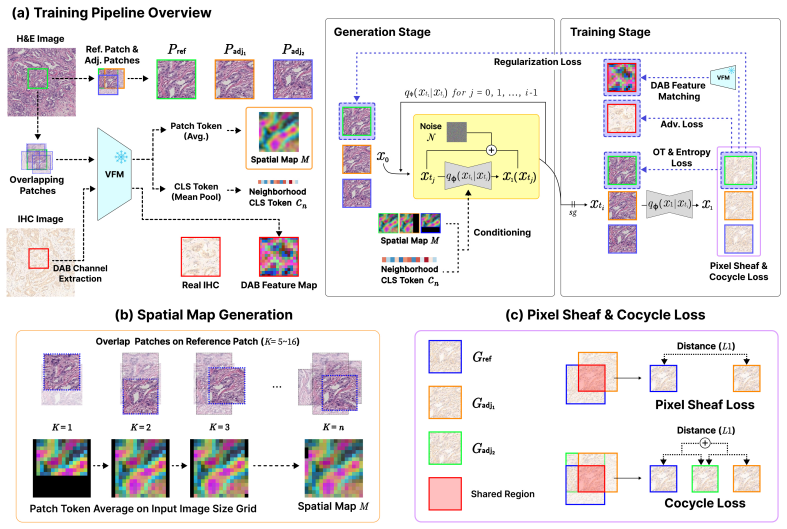
Treating vision foundation model embeddings as sheaf sections inside a Schrödinger Bridge produces virtual stains that remain consistent when patches are joined into full slide images.
A machine-rendered reading of the paper's core claim, the machinery that carries it, and where it could break.
Core claim
The central claim is that embeddings from pathology vision foundation models form a presheaf violating the gluing axiom due to context contamination from self-attention, and that integrating class and patch tokens as sheaf-like sections into a Schrödinger Bridge framework, using a co-pretrained H&E/IHC backbone, enforces spatial and biological consistency for virtual staining of whole slide images.
What carries the argument
Sheaf-like sections of class and patch tokens inside a Schrödinger Bridge, where class tokens anchor biological identity and patch tokens supply per-position spatial maps.
If this is right
- Single pretrained feature space supervises both conditioning and stain alignment without degenerate cross-stain stalks.
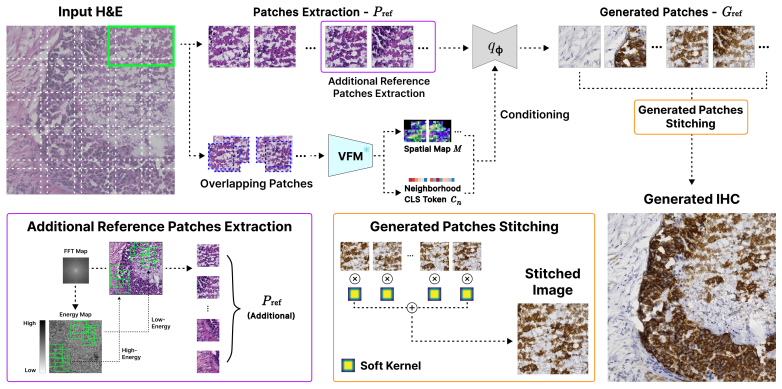
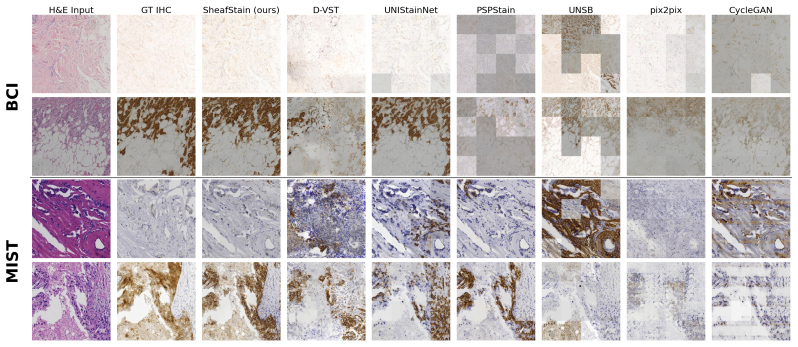
- Evaluation on stitched full-resolution outputs rather than isolated patches reveals the stitching artifact reduction.
- Class tokens maintain biological consistency while patch tokens enforce spatial continuity across the slide.
- Results hold across HER2, ER, PR and Ki-67 stains when translating at 256x256 resolution.
Where Pith is reading between the lines
- The same sheaf-section treatment could be tested on other large-image tasks that currently suffer from context-dependent embeddings, such as semantic segmentation of aerial or medical volumes.
- If the gluing enforcement works, it may reduce the need for post-processing seam removal steps in any patch-based inference pipeline.
- Extending the co-pretraining idea to additional stain pairs might allow one backbone to support multiple virtual staining directions without retraining.
- A direct test would be to measure whether the method preserves quantitative biomarker scores on the stitched outputs at the same level as on isolated patches.
Load-bearing premise
That the observed inconsistency across overlapping patches is caused by a sheaf gluing violation that the Schrödinger Bridge integration will enforce.
What would settle it
Quantitative boundary continuity scores and visual inspection on stitched 1024x1024 virtual stain outputs versus ground-truth IHC images for the four markers.
Figures



read the original abstract
Current virtual staining approaches offer the potential for time- and cost-efficient biomarker quantification in cancer diagnostics and prognostics. However, patch-wise inference for gigapixel whole slide images (WSIs) fails to maintain spatial continuity, yielding artifacts that cause catastrophic mismatches with ground-truth images. Although pathology Vision Foundation Models (VFMs) offer rich representations, their self-attention causes varying global contexts to produce inconsistent embeddings for the same physical region. We formalize and validate this ``context contamination'' as a sheaf-theoretic problem where these embeddings form a presheaf that violates the gluing axiom. To address this, we propose SheafStain, a new approach that reinterprets VFM features as sheaf-like sections for spatially and biologically coherent virtual staining. Specifically, SheafStain integrates class and patch tokens into a Schr\"odinger Bridge framework as sheaf-like sections. While the class token anchors biological consistency, patch tokens form a per-position spatial map. A backbone co-pretrained on Hematoxylin \& Eosin (H\&E) and Immunohistochemistry (IHC) yields non-degenerate cross-stain stalks, so a single VFM feature space supervises both input conditioning and output stain alignment. Departing from prior work that evaluates on isolated $256 \times 256$ patches and either random-crops or resizes the $1024 \times 1024$ ground truth, we translate at $256 \times 256$ and evaluate on the stitched $1024 \times 1024$ outputs across HER2, ER, PR, and Ki-67. SheafStain demonstrates promising results against six prior methods while mitigating patch-boundary stitching artifacts. Code will soon be released.
Editorial analysis
A structured set of objections, weighed in public.
Referee Report
Summary. The manuscript claims that self-attention in pathology Vision Foundation Models produces context-dependent embeddings that form a presheaf violating the gluing axiom (termed 'context contamination'), and proposes SheafStain to reinterpret class and patch tokens as sheaf-like sections inside a Schrödinger Bridge. A co-pretrained H&E/IHC backbone supplies non-degenerate cross-stain stalks so that a single feature space supervises both conditioning and output alignment. The method translates 256×256 patches and evaluates on stitched 1024×1024 images for HER2, ER, PR and Ki-67, asserting improved spatial/biological consistency and superior performance relative to six prior virtual-staining baselines while mitigating patch-boundary artifacts.
Significance. If the formalization and empirical claims hold, the work supplies a principled mechanism for enforcing consistency across overlapping patches in gigapixel virtual staining, a practical bottleneck in computational pathology. The explicit shift to stitched-image evaluation (rather than isolated-patch or resized-GT protocols) is a methodological advance that better matches clinical use. The co-pretraining strategy for cross-stain stalks and the planned code release are concrete strengths that would aid reproducibility if the central sheaf construction is shown to be non-circular.
major comments (3)
- [Abstract] Abstract (paragraph on formalization of context contamination): the claim that VFM self-attention embeddings constitute a presheaf violating the gluing axiom is presented as the central motivation, yet no explicit restriction maps, overlap diagrams, or verification that the gluing condition fails for the same physical region under different global contexts are supplied; without this derivation the sheaf framing remains an interpretive overlay rather than an independent justification for the subsequent Schrödinger Bridge construction.
- [Abstract] Abstract (evaluation protocol paragraph): the manuscript states that SheafStain 'demonstrates promising results against six prior methods' on stitched 1024×1024 outputs, but reports no quantitative metrics (PSNR, SSIM, FID, biomarker-specific concordance, or statistical tests), no ablation isolating the sheaf or co-pretraining components, and no verification that the cross-stain stalk parameters remain independent of the final staining result; these omissions make the empirical support for the central claim impossible to assess.
- [Abstract] Abstract (Schrödinger Bridge integration paragraph): the class token is said to 'anchor biological consistency' and patch tokens to 'form a per-position spatial map,' yet the manuscript supplies no equation or section demonstrating that the resulting sections satisfy the sheaf gluing axiom on overlaps or that the Schrödinger Bridge transport enforces this property beyond the co-pretraining step; this is load-bearing for the claim that the approach restores spatial and biological coherence.
minor comments (2)
- [Abstract] The statement 'Code will soon be released' should be replaced by an explicit repository URL or a clear statement that the code is already available, consistent with reproducibility standards.
- [Abstract] The phrase 'non-degenerate cross-stain stalks' is used without a preceding definition or reference to how degeneracy is measured; a brief parenthetical or citation would clarify the term for readers outside sheaf theory.
Simulated Author's Rebuttal
We thank the referee for the detailed and constructive report. The comments correctly identify areas where the abstract and manuscript require additional explicit constructions and empirical details to strengthen the sheaf-theoretic claims and evaluation. We address each major comment below and will incorporate the requested elements in the revised manuscript.
read point-by-point responses
-
Referee: [Abstract] Abstract (paragraph on formalization of context contamination): the claim that VFM self-attention embeddings constitute a presheaf violating the gluing axiom is presented as the central motivation, yet no explicit restriction maps, overlap diagrams, or verification that the gluing condition fails for the same physical region under different global contexts are supplied; without this derivation the sheaf framing remains an interpretive overlay rather than an independent justification for the subsequent Schrödinger Bridge construction.
Authors: We agree that the abstract omits explicit restriction maps, overlap diagrams, and direct verification of gluing failure. While Section 3 of the manuscript defines the presheaf structure on VFM embeddings, the presentation would benefit from concrete illustrations. In the revision we will add a dedicated figure and subsection that specifies the restriction maps for overlapping patches, provides an overlap diagram, and empirically verifies gluing violation by comparing embeddings of the same physical region under differing global contexts extracted from the co-pretrained backbone. This will make the sheaf framing a self-contained justification rather than an overlay. revision: yes
-
Referee: [Abstract] Abstract (evaluation protocol paragraph): the manuscript states that SheafStain 'demonstrates promising results against six prior methods' on stitched 1024×1024 outputs, but reports no quantitative metrics (PSNR, SSIM, FID, biomarker-specific concordance, or statistical tests), no ablation isolating the sheaf or co-pretraining components, and no verification that the cross-stain stalk parameters remain independent of the final staining result; these omissions make the empirical support for the central claim impossible to assess.
Authors: The abstract summarizes outcomes under length constraints. Section 5 of the manuscript describes the stitched 1024×1024 evaluation protocol and comparisons to six baselines, yet we acknowledge the absence of the requested quantitative metrics, ablations, and stalk-independence verification in the current version. In the revision we will expand the results section to report PSNR, SSIM, FID, biomarker-specific concordance with statistical tests, ablations that isolate the sheaf construction and co-pretraining, and an analysis confirming that cross-stain stalk parameters are independent of the generated staining output. revision: yes
-
Referee: [Abstract] Abstract (Schrödinger Bridge integration paragraph): the class token is said to 'anchor biological consistency' and patch tokens to 'form a per-position spatial map,' yet the manuscript supplies no equation or section demonstrating that the resulting sections satisfy the sheaf gluing axiom on overlaps or that the Schrödinger Bridge transport enforces this property beyond the co-pretraining step; this is load-bearing for the claim that the approach restores spatial and biological coherence.
Authors: We recognize that the current text does not supply an explicit equation linking the class/patch token construction to satisfaction of the gluing axiom under the Schrödinger Bridge. Section 4 describes the integration of tokens as sheaf-like sections, but the load-bearing demonstration is missing. In the revision we will insert a new equation together with a short derivation showing that the optimal transport map, when composed with the non-degenerate cross-stain stalks, produces sections that satisfy the gluing condition on overlaps; this will directly substantiate the claim that the framework restores spatial and biological coherence beyond the co-pretraining step alone. revision: yes
Circularity Check
No significant circularity detected
full rationale
The paper's derivation begins with an empirical observation of context-dependent embeddings in VFMs, formalizes this as a presheaf violating the gluing axiom, and proposes integration of class/patch tokens into a Schrödinger Bridge using a co-pretrained H&E/IHC backbone. No equations, fitted parameters, or self-citations are exhibited that reduce the central claims (sheaf sections enforcing consistency, cross-stain stalks) back to the inputs by construction. The evaluation protocol on stitched 1024×1024 images is explicitly separated from prior patch-wise methods and serves as independent empirical support. The derivation remains self-contained against external benchmarks.
Axiom & Free-Parameter Ledger
free parameters (1)
- cross-stain stalk parameters
axioms (1)
- standard math Gluing axiom of sheaf theory
invented entities (1)
-
sheaf-like sections from class and patch tokens
no independent evidence
Reference graph
Works this paper leans on
-
[1]
S. Liu, C. Zhu, F. Xu, X. Jia, Z. Shi, and M. Jin. BCI: Breast cancer immunohistochemical image generation through pyramid pix2pix. InCVPR Workshops, pages 1815–1824, 2022. 9
2022
-
[2]
F. Li, Z. Hu, W. Chen, and A. Kak. Adaptive supervised PatchNCE loss for learning H&E-to-IHC stain translation with inconsistent groundtruth image pairs. InMICCAI, 2023
2023
-
[3]
Klöckner, J
P. Klöckner, J. Teixeira, D. Montezuma, J.S. Cardoso, H.M. Horlings, and S.P. Oliveira. GANs vs. Diffusion Models for virtual staining with the HER2match dataset. InDeep Generative Models, pages 120–130. Springer, 2025
2025
-
[4]
S. Yang, D. Wei, Y . Hu, Q. Peng, H. Liu, Y . Huang, X. Wu, Y . Zheng, and L. Wang. D-VST: Diffusion transformer for pathology-correct tone-controllable cross-dye virtual staining of whole slide images. In NeurIPS, 2025
2025
-
[5]
B. Kim, G. Kwon, K. Kim, and J.C. Ye. Unpaired image-to-image translation via neural Schrödinger bridge. InICLR, 2024
2024
-
[6]
F. Qiu, Y . Zhang, Z.-L. Huang, X. Zhu, and Z. Wang. PASB: Pathology-aware Schrödinger bridge for virtual immunohistochemical staining.Medical Image Analysis, 108:103869, 2026
2026
-
[7]
J.R. Saurav, T.L.H. Pham, P. Mukherjee, P. Yi, B.A. Orr, and J.M. Luber. UNIStainNet: Foundation-model- guided virtual staining of H&E to IHC.arXiv preprint arXiv:2603.12716, 2026
arXiv 2026
-
[8]
Saleem, A
A.B. Saleem, A. Ahmed, A. Behera, H. Amin, I.Y . Liao, M. Khattab, J.W. Pan, and H. Makmur. HistDiT: A structure-aware latent conditional diffusion model for high-fidelity virtual staining in histopathology. In ICPR, 2026
2026
- [9]
-
[10]
Isola, J.-Y
P. Isola, J.-Y . Zhu, T. Zhou, and A.A. Efros. Image-to-image translation with conditional adversarial networks. InCVPR, 2017
2017
-
[11]
J.-Y . Zhu, T. Park, P. Isola, and A.A. Efros. Unpaired image-to-image translation using cycle-consistent adversarial networks. InICCV, 2017
2017
-
[12]
F. Chen, R. Zhang, B. Zheng, Y . Sun, J. He, and W. Qin. Pathological semantics-preserving learning for H&E-to-IHC virtual staining. InMICCAI, pages 384–394. Springer, 2024
2024
-
[13]
Dubey, T
S. Dubey, T. Kataria, B. Knudsen, and S.Y . Elhabian. Structural cycle GAN for virtual immunohisto- chemistry staining of gland markers in the colon. InMICCAI Workshop on Machine Learning in Medical Imaging, pages 447–456. Springer, 2023
2023
-
[14]
S. Liu, K. Liu, S. Margolis, W. Wu, S.R. Knezevich, D.E. Elder, M.M. Eguchi, J.G. Elmore, and L. Shapiro. Generating seamless virtual immunohistochemical whole slide images with content and color consistency. arXiv preprint arXiv:2410.01072, 2024
arXiv 2024
-
[15]
T. Wang, M. Wang, Z. Wang, H. Wang, Q. Xu, F. Cong, and H. Xu. ODA-GAN: Orthogonal decoupling alignment GAN assisted by weakly-supervised learning for virtual immunohistochemistry staining. In CVPR, pages 25920–25929, 2025
2025
-
[16]
T. Kataria, B. Knudsen, and S.Y . Elhabian. StainDiffuser: MultiTask dual diffusion model for virtual staining.arXiv preprint arXiv:2403.11340, 2025
arXiv 2025
-
[17]
H. Xu, N. Usuyama, J. Bagga,et al.A whole-slide foundation model for digital pathology from real-world data.Nature, 630(8015):181–188, 2024
2024
-
[18]
R.J. Chen, T. Ding, M.Y . Lu,et al.Towards a general-purpose foundation model for computational pathology.Nature Medicine, 30(3):850–862, 2024
2024
-
[19]
V orontsov, A
E. V orontsov, A. Bozkurt, A. Casson,et al.A foundation model for clinical-grade computational pathology and rare cancers detection.Nature Medicine, 30:2924–2935, 2024
2024
-
[20]
Bodnar, F
C. Bodnar, F. Di Giovanni, B. Chamberlain, P. Liò, and M. Bronstein. Neural sheaf diffusion: A topological perspective on heterophily and oversmoothing in GNNs. InNeurIPS, 2022
2022
-
[21]
I. Duta, G. Cassarà, F. Silvestri, and P. Liò. Sheaf hypergraph networks. InNeurIPS, 2023
2023
-
[22]
Di Nino, S
L. Di Nino, S. Barbarossa, and P. Di Lorenzo. Learning sheaf Laplacian optimizing restriction maps. In Asilomar Conference on Signals, Systems, and Computers, pages 59–63, 2024
2024
-
[23]
Ribeiro, A.L
A. Ribeiro, A.L. Tenorio, J. Belieni,et al.Cooperative sheaf neural networks. InICLR, 2026
2026
-
[24]
Bredon.Sheaf Theory
G.E. Bredon.Sheaf Theory. Springer, 2nd edition, 1997. 10
1997
-
[25]
A. Ayzenberg, T. Gebhart, G. Magai, and G. Solomadin. Sheaf theory: from deep geometry to deep learning.arXiv preprint arXiv:2502.15476, 2025
arXiv 2025
-
[26]
Schrödinger
E. Schrödinger. Sur la théorie relativiste de l’électron et l’interprétation de la mécanique quantique.Annales de l’institut Henri Poincaré, 2(4):269–310, 1932
1932
-
[27]
C. Léonard. A survey of the Schrödinger problem and some of its connections with optimal transport. arXiv preprint arXiv:1308.0215, 2013
arXiv 2013
-
[28]
Villani.Optimal Transport: Old and New
C. Villani.Optimal Transport: Old and New. Springer, 2009
2009
-
[29]
Chen, T.T
Y . Chen, T.T. Georgiou, and M. Pavon. Stochastic control liaisons: Richard Sinkhorn meets Gaspard Monge on a Schrödinger bridge.SIAM Review, 63(2):249–313, 2021
2021
-
[30]
Ruifrok and D.A
A.C. Ruifrok and D.A. Johnston. Quantification of histochemical staining by color deconvolution.Analyti- cal and Quantitative Cytology and Histology, 23(4):291–299, 2001
2001
-
[31]
Kingma and J
D.P. Kingma and J. Ba. Adam: A method for stochastic optimization. InICLR, 2015
2015
-
[32]
Heusel, H
M. Heusel, H. Ramsauer, T. Unterthiner, B. Nessler, and S. Hochreiter. GANs trained by a two time-scale update rule converge to a local Nash equilibrium. InNeurIPS, 2017
2017
-
[33]
Bi ´nkowski, D.J
M. Bi ´nkowski, D.J. Sutherland, M. Arbel, and A. Gretton. Demystifying MMD GANs. InICLR, 2018
2018
-
[34]
Zhang, P
R. Zhang, P. Isola, A.A. Efros, E. Shechtman, and O. Wang. The unreasonable effectiveness of deep features as a perceptual metric. InCVPR, 2018
2018
-
[35]
K. Ding, K. Ma, S. Wang, and E.P. Simoncelli. Image quality assessment: Unifying structure and texture similarity.IEEE TPAMI, 44(5):2567–2581, 2022
2022
-
[36]
Wang, A.C
Z. Wang, A.C. Bovik, H.R. Sheikh, and E.P. Simoncelli. Image quality assessment: From error visibility to structural similarity.IEEE TIP, 13(4):600–612, 2004
2004
-
[37]
S. Modi, W. Jacot, T. Yamashita,et al.Trastuzumab deruxtecan in previously treated HER2-low advanced breast cancer.New England Journal of Medicine, 387(1):9–20, 2022
2022
-
[38]
Wolff, M.E.H
A.C. Wolff, M.E.H. Hammond, K.H. Allison,et al.Human epidermal growth factor receptor 2 testing in breast cancer: American Society of Clinical Oncology/College of American Pathologists clinical practice guideline focused update.Journal of Clinical Oncology, 36(20):2105–2122, 2018. 11 A Sheaf Theory Background This section expands upon the brief sheaf-theo...
2018
-
[39]
Gluing:If a family of local sections {si ∈ F(U i)} is pairwise compatible on overlaps, there exists a uniques∈ F(V)whose restriction to eachU i equalss i. Locality says a section is determined by its local restrictions; gluing says compatible local sections assemble into a unique section. The compatibility condition and the very notion of "restriction to ...
arXiv 2036
discussion (0)
Sign in with ORCID, Apple, or X to comment. Anyone can read and Pith papers without signing in.