Universal Information-Theoretic Structure of the Quasi-Stationary Domany--Kinzel Automaton
Pith reviewed 2026-06-27 08:17 UTC · model grok-4.3
The pith
The quasi-stationary distribution in the inactive phase of the Domany-Kinzel automaton encodes only one bit of positional information.
A machine-rendered reading of the paper's core claim, the machinery that carries it, and where it could break.
Core claim
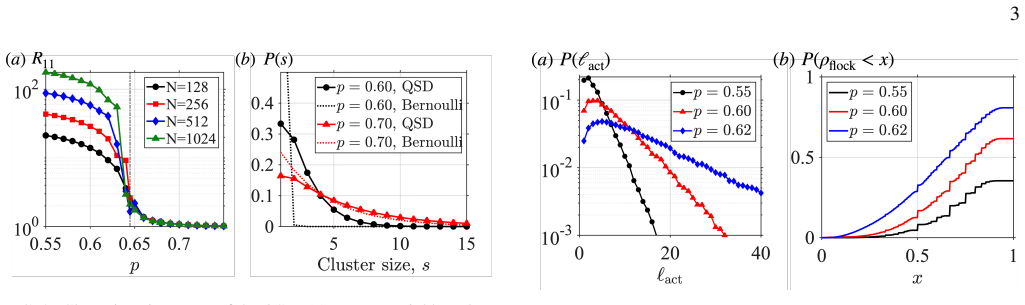
Throughout the inactive phase the bipartite mutual information of the QSD equals the entropy of a single binary choice -- whether the flock lies to the left or right of the cut -- so the surviving clusters together encode just one bit of positional information, corresponding to a single effective cluster.
What carries the argument
Matrix-product-state representation of the probability distribution obtained by projecting out the absorbing state and iterating the transfer matrix, providing the full conditional distribution for information-theoretic quantities.
If this is right
- The active phase exhibits bulk-like behavior with finite density while the inactive phase has activity collapsed into a single flock on a vanishing fraction of the chain.
- The flock's internal filling ranges from a single cluster deep in the inactive phase to a loose partially filled group near criticality.
- The matrix-product-state approach extends to the projected eigenvector for QSDs in absorbing-state systems.
- Information-theoretic diagnostics become available for absorbing-state systems where bulk-observable methods fall short.
Where Pith is reading between the lines
- The single-bit encoding suggests that the effective description in the inactive phase reduces to a two-state positional variable for the flock.
- This could be checked in related models such as the contact process to see if the one-bit signature is universal for directed percolation.
- Information measures might serve as order parameters that remain sharp even when density fluctuations are large.
Load-bearing premise
The matrix-product-state representation yields the exact quasi-stationary distribution without significant truncation errors or approximations that would affect the computed mutual information.
What would settle it
Compute the bipartite mutual information for system sizes larger than those in the paper and check whether it remains equal to one bit throughout the inactive phase or begins to deviate.
Figures


read the original abstract
We characterize the quasi-stationary distribution (QSD) of the bond directed-percolation line of the Domany--Kinzel automaton using a matrix-product-state representation of the probability distribution, obtained by projecting out the absorbing state and iterating the transfer matrix. Unlike moment- or sampling-based methods, this yields the full conditional distribution and direct access to information-theoretic diagnostics. The spatial structure of the QSD changes sharply across the transition: the active phase is bulk-like with finite density, whereas in the inactive phase the surviving activity collapses into a single flock occupying a vanishing fraction of the chain, with an internal filling that ranges from a single cluster deep in the inactive phase to a loose, partially filled group near criticality. This picture carries a sharp information-theoretic signature: throughout the inactive phase the bipartite mutual information of the QSD equals the entropy of a single binary choice -- whether the flock lies to the left or right of the cut -- so the surviving clusters together encode just one bit of positional information, corresponding to a single effective cluster. The approach extends matrix-product-state techniques to the projected eigenvector defining a QSD, opening information-theoretic diagnostics for absorbing-state systems that bulk-observable methods cannot reach.
Editorial analysis
A structured set of objections, weighed in public.
Referee Report
Summary. The paper characterizes the quasi-stationary distribution (QSD) of the bond directed-percolation line in the Domany-Kinzel automaton via a matrix-product-state (MPS) representation obtained by projecting out the absorbing state and iterating the transfer matrix. It reports that the spatial structure of the QSD changes across the transition, with the inactive phase featuring a single flock that encodes only one bit of positional information; specifically, the bipartite mutual information equals exactly the entropy of a single binary choice (log 2) throughout the inactive phase.
Significance. If the central information-theoretic result holds without approximation artifacts, the work supplies a new diagnostic for absorbing-state transitions that is inaccessible to moment- or sampling-based methods and extends MPS techniques to projected eigenvectors defining QSDs. The parameter-free nature of the reported mutual-information value (no free parameters listed in the axiom ledger) would constitute a sharp, falsifiable signature of the single-effective-cluster picture.
major comments (1)
- [MPS representation and numerical results] Abstract and MPS construction paragraph: the claim that the bipartite mutual information of the QSD equals exactly log(2) throughout the inactive phase is load-bearing for the single-effective-cluster interpretation. The construction iterates the projected transfer matrix in an MPS representation, yet the manuscript provides no D→∞ extrapolation, bond-dimension convergence data, or comparison against exact enumeration on small lattices to establish that finite-bond truncation does not shift the mutual information away from log(2).
Simulated Author's Rebuttal
Thank you for the referee's insightful comments on our manuscript. We appreciate the emphasis on validating the numerical aspects of our MPS approach. We respond to the major comment below.
read point-by-point responses
-
Referee: [MPS representation and numerical results] Abstract and MPS construction paragraph: the claim that the bipartite mutual information of the QSD equals exactly log(2) throughout the inactive phase is load-bearing for the single-effective-cluster interpretation. The construction iterates the projected transfer matrix in an MPS representation, yet the manuscript provides no D→∞ extrapolation, bond-dimension convergence data, or comparison against exact enumeration on small lattices to establish that finite-bond truncation does not shift the mutual information away from log(2).
Authors: We agree that explicit convergence checks are needed to confirm the result is not affected by finite bond dimension. The single-effective-cluster picture analytically implies that the bipartite mutual information equals exactly log(2) throughout the inactive phase, since all activity resides in one flock whose position relative to the cut encodes only one bit. To substantiate the numerical implementation, the revised manuscript will add bond-dimension convergence data for the mutual information across the inactive phase, D→∞ extrapolations at representative points, and direct comparisons against exact enumeration on small lattices (where the full QSD is computable without MPS). These will appear in the MPS section and a new appendix. revision: yes
Circularity Check
No circularity; central claim is numerical observation from MPS method
full rationale
The paper applies standard matrix-product-state techniques to the projected transfer-matrix eigenvector to obtain the QSD, then reports the bipartite mutual information equaling log(2) throughout the inactive phase as a computed signature of the resulting distribution. This is an empirical finding from the representation rather than a quantity defined in terms of itself, a fitted parameter renamed as a prediction, or a result forced by self-citation chains. No equations or steps reduce the claimed equality to an input by construction; the method is an extension of existing MPS tools to absorbing-state systems and remains self-contained against external benchmarks.
Axiom & Free-Parameter Ledger
Reference graph
Works this paper leans on
-
[1]
H. K. Janssen, On the nonequilibrium phase transition in reaction-diffusion systems with an absorbing stationary state, Zeitschrift f¨ ur Physik B Condensed Matter42, 151 (1981)
1981
-
[2]
Grassberger, On phase transitions in Schl¨ogl’s second model, Zeitschrift f¨ ur Physik B Condensed Matter47, 365 (1982)
P. Grassberger, On phase transitions in Schl¨ogl’s second model, Zeitschrift f¨ ur Physik B Condensed Matter47, 365 (1982)
1982
-
[3]
Hinrichsen, Non-equilibrium critical phenomena and phase transitions into absorbing states, Advances in Physics49, 815 (2000)
H. Hinrichsen, Non-equilibrium critical phenomena and phase transitions into absorbing states, Advances in Physics49, 815 (2000)
2000
-
[4]
Domany and W
E. Domany and W. Kinzel, Equivalence of cellular automata to Ising models and directed percolation, Physical Review Letters 53, 311 (1984)
1984
-
[5]
Dickman and R
R. Dickman and R. Vidigal, Quasi-stationary distributions for stochastic processes with an absorbing state, Journal of Physics A: Mathematical and General35, 1147 (2002)
2002
-
[6]
M. M. de Oliveira and R. Dickman, How to simulate the qua- sistationary state, Physical Review E71, 016129 (2005)
2005
-
[7]
Harada and N
K. Harada and N. Kawashima, Entropy governed by the absorb- ing state of directed percolation, Physical Review Letters123, 090601 (2019)
2019
-
[8]
Pizzi, D
A. Pizzi, D. Malz, A. Nunnenkamp, and J. Knolle, Bridging the gap between classical and quantum many-body information dynamics, Physical Review B106, 214303 (2022)
2022
-
[9]
Pizzi and N
A. Pizzi and N. Y. Yao, Bipartite mutual information in classical many-body dynamics, Physical Review B110, L020301 (2024)
2024
-
[10]
Jensen, Low-density series expansions for directed percola- tion: III
I. Jensen, Low-density series expansions for directed percola- tion: III. Some two-dimensional lattices, Journal of Physics A: Mathematical and General37, 6899 (2004)
2004
-
[11]
Chetrite and H
R. Chetrite and H. Touchette, Nonequilibrium Markov processes conditioned on large deviations, Annales Henri Poincar ´e16, 2005 (2015)
2005
-
[12]
Collet, S
P. Collet, S. Mart´ınez, and J. San Mart´ın,Quasi-Stationary Dis- tributions: Markov Chains, Diffusions and Dynamical Systems, Probability and Its Applications (Springer, Berlin, Heidelberg, 2013)
2013
-
[13]
Harada, T
K. Harada, T. Okubo, and N. Kawashima, Tensor tree learns hid- den relational structures in data to construct generative models, Machine Learning: Science and Technology6, 025002 (2025)
2025
-
[14]
This𝑁-scaling reflects the vanishing density baselineÍ 𝑖 ⟨𝑥𝑖⟩⟨𝑥 𝑖+1⟩ ∼𝑁¯𝜌 2 ∼1/𝑁in the inactive phase, withÍ 𝑖 ⟨𝑥𝑖𝑥𝑖+1⟩remaining𝑂(1)by the𝑁-independent saturation of𝑃(𝑠)established below; it is not a signal of long-range corre- lation
-
[15]
P. A. Ferrari, H. Kesten, S. Mart´ınez, and P. Picco, Existence of quasi-stationary distributions. A renewal dynamical approach, The Annals of Probability23, 501 (1995)
1995
-
[16]
P. A. Ferrari, H. Kesten, and S. Mart ´ınez,𝑅-positivity, quasi- stationary distributions and ratio limit theorems for a class of probabilistic automata, The Annals of Applied Probability6, 577 (1996)
1996
-
[17]
Champagnat and D
N. Champagnat and D. Villemonais, Exponential convergence to quasi-stationary distribution and𝑄-process, Probability Theory and Related Fields164, 243 (2016)
2016
-
[18]
Derrida, M
B. Derrida, M. R. Evans, V. Hakim, and V. Pasquier, Exact solution of a 1D asymmetric exclusion model using a matrix formulation, Journal of Physics A: Mathematical and General 26, 1493 (1993)
1993
-
[19]
T. H. Johnson, S. R. Clark, and D. Jaksch, Dynamical simula- tions of classical stochastic systems using matrix product states, Physical Review E82, 036702 (2010)
2010
-
[20]
M. C. Ba ˜nuls and J. P. Garrahan, Using matrix product states to study the dynamical large deviations of kinetically constrained models, Physical Review Letters123, 200601 (2019)
2019
-
[21]
Helms, U
P. Helms, U. Ray, and G. K.-L. Chan, Dynamical phase behavior of the single- and multi-lane asymmetric simple exclusion pro- cess via matrix product states, Physical Review E100, 022101 (2019)
2019
-
[22]
two-layer
E. Andjel, F. Ezanno, P. Groisman, and L. T. Rolla, Subcriti- cal contact process seen from the edge: convergence to quasi- equilibrium, Electronic Journal of Probability20, 1 (2015). 6 Supplemental Material Universal Information-Theoretic Structure of the Quasi-Stationary Domany–Kinzel Automaton Hyun-Yong Lee, Kenji Harada, and Naoki Kawashima This Suppl...
2015
-
[23]
The latent-variable identity (S26) is the exact entropy chain rule applied to (A1); no approximation enters
-
[24]
The decomposition of𝐻(𝑧|x 𝐿)in (S30) separates the vacuum branch (which carries the entireℓ-dependent 1/𝑁 contribution) from a bulk-ℓ-independent cut-local piece𝑐 𝐿 (𝑝)/𝑁supplied by (A2)
-
[25]
The leading-order form of𝑃(x 𝐿 =0 ℓ)in (S29) follows from counting deep-right and straddling-zero center positions; the error is𝑂((𝐾 eff/𝑁) 2)
-
[26]
The Taylor expansion (S31) is Lagrange-controlled in (A3)
-
[27]
Translation invariance of the ring guarantees that b𝐼drop and the cut-local constants𝑐 𝐿 (𝑝), 𝑐 𝑅 (𝑝)are allℓ-independent and contribute only to ˜𝑔(𝑝, 𝑁). Each step is rigorous at leading order in𝐾eff/𝑁, and the universal shape (S35) follows under (A1)–(A3) as a controlled𝑂(𝐾eff/𝑁) identity for𝐶 𝐾 eff ≤ℓ≤𝑁−𝐶 𝐾 eff with𝐶a hypothesis-dependent constant. Cru...
discussion (0)
Sign in with ORCID, Apple, or X to comment. Anyone can read and Pith papers without signing in.