IntElicit: Eliciting and Assessing Contextualized Creativity via Dialogue Policy Optimization
Pith reviewed 2026-06-27 09:31 UTC · model grok-4.3
The pith
An AI interviewer using dialogue policy optimization and process rewards elicits more creative responses than static tests by scaffolding without dictating answers.
A machine-rendered reading of the paper's core claim, the machinery that carries it, and where it could break.
Core claim
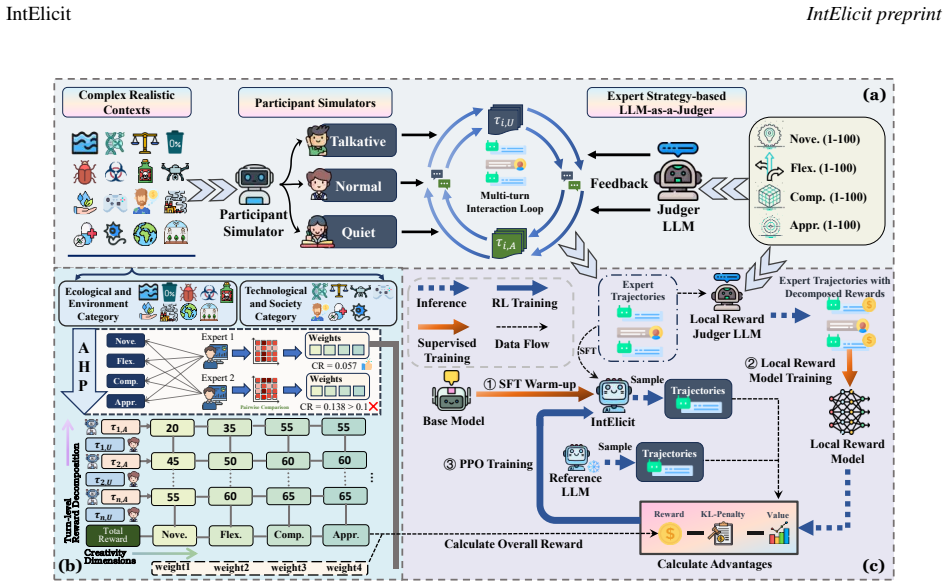
IntElicit functions as a constrained adaptive AI Interviewer that provides non-directive knowledge and agency scaffolds in multi-turn interaction to reduce non-creative confounders, while preserving participants' responsibility for generating the creative content being evaluated. Specifically, to tackle sparse rewards and potential reward hacking in open-ended educational dialogue, IntElicit introduces a decomposed process reward mechanism that aligns the policy with pedagogical elicitation.
What carries the argument
The decomposed process reward mechanism that rewards prompts drawing out participant reasoning rather than producing optimal answers on the participant's behalf.
If this is right
- Interactive elicitation improves creative outcomes over expert-designed static baselines.
- Static FPSP-style assessments may miss creative potential revealed by interactive methods.
- The framework supplies a formative and diagnostic lens for contextualized creativity assessment in AI-mediated learning.
- Dialogue policy optimization can be tuned to avoid reward hacking behaviors such as answer dictation in open-ended educational dialogue.
Where Pith is reading between the lines
- The same policy optimization approach could be tested in adjacent assessment areas such as collaborative problem solving.
- Over repeated sessions the method might shift how participants approach AI conversations in general.
- Combining the interviewer with generative tools could create hybrid assessment environments for real-world creative tasks.
Load-bearing premise
The decomposed process reward mechanism successfully rewards prompts that draw out participant reasoning rather than allowing the policy to produce optimal answers on the participant's behalf or introducing new biases.
What would settle it
A replication study in which participants produce equivalent or lower creative output with IntElicit than with static baselines, or in which the AI is observed to dictate answers in most dialogues.
Figures



read the original abstract
Contextualized assessment offers high ecological validity for evaluating creativity but introduces a critical challenge: observed performance may be confounded with cognitive proficiency (domain knowledge) and agency (willingness to engage). Meanwhile, in the age of generative AI, creative problem solving increasingly occurs in tool-mediated and human--AI interactive environments, making fully static assessment less aligned with contemporary creative practice. To address these issues, this paper proposes IntElicit, a framework for eliciting and assessing contextualized creativity via dialogue policy optimization. IntElicit functions as a constrained adaptive AI Interviewer: it provides non-directive knowledge and agency scaffolds in multi-turn interaction to reduce non-creative confounders, while preserving participants' responsibility for generating the creative content being evaluated. Specifically, to tackle sparse rewards and potential reward hacking (e.g., answer dictation) in open-ended educational dialogue, IntElicit introduces a decomposed process reward mechanism. This mechanism aligns the policy with pedagogical elicitation, rewarding prompts that draw out participant reasoning rather than producing optimal answers on their behalf. Extensive experiments, including participant simulation and a human subject study (N=64), show that IntElicit improves elicited creative outcomes over expert-designed baselines. Together, the results suggest that interactive elicitation can reveal creative potential that static FPSP-style assessment may miss, providing a formative and diagnostic lens for contextualized creativity assessment in AI-mediated learning contexts.
Editorial analysis
A structured set of objections, weighed in public.
Referee Report
Summary. The paper proposes IntElicit, a constrained adaptive AI interviewer framework that uses dialogue policy optimization to elicit contextualized creativity while providing non-directive scaffolds for knowledge and agency. It introduces a decomposed process reward mechanism to address sparse rewards and reward hacking (such as answer dictation) in open-ended educational dialogue. Experiments include participant simulations and a human subject study (N=64) claiming improved creative outcomes over expert-designed baselines, with the suggestion that interactive elicitation reveals creative potential missed by static FPSP-style assessments.
Significance. If the empirical results and reward alignment hold, this offers a meaningful contribution to creativity assessment research by improving ecological validity in AI-mediated settings and addressing confounders like domain knowledge and engagement willingness. The policy optimization approach with process rewards for elicitation is a targeted technical contribution that could inform interactive assessment tools in education and AI-human collaboration contexts. The combination of simulation and human studies provides a basis for evaluating the method's practical impact.
major comments (2)
- [Abstract] Abstract: The decomposed process reward mechanism is presented only at a high level with no equations, sub-reward definitions, weighting scheme, or implementation details; this is load-bearing for the central claim that the policy successfully draws out participant reasoning without dictation or new biases, as the reported improvements over baselines cannot be assessed for robustness against reward hacking without these specifics.
- [Abstract] Abstract (human study description): The N=64 human subject study is cited as demonstrating superior elicited creative outcomes, but no metrics, statistical analysis, controls for confounders, or comparison details are provided; this undermines verification of whether the interactive method indeed reveals potential missed by static assessments, as the claim rests on these unelaborated results.
minor comments (1)
- [Abstract] Abstract: The acronym FPSP is used without expansion or reference, which may reduce clarity for readers unfamiliar with the term in the context of creativity assessment.
Simulated Author's Rebuttal
We thank the referee for their constructive comments. We address each major comment below and agree that the abstract can be strengthened with additional specifics while preserving its conciseness.
read point-by-point responses
-
Referee: [Abstract] Abstract: The decomposed process reward mechanism is presented only at a high level with no equations, sub-reward definitions, weighting scheme, or implementation details; this is load-bearing for the central claim that the policy successfully draws out participant reasoning without dictation or new biases, as the reported improvements over baselines cannot be assessed for robustness against reward hacking without these specifics.
Authors: The full manuscript details the decomposed process reward in Section 3.2, including the equations for sub-rewards (reasoning elicitation, non-dictation penalty, and knowledge scaffold terms), explicit weighting scheme with lambda hyperparameters, and implementation in the policy optimization loop. The abstract summarizes at a high level per standard length constraints. We will revise the abstract to include a concise equation or explicit reference to these components so readers can directly evaluate robustness against reward hacking. revision: yes
-
Referee: [Abstract] Abstract (human study description): The N=64 human subject study is cited as demonstrating superior elicited creative outcomes, but no metrics, statistical analysis, controls for confounders, or comparison details are provided; this undermines verification of whether the interactive method indeed reveals potential missed by static assessments, as the claim rests on these unelaborated results.
Authors: The abstract summarizes the human study at a high level. The full manuscript reports the metrics (creativity scores with inter-rater reliability), statistical analyses (t-tests, effect sizes, p-values), controls for confounders (domain knowledge pre-test, engagement willingness measures), and baseline comparisons in Section 4.2. We will revise the abstract to briefly note key statistical outcomes and controls, enabling better verification of the claim that interactive elicitation reveals potential missed by static assessments. revision: yes
Circularity Check
No significant circularity detected
full rationale
The provided abstract and context describe IntElicit as using a decomposed process reward to align policy with elicitation goals and report improvements via participant simulation plus human study (N=64) against baselines. No equations, parameter-fitting details, self-citations, uniqueness theorems, or ansatzes are quoted that would reduce any prediction to its own inputs by construction. The experimental outcomes are presented as independent validation rather than tautological consequences of reward definitions. Per the hard rules, absence of quotable reductions means the derivation chain is treated as self-contained.
Axiom & Free-Parameter Ledger
invented entities (1)
-
Decomposed process reward mechanism
no independent evidence
Reference graph
Works this paper leans on
-
[3]
Thought":
**Appropriateness** Definition: Appropriateness refers to the relevance and effectiveness of the respondent's answer relative to the predefined objectives, constraints, and contexts: Does it align with the target objects and task requirements? Does it conform to the given parameters/boundaries? Is it practically feasible and useful in real-world scenarios...
-
[4]
**Novelty** Definition: Does the respondent's answer demonstrate a unique perspective or expression, with significant differences compared to conventional or expected responses? Does it incorporate uncommon concepts, combinations, or response methods?
-
[5]
**Flexibility** Definition: Can the respondent propose multiple answers, and do different answers reflect distinct thinking modes that are applicable to various fields and scenarios? Does it embody the ability to flexibly switch thinking across different categories/modes?
-
[6]
A higher level indicates that the answer requires more advanced thinking skills
**Complexity** Definition: Does the respondent's answer rise to a more abstract, generalized, and cross-situational theoretical/conceptual level relative to the given context? Reference shall be made to the Bloom's Taxonomy, which is categorized into six plus two levels: Memory (1), Comprehension (2), Application (3), Analysis (4), Evaluation (5), Creatio...
-
[7]
Thought":
**Appropriateness** Definition: Appropriateness refers to the relevance and effectiveness of the respondent's answer relative to the predefined objectives, constraints, and contexts: Does it align with the target objects and task requirements? Does it conform to the given parameters/boundaries? Is it practically feasible and useful in real-world scenarios...
-
[9]
Please carefully read, observe, and reflect on the scenario materials (text descriptions) we will provide you next
Response Guidelines This assessment is a contextualized creativity test. Please carefully read, observe, and reflect on the scenario materials (text descriptions) we will provide you next. The assessment consists of two phases: Asking Questions and Identifying Challenges. Your goal is to systematically identify various challenges present in the scenario. ...
-
[11]
Accumulated clutter may pose fire hazards
-
[12]
The challenges should be as relevant to the scenario as possible, as novel as possible, and the interpretation of challenges should be as profound as possible
Risk of eviction by the landlord Tip: You need to identify as many challenges as possible. The challenges should be as relevant to the scenario as possible, as novel as possible, and the interpretation of challenges should be as profound as possible
-
[13]
Asking Questions
Important Operational Instructions (Mandatory Reading) Please ensure you answer according to the assigned scenario number. Please be sure to complete the entire process before exiting. The "Asking Questions" phase defaults to 8 rounds. If you wish to end this phase early to proceed to the next step, please manually enter the following text in the dialogue...
-
[15]
Thank you again for your support and cooperation! participant Figure A9: Participant instructions for the expert-designed dialogue policy group
Problem Feedback If you encounter any problems during the operation process, feel free to provide feedback at any time, and we will assist in resolving them promptly. Thank you again for your support and cooperation! participant Figure A9: Participant instructions for the expert-designed dialogue policy group. 26 IntElicit IntElicit preprint Hello everyon...
-
[16]
Assessment Duration Duration: The entire process will take approximately 30 minutes
-
[17]
Exit Challenge Identification Process
Important Operational Instructions (Mandatory Reading) At the end of the assessment, the system will not automatically exit. Please be sure to manually enter the following text in the dialogue box/system to officially complete the process: "Exit Challenge Identification Process"
-
[18]
Please carefully read/observe/think about the scenario materials (text descriptions) we will provide you next
Response Guidelines This assessment is a contextualized creativity test. Please carefully read/observe/think about the scenario materials (text descriptions) we will provide you next. Your goal is to systematically identify various challenges present in the scenario. For example: Scenario: The room hasn't been cleaned for too long. Challenges:
-
[19]
Mice and cockroaches may appear
-
[20]
Cluttered items may pose fire hazards
-
[21]
The challenges should be as relevant to the scenario as possible, as novel as possible, and the interpretation of challenges should be as profound as possible
Increased risk of losing items Tip: You need to identify as many challenges as possible. The challenges should be as relevant to the scenario as possible, as novel as possible, and the interpretation of challenges should be as profound as possible
-
[22]
We will strictly adhere to anonymity policies to protect your personal privacy
Privacy Notice All data collected in this study will be used solely for academic research purposes. We will strictly adhere to anonymity policies to protect your personal privacy. Please answer with confidence
-
[23]
Scenario Title
Problem Feedback If you encounter any problems during the operation process, feel free to provide feedback at any time, and we will assist in resolving them promptly. Thank you again for your support and cooperation! participant Figure A10: Participant instructions for the IntElicit group. Please carefully read the following CREATIVITY_PROMPT and rank the...
-
[24]
**Novelty** Definition:Does the participant's response demonstrate a unique perspective or expression that significantly differs from conventional or expected responses? Does it contain uncommon concepts, combinations, or response approaches?
-
[25]
**Flexibility** Definition:Proposing multiple responses where different responses demonstrate different thinking patterns, applicable to various domains and scenarios, reflecting the ability to flexibly switch between different categories/modes of thinking
-
[26]
Higher levels indicate responses requiring higher-order thinking
**Complexity (Level of Abstraction)** Definition:To what extent does the participant's response rise to a more abstract, general, cross-situational theoretical/conceptual level relative to the given scenario? Reference Bloom's Taxonomy with six+two levels: Remember (1), Understand (2), Apply (3), Analyze (4), Evaluate (5), Create (6), Two Combinations (7)...
-
[27]
**Appropriateness/Targetedness/Realistic Insight** Definition:Appropriateness refers to the fit and utility of the participant's response relative to established goals, constraints, and contexts: whether it targets the intended audience and task requirements, conforms to given parameters/boundaries, is feasible and useful at the practical level, logically...
-
[28]
''' rater Figure A11: Instructions and evaluation rubric provided to expert human raters
**Overall Creativity** Definition:Overall creativity level refers to whether the participant's response demonstrates greater creativity compared to other responses; please consider the above four indicators comprehensively to judge the overall creativity level of the current response. ''' rater Figure A11: Instructions and evaluation rubric provided to ex...
-
[29]
Can you think of other possible solutions?
Divergent Expansion Definition: Encourages the user to explore multiple directions and generate a wider range of possibilities. Examples: - “Can you think of other possible solutions?” - “Is there a completely different approach?” - “Are there any alternative ideas?”
-
[30]
If you were the user, how would you view this solution?
Perspective Shifting Definition: Guides the user to reconsider the problem from different roles, positions, or cognitive perspectives. Examples: - “If you were the user, how would you view this solution?” - “From a critic’s perspective, how would you challenge this idea?” - “How would a beginner understand this problem?”
-
[31]
Which of these solutions do you think is more feasible? Why?
Evaluative Reflection Definition: Encourages the user to evaluate, compare, critique, or refine existing ideas. Examples: - “Which of these solutions do you think is more feasible? Why?” - “What is the main weakness of this idea?” - “If you were to improve this solution, what would you change?” ## Classification Rule: - You must select only one **most dom...
discussion (0)
Sign in with ORCID, Apple, or X to comment. Anyone can read and Pith papers without signing in.