Echoes of the Prior: A Computational Phenomenology of Forgetting
Pith reviewed 2026-06-27 09:49 UTC · model grok-4.3
The pith
Controlled decay in a feed-forward 3D reconstruction network generates visual chaos that stands in for the experience of human forgetting.
A machine-rendered reading of the paper's core claim, the machinery that carries it, and where it could break.
Core claim
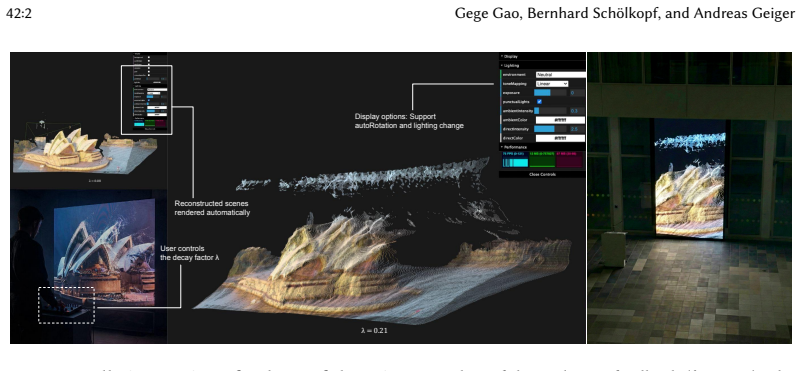
By applying controlled synaptic decay inside a feed-forward 3D reconstruction model, the installation produces a sequence of outputs that regress from coherent scenes into unrecognizable chaos, thereby creating an artistic analogy for the erosion of the brain's predictive priors and positioning the neural network as a cognitive proxy for the disorienting experience of losing one's grip on the world.
What carries the argument
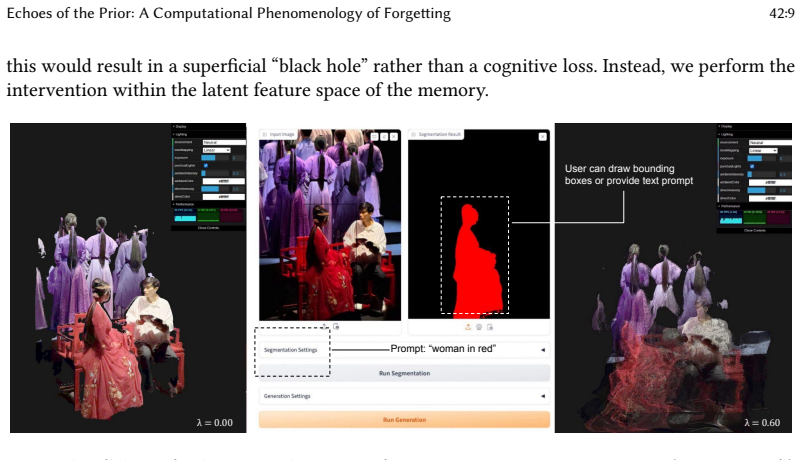
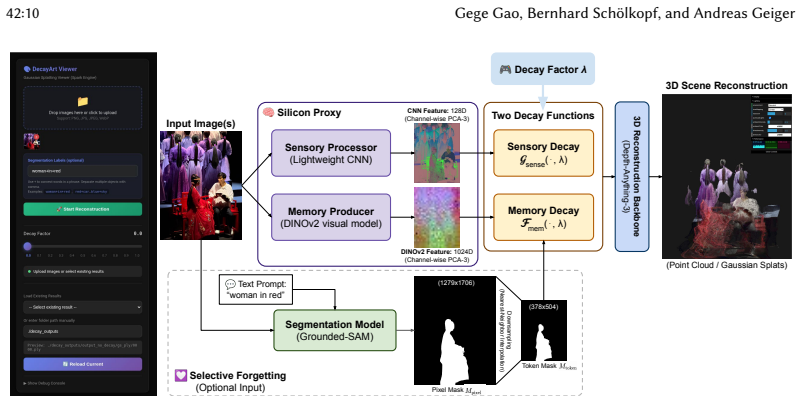
Feed-forward 3D reconstruction model with induced controlled synaptic decay, which progressively removes the network's capacity to enforce consistent scene geometry.
If this is right
- The same decay process can be applied to other reconstruction or generative models to produce analogous visualizations of cognitive erosion.
- The installation supplies a concrete, runnable example that the community can extend for further neuromorphic aesthetic experiments.
- If the analogy holds, it supplies a method for visualizing how loss of predictive structure turns ordered perception into chaos without requiring biological subjects.
- The framework treats neural networks as proxies rather than tools, opening repeated use of degradation as an artistic and exploratory device.
Where Pith is reading between the lines
- Similar decay schedules could be tested on models trained for other modalities such as audio or language to check whether the same progression toward incoherence appears.
- The installation might serve as a prompt for psychological experiments that compare reported subjective states during real forgetting with reported states during exposure to the decayed outputs.
- If the visual progression reliably produces the intended effect, the technique could be adapted to simulate early-stage cognitive decline for educational or therapeutic visualization purposes.
Load-bearing premise
The visual output of a degrading neural network can meaningfully evoke or stand in for the subjective, disorienting phenomenology of human forgetting.
What would settle it
Viewers who interact with the installation and report no increase in disorientation or sense of lost coherence as the model decays would falsify the central analogy.
Figures



read the original abstract
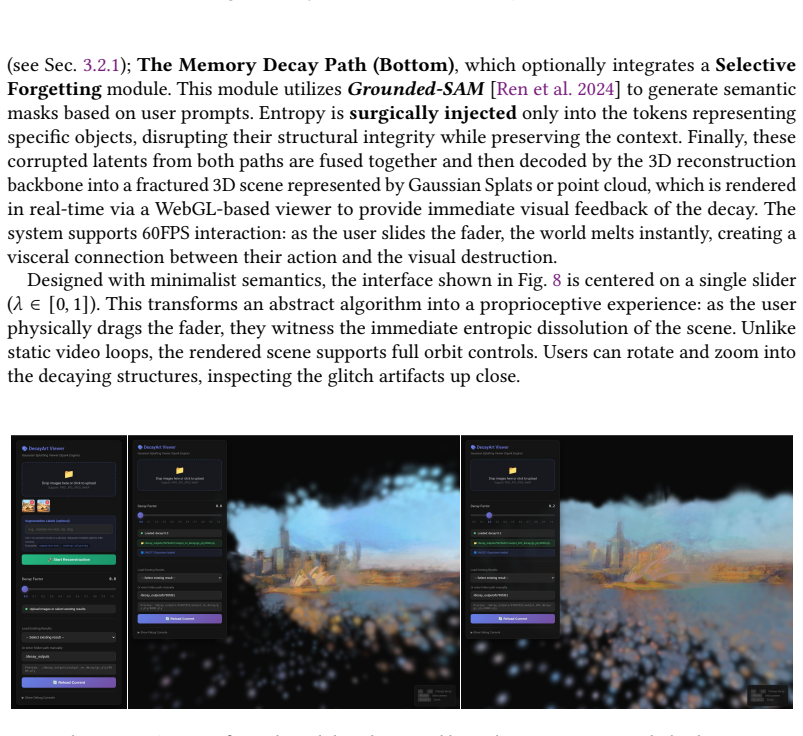
Memory is not merely the storage of data; it is the scaffolding of reality. When biological memory fades, the world does not simply turn black; it regresses into an unrecognizable chaos. Echoes of the Prior is an interactive installation that attempts to visualize this subjective phenomenology of forgetting. By inducing controlled synaptic decay within a Feed-Forward 3D Reconstruction model, we create an artistic analogy for the erosion of the brain's predictive priors. We position the Neural Network not as a tool for engineering, but as a cognitive proxy - a silicon brain whose structural degeneration evokes the disorienting, poetic, and terrifying experience of losing one's grip on the world. Ultimately, we offer this framework as a catalyst, inviting the wider community to explore the uncharted potential of neuromorphic aesthetics in visualizing the fragility of intelligence. Interactive demo see https://decart-4d.github.io/.
Editorial analysis
A structured set of objections, weighed in public.
Referee Report
Summary. The manuscript presents 'Echoes of the Prior,' an interactive installation that induces controlled synaptic decay in a Feed-Forward 3D Reconstruction model to create an artistic analogy for the erosion of the brain's predictive priors during forgetting. It frames the neural network as a cognitive proxy whose structural degeneration evokes the subjective, disorienting phenomenology of memory loss, and invites exploration of neuromorphic aesthetics without asserting biological or empirical equivalence.
Significance. If the intended analogy holds as an artistic device, the work contributes to neuromorphic aesthetics by offering a visual and interactive framework for representing cognitive fragility. Its explicit positioning as an analogy and catalyst for community exploration, rather than a mechanistic model, is a strength that aligns with the stated goals and distinguishes it from technical claims in computer vision.
minor comments (2)
- [Abstract] Abstract: the phrase 'controlled synaptic decay' is introduced without any accompanying description of the decay schedule, parameterization, or implementation details that would allow readers to understand or replicate the visual effects.
- The manuscript provides a demo link but contains no description of the interaction mechanics, input modalities, or how users are expected to experience the degradation process.
Simulated Author's Rebuttal
We thank the referee for their positive assessment of the manuscript and their recommendation to accept. We appreciate the recognition that the work is framed explicitly as an artistic analogy rather than a mechanistic or empirical model, which aligns with our intent to contribute to neuromorphic aesthetics.
Circularity Check
No derivation chain or quantitative claims; artistic analogy only
full rationale
The paper describes an interactive artistic installation that uses controlled degradation of a feed-forward 3D reconstruction network as a visual proxy for the phenomenology of forgetting. It makes no equations, predictions, fitted parameters, or load-bearing derivations of any kind. The central claim is explicitly positioned as an analogy and aesthetic exploration rather than a mechanistic or empirical result. No self-citations, ansatzes, or reductions to inputs exist that could trigger any of the enumerated circularity patterns. The work is self-contained within its stated artistic goals.
Axiom & Free-Parameter Ledger
Reference graph
Works this paper leans on
-
[1]
InACM SIGGRAPH 2019 Art Gallery
Learning to see: you are what you see. InACM SIGGRAPH 2019 Art Gallery. 1–6. Refik Anadol
2019
-
[2]
Anne Davis Basting
Working memory.Science255, 5044 (1992), 556–559. Anne Davis Basting. 2009.Forget Memory: Creating Better Lives for People with Dementia. Johns Hopkins University Press. Jeffrey S. Bowers, Gaurav Malhotra, Marin Dujmović, Milton Llera Montero, Christian Tsvetkov, Valerio Biscione, Guillermo Puebla, Federico Adolfi, John E. Hummel, Rachel F. Heaton, and et al
1992
-
[3]
David J Chalmers
Deep problems with neural network models of human vision.Behavioral and Brain Sciences46 (2023), e385. David J Chalmers
2023
-
[4]
Radoslaw Martin Cichy and Daniel Kaiser
Facing up to the problem of consciousness.Journal of Consciousness Studies2, 3 (1995), 200–219. Radoslaw Martin Cichy and Daniel Kaiser
1995
-
[5]
Philip R Corlett, Guillermo Horga, Paul C Fletcher, Ben Alderson-Day, Katharina Schmack, and Albert R Powers
Deep neural networks as scientific models.Trends in Cognitive Sciences23, 4 (2019), 305–317. Philip R Corlett, Guillermo Horga, Paul C Fletcher, Ben Alderson-Day, Katharina Schmack, and Albert R Powers
2019
-
[6]
Charles R
Hallucinations and strong priors.Trends in cognitive sciences23, 2 (2019), 114–127. Charles R. Crutch, Sebastian J.and Harrison, Emilie V. Brotherhood, Paul M. Camic, Brian Day, and Anthony J. Woods
2019
-
[7]
Sebastian J Crutch, Ron Isaacs, and Martin N Rossor
Created Out of Mind: Shaping Perceptions of Dementia Through Art and Science.Mobile Brain-Body Imaging and the Neuroscience of Art, Innovation and Creativity(2019), 135–143. Sebastian J Crutch, Ron Isaacs, and Martin N Rossor
2019
-
[8]
Russell L De Valois, Duane G Albrecht, and Lisa G Thorell
Some workmen can blame their tools: artistic change in an individual with Alzheimer’s disease.The Lancet357, 9274 (07 2001), 2129–2133. Russell L De Valois, Duane G Albrecht, and Lisa G Thorell
2001
-
[9]
C.H Espinel
Spatial frequency selectivity of cells in macaque visual cortex.Vision research22, 5 (1982), 545–559. C.H Espinel
1982
-
[10]
Martha J Farah
de Kooning’s late colours and forms: dementia, creativity, and the healing power of art.The Lancet347, 9008 (1996), 1096–1098. Martha J Farah. 2004.Visual Agnosia. MIT Press. Sigmund Freud
1996
-
[11]
Leon A Gatys, Alexander S Ecker, and Matthias Bethge
The free-energy principle: a unified brain theory?Nature reviews neuroscience11, 2 (2010), 127–138. Leon A Gatys, Alexander S Ecker, and Matthias Bethge
2010
-
[12]
Zehuan Huang, Yuan-Chen Guo, Xingqiao An, Yunhan Yang, Yangguang Li, Zi-Xin Zou, Ding Liang, Xihui Liu, Yan-Pei Cao, and Lu Sheng
Neural networks and physical systems with emergent collective computational abilities.Proceedings of the National Academy of Sciences79, 8 (1982), 2554–2558. Zehuan Huang, Yuan-Chen Guo, Xingqiao An, Yunhan Yang, Yangguang Li, Zi-Xin Zou, Ding Liang, Xihui Liu, Yan-Pei Cao, and Lu Sheng
1982
-
[13]
Eric Jonas and Konrad Paul Kording
Receptive fields, binocular interaction and functional architecture in the cat’s visual cortex.The Journal of Physiology160, 1 (1962), 106–154. Eric Jonas and Konrad Paul Kording
1962
-
[14]
Bernhard Kerbl, Georgios Kopanas, Thomas Leimkühler, and George Drettakis
Could a neuroscientist understand a microprocessor?PLOS Computational Biology13, 1 (2017), 1–24. Bernhard Kerbl, Georgios Kopanas, Thomas Leimkühler, and George Drettakis
2017
-
[15]
SIGGRAPH
3d gaussian splatting for real-time radiance field rendering.ACM Transactions on Graphics (TOG)42, 4 (2023), 1–14. SIGGRAPH
2023
-
[16]
1997.Dementia Reconsidered: The Person Comes First
Tom Kitwood. 1997.Dementia Reconsidered: The Person Comes First. Open University Press. Pia Kontos
1997
-
[17]
Shu-Chen Li, Ulman Lindenberger, and Sverker Sikström
Embodied selfhood in Alzheimer’s disease: Rethinking person-centred care.Dementia: The International Journal of Social Research and Practice4 (2005), 553–570. Shu-Chen Li, Ulman Lindenberger, and Sverker Sikström
2005
-
[18]
Trends in cognitive sciences5, 11 (2001), 479–486
Aging cognition: from neuromodulation to representation. Trends in cognitive sciences5, 11 (2001), 479–486. Proc. ACM Comput. Graph. Interact. Tech., Vol. 9, No. 3, Article
2001
-
[19]
arXiv:2511.10647 [cs.CV] Grace W
Depth Anything 3: Recovering the Visual Space from Any Views. arXiv:2511.10647 [cs.CV] Grace W. Lindsay
-
[20]
Wolfgang Maass
Convolutional neural networks as a model of the visual system: Past, present, and future.Journal of Cognitive Neuroscience33, 10 (2021), 2017–2031. Wolfgang Maass
2021
-
[21]
Rosa Menkman
Networks of spiking neurons: The third generation of neural network models.Neural networks10, 9 (1997), 1659–1671. Rosa Menkman. 2011.The glitch moment(um). Institute of Network Cultures. Maurice Merleau-Ponty. 1945.Phenomenology of Perception. Gallimard. Francesco Mezzadri
1997
-
[22]
Ben Mildenhall, Pratul P Srinivasan, Matthew Tancik, Jonathan T Barron, Ravi Ramamoorthi, and Ren Ng
How to generate random matrices from the classical compact groups.Notices of the AMS54, 5 (2007), 592–604. Ben Mildenhall, Pratul P Srinivasan, Matthew Tancik, Jonathan T Barron, Ravi Ramamoorthi, and Ren Ng
2007
-
[23]
A Bayesian explanation of the ‘Uncanny Valley’ effect and related psychological phenomena.Scientific Reports2 (2012),
2012
-
[24]
Fabian Offert and Peter Bell
Inceptionism: Going deeper into neural networks.Google Research Blog(2015). Fabian Offert and Peter Bell
2015
-
[25]
John O’Keefe and Jonathan Dostrovsky
Perceptual bias and technical metapictures: Critical machine vision as a humanities challenge.AI & Society36 (2021), 1–12. John O’Keefe and Jonathan Dostrovsky
2021
-
[26]
Nobel Prize winning work on Place Cells
The hippocampus as a spatial map: preliminary evidence from unit activity in the freely-moving rat.Brain research34, 1 (1971), 171–175. Nobel Prize winning work on Place Cells. Maxime Oquab, Timothée Darcet, Théo Moutakanni, Huy V. Vo, Marc Szafraniec, Vasil Khalidov, Pierre Fernandez, Daniel HAZIZA, Francisco Massa, Alaaeldin El-Nouby, Mido Assran, Nicol...
1971
-
[27]
Cynthia Owsley, Robert Sekuler, and Dennis Siemsen
DINOv2: Learning Robust Visual Features without Supervision.Transactions on Machine Learning Research(2024). Cynthia Owsley, Robert Sekuler, and Dennis Siemsen
2024
-
[28]
Albert R Powers, Christoph Mathys, and Philip R Corlett
Contrast sensitivity throughout adulthood.Vision Research23, 7 (1983), 689–699. Albert R Powers, Christoph Mathys, and Philip R Corlett
1983
-
[29]
René Ranftl, Alexey Bochkovskiy, and Vladlen Koltun
Pavlovian conditioning-induced hallucinations result from overweighting of perceptual priors.Science357, 6351 (2017), 596–600. René Ranftl, Alexey Bochkovskiy, and Vladlen Koltun
2017
-
[30]
Charles Bonnet Syndrome: Evidence for a Generative Model in the Cortex?PLOS Computational Biology9, 7 (2013), e1003134. Tianhe Ren, Shilong Liu, Ailing Zeng, Jing Lin, Kunchang Li, He Cao, Jiayu Chen, Xinyu Huang, Yukang Chen, Feng Yan, Zhaoyang Zeng, Hao Zhang, Feng Li, Jie Yang, Hongyang Li, Qing Jiang, and Lei Zhang
2013
-
[31]
arXiv:2401.14159 [cs.CV] Jun’ichiro Seyama and Ruth S
Grounded SAM: Assembling Open-World Models for Diverse Visual Tasks. arXiv:2401.14159 [cs.CV] Jun’ichiro Seyama and Ruth S. Nagayama
-
[32]
Michael N Shadlen and William T Newsome
The Uncanny Valley: Effect of Realism on the Impression of Artificial Human Faces.Presence: Teleoperators and Virtual Environments16, 4 (2007), 337–351. Michael N Shadlen and William T Newsome
2007
-
[33]
Oriane Siméoni, Huy V
The Variable Discharge of Cortical Neurons: Implications for Connectivity, Computation, and Information Coding.Journal of Neuroscience18, 10 (1998), 3870–3896. Oriane Siméoni, Huy V. Vo, Maximilian Seitzer, Federico Baldassarre, Maxime Oquab, Cijo Jose, Vasil Khalidov, Marc Szafraniec, Seungeun Yi, Michaël Ramamonjisoa, Francisco Massa, Daniel Haziza, Luc...
1998
-
[34]
arXiv:2508.10104 [cs.CV] Susan Sontag
DINOv3. arXiv:2508.10104 [cs.CV] Susan Sontag. 2003.Regarding the Pain of Others. Farrar, Straus and Giroux. Katherine R. Storrs, Tim C. Kietzmann, Alexander Walther, Johannes Mehrer, and Nikolaus Kriegeskorte
Pith/arXiv arXiv 2003
-
[35]
Francisco J Varela
Diverse deep neural networks all predict human inferior temporal cortex well, after training and fitting.Journal of Cognitive Neuroscience33, 10 (2021), 2044–2064. Francisco J Varela
2021
-
[36]
Tongzhou Wang and Phillip Isola
Neurophenomenology: A methodological remedy for the hard problem.Journal of Consciousness Studies3, 4 (1996), 330–349. Tongzhou Wang and Phillip Isola
1996
-
[37]
Daniel LK Yamins and James J DiCarlo
The selective impairment of semantic memory.Quarterly Journal of Experimental Psychology 27, 4 (1975), 635–657. Daniel LK Yamins and James J DiCarlo
1975
-
[38]
Using goal-driven deep learning models to understand sensory cortex.Nature Neuroscience19, 3 (2016), 356–365. Proc. ACM Comput. Graph. Interact. Tech., Vol. 9, No. 3, Article
2016
-
[39]
Joanna Zylinska
Dementia as a cultural metaphor.The Gerontologist54, 2 (2013), 258–267. Joanna Zylinska. 2020.AI Art: Machine Visions and Warped Dreams. Open Humanities Press. Proc. ACM Comput. Graph. Interact. Tech., Vol. 9, No. 3, Article
2013
-
[40]
Publication date: July 2026
2026
discussion (0)
Sign in with ORCID, Apple, or X to comment. Anyone can read and Pith papers without signing in.