Nonslop: A Gamified Experiment in Human-AI Collaborative Writing
Pith reviewed 2026-06-27 10:01 UTC · model grok-4.3
The pith
A dystopian gamified writing task reveals when people choose creative autonomy over AI suggestions.
A machine-rendered reading of the paper's core claim, the machinery that carries it, and where it could break.
Core claim
The central claim is that embedding AI suggestions inside a game whose story and scoring system actively discourage their use creates observable conditions under which participants reveal authentic choices between preserving individual expression and accepting machine assistance, thereby supplying a method for studying human-AI creative interaction that is less contaminated by the default helpfulness of ordinary interfaces.
What carries the argument
The dystopian narrative and rule set that presents AI suggestions while explicitly disincentivizing their adoption to protect human individuality.
If this is right
- Behavior patterns will vary systematically with task type, showing which prompts most strongly elicit resistance to AI input.
- Response characteristics such as length, originality, and deviation from suggestions will correlate with whether users obey or break the game rules.
- The setup supplies a reusable framework for collecting data on human-AI creative choices that is distinct from typical assistant interactions.
- The experiment directly tests the tension between efficiency gains from AI and the desire to retain personal voice.
Where Pith is reading between the lines
- The same narrative-framing technique could be tested in non-writing domains such as image editing or music composition to measure autonomy preferences.
- If the method succeeds, tool designers might deliberately add friction or narrative context to AI interfaces when user agency is the priority.
- Longer-term use of such games might reveal whether repeated exposure changes participants' baseline willingness to accept AI help outside the game.
Load-bearing premise
The game narrative and penalties successfully make participants act on their real preference for autonomy rather than simply complying with or rebelling against the artificial constraints.
What would settle it
If acceptance rates of AI suggestions remain as high as those observed in standard non-gamified writing interfaces, the dystopian framing has not produced the intended shift toward authentic preferences.
Figures

read the original abstract
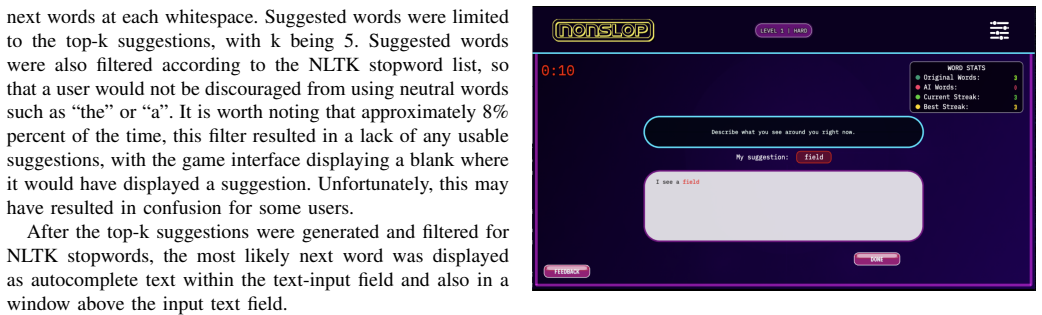
The rapid proliferation of large language models (LLMs) raises critical questions about human creativity and individual expression in an era of AI-assisted creation. When do humans adopt AI suggestions, and what are the implications for individual voice? This study examines these questions through a gamified writing exercise where 74 participants (214 responses) replied to prompts while AI-generated word suggestions were available as they wrote. The game simulates a dystopian future in which an AI is attempting to learn from what remains of human individuality, and disincentivizes AI-like writing. In doing so, it attempts to create conditions that reveal authentic user preferences rather than default behaviors, such as accepting a readily available AI-generated suggestion. Note that this is a deliberate inversion of the "helpful assistant" design pattern; the system is explicitly forbidding you from accepting AI suggestions. We analyze user behavior patterns across different task types, user behaviors, and response characteristics to understand the factors influencing human-AI interaction in creative tasks. The study focuses on when users choose to maintain creative autonomy versus violating the rules of the game and accepting AI assistance. It also explores how these choices relate to response patterns, task characteristics, and user behavior. This gamified approach offers both a framework for studying authentic human-AI interaction and a provocative lens for understanding the tension between efficiency and authenticity in AI-augmented creativity.
Editorial analysis
A structured set of objections, weighed in public.
Referee Report
Summary. The paper describes a gamified writing experiment ('Nonslop') with 74 participants (214 responses) who completed prompts while AI-generated word suggestions were available. The setup uses a dystopian narrative in which an AI seeks to learn from human individuality and explicitly prohibits accepting suggestions, framed as a deliberate inversion of typical helpful AI designs. The study claims to analyze when users maintain creative autonomy versus accepting AI assistance, relating these choices to task types, response characteristics, and user behaviors, and positions the approach as both a framework for studying authentic human-AI interaction and a lens on the tension between efficiency and authenticity.
Significance. If the empirical results were to show that the dystopian framing and explicit prohibition successfully surface genuine preferences for autonomy (rather than rule compliance), the work would offer a novel methodological contribution to empirical studies of human-AI collaboration in creative writing by providing a controlled inversion of standard assistant paradigms and generating falsifiable observations about adoption decisions.
major comments (2)
- [Abstract] Abstract: The manuscript states that 'We analyze user behavior patterns across different task types, user behaviors, and response characteristics' and that 'It also explores how these choices relate to response patterns, task characteristics, and user behavior,' yet the provided text contains no results, statistical analyses, tables, figures, or quantitative breakdowns of acceptance rates, task variations, or correlations. This absence makes it impossible to assess the central claims about factors influencing autonomy choices or the proposed framework.
- [Abstract] Abstract, paragraph 2: The design is presented as creating 'conditions that reveal authentic user preferences rather than default behaviors' via the dystopian narrative and explicit prohibition. However, no control condition, baseline neutral-instruction comparison, pre/post framing measures, or validation (such as self-report motivation data or differential refusal rates) is described to demonstrate that observed refusals reflect underlying preferences for autonomy instead of compliance with the game rules. This undercuts the interpretation that the setup isolates authentic preferences.
minor comments (2)
- [Abstract] Abstract: The parenthetical note 'Note that this is a deliberate inversion of the "helpful assistant" design pattern; the system is explicitly forbidding you from accepting AI suggestions' is written in second person and disrupts the formal tone; it should be rephrased or integrated into the third-person description of the system.
- [Abstract] Abstract: The claim that the approach offers 'a provocative lens for understanding the tension between efficiency and authenticity' is asserted without any reported data linking observed behaviors to efficiency/authenticity trade-offs; if results are added, this interpretive claim should be tied directly to specific findings.
Simulated Author's Rebuttal
We appreciate the referee's constructive feedback on our manuscript. We address each major comment below and outline our planned revisions.
read point-by-point responses
-
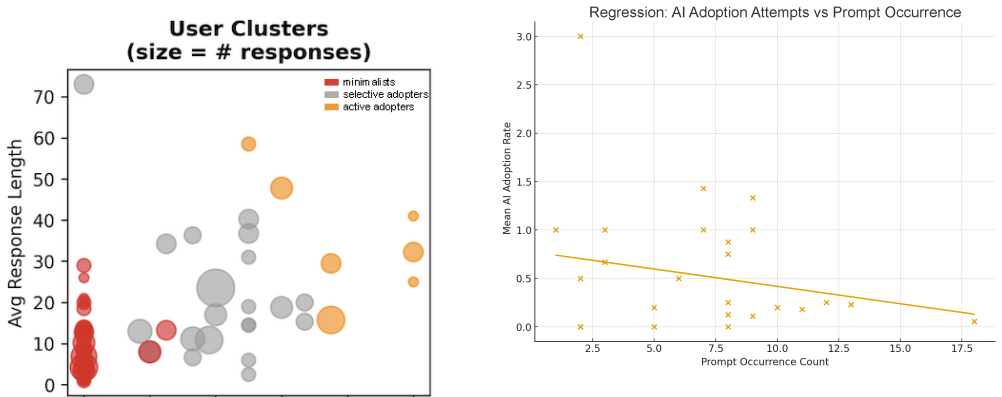
Referee: [Abstract] Abstract: The manuscript states that 'We analyze user behavior patterns across different task types, user behaviors, and response characteristics' and that 'It also explores how these choices relate to response patterns, task characteristics, and user behavior,' yet the provided text contains no results, statistical analyses, tables, figures, or quantitative breakdowns of acceptance rates, task variations, or correlations. This absence makes it impossible to assess the central claims about factors influencing autonomy choices or the proposed framework.
Authors: The current version of the manuscript primarily describes the experimental design and framework. While the abstract summarizes the intended analyses based on the collected data from 74 participants and 214 responses, the detailed results, statistical analyses, tables, and figures are not included in the provided text. We will revise the manuscript to include a dedicated results section with quantitative breakdowns, acceptance rates by task type, correlations with response characteristics, and supporting visualizations to substantiate the claims. revision: yes
-
Referee: [Abstract] Abstract, paragraph 2: The design is presented as creating 'conditions that reveal authentic user preferences rather than default behaviors' via the dystopian narrative and explicit prohibition. However, no control condition, baseline neutral-instruction comparison, pre/post framing measures, or validation (such as self-report motivation data or differential refusal rates) is described to demonstrate that observed refusals reflect underlying preferences for autonomy instead of compliance with the game rules. This undercuts the interpretation that the setup isolates authentic preferences.
Authors: We agree that the absence of a control condition or additional validation measures makes it challenging to conclusively attribute refusals to authentic preferences for autonomy rather than adherence to the game's explicit rules. The dystopian framing and prohibition are central to the inversion of standard AI designs, but to strengthen the interpretation, we will revise the abstract and discussion sections to more cautiously describe the setup as creating conditions that discourage AI use, without overclaiming isolation of authentic preferences. If possible with the existing dataset, we will explore adding any available self-report data or behavioral indicators. revision: partial
Circularity Check
Empirical user study contains no derivations or self-referential reductions
full rationale
The paper describes a gamified writing experiment with 74 participants and reports observed behaviors across task types and response characteristics. No equations, fitted parameters, predictions, or derivation chains appear in the abstract or described structure. Claims about revealing 'authentic user preferences' rest on the game design and data collection rather than any mathematical step that reduces to its own inputs by construction. The work is self-contained as an empirical report with no load-bearing self-citations or ansatzes that could trigger circularity patterns.
Axiom & Free-Parameter Ledger
Reference graph
Works this paper leans on
-
[1]
, title =
Photon Storm Ltd. , title =. 2025 , url =
2025
-
[2]
Mohi Reza and Jeb Thomas-Mitchell and Peter Dushniku and Nathan Laundry and Joseph Jay Williams and Anastasia Kuzminykh , year=. Co-Writing with. doi:https://doi.org/10.1145/3757566 , url=. 2504.12488 , archivePrefix=
-
[3]
International Conference on Computational Creativity , year=
Deeptingle , author=. International Conference on Computational Creativity , year=
-
[4]
From game design elements to gamefulness:
Deterding, Sebastian and Dixon, Dan and Khaled, Rilla and Nacke, Lennart , booktitle=. From game design elements to gamefulness:
-
[5]
Dhillon and Somayeh Molaei and Jiaqi Li and Maximilian Golub and Shaochun Zheng and Lionel P
Paramveer S. Dhillon and Somayeh Molaei and Jiaqi Li and Maximilian Golub and Shaochun Zheng and Lionel P. Robert , year=. Shaping. 2402.11723 , archivePrefix=
-
[6]
Kenneth C. Arnold and Jiho Kim , year=. Interaction-Required Suggestions for Control, Ownership, and Awareness in. 2504.08726 , archivePrefix=
-
[7]
2024 , eprint=
Inspo: Writing with Crowds Alongside AI , author=. 2024 , eprint=
2024
-
[8]
PLOS ONE , year=
Adoption of AI writing tools among academic researchers: A Theory of Reasoned Action approach , author=. PLOS ONE , year=
-
[9]
Lee, Hao-Ping (Hank) and Sarkar, Advait and Tankelevitch, Lev and Drosos, Ian and Rintel, Sean and Banks, Richard and Wilson, Nicholas , title =. Proceedings of the 2025 CHI Conference on Human Factors in Computing Systems , articleno =. 2025 , isbn =. doi:10.1145/3706598.3713778 , abstract =
-
[10]
Encyclopedia , VOLUME =
Christopoulos, Athanasios and Mystakidis, Stylianos , TITLE =. Encyclopedia , VOLUME =. 2023 , NUMBER =
2023
-
[11]
von Ahn, Luis and Dabbish, Laura , title =. Commun. ACM , month = aug, pages =. 2008 , issue_date =. doi:10.1145/1378704.1378719 , abstract =
-
[12]
2024 , howpublished =
Neal Agarwal , title =. 2024 , howpublished =
2024
-
[13]
2021 , howpublished =
Parrish, Allison , title =. 2021 , howpublished =
2021
discussion (0)
Sign in with ORCID, Apple, or X to comment. Anyone can read and Pith papers without signing in.