A Pfaffian quantum Hall state of ultracold bosons
Pith reviewed 2026-06-27 07:23 UTC · model grok-4.3
The pith
Ultracold rubidium atoms realize a three-particle bosonic Pfaffian quantum Hall state.
A machine-rendered reading of the paper's core claim, the machinery that carries it, and where it could break.
Core claim
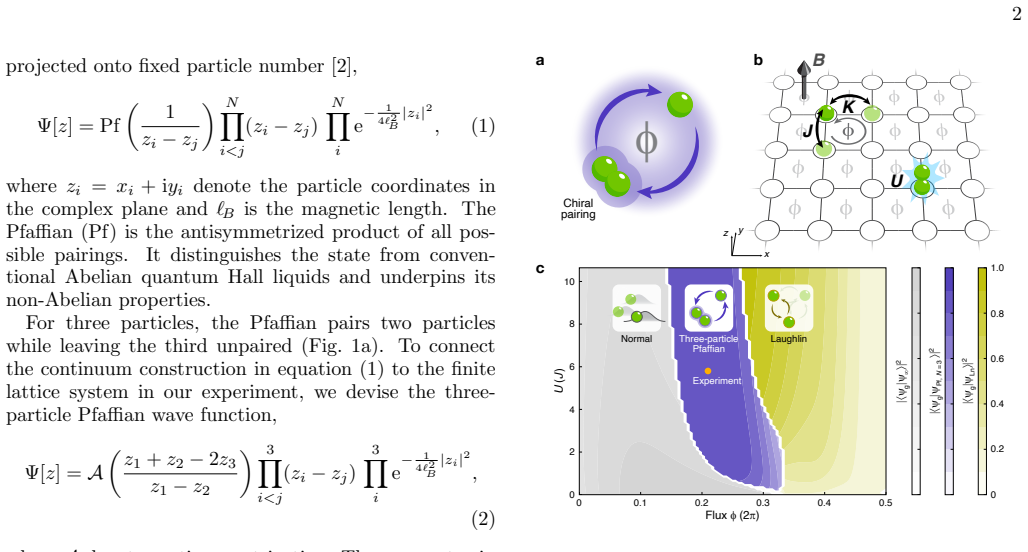
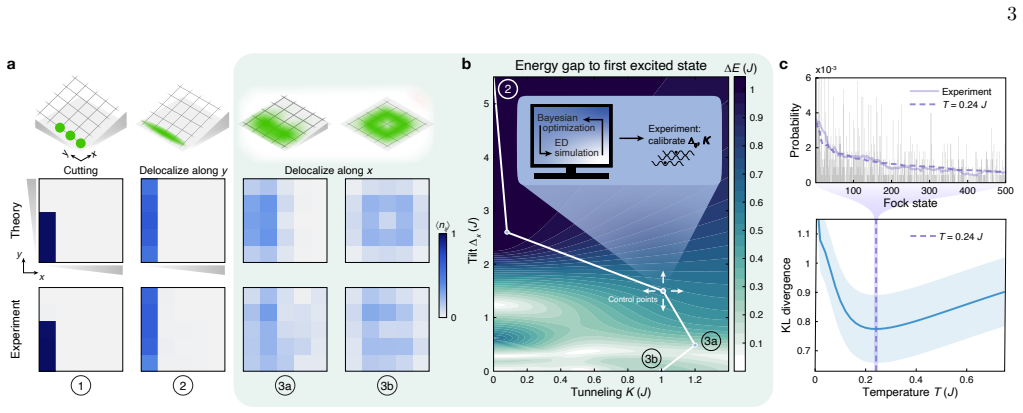
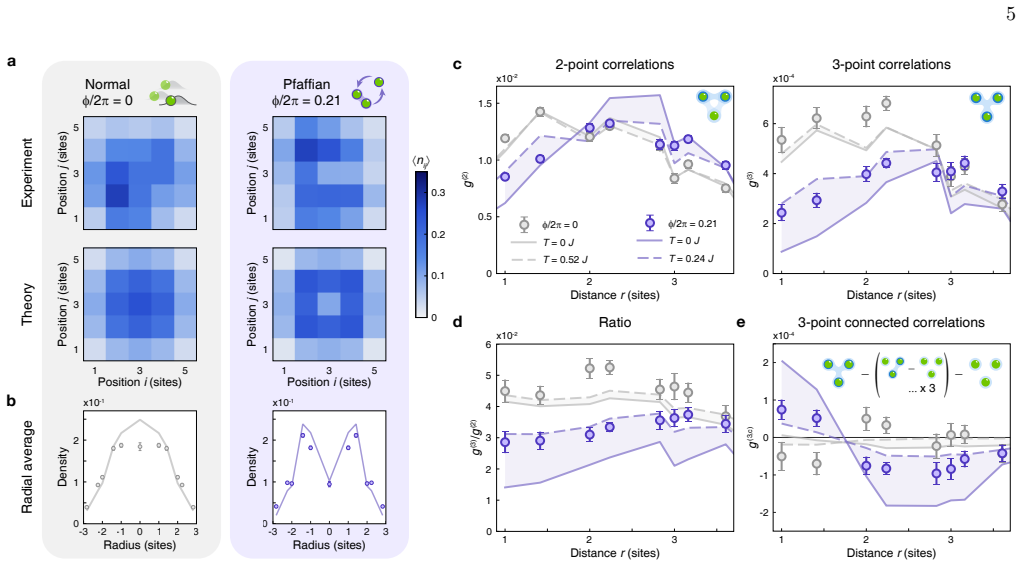
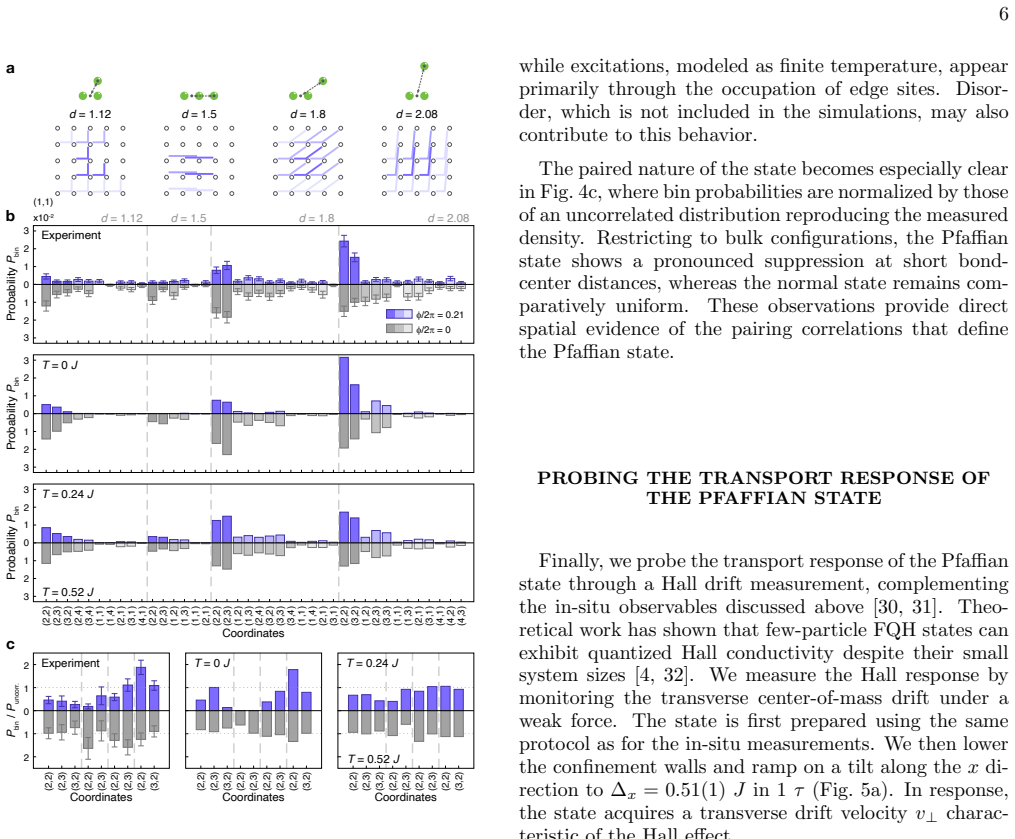
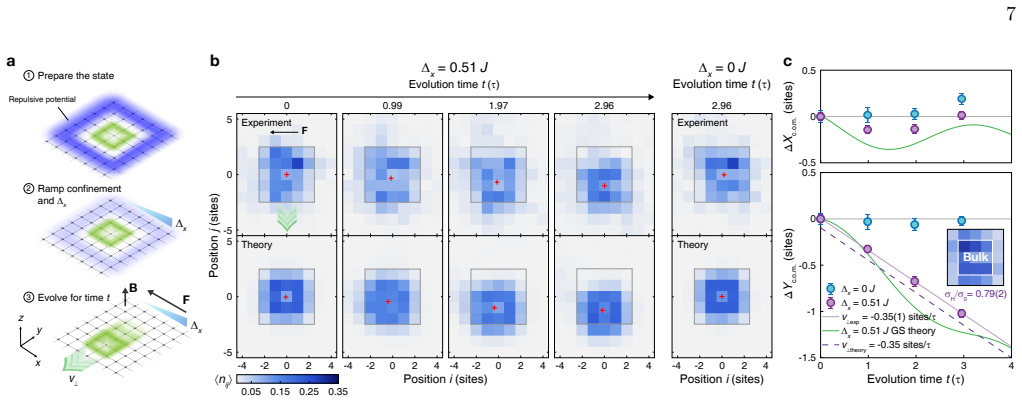
We realize a three-particle bosonic Pfaffian state of ultracold 87Rb atoms in an optical lattice subject to a Floquet-engineered synthetic magnetic field. Using a Bayesian-optimized adiabatic protocol, we prepare a state exhibiting Pfaffian pairing correlations. Site-resolved measurements of multi-point density correlations reveal a pronounced suppression of short-range three-body coincidences, reflecting the underlying pairing structure. We further probe the state's transport response through Hall drift measurements.
What carries the argument
The three-particle bosonic Pfaffian wavefunction, which encodes p-wave pairing of bosons in a synthetic magnetic field.
If this is right
- The preparation protocol demonstrates a bottom-up route to non-Abelian topological order in synthetic systems.
- The observed pairing correlations provide a measurable signature of the Pfaffian structure for future anyon studies.
- Hall drift data confirm the topological character of the state under synthetic gauge fields.
- The method extends existing quantum Hall techniques in cold atoms to paired, non-Abelian candidates.
Where Pith is reading between the lines
- The same correlation signature could be checked in larger particle numbers to test scaling of the pairing gap.
- Alternative preparation methods without Bayesian optimization might be compared to assess protocol robustness.
- The approach may generalize to other lattice geometries or interaction strengths where Pfaffian-like pairing is predicted.
Load-bearing premise
The measured suppression of three-body coincidences and Hall drift uniquely identify the prepared state as the theoretical Pfaffian wavefunction rather than another gapped or paired state.
What would settle it
Direct observation of unsuppressed short-range three-body coincidences in the site-resolved density measurements would indicate the state does not match the Pfaffian wavefunction.
Figures
read the original abstract
Fractional quantum Hall states are a cornerstone of topological physics, hosting fractionally charged quasiparticles with exotic statistics that promise to enable topologically protected quantum information processing. Among these, the Pfaffian state introduced by Moore and Read implements a p-wave pairing structure that supports excitations with non-Abelian exchange statistics. Despite extensive study in electronic systems, direct access to its pairing structure has remained limited. Here we realize a three-particle bosonic Pfaffian state of ultracold $^{87}\mathrm{Rb}$ atoms in an optical lattice subject to a Floquet-engineered synthetic magnetic field. Using a Bayesian-optimized adiabatic protocol, we prepare a state exhibiting Pfaffian pairing correlations. Site-resolved measurements of multi-point density correlations reveal a pronounced suppression of short-range three-body coincidences, reflecting the underlying pairing structure. We further probe the state's transport response through Hall drift measurements. Our results establish a bottom-up approach to engineering non-Abelian topological order and lay the groundwork for future explorations of anyonic braiding in synthetic matter.
Editorial analysis
A structured set of objections, weighed in public.
Referee Report
Summary. The manuscript claims to realize a three-particle bosonic Pfaffian state of ultracold 87Rb atoms in an optical lattice with Floquet-engineered synthetic magnetic field. A Bayesian-optimized adiabatic protocol prepares the state, which is identified via site-resolved multi-point density correlations showing pronounced suppression of short-range three-body coincidences (reflecting p-wave pairing) together with Hall drift measurements.
Significance. If the state identification holds, the result would constitute a notable experimental advance in bottom-up engineering of non-Abelian topological order in synthetic quantum matter, opening routes to direct probes of anyonic statistics. The combination of Floquet engineering, adiabatic preparation, and site-resolved correlation measurements is a strength.
major comments (2)
- [Abstract and correlation-measurement results] The central identification of the prepared state as the Pfaffian wavefunction rests on the three-body correlation suppression being a unique diagnostic. No explicit comparison of the measured multi-point correlator against predictions for alternative gapped or paired states in the same Floquet Hamiltonian is reported, so the specificity of the signature remains unestablished.
- [Preparation protocol and methods] The Bayesian-optimized adiabatic protocol is presented as reaching the target state, yet no quantitative fidelity, wavefunction overlap, or error analysis with the theoretical Pfaffian state is provided; without these, the link from observed correlations to the claimed Pfaffian identification is indirect.
minor comments (2)
- [Abstract] Quantitative values, error bars, and statistical significance for the reported suppression of three-body coincidences should be stated explicitly rather than described qualitatively as 'pronounced'.
- [Results section] Notation for the multi-point density correlators and the precise definition of the Hall drift observable should be clarified with equations for reproducibility.
Simulated Author's Rebuttal
We thank the referee for the constructive report and positive assessment of the work's significance. We address the two major comments point by point below. Both points identify genuine gaps in the original manuscript that we will correct in revision.
read point-by-point responses
-
Referee: [Abstract and correlation-measurement results] The central identification of the prepared state as the Pfaffian wavefunction rests on the three-body correlation suppression being a unique diagnostic. No explicit comparison of the measured multi-point correlator against predictions for alternative gapped or paired states in the same Floquet Hamiltonian is reported, so the specificity of the signature remains unestablished.
Authors: We agree that the manuscript would be strengthened by explicit comparisons. The observed short-range three-body suppression is a direct consequence of the p-wave pairing enforced by the Pfaffian wavefunction; however, we did not include numerical benchmarks against other candidate states (e.g., bosonic Laughlin or composite-fermion states) that could be stabilized in the same Floquet Hamiltonian. In the revised manuscript we will add exact-diagonalization and DMRG calculations of the three-body correlator for these alternatives under identical parameters, demonstrating that only the Pfaffian reproduces the measured suppression depth and range. revision: yes
-
Referee: [Preparation protocol and methods] The Bayesian-optimized adiabatic protocol is presented as reaching the target state, yet no quantitative fidelity, wavefunction overlap, or error analysis with the theoretical Pfaffian state is provided; without these, the link from observed correlations to the claimed Pfaffian identification is indirect.
Authors: The referee is correct that the original text reports neither a numerical fidelity estimate nor an error budget for the prepared state. The Bayesian optimization was performed on the theoretical model to maximize overlap with the Pfaffian ground state, but these overlap values and the resulting adiabatic-error estimates were omitted. We will add (i) the optimized ramp parameters together with the simulated final overlap (>0.85 in the three-particle sector) and (ii) a brief error analysis accounting for lattice imperfections and Floquet heating. Because direct experimental access to the many-body wavefunction overlap is unavailable, the revised manuscript will explicitly state that the identification remains correlation-based while the added theory quantifies the preparation fidelity. revision: yes
Circularity Check
No circularity: experimental measurements are independent observations
full rationale
The paper describes an experimental preparation of a three-particle bosonic Pfaffian state via a Bayesian-optimized adiabatic protocol in a Floquet-engineered optical lattice, followed by direct site-resolved measurements of multi-point density correlations (suppression of short-range three-body coincidences) and Hall drift. No derivation chain, equations, or first-principles results are presented that reduce any reported quantity to fitted parameters or self-citations by construction. The central claims rest on independent experimental data rather than any self-definitional, fitted-input, or self-citation load-bearing steps. The provided text contains no mathematical reductions or ansatzes that would trigger the enumerated circularity patterns.
Axiom & Free-Parameter Ledger
Forward citations
Cited by 1 Pith paper
-
Ultracold atomic lattice systems for simulating topological phases: A review
Review surveying experimental realizations of topological phases across optical lattices, synthetic lattices, Floquet-engineered systems, and optical tweezer arrays.
Reference graph
Works this paper leans on
-
[1]
Moore and N
G. Moore and N. Read, Nonabelions in the fractional quantum Hall effect, Nuclear Physics B360, 362 (1991)
1991
-
[2]
Greiter, X.-G
M. Greiter, X.-G. Wen, and F. Wilczek, Paired Hall state at half filling, Phys. Rev. Lett.66, 3205 (1991)
1991
-
[3]
Blatz, J
T. Blatz, J. Kwan, J. L´ eonard, and A. Bohrdt, Bayesian optimization for robust state preparation in quantum many-body systems, Quantum8, 1388 (2024)
2024
-
[4]
Repellin, J
C. Repellin, J. L´ eonard, and N. Goldman, Fractional Chern insulators of few bosons in a box: Hall plateaus from center-of-mass drifts and density profiles, Phys. Rev. A102, 063316 (2020)
2020
-
[5]
X. G. Wen, Topological orders in rigid states, Int. J. Mod. Phys. B04, 239 (1990)
1990
-
[6]
M. A. Levin and X.-G. Wen, String-net condensation: A physical mechanism for topological phases, Phys. Rev. B 71, 045110 (2005)
2005
-
[7]
Willett, J
R. Willett, J. P. Eisenstein, H. L. St¨ ormer, D. C. Tsui, A. C. Gossard, and J. H. English, Observation of an even- denominator quantum number in the fractional quantum Hall effect, Phys. Rev. Lett.59, 1776 (1987)
1987
-
[8]
Greiter, X
M. Greiter, X. G. Wen, and F. Wilczek, Paired Hall states, Nuclear Physics B374, 567 (1992)
1992
-
[9]
Read and D
N. Read and D. Green, Paired states of fermions in two dimensions with breaking of parity and time-reversal symmetries and the fractional quantum Hall effect, Phys. Rev. B61, 10267 (2000)
2000
-
[10]
A. Yu. Kitaev, Fault-tolerant quantum computation by anyons, Annals of Physics303, 2 (2003)
2003
-
[11]
Nayak, S
C. Nayak, S. H. Simon, A. Stern, M. Freedman, and S. Das Sarma, Non-Abelian anyons and topological quan- tum computation, Rev. Mod. Phys.80, 1083 (2008)
2008
-
[12]
Dolev, M
M. Dolev, M. Heiblum, V. Umansky, A. Stern, and D. Mahalu, Observation of a quarter of an electron charge at theν= 5/2 quantum Hall state, Nature452, 829 (2008)
2008
-
[13]
I. P. Radu, J. B. Miller, C. M. Marcus, M. A. Kastner, L. N. Pfeiffer, and K. W. West, Quasi-particle properties from tunneling in theν= 5/2 fractional quantum Hall state, Science320, 899 (2008)
2008
-
[14]
R. L. Willett, C. Nayak, K. Shtengel, L. N. Pfeiffer, and K. W. West, Magnetic-field-tuned Aharonov-Bohm oscil- lations and evidence for non-Abelian anyons atν= 5/2, Phys. Rev. Lett.111, 186401 (2013)
2013
-
[15]
R. L. Willett, K. Shtengel, C. Nayak, L. N. Pfeiffer, Y. J. Chung, M. L. Peabody, K. W. Baldwin, and K. W. West, Interference measurements of non-Abeliane/4 & Abeliane/2 quasiparticle braiding, Phys. Rev. X13, 011028 (2023)
2023
-
[16]
J. Kim, H. Dev, A. Shaer, R. Kumar, A. Ilin, A. Haug, S. Iskoz, K. Watanabe, T. Taniguchi, D. F. Mross, A. Stern, and Y. Ronen, Aharonov–Bohm interference in even-denominator fractional quantum Hall states, Na- ture649, 323 (2026)
2026
-
[17]
Banerjee, M
M. Banerjee, M. Heiblum, V. Umansky, D. E. Feldman, Y. Oreg, and A. Stern, Observation of half-integer ther- mal Hall conductance, Nature559, 205 (2018)
2018
-
[18]
L. W. Clark, N. Schine, C. Baum, N. Jia, and J. Si- mon, Observation of Laughlin states made of light, Na- ture582, 41 (2020)
2020
-
[19]
L´ eonard, S
J. L´ eonard, S. Kim, J. Kwan, P. Segura, F. Grusdt, C. Repellin, N. Goldman, and M. Greiner, Realization of a fractional quantum Hall state with ultracold atoms, 9 Nature619, 495 (2023)
2023
-
[20]
Wang, F.-M
C. Wang, F.-M. Liu, M.-C. Chen, H. Chen, X.-H. Zhao, C. Ying, Z.-X. Shang, J.-W. Wang, Y.-H. Huo, C.-Z. Peng, X. Zhu, C.-Y. Lu, and J.-W. Pan, Realization of fractional quantum Hall state with interacting photons, Science384, 579 (2024)
2024
-
[21]
P. Lunt, P. Hill, J. Reiter, P. M. Preiss, M. Ga lka, and S. Jochim, Realization of a Laughlin state of two rapidly rotating fermions, Phys. Rev. Lett.133, 253401 (2024)
2024
-
[22]
W. S. Bakr, J. I. Gillen, A. Peng, S. F¨ olling, and M. Greiner, A quantum gas microscope for detecting sin- gle atoms in a Hubbard-regime optical lattice, Nature 462, 74 (2009)
2009
-
[23]
P. G. Harper, Single band motion of conduction electrons in a uniform magnetic field, Proceedings of the Physical Society. Section A68, 874 (1955)
1955
-
[24]
D. R. Hofstadter, Energy levels and wave functions of Bloch electrons in rational and irrational magnetic fields, Phys. Rev. B14, 2239 (1976)
1976
-
[25]
M. E. Tai, A. Lukin, M. Rispoli, R. Schittko, T. Menke, Dan Borgnia, P. M. Preiss, F. Grusdt, A. M. Kaufman, and M. Greiner, Microscopy of the interacting Harper– Hofstadter model in the two-body limit, Nature546, 519 (2017)
2017
-
[26]
Garnett,Bayesian Optimization(Cambridge Univer- sity Press, Cambridge, 2023)
R. Garnett,Bayesian Optimization(Cambridge Univer- sity Press, Cambridge, 2023)
2023
-
[27]
P. B. Wigley, P. J. Everitt, A. van den Hengel, J. W. Bastian, M. A. Sooriyabandara, G. D. McDonald, K. S. Hardman, C. D. Quinlivan, P. Manju, C. C. N. Kuhn, I. R. Petersen, A. N. Luiten, J. J. Hope, N. P. Robins, and M. R. Hush, Fast machine-learning online optimization of ultra-cold-atom experiments, Sci Rep6, 25890 (2016)
2016
-
[28]
Vendeiro, J
Z. Vendeiro, J. Ramette, A. Rudelis, M. Chong, J. Sin- clair, L. Stewart, A. Urvoy, and V. Vuleti´ c, Machine- learning-accelerated Bose-Einstein condensation, Physi- cal Review Research4, 043216 (2022)
2022
-
[29]
F. A. Palm, M. Buser, J. L´ eonard, M. Aidelsburger, U. Schollw¨ ock, and F. Grusdt, Bosonic Pfaffian state in the Hofstadter-Bose-Hubbard model, Physical Review B 103, L161101 (2021)
2021
-
[30]
L. J. LeBlanc, K. Jim´ enez-Garc´ ıa, R. A. Williams, M. C. Beeler, A. R. Perry, W. D. Phillips, and I. B. Spielman, Observation of a superfluid Hall effect, Proceedings of the National Academy of Sciences109, 10811–10814 (2012)
2012
-
[31]
Aidelsburger, M
M. Aidelsburger, M. Lohse, C. Schweizer, M. Atala, J. T. Barreiro, S. Nascimb` ene, N. R. Cooper, I. Bloch, and N. Goldman, Measuring the Chern number of Hofstadter bands with ultracold bosonic atoms, Nature Physics11, 162–166 (2014)
2014
-
[32]
Motruk and I
J. Motruk and I. Na, Detecting fractional Chern insula- tors in optical lattices through quantized displacement, Phys. Rev. Lett.125, 236401 (2020)
2020
-
[33]
Goldman, J
N. Goldman, J. Budich, and P. Zoller, Topological quan- tum matter with ultracold gases in optical lattices, Na- ture Phys12, 639–645 (2016)
2016
-
[34]
L.-N. Wu, X. Li, N. Goldman, and B. Wang, Optimal control for preparing fractional quantum Hall states in optical lattices, Phys. Rev. B111, 235111 (2025)
2025
-
[35]
X. Wei, Z. Li, A. V. Karve, A. L. Shaw, D. I. Schuster, and J. Simon, A 10 megahertz spatial light modulator (2026), arXiv:2601.08906 [quant-ph]
arXiv 2026
-
[36]
F. A. Palm, J. Kwan, B. Bakkali-Hassani, M. Greiner, U. Schollw¨ ock, N. Goldman, and F. Grusdt, Growing ex- tended Laughlin states in a quantum gas microscope: A patchwork construction, Phys. Rev. Res.6, 013198 (2024)
2024
-
[37]
T. V. Zache, C. Kokail, B. Sundar, and P. Zoller, Entan- glement spectroscopy and probing the Li-Haldane con- jecture in topological quantum matter, Quantum6, 702 (2022)
2022
-
[38]
Binanti, N
F. Binanti, N. Goldman, and C. Repellin, Spectroscopy of edge and bulk collective modes in fractional Chern insulators, Phys. Rev. Res.6, L012054 (2024)
2024
-
[39]
Nardin, D
A. Nardin, D. De Bernardis, R. O. Umucal ılar, L. Mazza, M. Rizzi, and I. Carusotto, Quantum nonlinear optics on the edge of a few-particle fractional quantum Hall fluid in a small lattice, Phys. Rev. Lett.133, 183401 (2024)
2024
-
[40]
Raˇ ci¯ unas, F
M. Raˇ ci¯ unas, F. N.¨Unal, E. Anisimovas, and A. Eckardt, Creating, probing, and manipulating fractionally charged excitations of fractional Chern insulators in optical lat- tices, Phys. Rev. A98, 063621 (2018)
2018
-
[41]
R. O. Umucal ılar, Bulk density signatures of a lattice quasihole with very few particles, Phys. Rev. A108, L061302 (2023)
2023
-
[42]
Kapit, P
E. Kapit, P. Ginsparg, and E. Mueller, Non-Abelian braiding of lattice bosons, Phys. Rev. Lett.108, 066802 (2012)
2012
-
[43]
Wang, X.-Y
B. Wang, X.-Y. Dong, and A. Eckardt, Measurable sig- natures of bosonic fractional Chern insulator states and their fractional excitations in a quantum-gas microscope, SciPost Phys.12, 095 (2022)
2022
-
[44]
F. A. Palm, N. Mostaan, N. Goldman, and F. Grusdt, Interferometric braiding of anyons in Chern insulators (2025), arXiv:2511.09445 [quant-ph]
arXiv 2025
-
[45]
R. B. Laughlin, Anomalous quantum Hall effect: An in- compressible quantum fluid with fractionally charged ex- citations, Phys. Rev. Lett.50, 1395 (1983)
1983
-
[46]
R. Ma, M. E. Tai, P. M. Preiss, W. S. Bakr, J. Si- mon, and M. Greiner, Photon-assisted tunneling in a bi- ased strongly correlated Bose gas, Phys. Rev. Lett.107, 095301 (2011)
2011
-
[47]
P. M. Preiss, R. Ma, M. E. Tai, A. Lukin, M. Rispoli, P. Zupancic, Y. Lahini, R. Islam, and M. Greiner, Strongly correlated quantum walks in optical lattices, Science347, 1229 (2015)
2015
-
[48]
Zupancic, P
P. Zupancic, P. M. Preiss, R. Ma, A. Lukin, M. E. Tai, M. Rispoli, R. Islam, and M. Greiner, Ultra-precise holo- graphic beam shaping for microscopic quantum control, Opt. Express, OE24, 13881 (2016)
2016
-
[49]
Sun and A
G. Sun and A. Eckardt, Optimal frequency window for Floquet engineering in optical lattices, Phys. Rev. Res. 2, 013241 (2020)
2020
-
[50]
Rubio-Abadal, M
A. Rubio-Abadal, M. Ippoliti, S. Hollerith, D. Wei, J. Rui, S. L. Sondhi, V. Khemani, C. Gross, and I. Bloch, Floquet prethermalization in a Bose-Hubbard system, Phys. Rev. X10, 021044 (2020)
2020
-
[51]
Raˇ ci¯ unas, G.ˇZlabys, A
M. Raˇ ci¯ unas, G.ˇZlabys, A. Eckardt, and E. Anisimovas, Modified interactions in a Floquet topological system on a square lattice and their impact on a bosonic fractional Chern insulator state, Phys. Rev. A93, 043618 (2016)
2016
-
[52]
Hudomal, N
A. Hudomal, N. Regnault, and I. Vasi´ c, Bosonic frac- tional quantum Hall states in driven optical lattices, Phys. Rev. A100, 053624 (2019). 10 METHODS A. Analytic wave functions To choose the correct parameters for the on-site in- teractionUand flux per plaquetteϕin the experi- ment, we need to relate the analytical wave functions describing quantum Hal...
2019
-
[53]
Tilts∆ x and∆ y, on-site interactionU We simultaneously calibrate the tilt ∆ x alongx, gen- erated by a magnetic-field gradient in that direction, and the on-site interaction energyUusing lattice-depth mod- ulation spectroscopy [46]. Starting with ann= 1 Mott insulator, we apply a magnetic-field gradient alongxand lower the lattice depth toV x = 15E R whi...
-
[54]
To calibrate the flux per pla- quetteϕ, we set the frequencies of the two beams form- ing the running-wave lattice to be equal such that it be- comes a standing wave
Fluxϕ, tunneling amplitudesJandK We realize synthetic magnetic fields using the approach described in [25], where a running-wave lattice is pro- jected onto the atoms. To calibrate the flux per pla- quetteϕ, we set the frequencies of the two beams form- ing the running-wave lattice to be equal such that it be- comes a standing wave. This standing wave is ...
-
[55]
2a), at timet= 0 to the final state att=t f ≈100τunder the Harper–Hofstadter Hamiltonian in equation (14) with time-dependent pa- rametersJ(t),K(t), ∆ y(t) and ∆ x(t)
Bayesian optimization For each iteration of the optimization, we numerically simulate the evolution from the initial state, where the three particles are localized in the bottom-left corner of the lattice (step 1 in Fig. 2a), at timet= 0 to the final state att=t f ≈100τunder the Harper–Hofstadter Hamiltonian in equation (14) with time-dependent pa- ramete...
-
[56]
Calibrating∆ x(t= 0)andt 2D In the next step, the suggested ramp is implemented in the experiment, and the following two key parameters 16 0 20 40 60 80 100 Tilt Δx (J) 0 2 4 6 Tunneling K (J) 0 0.2 0.4 0.6 0.8 1 1.2 y x exp x num Optimized ramp (effective model) Time (τ) 5 3 1Position j (sites) 1 3 5 Position i (sites) Experiment Ground state Ramp predic...
-
[57]
As can be seen in Fig
Global scaling of the tilt ramp ∆ x(t)→γ∆ x(t). As can be seen in Fig. 2b, this parameter controls whether the ramp passes the gap closing near the (K,∆ x) = (0,1.2J) point, making it a switch between diabatic and adiabatic preparation
-
[58]
When the preparation protocol is diabatic, the to- tal ramp timet 2D becomes an important parame- ter: While the preparation fidelity is expected to increase monotonically witht 2D for an adiabatic protocol, we find it to be peaked around some opti- mum timet (opt) 2D in simulations of the diabatic case. In the experiment, we scan the two parameters sepa-...
-
[59]
As shown in Fig
Interplay with disorder The fact that the calibration procedure described above produces a non-trivial factorγ̸= 1 demonstrates the importance of optimizing these final two parameters in the experiment, given their dependence on disorder. As shown in Fig. 2b, crossing into the Pfaffian regime requires passing a region where the many-body gap reaches a min...
discussion (0)
Sign in with ORCID, Apple, or X to comment. Anyone can read and Pith papers without signing in.