Infinite-Order Lattice Chiral Anomalies and CPT
Pith reviewed 2026-06-27 09:07 UTC · model grok-4.3
The pith
Imposing lattice CPT symmetry enhances the Onsager chiral anomaly from order two to infinite order.
A machine-rendered reading of the paper's core claim, the machinery that carries it, and where it could break.
Core claim
The Onsager symmetry has an anomaly of order two. However, imposing lattice CPT symmetry enhances this anomaly from order two to infinite order, yielding a lattice chiral symmetry structure that more faithfully matches the continuum chiral anomaly. The corresponding 2+1d symmetry-protected topological phases for these infinite-order lattice anomalies are discussed.
What carries the argument
The order of an anomaly, defined as the smallest integer n for which the diagonal symmetry of the n-copy system is anomaly-free; the lattice CPT symmetry raises this order from two to infinity.
If this is right
- The combined Onsager-plus-CPT lattice symmetry reproduces the infinite-order property of continuum perturbative chiral anomalies.
- Specific 2+1d symmetry-protected topological phases are classified by these infinite-order lattice anomalies.
- Lattice regularizations of chiral fermions can be constructed to carry anomalies whose order matches the continuum rather than truncating at finite order.
Where Pith is reading between the lines
- Similar CPT enhancements could be applied to other finite-order lattice anomalies to produce continuum-like structures in higher dimensions.
- The infinite-order constraint may restrict the possible ultraviolet completions of lattice chiral gauge theories more severely than finite-order versions.
- These phases could serve as building blocks for constructing lattice models of chiral fermions whose anomalies survive all finite-copy checks.
Load-bearing premise
The lattice CPT symmetry interacts with the Onsager symmetry such that anomaly cancellation occurs only after infinitely many copies rather than at some larger finite number.
What would settle it
An explicit calculation of the anomaly polynomial or partition function for the n-copy system with both Onsager and CPT symmetries at some finite n that shows the diagonal symmetry is anomaly-free would falsify the infinite-order claim.
Figures

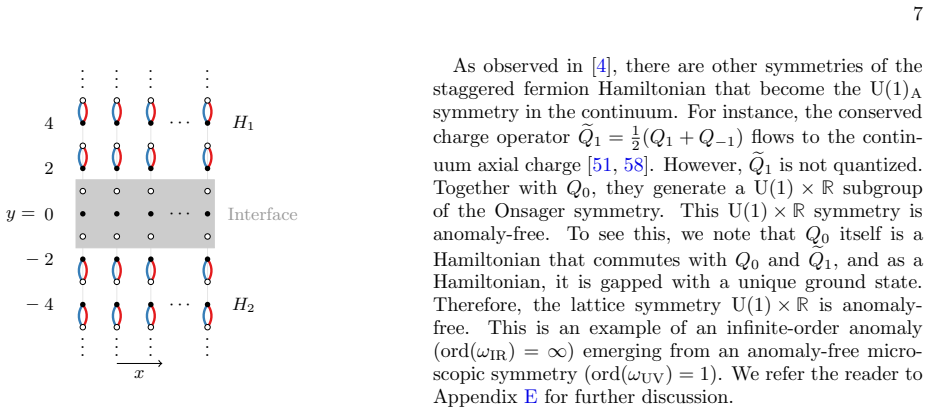

read the original abstract
A key property of a global symmetry's anomaly is its order: the smallest integer $n$ for which the diagonal symmetry of the $n$-copy system is anomaly-free. While many familiar lattice anomalies have finite order, perturbative anomalies in the continuum$-$those captured by Feynman diagrams$-$have infinite order. In this paper, we show that the Onsager symmetry, a lattice realization of the chiral symmetry of a 1+1d massless Dirac fermion, has an order-two anomaly. However, imposing lattice CPT symmetry enhances this anomaly from order two to infinite order, yielding a lattice chiral symmetry structure that more faithfully matches the continuum chiral anomaly. We also discuss the corresponding 2+1d symmetry-protected topological phases for these infinite-order lattice anomalies.
Editorial analysis
A structured set of objections, weighed in public.
Referee Report
Summary. The manuscript claims that the Onsager symmetry (a lattice realization of 1+1d chiral symmetry) has a finite-order anomaly of exactly two, but that imposing an additional lattice CPT symmetry raises the anomaly order of the diagonal n-copy symmetry to infinity for every finite n. This is asserted to produce a lattice chiral structure that more closely reproduces the infinite-order character of continuum perturbative anomalies. The paper also discusses the associated 2+1d symmetry-protected topological phases protected by these infinite-order anomalies.
Significance. If the central claim is established by explicit operator constructions and anomaly cancellation criteria, the result would supply a concrete lattice example in which a discrete symmetry enhancement converts a finite-order anomaly into an infinite-order one. This addresses a known mismatch between most lattice anomalies and continuum perturbative ones, and the associated SPT discussion could be useful for classifying lattice topological phases. No machine-checked proofs or parameter-free derivations are presented.
major comments (2)
- [Section defining the n-copy diagonal symmetry and CPT action] The load-bearing step is the assertion that lattice CPT, when adjoined to the Onsager symmetry, renders the diagonal symmetry anomalous for every finite n. The manuscript must supply the explicit action of the CPT operator on the n-copy Hilbert space together with the commutation relations that prevent cancellation of the anomaly phase (or index) at all finite n; without this calculation the enhancement from order two to infinite order remains an assumption rather than a derived result.
- [Definition of anomaly order and cancellation criterion] The anomaly-order definition itself (smallest n for which the diagonal symmetry is anomaly-free) must be applied uniformly to both the pure Onsager case and the CPT-enhanced case. Any difference in the precise cancellation criterion (e.g., vanishing of a lattice index versus a partition-function phase) between the two settings would undermine the direct comparison that the infinite-order claim requires.
minor comments (1)
- Notation for the Onsager and CPT operators should be introduced with explicit matrix or operator expressions in the single-copy and n-copy spaces before the anomaly calculation begins.
Simulated Author's Rebuttal
We thank the referee for their careful reading of the manuscript and for identifying the points that require clarification. We address each major comment below. Where the referee correctly notes that additional explicit detail would strengthen the presentation, we agree to revise accordingly.
read point-by-point responses
-
Referee: [Section defining the n-copy diagonal symmetry and CPT action] The load-bearing step is the assertion that lattice CPT, when adjoined to the Onsager symmetry, renders the diagonal symmetry anomalous for every finite n. The manuscript must supply the explicit action of the CPT operator on the n-copy Hilbert space together with the commutation relations that prevent cancellation of the anomaly phase (or index) at all finite n; without this calculation the enhancement from order two to infinite order remains an assumption rather than a derived result.
Authors: We agree that the explicit action of the CPT operator on the n-copy Hilbert space and the associated commutation relations with the diagonal Onsager generators should be written out in full. In the revised manuscript we will add a dedicated paragraph (or short subsection) that (i) defines the single-copy CPT operator via its action on the fermion fields and lattice sites, (ii) extends it to the n-copy space by tensor product, and (iii) computes the resulting commutation relations with the diagonal symmetry generators, showing that the extra phase arising from the CPT–Onsager anticommutator survives for every finite n and prevents cancellation of the anomaly cocycle. revision: yes
-
Referee: [Definition of anomaly order and cancellation criterion] The anomaly-order definition itself (smallest n for which the diagonal symmetry is anomaly-free) must be applied uniformly to both the pure Onsager case and the CPT-enhanced case. Any difference in the precise cancellation criterion (e.g., vanishing of a lattice index versus a partition-function phase) between the two settings would undermine the direct comparison that the infinite-order claim requires.
Authors: The anomaly order is defined uniformly throughout the paper as the smallest integer n such that the diagonal n-copy symmetry is anomaly-free, with anomaly-freeness diagnosed by the vanishing of the same lattice index (or equivalently the triviality of the projective phase in the partition function). Both the pure Onsager case (order two) and the CPT-enhanced case (infinite order) are evaluated with this identical criterion; no change of diagnostic is introduced when CPT is adjoined. revision: no
Circularity Check
No circularity; derivation uses explicit symmetry definitions and anomaly-order counting
full rationale
The paper constructs the Onsager symmetry explicitly as a lattice realization of chiral symmetry, computes its anomaly order as two via the n-copy diagonal symmetry, and shows that adding lattice CPT raises the order to infinity through the same anomaly cancellation criterion. These steps rely on direct definitions of operators, commutation relations, and index/phase computations rather than any self-definition, fitted parameters renamed as predictions, or load-bearing self-citations. The provided abstract and context contain no equations or claims that reduce by construction to their own inputs. This is the normal case of a self-contained theoretical derivation.
Axiom & Free-Parameter Ledger
axioms (1)
- standard math Anomaly order is defined as the smallest integer n such that the diagonal symmetry of the n-copy system is anomaly-free.
Reference graph
Works this paper leans on
-
[1]
The lattice anomaly being order two, i.e., ord(ω UV) = 2, is entirely compatible with the IR chiral anomaly being infinite-order, i.e., ord(ωIR) =∞
It is straightfor- ward to check that the following Hamiltonian commutes with these charges and has a unique gapped ground state: H= ig 2 LX j=1 (a↑ j a↓ j +b ↑ j b↓ j).(15) Thus, the diagonal part of two copies of the Onsager symmetry is anomaly-free, which shows that the Onsager symmetry’s anomaly is of order two. The lattice anomaly being order two, i....
-
[2]
Indeed, as we show in Appendix C 2, the original system remains gapless upon adding these ancillas. A more nontrivial example of an anomaly-free Onsager symmetry in a system with a single complex fermion at each lattice site is one whose Onsager algebra is generated byQ 0 andQ 2.7 This is anomaly-free since it commutes with the Hamiltonian H=− i 2 L/2X ℓ=...
-
[3]
aj bj # Π−1 =
It is straightforward to show that every local Hamiltonian commuting with these charges is gapless. Indeed, as in Appendix C 1, any symmetric Hamiltonian must also commute with a Majorana sepa- rating operatore − iπ 2 Q1 ei π 2 Q0 which acts as e− iπ 2 Q1 ei π 2 Q0 a↑ j b↑ j a↓ j b↓ j e−i π 2 Q0 e iπ 2 Q1 = a↑ j−1 b↑ j+1 a↓ j−2 b↓ ...
-
[4]
aj bj # e−i π 2 Q0 e iπ 2 Q1 =
Review of the Onsager symmetry anomaly For completeness, we first review the proof in [4, App B] that Eq. (14) is the most general local Hamiltonian commuting with Q0 = i 2 LX j=1 ajbj, Q 1 = i 2 LX j=1 ajbj+1.(C1) First, we define a Majorana separating operator asM= e− iπ 2 Q1 ei π 2 Q0 which, from Eq. (10), acts on the fermions as e− iπ 2 Q1 ei π 2 Q0 "...
-
[5]
We consider ancillas comprised of two complex fermions per site with an anomaly-free Onsager symmetry generated byQ ↑ 0 +Q ↓ 0 andQ ↑ 1 +Q ↓
Onsager symmetric ancillas In this section, we show that the anomaly of the On- sager symmetry generated byQ 0 andQ 1 is robust to adding ancillas. We consider ancillas comprised of two complex fermions per site with an anomaly-free Onsager symmetry generated byQ ↑ 0 +Q ↓ 0 andQ ↑ 1 +Q ↓
-
[6]
aI j bI j # M −1 =
This ro- bustness is equivalent to the following: in a system ofN f complex fermions per site, the Onsager symmetry gener- ated by Q0 = NfX I=1 QI 0, Q 1 = NfX I=1 QI 1 ,(C5) is anomalous whenN f is odd. Since theQ I n andQ I ′ n commute forI̸=I ′, the operator Eq. (C2) acts on the fermions as M " aI j bI j # M −1 = " aI j−1 bI j+1 # .(C6) An argument ent...
-
[7]
The infinite-order anomaly ofOnsager⋊Z CPT 2 Here, we consider the same setup as the previous section, but now impose an additional CPT symmetry that acts as Eq. (22). As shown in the previous sec- tion, the most general Onsager symmetric Hamiltonian is Eq. (C8). Imposing CPT enforces thatg IJ n =g JI n which meansg IJ n =−g IJ −n. Thus, H= NfX I,J=1 LX k...
-
[8]
aI j bI j # Π−1 =s I
is anomaly-free due to the existence of the Hamiltonian Eq. (15) which has a unique gapped ground state. We further showed that the anomaly of the Onsager symmetry generated by (Q0, Q1) persists under stacking with these anomaly-free ancilla. Here, we will extend this discussion to include ancillas with CPT symmetry. In particular, we will con- sider the ...
-
[9]
(C10) stacked withN copy ≥1 copies of the anomalous Onsager⋊Z CPT 2 symmetry is anomalous sinceN + = Nf 2 +N copy ̸= Nf 2
and Eq. (C10) stacked withN copy ≥1 copies of the anomalous Onsager⋊Z CPT 2 symmetry is anomalous sinceN + = Nf 2 +N copy ̸= Nf 2 . Appendix D: Some fermionic crystalline SPTs In the main text, we discussed 2 + 1d fermionic SPTs for the Onsager symmetry. Here, we review fermionic invertible phases in 1+1d and SPTs for Majorana trans- lations in 2+1d
-
[10]
There are two invertible fermionic phases of this system
Review of1 + 1d fermionic invertible phases Consider a 1 + 1d lattice system ofLsites where a single Majorana fermionχ j resides at each sitej,Lis even, and there are periodic boundary conditions. There are two invertible fermionic phases of this system. The Hamiltonians H1 =i L/2X ℓ=1 χ2ℓχ2ℓ+1, H 2 =i L/2X ℓ=1 χ2ℓ−1χ2ℓ ,(D1) are exactly solvable gapped H...
-
[11]
See, for example, [1, 74, 75] for modern discussions in the context of anoma- lies
Spectral flows in CFT We begin with a brief review of spectral flows in CFTs with a U(1) global symmetry [73]. See, for example, [1, 74, 75] for modern discussions in the context of anoma- lies. The spin-1 currents for the U(1) global symmetry have a holomorphic componentJ(z) and an antiholomor- phic component J(z). Their OPEs are J(z)J(0)∼ k z2 , J(z)J(0...
-
[12]
To avoid complications from the zero modes, in this ap- pendix alone, we work with antiperiodic boundary con- ditions
Spectral flows on the lattice We now turn to the staggered fermion Hamiltonian. To avoid complications from the zero modes, in this ap- pendix alone, we work with antiperiodic boundary con- ditions. This simply means we take the opposite sign for the coupling betweenc L andc L+1 so that the Hamilto- nian and eQ1 charge are H=−i L−1X j=1 c† jcj+1 +ic † Lc1...
-
[13]
(E6a) upon identifyingQ A as the continuum limit of eQ1
These match perfectly with the spectral flow formula in the CFT Eq. (E6a) upon identifyingQ A as the continuum limit of eQ1. Next, consider the unquantized axial charge in the presence of the U(1) V defect. Normal ordering Eq. (E10b) we find eQ1,θ = L 2 − 1 2X k= 1 2 " cos 2πk−θ L γ† kγk −cos 2πk+θ L γ−kγ† −k # (E15) −sin θ L csc π L . In the largeLlimit,...
-
[14]
Lieb-Schultz-Mattis, Lut- tinger, and ’t Hooft - anomaly matching in lat- tice systems,
M. Cheng and N. Seiberg, “Lieb-Schultz-Mattis, Lut- tinger, and ’t Hooft - anomaly matching in lat- tice systems,”SciPost Phys.15no. 2, (2023) 051, arXiv:2211.12543 [cond-mat.str-el]
arXiv 2023
-
[15]
Lieb-Schultz-Mattis anomalies as ob- structions to gauging (non-on-site) symmetries,
S. Seifnashri, “Lieb-Schultz-Mattis anomalies as ob- structions to gauging (non-on-site) symmetries,”Sci- Post Phys.16no. 4, (2024) 098,arXiv:2308.05151 [cond-mat.str-el]
arXiv 2024
-
[16]
A. Kapustin and N. Sopenko, “Anomalous Symmetries of Quantum Spin Chains and a Generalization of the Lieb– Schultz–Mattis Theorem,”Commun. Math. Phys.406 no. 10, (2025) 238,arXiv:2401.02533 [math-ph]
arXiv 2025
-
[17]
Quan- tized Axial Charge of Staggered Fermions and the Chiral 16 Anomaly,
A. Chatterjee, S. D. Pace, and S.-H. Shao, “Quan- tized Axial Charge of Staggered Fermions and the Chiral 16 Anomaly,”Phys. Rev. Lett.134no. 2, (2025) 021601, arXiv:2409.12220 [hep-th]
arXiv 2025
-
[18]
Lattice T- duality from non-invertible symmetries in quantum spin chains,
S. D. Pace, A. Chatterjee, and S.-H. Shao, “Lattice T- duality from non-invertible symmetries in quantum spin chains,”SciPost Phys.18(2025) 121,arXiv:2412.18606 [cond-mat.str-el]
arXiv 2025
-
[19]
Disentangling Anomaly- Free Symmetries of Quantum Spin Chains,
S. Seifnashri and W. Shirley, “Disentangling Anomaly- Free Symmetries of Quantum Spin Chains,”Phys. Rev. Lett.136no. 21, (2026) 216603,arXiv:2503.09717 [cond-mat.str-el]
arXiv 2026
-
[20]
Classification of Locality Preserving Symme- tries on Spin Chains,
A. Bols, W. De Roeck, M. De Wilde, and B. d. O. Carvalho, “Classification of Locality Preserving Symme- tries on Spin Chains,”Commun. Math. Phys.407no. 1, (2026) 10,arXiv:2503.15088 [quant-ph]
arXiv 2026
-
[21]
Parity Anomaly from a Lieb-Schultz-Mattis Theorem: Exact Valley Symmetries on the Lattice,
S. D. Pace, M. L. Kim, A. Chatterjee, and S.-H. Shao, “Parity Anomaly from a Lieb-Schultz-Mattis Theorem: Exact Valley Symmetries on the Lattice,”Phys. Rev. Lett.135no. 23, (2025) 236501,arXiv:2505.04684 [cond-mat.str-el]
arXiv 2025
-
[22]
Higher symmetries and anoma- lies in quantum lattice systems,
A. Kapustin and S. Xu, “Higher symmetries and anoma- lies in quantum lattice systems,”arXiv:2505.04719 [math-ph]
-
[23]
Anomaly diagnosis via symmetry restriction in two-dimensional lattice sys- tems,
K. Kawagoe and W. Shirley, “Anomaly diagnosis via symmetry restriction in two-dimensional lattice sys- tems,”arXiv:2507.07430 [cond-mat.str-el]
-
[24]
Higher symmetries, anomalies, and crossed squares in lattice gauge theory,
A. Kapustin and L. Spodyneiko, “Higher symmetries, anomalies, and crossed squares in lattice gauge theory,” arXiv:2507.16966 [hep-th]
-
[25]
Anoma- lies of Global Symmetries on the Lattice,
Y.-T. Tu, D. M. Long, and D. V. Else, “Anoma- lies of Global Symmetries on the Lattice,”Phys. Rev. X16no. 1, (2026) 011027,arXiv:2507.21209 [cond-mat.str-el]
arXiv 2026
-
[26]
Anomaly- Free Symmetries with Obstructions to Gauging and On- siteability,
W. Shirley, C. Zhang, W. Ji, and M. Levin, “Anomaly- Free Symmetries with Obstructions to Gauging and On- siteability,”Phys. Rev. Lett.136no. 21, (2026) 216602, arXiv:2507.21267 [cond-mat.str-el]
arXiv 2026
-
[27]
N. Seiberg, S.-H. Shao, and W. Zhang, “LSM and CPT,” JHEP11(2025) 116,arXiv:2508.17115 [hep-th]
arXiv 2025
-
[28]
Higher- Form Anomalies on Lattices,
Y. Feng, R. Kobayashi, Y.-A. Chen, and S. Ryu, “Higher- Form Anomalies on Lattices,”Phys. Rev. Lett.136no. 4, (2026) 046504,arXiv:2509.12304 [cond-mat.str-el]
arXiv 2026
-
[29]
R. Liu, J. Yi, and L. Zou, “Twisted locality-preserving automorphisms, anomaly index, and generalized Lieb- Schultz-Mattis theorems with anti-unitary symmetries,” arXiv:2510.06555 [cond-mat.str-el]
-
[30]
Onsiteability of Higher-Form Symmetries,
Y. Feng, Y.-A. Chen, P.-S. Hsin, and R. Kobayashi, “Onsiteability of Higher-Form Symmetries,” arXiv:2510.23701 [cond-mat.str-el]
-
[31]
A. M. Czajka, R. Geiko, and R. Thorngren, “Anoma- lies on the Lattice, Homotopy of Quantum Cellu- lar Automata, and a Spectrum of Invertible States,” arXiv:2512.02105 [cond-mat.str-el]
-
[32]
Tori, Klein bottles, and mod- ulo 8 parity/time-reversal anomalies of 2+1d staggered fermions,
N. Seiberg and W. Zhang, “Tori, Klein bottles, and mod- ulo 8 parity/time-reversal anomalies of 2+1d staggered fermions,”JHEP05(2026) 264,arXiv:2601.01191 [hep-th]
Pith/arXiv arXiv 2026
-
[33]
Lieb-Schultz-Mattis con- straints from stratified anomalies of modulated symme- tries,
S. D. Pace and D. Bulmash, “Lieb-Schultz-Mattis con- straints from stratified anomalies of modulated symme- tries,”arXiv:2602.11266 [cond-mat.str-el]
-
[34]
Anomalies in quantum spin systems and Nielsen-Ninomiya type Theorems,
R. Liu, “Anomalies in quantum spin systems and Nielsen-Ninomiya type Theorems,”arXiv:2602.13948 [math-ph]
-
[35]
Lieb-Schultz-Mattis Anoma- lies and Anomaly Matching,
L. Zou and M. Cheng, “Lieb-Schultz-Mattis Anoma- lies and Anomaly Matching,”arXiv:2604.00347 [cond-mat.str-el]
-
[36]
In- trinsically gapless topological phases,
R. Thorngren, A. Vishwanath, and R. Verresen, “In- trinsically gapless topological phases,”Phys. Rev. B104no. 7, (2021) 075132,arXiv:2008.06638 [cond-mat.str-el]
arXiv 2021
-
[37]
Intrinsic and emer- gent anomalies at deconfined critical points,
M. A. Metlitski and R. Thorngren, “Intrinsic and emer- gent anomalies at deconfined critical points,”Phys. Rev. B98no. 8, (2018) 085140,arXiv:1707.07686 [cond-mat.str-el]
Pith/arXiv arXiv 2018
-
[38]
Majorana chain and Ising model – (non-invertible) translations, anomalies, and emanant symmetries,
N. Seiberg and S.-H. Shao, “Majorana chain and Ising model – (non-invertible) translations, anomalies, and emanant symmetries,”SciPost Phys.16(2024) 064, arXiv:2307.02534 [cond-mat.str-el]
arXiv 2024
-
[39]
Abelian gauge the- ories on the lattice:θ-Terms and compact gauge theory with(out) monopoles,
T. Sulejmanpasic and C. Gattringer, “Abelian gauge the- ories on the lattice:θ-Terms and compact gauge theory with(out) monopoles,”Nucl. Phys. B943(2019) 114616, arXiv:1901.02637 [hep-lat]
Pith/arXiv arXiv 2019
-
[40]
A modified Villain formulation of fractons and other exotic theories,
P. Gorantla, H. T. Lam, N. Seiberg, and S.-H. Shao, “A modified Villain formulation of fractons and other exotic theories,”J. Math. Phys.62no. 10, (2021) 102301, arXiv:2103.01257 [cond-mat.str-el]
arXiv 2021
-
[41]
Exact lattice chiral symmetry in 2D gauge theory,
E. Berkowitz, A. Cherman, and T. Jacobson, “Exact lattice chiral symmetry in 2D gauge theory,”Phys. Rev. D110no. 1, (2024) 014510,arXiv:2310.17539 [hep-lat]
arXiv 2024
-
[42]
L. Fazza and T. Sulejmanpasic, “Lattice quantum Vil- lain Hamiltonians: compact scalars, U(1) gauge theo- ries, fracton models and quantum Ising model dualities,” JHEP05(2023) 017,arXiv:2211.13047 [hep-th]
arXiv 2023
-
[43]
Non- invertible bosonic chiral symmetry on the lattice,
L. Fidkowski, C. Xu, and C. Zhang, “Non- invertible bosonic chiral symmetry on the lattice,” arXiv:2510.17969 [cond-mat.str-el]
-
[44]
Chiral Lattice Gauge Theories from Symmetry Disentanglers,
R. Thorngren, J. Preskill, and L. Fidkowski, “Chiral Lattice Gauge Theories from Symmetry Disentanglers,” arXiv:2601.04304 [hep-th]
-
[45]
Exactly Solvable 1+1d Chiral Lattice Gauge Theories,
S. Seifnashri, “Exactly Solvable 1+1d Chiral Lattice Gauge Theories,”arXiv:2601.14359 [hep-th]
-
[46]
Lattice chiral symmetry from bosons in 3+1d,
Z. Lu, S. Seifnashri, and S.-H. Shao, “Lattice chiral symmetry from bosons in 3+1d,”arXiv:2604.06307 [hep-th]
-
[47]
L. Fidkowski and C. Xu, “A No-Go Result for Imple- menting Chiral Symmetries by Locality-Preserving Uni- taries in a Three-Dimensional Hamiltonian Lattice Model of Fermions,”Phys. Rev. Lett.131no. 19, (2023) 196601, arXiv:2306.10105 [cond-mat.str-el]
arXiv 2023
-
[48]
Absence of Neutri- nos on a Lattice. 1. Proof by Homotopy Theory,
H. B. Nielsen and M. Ninomiya, “Absence of Neutri- nos on a Lattice. 1. Proof by Homotopy Theory,”Nucl. Phys. B185(1981) 20. [Erratum: Nucl.Phys.B 195, 541 (1982)]
1981
-
[49]
Absence of Neutrinos on a Lattice. 2. Intuitive Topological Proof,
H. B. Nielsen and M. Ninomiya, “Absence of Neutrinos on a Lattice. 2. Intuitive Topological Proof,”Nucl. Phys. B193(1981) 173–194
1981
-
[50]
No Go Theorem for Regularizing Chiral Fermions,
H. B. Nielsen and M. Ninomiya, “No Go Theorem for Regularizing Chiral Fermions,”Phys. Lett. B105(1981) 219–223
1981
-
[51]
A Proof of the Nielsen-Ninomiya Theorem,
D. Friedan, “A Proof of the Nielsen-Ninomiya Theorem,” Commun. Math. Phys.85(1982) 481–490
1982
-
[52]
E. Witten, “The ”Parity” Anomaly On An Unorientable Manifold,”Phys. Rev. B94no. 19, (2016) 195150, arXiv:1605.02391 [hep-th]
Pith/arXiv arXiv 2016
-
[53]
Crystal Statistics. I. A Two-Dimensional Model with an Order-Disorder Transition,
L. Onsager, “Crystal Statistics. I. A Two-Dimensional Model with an Order-Disorder Transition,”Phys. Rev. 65(Feb, 1944) 117–149
1944
-
[54]
On- 17 sager symmetries inU(1)-invariant clock models,
E. Vernier, E. O’Brien, and P. Fendley, “On- 17 sager symmetries inU(1)-invariant clock models,”J. Stat. Mech.1904(2019) 043107,arXiv:1812.09091 [cond-mat.stat-mech]
Pith/arXiv arXiv 1904
-
[55]
Staggered Fermions with Chiral Anomaly Cancellation,
L.-X. Xu, “Staggered Fermions with Chiral Anomaly Cancellation,”arXiv:2501.10837 [hep-lat]
-
[56]
Quantized axial charge in the Hamilto- nian approach to Wilson fermions,
T. Yamaoka, “Quantized axial charge in the Hamilto- nian approach to Wilson fermions,”JHEP10(2025) 102, arXiv:2504.10263 [hep-lat]
arXiv 2025
-
[57]
Symmetry Spans and Enforced Gaplessness,
T. Ando and K. Ohmori, “Symmetry Spans and Enforced Gaplessness,”arXiv:2602.11696 [cond-mat.str-el]
-
[58]
Interacting invariants for Floquet phases of fermions in two dimensions,
L. Fidkowski, H. C. Po, A. C. Potter, and A. Vishwanath, “Interacting invariants for Floquet phases of fermions in two dimensions,”Phys. Rev. B99no. 8, (2019) 085115, arXiv:1703.07360 [cond-mat.str-el]
Pith/arXiv arXiv 2019
-
[59]
Index Theory of One Dimensional Quantum Walks and Cellular Automata,
D. Gross, V. Nesme, H. Vogts, and R. F. Werner, “Index Theory of One Dimensional Quantum Walks and Cellular Automata,”Commun. Math. Phys.310no. 2, (2012) 419–454,arXiv:0910.3675 [quant-ph]
Pith/arXiv arXiv 2012
-
[60]
Anyons in an exactly solved model and beyond,
A. Kitaev, “Anyons in an exactly solved model and beyond,”Annals Phys.321no. 1, (2006) 2–111, arXiv:cond-mat/0506438
Pith/arXiv arXiv 2006
-
[61]
Quantum circuit complexity of one-dimensional topological phases,
Y. Huang and X. Chen, “Quantum circuit complexity of one-dimensional topological phases,”Phys. Rev. B91 no. 19, (2015) 195143,arXiv:1401.3820 [quant-ph]
Pith/arXiv arXiv 2015
-
[62]
The finite group veloc- ity of quantum spin systems,
E. H. Lieb and D. W. Robinson, “The finite group veloc- ity of quantum spin systems,”Commun. Math. Phys.28 (1972) 251–257
1972
-
[63]
Lieb- Robinson Bounds and the Generation of Correlations and Topological Quantum Order,
S. Bravyi, M. B. Hastings, and F. Verstraete, “Lieb- Robinson Bounds and the Generation of Correlations and Topological Quantum Order,”Phys. Rev. Lett.97(2006) 050401,arXiv:quant-ph/0603121
Pith/arXiv arXiv 2006
-
[64]
Strong Cou- pling Calculations of Lattice Gauge Theories: (1+1)- Dimensional Exercises,
T. Banks, L. Susskind, and J. B. Kogut, “Strong Cou- pling Calculations of Lattice Gauge Theories: (1+1)- Dimensional Exercises,”Phys. Rev. D13(1976) 1043
1976
-
[65]
Field theory commutators,
J. S. Schwinger, “Field theory commutators,”Phys. Rev. Lett.3(1959) 296–297
1959
-
[66]
gamma(5) invariance,
K. Johnson, “gamma(5) invariance,”Phys. Lett.5(1963) 253–255
1963
-
[67]
Non- invertible Symmetry-Protected Topological Order in a Group-Based Cluster State,
C. Fechisin, N. Tantivasadakarn, and V. V. Albert, “Non- invertible Symmetry-Protected Topological Order in a Group-Based Cluster State,”Phys. Rev. X15no. 1, (2025) 011058,arXiv:2312.09272 [cond-mat.str-el]
arXiv 2025
-
[68]
Cluster State as a Nonin- vertible Symmetry-Protected Topological Phase,
S. Seifnashri and S.-H. Shao, “Cluster State as a Nonin- vertible Symmetry-Protected Topological Phase,”Phys. Rev. Lett.133no. 11, (2024) 116601,arXiv:2404.01369 [cond-mat.str-el]
arXiv 2024
-
[69]
1+1d SPT phases with fusion category symmetry: interface modes and non-abelian Thouless pump,
K. Inamura and S. Ohyama, “1+1d SPT phases with fusion category symmetry: interface modes and non-abelian Thouless pump,”arXiv:2408.15960 [cond-mat.str-el]
-
[70]
Non- Invertible Interfaces Between Symmetry-Enriched Crit- ical Phases,
S. Prembabu, S.-H. Shao, and R. Verresen, “Non- Invertible Interfaces Between Symmetry-Enriched Crit- ical Phases,”arXiv:2512.23706 [cond-mat.str-el]
-
[71]
Lattice Fermions,
L. Susskind, “Lattice Fermions,”Phys. Rev. D16(1977) 3031–3039
1977
-
[72]
2-d Fermionic SPT with CRT symmetry,
Y. Ogata, “2-d Fermionic SPT with CRT symmetry,”J. Math. Phys.64no. 9, (2023) 091901,arXiv:2212.09038 [math-ph]
arXiv 2023
-
[73]
Reflection positivity and a refined index for 2d invertible phases,
N. Sopenko, “Reflection positivity and a refined index for 2d invertible phases,”arXiv:2509.01711 [math-ph]
-
[74]
Symmetries and anomalies of Hamiltonian staggered fermions,
S. Catterall, A. Pradhan, and A. Samlodia, “Symmetries and anomalies of Hamiltonian staggered fermions,”Phys. Rev. D113no. 1, (2026) 014504,arXiv:2501.10862 [hep-lat]
arXiv 2026
-
[75]
Exact Chiral Symme- tries of 3+1D Hamiltonian Lattice Fermions,
L. Gioia and R. Thorngren, “Exact Chiral Symme- tries of 3+1D Hamiltonian Lattice Fermions,”Phys. Rev. Lett.136no. 6, (2026) 061601,arXiv:2503.07708 [cond-mat.str-el]
Pith/arXiv arXiv 2026
-
[76]
Chiral anomaly of Kogut-Susskind fermions in the (3+1)- dimensional Hamiltonian formalism,
S. Aoki, Y. Kikukawa, and T. Takemoto, “Chiral anomaly of Kogut-Susskind fermions in the (3+1)- dimensional Hamiltonian formalism,”Phys. Rev. D113 no. 3, (2026) 034514,arXiv:2511.06198 [hep-lat]
arXiv 2026
-
[77]
Symmetry- Enforced Fermi Surfaces,
M. L. Kim, S. D. Pace, and S.-H. Shao, “Symmetry- Enforced Fermi Surfaces,”Phys. Rev. Lett.136no. 17, (2026) 176502,arXiv:2512.04150 [cond-mat.str-el]
Pith/arXiv arXiv 2026
-
[78]
Conserved Non-Singlet Charges for Staggered Fermion Hamiltonian in 3+1 Di- mensions,
T. Onogi and T. Yamaoka, “Conserved Non-Singlet Charges for Staggered Fermion Hamiltonian in 3+1 Di- mensions,” in42nd International Symposium on Lattice Field Theory. 3, 2026.arXiv:2603.26084 [hep-lat]
arXiv 2026
-
[79]
Symmetry transmuta- tion and anomaly matching,
N. Seiberg and S. Seifnashri, “Symmetry transmuta- tion and anomaly matching,”JHEP09(2025) 014, arXiv:2505.08618 [hep-th]
arXiv 2025
-
[80]
Unpaired Majorana fermions in quan- tum wires,
A. Kitaev, “Unpaired Majorana fermions in quan- tum wires,”Phys. Usp.44no. 10S, (2001) 131–136, arXiv:cond-mat/0010440
Pith/arXiv arXiv 2001
discussion (0)
Sign in with ORCID, Apple, or X to comment. Anyone can read and Pith papers without signing in.