Reservoir-controlled electromagnetically induced gratings in a weakly driven two-level medium
Pith reviewed 2026-06-27 06:09 UTC · model grok-4.3
The pith
Reservoir statistics alter the amplitude and phase of induced gratings to reshape diffraction in a weakly driven two-level medium.
A machine-rendered reading of the paper's core claim, the machinery that carries it, and where it could break.
Core claim
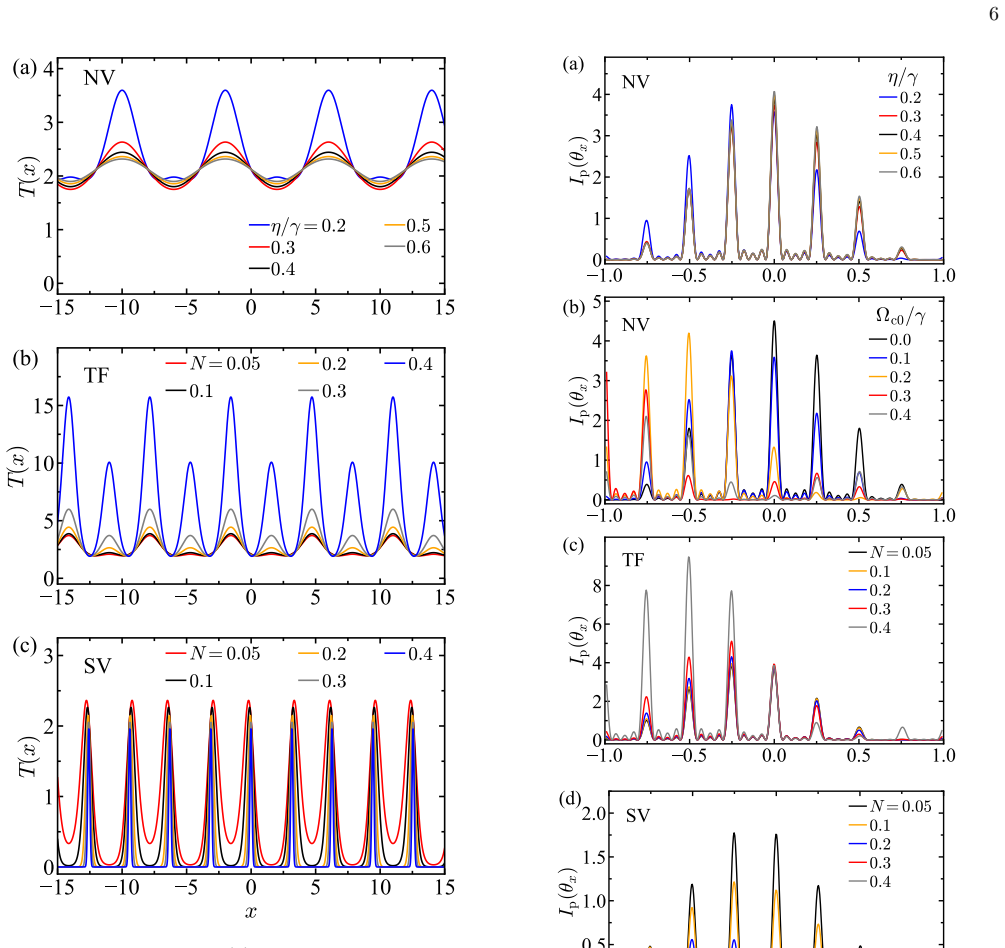
In a weakly driven two-level medium coupled to engineered reservoirs, the probe susceptibility is modified by reservoir statistics, which in turn alters the amplitude and phase profile of the induced grating. Thermal reservoirs enhance transmission modulation and increase the intensity of dominant diffraction orders. Broadband squeezed-vacuum reservoirs generate phase-sensitive modifications that selectively redistribute power among diffraction channels, with the detuning between reservoir and driving field providing directional control. In two-dimensional geometries the squeezed-vacuum correlations produce structured phase landscapes and strongly anisotropic patterns that amplify selected c
What carries the argument
The perturbative solution of the optical Bloch equations for the spatially modulated probe susceptibility under normal-vacuum, thermal, and broadband squeezed-vacuum reservoir couplings, which determines the transmission function and far-field diffraction.
If this is right
- Thermal reservoirs increase the intensity of the dominant diffraction orders.
- Squeezed-vacuum reservoirs produce phase-sensitive modifications that redistribute optical power among channels.
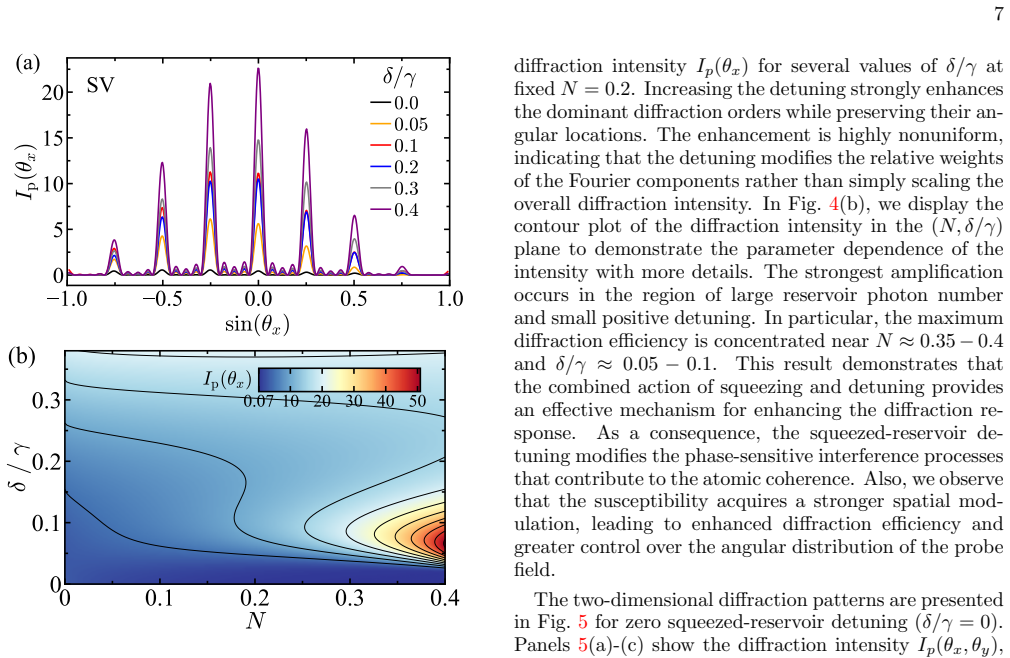
- Detuning between the squeezed reservoir and the driving field controls diffraction directionality and amplifies selected angular orders.
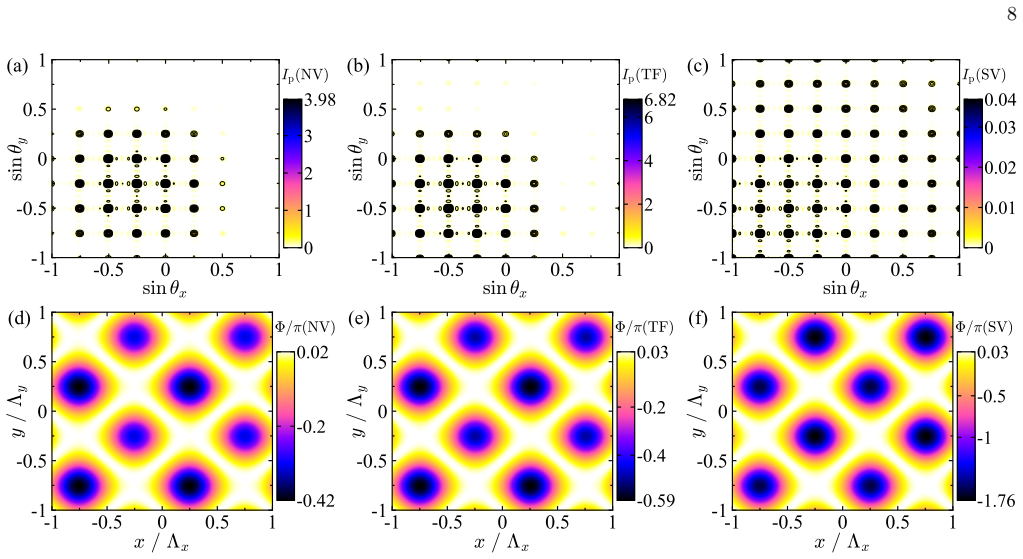
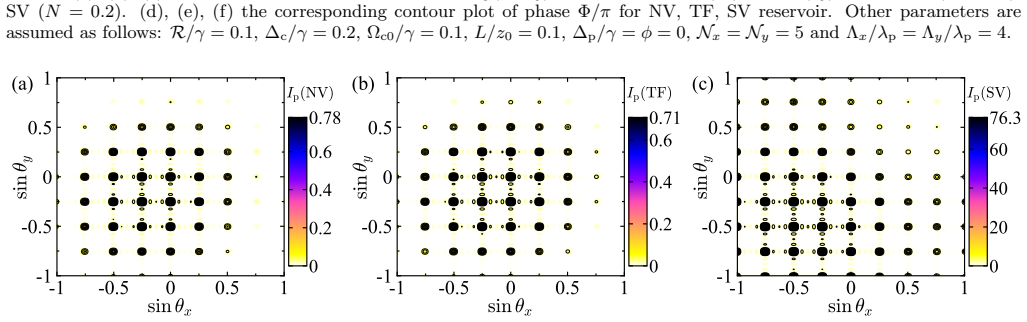
- In two-dimensional geometries, squeezed-vacuum correlations yield anisotropic diffraction patterns that enhance some channels while suppressing others.
Where Pith is reading between the lines
- The same reservoir-controlled susceptibility could be tested in single-atom or quantum-dot realizations to check whether the predicted redistribution persists at the few-photon level.
- Varying the squeezing bandwidth or temperature in experiment would map the boundary between amplitude-dominated and phase-dominated diffraction regimes.
- The directional control via detuning suggests a route to reservoir-tuned beam steering that could be combined with existing slow-light techniques in the same medium.
Load-bearing premise
The perturbative solution of the optical Bloch equations remains valid and sufficient to capture the full spatial transmission function and far-field diffraction when the driving field is weak.
What would settle it
Measuring the far-field diffraction intensities for a squeezed-vacuum reservoir at a fixed detuning and finding no selective redistribution of power into higher orders compared with the thermal-reservoir case would falsify the claim.
Figures

read the original abstract
We theoretically investigate the transmission and diffraction of a weak probe field from an electromagnetically induced grating formed in a weakly driven two-level medium coupled to engineered quantum reservoirs. Using a perturbative solution of the optical Bloch equations in the weak-driving regime, we analyze how normal-vacuum, thermal, and broadband squeezed-vacuum environments modify the probe susceptibility and consequently reshape both the spatial transmission function and the far-field diffraction patterns. We show that reservoir statistics have a pronounced impact on the diffraction response by altering the amplitude and phase of the induced grating. Thermal reservoirs enhance the transmission modulation and increase the intensity of the dominant diffraction orders, whereas squeezed-vacuum reservoirs generate strongly phase-sensitive modifications that selectively redistribute optical power among diffraction channels. We further demonstrate that the detuning between the squeezed reservoir and the driving field provides an efficient mechanism for controlling diffraction directionality, leading to substantial amplification of selected angular orders. In two-dimensional geometries, squeezed-vacuum correlations produce highly structured phase landscapes and strongly anisotropic diffraction patterns, enabling directional enhancement of specific diffraction channels while suppressing others. These results establish reservoir engineering as a versatile approach for controlling transmission, diffraction efficiency, and angular selectivity in minimal two-level systems, with potential applications in programmable photonic devices, beam steering, and quantum optical platforms.
Editorial analysis
A structured set of objections, weighed in public.
Referee Report
Summary. The paper claims that a perturbative solution of the optical Bloch equations for a weakly driven two-level atom coupled to normal-vacuum, thermal, or broadband squeezed-vacuum reservoirs shows that reservoir statistics strongly modify the amplitude and phase of an electromagnetically induced grating. This in turn controls the spatial transmission function and far-field diffraction, with thermal reservoirs enhancing modulation and squeezed-vacuum reservoirs producing phase-sensitive power redistribution among orders; detuning in the squeezed case further enables directional control, and 2D geometries yield anisotropic patterns.
Significance. If the perturbative treatment remains valid across the parameter ranges examined, the work demonstrates that reservoir engineering can be used to control diffraction efficiency and angular selectivity in a minimal two-level system without additional atomic levels or strong driving fields. This would be of interest for programmable photonic elements and beam-steering applications.
major comments (2)
- [perturbative solution of the optical Bloch equations (weak-driving regime)] The central claim that the first-order perturbative solution fully determines the spatially modulated susceptibility and far-field diffraction for the squeezed-vacuum reservoir rests on an unverified assumption. The manuscript provides no error estimates, comparison to non-perturbative integration of the master equation, or checks against limiting cases when the squeezing parameter r and detuning are varied; phase-dependent two-photon correlations introduced by the broadband squeezed vacuum may generate additional coherences outside the linear-in-probe regime.
- [two-dimensional geometries] In the two-dimensional geometry analysis, the reported highly structured phase landscapes and anisotropic diffraction patterns are obtained from the same first-order susceptibility; without explicit verification that higher-order terms remain negligible under squeezed-vacuum correlations, the directional enhancement and suppression of specific channels cannot be taken as robust predictions.
minor comments (2)
- The abstract and main text would benefit from an explicit statement of the range of validity (e.g., maximum squeezing parameter and detuning values) for which the perturbative solution is asserted to hold.
- Notation for the reservoir correlation functions and the definition of the squeezing parameter r should be introduced with a brief reminder of the standard master-equation terms they enter.
Simulated Author's Rebuttal
We thank the referee for the careful reading and constructive comments regarding the perturbative treatment. We address the two major comments point by point below.
read point-by-point responses
-
Referee: [perturbative solution of the optical Bloch equations (weak-driving regime)] The central claim that the first-order perturbative solution fully determines the spatially modulated susceptibility and far-field diffraction for the squeezed-vacuum reservoir rests on an unverified assumption. The manuscript provides no error estimates, comparison to non-perturbative integration of the master equation, or checks against limiting cases when the squeezing parameter r and detuning are varied; phase-dependent two-photon correlations introduced by the broadband squeezed vacuum may generate additional coherences outside the linear-in-probe regime.
Authors: The solution is obtained by expanding the atomic density-matrix elements to first order in the weak probe Rabi frequency within the optical Bloch equations. This is the standard linear-response regime for electromagnetically induced gratings. The broadband squeezed-vacuum reservoir modifies the zeroth-order steady-state populations and coherences through its phase-dependent decay rates, but the first-order probe response remains a closed linear system. Higher-order coherences generated by two-photon correlations would appear only at second order in the probe amplitude and are therefore excluded consistently with the weak-driving assumption used throughout the work. The formalism reduces to established results for normal and thermal reservoirs when the squeezing parameter vanishes. While explicit numerical benchmarks against full master-equation integration are not presented, the analytic structure of the linear equations guarantees that the neglected terms are O(Ω_p²). We are prepared to add a clarifying paragraph on the range of validity if requested. revision: partial
-
Referee: [two-dimensional geometries] In the two-dimensional geometry analysis, the reported highly structured phase landscapes and anisotropic diffraction patterns are obtained from the same first-order susceptibility; without explicit verification that higher-order terms remain negligible under squeezed-vacuum correlations, the directional enhancement and suppression of specific channels cannot be taken as robust predictions.
Authors: The two-dimensional diffraction patterns are computed from the identical first-order susceptibility derived for the one-dimensional case. Because the perturbative expansion is justified solely by the weak-probe limit and does not depend on spatial dimensionality, the same linear-response argument applies directly. The anisotropic features originate from the spatially modulated phase of the linear susceptibility under squeezed-vacuum driving, which is fully captured at this order. We therefore regard the directional predictions as robust within the stated regime. revision: no
Circularity Check
No circularity; results follow from explicit perturbative solution of Bloch equations
full rationale
The manuscript derives transmission and diffraction from a first-order perturbative solution of the optical Bloch equations under weak driving, applied to three reservoir types. No equations reduce to input parameters by construction, no fitted quantities are relabeled as predictions, and no load-bearing claims rest on self-citations or imported uniqueness theorems. The reported effects on amplitude, phase, and angular selectivity are direct consequences of the solved susceptibility, not tautological redefinitions. The derivation is therefore self-contained.
Axiom & Free-Parameter Ledger
axioms (1)
- domain assumption The optical Bloch equations for a weakly driven two-level atom remain perturbatively solvable when coupled to normal, thermal, or broadband squeezed-vacuum reservoirs.
Reference graph
Works this paper leans on
-
[1]
M. O. Scully and M. S. Zubairy.Quantum Optics. Cambridge University Press, Cambridge, 2012. doi: 10.1017/CBO9780511813993
-
[2]
C. C. Gerry and P. L. Knight.Introductory Quantum Optics. Cambridge University Press, Cambridge, 2012. doi:10.1017/CBO9780511791239
-
[3]
L. Stern, B. Desiatov, I. Goykhman, and U. Levy. Nanoscale light–matter interactions in atomic cladding 12 waveguides.Nat. Commun., 4:1548, 2013. doi: 10.1038/ncomms2554
-
[4]
S. E. Harris. Electromagnetically induced transparency. Phys. Today, 50:36, 1997. doi:10.1063/1.881806
-
[5]
Fleischhauer and M
M. Fleischhauer and M. D. Lukin. Quantum memory for photons: Dark-state polaritons.Phys. Rev. A, 65:022314,
-
[6]
doi:10.1103/PhysRevA.65.022314
-
[7]
M. Fleischhauer, A. Imamoglu, and J. P. Marangos. Elec- tromagnetically induced transparency: Optics in coher- ent media.Rev. Mod. Phys., 77:633–673, 2005. doi: 10.1103/RevModPhys.77.633
-
[8]
M. Mitsunaga and N. Imoto. Observation of an electromagnetically induced grating in cold sodium atoms.Phys. Rev. A, 59:4773–4776, 1999. doi: 10.1103/PhysRevA.59.4773
-
[9]
L. Deng and M. G. Payne. Inhibiting the onset of the three-photon destructive interference in ultraslow propagation-enhanced four-wave mixing with dual in- duced transparency.Phys. Rev. Lett., 91:243902, 2003. doi:10.1103/PhysRevLett.91.243902
-
[10]
J. Wen, S. Du, H. Chen, and M. Xiao. Electromagneti- cally induced talbot effect.Appl. Phys. Lett., 98:081108,
-
[11]
doi:10.1063/1.3559610
-
[12]
N. Ba, X.-Y. Wu, X.-J. Liu, S.-Q. Zhang, and J. Wang. Electromagnetically induced grating in an atomic system with a static magnetic field.Opt. Commun., 285:3792– 3797, 2012. doi:10.1016/j.optcom.2012.05.015
-
[13]
A. W. Brown and M. Xiao. All-optical switching and routing based on an electromagnetically induced ab- sorption grating.Opt. Lett., 30:699–701, 2005. doi: 10.1364/OL.30.000699
-
[14]
P.-W. Zhai, X.-M. Su, and J.-Y. Gao. Optical bistability in electromagnetically induced grating.Phys. Lett. A, 289:27–32, 2001. doi:10.1016/S0375-9601(01)00576-X
-
[15]
Chen, Z.-Z
Y.-Y. Chen, Z.-Z. Liu, and R.-G. Wan. Beam splitter and router via an incoherent pump-assisted electromagneti- cally induced blazed grating.Appl. Opt., 56:5736–5742,
-
[16]
doi:10.1364/AO.56.005736
-
[17]
G.-L. Cheng, L. Cong, and A.-X. Chen. Two-dimensional electromagnetically induced grating via gain and phase modulation in a two-level system.J. Phys. B: At. Mol. Opt. Phys., 49(8):085501, 2016. doi:10.1088/0953- 4075/49/8/085501
-
[18]
B. Wang, D. Yan, Y. Liu, and J. Wu. Two- dimension asymmetric electromagnetically induced grat- ing in rydberg atoms.Photonics, 9(10):674, 2022. doi: 10.3390/photonics9100674
-
[19]
S. H. Asadpour, T. Kirova, J. Qian, H. R. Hamedi, G. Juzeli=unas, and E. Paspalakis. Azimuthal mod- ulation of electromagnetically induced grating using structured light.Sci. Rep., 11:20721, 2021. doi: 10.1038/s41598-021-00141-9
-
[20]
L. Deng, E. W. Hagley, and M. Payne. Elec- tromagnetically induced gratings in rubidium va- por.Phys. Rev. Lett., 86:5409–5412, 2001. doi: 10.1103/PhysRevLett.86.5409
-
[21]
H. Kang, G. Hernandez, and Y. Zhu. Electromagnetically induced grating: Efficient diffraction of weak probe light in a rubidium vapor.Phys. Rev. A, 67:053824, 2003. doi: 10.1103/PhysRevA.67.053824
-
[22]
M. Yan, H. Kang, and Y. Zhu. High-order diffrac- tion in electromagnetically induced gratings with ru- bidium vapor.Phys. Rev. A, 68:023812, 2003. doi: 10.1103/PhysRevA.68.023812
-
[23]
M. Yan, E. G. Rickey, and Y. Zhu. Observa- tion of absorptive photon switching by quantum in- terference.Phys. Rev. A, 64:041801, 2001. doi: 10.1103/PhysRevA.64.041801
-
[24]
Z. Zhang, X. Liu, D. Zhang, J. Sheng, Y. Zhang, Y. Zhang, and M. Xiao. Observation of elec- tromagnetically induced talbot effect in an atomic system.Phys. Rev. A, 97:013603, 2018. doi: 10.1103/PhysRevA.97.013603
-
[25]
C. Xu, L. Zhang, S. Huang, T. Ma, and M. Xiao. Sensing and tracking enhanced by quantum squeezing.Photon. Res., 7:A14–A19, 2019. doi:10.1364/PRJ.7.000A14
-
[26]
M. R. Grace, C. N. Gagatsos, Q. Zhuang, and S. Guha. Quantum-enhanced fiber-optic gyroscopes us- ing quadrature squeezing and continuous-variable entan- glement.Phys. Rev. Applied, 14:034065, 2020. doi: 10.1103/PhysRevApplied.14.034065
-
[27]
M. Malitesta, A. Smerzi, and L. Pezz‘e. Distributed quantum sensing with squeezed-vacuum light in a config- urable array of mach–zehnder interferometers.Phys. Rev. A, 108:032621, 2023. doi:10.1103/PhysRevA.108.032621
-
[28]
S.-D. Zhang, S ¸. K. ”Ozdemir, C.-W. Qiu, F. Nori, and H. Jing. Squeezing-enhanced quantum sensing with quadratic optomechanics.Optica, 9:345–352, 2022. doi: 10.1364/OPTICA.9.000345
-
[29]
C. M. Caves. Quantum-mechanical noise in an inter- ferometer.Phys. Rev. D, 23:1693–1708, 1981. doi: 10.1103/PhysRevD.23.1693
-
[30]
H. Vahlbruch, M. Mehmet, K. Danzmann, and R. Schn- abel. Detection of 15 db squeezed states of light and their application for the absolute calibration of photoelectric quantum efficiency.Phys. Rev. Lett., 117:110801, 2016. doi:10.1103/PhysRevLett.117.110801
-
[31]
S. L. Braunstein and P. van Loock. Quantum information with continuous variables.Rev. Mod. Phys., 77:513–577,
-
[32]
doi:10.1103/RevModPhys.77.513
-
[33]
N. Gisin and R. Thew. Quantum communica- tion.Nat. Photonics, 1:165–171, 2007. doi: 10.1038/nphoton.2007.22
-
[34]
R. Schnabel. Squeezed states of light and their applica- tions in laser interferometers.Phys. Rep., 684:1–51, 2017. doi:10.1016/j.physrep.2017.04.001
-
[35]
R. Loudon.The Quantum Theory of Light. Ox- ford University Press, Oxford, 3 edition, 2000. doi: 10.1093/acprof:oso/9780198501763.001.0001
work page doi:10.1093/acprof:oso/9780198501763.001.0001 2000
-
[37]
D. F. Walls and G. J. Milburn.Quantum Optics. Springer, Berlin, 2 edition, 2008. doi:10.1007/978-3-540- 28574-8
-
[38]
L.-A. Wu, H. J. Kimble, J. L. Hall, and H. Wu. Gen- eration of squeezed states by parametric down con- version.Phys. Rev. Lett., 57:2520–2523, 1986. doi: 10.1103/PhysRevLett.57.2520
-
[39]
T. Serikawa, J. Yoshikawa, K. Makino, and A. Furusawa. Creation and measurement of broadband squeezed vac- uum from a ring optical parametric oscillator.Opt. Ex- press, 25:28357, 2017. doi:10.1364/OE.25.028357
-
[40]
S. Chelkowski, H. Vahlbruch, K. Danzmann, and R. Schnabel. Coherent control of broadband vac- uum squeezing.Phys. Rev. A, 75:043814, 2007. doi: 10.1103/PhysRevA.75.043814
-
[41]
M. E. Anderson, M. Beck, M. G. Raymer, and J. D. Bier- 13 lein. Quadrature squeezing with ultrashort-pulse optical parametric oscillators.Opt. Lett., 20:620–622, 1995. doi: 10.1364/OL.20.000620
-
[42]
C. Silberhorn, P. K. Lam, O. Weiß, F. K”onig, N. Ko- rolkova, and G. Leuchs. Generation of continuous vari- able einstein–podolsky–rosen entanglement via the kerr nonlinearity in an optical fiber.Phys. Rev. Lett., 86: 4267–4270, 2001. doi:10.1103/PhysRevLett.86.4267
-
[43]
C. M. Caves and B. L. Schumaker. New formalism for two-photon quantum optics. i. quadrature phases and squeezed states.Phys. Rev. A, 31:3068–3092, 1985. doi: 10.1103/PhysRevA.31.3068
-
[44]
B. L. Schumaker and C. M. Caves. New formalism for two-photon quantum optics. ii. mathematical foundation and compact notation.Phys. Rev. A, 31:3093–3111, 1985. doi:10.1103/PhysRevA.31.3093
-
[45]
Y. J. Lu and Z. Y. Ou. Observation of nonclassi- cal quantum interference between independent squeezed vacua.Phys. Rev. Lett., 80:1857–1860, 1998. doi: 10.1103/PhysRevLett.80.1857
-
[46]
A. Christ, K. Laiho, A. Eckstein, K. N. Cassemiro, and C. Silberhorn. Probing multimode squeezing with cor- relation functions.New J. Phys., 13:033027, 2011. doi: 10.1088/1367-2630/13/3/033027
-
[47]
J. Roslund, R. M. de Ara´ ujo, S. Jiang, C. Fabre, and N. Treps. Wavelength-multiplexed quantum networks with ultrafast frequency combs.Nat. Photonics, 8:109– 112, 2014. doi:10.1038/nphoton.2013.340
-
[48]
C. W. Gardiner and P. Zoller.Quantum Noise: A Handbook of Markovian and Non-Markovian Quantum Stochastic Methods with Applications to Quantum Optics. Springer, Berlin, 2004. doi:10.1007/978-3-662-05328-3
-
[49]
M. J. Collett and C. W. Gardiner. Squeezing of intra- cavity and traveling-wave light fields produced in para- metric amplification.Phys. Rev. A, 30:1386–1391, 1984. doi:10.1103/PhysRevA.30.1386
-
[50]
C. W. Gardiner. Inhibition of atomic phase de- cays by squeezed light: A direct effect of squeez- ing.Phys. Rev. Lett., 56:1917–1920, 1986. doi: 10.1103/PhysRevLett.56.1917
-
[51]
E. S. Polzik, J. Carri, and H. J. Kimble. Spectroscopy with squeezed light.Phys. Rev. Lett., 68:3020–3023,
-
[52]
doi:10.1103/PhysRevLett.68.3020
-
[53]
Y. Zhu and T. N. Dey. Modified resonance fluorescence of a two-level atom in a squeezed vacuum.Phys. Rev. A, 41:254–263, 1990. doi:10.1103/PhysRevA.41.254
-
[54]
R.-B. Jin and S.-H. Tang. Resonance fluorescence spec- trum of a two-level atom in a finite-bandwidth squeezed vacuum.Phys. Rev. A, 42:3277–3285, 1990. doi: 10.1103/PhysRevA.42.3277
-
[55]
S. S. Hassan and R. A. Alharbey. Nonlinear optical pro- cesses in multi-level atomic systems.Nonlinear Optics and Quantum Optics, 45:171–186, 2013
2013
-
[56]
N. Lu. Frequency-dependent effects of squeezed vacuum on resonance fluorescence.Phys. Rev. A, 57:2445–2452,
-
[57]
doi:10.1103/PhysRevA.57.2445
-
[58]
A. S. Parkins, P. Marte, P. Zoller, and H. J. Carmichael. Squeezed-light-induced two-photon transitions in atom– cavity systems.Phys. Rev. A, 48:758–765, 1993. doi: 10.1103/PhysRevA.48.758
-
[59]
F. X. Kaertner and P. Russer. Generation of squeezed microwave states by a dc-pumped degenerate paramet- ric josephson junction oscillator.Phys. Rev. A, 42:5601– 5612, 1990. doi:10.1103/PhysRevA.42.5601
-
[60]
Qiu.Broadband Squeezed Microwave States in Joseph- son Traveling-Wave Parametric Amplifiers
J. Qiu.Broadband Squeezed Microwave States in Joseph- son Traveling-Wave Parametric Amplifiers. PhD the- sis, Massachusetts Institute of Technology, 2022. URL https://dspace.mit.edu/handle/1721.1/150037
2022
-
[61]
M. Haider, J. A. Russer, J. A. Patino, C. Jirauschek, and P. Russer. A josephson traveling wave para- metric amplifier for quantum coherent signal pro- cessing. In2019 IEEE MTT-S International Mi- crowave Symposium (IMS), pages 956–958, 2019. doi: 10.1109/MWSYM.2019.8700884
-
[62]
A. D. Corcoles, J. M. Chow, J. M. Gambetta, C. Rigetti, J. R. Rozen, G. A. Keefe, M. B. Ketchen, and M. Steffen. Protecting superconducting qubits from external sources of loss and heat.Appl. Phys. Lett., 99:181906, 2011. doi: 10.1063/1.3658630
-
[63]
Krinner, S
S. Krinner, S. Storz, P. Kurpiers, P. Magnard, J. Hein- soo, R. Keller, J. L¨ utolf, C. Eichler, and A. Wallraff. Engineering cryogenic setups for 100-qubit scale super- conducting circuit systems.EPJ Quantum Technol., 6:2,
-
[64]
doi:10.1140/epjqt/s40507-019-0072-3
-
[65]
Smith et al
T. Smith et al. Cryogenic thermal modeling of microwave high density signaling.EPJ Quantum Technol., 12:124,
-
[66]
doi:10.1140/epjqt/s40507-025-00427-1
discussion (0)
Sign in with ORCID, Apple, or X to comment. Anyone can read and Pith papers without signing in.