The ultra low-frequency spectral properties of bright extended radio galaxies in the 3CRR catalogue
Pith reviewed 2026-06-27 06:20 UTC · model grok-4.3
The pith
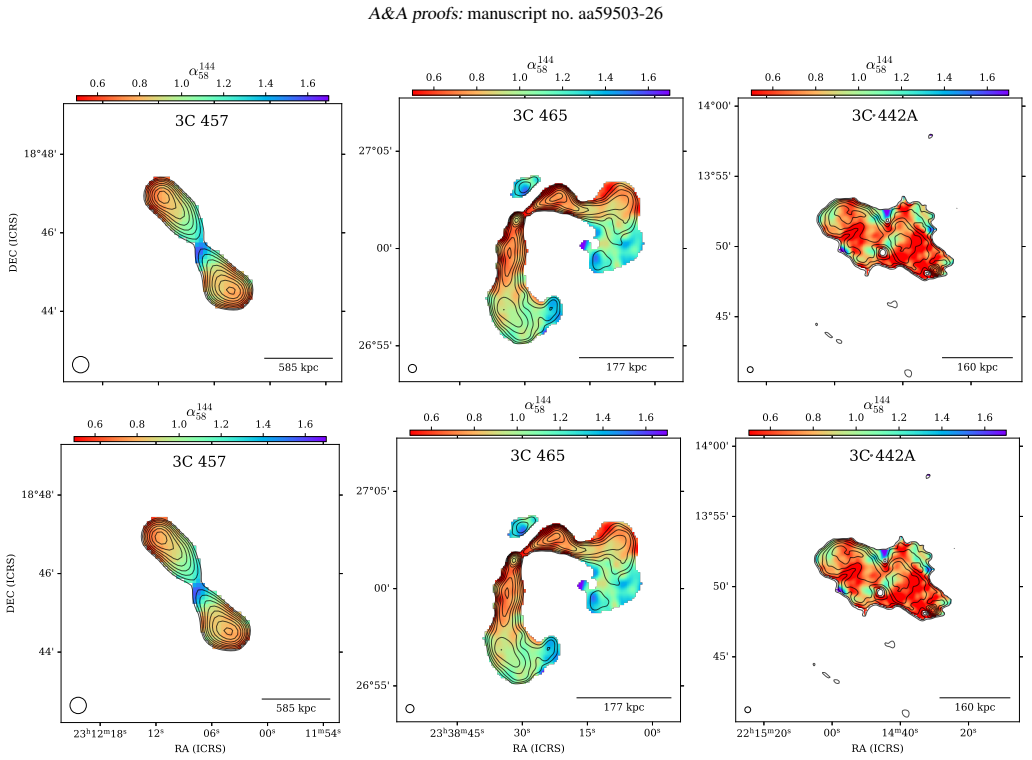
Ultra-low frequency maps of 22 radio galaxies show spectral indices rising from 0.5 at cores to over 1.0 in lobes for FR I sources.
A machine-rendered reading of the paper's core claim, the machinery that carries it, and where it could break.
Core claim
This study presents the ultra-low frequency spectral index maps for this sample. For FR I galaxies, spectral indices range from ~0.5 near the core (consistent with first-order Fermi acceleration) to > 1.0 in the lobes. For FR II galaxies, hotspots exhibit steep low-frequency spectra (0.5 - 0.9), suggesting complex acceleration or absorption effects.
What carries the argument
Spectral index maps and radio colour-colour diagrams built from 58 MHz LOFAR LBA data combined with 144 MHz HBA and RACS observations at 887-1367 MHz to measure low-frequency spectral shapes and constrain ageing parameters.
If this is right
- FR I cores exhibit first-order Fermi acceleration as the dominant injection process.
- Lobes contain aged electron populations whose spectra steepen with distance from the core.
- FR II hotspots require additional physics such as complex acceleration or low-frequency absorption to explain their 0.5-0.9 indices.
- The measured low-frequency indices provide direct constraints on the injection index used in synchrotron ageing models.
Where Pith is reading between the lines
- The maps could be combined with X-ray or optical data to test whether the steep lobe spectra correlate with specific environmental densities.
- Repeating the analysis on a larger sample of fainter sources would show whether the same core-to-lobe gradient holds beyond the brightest 3CRR objects.
- If absorption is confirmed in hotspots, it would affect estimates of total energy injected by AGN jets into their environments.
Load-bearing premise
That the combination of 58 MHz LOFAR LBA data with HBA and RACS observations yields accurate low-frequency spectral shapes without dominant calibration, resolution, or absorption biases for the selected extended sources.
What would settle it
A re-reduction of the same sources with independent calibration pipelines or higher-resolution arrays that produces core indices clearly different from 0.5 or lobe indices clearly below 1.0 for FR I galaxies would falsify the reported spectral shapes.
Figures



read the original abstract
Context. Active galactic nuclei (AGN) jets are fundamental drivers of galaxy evolution, injecting kinetic energy into their environments. The large-scale morphology and spectral properties of these radio galaxies are consequences of complex particle acceleration, energy loss, and absorption processes. While the shape of the synchrotron spectrum encodes the plasma's energetic history, understanding the physics of particle acceleration and duty cycles has historically been limited by a lack of well-resolved observations at ultra-low frequencies (< 100 MHz), where the oldest cosmic ray electron populations are traced. Aims. This study aims to perform the first comprehensive multi-frequency analysis of bright extended radio galaxies down to 58 MHz. The goal is to study electron acceleration mechanisms, accurately measure the low-frequency spectral shape, and constrain the injection index for a sample of Fanaroff-Riley (FR) I and II galaxies using spectral ageing models. Methods. Utilising new 58 MHz observations from the LOFAR Low Band Antenna (LBA) combined with LOFAR High Band Antenna (HBA; 144 MHz) and Rapid ASKAP Continuum Survey (RACS, 887 MHz & 943.5 MHz & 1367.5 MHz) data, a sub-sample of 22 extended sources from the 3CRR catalogue was selected, requiring the largest angular size to be at least 2.5'. The analysis involves constructing detailed spectral index maps and utilising radio colour-colour diagrams to interpret spectral shapes and constrain ageing model parameters across the radio lobes. Results. This study presents the ultra-low frequency spectral index maps for this sample. For FR I galaxies, spectral indices range from ~0.5 near the core (consistent with first-order Fermi acceleration) to > 1.0 in the lobes. For FR II galaxies, hotspots exhibit steep low-frequency spectra (0.5 - 0.9), suggesting complex acceleration or absorption effects.
Editorial analysis
A structured set of objections, weighed in public.
Referee Report
Summary. The manuscript reports the first multi-frequency analysis of 22 extended 3CRR radio galaxies down to 58 MHz using new LOFAR LBA observations combined with LOFAR HBA (144 MHz) and RACS (887–1367 MHz) data. It constructs spectral index maps and colour-colour diagrams for a sample selected by LAS ≥ 2.5 arcmin, finding FR I cores with indices ~0.5 (consistent with first-order Fermi acceleration) steepening to >1.0 in lobes, and FR II hotspots with indices 0.5–0.9 interpreted as evidence for complex acceleration or absorption.
Significance. If the low-frequency maps are robust, the work supplies new observational constraints on the oldest electron populations and injection indices in FR I and FR II sources, directly addressing the gap in ultra-low-frequency resolved spectroscopy. The application of colour-colour diagrams to ageing models is a positive methodological step.
major comments (3)
- [Methods] Methods (Aims and Methods sections): The central results rest on the assumption that the 58 MHz LBA data, after combination with HBA and RACS, recover the same spatial scales and total flux without dominant missing-flux, resolution mismatch, or ionospheric-calibration residuals. No quantitative test (e.g., uv-coverage comparison, simulated source recovery, or total-flux consistency check across frequencies) is described to validate this for the selected extended sources.
- [Results] Results: Spectral index ranges are stated (~0.5 near cores, >1.0 in lobes for FR I; 0.5–0.9 for FR II hotspots) without reported uncertainties, error maps, or data-exclusion criteria. This prevents assessment of whether the quoted values are statistically distinguishable from steeper spectra or affected by noise or calibration systematics.
- [Results] Results (spectral index maps): The interpretation that FR II hotspot indices of 0.5–0.9 indicate complex acceleration or absorption requires demonstration that the maps are not biased by primary-beam or resolution effects at 58 MHz; the selection criterion LAS ≥2.5' alone does not guarantee matched resolution across bands.
minor comments (2)
- [Abstract] Abstract: The reported index ranges lack accompanying uncertainties or sample statistics (e.g., number of sources per morphological class).
- Notation: The term 'ultra-low frequency spectral index maps' should be defined with explicit reference to the frequency pairs used for each map.
Simulated Author's Rebuttal
We thank the referee for their thorough and constructive review. We address each major comment below and have revised the manuscript accordingly where the points identify omissions or needed clarifications.
read point-by-point responses
-
Referee: [Methods] Methods (Aims and Methods sections): The central results rest on the assumption that the 58 MHz LBA data, after combination with HBA and RACS, recover the same spatial scales and total flux without dominant missing-flux, resolution mismatch, or ionospheric-calibration residuals. No quantitative test (e.g., uv-coverage comparison, simulated source recovery, or total-flux consistency check across frequencies) is described to validate this for the selected extended sources.
Authors: We agree that the manuscript does not describe quantitative validation tests for flux recovery and spatial scale consistency. In the revised version we will add a dedicated paragraph in the Methods section that compares uv-coverage across the three frequency regimes and reports integrated flux-density consistency checks against published values at overlapping frequencies. revision: yes
-
Referee: [Results] Results: Spectral index ranges are stated (~0.5 near cores, >1.0 in lobes for FR I; 0.5–0.9 for FR II hotspots) without reported uncertainties, error maps, or data-exclusion criteria. This prevents assessment of whether the quoted values are statistically distinguishable from steeper spectra or affected by noise or calibration systematics.
Authors: We accept that uncertainties and error information were omitted. The revised manuscript will include spectral-index error maps, quote representative uncertainties on the reported index ranges, and state the signal-to-noise thresholds applied to mask unreliable pixels. revision: yes
-
Referee: [Results] Results (spectral index maps): The interpretation that FR II hotspot indices of 0.5–0.9 indicate complex acceleration or absorption requires demonstration that the maps are not biased by primary-beam or resolution effects at 58 MHz; the selection criterion LAS ≥2.5' alone does not guarantee matched resolution across bands.
Authors: The referee correctly identifies that the paper does not explicitly demonstrate the absence of resolution or primary-beam biases. We will expand the Methods section to describe the convolution to a common restoring beam (set by the 58 MHz data) and the application of primary-beam corrections, thereby supporting the hotspot-index interpretation. revision: yes
Circularity Check
No circularity: results are direct observational mappings with no self-referential derivations
full rationale
The paper reports empirical spectral index maps constructed from combined LOFAR LBA (58 MHz), HBA (144 MHz), and RACS data for 22 extended 3CRR sources. No equations, model predictions, fitted parameters, or first-principles derivations appear in the provided text; the reported ranges (~0.5 near cores, >1.0 in lobes for FR I; 0.5-0.9 in hotspots for FR II) are direct measurements from the maps and colour-colour diagrams. No self-citations, uniqueness theorems, or ansatzes are invoked as load-bearing steps. The analysis is self-contained against external radio data benchmarks and does not reduce any claim to its own inputs by construction.
Axiom & Free-Parameter Ledger
axioms (1)
- domain assumption Synchrotron radiation from relativistic electrons in magnetic fields produces the observed radio emission whose spectrum encodes acceleration and energy loss history.
Reference graph
Works this paper leans on
-
[1]
Systematic effects in LOFAR data: A unified calibration strategy
Systematic effects in LOFAR data: A unified calibration strategy. , keywords =. doi:10.1051/0004-6361/201833867 , archivePrefix =. 1811.07954 , primaryClass =
work page internal anchor Pith review Pith/arXiv arXiv doi:10.1051/0004-6361/201833867
-
[2]
, year = 1967, month = jun, volume =
Discrete Radio Sources at 38 Mc/s. , year = 1967, month = jun, volume =. doi:10.1038/214971a0 , adsurl =
-
[3]
Interferometry and synthesis in radio astronomy
-
[4]
The effect of the ionosphere on ultra-low frequency radio-interferometric observations
The effect of the ionosphere on ultra-low-frequency radio-interferometric observations. , keywords =. doi:10.1051/0004-6361/201833012 , archivePrefix =. 1804.07947 , primaryClass =
work page internal anchor Pith review Pith/arXiv arXiv doi:10.1051/0004-6361/201833012
-
[5]
Revisiting the radio interferometer measurement equation. I. A full-sky Jones formalism. , keywords =. doi:10.1051/0004-6361/201016082 , archivePrefix =. 1101.1764 , primaryClass =
work page internal anchor Pith review Pith/arXiv arXiv doi:10.1051/0004-6361/201016082
-
[6]
Ionospheric calibration of low frequency radio interferometric observations using the peeling scheme. I. Method description and first results. , keywords =. doi:10.1051/0004-6361/200811094 , archivePrefix =. 0904.3975 , primaryClass =
work page internal anchor Pith review Pith/arXiv arXiv doi:10.1051/0004-6361/200811094
-
[7]
Bounding higher-order ionosphere errors for the dual-frequency GPS user. Radio Science , keywords =. doi:10.1029/2007RS003772 , adsurl =
-
[8]
Pushing sub-arcsecond resolution imaging down to 30 MHz with the trans-European International LOFAR Telescope. , keywords =. doi:10.1051/0004-6361/202141352 , archivePrefix =. 2108.07286 , primaryClass =
-
[9]
Toothbrush radio relic downstream of the shock front
Reaching thermal noise at ultra-low radio frequencies. Toothbrush radio relic downstream of the shock front. , keywords =. doi:10.1051/0004-6361/202038663 , archivePrefix =. 2007.16043 , primaryClass =
-
[10]
LOFAR: The LOw-Frequency ARray
LOFAR: The LOw-Frequency ARray. , keywords =. doi:10.1051/0004-6361/201220873 , archivePrefix =. 1305.3550 , primaryClass =
work page internal anchor Pith review Pith/arXiv arXiv doi:10.1051/0004-6361/201220873
-
[11]
Bright radio sources at 178 MHz : flux densities, optical identifications and the cosmological evolution of powerful radio galaxies. , keywords =. doi:10.1093/mnras/204.1.151 , adsurl =
-
[12]
A ``twin-exhaust'' model for double radio sources. , keywords =. doi:10.1093/mnras/169.3.395 , adsurl =
-
[13]
, year = 1959, month = jan, volume =
A survey of radio sources at a frequency of 159 Mc/s. , year = 1959, month = jan, volume =
1959
-
[14]
Electron Population Aging Models for Wide-Angle Tails
Electron population aging models for wide-angle tails. , keywords =. doi:10.1016/S1387-6473(01)00164-6 , archivePrefix =. astro-ph/9909182 , primaryClass =
work page internal anchor Pith review Pith/arXiv arXiv doi:10.1016/s1387-6473(01)00164-6
-
[15]
title The morphology of extragalactic radio sources of high and low luminosity
The morphology of extragalactic radio sources of high and low luminosity. , year = 1974, month = may, volume =. doi:10.1093/mnras/167.1.31P , adsurl =
-
[16]
Low-frequency study of two giant radio galaxies: 3C35 and 3C223
Low-frequency study of two giant radio galaxies: 3C 35 and 3C 223. , keywords =. doi:10.1051/0004-6361/200913837 , archivePrefix =. 1003.0623 , primaryClass =
work page internal anchor Pith review Pith/arXiv arXiv doi:10.1051/0004-6361/200913837
-
[17]
, archivePrefix = "arXiv", eprint =
A broad-band flux scale for low-frequency radio telescopes. , keywords =. doi:10.1111/j.1745-3933.2012.01251.x , archivePrefix =. 1203.0977 , primaryClass =
-
[18]
IEEE Transactions on Signal Processing , year = 2007, month = sep, volume =
Self-Calibration for the LOFAR Radio Astronomical Array. IEEE Transactions on Signal Processing , year = 2007, month = sep, volume =. doi:10.1109/TSP.2007.896243 , adsurl =
-
[19]
Cassiopeia A, Cygnus A, Taurus A, and Virgo A at ultra-low radio frequencies. , keywords =. doi:10.1051/0004-6361/201936844 , archivePrefix =. 2002.10431 , primaryClass =
-
[20]
DPPP: Default Pre-Processing Pipeline
-
[21]
WSClean: an implementation of a fast, generic wide-field imager for radio astronomy
WSCLEAN: an implementation of a fast, generic wide-field imager for radio astronomy. , keywords =. doi:10.1093/mnras/stu1368 , archivePrefix =. 1407.1943 , primaryClass =
work page internal anchor Pith review Pith/arXiv arXiv doi:10.1093/mnras/stu1368 1943
-
[22]
An optimized algorithm for multi-scale wideband deconvolution of radio astronomical images
An optimized algorithm for multiscale wideband deconvolution of radio astronomical images. , keywords =. doi:10.1093/mnras/stx1547 , archivePrefix =. 1706.06786 , primaryClass =
work page internal anchor Pith review Pith/arXiv arXiv doi:10.1093/mnras/stx1547
-
[23]
A morphological algorithm for improving radio-frequency interference detection
A morphological algorithm for improving radio-frequency interference detection. , keywords =. doi:10.1051/0004-6361/201118497 , archivePrefix =. 1201.3364 , primaryClass =
work page internal anchor Pith review Pith/arXiv arXiv doi:10.1051/0004-6361/201118497
-
[24]
Post-correlation radio frequency interference classification methods. , keywords =. doi:10.1111/j.1365-2966.2010.16471.x , archivePrefix =. 1002.1957 , primaryClass =
-
[25]
Compression of interferometric radio-astronomical data
Compression of interferometric radio-astronomical data. , keywords =. doi:10.1051/0004-6361/201629565 , archivePrefix =. 1609.02019 , primaryClass =
work page internal anchor Pith review Pith/arXiv arXiv doi:10.1051/0004-6361/201629565
-
[26]
LOFAR Facet Calibration. , keywords =. doi:10.3847/0067-0049/223/1/2 , archivePrefix =. 1601.05422 , primaryClass =
work page internal anchor Pith review Pith/arXiv arXiv doi:10.3847/0067-0049/223/1/2
-
[27]
Revisiting the radio interferometer measurement equation. II. Calibration and direction-dependent effects. , keywords =. doi:10.1051/0004-6361/201116434 , archivePrefix =. 1101.1765 , primaryClass =
work page internal anchor Pith review Pith/arXiv arXiv doi:10.1051/0004-6361/201116434
-
[28]
, year = 1973, month = dec, volume =
The low-frequency spectra of nonthermal radio sources. , year = 1973, month = dec, volume =. doi:10.1086/111506 , adsurl =
-
[29]
, keywords =
The absolute spectrum of Cas A: an accurate flux density scale and a set of secondary calibrators. , keywords =
-
[30]
, year = 1969, month = jul, volume =
The Spectra of Radio Sources in the Revised 3c Catalogue. , year = 1969, month = jul, volume =. doi:10.1086/150046 , adsurl =
-
[31]
, year = 1966, month = dec, volume =
On the Interpretation of Radio-Source Spectra and the Evolution of Radio Galaxies and Quasi-Stellar Sources. , year = 1966, month = dec, volume =. doi:10.1086/148940 , adsurl =
-
[32]
IAU Colloq
Interaction of Jets with the Interstellar Medium in GPS; CSS and CSO Sources. IAU Colloq. 163: Accretion Phenomena and Related Outflows , year = 1997, editor =
1997
-
[33]
An Investigation of Synchrotron Self-absorption and Free-Free Absorption Models in Explanation of the Gigahertz-peaked Spectrum of PKS 1718-649. , keywords =. doi:10.1086/376600 , adsurl =
-
[34]
, year = 1973, month = jan, volume =
Models of extended radiosources. , year = 1973, month = jan, volume =. doi:10.1093/mnras/164.3.243 , adsurl =
-
[35]
, year = 1973, month = aug, volume =
Dynamical Models of Tailed Radio Sources in Clusters of Galaxies. , year = 1973, month = aug, volume =
1973
-
[36]
, year = 1962, month = dec, volume =
Nonstationarity of Spectra of Young Sources of Nonthermal Radio Emission. , year = 1962, month = dec, volume =
1962
-
[37]
Nonthermal processes in galactic and extragalactic sources
Radio astrophysics. Nonthermal processes in galactic and extragalactic sources
-
[38]
Sub-arcsecond imaging with the International LOFAR Telescope. I. Foundational calibration strategy and pipeline. , keywords =. doi:10.1051/0004-6361/202140649 , archivePrefix =. 2108.07283 , primaryClass =
-
[39]
LOFAR high-band antenna observations of the Perseus cluster. arXiv e-prints , keywords =. doi:10.48550/arXiv.2410.02863 , archivePrefix =. 2410.02863 , primaryClass =
-
[40]
High-resolution VLA low radio frequency observations of the Perseus cluster: radio lobes, mini-halo, and bent-jet radio galaxies. , keywords =. doi:10.1093/mnras/staa2003 , archivePrefix =. 2005.12298 , primaryClass =
-
[41]
Synchrotron and inverse-Compton emission from radio galaxies with non-uniform magnetic field and electron distributions. , keywords =. doi:10.1093/mnras/stt1024 , archivePrefix =. 1306.1640 , primaryClass =
work page internal anchor Pith review Pith/arXiv arXiv doi:10.1093/mnras/stt1024
-
[42]
Spectral ageing in the lobes of cluster-centre FR-II radio galaxies
Spectral ageing in the lobes of cluster-centre FR II radio galaxies. , keywords =. doi:10.1093/mnras/stv2194 , archivePrefix =. 1509.06757 , primaryClass =
work page internal anchor Pith review Pith/arXiv arXiv doi:10.1093/mnras/stv2194
-
[43]
Spectral ageing in the lobes of FR-II radio galaxies: new methods of analysis for broad-band radio data. , keywords =. doi:10.1093/mnras/stt1526 , archivePrefix =. 1308.4137 , primaryClass =
work page internal anchor Pith review Pith/arXiv arXiv doi:10.1093/mnras/stt1526
-
[44]
A study of spectral ageing in the radio galaxy 3C 234 and its implications. , keywords =. doi:10.1093/mnras/225.1.27 , adsurl =
-
[45]
Mapping the emission and spectral properties of the FRI radio galaxy 3C 449 with LOFAR and the VLA
Mapping the emission and spectral properties of the FRI radio galaxy 3C 449 with LOFAR and the VLA. arXiv e-prints , keywords =. doi:10.48550/arXiv.2604.12043 , archivePrefix =. 2604.12043 , primaryClass =
work page internal anchor Pith review Pith/arXiv arXiv doi:10.48550/arxiv.2604.12043
-
[46]
Radio synthesis observations of 3C 296, 3C 442A and 3C 449 at 0.4, 1.4 and 2.7 GHz. , keywords =. doi:10.1093/mnras/197.2.253 , adsurl =
-
[47]
, year = 2024, month = sep, volume =
Black hole jets on the scale of the cosmic web. , year = 2024, month = sep, volume =. doi:10.1038/s41586-024-07879-y , adsurl =
-
[48]
Radiative processes in astrophysics
-
[49]
IEEE transactions on automatic control , volume=
A new look at the statistical model identification , author=. IEEE transactions on automatic control , volume=. 1974 , publisher=
1974
-
[50]
Information and likelihood theory : A basis for model selection and inference. doi:10.1007/b97636 , isbn=
-
[51]
The Rapid ASKAP Continuum Survey I: Design and first results. , keywords =. doi:10.1017/pasa.2020.41 , archivePrefix =. 2012.00747 , primaryClass =
-
[52]
LOFAR reveals the giant: a low-frequency radio continuum study of the outflow in the nearby FR I radio galaxy 3C 31. , keywords =. doi:10.1093/mnras/stx2869 , archivePrefix =. 1710.09746 , primaryClass =
work page internal anchor Pith review Pith/arXiv arXiv doi:10.1093/mnras/stx2869
-
[53]
The LOFAR Two-metre Sky Survey. II. First data release. , keywords =. doi:10.1051/0004-6361/201833559 , archivePrefix =. 1811.07926 , primaryClass =
work page internal anchor Pith review Pith/arXiv arXiv doi:10.1051/0004-6361/201833559
-
[54]
Determining the Shape of Spectra in Extended Radio Sources. , keywords =. doi:10.1086/172536 , adsurl =
-
[55]
Ageing and dynamics of the tailed radio galaxies in Abell 2142. , keywords =. doi:10.1051/0004-6361/202451515 , archivePrefix =. 2409.03453 , primaryClass =
-
[56]
PSZ2 G181.06+48.47. II. Radio Analysis of a Low-mass Cluster with Exceptionally Distant Radio Relics. , keywords =. doi:10.3847/1538-4357/adbbb9 , archivePrefix =. 2501.08390 , primaryClass =
-
[57]
Re-energization of AGN head-tail radio galaxies in the galaxy cluster ZwCl 0634.1+47474. , keywords =. doi:10.1093/mnras/stad3962 , archivePrefix =. 2401.04710 , primaryClass =
-
[58]
New mysteries and challenges from the Toothbrush relic: wideband observations from 550 MHz to 8 GHz. , keywords =. doi:10.1051/0004-6361/201937139 , archivePrefix =. 1911.08904 , primaryClass =
-
[59]
, year = 1969, month = jan, volume =
The spectra of discrete radio sources at decametric wavelengths-I. , year = 1969, month = jan, volume =. doi:10.1093/mnras/143.3.289 , adsurl =
-
[60]
, year = 1968, month = oct, volume =
Observations of radio sources at 10.03 MHz. , year = 1968, month = oct, volume =. doi:10.1086/110684 , adsurl =
-
[61]
Spectral flux densities of radio sources at 22.25 MHz. I. , year = 1969, month = apr, volume =. doi:10.1086/110817 , adsurl =
-
[62]
The relation between radio luminosity and spectrum for extended extragalactic radio sources. , keywords =. doi:10.1093/mnras/190.4.903 , adsurl =
-
[63]
, keywords =
Comments on the absolute flux density scale at low radio frequencies. , keywords =
-
[64]
, keywords =
A deep 38-MHz radio survey of the area delta >+60. , keywords =
-
[65]
, year = 1971, month = jan, volume =
The flux density scale for radio sources at 81.5 MHz. , year = 1971, month = jan, volume =. doi:10.1093/mnras/154.1.19P , adsurl =
-
[66]
, year = 1969, month = feb, volume =
Flux Densities and Spectral Indices for the Sources in the 3C and 3CR Catalogs at 86-MHz Frequency. , year = 1969, month = feb, volume =
1969
-
[67]
The 6C survey of radio sources - I. Declination zone delta > +80. , keywords =. doi:10.1093/mnras/217.4.717 , adsurl =
-
[68]
The 6C survey of radio sources. VI. The continuous zone30<delta<51, Oh<alpha<09h05m and 22h<alpha<24h. , keywords =. doi:10.1093/mnras/263.1.25 , adsurl =
-
[69]
A 570 square degree Mini-Survey around the North Ecliptic Pole
The Westerbork Northern Sky Survey (WENSS), I. A 570 square degree Mini-Survey around the North Ecliptic Pole. , keywords =. doi:10.1051/aas:1997358 , adsurl =
-
[70]
, keywords =
A Catalogue of Extragalactic Radio Sources Having Flux Densities Greater than 1-JY at 5-GHZ. , keywords =
-
[71]
The Texas Survey of Radio Sources Covering -35.5 degrees < declination < 71.5 degrees at 365 MHz. , keywords =. doi:10.1086/117932 , adsurl =
-
[72]
, year = 1970, month = mar, volume =
A catalogue of 3235 radio sources at 408 MHz. , year = 1970, month = mar, volume =
1970
-
[73]
, year = 1972, month = sep, volume =
The B2 Catalogue of radio sources - second part. , year = 1972, month = sep, volume =
1972
-
[74]
, year = 1973, month = sep, volume =
The B2 catalogue of radio sources - third part. , year = 1973, month = sep, volume =
1973
-
[75]
, year = 1974, month = jan, volume =
The B2 catalogue of radio sources - fourth part. , year = 1974, month = jan, volume =
1974
-
[76]
Bulletin of the Special Astrophysics Observatory , year = 1997, month = jan, volume =
IKI/ASC at the RATAN-600 in 1979-1996: spectra monitoring and the nature of long-term variability of extragalactic radio sources. Bulletin of the Special Astrophysics Observatory , year = 1997, month = jan, volume =
1979
-
[77]
The VLA Low-frequency Sky Survey
The VLA Low-Frequency Sky Survey. , keywords =. doi:10.1086/520719 , archivePrefix =. 0706.1191 , primaryClass =
work page internal anchor Pith review Pith/arXiv arXiv doi:10.1086/520719
-
[78]
The LOFAR LBA Sky Survey. I. Survey description and preliminary data release. , keywords =. doi:10.1051/0004-6361/202140316 , archivePrefix =. 2102.09238 , primaryClass =
-
[79]
The LOFAR LBA Sky Survey. II. First data release. , keywords =. doi:10.1051/0004-6361/202245389 , archivePrefix =. 2301.12724 , primaryClass =
-
[80]
Journal of Astrophysics and Astronomy , keywords =
The Multiwavelength Study of Two Unique Radio Galaxies. Journal of Astrophysics and Astronomy , keywords =. doi:10.1007/BF02702470 , adsurl =
discussion (0)
Sign in with ORCID, Apple, or X to comment. Anyone can read and Pith papers without signing in.