Physics-conforming Latent Twins
Pith reviewed 2026-06-27 04:55 UTC · model grok-4.3
The pith
Latent surrogate solution operators can be trained to obey selected physical conservation and dissipation rules by design through transferred constraints.
A machine-rendered reading of the paper's core claim, the machinery that carries it, and where it could break.
Core claim
Physics-conforming Latent Twins jointly learn an encoder, a decoder, and a latent flow map between time-indexed states while constraining the latent dynamics to preserve or dissipate prescribed structural quantities; a constraint-transfer viewpoint connects physical structure in the original state space to compatible latent constraints, structure-preservation bounds quantify the resulting improvement in decoded fidelity, and algebraic conditions on the flow map guarantee preservation of linear and quadratic invariants or enforcement of dissipative inequalities.
What carries the argument
Constraint-transfer viewpoint that links physical structure in state space to compatible constraints in latent space, enabling enforcement inside the latent flow map.
If this is right
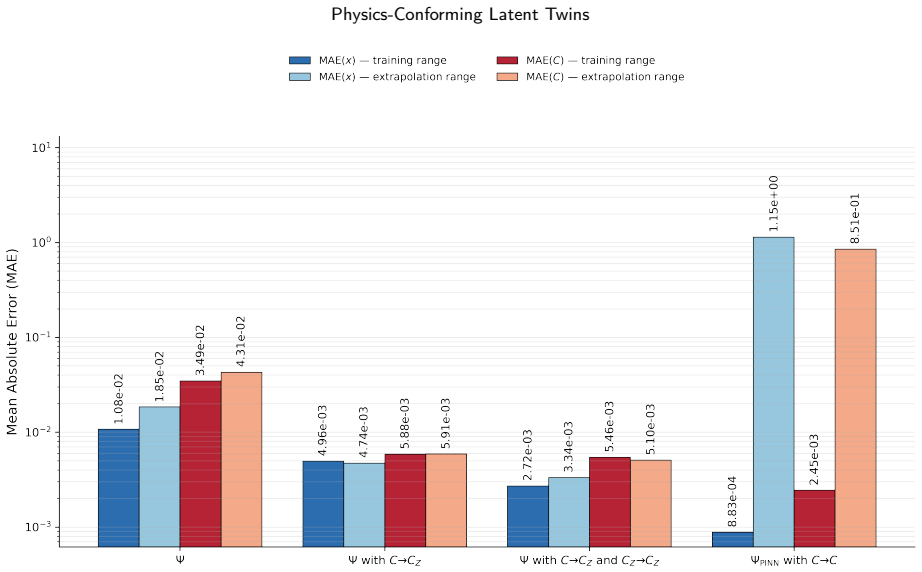
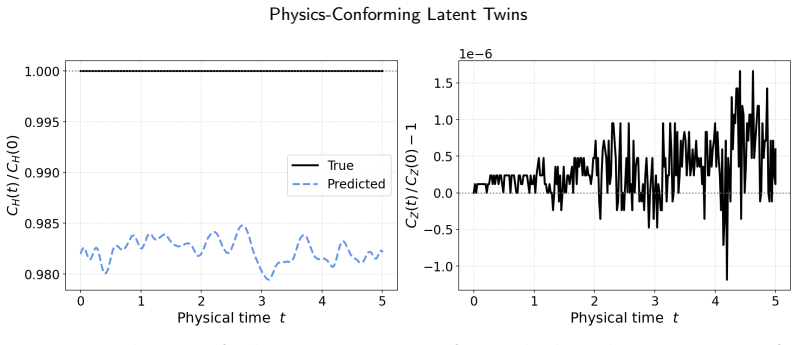
- Latent enforcement of the transferred constraints produces lower physical defects in the decoded trajectories than unconstrained latent models.
- Latent flow maps satisfying the derived algebraic conditions preserve linear and quadratic invariants or enforce the prescribed dissipative inequalities by construction.
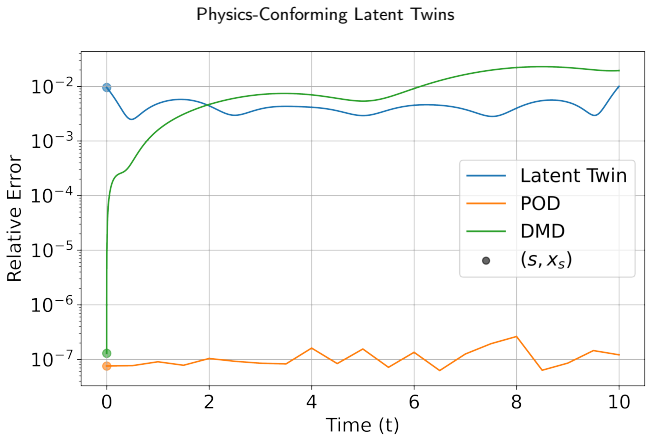
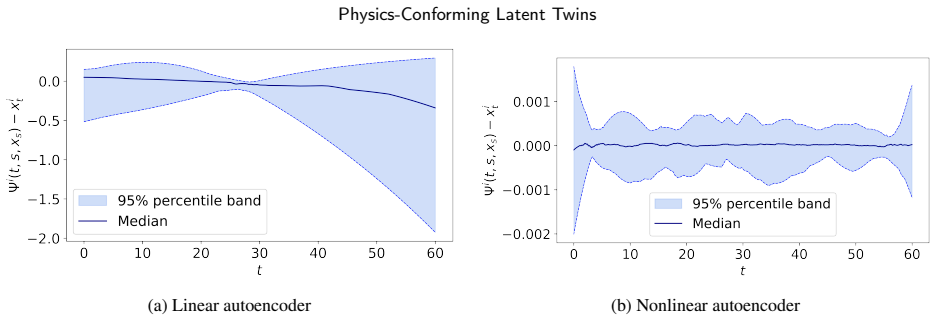
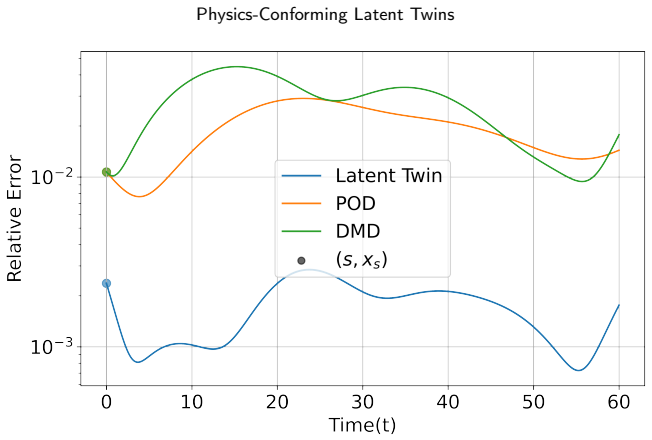
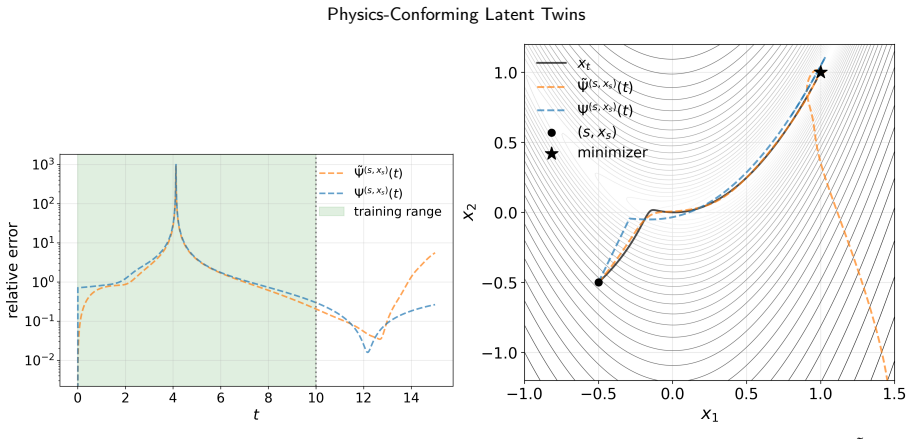
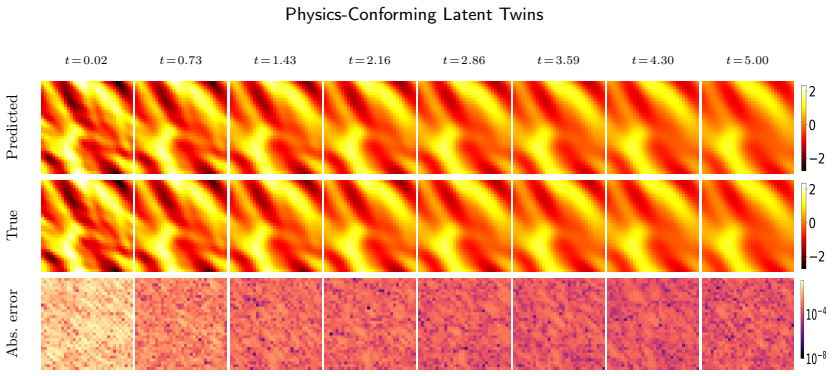
- Surrogate predictions maintain pointwise accuracy while exhibiting improved qualitative long-time behavior on representative ODE and PDE systems.
- The same framework applies to both linear and nonlinear invariants provided the algebraic conditions for the flow map can be satisfied.
Where Pith is reading between the lines
- The approach could be combined with existing reduced-order modeling techniques that already operate in latent spaces to add physics compliance at low extra cost.
- Extension to systems with time-dependent or state-dependent constraints would require generalizing the algebraic conditions derived for fixed invariants.
- If the latent dimension is chosen too small, the transferred constraints may become incompatible and force a trade-off between representation power and structure preservation.
- The structure-preservation bounds suggest a quantitative way to choose the strength of the latent penalty term during training.
Load-bearing premise
Compatible structural constraints can be found and transferred into latent space without destroying the encoder-decoder pair's ability to represent the true dynamics accurately.
What would settle it
If numerical experiments on the ODE and PDE benchmarks show that enforcing the latent constraints produces no measurable reduction in physical defects after decoding, the structure-preservation bounds and the overall approach would be falsified.
Figures




read the original abstract
Surrogate models are central to scientific machine learning, where they enable fast prediction, simulation, inference, and control for complex physical systems. For time-dependent problems, however, accurate interpolation of training trajectories is not sufficient: reliable surrogates should also respect the conservation laws, invariants, admissibility conditions, and dissipative structures that give those trajectories physical meaning. We introduce Physics-conforming Latent Twins, a framework for learning latent surrogate solution operators whose dynamics satisfy selected physical principles by design. The method builds on the Latent Twin formulation by jointly learning an encoder, a decoder, and a latent flow map between arbitrary time-indexed states, while constraining the latent dynamics to preserve or dissipate prescribed structural quantities. We develop a constraint-transfer viewpoint that connects physical structure in the original state space with compatible constraints in latent space, and prove structure-preservation bounds showing how latent enforcement improves control of physical defects after decoding. We also derive algebraic conditions for latent flow maps that preserve linear and quadratic invariants or enforce dissipative inequalities. Numerical experiments on representative ODE and PDE benchmarks demonstrate improved constraint satisfaction, structural fidelity, and qualitative long-time behavior while maintaining accurate surrogate prediction.
Editorial analysis
A structured set of objections, weighed in public.
Referee Report
Summary. The manuscript introduces Physics-conforming Latent Twins, a framework for learning latent surrogate solution operators for time-dependent physical systems. Building on the Latent Twin formulation, it jointly learns an encoder, decoder, and latent flow map while constraining the latent dynamics to preserve or dissipate prescribed structural quantities. The paper develops a constraint-transfer viewpoint connecting state-space physical structure to compatible latent constraints, proves structure-preservation bounds on how latent enforcement controls physical defects after decoding, derives algebraic conditions for latent flow maps that preserve linear/quadratic invariants or enforce dissipative inequalities, and reports numerical experiments on ODE and PDE benchmarks demonstrating improved constraint satisfaction, structural fidelity, and long-time behavior while maintaining surrogate accuracy.
Significance. If the claimed proofs and derivations hold, the work is significant for scientific machine learning because it supplies a systematic way to embed physical principles directly into latent-space dynamics, addressing the common failure of data-driven surrogates to respect conservation laws, invariants, and dissipation over long times. The structure-preservation bounds and algebraic conditions for invariant-preserving or dissipative latent maps constitute theoretical contributions that could guide the design of physics-conforming models. The numerical experiments are presented as evidence that accuracy can be retained alongside improved physical fidelity.
major comments (1)
- [Abstract] Abstract and constraint-transfer viewpoint: the central claims rest on the existence of compatible structural constraints that can be transferred from state space to latent space and jointly optimized with the encoder/decoder without destroying representational accuracy. The manuscript must supply the explicit construction of these transferred constraints, the precise statement of the structure-preservation bounds (including any assumptions on the decoder), and the full algebraic derivations for the invariant and dissipative conditions; without these details the load-bearing theoretical results cannot be verified.
Simulated Author's Rebuttal
We thank the referee for the thorough review and for identifying the need to strengthen the presentation of the theoretical results. We address the major comment below and will incorporate the requested clarifications in a revised manuscript.
read point-by-point responses
-
Referee: [Abstract] Abstract and constraint-transfer viewpoint: the central claims rest on the existence of compatible structural constraints that can be transferred from state space to latent space and jointly optimized with the encoder/decoder without destroying representational accuracy. The manuscript must supply the explicit construction of these transferred constraints, the precise statement of the structure-preservation bounds (including any assumptions on the decoder), and the full algebraic derivations for the invariant and dissipative conditions; without these details the load-bearing theoretical results cannot be verified.
Authors: We agree that the explicit constructions, precise bound statements, and full derivations are essential for verifiability. These elements are present in the manuscript (constraint transfer in Section 3 with the encoder-decoder commutativity construction; structure-preservation bounds in Theorem 4.1 under a Lipschitz decoder assumption; algebraic conditions for linear/quadratic invariants and dissipation in Sections 4.2–4.3), but we acknowledge they require expansion for clarity. In the revision we will add the explicit transferred-constraint formulas, restate the bounds with all decoder assumptions listed, and include the complete step-by-step algebraic derivations for the latent flow-map conditions. revision: yes
Circularity Check
No significant circularity; derivation self-contained
full rationale
The abstract and reader's summary indicate that the constraint-transfer viewpoint, structure-preservation bounds, and algebraic conditions for invariant-preserving latent flow maps are presented as new derived contributions. The framework builds on a prior Latent Twin formulation via reference, but the core proofs and conditions do not reduce by construction to fitted parameters, self-defined quantities, or load-bearing self-citations whose validity depends on the present work. No quoted equations or steps exhibit the enumerated circular patterns such as self-definitional relations or renaming known results as novel predictions. The numerical experiments are described as demonstrating maintained accuracy alongside improved constraint satisfaction, consistent with independent validation rather than forced outcomes. This is the expected non-finding for a paper whose central claims retain independent mathematical content.
Axiom & Free-Parameter Ledger
Reference graph
Works this paper leans on
-
[1]
Ascher , title =
Uri M. Ascher , title =. Hybrid Systems: Computation and Control , series =. 2002 , doi =
2002
-
[2]
Stewart , title =
David E. Stewart , title =. 2011 , doi =
2011
-
[3]
Ernst Hairer and Gerhard Wanner , title =
-
[4]
Computer Methods in Applied Mechanics and Engineering , volume=
tLaSDI: Thermodynamics-informed latent space dynamics identification , author=. Computer Methods in Applied Mechanics and Engineering , volume=. 2024 , publisher=
2024
-
[5]
Computer Methods in Applied Mechanics and Engineering , volume=
Weak-form latent space dynamics identification , author=. Computer Methods in Applied Mechanics and Engineering , volume=. 2024 , publisher=
2024
-
[6]
International Journal for Numerical Methods in Engineering , volume=
Physics-Informed Active Learning With Simultaneous Weak-Form Latent Space Dynamics Identification , author=. International Journal for Numerical Methods in Engineering , volume=. 2025 , publisher=
2025
-
[7]
arXiv preprint arXiv:2403.10748 , year=
A comprehensive review of latent space dynamics identification algorithms for intrusive and non-intrusive reduced-order-modeling , author=. arXiv preprint arXiv:2403.10748 , year=
-
[8]
, series=
Murray, James D. , series=. Mathematical Biology:. 2007 , publisher=
2007
-
[9]
, title =
Khalil, Hassan K. , title =
-
[10]
1990 , publisher =
A Mathematical Introduction to Fluid Mechanics , author =. 1990 , publisher =
1990
-
[11]
Advances in Neural Information Processing Systems , volume=
Pinnacle: A comprehensive benchmark of physics-informed neural networks for solving pdes , author=. Advances in Neural Information Processing Systems , volume=
-
[12]
AI , volume=
Understanding physics-informed neural networks: Techniques, applications, trends, and challenges , author=. AI , volume=. 2024 , publisher=
2024
-
[13]
SIAM Journal on Scientific Computing , volume=
Understanding and mitigating gradient flow pathologies in physics-informed neural networks , author=. SIAM Journal on Scientific Computing , volume=. 2021 , publisher=
2021
-
[14]
Artificial Intelligence Review , volume=
Physics-informed neural networks for PDE problems: A comprehensive review , author=. Artificial Intelligence Review , volume=. 2025 , publisher=
2025
-
[15]
Applied Sciences , volume=
Physics-informed neural networks: A review of methodological evolution, theoretical foundations, and interdisciplinary frontiers toward next-generation scientific computing , author=. Applied Sciences , volume=. 2025 , publisher=
2025
-
[16]
Annual review of fluid mechanics , volume=
The proper orthogonal decomposition in the analysis of turbulent flows , author=. Annual review of fluid mechanics , volume=. 1993 , publisher=
1993
-
[17]
Journal of Fluid Mechanics , volume=
Dynamic mode decomposition of numerical and experimental data , author=. Journal of Fluid Mechanics , volume=. 2010 , publisher=
2010
-
[18]
Model Reduction and Approximation: Theory and Algorithms , volume=
A tutorial introduction to the Loewner framework for model reduction , author=. Model Reduction and Approximation: Theory and Algorithms , volume=. 2017 , publisher=
2017
-
[19]
2005 , publisher=
Approximation of large-scale dynamical systems , author=. 2005 , publisher=
2005
-
[20]
Journal of Computational Dynamics , volume=
On dynamic mode decomposition: theory and applications , author=. Journal of Computational Dynamics , volume=
-
[21]
2016 , publisher=
Dynamic Mode Decomposition: Data-Driven Modeling of Complex Systems , author=. 2016 , publisher=
2016
-
[22]
arXiv preprint arXiv:2209.14855 , year=
Continuous pde dynamics forecasting with implicit neural representations , author=. arXiv preprint arXiv:2209.14855 , year=
-
[23]
Advances in Neural Information Processing Systems , volume=
Operator learning with neural fields: Tackling pdes on general geometries , author=. Advances in Neural Information Processing Systems , volume=
-
[24]
Computer Methods in Applied Mechanics and Engineering , volume=
Lasdi: Parametric latent space dynamics identification , author=. Computer Methods in Applied Mechanics and Engineering , volume=. 2022 , publisher=
2022
-
[25]
arXiv preprint arXiv:2206.02607 , year=
CROM: Continuous reduced-order modeling of PDEs using implicit neural representations , author=. arXiv preprint arXiv:2206.02607 , year=
-
[26]
Journal of Computational Physics , volume=
gLaSDI: Parametric physics-informed greedy latent space dynamics identification , author=. Journal of Computational Physics , volume=. 2023 , publisher=
2023
-
[27]
Journal of Machine Learning Research , volume=
Neural operator: Learning maps between function spaces with applications to pdes , author=. Journal of Machine Learning Research , volume=
-
[28]
Advances in neural information processing systems , volume=
Implicit neural representations with periodic activation functions , author=. Advances in neural information processing systems , volume=
-
[29]
Physical Review E , volume=
Using noisy or incomplete data to discover models of spatiotemporal dynamics , author=. Physical Review E , volume=. 2020 , publisher=
2020
-
[30]
Nature communications , volume=
Deep learning for universal linear embeddings of nonlinear dynamics , author=. Nature communications , volume=. 2018 , publisher=
2018
-
[31]
Proceedings of the Royal Society A: Mathematical, Physical and Engineering Sciences , volume=
SINDy-PI: a robust algorithm for parallel implicit sparse identification of nonlinear dynamics , author=. Proceedings of the Royal Society A: Mathematical, Physical and Engineering Sciences , volume=. 2020 , publisher=
2020
-
[32]
Proceedings of the Royal Society A: Mathematical, Physical and Engineering Sciences , volume=
Learning partial differential equations via data discovery and sparse optimization , author=. Proceedings of the Royal Society A: Mathematical, Physical and Engineering Sciences , volume=. 2017 , publisher=
2017
-
[33]
Science advances , volume=
Data-driven discovery of partial differential equations , author=. Science advances , volume=. 2017 , publisher=
2017
-
[34]
Proceedings of the national academy of sciences , volume=
Discovering governing equations from data by sparse identification of nonlinear dynamical systems , author=. Proceedings of the national academy of sciences , volume=. 2016 , publisher=
2016
-
[35]
Journal of Machine Learning for Modeling and Computing , volume=
Sparse L 1-Autoencoders for Scientific Data Compression , author=. Journal of Machine Learning for Modeling and Computing , volume=. 2025 , publisher=
2025
-
[36]
Advances in neural information processing systems , volume=
Learning Koopman invariant subspaces for dynamic mode decomposition , author=. Advances in neural information processing systems , volume=
-
[37]
Nonlinear Dynamics , volume=
Spectral properties of dynamical systems, model reduction and decompositions , author=. Nonlinear Dynamics , volume=. 2005 , publisher=
2005
-
[38]
Proceedings of the National Academy of Sciences , volume=
Hamiltonian systems and transformation in Hilbert space , author=. Proceedings of the National Academy of Sciences , volume=
-
[39]
SIAM review , volume=
A survey of projection-based model reduction methods for parametric dynamical systems , author=. SIAM review , volume=. 2015 , publisher=
2015
-
[40]
2016 , publisher=
Certified Reduced Basis Methods for Parametrized Partial Differential Equations , author=. 2016 , publisher=
2016
-
[41]
2005 , publisher=
Gradient flows: in metric spaces and in the space of probability measures , author=. 2005 , publisher=
2005
-
[42]
2006 , publisher=
Numerical optimization , author=. 2006 , publisher=
2006
-
[43]
Ussr computational mathematics and mathematical physics , volume=
Some methods of speeding up the convergence of iteration methods , author=. Ussr computational mathematics and mathematical physics , volume=. 1964 , publisher=
1964
-
[44]
Nachrichten von der Gesellschaft der Wissenschaften zu G
Noether, Emmy , title =. Nachrichten von der Gesellschaft der Wissenschaften zu G
-
[45]
Invariante
Noether, Emmy , booktitle=. Invariante. 1983 , publisher=
1983
-
[46]
Machine Learning: Science and Technology , volume=
Latent Twins , author=. Machine Learning: Science and Technology , volume=. 2026 , publisher=
2026
-
[47]
Nature machine intelligence , volume=
Learning nonlinear operators via DeepONet based on the universal approximation theorem of operators , author=. Nature machine intelligence , volume=. 2021 , publisher=
2021
-
[48]
Fourier Neural Operator for Parametric Partial Differential Equations
Fourier neural operator for parametric partial differential equations , author=. arXiv preprint arXiv:2010.08895 , year=
work page internal anchor Pith review Pith/arXiv arXiv 2010
-
[49]
Lecture Notes, Institute of Mathematics and Scientific Computing, University of Graz
Model reduction using proper orthogonal decomposition , author=. Lecture Notes, Institute of Mathematics and Scientific Computing, University of Graz. see http://www. uni-graz. at/imawww/volkwein/POD. pdf , volume=
-
[50]
2021 , publisher=
Classical Electrodynamics , author=. 2021 , publisher=
2021
-
[51]
2006 , publisher=
Mathematical Aspects of Classical and Celestial Mechanics , author=. 2006 , publisher=
2006
-
[52]
1992 , publisher=
Microeconomic Analysis , author=. 1992 , publisher=
1992
-
[53]
1993 , publisher=
Network Flows: Theory, Algorithms, and Applications , author=. 1993 , publisher=
1993
-
[54]
1991 , publisher =
Elements of Information Theory , author =. 1991 , publisher =
1991
-
[55]
Journal of Computational physics , volume=
Physics-informed neural networks: A deep learning framework for solving forward and inverse problems involving nonlinear partial differential equations , author=. Journal of Computational physics , volume=. 2019 , publisher=
2019
-
[56]
Nature Reviews Physics , volume=
Physics-informed machine learning , author=. Nature Reviews Physics , volume=. 2021 , publisher=
2021
-
[57]
Computer Methods in Applied Mechanics and Engineering , volume=
When and why PINNs fail to train: A neural tangent kernel perspective , author=. Computer Methods in Applied Mechanics and Engineering , volume=. 2021 , publisher=
2021
-
[58]
Advances in Neural Information Processing Systems (NeurIPS) , year=
PINNacle: A Comprehensive Benchmark of Physics-Informed Neural Networks for Solving PDEs , author=. Advances in Neural Information Processing Systems (NeurIPS) , year=
-
[59]
International Conference on Learning Representations , year=
HyperNetworks , author=. International Conference on Learning Representations , year=
-
[60]
Journal of Computational Physics , volume=
Thermodynamically consistent physics-informed neural networks for hyperbolic systems , author=. Journal of Computational Physics , volume=. 2022 , publisher=
2022
-
[61]
Advances in Neural Information Processing Systems , volume=
Hamiltonian Neural Networks , author=. Advances in Neural Information Processing Systems , volume=
-
[62]
Proceedings of the Royal Society A , volume=
Physics-informed dynamic mode decomposition , author=. Proceedings of the Royal Society A , volume=. 2023 , publisher=
2023
-
[63]
Annual Conference on Neural Information Processing Systems , year=
Guaranteeing Conservation Laws with Projection in Physics-Informed Neural Networks , author=. Annual Conference on Neural Information Processing Systems , year=
-
[64]
SIAM review , volume=
The Mathematics of Infectious Diseases , author=. SIAM review , volume=. 2000 , publisher=
2000
-
[65]
Campbell, S. L. and Gear, C. W. The index of general nonlinear D A E S. Numer. M ath. 1995
1995
-
[66]
Slifka, M. K. and Whitton, J. L. Clinical implications of dysregulated cytokine production. J. M ol. M ed. 2000. doi:10.1007/s001090000086
-
[67]
Quasimonotonicity, regularity and duality for nonlinear systems of partial differential equations
Hamburger, C. Quasimonotonicity, regularity and duality for nonlinear systems of partial differential equations. Ann. Mat. Pura. Appl. 1995
1995
-
[68]
Geddes, K. O. and Czapor, S. R. and Labahn, G. Algorithms for C omputer A lgebra. 1992
1992
-
[69]
Software engineering---from auxiliary to key technologies
Broy, M. Software engineering---from auxiliary to key technologies. Software Pioneers. 1992
1992
-
[70]
Conductive P olymers. 1981
1981
-
[71]
Smith, S. E. Neuromuscular blocking drugs in man. Neuromuscular junction. H andbook of experimental pharmacology. 1976
1976
-
[72]
Chung, S. T. and Morris, R. L. Isolation and characterization of plasmid deoxyribonucleic acid from Streptomyces fradiae. 1978
1978
-
[73]
and AghaKouchak, A
Hao, Z. and AghaKouchak, A. and Nakhjiri, N. and Farahmand, A. Global integrated drought monitoring and prediction system (GIDMaPS) data sets. 2014
2014
-
[74]
Babichev, S. A. and Ries, J. and Lvovsky, A. I. Quantum scissors: teleportation of single-mode optical states by means of a nonlocal single photon. 2002
2002
-
[75]
Wormholes in Maximal Supergravity
Beneke, M. and Buchalla, G. and Dunietz, I. Mixing induced CP asymmetries in inclusive B decays. Phys. L ett. 1997. arXiv:0707.3168
work page internal anchor Pith review Pith/arXiv arXiv 1997
-
[76]
deep SIP : deep learning of S upernova I a P arameters
Stahl, B. deep SIP : deep learning of S upernova I a P arameters. 2020. ascl:2006.023
2020
-
[77]
Abbott, T. M. C. and others. Dark Energy Survey Year 1 Results: Constraints on Extended Cosmological Models from Galaxy Clustering and Weak Lensing. Phys. Rev. D. 2019. doi:10.1103/PhysRevD.99.123505. arXiv:1810.02499
-
[78]
Physica D: Nonlinear Phenomena , volume=
Model reduction for compressible flows using POD and Galerkin projection , author=. Physica D: Nonlinear Phenomena , volume=. 2004 , publisher=
2004
-
[79]
Physical Review Research , volume=
Dedalus: A flexible framework for numerical simulations with spectral methods , author=. Physical Review Research , volume=. 2020 , publisher=
2020
discussion (0)
Sign in with ORCID, Apple, or X to comment. Anyone can read and Pith papers without signing in.