Ornaments and Difference Distance Magic Oriented Graphs
Pith reviewed 2026-06-27 03:21 UTC · model grok-4.3
The pith
An oriented graph is an ornament if its weighted sum with a difference distance magic oriented graph yields another such graph.
A machine-rendered reading of the paper's core claim, the machinery that carries it, and where it could break.
Core claim
We introduce the notion of an ornament, which is an oriented graph that, when used in a weighted sum with an existing DDMOG, creates a new DDMOG. We provide results on the construction of a specific type of ornaments, called s-nodes ornaments.
What carries the argument
The ornament: an oriented graph whose weighted sum with any DDMOG remains a DDMOG.
If this is right
- Weighted sums involving s-nodes ornaments generate new DDMOGs.
- The ornament condition is exactly what preserves the difference distance magic property under the sum operation.
- Specific constructions exist for s-nodes ornaments that can be added to known DDMOGs.
- Further study of ornaments may address the open questions listed at the end of the paper.
Where Pith is reading between the lines
- The ornament approach could be used to produce infinite families of DDMOGs by repeated addition.
- Ornaments might eventually help decide whether every DDMOG arises from such sums.
- The definition invites comparison with other additive constructions in oriented graph labeling problems.
Load-bearing premise
The weighted sum operation produces a valid DDMOG precisely when the added component meets the ornament definition.
What would settle it
An explicit oriented graph that either fails to produce a DDMOG under weighted sum despite satisfying the ornament condition, or succeeds despite violating it.
Figures


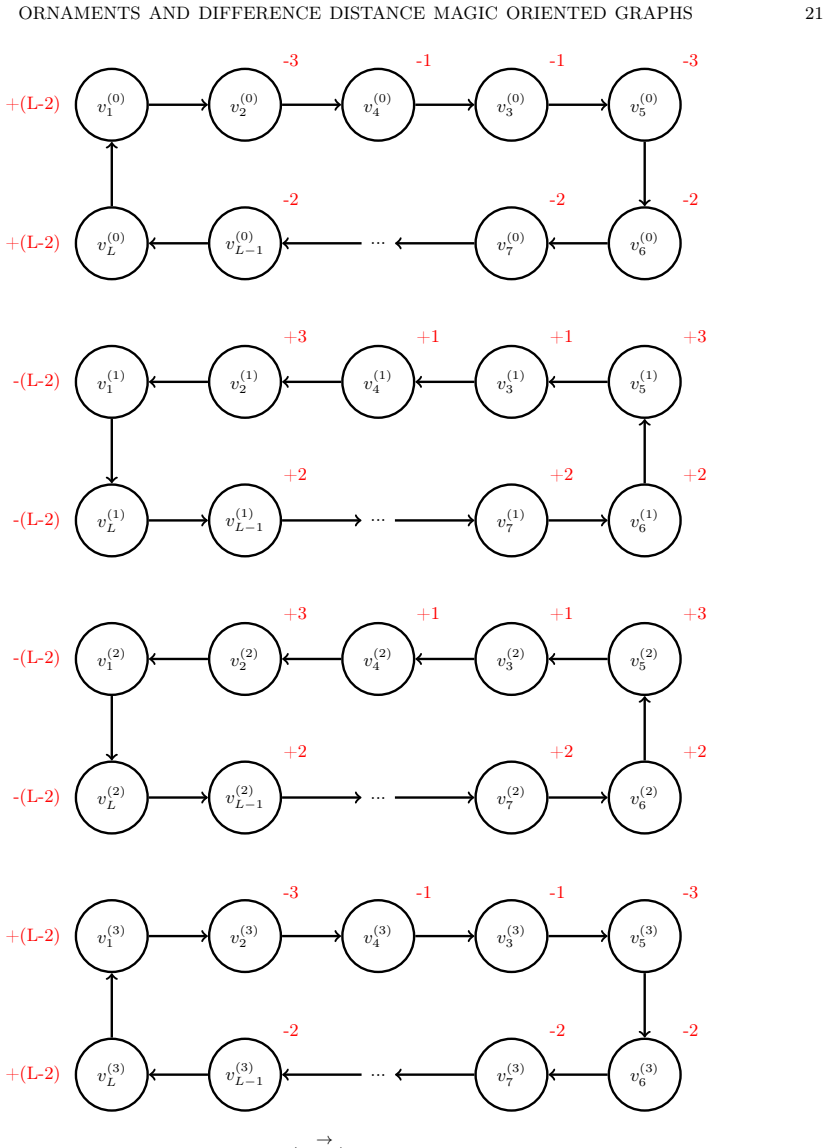


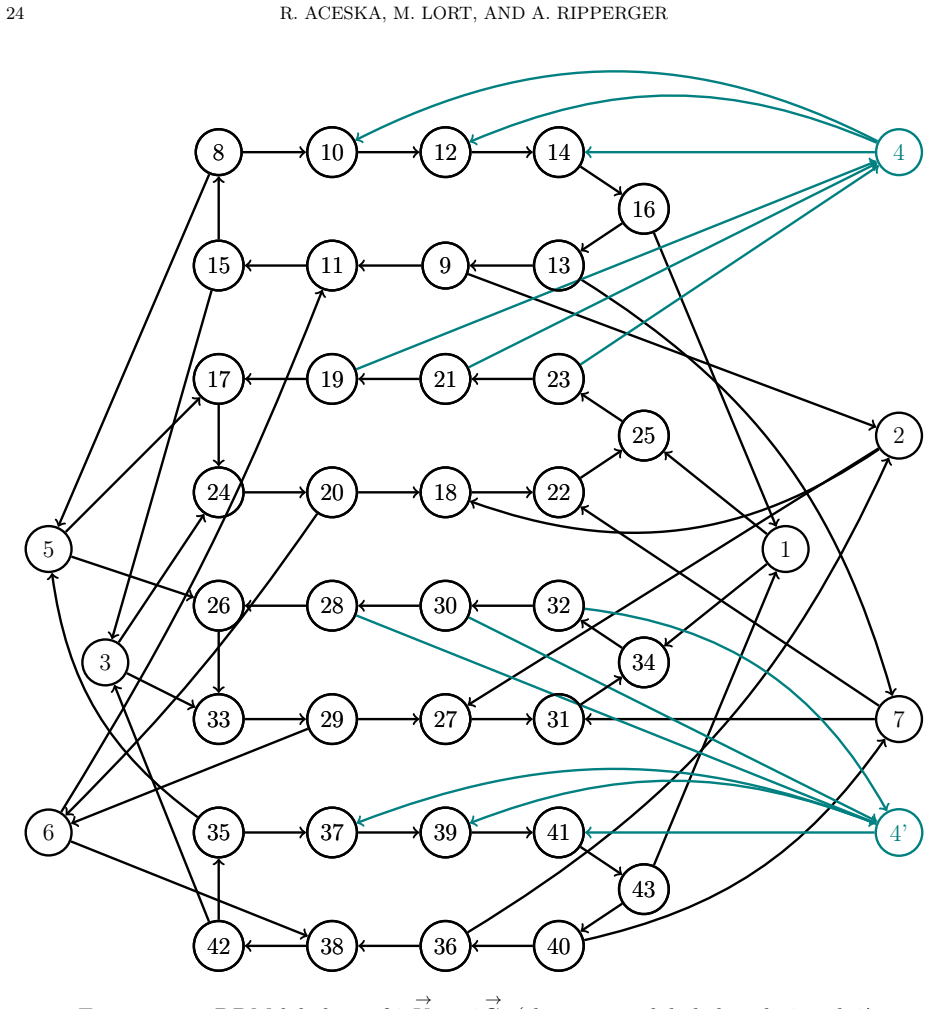


read the original abstract
One way to construct Difference Distance Magic Oriented Graphs (DDMOGs) is via a recently introduced technique called weighted sum. We explore the quality of said construction further by introducing the notion of an ornament. An ornament is an oriented graph that, when used in a weighted sum with an existing DDMOG, creates a new DDMOG. We provide results on the construction of a specific type of ornaments, called s-nodes ornaments. We conclude the paper with a list of open questions related to DDMOGs and ornaments.
Editorial analysis
A structured set of objections, weighed in public.
Referee Report
Summary. The paper introduces the notion of an 'ornament' as an oriented graph that, when combined via the weighted-sum operation with an existing Difference Distance Magic Oriented Graph (DDMOG), yields a new DDMOG. It claims to provide results on the construction of a subclass called s-nodes ornaments and concludes with a list of open questions on DDMOGs and ornaments.
Significance. If the claimed constructions for s-nodes ornaments are valid and the weighted-sum preservation property holds, the work would extend prior techniques for generating DDMOGs by supplying reusable auxiliary components. The explicit introduction of new objects together with constructive results and open questions could facilitate further exploration in magic labelings of oriented graphs.
major comments (1)
- The manuscript states that results on the construction of s-nodes ornaments are provided, yet the text supplies neither explicit constructions, formal definitions of the s-nodes subclass beyond the general ornament notion, nor any verification that the weighted-sum operation preserves the DDMOG property for these objects. This absence is load-bearing for the central claim.
Simulated Author's Rebuttal
We thank the referee for their detailed reading and for identifying a critical gap in the presentation of our results. We agree that the central claims require explicit support and will revise the manuscript accordingly.
read point-by-point responses
-
Referee: The manuscript states that results on the construction of s-nodes ornaments are provided, yet the text supplies neither explicit constructions, formal definitions of the s-nodes subclass beyond the general ornament notion, nor any verification that the weighted-sum operation preserves the DDMOG property for these objects. This absence is load-bearing for the central claim.
Authors: We acknowledge that the submitted manuscript does not contain the explicit constructions, a formal definition of the s-nodes subclass, or the required verification that the weighted-sum operation preserves the DDMOG property. These elements were intended to be included but were omitted from the final text. In the revised version we will add: (i) a precise definition of s-nodes ornaments as a subclass of ornaments, (ii) explicit constructions for such ornaments, and (iii) a complete proof that any weighted sum of an s-nodes ornament with a DDMOG yields a new DDMOG. We will also ensure all claims are supported by these additions. revision: yes
Circularity Check
No significant circularity; definition and constructions are independent of inputs
full rationale
The paper defines an ornament explicitly as an oriented graph preserving the DDMOG property under the weighted-sum operation introduced in prior (non-self) work, then supplies explicit constructions for the s-nodes subclass and lists open questions. No derivation reduces a claimed result to a fitted parameter, self-citation, or redefinition of its own inputs; the central contribution is the auxiliary notion plus constructive examples, which remain self-contained against external benchmarks.
Axiom & Free-Parameter Ledger
invented entities (2)
-
ornament
no independent evidence
-
s-nodes ornament
no independent evidence
Reference graph
Works this paper leans on
- [1]
-
[2]
K. Altman, L. Calzado, B. Freyberg, B. Kov \'a r , E. Lewis, A. Marr, L. Ross and R. Via. Difference distance magic oriented graphs. Res Math Sci. 11 67 (2024). https://doi.org/10.1007/s40687-024-00482-7 https://doi.org/10.1007/s40687-024-00482-7
-
[3]
J.A. Gallian. A Dynamic Survey of Graph Labeling. Electron. J. Combin. DS6 27, 1-712 (2024). https://doi.org/10.37236/27 https://doi.org/10.37236/27
work page doi:10.37236/27 2024
-
[4]
H. Enomoto, A. S. Llad \'o , T. Nakamigawa, and G. Ringel, Super edge-magic graphs, SUT J. Math. 34 (1998), 105--109. https://doi.org/10.55937/sut/991985322 https://doi.org/10.55937/sut/991985322
-
[5]
R. L. Graham and N. J. A. Sloane, On additive bases and harmonious graphs, SIAM J. Algebraic Discrete Methods 1 (1980), 382--404. https://doi.org/10.1137/0601045 https://doi.org/10.1137/0601045
-
[6]
Miller, C
M. Miller, C. Rodger and R. Simanjuntak. Distance magic labelings of graphs. Australasian J. of Combinatorics . 28 (2003) 305-315. https://ajc.maths.uq.edu.au/pdf/28/ajcv28p305.pdf https://ajc.maths.uq.edu.au/pdf/28/ajc_v28_p305.pdf
2003
-
[7]
Sedl \'a c ek, Problem 27, in: Theory of Graphs and its Applications, Proc
J. Sedl \'a c ek, Problem 27, in: Theory of Graphs and its Applications, Proc. Symposium Smolenice 1963, Publ. House Czechoslovak Acad. Sci., Prague (1964) 163--164
1963
-
[8]
(2021) ``Graph Theory and Complex Networks: An Introduction.''Link https://www.distributed-systems.net/index.php/books/gtcn/
Van Steen, M. (2021) ``Graph Theory and Complex Networks: An Introduction.''Link https://www.distributed-systems.net/index.php/books/gtcn/
2021
-
[9]
Link https://github.com/zachwilcher/DDMOG
Zach Wilcher's GitHub page. Link https://github.com/zachwilcher/DDMOG
-
[10]
D. B. West, Introduction to Graph Theory, 2nd ed. Upper Saddle River, NJ: Prentice Hall, 2001
2001
-
[11]
Zhao, W., Li, Y., Lin, R..``The existence of a graph whose vertex set can be partitioned into a fixed number of strong domination-critical vertex-sets.'' AIMS Mathematics . 9 1 (2024). Link https://doi.org/10.3934/math.2024095
discussion (0)
Sign in with ORCID, Apple, or X to comment. Anyone can read and Pith papers without signing in.