WAM-RL: World-Action Model Reinforcement Learning with Reconstruction Rewards and Online Video SFT
Pith reviewed 2026-06-27 00:58 UTC · model grok-4.3
The pith
Joint optimization of world model and actor is required for strong long-horizon performance in World-Action models.
A machine-rendered reading of the paper's core claim, the machinery that carries it, and where it could break.
Core claim
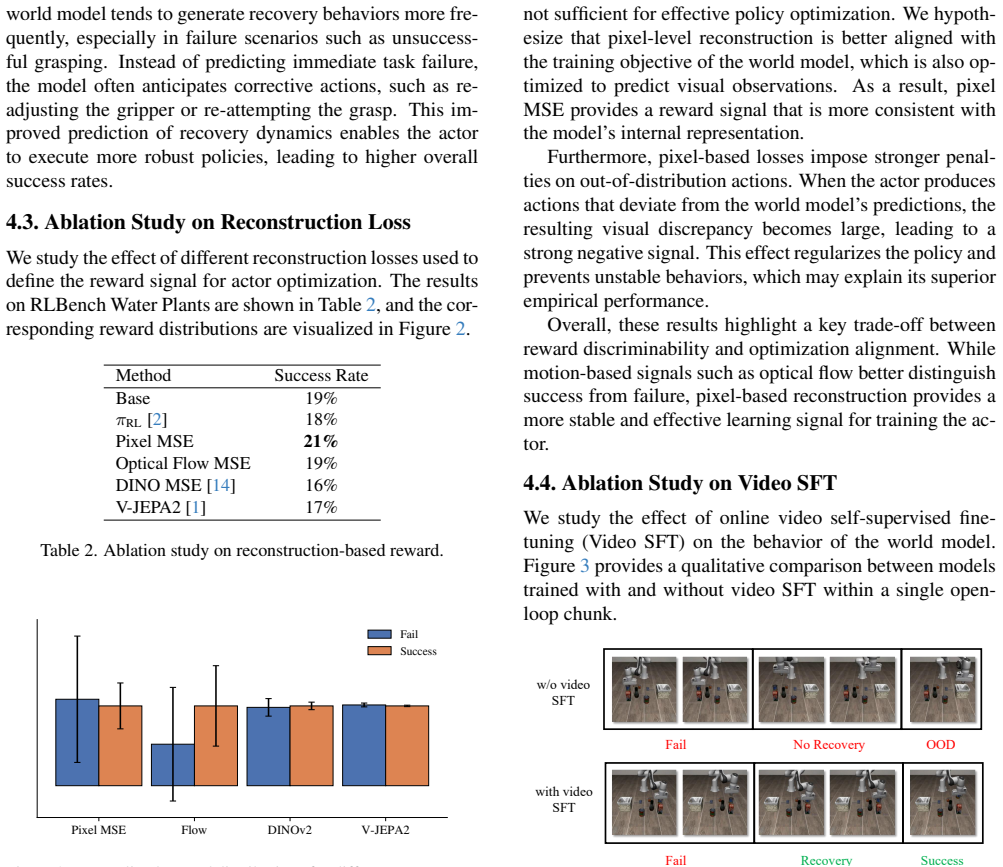
WAM-RL is the first reinforcement learning method applied inside the World-Action paradigm. It performs joint online optimization of the world model and the actor via a tailored hierarchical RL procedure that uses reconstruction rewards. Experiments demonstrate that actor-only optimization improves short-horizon tasks yet fails to deliver significant gains on long-horizon tasks, whereas joint optimization of both components is critical for strong long-horizon performance.
What carries the argument
Hierarchical reinforcement learning procedure that coordinates co-evolution of the world model and actor through online interaction and reconstruction rewards.
If this is right
- Actor-only RL suffices for short-horizon tasks but is insufficient for long-horizon ones.
- Joint world-model and actor optimization enables acquisition of fine-grained manipulation skills outside the expert distribution.
- Online interaction allows the model to keep improving after initial expert data are exhausted.
- The same hierarchical optimization structure can be applied to other World-Action architectures.
Where Pith is reading between the lines
- If the joint optimization scales, it could lower the volume of expert trajectories needed to reach a given performance level.
- The approach may transfer to other embodied settings where prediction quality directly affects planning horizon.
- Testing whether the same joint-training benefit appears when the world model is a video diffusion model rather than the current architecture would be a direct next experiment.
Load-bearing premise
The hierarchical RL procedure can keep the world model and actor stable while they co-evolve through online interaction without the predictions collapsing.
What would settle it
A controlled experiment in which joint optimization produces either unstable world-model predictions or no measurable improvement over actor-only training on the same long-horizon tasks would falsify the central claim.
Figures

read the original abstract
Recent World-Action (WA) models demonstrate strong generalization ability and data efficiency, but they typically rely on expert trajectories for training. This reliance limits their ability to acquire fine-grained manipulation skills beyond the demonstration distribution and prevents them from continuously improving through real-world interaction. To address these limitations, we propose WAM-RL, a reinforcement learning framework that enables joint optimization of the world model and the action model through online interaction with the environment. By allowing the two components to co-evolve, our approach enhances fine-grained control and adaptability. Specifically, a WA model consists of a world model and an actor. We design a tailored reinforcement learning method with hierarchical optimization to coordinate their improvement. On the methodological side, we systematically investigate the effects of applying reinforcement learning to the action model, as well as online training of the world model within an RL setting. Our experiments reveal a key insight: optimizing only the actor yields improvements on short-horizon tasks, but fails to provide significant gains on long-horizon tasks. In contrast, jointly optimizing both the world model and the actor is critical for achieving strong performance in long-horizon settings. Our work is the first to introduce reinforcement learning into the World-Action paradigm, and provides insights into how online optimization of both the action head and the world model impacts overall performance.
Editorial analysis
A structured set of objections, weighed in public.
Referee Report
Summary. The manuscript proposes WAM-RL, an RL framework that enables joint online optimization of the world model and actor within World-Action models via a tailored hierarchical optimization procedure. It reports that actor-only optimization improves short-horizon tasks while joint optimization of both components is required for strong long-horizon performance, and positions the work as the first introduction of RL into the WA paradigm.
Significance. If the empirical claims hold, the result would show that co-evolution of the world model and actor through online interaction overcomes the expert-data limitation of prior WA models and yields better fine-grained, long-horizon control. The systematic ablation of RL on the action head versus online world-model training supplies a concrete methodological insight.
major comments (1)
- [Abstract] Abstract: the claim that 'jointly optimizing both the world model and the actor is critical for achieving strong performance in long-horizon settings' is load-bearing, yet the abstract supplies no description of the reconstruction reward, the hierarchical update schedule, replay buffering, prediction regularization, or any other mechanism that would prevent compounding model error or collapse under the non-stationary data distribution induced by an improving actor.
Simulated Author's Rebuttal
We thank the referee for the thoughtful review and the opportunity to respond. We address the single major comment below. We agree the abstract is high-level and will revise it to better support the key claim while preserving conciseness.
read point-by-point responses
-
Referee: [Abstract] Abstract: the claim that 'jointly optimizing both the world model and the actor is critical for achieving strong performance in long-horizon settings' is load-bearing, yet the abstract supplies no description of the reconstruction reward, the hierarchical update schedule, replay buffering, prediction regularization, or any other mechanism that would prevent compounding model error or collapse under the non-stationary data distribution induced by an improving actor.
Authors: We acknowledge that the provided abstract does not explicitly name these mechanisms. The manuscript details them in the body: reconstruction rewards train the world model online (Section 3.2), the hierarchical schedule alternates actor and world-model updates with specific frequencies to maintain stability (Section 3.3), replay buffering stores recent trajectories to handle non-stationarity (Section 3.4), and prediction regularization plus KL penalties mitigate compounding error and collapse (Section 3.5). These components are what enable the reported long-horizon gains. To strengthen the abstract, we will add a concise clause such as 'via reconstruction rewards, hierarchical optimization, replay buffering, and regularization' so the load-bearing claim is better supported at the summary level. revision: yes
Circularity Check
No significant circularity detected
full rationale
The paper's central claim—that jointly optimizing the world model and actor is critical for long-horizon performance—is presented as an empirical observation from experiments comparing actor-only versus joint optimization. No equations, fitted parameters called predictions, self-citations, uniqueness theorems, or ansatzes appear in the abstract or described methodology that would reduce this insight to a tautology or input by construction. The analysis remains self-contained as an experimental result without load-bearing reductions to prior self-referential elements.
Axiom & Free-Parameter Ledger
Reference graph
Works this paper leans on
-
[1]
V-jepa 2: Self-supervised video models enable understanding, prediction and planning, 2025
Mido Assran, Adrien Bardes, David Fan, Quentin Garrido, Russell Howes, Mojtaba, Komeili, Matthew Muckley, Am- mar Rizvi, Claire Roberts, Koustuv Sinha, Artem Zholus, Sergio Arnaud, Abha Gejji, Ada Martin, Francois Robert Hogan, Daniel Dugas, Piotr Bojanowski, Vasil Khalidov, Patrick Labatut, Francisco Massa, Marc Szafraniec, Kapil Krishnakumar, Yong Li, X...
2025
-
[2]
πRL: Online rl fine-tuning for flow-based vision-language- action models, 2026
Kang Chen, Zhihao Liu, Tonghe Zhang, Zhen Guo, Si Xu, Hao Lin, Hongzhi Zang, Xiang Li, Quanlu Zhang, Zhaofei Yu, Guoliang Fan, Tiejun Huang, Yu Wang, and Chao Yu. πRL: Online rl fine-tuning for flow-based vision-language- action models, 2026. 2, 5, 6
2026
-
[3]
Conrft: A reinforced fine-tuning method for vla models via consistency policy, 2025
Yuhui Chen, Shuai Tian, Shugao Liu, Yingting Zhou, Hao- ran Li, and Dongbin Zhao. Conrft: A reinforced fine-tuning method for vla models via consistency policy, 2025. 2
2025
-
[4]
Video prediction policy: A generalist robot policy with predictive visual representations, 2025
Yucheng Hu, Yanjiang Guo, Pengchao Wang, Xiaoyu Chen, Yen-Jen Wang, Jianke Zhang, Koushil Sreenath, Chaochao Lu, and Jianyu Chen. Video prediction policy: A generalist robot policy with predictive visual representations, 2025. 1, 2
2025
-
[5]
Co-rft: Efficient fine-tuning of vision-language-action models through chunked offline re- inforcement learning, 2025
Dongchi Huang, Zhirui Fang, Tianle Zhang, Yihang Li, Lin Zhao, and Chunhe Xia. Co-rft: Efficient fine-tuning of vision-language-action models through chunked offline re- inforcement learning, 2025. 2
2025
-
[6]
Stephen James, Zicong Ma, David Rovick Arrojo, and An- drew J. Davison. Rlbench: The robot learning benchmark & learning environment, 2019. 2, 5
2019
-
[7]
Cosmos policy: Fine- tuning video models for visuomotor control and planning,
Moo Jin Kim, Yihuai Gao, Tsung-Yi Lin, Yen-Chen Lin, Yunhao Ge, Grace Lam, Percy Liang, Shuran Song, Ming- Yu Liu, Chelsea Finn, and Jinwei Gu. Cosmos policy: Fine- tuning video models for visuomotor control and planning,
-
[8]
Vla-rft: Vision- language-action reinforcement fine-tuning with verified re- wards in world simulators, 2025
Hengtao Li, Pengxiang Ding, Runze Suo, Yihao Wang, Zirui Ge, Dongyuan Zang, Kexian Yu, Mingyang Sun, Hongyin Zhang, Donglin Wang, and Weihua Su. Vla-rft: Vision- language-action reinforcement fine-tuning with verified re- wards in world simulators, 2025. 2
2025
-
[9]
Simplevla- rl: Scaling vla training via reinforcement learning, 2025
Haozhan Li, Yuxin Zuo, Jiale Yu, Yuhao Zhang, Zhaohui Yang, Kaiyan Zhang, Xuekai Zhu, Yuchen Zhang, Tianxing Chen, Ganqu Cui, Dehui Wang, Dingxiang Luo, Yuchen Fan, Youbang Sun, Jia Zeng, Jiangmiao Pang, Shanghang Zhang, Yu Wang, Yao Mu, Bowen Zhou, and Ning Ding. Simplevla- rl: Scaling vla training via reinforcement learning, 2025. 2
2025
-
[10]
Causal world modeling for robot control, 2026
Lin Li, Qihang Zhang, Yiming Luo, Shuai Yang, Ruilin Wang, Fei Han, Mingrui Yu, Zelin Gao, Nan Xue, Xing Zhu, Yujun Shen, and Yinghao Xu. Causal world modeling for robot control, 2026. 1, 2
2026
-
[11]
Gr-rl: Going dexterous and pre- cise for long-horizon robotic manipulation, 2025
Yunfei Li, Xiao Ma, Jiafeng Xu, Yu Cui, Zhongren Cui, Zhi- gang Han, Liqun Huang, Tao Kong, Yuxiao Liu, Hao Niu, Wanli Peng, Jingchao Qiao, Zeyu Ren, Haixin Shi, Zhi Su, Jiawen Tian, Yuyang Xiao, Shenyu Zhang, Liwei Zheng, Hang Li, and Yonghui Wu. Gr-rl: Going dexterous and pre- cise for long-horizon robotic manipulation, 2025. 2
2025
-
[12]
Genie envisioner: A unified world foun- dation platform for robotic manipulation, 2025
Yue Liao, Pengfei Zhou, Siyuan Huang, Donglin Yang, Shengcong Chen, Yuxin Jiang, Yue Hu, Jingbin Cai, Si Liu, Jianlan Luo, Liliang Chen, Shuicheng Yan, Maoqing Yao, and Guanghui Ren. Genie envisioner: A unified world foun- dation platform for robotic manipulation, 2025. 1, 2
2025
-
[13]
Libero: Benchmarking knowl- edge transfer for lifelong robot learning, 2023
Bo Liu, Yifeng Zhu, Chongkai Gao, Yihao Feng, Qiang Liu, Yuke Zhu, and Peter Stone. Libero: Benchmarking knowl- edge transfer for lifelong robot learning, 2023. 2, 5
2023
-
[14]
Dinov2: Learning robust visual features with- out supervision, 2024
Maxime Oquab, Timoth ´ee Darcet, Th ´eo Moutakanni, Huy V o, Marc Szafraniec, Vasil Khalidov, Pierre Fernandez, Daniel Haziza, Francisco Massa, Alaaeldin El-Nouby, Mah- moud Assran, Nicolas Ballas, Wojciech Galuba, Russell Howes, Po-Yao Huang, Shang-Wen Li, Ishan Misra, Michael Rabbat, Vasu Sharma, Gabriel Synnaeve, Hu Xu, Herv ´e Je- gou, Julien Mairal, ...
2024
-
[15]
Interactive post-training for vision-language- action models, 2025
Shuhan Tan, Kairan Dou, Yue Zhao, and Philipp Kr¨ahenb¨uhl. Interactive post-training for vision-language- action models, 2025. 2
2025
-
[16]
Self- improving vision-language-action models with data gener- ation via residual rl, 2025
Wenli Xiao, Haotian Lin, Andy Peng, Haoru Xue, Tairan He, Yuqi Xie, Fengyuan Hu, Jimmy Wu, Zhengyi Luo, Linxi ”Jim” Fan, Guanya Shi, and Yuke Zhu. Self- improving vision-language-action models with data gener- ation via residual rl, 2025. 2
2025
-
[17]
Twinrl-vla: Digital twin-driven reinforcement learn- ing for real-world robotic manipulation, 2026
Qinwen Xu, Jiaming Liu, Rui Zhou, Shaojun Shi, Nuowei Han, Zhuoyang Liu, Chenyang Gu, Shuo Gu, Yang Yue, Gao Huang, Wenzhao Zheng, Sirui Han, Peng Jia, and Shanghang Zhang. Twinrl-vla: Digital twin-driven reinforcement learn- ing for real-world robotic manipulation, 2026. 2
2026
-
[18]
World action models are zero-shot policies, 2026
Seonghyeon Ye, Yunhao Ge, Kaiyuan Zheng, Shenyuan Gao, Sihyun Yu, George Kurian, Suneel Indupuru, You Liang Tan, Chuning Zhu, Jiannan Xiang, Ayaan Malik, Kyungmin Lee, William Liang, Nadun Ranawaka, Jiasheng Gu, Yinzhen Xu, Guanzhi Wang, Fengyuan Hu, Avnish Narayan, Johan Bjorck, Jing Wang, Gwanghyun Kim, Dan- tong Niu, Ruijie Zheng, Yuqi Xie, Jimmy Wu, Q...
2026
-
[19]
Balancing sig- nal and variance: Adaptive offline rl post-training for vla flow models, 2025
Hongyin Zhang, Shiyuan Zhang, Junxi Jin, Qixin Zeng, Yi- fan Qiao, Hongchao Lu, and Donglin Wang. Balancing sig- nal and variance: Adaptive offline rl post-training for vla flow models, 2025. 2
2025
-
[20]
Unified world mod- els: Coupling video and action diffusion for pretraining on large robotic datasets, 2025
Chuning Zhu, Raymond Yu, Siyuan Feng, Benjamin Burch- fiel, Paarth Shah, and Abhishek Gupta. Unified world mod- els: Coupling video and action diffusion for pretraining on large robotic datasets, 2025. 2
2025
discussion (0)
Sign in with ORCID, Apple, or X to comment. Anyone can read and Pith papers without signing in.