Data-Driven Discovery of a Simple Phantom-Crossing Dark Energy Parametrization
Pith reviewed 2026-06-26 23:41 UTC · model grok-4.3
The pith
A one-parameter dark energy form w(a) = w0 / sqrt(a) fits observations as well as two-parameter models and gains Bayesian support over LambdaCDM.
A machine-rendered reading of the paper's core claim, the machinery that carries it, and where it could break.
Core claim
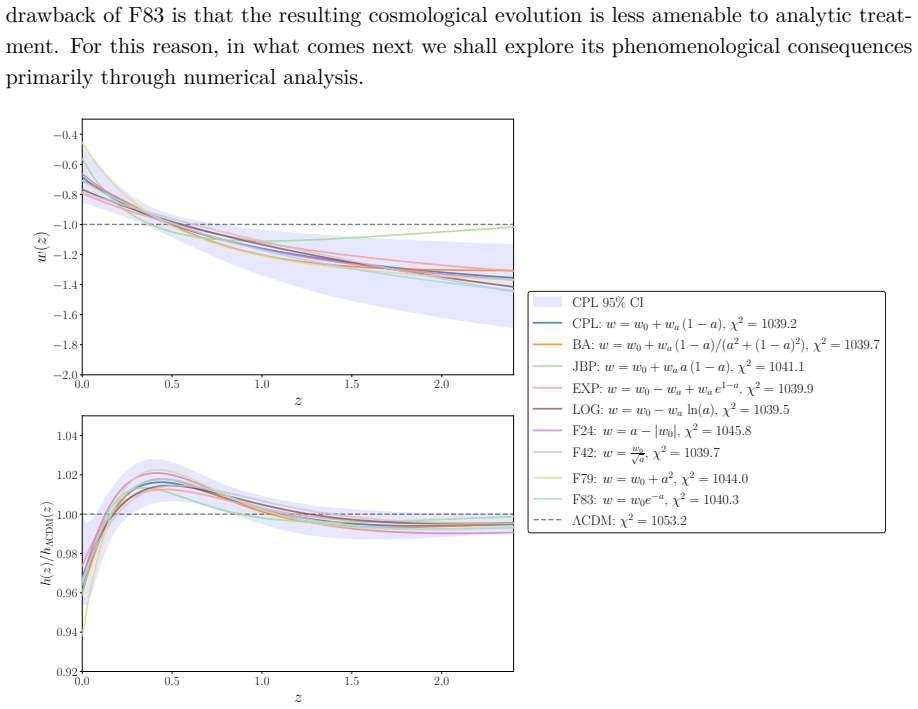
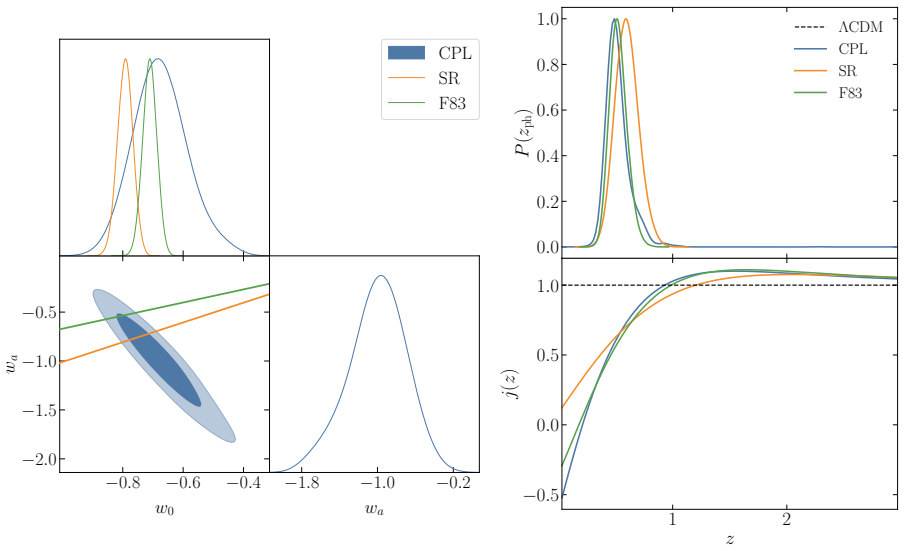
Within VCDM, Bayesian spline reconstruction of w(a) from CMB, BAO, and type-Ia supernova data disfavors increasingly complex models and prefers smooth monotonic phantom-crossing trajectories. Exhaustive symbolic regression then isolates the one-parameter parametrization w(a) = w0 / sqrt(a) that matches the reconstructed behavior while achieving data fits comparable to the two-parameter CPL form. Bayesian model comparison gives this parametrization mild-to-moderate support relative to standard two-parameter alternatives and stronger evidence relative to LambdaCDM; the model naturally crosses the phantom divide for w0 < 0, suppresses early dark energy, and predicts a transient accelerating and
What carries the argument
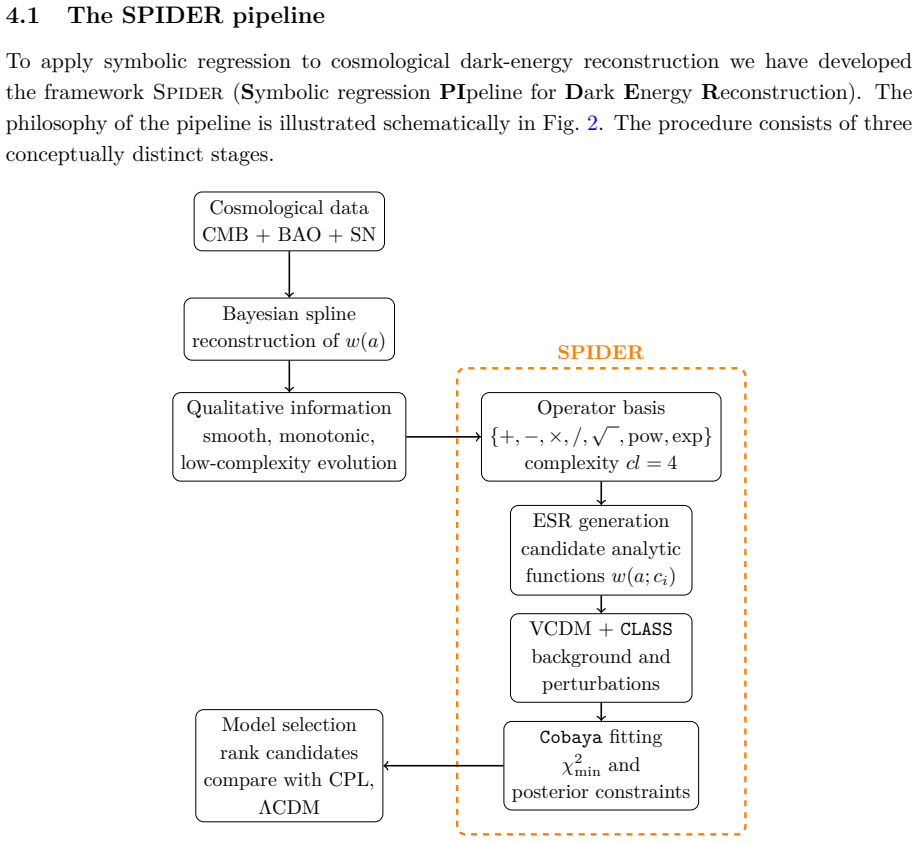
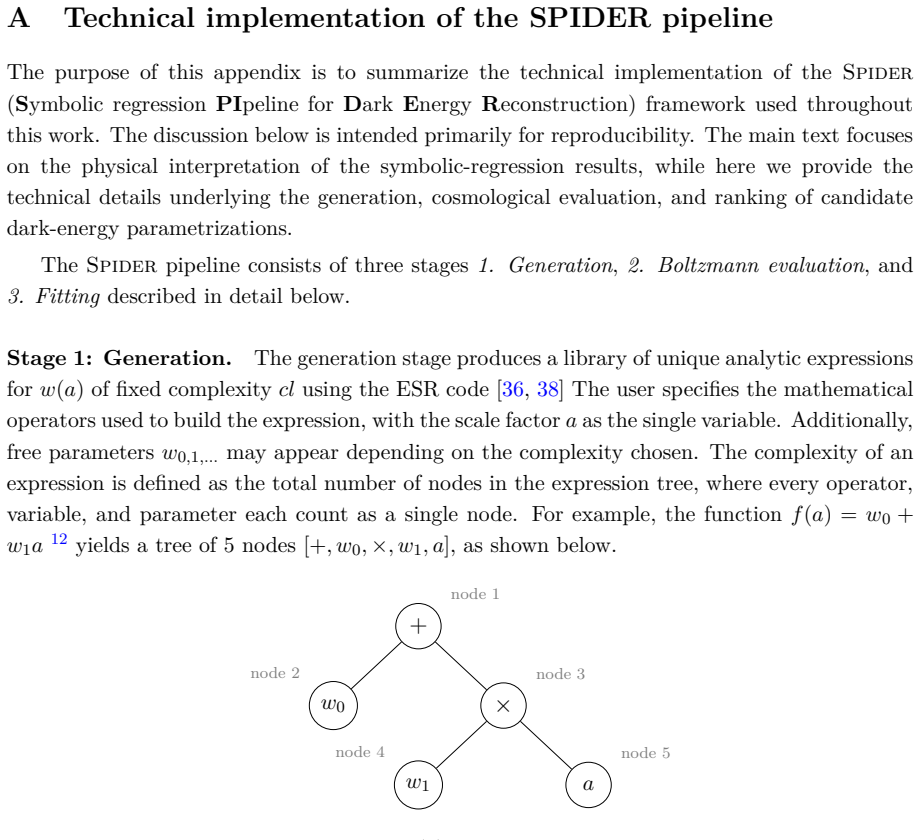
Exhaustive symbolic regression applied after Bayesian spline reconstruction of w(a), which systematically enumerates analytic expressions of fixed complexity and selects w(a) = w0 / sqrt(a) as the minimal form that reproduces the data-driven preference for phantom-crossing dynamics.
If this is right
- The model crosses the phantom divide for any w0 < 0.
- Early dark energy is automatically suppressed.
- Acceleration and the phantom phase are transient and end without a big-rip singularity.
- As a one-parameter model it is highly predictive and does not recover LambdaCDM as a limit.
- It constitutes a dynamical deformation of the cosmological constant.
Where Pith is reading between the lines
- The same reconstruction-plus-symbolic-regression pipeline could be applied to other cosmological functions such as the growth rate or the sound horizon to test whether similarly simple analytic forms emerge.
- Future surveys with tighter constraints on w(a) at multiple redshifts could directly test whether the inverse-square-root dependence continues to be favored.
- If the form persists, it may point to underlying mechanisms in minimally modified gravity that naturally generate scale-factor dependence of this type.
Load-bearing premise
The Bayesian spline reconstruction accurately reflects the true underlying w(a) trajectory preferred by the data rather than an artifact of the spline prior or the particular data combination.
What would settle it
New or reanalyzed data that either eliminate the preference for monotonic phantom-crossing behavior in the spline reconstruction or show that the one-parameter form w(a) = w0 / sqrt(a) fits significantly worse than LambdaCDM or CPL would falsify the central claim.
Figures


read the original abstract
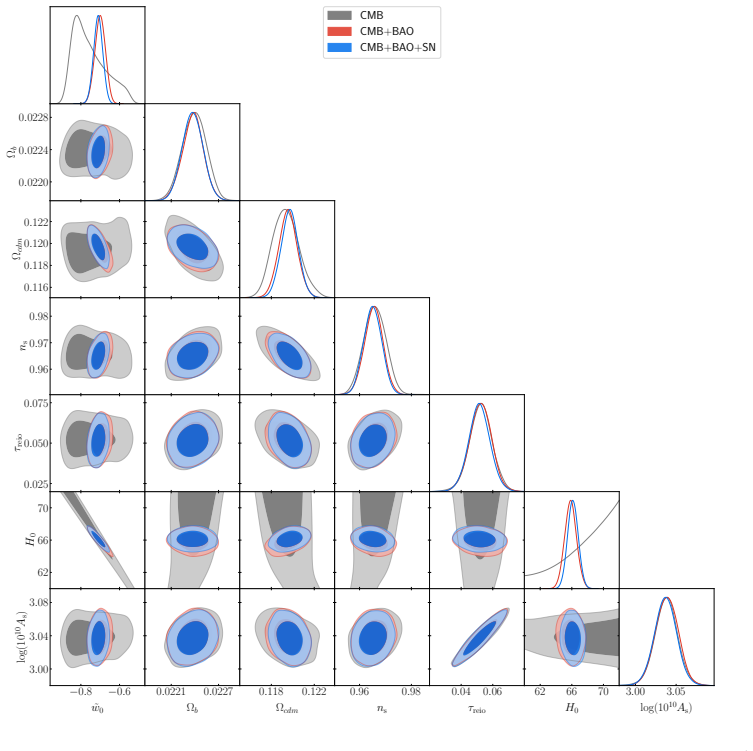
We develop a data-driven reconstruction programme for the dark-energy equation of state within VCDM, a minimally modified gravity framework in which both background and linear perturbations can be consistently evolved across the phantom divide. Using CMB, BAO, and type-Ia supernova data, we first perform a Bayesian spline reconstruction of $w(a)$, finding a preference for smooth, monotonic phantom-crossing trajectories. Bayesian evidence disfavors increasingly complex spline models, indicating that current observations exhibit a statistical preference for low-complexity dark-energy dynamics. Motivated by this result, we apply Exhaustive Symbolic Regression, an interpretable machine-learning technique that systematically searches over analytic expressions of fixed complexity, identifying the remarkably simple one-parameter form $w(a)={w_0}/{\sqrt a}$, which reproduces the reconstructed behaviour and fits the data at a level comparable to standard two-parameter parametrizations such as CPL. The model naturally crosses the phantom divide for $w_0<0$, suppresses early dark energy, and predicts a transient accelerating and phantom phase without a future big-rip singularity. As a one-parameter model, it is highly predictive, being a genuinely dynamical deformation of the cosmological constant rather than containing it as a limit. Bayesian model comparison yields mild-to-moderate support for this parametrization relative to standard two-parameter alternatives, and stronger evidence relative to $\Lambda$CDM. Our results suggest that current observations favour surprisingly simple dark-energy dynamics and illustrate how Bayesian reconstruction and symbolic regression can be combined into a principled model-discovery framework for cosmology.
Editorial analysis
A structured set of objections, weighed in public.
Referee Report
Summary. The manuscript develops a data-driven reconstruction programme for the dark-energy equation of state w(a) within the VCDM framework. Using CMB+BAO+SN data, it performs a Bayesian spline reconstruction that prefers smooth monotonic phantom-crossing trajectories, with evidence disfavoring complex splines. This motivates exhaustive symbolic regression, which identifies the one-parameter form w(a)=w0/sqrt(a) as reproducing the reconstruction and fitting the data at a level comparable to CPL, with mild-to-moderate Bayesian support over two-parameter alternatives and stronger support over LambdaCDM. The model naturally crosses the phantom divide for w0<0, suppresses early dark energy, and avoids a future big-rip.
Significance. If the spline reconstruction is robust, the work supplies a highly predictive, one-parameter dynamical deformation of LambdaCDM that is falsifiable and avoids singularities. The combination of Bayesian reconstruction with exhaustive symbolic regression constitutes a principled model-discovery framework; the explicit one-parameter form and reported evidence ratios are concrete strengths that would be valuable if the reconstruction step is shown to be data-driven rather than prior-driven.
major comments (2)
- [Bayesian spline reconstruction (motivating section)] The load-bearing step is the Bayesian spline reconstruction of w(a) (described in the abstract and motivating the symbolic regression). Spline reconstructions of w(a) are known to depend on knot number, placement, and the prior on coefficients, especially at high redshift where data are weak. The manuscript must demonstrate that the reported preference for smooth monotonic phantom-crossing trajectories survives changes in these choices; without such tests the subsequent symbolic regression searches an unverified shape rather than a data-driven feature.
- [Bayesian model comparison] The claim that the identified form 'fits the data at a level comparable to standard two-parameter parametrizations such as CPL' and yields 'mild-to-moderate support' requires explicit quantitative comparison (e.g., Delta ln Z or chi^2 values) in the model-comparison section or table; the abstract alone does not supply the numbers needed to assess whether the one-parameter model is genuinely competitive.
minor comments (2)
- Clarify the precise data combinations, redshift cuts, and any exclusion criteria used in the spline reconstruction.
- Number all equations and ensure consistent cross-referencing between the reconstruction and symbolic-regression sections.
Simulated Author's Rebuttal
We thank the referee for their constructive and detailed report. The comments highlight important points regarding robustness and quantitative presentation, which we address below.
read point-by-point responses
-
Referee: [Bayesian spline reconstruction (motivating section)] The load-bearing step is the Bayesian spline reconstruction of w(a) (described in the abstract and motivating the symbolic regression). Spline reconstructions of w(a) are known to depend on knot number, placement, and the prior on coefficients, especially at high redshift where data are weak. The manuscript must demonstrate that the reported preference for smooth monotonic phantom-crossing trajectories survives changes in these choices; without such tests the subsequent symbolic regression searches an unverified shape rather than a data-driven feature.
Authors: We agree that explicit robustness checks are necessary to confirm the reconstruction is data-driven rather than sensitive to modeling choices. While the reported Bayesian evidence already penalizes increasing spline complexity (thereby providing some protection against prior-driven artifacts), we acknowledge that varying knot number, placement, and coefficient priors constitutes a stronger test. In the revised manuscript we add these tests (varying knots from 3 to 8, uniform vs. Gaussian priors of different widths, and both fixed and adaptive knot placements) and show that the preference for smooth monotonic phantom-crossing trajectories persists in all cases, with evidence ratios continuing to disfavor more complex models. The new results are presented in an appendix. revision: yes
-
Referee: [Bayesian model comparison] The claim that the identified form 'fits the data at a level comparable to standard two-parameter parametrizations such as CPL' and yields 'mild-to-moderate support' requires explicit quantitative comparison (e.g., Delta ln Z or chi^2 values) in the model-comparison section or table; the abstract alone does not supply the numbers needed to assess whether the one-parameter model is genuinely competitive.
Authors: The manuscript text already contains the model-comparison results that underlie the qualitative statements in the abstract. To make the quantitative evidence immediately accessible, we have added an explicit table (new Table 4) reporting Delta ln Z and chi^2 differences between the one-parameter form, CPL, and LambdaCDM. This table confirms the mild-to-moderate support relative to CPL and the stronger support over LambdaCDM. revision: yes
Circularity Check
Symbolic regression fits analytic form directly to spline-reconstructed w(a), presented as data-driven discovery
specific steps
-
fitted input called prediction
[Abstract]
"Motivated by this result, we apply Exhaustive Symbolic Regression, an interpretable machine-learning technique that systematically searches over analytic expressions of fixed complexity, identifying the remarkably simple one-parameter form w(a)={w_0}/{\\sqrt a}, which reproduces the reconstructed behaviour and fits the data at a level comparable to standard two-parameter parametrizations such as CPL."
The symbolic regression is applied to the spline-reconstructed w(a) trajectory and selects the form precisely because it reproduces that reconstruction; the 'discovery' is therefore the output of fitting analytic expressions to the fitted spline result rather than a prediction or derivation independent of the reconstruction inputs.
full rationale
The paper's derivation proceeds from Bayesian spline reconstruction of w(a) (showing monotonic phantom-crossing preference) to exhaustive symbolic regression that identifies w(a)=w0/sqrt(a) because it reproduces the reconstructed behaviour. This matches the fitted_input_called_prediction pattern: the symbolic step searches expressions of fixed complexity to match the spline output, so the claimed simple parametrization is a direct fit to the intermediate reconstruction rather than an independent result. The spline reconstruction itself is grounded in CMB+BAO+SN data and the subsequent model comparison to CPL and LambdaCDM provides external validation, preventing a higher circularity score. No self-citation load-bearing or self-definitional steps are evident in the provided chain.
Axiom & Free-Parameter Ledger
free parameters (1)
- w0
axioms (1)
- domain assumption VCDM minimally modified gravity allows consistent evolution of background and linear perturbations across the phantom divide
Forward citations
Cited by 1 Pith paper
-
Quintom Model Perturbations
A two-field quintom model reproduces w0waCDM perturbation features and is mildly favored over it in Bayesian fits to BAO, CMB, and SNIa data.
Reference graph
Works this paper leans on
-
[1]
E. J. Copeland, M. Sami, and S. Tsujikawa, “Dynamics of dark energy,”Int. J. Mod. Phys. D15 (2006) 1753–1936,arXiv:hep-th/0603057. 25
Pith/arXiv arXiv 2006
-
[2]
Dark Energy and the Accelerating Universe,
J. Frieman, M. Turner, and D. Huterer, “Dark Energy and the Accelerating Universe,”Ann. Rev. Astron. Astrophys.46(2008) 385–432,arXiv:0803.0982 [astro-ph]
Pith/arXiv arXiv 2008
-
[3]
M. Li, X.-D. Li, S. Wang, and Y. Wang, “Dark Energy,”Commun. Theor. Phys.56(2011) 525–604,arXiv:1103.5870 [astro-ph.CO]. [4]DESICollaboration, A. G. Adameet al., “DESI 2024 VI: Cosmological Constraints from the Measurements of Baryon Acoustic Oscillations,”arXiv:2404.03002 [astro-ph.CO]. [5]DESICollaboration, M. Abdul Karimet al., “DESI DR2 results. II. M...
Pith/arXiv arXiv 2011
-
[4]
The Pantheon+ Analysis: Cosmological Constraints,
D. Broutet al., “The Pantheon+ Analysis: Cosmological Constraints,”Astrophys. J.938no. 2, (2022) 110,arXiv:2202.04077 [astro-ph.CO]
Pith/arXiv arXiv 2022
-
[5]
Union Through UNITY: Cosmology with 2,000 SNe Using a Unified Bayesian Framework,
D. Rubinet al., “Union Through UNITY: Cosmology with 2,000 SNe Using a Unified Bayesian Framework,”Astrophys. J.986no. 2, (2025) 231,arXiv:2311.12098 [astro-ph.CO]. [8]DESCollaboration, T. M. C. Abbottet al., “The Dark Energy Survey: Cosmology Results with ∼1500 New High-redshift Type Ia Supernovae Using the Full 5 yr Data Set,”Astrophys. J. Lett. 973no. ...
Pith/arXiv arXiv 2025
-
[6]
A Reassessment of the Pantheon+ and DES 5YR Calibration Uncertainties: Dovekie,
B. Popovicet al., “A Reassessment of the Pantheon+ and DES 5YR Calibration Uncertainties: Dovekie,”arXiv:2506.05471 [astro-ph.CO]. [11]DESCollaboration, B. Popovicet al., “The Dark Energy Survey Supernova Program: A Reanalysis Of Cosmology Results And Evidence For Evolving Dark Energy With An Updated Type Ia Supernova Calibration,”arXiv:2511.07517 [astro-...
arXiv 2018
-
[7]
Assessing observational constraints on dark energy,
D. Shlivko and P. J. Steinhardt, “Assessing observational constraints on dark energy,”Phys. Lett. B855(2024) 138826,arXiv:2405.03933 [astro-ph.CO]. 26
Pith/arXiv arXiv 2024
-
[8]
Quintessential interpretation of the evolving dark energy in light of DESI observations,
Y. Tada and T. Terada, “Quintessential interpretation of the evolving dark energy in light of DESI observations,”Phys. Rev. D109no. 12, (2024) L121305,arXiv:2404.05722 [astro-ph.CO]
arXiv 2024
-
[9]
Interpreting DESI’s evidence for evolving dark energy,
M. Cortês and A. R. Liddle, “Interpreting DESI’s evidence for evolving dark energy,”JCAP12 (2024) 007,arXiv:2404.08056 [astro-ph.CO]
arXiv 2024
-
[10]
Cosmological constraints on curved quintessence,
S. Bhattacharya, G. Borghetto, A. Malhotra, S. Parameswaran, G. Tasinato, and I. Zavala, “Cosmological constraints on curved quintessence,”JCAP09(2024) 073,arXiv:2405.17396 [astro-ph.CO]
arXiv 2024
-
[11]
E. Ó. Colgáin, M. G. Dainotti, S. Capozziello, S. Pourojaghi, M. M. Sheikh-Jabbari, and D. Stojkovic, “Does DESI 2024 confirmΛCDM?,”JHEAp49(2026) 100428,arXiv:2404.08633 [astro-ph.CO]
arXiv 2024
-
[12]
Does dark energy really revive using DESI 2024 data?,
Y. Carloni, O. Luongo, and M. Muccino, “Does dark energy really revive using DESI 2024 data?,” Phys. Rev. D111no. 2, (2025) 023512,arXiv:2404.12068 [astro-ph.CO]. [24]DESICollaboration, K. Lodhaet al., “Extended dark energy analysis using DESI DR2 BAO measurements,”Phys. Rev. D112no. 8, (2025) 083511,arXiv:2503.14743 [astro-ph.CO]
arXiv 2024
-
[13]
Robustness of dark energy phenomenology across different parameterizations,
W. J. Wolf, C. García-García, and P. G. Ferreira, “Robustness of dark energy phenomenology across different parameterizations,”JCAP05(2025) 034,arXiv:2502.04929 [astro-ph.CO]
arXiv 2025
-
[14]
An overview of what current data can (and cannot yet) say about evolving dark energy,
W. Giarè, T. Mahassen, E. Di Valentino, and S. Pan, “An overview of what current data can (and cannot yet) say about evolving dark energy,”Phys. Dark Univ.48(2025) 101906, arXiv:2502.10264 [astro-ph.CO]. [27]CosmoV erse NetworkCollaboration, E. Di Valentinoet al., “The CosmoVerse White Paper: Addressing observational tensions in cosmology with systematics...
arXiv 2025
-
[15]
Effective Phantom Dark Energy: What Cosmological Reconstruction Does and Does Not Imply,
S. S. Mishra, “Effective Phantom Dark Energy: What Cosmological Reconstruction Does and Does Not Imply,”arXiv:2605.27301 [astro-ph.CO]
-
[16]
Accelerating universes with scaling dark matter,
M. Chevallier and D. Polarski, “Accelerating universes with scaling dark matter,”Int. J. Mod. Phys. D10(2001) 213–224,arXiv:gr-qc/0009008
Pith/arXiv arXiv 2001
-
[17]
Exploring the expansion history of the universe,
E. V. Linder, “Exploring the expansion history of the universe,”Phys. Rev. Lett.90(2003) 091301, arXiv:astro-ph/0208512
Pith/arXiv arXiv 2003
-
[18]
Parameterizing Dark Energy at the density level: A two-parameter alternative to CPL,
G. Montefalcone and R. Stiskalek, “Parameterizing Dark Energy at the density level: A two-parameter alternative to CPL,”arXiv:2603.25735 [astro-ph.CO]
-
[19]
A theory of type-II minimally modified gravity,
A. De Felice, A. Doll, and S. Mukohyama, “A theory of type-II minimally modified gravity,”JCAP 09(2020) 034,arXiv:2004.12549 [gr-qc]
arXiv 2020
-
[20]
Comparison of two theories of Type-IIa minimally modified gravity,
A. De Felice, K.-i. Maeda, S. Mukohyama, and M. C. Pookkillath, “Comparison of two theories of Type-IIa minimally modified gravity,”Phys. Rev. D106no. 2, (2022) 024028,arXiv:2204.08294 [gr-qc]
arXiv 2022
-
[21]
Dynamical dark energy parametrizations in VCDM,
S. Arora, A. De Felice, and S. Mukohyama, “Dynamical dark energy parametrizations in VCDM,” Phys. Rev. D112no. 12, (2025) 123518,arXiv:2508.03784 [gr-qc]
arXiv 2025
-
[22]
The Cosmic Linear Anisotropy Solving System (CLASS) II: Approximation schemes,
D. Blas, J. Lesgourgues, and T. Tram, “The Cosmic Linear Anisotropy Solving System (CLASS) II: Approximation schemes,”JCAP1107(2011) 034,arXiv:1104.2933 [astro-ph.CO]. 27
Pith/arXiv arXiv 2011
-
[23]
Exhaustive Symbolic Regression,
D. J. Bartlett, H. Desmond, and P. G. Ferreira, “Exhaustive Symbolic Regression,”IEEE Trans. Evol. Comput.28no. 4, (2024) 964,arXiv:2211.11461 [astro-ph.CO]
arXiv 2024
-
[24]
Interpretable machine learning for science with pysr and symbolicregression.jl,
M. Cranmer, “Interpretable machine learning for science with pysr and symbolicregression.jl,” arXiv:2305.01582 [astro-ph.IM]
-
[25]
(Exhaustive) Symbolic Regression and model selection by minimum description length,
H. Desmond, “(Exhaustive) Symbolic Regression and model selection by minimum description length,”arXiv:2507.13033 [astro-ph.IM]
-
[26]
Symbolic regression analysis of dynamical dark energy with DESI-DR2 and SN data,
A. Sousa-Neto, C. Bengaly, J. E. Gonzalez, and J. Alcaniz, “Symbolic regression analysis of dynamical dark energy with DESI-DR2 and SN data,”Phys. Dark Univ.50(2025) 102108, arXiv:2502.10506 [astro-ph.CO]
arXiv 2025
-
[27]
Reconstruction of the Dark Energy equation of state,
J. Alberto Vazquez, M. Bridges, M. P. Hobson, and A. N. Lasenby, “Reconstruction of the Dark Energy equation of state,”JCAP09(2012) 020,arXiv:1205.0847 [astro-ph.CO]
Pith/arXiv arXiv 2012
-
[28]
Bayesian model selection without evidences: application to the dark energy equation-of-state,
S. Hee, W. Handley, M. P. Hobson, and A. N. Lasenby, “Bayesian model selection without evidences: application to the dark energy equation-of-state,”Mon. Not. Roy. Astron. Soc.455 no. 3, (2016) 2461–2473,arXiv:1506.09024 [astro-ph.CO]
Pith/arXiv arXiv 2016
-
[29]
Non-parametric reconstructions of dynamical dark energy via flexknots,
A. N. Ormondroyd, W. J. Handley, M. P. Hobson, and A. N. Lasenby, “Non-parametric reconstructions of dynamical dark energy via flexknots,”Mon. Not. Roy. Astron. Soc.541no. 4, (2025) 3388–3400,arXiv:2503.08658 [astro-ph.CO]
arXiv 2025
-
[30]
Comparison of dynamical dark energy withΛCDM in light of DESI DR2,
A. N. Ormondroyd, W. J. Handley, M. P. Hobson, and A. N. Lasenby, “Comparison of dynamical dark energy withΛCDM in light of DESI DR2,”arXiv:2503.17342 [astro-ph.CO]
-
[31]
Reconstructing dark energy with model independent methods after DESI DR2,
J.-X. Li and S. Wang, “Reconstructing dark energy with model independent methods after DESI DR2,”Eur. Phys. J. C85no. 11, (2025) 1308,arXiv:2506.22953 [astro-ph.CO]
arXiv 2025
-
[32]
Reconstruction of dark energy using DESI DR2,
X. Zhang, Y.-H. Xu, and Y. Sang, “Reconstruction of dark energy using DESI DR2,”Commun. Theor. Phys.78no. 3, (2026) 035404,arXiv:2511.02220 [astro-ph.CO]
arXiv 2026
-
[33]
Reconstructing dark energy with fewer assumptions,
D. A. Kessler, E. Di Valentino, L. A. Escamilla, and D. Huterer, “Reconstructing dark energy with fewer assumptions,”arXiv:2606.05853 [astro-ph.CO]
-
[34]
Latent-Space Gaussian Processes for Dark-Energy Reconstruction from ObservationalH(z)Data,
J.-y. Jiang, W. Hong, and T.-j. Zhang, “Latent-Space Gaussian Processes for Dark-Energy Reconstruction from ObservationalH(z)Data,”arXiv:2605.13427 [astro-ph.CO]
-
[35]
A one-parameter formula for testing slow-roll dark energy: observational prospects,
Z. Slepian, J. R. Gott, III, and J. Zinn, “A one-parameter formula for testing slow-roll dark energy: observational prospects,”Mon. Not. Roy. Astron. Soc.438no. 3, (2014) 1948–1970, arXiv:1301.4611 [astro-ph.CO]. [49]PlanckCollaboration, P. A. R. Adeet al., “Planck 2015 results. XIV. Dark energy and modified gravity,”Astron. Astrophys.594(2016) A14,arXiv:...
Pith/arXiv arXiv 2014
-
[36]
Observational constraints on one-parameter dynamical dark-energy parametrizations and theH0 tension,
W. Yang, S. Pan, E. Di Valentino, E. N. Saridakis, and S. Chakraborty, “Observational constraints on one-parameter dynamical dark-energy parametrizations and theH0 tension,”Phys. Rev. D99 no. 4, (2019) 043543,arXiv:1810.05141 [astro-ph.CO]
Pith/arXiv arXiv 2019
-
[37]
New Parametrization of the Dark-Energy Equation of State with a Single Parameter,
J. K. Singh, P. Singh, E. N. Saridakis, S. Myrzakul, and H. Balhara, “New Parametrization of the Dark-Energy Equation of State with a Single Parameter,”Universe10no. 6, (2024) 246, arXiv:2304.03783 [gr-qc]
arXiv 2024
-
[38]
What do we learn by mapping dark energy to a single value of w?,
S. S. Taylor and R. J. Scherrer, “What do we learn by mapping dark energy to a single value of w?,”Phys. Rev. D111no. 4, (2025) 043534,arXiv:2412.08766 [astro-ph.CO]. 28
arXiv 2025
-
[39]
R. Fikri, E. Elkhateeb, E. I. Lashin, and W. El Hanafy, “A preference for dynamical phantom dark energy using one-parameter model with Planck, DESI DR1 BAO and SN data,”Annals Phys.481 (2025) 170190,arXiv:2411.19362 [astro-ph.CO]
arXiv 2025
-
[40]
One-parameter dynamical dark energy: Hints for oscillations,
D. A. Kessler, L. A. Escamilla, S. Pan, and E. Di Valentino, “One-parameter dynamical dark energy: Hints for oscillations,”arXiv:2504.00776 [astro-ph.CO]
-
[41]
Cobaya: Code for Bayesian Analysis of hierarchical physical models,
J. Torrado and A. Lewis, “Cobaya: Code for Bayesian Analysis of hierarchical physical models,” JCAP05(2021) 057,arXiv:2005.05290 [astro-ph.IM]. [56]PlanckCollaboration, N. Aghanimet al., “Planck 2018 results. V. CMB power spectra and likelihoods,”Astron. Astrophys.641(2020) A5,arXiv:1907.12875 [astro-ph.CO]. [57]PlanckCollaboration, N. Aghanimet al., “Pla...
Pith/arXiv arXiv 2021
-
[42]
Label switching problem in Bayesian analysis for gravitational wave astronomy,
R. Buscicchio, E. Roebber, J. M. Goldstein, and C. J. Moore, “Label switching problem in Bayesian analysis for gravitational wave astronomy,”Phys. Rev. D100no. 8, (2019) 084041, arXiv:1907.11631 [astro-ph.IM]
arXiv 2019
-
[43]
Bayes in the sky: Bayesian inference and model selection in cosmology,
R. Trotta, “Bayes in the sky: Bayesian inference and model selection in cosmology,”Contemp. Phys.49(2008) 71–104,arXiv:0803.4089 [astro-ph]
Pith/arXiv arXiv 2008
-
[44]
PolyChord: nested sampling for cosmology,
W. J. Handley, M. P. Hobson, and A. N. Lasenby, “PolyChord: nested sampling for cosmology,” Mon. Not. Roy. Astron. Soc.450no. 1, (2015) L61–L65,arXiv:1502.01856 [astro-ph.CO]
Pith/arXiv arXiv 2015
-
[45]
POLYCHORD: next-generation nested sampling,
W. J. Handley, M. P. Hobson, and A. N. Lasenby, “POLYCHORD: next-generation nested sampling,”Mon. Not. Roy. Astron. Soc.453(Nov., 2015) 4384–4398,arXiv:1506.00171 [astro-ph.IM]
Pith/arXiv arXiv 2015
-
[46]
A parametric model for dark energy,
E. M. Barboza, Jr. and J. S. Alcaniz, “A parametric model for dark energy,”Phys. Lett. B666 (2008) 415–419,arXiv:0805.1713 [astro-ph]
Pith/arXiv arXiv 2008
-
[47]
Growth of perturbations in dark energy parametrization scenarios,
A. Mehrabi, “Growth of perturbations in dark energy parametrization scenarios,”Phys. Rev. D97 no. 8, (2018) 083522,arXiv:1804.09886 [astro-ph.CO]
Pith/arXiv arXiv 2018
-
[48]
WMAP constraints on low redshift evolution of dark energy,
H. K. Jassal, J. S. Bagla, and T. Padmanabhan, “WMAP constraints on low redshift evolution of dark energy,”Mon. Not. Roy. Astron. Soc.356(2005) L11–L16,arXiv:astro-ph/0404378
Pith/arXiv arXiv 2005
-
[49]
H. K. Jassal, J. S. Bagla, and T. Padmanabhan, “Observational constraints on low redshift evolution of dark energy: How consistent are different observations?,”Phys. Rev. D72(2005) 103503,arXiv:astro-ph/0506748
Pith/arXiv arXiv 2005
-
[50]
S. Pan, W. Yang, and A. Paliathanasis, “Imprints of an extended Chevallier–Polarski–Linder parametrization on the large scale of our universe,”Eur. Phys. J. C80no. 3, (2020) 274, arXiv:1902.07108 [astro-ph.CO]
arXiv 2020
-
[51]
Dynamical dark energy confronted with multiple CMB missions,
M. Najafi, S. Pan, E. Di Valentino, and J. T. Firouzjaee, “Dynamical dark energy confronted with multiple CMB missions,”Phys. Dark Univ.45(2024) 101539,arXiv:2407.14939 [astro-ph.CO]
arXiv 2024
-
[52]
Dark energy equation of state parameter and its evolution at low redshift,
A. Tripathi, A. Sangwan, and H. K. Jassal, “Dark energy equation of state parameter and its evolution at low redshift,”JCAP06(2017) 012,arXiv:1611.01899 [astro-ph.CO]
Pith/arXiv arXiv 2017
-
[53]
G. Efstathiou, “Constraining the equation of state of the universe from distant type Ia supernovae and cosmic microwave background anisotropies,”Mon. Not. Roy. Astron. Soc.310(1999) 842–850, arXiv:astro-ph/9904356. 29
Pith/arXiv arXiv 1999
-
[54]
Dynamical dark energy after Planck CMB final release andH0 tension,
W. Yang, E. Di Valentino, S. Pan, Y. Wu, and J. Lu, “Dynamical dark energy after Planck CMB final release andH0 tension,”Mon. Not. Roy. Astron. Soc.501no. 4, (2021) 5845–5858, arXiv:2101.02168 [astro-ph.CO]
arXiv 2021
-
[55]
Exponential quintessence: curved, steep and stringy?,
D. Andriot, S. Parameswaran, D. Tsimpis, T. Wrase, and I. Zavala, “Exponential quintessence: curved, steep and stringy?,”JHEP08(2024) 117,arXiv:2405.09323 [hep-th]
arXiv 2024
-
[56]
Cosmological tests of quintessence in quantum gravity,
S. Bhattacharya, G. Borghetto, A. Malhotra, S. Parameswaran, G. Tasinato, and I. Zavala, “Cosmological tests of quintessence in quantum gravity,”JCAP04(2025) 086,arXiv:2410.21243 [astro-ph.CO]
arXiv 2025
-
[57]
The bobyqa algorithm for bound constrained optimization without derivatives,
M. J. D. Powell, “The bobyqa algorithm for bound constrained optimization without derivatives,” 2009.https://api.semanticscholar.org/CorpusID:2488733
2009
-
[58]
Improving the flexibility and robustness of model-based derivative-free optimization solvers
C. Cartis, J. Fiala, B. Marteau, and L. Roberts, “Improving the flexibility and robustness of model-based derivative-free optimization solvers.” 2018.https://arxiv.org/abs/1804.00154. 30
Pith/arXiv arXiv 2018
discussion (0)
Sign in with ORCID, Apple, or X to comment. Anyone can read and Pith papers without signing in.