Quintom Model Perturbations
Pith reviewed 2026-06-26 04:09 UTC · model grok-4.3
The pith
A two-scalar-field quintom model reproduces w0waCDM features of phantom-to-quintessence crossing and is mildly favoured by BAO, CMB and supernova data.
A machine-rendered reading of the paper's core claim, the machinery that carries it, and where it could break.
Core claim
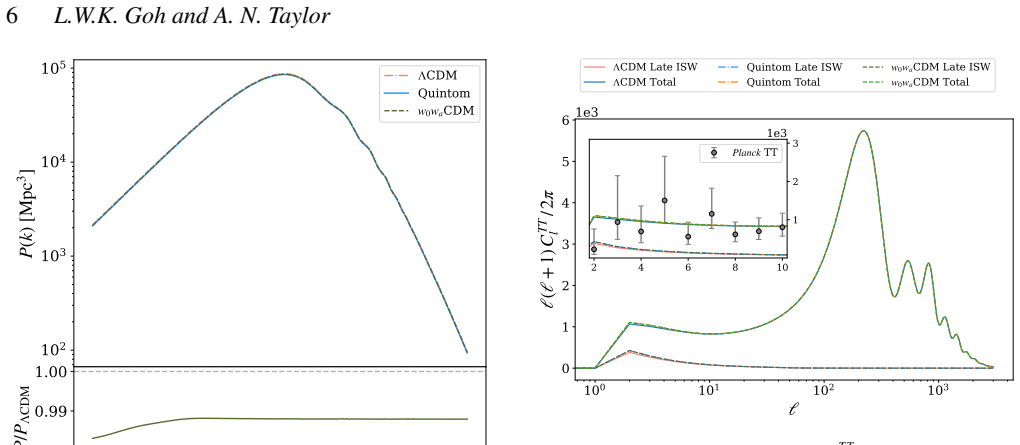
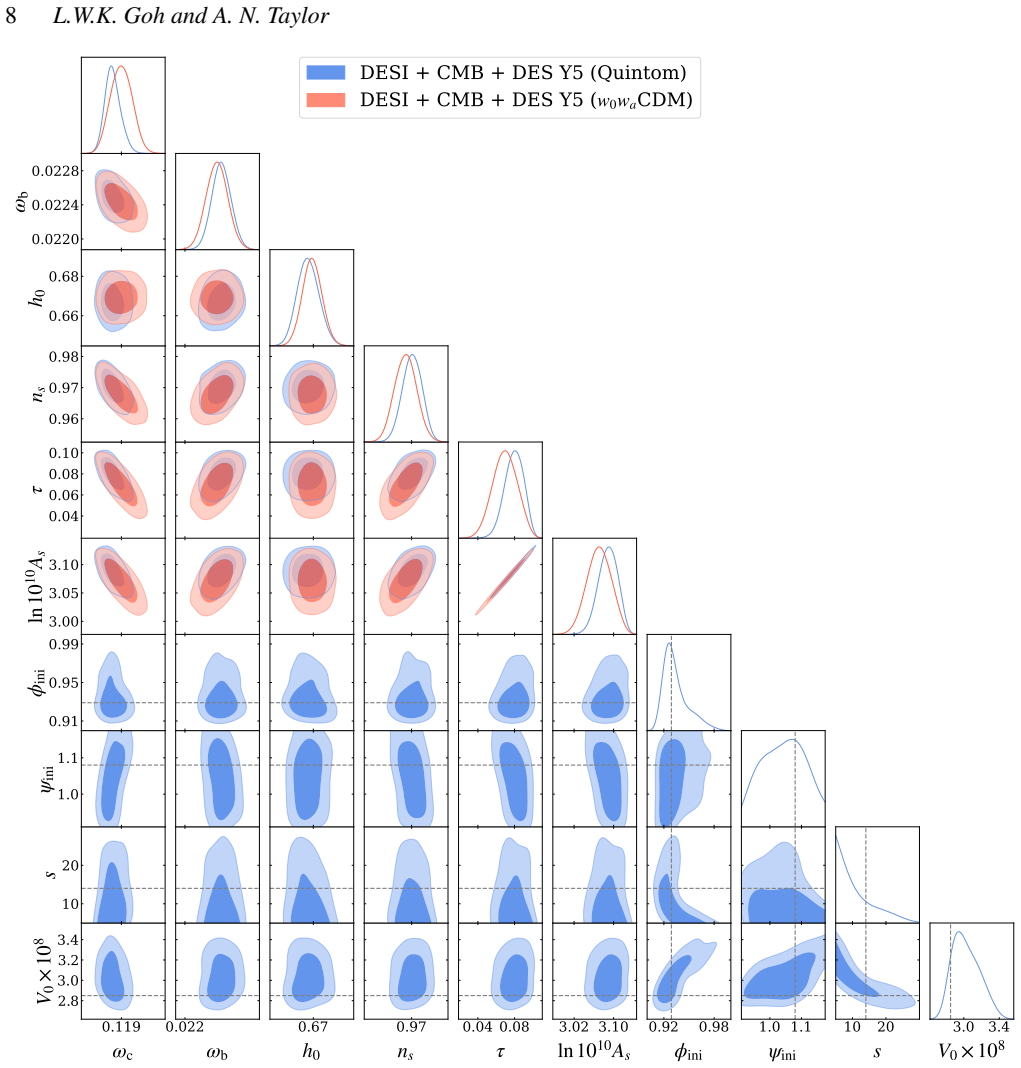
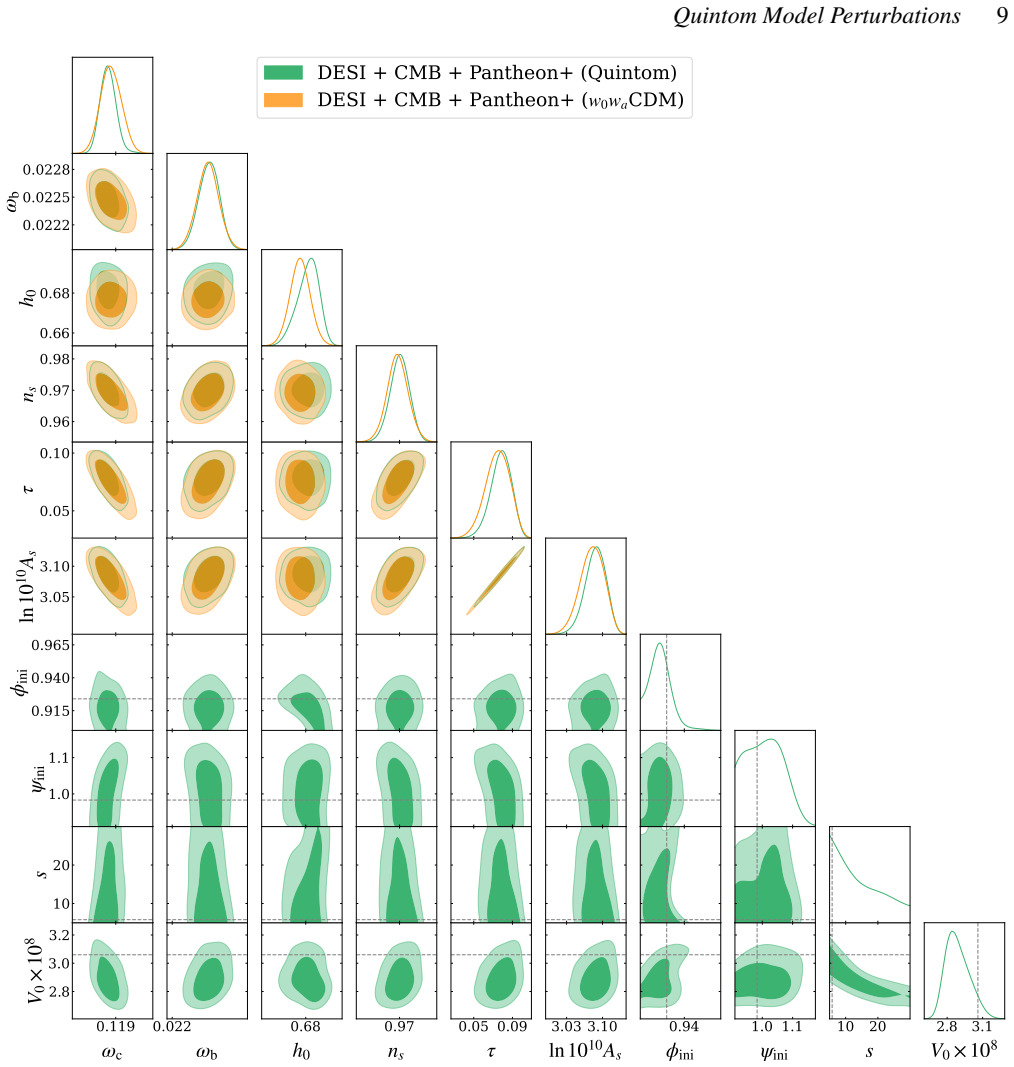
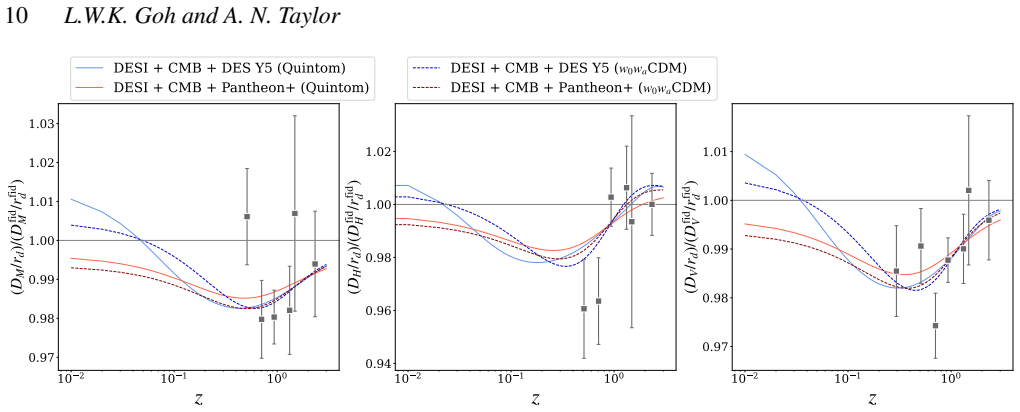
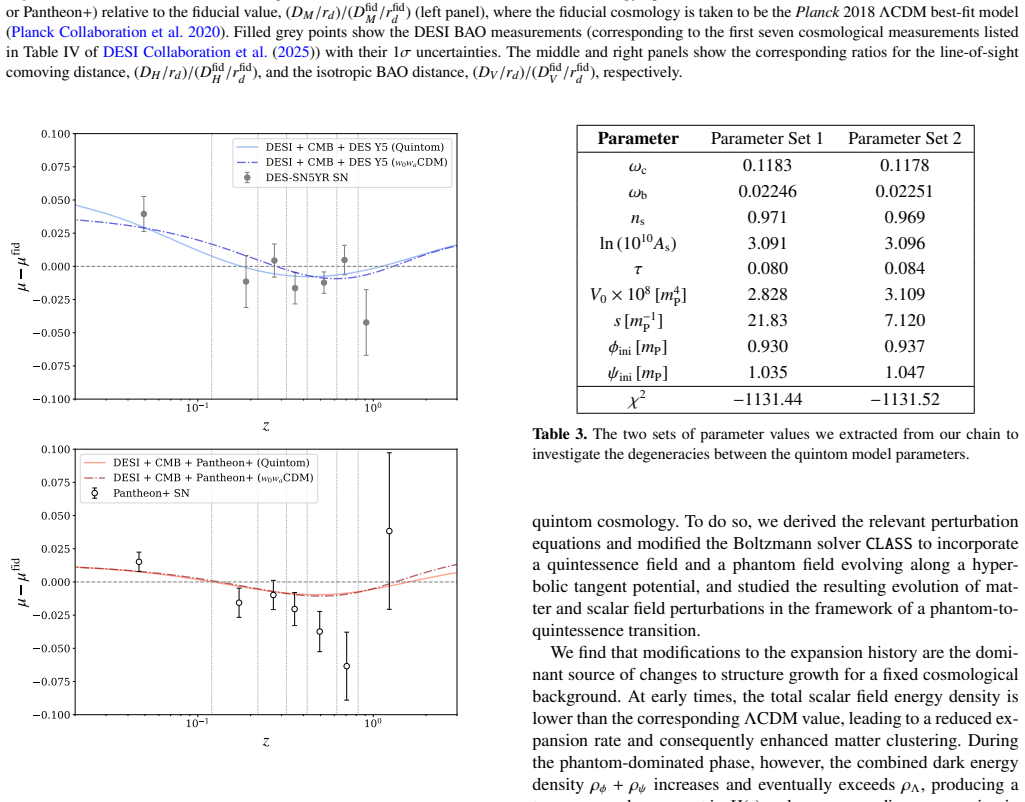
We show that the quintom model is able to reproduce the phenomenological features of a w0waCDM cosmology with phantom-to-quintessence crossing, including suppressions in the matter power spectrum and enhancements to the late-time Integrated Sachs-Wolfe effect. Bayesian analysis of the quintom framework with BAO, CMB and Type 1a supernovae data finds that it is mildly favoured over the standard w0waCDM parametrisation, while successfully reproducing physical trends observed in the data.
What carries the argument
The linear perturbation equations derived from the two-scalar-field quintom framework, which govern the evolution of density and velocity perturbations across the phantom divide.
If this is right
- The model produces suppressions in the matter power spectrum matching phantom-to-quintessence crossing.
- It generates enhancements to the late-time Integrated Sachs-Wolfe effect.
- Bayesian analysis mildly favours the quintom framework over w0waCDM.
- The model reproduces physical trends seen in BAO, CMB and supernova data.
- Parameter degeneracies can be examined to guide future observations.
Where Pith is reading between the lines
- Higher-precision measurements of structure growth could break degeneracies and distinguish the quintom model from other dynamical dark energy parametrizations.
- The framework supplies an explicit field-theoretic realization of crossing rather than an effective equation-of-state description.
- Future surveys targeting the ISW effect at late times may provide independent tests of the perturbation predictions.
Load-bearing premise
The linear perturbation equations remain valid on the scales probed by current data without higher-order or instability effects altering the power spectrum and ISW signatures.
What would settle it
A precise measurement of the matter power spectrum or late-time ISW effect that shows neither the predicted suppression nor enhancement relative to a non-crossing model would contradict the reproduction of w0waCDM features.
Figures


read the original abstract
We build upon the work of Goh and Taylor 2025, in which we proposed a two scalar field quintom framework capable of naturally realising a phantom-to-quintessence transition in the dark energy equation of state. In this work, we derive the linear perturbation equations of our model and investigate its implications for large scale structure formation. We show that the quintom model is able to reproduce the phenomenological features of a w0waCDM cosmology with phantom-to-quintessence crossing, including suppressions in the matter power spectrum and enhancements to the late-time Integrated Sachs-Wolfe effect. We then perform a Bayesian analysis of the quintom framework with BAO, CMB and Type 1a supernovae data, finding that it is mildly favoured over the standard w0waCDM parametrisation, while successfully reproducing physical trends observed in the data. We further examine the parameter degeneracies inherent to the model and discuss prospective observational strategies for distinguishing quintom cosmologies from conventional dynamical dark energy models given current and future data precision.
Editorial analysis
A structured set of objections, weighed in public.
Referee Report
Summary. The manuscript extends the authors' prior two-scalar-field quintom framework (Goh & Taylor 2025) by deriving linear perturbation equations. It claims the model reproduces w0waCDM phenomenological features, specifically suppressions in the matter power spectrum and enhancements to the late-time Integrated Sachs-Wolfe effect, and reports a Bayesian analysis using BAO, CMB, and Type Ia supernovae data that finds the quintom model mildly favored over standard w0waCDM while reproducing observed trends.
Significance. If the perturbation equations remain stable across the w = -1 crossing, the work supplies a concrete scalar-field realization of dynamical dark energy capable of phantom-to-quintessence transitions, with direct implications for large-scale structure observables. The reported Bayesian preference, if robust to prior choices and parameter counting, would motivate targeted searches for crossing signatures in upcoming surveys.
major comments (2)
- [Perturbation derivation section] Perturbation derivation section (as described in the abstract): the linear perturbation equations are presented without explicit verification that the effective sound speed squared remains positive throughout the phantom-to-quintessence crossing on the scales relevant to BAO, CMB, and matter power spectrum calculations. Quintom constructions with a phantom field are susceptible to gradient instabilities when w crosses -1; absence of this check undermines the reliability of the claimed power-spectrum suppression and ISW enhancement.
- [Bayesian analysis section] Bayesian analysis section: the mild preference over w0waCDM is obtained within a parameter space whose mapping and priors are inherited from the self-cited 2025 paper. The manuscript does not quantify how the additional degrees of freedom in the two-field model affect the evidence ratio or demonstrate that the reported preference survives marginalization over the extra parameters.
minor comments (2)
- [Abstract] Abstract: 'Type 1a supernovae' should read 'Type Ia supernovae'.
- The specific BAO and CMB datasets (e.g., DESI, Planck, SDSS) and the precise likelihood implementations should be stated explicitly for reproducibility.
Simulated Author's Rebuttal
We thank the referee for their constructive and detailed comments on our manuscript. We address each major comment point-by-point below, providing our responses and indicating the revisions we will implement.
read point-by-point responses
-
Referee: [Perturbation derivation section] Perturbation derivation section (as described in the abstract): the linear perturbation equations are presented without explicit verification that the effective sound speed squared remains positive throughout the phantom-to-quintessence crossing on the scales relevant to BAO, CMB, and matter power spectrum calculations. Quintom constructions with a phantom field are susceptible to gradient instabilities when w crosses -1; absence of this check undermines the reliability of the claimed power-spectrum suppression and ISW enhancement.
Authors: We agree that an explicit verification of c_s^2 > 0 is necessary to confirm the absence of gradient instabilities. While the two-field quintom construction in our framework is designed such that the effective sound speed remains positive by virtue of the potential form and field evolution (as established in the 2025 precursor paper), the current manuscript does not include a dedicated check or plot for the relevant scales. In the revised version, we will add an explicit calculation and accompanying discussion or figure verifying that the effective sound speed squared stays positive throughout the crossing for wavenumbers relevant to BAO, CMB, and the matter power spectrum. revision: yes
-
Referee: [Bayesian analysis section] Bayesian analysis section: the mild preference over w0waCDM is obtained within a parameter space whose mapping and priors are inherited from the self-cited 2025 paper. The manuscript does not quantify how the additional degrees of freedom in the two-field model affect the evidence ratio or demonstrate that the reported preference survives marginalization over the extra parameters.
Authors: We acknowledge that the manuscript would be strengthened by a more explicit quantification of how the additional degrees of freedom influence the Bayesian evidence. The reported mild preference was obtained from the full two-field parameter space (with priors carried over from the 2025 work), so the evidence ratio already incorporates the extra parameters. Nevertheless, to address the referee's point directly, we will expand the Bayesian section in revision to include a dedicated discussion and, where feasible, additional results showing the sensitivity of the evidence ratio to the extra parameters and confirming that the preference holds under marginalization. revision: yes
Circularity Check
No significant circularity; derivation chain is self-contained
full rationale
The paper cites its own prior 2025 work solely to define the background quintom model and then derives new linear perturbation equations from it. It demonstrates phenomenological reproduction of w0waCDM features via those equations and conducts an independent Bayesian fit to BAO+CMB+SNIa data. Neither the perturbation derivation nor the data-driven likelihood comparison reduces to a fitted input, self-defined quantity, or unverified self-citation chain; the central results rest on explicit new calculations and external observations rather than by-construction equivalence to prior inputs.
Axiom & Free-Parameter Ledger
free parameters (1)
- quintom model parameters
axioms (2)
- domain assumption Linear perturbation theory is valid on the scales relevant to BAO, CMB, and large-scale structure observations.
- domain assumption The quintom framework from Goh and Taylor 2025 provides a stable background evolution through the phantom divide.
invented entities (1)
-
two scalar fields in the quintom model
no independent evidence
Reference graph
Works this paper leans on
-
[1]
A short review on Quintom dark energy theory
A short review on Quintom dark energy theory. arXiv e-prints , keywords =. doi:10.48550/arXiv.2606.01360 , archivePrefix =. 2606.01360 , primaryClass =
work page internal anchor Pith review Pith/arXiv arXiv doi:10.48550/arxiv.2606.01360
-
[2]
Constraints on Horndeski Gravity with Phantom Crossing
Constraints on Horndeski Gravity with Phantom Crossing. arXiv e-prints , keywords =. doi:10.48550/arXiv.2606.20794 , archivePrefix =. 2606.20794 , primaryClass =
work page internal anchor Pith review Pith/arXiv arXiv doi:10.48550/arxiv.2606.20794
-
[3]
Data-Driven Discovery of a Simple Phantom-Crossing Dark Energy Parametrization
Data-Driven Discovery of a Simple Phantom-Crossing Dark Energy Parametrization. arXiv e-prints , keywords =. doi:10.48550/arXiv.2606.17951 , archivePrefix =. 2606.17951 , primaryClass =
work page internal anchor Pith review Pith/arXiv arXiv doi:10.48550/arxiv.2606.17951
-
[4]
Constraints on Coupled Dark Energy in the DESI Era
Constraints on Coupled Dark Energy in the DESI Era. arXiv e-prints , keywords =. doi:10.48550/arXiv.2604.12032 , archivePrefix =. 2604.12032 , primaryClass =
work page internal anchor Pith review Pith/arXiv arXiv doi:10.48550/arxiv.2604.12032
-
[5]
Dynamical Solution to the Problem of a Small Cosmological Constant and Late-Time Cosmic Acceleration. , keywords =. doi:10.1103/PhysRevLett.85.4438 , archivePrefix =. astro-ph/0004134 , primaryClass =
work page internal anchor Pith review Pith/arXiv arXiv doi:10.1103/physrevlett.85.4438
-
[6]
CosmoSIS: modular cosmological parameter estimation
CosmoSIS: Modular cosmological parameter estimation. Astronomy and Computing , keywords =. doi:10.1016/j.ascom.2015.05.005 , archivePrefix =. 1409.3409 , primaryClass =
work page internal anchor Pith review Pith/arXiv arXiv doi:10.1016/j.ascom.2015.05.005 2015
-
[7]
Qu, Frank J. and others. The Atacama Cosmology Telescope: A Measurement of the DR6 CMB Lensing Power Spectrum and Its Implications for Structure Growth. Astrophys. J. 2024. doi:10.3847/1538-4357/acfe06. arXiv:2304.05202
work page internal anchor Pith review Pith/arXiv arXiv doi:10.3847/1538-4357/acfe06 2024
-
[8]
Thermalisation of sterile neutrinos in the early Universe in the 3+1 scheme with full mixing matrix
Thermalisation of sterile neutrinos in the early universe in the 3+1 scheme with full mixing matrix. , keywords =. doi:10.1088/1475-7516/2019/07/014 , archivePrefix =. 1905.11290 , primaryClass =
work page internal anchor Pith review Pith/arXiv arXiv doi:10.1088/1475-7516/2019/07/014 2019
-
[9]
Fast test to assess the impact of marginalization in Monte Carlo analyses and its application to cosmology. , keywords =. doi:10.1103/PhysRevD.106.063506 , archivePrefix =. 2203.16285 , primaryClass =
-
[10]
Is the Hubble tension a hint of AdS phase around recombination?
Is the Hubble tension a hint of AdS phase around recombination?. , keywords =. doi:10.1103/PhysRevD.101.083507 , archivePrefix =. 2001.02451 , primaryClass =
-
[11]
Crossing the phantom divide in scalar-tensor and vector-tensor theories. arXiv e-prints , keywords =. doi:10.48550/arXiv.2508.17231 , archivePrefix =. 2508.17231 , primaryClass =
-
[12]
Phantom Crossing and Oscillating Dark Energy with F(R) Gravity. arXiv e-prints , keywords =. doi:10.48550/arXiv.2506.21010 , archivePrefix =. 2506.21010 , primaryClass =
-
[13]
Can recent DESI BAO measurements accommodate a negative cosmological constant?
Can recent DESI BAO measurements accommodate a negative cosmological constant?. , keywords =. doi:10.1103/PhysRevD.111.L061306 , archivePrefix =. 2406.03395 , primaryClass =
-
[14]
Resolving the Planck-DESI tension by nonminimally coupled quintessence
Resolving the Planck-DESI tension by non-minimally coupled quintessence. arXiv e-prints , keywords =. doi:10.48550/arXiv.2508.01759 , archivePrefix =. 2508.01759 , primaryClass =
work page internal anchor Pith review Pith/arXiv arXiv doi:10.48550/arxiv.2508.01759
-
[15]
Physics Letters B , keywords =
Effective phantom divide crossing with standard and negative quintessence. Physics Letters B , keywords =. doi:10.1016/j.physletb.2025.140096 , archivePrefix =. 2508.00621 , primaryClass =
-
[16]
International Journal of Theoretical Physics , keywords =
Second-order scalar-tensor field equations in a four-dimensional space. International Journal of Theoretical Physics , keywords =. doi:10.1007/BF01807638 , adsurl =
-
[17]
KiDS-1000 methodology: Modelling and inference for joint weak gravitational lensing and spectroscopic galaxy clustering analysis. , keywords =. doi:10.1051/0004-6361/202038831 , archivePrefix =. 2007.01844 , primaryClass =
-
[18]
Dark Energy Survey Year 3 Results: Multi-Probe Modeling Strategy and Validation. arXiv e-prints , keywords =. doi:10.48550/arXiv.2105.13548 , archivePrefix =. 2105.13548 , primaryClass =
-
[19]
Cosmology with the EFTofLSS and BOSS: dark energy constraints and a note on priors. , keywords =. doi:10.1088/1475-7516/2023/01/028 , archivePrefix =. 2207.14784 , primaryClass =
-
[20]
PolyChord: next-generation nested sampling
POLYCHORD: next-generation nested sampling. , keywords =. doi:10.1093/mnras/stv1911 , archivePrefix =. 1506.00171 , primaryClass =
work page internal anchor Pith review Pith/arXiv arXiv doi:10.1093/mnras/stv1911
-
[21]
On the road to per cent accuracy IV: ReACT - computing the non-linear power spectrum beyond CDM. , keywords =. doi:10.1093/mnras/staa2696 , archivePrefix =. 2005.12184 , primaryClass =
-
[22]
The Atacama Cosmology Telescope: DR6 Gravitational Lensing Map and Cosmological Parameters
The Atacama Cosmology Telescope: DR6 Gravitational Lensing Map and Cosmological Parameters. , keywords =. doi:10.3847/1538-4357/acff5f , archivePrefix =. 2304.05203 , primaryClass =
work page internal anchor Pith review Pith/arXiv arXiv doi:10.3847/1538-4357/acff5f
-
[23]
CMB lensing from Planck PR4 maps
CMB lensing from Planck PR4 maps. , keywords =. doi:10.1088/1475-7516/2022/09/039 , archivePrefix =. 2206.07773 , primaryClass =
work page internal anchor Pith review Pith/arXiv arXiv doi:10.1088/1475-7516/2022/09/039 2022
-
[24]
PolyChord: nested sampling for cosmology
polychord: nested sampling for cosmology. , keywords =. doi:10.1093/mnrasl/slv047 , archivePrefix =. 1502.01856 , primaryClass =
work page internal anchor Pith review Pith/arXiv arXiv doi:10.1093/mnrasl/slv047
-
[25]
The Cosmic Linear Anisotropy Solving System (CLASS) II: Approximation schemes
The Cosmic Linear Anisotropy Solving System (CLASS). Part II: Approximation schemes. , keywords =. doi:10.1088/1475-7516/2011/07/034 , archivePrefix =. 1104.2933 , primaryClass =
work page internal anchor Pith review Pith/arXiv arXiv doi:10.1088/1475-7516/2011/07/034 2011
-
[26]
Phantom crossing with quintom models. , keywords =. doi:10.1093/mnras/staf1927 , archivePrefix =. 2509.12335 , primaryClass =
-
[27]
Assessing cosmological evidence for non-minimal coupling. arXiv e-prints , keywords =. doi:10.48550/arXiv.2504.07679 , archivePrefix =. 2504.07679 , primaryClass =
-
[28]
Breaking a Dark Degeneracy with Gravitational Waves
Breaking a dark degeneracy with gravitational waves. , keywords =. doi:10.1088/1475-7516/2016/03/031 , archivePrefix =. 1509.08458 , primaryClass =
work page internal anchor Pith review Pith/arXiv arXiv doi:10.1088/1475-7516/2016/03/031 2016
-
[29]
Essentials of k-essence. , keywords =. doi:10.1103/PhysRevD.63.103510 , archivePrefix =. astro-ph/0006373 , primaryClass =
work page internal anchor Pith review Pith/arXiv arXiv doi:10.1103/physrevd.63.103510
-
[30]
Cosmological consequences of a rolling homogeneous scalar field , author =. Phys. Rev. D , volume =. 1988 , month =. doi:10.1103/PhysRevD.37.3406 , url =
-
[31]
Cosmology and the Fate of Dilatation Symmetry
Cosmology and the fate of dilatation symmetry. Nuclear Physics B , keywords =. doi:10.1016/0550-3213(88)90193-9 , archivePrefix =. 1711.03844 , primaryClass =
work page internal anchor Pith review Pith/arXiv arXiv doi:10.1016/0550-3213(88)90193-9
-
[32]
Quintessence, Cosmic Coincidence, and the Cosmological Constant
Quintessence, Cosmic Coincidence, and the Cosmological Constant. , keywords =. doi:10.1103/PhysRevLett.82.896 , archivePrefix =. astro-ph/9807002 , primaryClass =
work page internal anchor Pith review Pith/arXiv arXiv doi:10.1103/physrevlett.82.896
-
[33]
Cosmological Tracking Solutions
Cosmological tracking solutions. , keywords =. doi:10.1103/PhysRevD.59.123504 , archivePrefix =. astro-ph/9812313 , primaryClass =
work page internal anchor Pith review Pith/arXiv arXiv doi:10.1103/physrevd.59.123504
-
[34]
The dS/CFT Correspondence and the Big Smash
The dS/CFT Correspondence and the Big Smash. Journal of High Energy Physics , keywords =. doi:10.1088/1126-6708/2002/08/029 , archivePrefix =. hep-th/0112066 , primaryClass =
work page internal anchor Pith review Pith/arXiv arXiv doi:10.1088/1126-6708/2002/08/029 2002
-
[35]
Super-Acceleration from Massless, Minimally Coupled $\phi^4$
Super-acceleration from massless, minimally coupled ^ 4. Classical and Quantum Gravity , keywords =. doi:10.1088/0264-9381/19/17/311 , archivePrefix =. gr-qc/0204065 , primaryClass =
work page internal anchor Pith review Pith/arXiv arXiv doi:10.1088/0264-9381/19/17/311
-
[36]
Quantum effects can render w<-1 on cosmological scales
Quantum effects can render w<-1 on cosmological scales. , keywords =. doi:10.1103/PhysRevD.70.107301 , archivePrefix =. gr-qc/0406098 , primaryClass =
work page internal anchor Pith review Pith/arXiv arXiv doi:10.1103/physrevd.70.107301
-
[37]
Exactly Solvable SFT Inspired Phantom Model
Exact solution in a string cosmological model. Theoretical and Mathematical Physics , keywords =. doi:10.1007/s11232-006-0086-5 , archivePrefix =. astro-ph/0412619 , primaryClass =
work page internal anchor Pith review Pith/arXiv arXiv doi:10.1007/s11232-006-0086-5
-
[38]
Time Lumps in Nonlocal Stringy Models and Cosmological Applications
Time lumps in nonlocal stringy models and cosmological applications. Journal of High Energy Physics , keywords =. doi:10.1088/1126-6708/2005/10/087 , archivePrefix =. hep-th/0504200 , primaryClass =
work page internal anchor Pith review Pith/arXiv arXiv doi:10.1088/1126-6708/2005/10/087 2005
-
[39]
Phantom Matter and the Cosmological Constant
Phantom Matter and the Cosmological Constant. arXiv e-prints , keywords =. doi:10.48550/arXiv.hep-th/0302199 , archivePrefix =. hep-th/0302199 , primaryClass =
work page internal anchor Pith review Pith/arXiv arXiv doi:10.48550/arxiv.hep-th/0302199
-
[40]
The Tensor to Scalar Ratio of Phantom Dark Energy Models
Tensor to scalar ratio of phantom dark energy models. , keywords =. doi:10.1103/PhysRevD.64.043514 , archivePrefix =. astro-ph/0104112 , primaryClass =
work page internal anchor Pith review Pith/arXiv arXiv doi:10.1103/physrevd.64.043514
-
[41]
Phantom cosmologies. , keywords =. doi:10.1103/PhysRevD.68.103519 , archivePrefix =. hep-th/0307128 , primaryClass =
work page internal anchor Pith review Pith/arXiv arXiv doi:10.1103/physrevd.68.103519
-
[42]
Cosmological Dynamics of Phantom Field
Cosmological dynamics of a phantom field. , keywords =. doi:10.1103/PhysRevD.68.023522 , archivePrefix =. hep-th/0305110 , primaryClass =
work page internal anchor Pith review Pith/arXiv arXiv doi:10.1103/physrevd.68.023522
-
[43]
Quantum deSitter cosmology and phantom matter
Quantum de Sitter cosmology and phantom matter. Physics Letters B , keywords =. doi:10.1016/S0370-2693(03)00594-X , archivePrefix =. hep-th/0303117 , primaryClass =
work page internal anchor Pith review Pith/arXiv arXiv doi:10.1016/s0370-2693(03)00594-x
-
[44]
Quintom Cosmology: Theoretical implications and observations
Quintom cosmology: Theoretical implications and observations. , keywords =. doi:10.1016/j.physrep.2010.04.001 , archivePrefix =. 0909.2776 , primaryClass =
work page internal anchor Pith review Pith/arXiv arXiv doi:10.1016/j.physrep.2010.04.001 2010
-
[45]
Cosmic structure growth and dark energy. , keywords =. doi:10.1046/j.1365-2966.2003.07112.x , archivePrefix =. astro-ph/0305286 , primaryClass =
-
[46]
Exploring the Expansion History of the Universe
Exploring the Expansion History of the Universe. , keywords =. doi:10.1103/PhysRevLett.90.091301 , archivePrefix =. astro-ph/0208512 , primaryClass =
work page internal anchor Pith review Pith/arXiv arXiv doi:10.1103/physrevlett.90.091301
-
[47]
Uncorrelated Estimates of Dark Energy Evolution
Uncorrelated estimates of dark energy evolution. , keywords =. doi:10.1103/PhysRevD.71.023506 , archivePrefix =. astro-ph/0404062 , primaryClass =
work page internal anchor Pith review Pith/arXiv arXiv doi:10.1103/physrevd.71.023506
-
[48]
Crossing the Phantom Divide with Parameterized Post-Friedmann Dark Energy
Crossing the phantom divide with parametrized post-Friedmann dark energy. , keywords =. doi:10.1103/PhysRevD.78.087303 , archivePrefix =. 0808.3125 , primaryClass =
work page internal anchor Pith review Pith/arXiv arXiv doi:10.1103/physrevd.78.087303
-
[49]
A Parameterized Post-Friedmann Framework for Modified Gravity
Parametrized post-Friedmann framework for modified gravity. , keywords =. doi:10.1103/PhysRevD.76.104043 , archivePrefix =. 0708.1190 , primaryClass =
work page internal anchor Pith review Pith/arXiv arXiv doi:10.1103/physrevd.76.104043
-
[50]
Constraints on Interacting Dark Energy Models from the DESI Baryon Acoustic Oscillation and DES Supernovae Data. , keywords =. doi:10.3847/1538-4357/ad87f0 , archivePrefix =. 2407.14934 , primaryClass =
-
[51]
Interpreting DESI's evidence for evolving dark energy. , keywords =. doi:10.1088/1475-7516/2024/12/007 , archivePrefix =. 2404.08056 , primaryClass =
-
[52]
Gaussian-process reconstructions and model building of quintom dark energy from latest cosmological observations. arXiv e-prints , keywords =. doi:10.48550/arXiv.2501.18336 , archivePrefix =. 2501.18336 , primaryClass =
-
[53]
Interacting dark energy after DESI DR2: a challenge for Λ CDM paradigm?. arXiv e-prints , keywords =. doi:10.48550/arXiv.2504.00994 , archivePrefix =. 2504.00994 , primaryClass =
-
[54]
Dark Energy within the Generalized Uncertainty Principle in Light of DESI DR2. arXiv e-prints , keywords =. doi:10.48550/arXiv.2503.20896 , archivePrefix =. 2503.20896 , primaryClass =
-
[55]
Non-minimally coupled gravity constraints from DESI DR2 data
Non-minimally coupled gravity constraints from DESI DR2 data. arXiv e-prints , keywords =. doi:10.48550/arXiv.2503.19898 , archivePrefix =. 2503.19898 , primaryClass =
work page internal anchor Pith review Pith/arXiv arXiv doi:10.48550/arxiv.2503.19898
-
[56]
Accelerating Universes with Scaling Dark Matter
Accelerating Universes with Scaling Dark Matter. International Journal of Modern Physics D , keywords =. doi:10.1142/S0218271801000822 , archivePrefix =. gr-qc/0009008 , primaryClass =
work page internal anchor Pith review Pith/arXiv arXiv doi:10.1142/s0218271801000822
-
[57]
Journal of High Energy Physics , keywords =
Cosmic clues: DESI, dark energy, and the cosmological constant problem. Journal of High Energy Physics , keywords =. doi:10.1007/JHEP05(2024)327 , archivePrefix =. 2404.06444 , primaryClass =
-
[58]
Extended Dark Energy analysis using DESI DR2 BAO measurements
Extended Dark Energy analysis using DESI DR2 BAO measurements. arXiv e-prints , keywords =. doi:10.48550/arXiv.2503.14743 , archivePrefix =. 2503.14743 , primaryClass =
work page internal anchor Pith review Pith/arXiv arXiv doi:10.48550/arxiv.2503.14743
-
[59]
Modified gravity interpretation of the evolving dark energy in light of DESI data
Modified gravity interpretation of the evolving dark energy in light of DESI data. , keywords =. doi:10.1103/PhysRevD.110.123524 , archivePrefix =. 2407.02558 , primaryClass =
-
[60]
Journal of High Energy Astrophysics , keywords =
f(T) gravity after DESI Baryon acoustic oscillation and DES supernovae 2024 data. Journal of High Energy Astrophysics , keywords =. doi:10.1016/j.jheap.2024.05.005 , archivePrefix =. 2405.00608 , primaryClass =
-
[61]
DESI DR2 Results II: Measurements of Baryon Acoustic Oscillations and Cosmological Constraints
DESI DR2 Results II: Measurements of Baryon Acoustic Oscillations and Cosmological Constraints. arXiv e-prints , keywords =. doi:10.48550/arXiv.2503.14738 , archivePrefix =. 2503.14738 , primaryClass =
work page internal anchor Pith review Pith/arXiv arXiv doi:10.48550/arxiv.2503.14738
-
[62]
The Quintom theory of dark energy after DESI DR2
The Quintom theory of dark energy after DESI DR2. arXiv e-prints , keywords =. doi:10.48550/arXiv.2505.24732 , archivePrefix =. 2505.24732 , primaryClass =
work page internal anchor Pith review Pith/arXiv arXiv doi:10.48550/arxiv.2505.24732
-
[63]
Crossing the Phantom Divide: Dark Energy Internal Degrees of Freedom
Crossing the phantom divide: Dark energy internal degrees of freedom. , keywords =. doi:10.1103/PhysRevD.71.047301 , archivePrefix =. astro-ph/0410680 , primaryClass =
work page internal anchor Pith review Pith/arXiv arXiv doi:10.1103/physrevd.71.047301
-
[64]
Cosmological evolution of a quintom model of dark energy. Phys. Lett. B , keywords =. doi:10.1016/j.physletb.2005.01.017 , archivePrefix =. astro-ph/0410654 , primaryClass =
work page internal anchor Pith review Pith/arXiv arXiv doi:10.1016/j.physletb.2005.01.017 2005
-
[65]
A phantom menace? Cosmological consequences of a dark energy component with super-negative equation of state. Phys. Lett. B , keywords =. doi:10.1016/S0370-2693(02)02589-3 , archivePrefix =. astro-ph/9908168 , primaryClass =
work page internal anchor Pith review Pith/arXiv arXiv doi:10.1016/s0370-2693(02)02589-3
-
[66]
Phantom Energy and Cosmic Doomsday
Phantom Energy: Dark Energy with w<-1 Causes a Cosmic Doomsday. , keywords =. doi:10.1103/PhysRevLett.91.071301 , archivePrefix =. astro-ph/0302506 , primaryClass =
work page internal anchor Pith review Pith/arXiv arXiv doi:10.1103/physrevlett.91.071301
-
[67]
Crossing the phantom divide. , keywords =. doi:10.1103/PhysRevD.74.123503 , archivePrefix =. astro-ph/0609040 , primaryClass =
work page internal anchor Pith review Pith/arXiv arXiv doi:10.1103/physrevd.74.123503
-
[68]
Constraints on the Sound Speed of Dynamical Dark Energy
Constraints on the Sound Speed of Dynamical Dark Energy. International Journal of Modern Physics D , keywords =. doi:10.1142/S0218271808012784 , archivePrefix =. astro-ph/0703202 , primaryClass =
work page internal anchor Pith review Pith/arXiv arXiv doi:10.1142/s0218271808012784
-
[69]
How to Test Stringy Dark Energy?
How to test stringy dark energy?. Physics Letters B , keywords =. doi:10.1016/S0370-2693(03)00055-8 , archivePrefix =. astro-ph/0209037 , primaryClass =
work page internal anchor Pith review Pith/arXiv arXiv doi:10.1016/s0370-2693(03)00055-8
-
[70]
Braneworld models of dark energy
Braneworld models of dark energy. , keywords =. doi:10.1088/1475-7516/2003/11/014 , archivePrefix =. astro-ph/0202346 , primaryClass =
work page internal anchor Pith review Pith/arXiv arXiv doi:10.1088/1475-7516/2003/11/014 2003
-
[71]
Hessence: A New View of Quintom Dark Energy
Hessence: a new view of quintom dark energy. Classical and Quantum Gravity , keywords =. doi:10.1088/0264-9381/22/16/005 , archivePrefix =. hep-th/0501160 , primaryClass =
work page internal anchor Pith review Pith/arXiv arXiv doi:10.1088/0264-9381/22/16/005
-
[72]
The phantom menaced: constraints on low-energy effective ghosts
The phantom menaced: Constraints on low-energy effective ghosts. , keywords =. doi:10.1103/PhysRevD.70.043543 , archivePrefix =. hep-ph/0311312 , primaryClass =
work page internal anchor Pith review Pith/arXiv arXiv doi:10.1103/physrevd.70.043543
-
[73]
Kinetically Driven Quintessence
Kinetically driven quintessence. , keywords =. doi:10.1103/PhysRevD.62.023511 , archivePrefix =. astro-ph/9912463 , primaryClass =
work page internal anchor Pith review Pith/arXiv arXiv doi:10.1103/physrevd.62.023511
-
[74]
Can dark energy evolve to the Phantom?
Can dark energy evolve to the phantom?. , keywords =. doi:10.1103/PhysRevD.71.023515 , archivePrefix =. astro-ph/0407107 , primaryClass =
work page internal anchor Pith review Pith/arXiv arXiv doi:10.1103/physrevd.71.023515
-
[75]
Dark-Energy Evolution Across the Cosmological-Constant Boundary
Dark-energy evolution across the cosmological-constant boundary. , keywords =. doi:10.1103/PhysRevD.72.043527 , archivePrefix =. astro-ph/0501104 , primaryClass =
work page internal anchor Pith review Pith/arXiv arXiv doi:10.1103/physrevd.72.043527
-
[76]
Can the dark energy equation-of-state parameter w be less than -1?
Can the dark energy equation-of-state parameter w be less than -1?. , keywords =. doi:10.1103/PhysRevD.68.023509 , archivePrefix =. astro-ph/0301273 , primaryClass =
work page internal anchor Pith review Pith/arXiv arXiv doi:10.1103/physrevd.68.023509
-
[77]
Planck 2018 results. VI. Cosmological parameters. , keywords =. doi:10.1051/0004-6361/201833910 , archivePrefix =. 1807.06209 , primaryClass =
work page internal anchor Pith review Pith/arXiv arXiv doi:10.1051/0004-6361/201833910 2018
-
[78]
Dark energy constraints from the cosmic age and supernova. Phys. Lett. B , keywords =. doi:10.1016/j.physletb.2004.12.071 , archivePrefix =. astro-ph/0404224 , primaryClass =
work page internal anchor Pith review Pith/arXiv arXiv doi:10.1016/j.physletb.2004.12.071 2004
-
[79]
Modified gravity realizations of quintom dark energy after DESI DR2. arXiv e-prints , keywords =. doi:10.48550/arXiv.2504.06784 , archivePrefix =. 2504.06784 , primaryClass =
-
[80]
Cosmological Perturbation Theory in the Synchronous and Conformal Newtonian Gauges
Cosmological Perturbation Theory in the Synchronous and Conformal Newtonian Gauges. , keywords =. doi:10.1086/176550 , archivePrefix =. astro-ph/9506072 , primaryClass =
work page internal anchor Pith review Pith/arXiv arXiv doi:10.1086/176550
discussion (0)
Sign in with ORCID, Apple, or X to comment. Anyone can read and Pith papers without signing in.